Thursday, April 2, 2026

'Iran drafting Hormuz safe transit protocol with Oman'

 Iranian Deputy Foreign Minister Kazem Gharibabadi announced on Thursday that his country is working on a protocol for safe maritime passage through the Strait of Hormuz with Oman, including rules for fees.

Speaking to Sputnik, Gharibabadi noted that the future regulation addresses the period after the conflict between Iran on one side, and the United States and Israel on the other. He also insisted that the strait operated normally at the beginning of the crisis, but that the US and Israel's escalation of their operation led to the ongoing disruption.

Since the conflict began, Iran has allowed several vessels from countries it considers friendly to cross the Strait of Hormuz. Meanwhile, US President Donald Trump claimed that Washington could agree to a ceasefire with Iran if it opened the strait. However, Tehran insisted that it will not do so until given security guarantees.

https://breakingthenews.net/Article/Iran-drafting-Hormuz-safe-transit-protocol-with-Oman/66007278

'IRGC Navy: Escalation to expel US from region'

 The Islamic Revolutionary Guard Corps (IRGC) Navy insisted on Thursday that Iran will broaden its operation against the United States and expel it completely from the Middle East if it continues to escalate the conflict between the two countries.

In a statement shared with Iranian media, the IRGC Navy reiterated that it conducted a series of attacks against US facilities in the region in the past 24 hours, including its steel industry sites in Abu Dhabi, the Salman Industrial City in Al Hidd in Bahrain, as well as aluminium production infrastructure in the island country.

In a previous statement, when it first announced targeting those facilities, the IRGC noted that "these attacks are a warning, and if attacks on Iranian industries are repeated, the next response will be much more painful."

https://breakingthenews.net/Article/IRGC-Navy:-Escalation-to-expel-US-from-region/66006719

Rubio: China's actions against Panama raise concerns

 United States Secretary of State Marco Rubio said on Thursday that China's increased detention of Panama-flagged vessels in its ports raises "serious concerns about the use of economic tools to undermine the rule of law" in Panama. The US Federal Maritime Commission described the detention rate last week as "far exceeding historical norms," warning that it could affect US shipping, as Panama-flagged ships carry a "meaningful share" of US containerized trade.

Rubio noted that China's measures started after Panama ended Hong Kong-based CK Hutchison's concession to operate in the Balboa and Cristobal terminals on the Panama Canal. He said the US stands "firmly" with Panama and "looks forward to increasing our economic and security cooperation with this important partner."

https://breakingthenews.net/Article/Rubio:-China's-actions-against-Panama-raise-concerns/66006959

Speeding Up Approvals, Getting More Drugs OTC Among FDA's Top Priorities

 The FDA is continuing its quest to speed up drug approvals and make more drugs available over the counter (OTC), FDA Commissioner Marty Makary, MD, MPH, said Wednesday.

"We want to challenge the assumption that it takes 10 to 12 years for a drug to come to market," Makary said during a press conference with reporters. "We believe it can be done faster without cutting any corners on safety. We'd like to modernize the agency with technology, while maintaining our gold-standard thresholds for approving drugs, devices, food, cosmetics, and tobacco."

He noted that the FDA approved 67 medications last year, more than the 5-year average (65), the 10-year average (64), and the 15-year average (60). "One of our big priorities at the agency is to reduce the idle time, use technology, and prioritize drug applications," he said, touting the pilot National Priority Voucher Program, which addresses those issues.

"We are giving vouchers to drugs that can meet an unmet public health need, companies that are making steps towards affordability -- to summarize, I would say drugs that are game-changing drugs," Makary said.

One drug being evaluated for possible approval under the program is a gene therapy known as DB-OTO for a congenital form of deafness. "When you see an amazing set of results, as was reported in the New England Journal of Medicine, that is the type of game-changing finding that we want to see delivered to patients rapidly, without cutting any corners on safety," he noted.

In line with the FDA's goal of speeding up approvals, Makary said the agency was "100% compliant" with its Prescription Drug User Fee Act (PDUFA) deadlines. However, when asked by MedPage Today about a couple of PDUFA deadlines the agency had missed last year -- a late April deadline for elamipretide (Forzinity) for Barth syndrome and a December deadline for mitapivat (Aqvesme) for thalassemia-related anemia, Makary said that those drug approval processes started before he arrived at the agency.

"You are correct; PDUFA dates were missed last year," he added. "We achieved our goal of hitting 100% compliance with PDUFA in late fall of last year or so, and we're still there ... It is not an absolute that we have to be at 100%, but in the last several months, we've been at 100%." (Editor's note: Makary is the former medical editor-in-chief of MedPage Today.)

Regarding OTC drugs, "when I look at the reasons those drugs were not approved in the past, I think we can do better," he said. For instance, "every single pill that is approved to be over the counter by the agency is required to have a study showing that people can read the instructions and take the pill ... It's just not common sense. So we want to reduce the requirements that are onerous that don't make sense, and focus instead on safety and labeling."

Putting more drugs over the counter "enables better access to medication, can reduce unnecessary healthcare utilization like waiting in an urgent care facility or emergency department to get [a refill]," and it encourages price competition, Makary explained. "It also enables people to buy drugs without going through the shell games of a PBM [pharmacy benefit manager]."

Vaginal estrogen is one drug Makary said he'd like to see go OTC. "There has been tremendous demand for [different types of] hormone replacement therapy for postmenopausal women; we've been tracking it closely."

Institutional review boards (IRBs) that approve clinical trials at universities are another FDA focus, according to Makary. Sometimes the IRBs -- which are usually staffed by volunteers -- only meet monthly, "and if you think about it, our entire U.S. research infrastructure is dependent on this sometimes rate-limiting step of this committee meeting," he said. "We can do better. We are seeing IRBs approved in shorter periods of time in Australia and other places."

The IRB process needs to be re-evaluated, he added. "When I was at Johns Hopkins, it took a year and a half for one IRB proposal to get approved, and in the end, it was not even approved -- and it was a survey. So we have to be more competitive and get decisions out."

One idea for improving IRB response times is to pay the members who are reviewing potential studies, instead of relying on a voluntary committee, Makary suggested.

Competing with China for drug trials is another concern of Makary's. "China, in the last several years, surpassed the United States and the number of phase I trials being conducted," he said. "And when we look at initiation of phase I trials, [in 2024] they were at least four times more than the United States. ... We have to be smart, and we have to think about how we can maintain our high standards for safety and yet be more competitive. We are looking at re-engineering the entire drug approval process from A to Z."

Makary was also asked about the changes initiated by the Department of Government Efficiency, a non-governmental body headed up by tech entrepreneur Elon Musk. "The cuts that made the most sense were cuts that involved consolidation, because each of six major agencies or centers within the agency had duplicative services," he said. For instance, they would each have their own teams to contract software licenses, "and they'd be buying the same software multiple times ... So we have had success with shared services, with procurement, with centralizing a lot of it."

On the other hand, he added, "I would not have offered early retirement to the scientists at the FDA. We have scientists who left with that package, but we are [now] hiring scientists."

https://www.medpagetoday.com/publichealthpolicy/fdageneral/120604

Ultragenyx FDA OKs Resubmission for UX111 AAV Gene Therapy to Treat Sanfilippo Syndrome

 If approved, UX111 will be the first approved therapy for the treatment of Sanfilippo syndrome Type A, a rare disease affecting young children that leads to progressive, irreversible neurodegeneration and early death

PDUFA action date set for September 19, 2026

https://finviz.com/news/342120/ultragenyx-announces-us-fda-acceptance-of-bla-resubmission-for-ux111-aav-gene-therapy-to-treat-sanfilippo-syndrome-type-a-mps-iiia

Iran’s Khuzestan Steel says repairs may take up to a year after strikes


Iran’s Khuzestan Steel Company said on Thursday that repairs to damaged facilities could take between six months and one year after recent strikes.

Mehran Pakbin, deputy for operations at the company, said all modules and steelmaking furnaces at the complex in Ahvaz had been damaged.

Last week that US and Israeli strikes hit two of the country’s largest steel producers, including Mobarakeh Steel Company and Khuzestan Steel.

Pakbin said restarting the units would take at least six months and up to a year, adding the company aimed to rebuild using domestic expertise.

https://www.iranintl.com/en/liveblog/202604015564#202604027962

Iran’s Mobarakeh Steel says production halted after strikes


Mobarakeh Steel Company said on Thursday that damage to production units had forced a complete halt to its lines.

The company said operations could not continue and asked staff to avoid coming to the complex until further notice.

State media reported last week that US and Israeli strikes hit two of the country’s largest steel producers, including Mobarakeh Steel in Isfahan and Khuzestan Steel Company in Ahvaz.

Khuzestan Steel said earlier on Thursday that repairs to its facilities could take between six months and one year after the strikes.

https://www.iranintl.com/en/liveblog/202604015564#202604027962

Senior IRGC special unit commander killed in strikes - state media


Senior IRGC special unit commander killed in strikes - state media

Iranian media reported that a commander of a special unit of the Islamic Revolutionary Guard Corps was killed in strikes on Wednesday.

They said Mohammad Ali Fathalizadeh, commander of the Fatehin special unit, was among those killed.

No further details were immediately available.

The Fatehin unit is part of the IRGC and its members receive advanced military training and have previously been deployed in conflicts such as Syria.

https://www.iranintl.com/en/liveblog/202604015564#202604023811

RBI Clampdown on Rupee Speculation Triggers Market Dislocation


The Reserve Bank of India’s crackdown on speculation against the rupee has come at the cost of a broader market disruption.

After the central bank imposed a $100 million cap on banks’ onshore currency bets on Friday, lenders rushed to unwind arbitrage trades — buying dollars abroad and selling them locally. That pushed speculative activity into overseas markets, which the RBI quickly shut off late Wednesday by barring banks from offering non-deliverable forwards.

https://www.bloomberg.com/news/articles/2026-04-02/rbi-clampdown-on-rupee-speculation-triggers-market-dislocation

Walgreens’ Private Equity Owner Plans to Double Pharmacy Chain’s Profits


The private equity firm that acquired Walgreens as part of a $10 billion deal plans to double the pharmacy chain’s profitability over the next several years, according to people familiar with the matter.

Sycamore Partners, a New York-based buyout firm, wants to grow the retailer’s earnings before interest, taxes, depreciation, and amortization to $4 billion, said the people, who asked not to be identified discussing private matters. That’s up from about $2 billion that the US drugstore chain earned in 2024.

Lipocine Phase 3 trial of LPCN 1154 in postpartum depression misses primary endpoint


 post hoc analysis shows benefit signals

  • Lipocine is evaluating next steps for LPCN 1154 in postpartum depression after the failed Phase 3.
  • The company plans to seek FDA breakthrough therapy and fast track designations for LPCN 1154.

Globalstar Soars On Amazon Buyout Report Amid Satellite Constellation Race

 Globalstar shares surged 12% in premarket trading in New York...

...marking their biggest jump in nearly five months, after the Financial Times reported overnight that Amazon is in talks to acquire the satellite operator, a move that would certainly intensify the race to build satellite constellations. 

The FT cited people familiar with the Amazon-Globalstar talks and said both sides are still negotiating over "some of the complexities," including the fact that Apple owns a 20% stake in the satellite communications company, which operates 24 satellites in low Earth orbit, arranged in a Walker-24 configuration, and sells services for emergency messaging, asset tracking, remote voice/data links, and IoT connectivity in places where cell coverage is weak or nonexistent.

Globalstar powers Apple's emergency satellite feature on iPhones, but that system is far more limited than the high-speed broadband network offered by SpaceX's Starlink.

Amazon has deployed around 200 internet satellites into orbit as part of its Leo program, formerly called Project Kuiper. This is dwarfed by the more than 10,000 active satellites operated by Starlink, which provides high-speed internet to more than 10 million customers worldwide.

The rationale for Amazon buying Globalstar's older, higher-orbit satellite constellation was not immediately explained in the FT report or by its sources familiar with the deal talks. 

But our view is that a potential buyout of Globalstar could give Amazon a faster path to more infrastructure, customers, and operational know-how to scale its Leo program and become a real competitor to Starlink, which is years ahead of any competition and even nation-states. 

https://www.zerohedge.com/technology/globalstar-soars-amazon-buyout-report-amid-satellite-constellation-race

Private Credit Bank Run Begins: Blue Owl Gates As 41% Of OTIC Investors Ask Redemptioon

 A week ago, in an attempt to calm the market, Goldman's economists published a lengthy, if at times disjointed, report discussing why a crisis in private credit would not lead to another financial crisis.
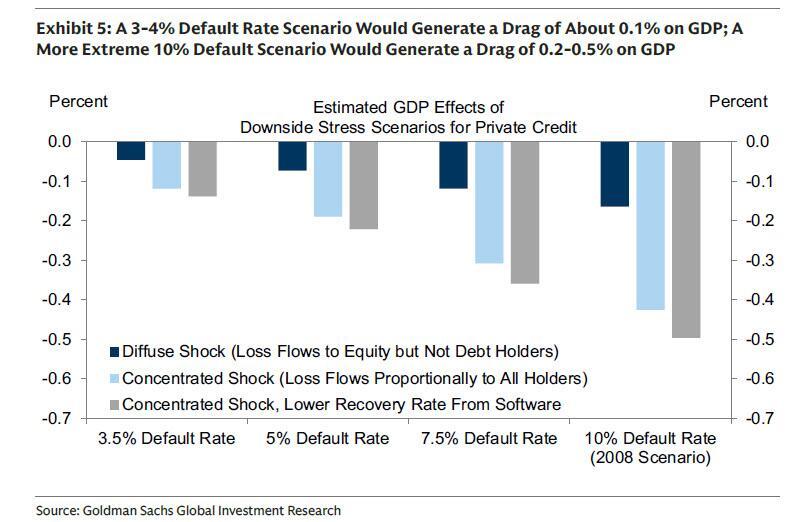
We are about to find out if they were right. 

Recall that in mid-March, while attention was understandably focused on the Iran war, we explained why Blue Owl's February decision to commence liquidations of loans in its three core private credit funds to fund current and future redemptions, was the industry's "Margin Call" moment, to wit: 

First it was Blue Owl, the largest pure play Private Credit fund with over $300 billion in AUM. The company, the first to face massive redemption demands, refused to gate investors and instead announced it would sell $1.4 billion in private loans (it was unclear which loans were sold, but Goldman suggested that these are likely the best ones so as to find willing buyers, leaving the company with the toxic sludge) from its three BDCs (OBDCII, OBDC and OTIC) at 99.7 cents (a number which was meant to inspire confidence yet was laughable, especially since once of the "buyers" was a related-party insurance company, Kuvare, also owned by Blue Owl), to satisfy redemption requests. 
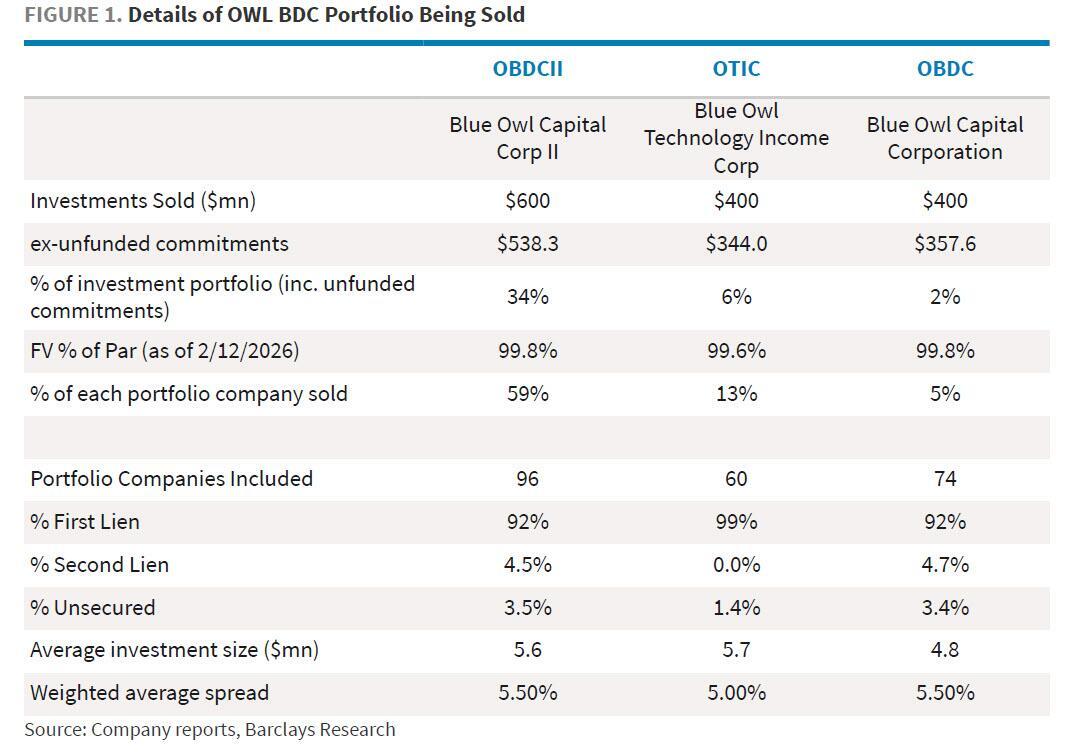
In our February 19 article describing the Blue Owl transaction, we said that "while it is unclear how deep the secondary market for private credit assets is, to the extent demand is relatively scarce, a transaction of this size could dry up market liquidity. If that assumption is true, other BDCs looking to exit portfolio investments could be jeopardized. Recall the immortal line from Margin Call: "Be First, Be Smarter, or Cheat."

We then said that "this could very well be Blue Owl's "Be First" moment... "Sell it all, today" especially if it were to later emerge that the secondary market is only deep for higher quality private credit assets, like the ones in the portfolio OWL is selling. In a concurrent report, Barclays warned that "if this transaction dries up secondary liquidity for private credit assets (or proves that the bid is only there for higher quality assets), it could be negative for other BDCs exploring portfolio sales."

In retrospect, this is precisely when the "Margin Call moment" of the private credit sector happened, because what happened next would make the market's head spin.

And unfortunately for Blue Owl, while the firm's catastrophic practices and financial engineering was indeed the snowflake that started the avalanche in the broader private credit sector, it has now boomeranged on the company itself and may have well led to its demise when two months after desperately seeking to avoid gating redemptions, the private credit giant announced it will in fact limit redemptions from two of its private credit funds after facing a historic surge in withdrawal requests that is unprecedented among major firms in the $1.8 trillion market.

Redemption requests in Blue Owl's marquee $36 billion Credit Income Corp. fund, one of the industry’s largest, soared to 21.9% in the three months ended March 31, according to an investor letter first reported by Bloomberg, up from "only" 5.2% in the prior period. But it was the smaller Blue Owl Technology Income Corp, which was at the center of the February turmoil, that was the real shock after its shareholders asked for a shocking 40.7% back, compared with 15.4% three months earlier, according to a separate letter. 

Both funds had previously met the requests in excess of its 5% tender offer. This time, though, Blue Owl - whose actions sparked the crisis that is now sweeping across pricvate credit - said it would join industry peers in capping redemptions at that level, “in accordance with the fund structure, reflecting our commitment to balancing the interests of both tendering and remaining shareholders.”

For the bigger fund, OCIC, that amounts to $988 million of redemptions honored and about $3.2 billion remaining in the fund, while for OTIC it means redeeming $179 million and keeping roughly $1 billion of investors’ cash, according to Bloomberg.

Craig Packer, Blue Owl’s co-president, said in an investor update that he believed the uptick in redemptions reflected a “period of heightened negative sentiment toward the asset class that has intensified as peers have reported tender results”.

And why would their tender results be intensified one wonders? Would it have something to do with that pinnacle of financial engineering where Blue Owl dumped many of its best loans to a related entity? Maybe Craig thinks that his investors are all idiots, but as he just found out, they may be far smarter than him.

“While we believe market perception has driven elevated tender activity, underlying credit fundamentals across our portfolio have remained resilient,” he added. “We continue to observe a meaningful disconnect between the public dialogue on private credit and the underlying trends in our portfolio.”

In the letters, OCIC said 90% of its shareholders chose not to tender, reflecting concentrated withdrawal demands, which means it was driven by institutions not retail investors who have been frequently blamed for all the ills plaguing private credit.. OTIC said its redemption pressure “was amplified by the fund’s more concentrated shareholder base, particularly within certain wealth channels and regions, and its specialized investment mandate.”

Both Blue Owl funds, which have returned more than 9% annualized since inception (not all too different from how Bernie Madoff generated double digits returns until one day his ponzi scheme collapsed), said they’re in a “strong position” to meet the 5% redemption requests and future tenders. OCIC and OTIC had $11.3 billion and $1.3 billion, respectively, across cash, available borrowing and liquid Level 2 assets as of the end of February, according to the letters.

While Blue Owl joins industry peers including Apollo Global, Ares Management and BlackRock in sticking to their redemption threshold on non-traded business development companies, the staggering magnitude of the requests underscores how Blue Owl has found itself squarely in the middle of worries about private credit.

The limitation on outflows highlights the risks to individual investors who had flocked to so-called non-traded private credit funds over the past three years in periods of stress. Those wealthy individuals had been promised access to higher-yielding investments in exchange for limited liquidity. Now they are regretting it. 

Private credit asset managers have diverged in how they have dealt with redemption requests, with some going to great lengths to cash out investors, while others have stuck to their limit. Still, no major manager has disclosed facing the percentage that Blue Owl’s BDCs were asked to pay back.

And with Blue Owl's private credit business now effectively in wind down mode, and mothballing the entire private credit industry, one wonders where so many crappy small and medium (mostly tech) companies will get the funding to exist. But before that, one wonders more just how wrong Goldman's analysis is that a private credit crisis won't impact the broader economy. We'll find out very soon. 

https://www.zerohedge.com/markets/private-credit-bank-run-begins-blue-owl-gates-after-shocking-41-tech-fund-investors-ask

'Highest bridge in Middle East hit amid attacks'

 Highway Bridge B1 linking Tehran and the western city of Karaj, known as "the highest bridge in the Middle East," was hit by airstrikes earlier today, the Fars News Agency reported on Wednesday.

According to the media outlet, preliminary reports indicated that several people were injured, while other areas of Karaj were also targeted.

Additionally, United States President Donald Trump announced yesterday that the US military will strike Iran "extremely hard" over the next "two to three weeks."

'Kallas, Wang discuss Iran, Strait of Hormuz'

 European Union High Representative for Foreign Affairs and Security Policy Kaja Kallas said on Thursday she held a phone call with Chinese Foreign Minister Wang Yi to address the situation in Iran and its implications for the global economy and energy security. The call was their first direct conversation in recent months, local media said.

Kallas highlighted that Iranian attacks on civilian ships have nearly stopped traffic in the Strait of Hormuz, calling for the "restoration of safe, toll-free navigation" in line with the Law of the Sea. "The EU supports all diplomatic efforts to achieve this and calls for de-escalation and restraint. Attacks against civilians and civilian infrastructure must cease," she noted on X.

During the day, other European partners, including France and the United Kingdom, voiced similar concerns, while China blamed the US and Israel for the Strait's disruption.

https://breakingthenews.net/Article/Kallas-Wang-discuss-Iran-Strait-of-Hormuz/66005944

'Germany, China: States must not control sea lanes'

 German Foreign Minister Johann Wadephul spoke on the phone with Chinese Foreign Minister Wang Yi, the German Foreign Ministry said on Thursday. They agreed that the Strait of Hormuz should be reopened and that no individual state should "control sea lanes and impose tolls for passage."

The two diplomats expressed concern about the situation in the Middle East and hope for its swift end. Wadephul also noted that Iran has behaved in a hostile manner toward its neighbors "for decades" and "endangered peace and security with its missile and nuclear programs." He called on China to use its influence to push Tehran toward a negotiated solution to the crisis.

https://breakingthenews.net/Article/Germany-China:-States-must-not-control-sea-lanes/66006024

US Initial Jobless Claims Fall to Just Shy of Two-Year Low


Applications for US unemployment benefits fell last week to one of the lowest levels in the last two years, suggesting layoffs remain low.

Initial claims decreased by 9,000 to 202,000 in the week ended March 28, according to Labor Department data released Thursday. The median forecast in a Bloomberg survey of economists called for 212,000.

https://www.bloomberg.com/news/articles/2026-04-02/us-initial-jobless-claims-fell-to-202-000-last-week

Challenger: US job cuts up 25% to 60,620 in March

 Job cuts in the United States totaled 60,620 in March, rising 25% the month before, but dropping 78% from the same month a year prior, Challenger, Gray & Christmas revealed in its report released on Thursday.

In the first quarter of 2026, employers announced 217,362 job cuts, down 56% year-over-year. Most jobs, 52,050, were cut in technology in the reported quarter, followed by transportation at 32,241, and healthcare at 23,520.

Meanwhile, employers announced 32,826 hiring plans in March, up 149% from last year. "Companies are shifting budgets toward AI investments at the expense of jobs. The actual replacing of roles can be seen in Technology companies, where AI can replace coding functions. Other industries are testing the limits of this new technology, and while it can’t replace jobs completely, it is costing jobs," Challenger's Chief Revenue Officer Andy Challenger commented.

https://breakingthenews.net/Article/Challenger:-US-job-cuts-up-25-to-60620-in-March/66005294