Search This Blog

Saturday, September 15, 2018

Morgan Stanley: ‘Street Is Overestimating Weight Watchers’ Addressable Market’


Weight Watchers International, Inc. WTW 1.58%‘s turnaround story remains compelling, but the company’s growth trajectory precludes a bullish stance, according to Morgan Stanley.

The Analyst

Morgan Stanley’s Vincent Sinisi initiated coverage of Weight Watchers International with an Equal-weight rating and $76 price target.

The Thesis

One of the biggest disconnects between the Street’s expectations for Weight Watchers and reality is the total addressable market, Sinisi said in the initiation note. (See his track record here.)
The market is assuming the the $66-billion U.S. commercial weight loss market is fully applicable to Weight Watchers, the analyst said. A more realistic view of Weight Watchers’ addressable market is around $18 billion and based on an addressable market of 31 million people in the U.S. and 50 million globally, he said.
While the Street is assuming the company has a “long expansion runway ahead,” investors should be cautious on the opportunity until Weight Watchers demonstrates an ability to significantly expand into new demographic groups, Sinisi said.
The company could rebrand itself from a dieting and weight loss platform to an all-inclusive, health and wellness lifestyle platform, which would give it better exposure to the $3.7-trillion global health and wellness market, according to Morgan Stanley. Yet a radical shift to better target the larger market will take “considerable time” and may not even be feasible given its decades-long image as a weight loss company, Sinisi said.
Weight Watchers’ digital focus is flashing some concerning signs, including “very low” user engagement of 2 minutes per user per day on its app, the analyst said. The app is in direct competition with social media giants with an established organic Weight Watchers group that includes hundreds of thousands of people, he said.
Morgan Stanley’s $76 price target implies minimal upside from current levels and is based on a 19 times multiple on 2019 estimated EPS, which is already a slight premium to its three-year average.
A more constructive stance on the stock would be appropriate if the company improves retention at a faster-than-expected rate and shows material expansion in smaller demographic groups like younger males.

7 Simple Exercises That Undo the Damage of Sitting


If you’re like most men living and working in a techno-service economy, you probably spend a good deal of your day sitting down. You go from the kitchen table to your desk at work to your chair in front of the TV. But as we’ve discussed before, spending most of your waking hours planted on your keister is terrible for your health.
You’ve probably experienced those moments when you get up from a sitting position and your butt feels numb and your hips feel so tight that you have to lean forward at the waist just to walk. Excessive sitting leaves your hips and legs tight and your glutes inactive. Even after you stand up, the ill effects of sitting stay with you and may prevent your butt muscles from firing at an optimal level when you really need them – like when you suddenly need to chase down a purse snatcher!
Some fitness experts argue that sitting causes muscles in the hip area to physically shorten (and stay shorter), even after you stand up. While there are no scientific studies to back that claim, from my own personal experience, sitting for lengthy periods of time definitely makes everything feel tight in the groin/butt area.
If you’re an athlete (or fancy yourself one), tight hips and inactive glutes can hamper physical performance in a variety of activities, such as sprinting, squatting, and — my favorite — deadlifting. If you want to perform at your best, you need to make sure that your hips stay limber and that your butt muscles are firing on all cylinders. Even if you’re not interested in deadlifting 600 lbs. (though I hope to change your mind on that someday), keeping your hip flexors loose and glutes active can improve your life on other fronts.
First, having limber hips just feels good, plain and simple. Second, having a healthy range of motion in your hips can help prevent injury when you pursue more recreational physical activities and do household chores. For example, loose hips keep your IT band loose as well, which can ward off knee pain. Finally, taking care of your hips may help improve your posture, which can in turn alleviate back or neck pain. (Not to mention the role of limber hips in doing a mean mambo.)
Below, we provide some simple stretches and exercises that will undo the damage to your hips and butt caused by sitting.

Prevention Is the Best Remedy: Sit Less and Move More

As the saying goes, “an ounce of prevention is worth a pound of cure.” The best thing you can do for your hip mobility and glute activation is to simply sit less and move more during the day.
If your employer will allow it, try using a standing desk, which keeps your muscles activated at the office. Keep in mind that, just as with sitting, standing should be done in moderation (doing it for an extended period of time isn’t that great for you, either).
If a standing desk isn’t an option, take five-minute breaks from sitting every 30 to 45 minutes. Stand up and walk around a bit. Maybe even perform a few of the exercises below. Even if you have a standing desk, you should still take breaks every now and then for some movement.

Stretch Out Those Hips

These dynamic stretches and exercises are designed for loosening tight hips that come from sitting too much. I try to incorporate a few of them in my daily workout warm-ups or even sneak some in when I’m hanging out with the kids (who think their dad is pretty odd). Every now and then I also dedicate an hour on Saturdays to just hip and glute work, along with some intense foam rolling.
If you’re really tight, take it nice and easy. As physical therapist Kelly Starrett says, “Don’t go into the pain cave. Your animal totem won’t be there to help you.”

Leg Swings

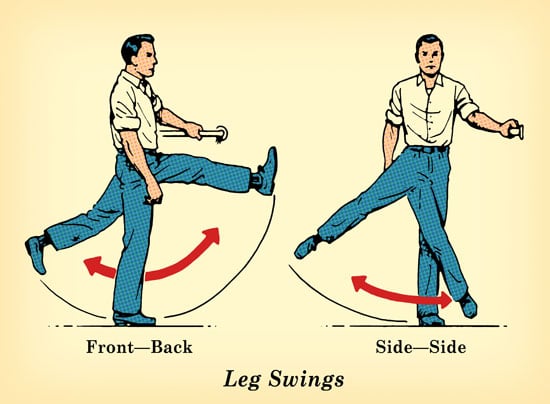
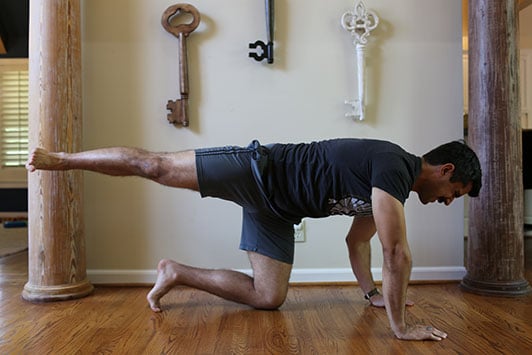
leg swing exercise undo damage of sittingThis is a great dynamic stretch that I do before every workout. It loosens up the hips, hamstrings, and glutes.
Begin with forward leg swings. Find something to hold for balance. Start off swinging your right leg backwards and forwards as high and as far back as you comfortably can. Do 20 swings and then switch legs.
Next are side-to-side swings. Again, find something to hold for balance. Swing your right leg out to the side as high as possible and then in front of you towards your left as far as you can go. Perform 20 swings and then switch legs. Depending on how tight you feel, you may need another set.

Grok Squat

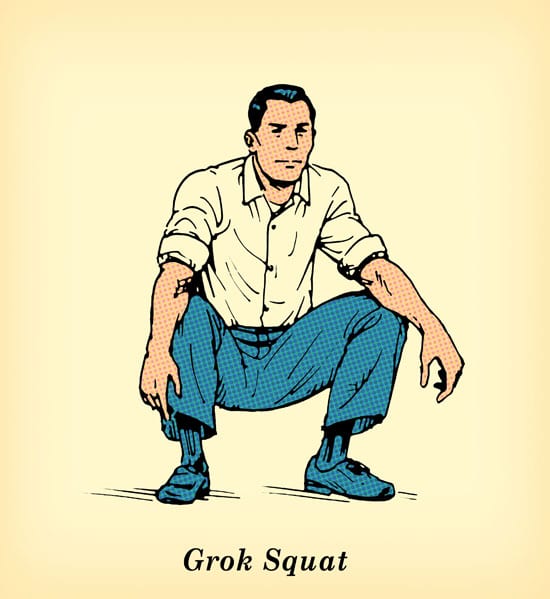
grok squat exercise undo damage of sittingThe Grok Squat is very similar to a catcher’s stance in baseball. Simply squat down until your butt touches your ankles. Keep your heels firmly on the ground and your back straight. Hold that position for 30-60 seconds. You should feel your hamstrings, quads, Achilles tendons, lower back, and groin gently stretching. If you’re super stiff, it may take a few days of practice to sink into a full squat. Keep at it. Your back and hips will thank you.
Intersperse a few short squatting sessions into your daily routine.

Table Pigeon Pose

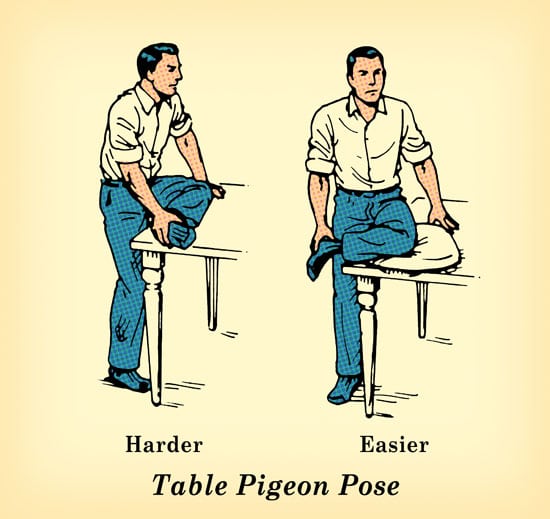
pigeon pose exercise undo damage of sittingIf you’ve done yoga, you’re probably familiar with the pigeon pose. This stretch is the same thing, except you use a table, which makes it a bit easier to perform and allows you to stretch out your muscles from different angles. Start by placing your leg on a tabletop (you could also use your bed) with the knee bent at 90 degrees. Place one hand on the table and one hand on your foot for support. Lean forward and hold for 60-90 seconds. Then lean left to the 10 o’clock position and hold for 60-90 seconds. Lean right to the 2 o’clock position and hold for 60-90 seconds. Repeat on the other leg.
If you have knee problems, rotate your body so that your ankle hangs off the table and place a pillow underneath your knee. Aim to do two pigeon poses a day (I personally do one during my workout and another at a random time).

Couch Stretch

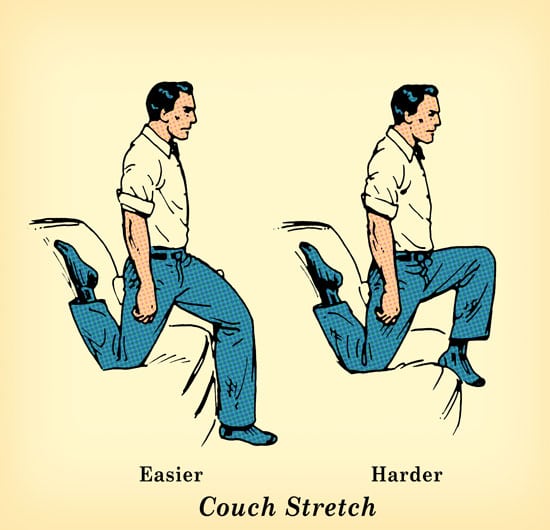
couch stretch exercise undo damage of sittingThis stretch is a killer. I didn’t realize how unlimber I was until I tried doing the couch stretch. It’s basically a quad stretch ratcheted up a few notches. Starrett argues that this will undo years of sitting.
You actually don’t need a couch for this stretch, it just makes it a bit more comfortable (if that’s even possible). You can also do it on the floor by putting your knee against a wall.
For the “easy” version, place the knee of the leg you’re stretching against the back of your sofa. Place the foot of your other leg on the floor. Slowly raise your torso to a neutral spine position (i.e. standing straight and tall). As you raise your torso, squeeze your butt and abs. Hold the position for up to four minutes. Switch and repeat on the other leg. You should feel things really stretch in your hip flexor area — just don’t push yourself too hard.
To up the ante, bring your non-stretching leg up onto the seat of the couch. Keeping a straight, neutral spine, squeeze the butt and abs and work your way up to holding the position for four minutes. Keep in mind that it may be awhile before you can get your torso to a straight position. When I first started doing this stretch the “hard way,” I could only raise my torso to a 45-degree angle and I’d have to support myself with my hand on the floor. I was eventually able to move to a straight position after two weeks of dedicated stretching. The difference in the mobility of my hips was (and continues to be) significant.
This stretch is so good that I try to do it every day, sometimes before a workout, sometimes when I’m just hanging out while Gus watches Paw Patrol.

Activate Those Glutes

Barbell Bridges

barbell bridge exercise undo damage of sitting
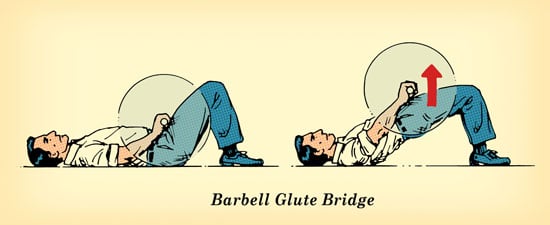
This is another exercise that makes you look goofy but does wonders for your glutes and hips. It has been a great support exercise for the deadlift.
Lay on the ground with your knees bent and feet flat on the floor. Put a padded barbell across your hips and grab it with an overhand grip about shoulder-width apart. Raise your waist off the ground while squeezing your glutes until your hips are aligned with your body. Return to the starting position, and complete three sets of 10 reps.
Aim to do this exercise one to two times a week. You can add weight as you get stronger. If you can’t do it with the weight of the barbell, try un-weighted bridges.

Clamshells

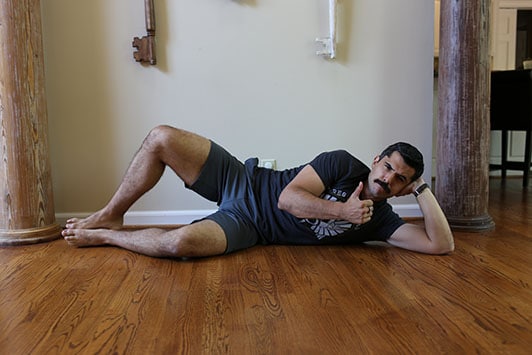
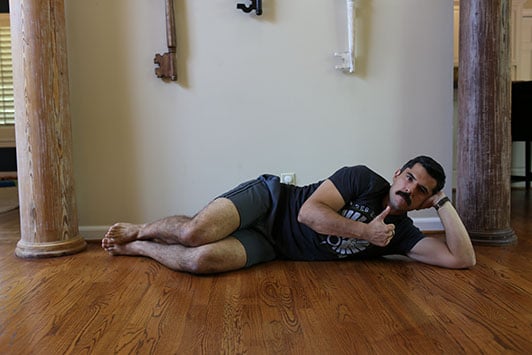
Fair warning: You’re going to feel a bit ridiculous doing this exercise. But it’s one of the best for activating your glutes. If you’re self-conscious, do this at home before you go to the gym so no one sees you.
clam shell exercise undo damage of sitting

Fire Hydrants

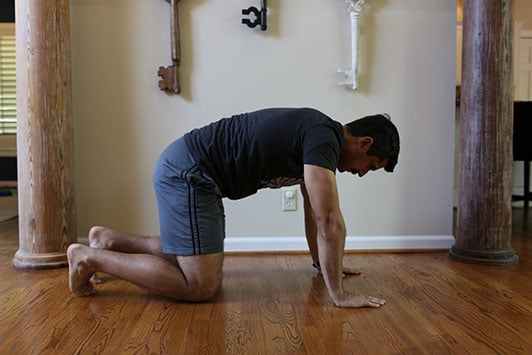
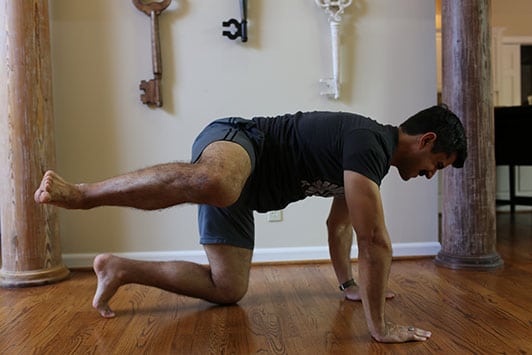
Hey, look! Another glute activation exercise that makes you look goofy! It’s called the fire hydrant because you’re going to mimic how a dog pees on a fire hydrant. For real.
fire hydrant leg exercise undo damage of sitting
__________________________
I learned these moves from a few sources: Becoming the Supple Leopard by physical therapist Kelly Starrett, paleo guru Mark Sisson of Mark’s Daily Apple, and weightlifter Medhi from Stronglifts. If you’re looking to increase not only your hip mobility, but your all-around limberness, Starrett’s book and website are especially helpful.
Illustrations by Ted Slampyak

How to raise emotionally intelligent kids


Dealing with kids ain’t easy. They need an exhausting amount of attention and help.
Behavioral psychologists have observed that preschoolers typically demand that their caretakers deal with some kind of need or desire at an average rate of three times a minute.
Most advice on parenting focuses on how to deal with misbehavior. While helpful, this is also akin to only offering advice on how to survive after a nuclear holocaust and not talking about how to prevent one. What’s the secret to making sure your living room doesn’t resemble a scene from “Mad Max: Fury Road”?
What usually underlies bad behavior is how the child handles negative emotions. And this is something we rarely teach deliberately and almost never teach well. Showing kids how to recognize and deal with feelings prevents misbehavior — and it’s a skill that will serve them their entire lives. It prevents tantrums at age 4 but it’s also the difference between saving college money and saving bail money later on. Look at it as potty training for feelings.
But how do we do that?
Professor John Gottman is the guy who revolutionized the study of relationships, getting it to the point where he could listen to a couple for just a few minutes and determine with a frightening amount of accuracy whether or not they’d divorce. Well, luckily, Gottman also analyzed parenting. And this wasn’t the latest parenting theory-of-the-week that somebody came up with over lunch — this was a truly epic study of mind-bending proportions.
He took over 100 married couples with kids ages 4 or 5 and gave them questionnaires. Then conducted thousands of hours of interviews. He observed their behavior in his lab. Taped sessions of the kids playing with their best friends. Monitored heart rates, respiration, blood flow and sweating. Took urine samples — yeah, urine samples — from the kids to measure stress-related hormones. And then followed up with the children and families all the way through adolescence, conducting more interviews, evaluating academic performance and…
Okay, enough. You get it. The plans of Hollywood Bond Villains aren’t this thorough. And when it came to dealing with emotions, Gottman realized there are 4 types of parents. And three ain’t so hot:
  • Dismissing parents: They disregard, ignore, or trivialize negative emotions.
  • Disapproving parents. They’re critical of negative feelings and punish kids for emotional expression.
  • Laissez-Faire parents: They accept their children’s emotions and empathize with them, but don’t offer guidance or set limits on behavior.
Children of these parents didn’t do as well over time. They misbehaved more, had trouble making friends or had self-esteem problems. One of them may be breaking into your car right now.
And then there were the Ultra-Parents. These mothers and fathers unknowingly used what Gottman calls “emotion-coaching.” And this produced emotionally intelligent kids. These parents accepted their children’s feelings (but not all of the children’s behavior), guided the kids through emotional moments, and helped them problem-solve their way to a solution that didn’t involve putting the neighbor’s kid in the emergency room. How did these tykes end up?
The children were better at soothing themselves when they were upset. They could calm down their hearts faster. Because of the superior performance in that part of their physiology that is involved in calming themselves, they had fewer infectious illnesses. They were better at focusing attention. They related better to other people, even in the tough social situations they encountered in middle childhood like getting teased, where being overly emotional is a liability, not an asset. They were better at understanding people. They had better friendships with other children. They were also better at situations in school that required academic performance. In short, they had developed a kind of “IQ” that is about people and the world of feelings, or emotional intelligence.
And it all came down to how the parents handled the child’s negative emotional outbursts. These parents did five things that the other types rarely did.
Alrighty, let’s get to it…

1) Be Aware Of Emotions

Parenting is stressful and can feel non-stop. Often it’s not like running a marathon — it’s like running until you die. So there’s a natural tendency to look around when things are (finally) calm and think, “Nothing is currently on fire. Okay, life is good.”
But this can be like standing in a coal mine ignoring the thousands of dead canaries. Usually emotions precede outbursts. So noticing the child’s emotions early — and not just the resulting bad behavior — is critical.
“Not misbehaving” doesn’t mean “not upset.” When a passive-aggressive spouse crosses their arms, scowls and says, “I’m fine,” at least you know they’re definitely not fine. Kids may not even understand what they’re feeling or how to best express it. So being aware and noticing early can prevent Tonka trucks from taking flight without FAA approval.
But the problem many parents have here is noticing their own emotions. If you’re not aware of your feelings and moods you’ll have trouble noticing and relating to those of others.
Our studies show that for parents to feel what their children are feeling, they must be aware of emotions, first in themselves and then in their kids… Emotional awareness simply means that you recognize when you are feeling an emotion, you can identify your feelings, and you are sensitive to the presence of emotions in other people.
Don’t be afraid to show emotions in front of your kids. Gottman found that even anger (as long as it’s expressed respectfully and constructively) has its place. If parents hold back from showing feelings then kids can learn “Mom and dad don’t have these emotions and neither should I.”
Seeing arguments and then seeing them resolved amicably is far better than never seeing them at all. Kids need a role model not just for values, but also for feelings.
Such moms and dads may try to compensate for their fear of losing control by being “super-parents,” hiding their emotions from their children… The irony is that by hiding their emotions, these parents may be raising youngsters who are even less capable of handling negative emotions than they would have been if their parents had learned to let their feelings show in a nonabusive way. That’s because the kids grow up emotionally distant from their parents. Also, the children have one less role model to teach them how to handle difficult emotions effectively.
Shielding kids from emotional situations and then sending them out into the world is like sending an athlete to the Olympics with no training. Kids need those moments in order to learn how to regulate their feelings.
(To learn more about the science of a successful life, check out my bestselling book here.)
Notice feelings now and avoid a crisis later. But what perspective did the smart parents take when outbursts did occur?

2) Emotion Is An Opportunity For Intimacy And Teaching

It’s understandable to see a tantrum as an irrational inconvenience that should be eliminated ASAP. But the parents whose children thrived saw outbursts as teaching moments and a time to bond with their kid. Yeah, that doesn’t always feel natural when a child is angrily throwing things.
Does saying anything resembling, “You should not feel this way” ever work with emotional adults? Exactly. Then it sure as hell isn’t going to work with your kid. Saying “There’s nothing to be afraid of,” or “Oh, it’ll be fine” is dismissive. This is how kids learn to doubt their own judgment and lose confidence. The Emotion-Coaching parents realized that a tantrum was the best time to connect with their child and teach them a valuable skill.
Yes, you need to stop misbehavior immediately. But you want to do it in a way specific to the child’s actions and not make it about their identity. So you want to say, “We don’t paint Grandma’s couch purple,” instead of, “Stop being a nightmare!” The children who consistently heard the latter did not fare as well in Gottman’s follow ups.
When we checked in with these same families three years later, we found that the children who experienced such disrespectful, contemptuous behavior from their parents were the same kids who were having more trouble with schoolwork and getting along with friends. These were the kids who had higher levels of stress-related hormones in their bodies. Their teachers reported they were having more behavior problems, and their moms reported they had more illnesses.
It takes practice but you want to see kids’ emotional pain like you’d see their physical pain. It’s not their fault. It’s a challenge they’re facing. And one you can help them with.
(To learn the two-word morning ritual that will make you happy all day, click here.)
Okay, so you’ve got the right perspective. You’re an emotional mentor, not a corrections officer. But what do you actually do to help?

3) Listen Empathetically And Validate Feelings

Don’t argue the facts. Feelings aren’t logical. You wouldn’t expect the new employee to know how to find the bathroom and you shouldn’t expect a child to know how to handle emotions that, frankly, you still have problems dealing with after decades of experience.
Don’t immediately try to fix things. You need to establish you’re a safe ally before you can solve anything. Understanding must precede advice, and, just as with adults, they decide when you understand.
The critical distinction Gottman realized is that it’s important to accept all feelings — but not all behavior. If you skip immediately to problem-solving, the kid never learns the skill of how to deal with those uncomfortable emotions.
You want to use “empathetic listening.” Get them to talk. Help them clarify. Validate their feelings (but, again, not necessarily their behavior). They need to feel you really understand and are on their side.
Take a deep breath, relax and focus on them. They’ll notice if you’re impatient or frustrated and just going through the motions.
In this context, listening means far more than collecting data with your ears. Empathetic listeners use their eyes to watch for physical evidence of their children’s emotions. They use their imaginations to see the situation from the child’s perspective. They use their words to reflect back, in a soothing, noncritical way, what they are hearing and to help their children label their emotions.
Relate their child problems to adult problems in your head to help you empathize. “But why is she freaking out about her new baby brother?! It makes no sense!” Really? How would you like it if your spouse brought home a new lover and expected you to welcome them into the home? Get out of your head and into theirs. Relate. Empathize.
Probing questions may be too much for a little kid. It can feel like interrogation. They may not even know why they’re sad. Try sharing simple observations. Say, “I noticed that you frowned when I mentioned going to the party” and then wait for a response.
(To learn the 4 rituals neuroscience says will make you an awesome parent, click here.)
Alright, they’re opening up. How do you calm them down and teach them how to cope?

4) Help Them Label Their Emotions

A young child is not going to be able to say, “Dearest mother, I apologize for my unnecessary irritability. My transition to the new kindergarten class has caused me an unexpected amount of stress. My future academic adjustments will be conducted with a level of grace heretofore unseen in our lovely household.”
You’ve got the words; they don’t. Help them get a handle on what’s going on by labeling what they feel.
Providing words in this way can help children transform an amorphous, scary, uncomfortable feeling into something definable, something that has boundaries and is a normal part of everyday life. Anger, sadness, and fear become experiences everybody has and everybody can handle. Labeling emotions goes hand in hand with empathy. A parent sees his child in tears and says, “You feel very sad, don’t you?” Now, not only is the child understood, he has a word to describe this intense feeling. Studies indicate that the act of labeling emotions can have a soothing effect on the nervous system, helping children to recover more quickly from upsetting incidents.
Don’t gloss over this. Labeling is absurdly powerful. Neuroscience has repeatedly demonstrated its ability to soothe emotions. It’s one of the main techniques hostage negotiators use to keep the most dangerous situations calm.
So when a child is crying because their sister got a better gift than they did, you don’t want to be dismissive and say, “I’m sure you’ll get a better present next time.” You want to validate and label the feeling with something like, “You wish you’d gotten something more fun. I bet that makes you feel kind of jealous.”
Now the kid is thinking, “They understand me.” And they’ve learned something about how to cope by talking it out and labeling the emotions to get a handle on them. And Gottman found this leads to really good things.
As we have discussed earlier, the implications of teaching a child to self-soothe are enormous. Kids who can calm themselves from an early age show several signs of emotional intelligence: They are more likely to concentrate better, have better peer relationships, higher academic achievement, and good health. My advice to parents, then, is to help your kids find words to describe what they are feeling. This doesn’t mean telling kids how they ought to feel. It simply means helping them develop a vocabulary with which to express their emotions.
(To learn how to make sure your kids are resilient, click here.)
They’re more calm. The storm has passed. They’re learning about emotions. But how do you teach them better behavior and how to fix the actual problem?

5) Set Limits And Help Them Problem-Solve

Again, all feelings are acceptable — but all behavior isn’t. You need to set limits. The parent-child relationship is not a democracy. Once the emotions are dealt with, you can be firm.
After the parent acknowledges the emotion behind the misbehavior and helps him to label it, the parent can make sure the child understands that certain behaviors are inappropriate and can’t be tolerated. Then the parent can guide the child into thinking of more appropriate ways to handle negative feelings. “You’re mad that Danny took that game away from you,” the parent might say. “I would be, too. But it’s not okay for you to hit him. What can you do instead?”
After you’ve listened empathetically, labeled feelings, and set limits on any bad behavior, it’s time to fix things. Someone needs to lead the problem solving. And that person is not you.
This is another skill you want to help them develop. You won’t always be there to tell them what to do. So encourage them to come up with ideas, guide them to a solution in line with your values that is effective and takes other people’s feelings into consideration. This is how emotionally intelligent kids become resourceful, responsible children.
(To learn how to be a better parent, from Wharton professor Adam Grant, click here.)
Okay, we’ve learned a lot. Let’s round it up and address the question every realistic parent has been thinking from the start: How the heck am I supposed to do all of this stuff when I’m stressed to the gills, we’re in the middle of the mall, and already 15 minutes late for a doctor’s appointment?
Yes, there is an answer…

Sum Up

This is how to raise emotionally intelligent kids:
  • Be aware of emotions: Canaries. Coal mines. Sometimes you can ignore the words but if you ignore the underlying feelings you’re going to be cleaning spaghetti off the walls.
  • Emotion is an opportunity for intimacy and teaching: The best lessons about dealing with emotions are learned when things get emotional. Yes, this is inconvenient.
  • Listen empathetically and validate feelings: Accept all feelings but not all behavior. Don’t interrogate, validate.
  • Help them label their emotions: You’ve got the words; they don’t. It works for hostage negotiators so use it to make sure your kids don’t end up talking to hostage negotiators.
  • Set limits and help them problem-solve: “We don’t stab Timmy. Now how might we be able to exact revenge in a way that doesn’t leave evidence?”
You don’t always have time to do all of the above when a meltdown happens… Or, more accurately, it’s extraordinarily rare when you ever have time to. Understood.
Don’t worry. Gottman says you don’t have to do it when the problem occurs. That would be preferable, but as long as you set aside time to sit down and have the conversation, you can help your kid become more emotionally intelligent.
In an ideal world, we’d always have time to sit and talk with our kids as feelings come up. But for most parents, that’s not always an option. It’s important, therefore, to designate a time—preferably at the same period each day—when you can talk to your child without time pressures or interruptions.
Emotion-coaching is not a panacea. It doesn’t have Harry Potter magic powers to turn your little devil into a little angel. There will still be outbursts. You’ll still need discipline and limits. But with time it’ll build a tighter bond with your child and help them develop a skill that will benefit them the rest of their life.
What most parents want more than anything is for their kids to be happy. What’s happiness? An emotion.
So you’ll teach them to go potty. And school will teach them how to think.
But more than anything, don’t forget to teach them how to feel.

10 Tests, Exercises, Games to Heighten Your Senses and Situational Awareness


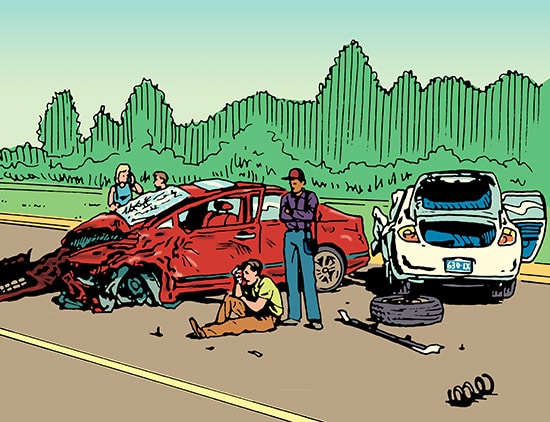
car accident on road two cars illustration
STOP: BEFORE YOU READ ON, STUDY THE PICTURE ABOVE FOR 60 SECONDS.
THEN, SCROLL DOWN AND SEE IF YOU CAN ANSWER THE FOLLOWING QUESTIONS:
  • How many people total were involved in this accident?
  • How many males and how many females?
  • What color were the two cars?
  • What objects were lying on the ground?
  • What injury did the man on the ground seem to be suffering from?
  • What was the license plate number of one of the cars?
How did you do on this little test? Not as well as you would have liked? Perhaps it’s time you strengthened your powers of observation and heightened your situational awareness.
Enhancing one’s observational abilities has numerous benefits: it helps you live more fully in the present, notice interesting and delightful phenomena you would have otherwise missed, seize opportunities that disappear as quickly as they arrive, and keep you and your loved ones safe.
Today we’re going to offer some games, tests, and exercises that will primarily center on that latter advantage: having the kind of situational awareness that can help you prevent and handle potentially dangerous and critical situations. But the benefits of practicing them will certainly carry over into all other aspects of your life as well.
Ready to start heightening your senses and building your powers of observation? Read on.

Situational Awareness and Your Senses

five senses sight hearing smell touch taste illustration
Strengthening your situational awareness involves making sure all of your senses are turned on and fully tuned into your environment. It seems like your mind and body do this automatically — aren’t you seeing, smelling, and hearing everything around you, all the time?
But when someone asks you something like, “What’s your license plate number?” and you draw a blank, you quickly realize that it’s possible to have looked at something hundreds of times without ever seeing it.
In fact, while our brain gives us the feeling that we’re taking in the whole picture of our environment from moment to moment, this is an illusion. We’re really only paying attention to some sets of stimuli, while ignoring others.
Thus, if you want to strengthen your situational awareness, you have to be truly intentional about it — you have to consciously think about utilizing and directing all your senses to a greater degree. You have to train for observation. And the first step in doing so, is getting reacquainted with the powers and pitfalls of your senses:

Sight

Seeing is what we typically think of when we think of observation, and it’s what we lean on the most to make sense of our world. Yet what our eyes take in is also not as accurate as our brains would have us believe. Eyewitness accounts of crimes are notoriously unreliable, and famous studies — like the one in which folks are asked to concentrate on people passing a basketball back and forth, and in so doing miss a man in a gorilla suit walking through the picture — show us that we can look right at something, without actually seeing it.
These blind spots are due to the fact that our eyes don’t operate like cameras that record scenes just as they unfold; rather, our brains take in a number of different shots, and then interpret and assemble them together to form a coherent picture. Left on autopilot, our brain ignores many things in our environment, deeming them unimportant in creating this image.
Nevertheless, sight is an incredibly vital part of our situational awareness arsenal — especially if we train ourselves to look for things we’d normally miss. Our eyes tell us if someone looks suspicious or if something is out of place in our hotel room (indicating someone’s been there in our absence); they spot peculiar features of a landscape to help us create a mental map to guide us home from a hike; they take footage of the exits in a building or of a crime that we can remember later.

Hearing

As sight-driven creatures, we take in a ton of information with our eyes (as much as a third of our brain’s processing power goes towards handling visual input), and most of us feel we’d rather lose our hearing than our sight.
But hearing is far more essential to keeping track of and understanding what’s going on around us than we realize — especially when it comes to staying safe. Our hearing is incredibly attuned to our surroundings and functions as our brain’s first response system, notifying us of things to pay attention to and fundamentally shaping our perception of what’s happening around us. As neuroscientist Seth Horowitz explains:
“You hear anywhere from twenty to one hundred times faster than you see so that everything that you perceive with your ears is coloring every other perception you have, and every conscious thought you have. Sound gets in so fast that it modifies all the other input and sets the stage for it.”
Our hearing is so fast because its circuitry isn’t as widely dispersed in the brain as the visual system is, and because it’s hooked into the brain’s most basic “primal” parts. Noises hit us right in the gut and trigger a visceral emotional response.
The quickness and sharpness of our hearing evolved from its survival advantage. At night, in dense forests, and underneath murky waters, our sight greatly diminishes or completely fails us, and we can’t see anything beyond our field of vision. But our ears can still pick up sensory input in darkness, around corners, and through water in order to build a mental picture of what’s going on.
Noises are nothing more than vibrations, and we’re completely surrounded by them every day. But just like with sight, your ears can be listening to tons of sounds in your environment, without your brain really hearing them; your antennae are always up, but they don’t always send a signal to pay attention. Such signals only register in your conscious awareness when they’re particularly salient (as in when you hear your name said at a busy party), or when they break the usual pattern/tone/rhythm that your brain expects (like when there’s a scream, crash, or explosion, or someone is talking in a strange/suspicious way).
We can tune into more sounds than we usually hear by “perking up” our ears, concentrating, and trying to distinguish and pull out noises we’re usually “ear-blind” to.

Smell

In comparison to our senses of sight and hearing, smell doesn’t get much attention and respect. It’s our oldest sense, and we tend to think of it moreso with animals than ourselves — like the wolf that can smell its prey almost 2 miles away.
While dogs indeed have a sense of smell that’s 10,000-100,00X more powerful than ours, the human sense of smell is nothing to, well, sniff at. Humans have the ability to detect one trillion distinct scents. And while our other senses have to be processed by numerous synapses before reaching the amygdala and hippocampus and eliciting a reaction, smell connects with the brain directly, and thus gets deeply attached to our emotions and long-term memories. This is why catching a whiff of something from long ago can instantly transport you back in time.
These ingrained, smell-induced memories serve the same kind of survival purpose in humans as they do in animals — to identify family and mates, find food, and be alerted to possible threats. Our sense of smell is able to distinguish blood kin by scent, and not only can it identify danger through picking up the scents of smoke, death, gas, etc., but can even pick up on fear, stress, and disgust in fellow humans.
Indeed, while the human sense of smell isn’t up to par with animals, studies have shown that we can track a scent trail in the same way dogs do, and that the reason we’re not better at it than we are, is that it’s a skill that has to be developed through practice. Consummate outdoorsman of days gone by who were highly observant of their surroundings often reported becoming able to track an animal by scent.
While both animals and humans process smell in automatic ways — when the smell of freshly baked cookies hits you, your tummy instinctively grumbles — human smell is in one way superior to the animal variety: we have the ability to consciously analyze smells and interpret what they might mean.
Smell can thus help you identify friend or foe, navigate an area — if we’re close to a factory or dump or a grove of pines or the campfire of home base, our nose will let us know — and even track game.

Touch & Taste

Touch and taste are two senses that are incredibly enriching for those seeking to live more mindfully and fully immerse themselves in their experiences. But for the purposes of being situationally aware of risk and danger, you won’t use them as much. Touch can come in handy though when you’re trying to navigate in the dark, and must let the sensations of your feet and hands lead the way.

Training for Observation: 10 Tests, Exercises, and Games You Can Play to Strengthen Your Situational Awareness

“As a Scout, you should make it a point to see and observe more than the average person.” —Scout Field Book, 1948
If our senses are truly as amazing as we’ve just described, and what holds us back from using them more is allowing them to default to autopilot, then we have to find ways to intentionally exercise and challenge them in order to give them full play.
Mastering situational awareness involves learning how to observe, interpret, and remember. The following exercises, tests, and games are designed to strengthen these skills while activating the latent powers of your senses.

Some of the games and exercises can be practiced alone, while others would work best in groups, such as a club, gathering of friends, or Boy Scout troop (several of the ideas in fact come from the 1948 edition of the Boy Scout Fieldbook). The games are also great to do as a family — they’ll keep your kids entertained without your having to reach for the smartphone!

1. “Kim’s Game”

In Rudyard Kipling famous novel Kim, Kimball O’Hara, an Irish teenager, undergoes training to be a spy for the British Secret Service. As part of this training, he is mentored by Lurgan Sahib, an ostensible owner of a jewelry store in British India, who is really doing espionage work against the Russians.
Lurgan invites both his boy servant and Kim to play the “Jewel Game.” The shopkeeper lays 15 jewels out on a tray, has the two young men look at them for a minute, and then covers the stones with a newspaper. The servant, who has practiced the game many times before, is easily able to name and exactly describe all the jewels under the paper, and can even accurately guess the weight of each stone. Kim, however, struggles with his recall and cannot transcribe a complete list of what lies under the paper.
Kim protests that the servant is more familiar with jewels than he is, and asks for a rematch. This time the tray is lined with odds and ends from the shop and kitchen. But the servant’s memory easily beats Kim’s once again, and he even wins a match in which he only feels the objects while blindfolded before they are covered up.
Both humbled and intrigued, Kim wishes to know how the boy has become such a master of the game. Lurgan answers: “By doing it many times over till it is done perfectly — for it is worth doing.”
Over the next 10 days, Kim and the servant practice over and over together, using all different kinds of objects — jewels, daggers, photographs, and more. Soon, Kim’s powers of observation come to rival his mentor’s.
Today this game is known as “Kim’s Game” and it is played both by Boy Scouts and by military snipers to increase their ability to notice and remember details. It’s an easy game to execute: have someone place a bunch of different objects on a table (24 is a good number), study them for a minute, and then cover them with a cloth. Now write down as many of the objects as you can remember. You should be able to recall at least 16 or more.
Here’s an opportunity to play Kim’s Game right now: look at the illustration below for 60 seconds, then scroll past it, and see how many objects you can remember!
kim's game situational awareness test 24 odd objects illustration
How did you do? Better keep practicing!

2. Expand and Enhance Your Field of Vision

Most of us, though we don’t realize it, walk around with tunnel vision. We’re concentrating on a few things directly around or ahead of us, and everything else drops out of our line of sight. So when you’re walking around, remind yourself to take in more than you usually do. Intentionally look for details in your environment you’d ordinarily overlook. Take note of peculiar features in the landscape, what people are wearing, side roads, alleyways, car makes and models, signs, graffiti on the wall — whatever.
To practice expanding your field of vision when you walk, follow these tips from the Boy Scout Fieldbook:
“Learn to scan the ground in front of you…Let your eyes roam slowly in a half-circle from right to left over a narrow strip of land directly before you. Then sweep them from left to right over the ground farther away. By continuing in this way you can cover the whole field thoroughly.”

3. What’s That Sound?

Put up a blanket in the corner of the room. Then take turns standing behind it and making noises with random objects that the rest of the group has to try to identify. The more obscure and challenging the noises people can come up with, the better — think striking a match, peeling an apple, sharpening a knife, combing your hair, etc.  

4. Eyewitness Test

Invite someone who your Scouts/friends don’t know to a group gathering. Have them come in for a few minutes and then leave. Then have everyone write down a physical description of the stranger and see how accurate they are.

5. Navigate by Touch and Feel

Can you dress yourself quickly in a pitch black room? Can you walk through the dark woods without a flashlight? Can you walk around the house blindfolded? Practice maneuvering and navigating without the use of your eyes.

6. Whose Nose Knows?

Have one member of a family/group fill paper cups with a variety of fragrant materials — orange rinds, onion, coffee, spices (cinnamon, pepper, garlic, etc.), grass, Hoppes No. 9 (any of the sources of these manly smells are good candidates) and so on. Then hand the cups to blindfolded participants, who take a sniff, and pass the cup on. Once the cup has been re-collected by the facilitator, the participants write down what they smelled.

7. Feel It

Similar to #6, but place different odds and ends into a box that then gets passed around. The participants have to feel the object and identify it from touch alone.

8. Observation Scavenger Hunt

This is a great one to do with kids, and can turn a long walk in the woods or the city, in which they might be prone to complain, into a fun game, and chance to strengthen their powers of observation! Before you set out, come up with a list of things the kids need to find; for example, on a nature walk you could put down things like a bush with berries, a bird’s nest, moss, a pine cone, etc. As you walk along, the kids will be on the lookout for the listed items, and every time they’re the first to spy one, they can mark another item off their list. See who can find the most things. It doesn’t have to be a competition either; you can all look for the items together as a family and simply keep one checklist.

9. Exit Interview

When you go to a restaurant or other place of business with your family, make a note of a few things about your environment: the number of workers behind the counter, the clothing and gender of the person sitting next to you, how many entrances/exits there are, etc. When you leave and get into the car to head home, ask your kids questions like “How many workers were behind the counter?” “Was the person sitting next to us a man or a woman?” “What color was his/her shirt?” “How many exits were there?”

10. People Watching With a Purpose

In Sir Arthur Conan Doyle’s A Study In Scarlet, Dr. Watson first becomes apprised as to his future companion’s keen powers of observation and deduction. When the pair notices a man walking down the street looking at addresses and carrying a large envelope, Holmes immediately identifies the stranger as a retired Marine sergeant. After the message bearer affirms this identity, Watson is entirely startled at Holmes’ observational powers. “How in the world did you deduce that?” he asks. The detective then offers this explanation:
“It was easier to know it than to explain why I know it. If you were asked to prove that two and two made four, you might find some difficulty, and yet you are quite sure of the fact. Even across the street I could see a great, blue anchor tattooed on the back of the fellow’s hand. That smacked of the sea. He had a military carriage, however, and regulation side-whiskers. There we have the marine. He was a man with some amount of self-importance and a certain air of command. You must have observed the way in which he held his head and swung his cane. A steady, respectable, middle-aged man, too, on the face of him — all facts which led me to believe that he had been a sergeant.”
“Wonderful!” Dr. Watson exclaims.
“Commonplace,” Holmes replies.
If you’d like powers of deduction similar to the resident of 221B Baker St., practice people watching with more deliberation than is usually lent the pastime. Notice the clothing, tattoos, and accessories of passersby, and observe their manners and how they carry themselves. Then try to guess their background and occupation.
With enough practice in this and the other exercises and games outlined above, your senses will be heightened, your powers of observation will increase, and your situational awareness will be strengthened. Soon you’ll be able to say with Holmes: “I have trained myself to notice what I see.”