Search This Blog

Sunday, September 16, 2018

Obesity alters airway muscle function, increases asthma risk


New research suggests that obesity changes how airway muscles function, increasing the risk of developing asthma. The study is published ahead of print in the American Journal of Physiology — Lung Cellular and Molecular Physiology.
The prevalence of asthma and obesity — as both separate and coexisting conditions — has grown considerably in the U.S. in recent years. Obesity is a major risk factor for asthma, in part because of the systemic and localized inflammation of the airways that occurs in people with a high body mass index.
People with obesity “also manifest a higher risk of severe asthma, decreased disease control and decreased response to corticosteroids therapy,” explained the bicoastal team of scientists who conducted the research. However, previous studies suggest that some people with obesity may have a type of asthma that is not caused by airway inflammation, but by hyperresponsiveness — a higher-than-normal response to an allergen — in the airway smooth muscle. Hyperresponsiveness causes the airways to narrow, obstructing ease of breathing, and can occur when the muscles contract or begin to spasm.
The research team combined human airway smooth muscle cells with histamine, a chemical the immune system makes in response to an allergen, and carbachol, a drug that stimulates the part of the nervous system that controls the airways. Stimulating airway cells with these substances causes the cells to release calcium, which mimics muscle contraction. The researchers found that muscle cells from obese donors released more calcium and had greater shortening — a function that occurs during muscle contraction — than the cells from normal-weight donors. In addition, the cells from female obese donors released more calcium than cells from male obese donors.
These results suggest that obesity “imprints on structural cells [or airway smooth muscle cells] a unique signature that can be identified and that may lead to novel targeted approaches to improve asthma management without the use of steroids,” explained Reynold Panettieri Jr., MD, director of the Rutgers Institute for Translational Medicine and Science and corresponding author of the study.
Story Source:
Materials provided by American Physiological SocietyNote: Content may be edited for style and length.

Journal Reference:
  1. Sarah Orfanos, Joseph Jude, Brian Thomas Deeney, Gaoyuan Cao, Deepa Rastogi, Mark van Zee, Ivan Pushkarsky, Hector E Munoz, Robert Damoiseaux, Dino Di Carlo, Reynold Panettieri. Obesity increases airway smooth muscle responses to contractile agonists.American Journal of Physiology-Lung Cellular and Molecular Physiology, 2018; DOI: 10.1152/ajplung.00459.2017

Testosterone replacement therapy may slow the progression of COPD


Researchers from The University of Texas Medical Branch at Galveston found that testosterone replacement therapy may slow disease progression of chronic obstructive pulmonary disease. The paper is currently available in Chronic Respiratory Disease.
Chronic obstructive pulmonary disease, or COPD, is predicted by the World Health Organization to be the third-leading cause of illness and death internationally by 2030. Low testosterone is common in men with COPD and may worsen their condition. Men with COPD have shortness of breath and often take steroid-based medications for an extended time, both of which increase their risk of low testosterone.
“Previous studies have suggested that testosterone replacement therapy may have a positive effect on lung function in men with COPD,” said Jacques Baillargeon, UTMB professor in preventive medicine and community health. “However, we are the first to conduct a large scale nationally representative study on this association.”
The goal of the study was to find out whether testosterone replacement therapy reduced the risk of respiratory hospitalizations in middle-aged and older men with COPD.
Using the Clinformatics Data Mart, a database of one of the largest commercially insured populations in the U.S., Baillargeon and colleagues examined data of 450 men aged 40 to 63 with COPD who began testosterone replacement therapy between 2005 and 2014. They also used the national Medicare database to study data from 253 men with COPD aged 66 and older who initiated testosterone replacement therapy between 2008 and 2013.
“We found that testosterone users had a greater decrease in respiratory hospitalizations compared with non-users. Specifically, middle-aged testosterone replacement therapy users had a 4.2 percent greater decrease in respiratory hospitalizations compared with non-users and older testosterone replacement therapy users had a 9.1 percent greater decrease in respiratory hospitalizations compared with non-users,” said Baillargeon. “The findings suggest that testosterone replacement therapy may slow the progression of disease in men with COPD.”
Other authors include UTMB’s Dr. Randall Urban, Wei Zhang, Mohammed Zaiden, Zulqarnain Javed, Melinda Sheffield-Moore, Yong-Fang Kuo, and Dr. Gulshan Sharma.
Story Source:
Materials provided by The University of Texas Medical Branch at GalvestonNote: Content may be edited for style and length.

Journal Reference:
  1. Jacques Baillargeon, Randall James Urban, Wei Zhang, Mohammed Fathi Zaiden, Zulqarnain Javed, Melinda Sheffield-Moore, Yong-Fang Kuo, Gulshan Sharma. Testosterone replacement therapy and hospitalization rates in men with COPDChronic Respiratory Disease, 2018; 147997231879300 DOI: 10.1177/1479972318793004

Saturday, September 15, 2018

Some startup insurers are ditching the deductible


Fed up with rising healthcare costs, Dove Healthcare, a skilled-nursing facility in South Eau Claire, Wis., opted to do away with its Medica high-deductible health plans and offer its 500 full-time workers coverage with no deductibles and no coinsurance through startup Bind Benefits.
The plan features lower premiums and straightforward copayments; employees can use a web tool to determine copayments before buying a healthcare service.
“With other plans we’ve had, you may not have known what the cost would be because it may be subject to the deductible and you’d have to wait for that (explanation of benefits) to arrive to know what your share of the cost is,” said Jenny Risinger, Dove’s regional director of human resources. But Bind, she said, is helping workers become better consumers “because they have the information ahead of time.”
Minneapolis-based Bind, which has financial backing from industry giants UnitedHealth Group and Ascension, isn’t the only anti-deductible insurance startup bucking the trend of shifting more costs onto employees’ shoulders in favor of models that offer better price certainty. (Ascension Ventures, the venture capital arm of the health system, could not be reached for comment; no one at UnitedHealth was available for comment.)
Another startup called Centivo also eliminated deductibles if members seek care that is coordinated by a primary-care doctor.
While employers are not yet dumping their high-deductible health plans en masse, the startups’ movement away from deductibles illustrates a growing sentiment that exposing patients to more out-of-pocket healthcare costs doesn’t solve the cost conundrum and could harm patients’ health.
Bind CEO Tony Miller helped pioneer high-deductible health plans paired with health savings accounts when he was CEO of Definity Health, which he sold to UnitedHealth in 2004. But he came to consider deductibles “a bad idea” as they rose higher and employers contributed less to savings accounts.
People end up avoiding both necessary and unnecessary care, he said. Eliminating the deductible allows patients in self-funded employer plans to shop with more certainty of the cost. So far, Bind has enrolled 50,000 members.
Bind covers primary and specialty care, emergency and hospital services, chronic care and pharmaceuticals as part of its main benefits package. Members must buy additional coverage for expensive treatments that can be planned for, such as knee replacements.
A little more than half of all workers with employer-sponsored coverage had a deductible of $1,000 or more in 2017, up from a third of workers in 2012, according to the Kaiser Family Foundation. The average deductible among workers with a deductible rose to $1,505 in 2017 for single coverage, about 2% higher than in 2016.
Average deductibles, 2016-17, for single coverage
But even with employees shouldering a larger share of their costs under a high deductible, employers haven’t been able to blunt rising healthcare spending. Employers and employees spent $6,690 for single-coverage premiums in 2017, up 4% over 2016, and $18,764 for family coverage, up 3%, according to the Kaiser Family Foundation.
That’s partly because few consumers shop for healthcare services. In a July 2018 National Bureau of Economic Research working paper, economists found that privately insured individuals often got lower-limb MRI scans at high-priced locations even when lower-priced options were available. The researchers concluded that referring physicians had more influence over where consumers sought care than cost did.
Employer-sponsored insurance startup Centivo has taken that knowledge to heart. CEO Ashok Subramanian said the health plan, launching January 2019, gives incentives to primary-care physicians and patients to work together to lower the total cost of care, rather than relying on high deductibles to influence where and when the patient seeks care.
Providers receive incentive payments for coordinating care and promoting quality and good outcomes. And patients never see a deductible or co-insurance if they get the care that is directed by the primary-care doctor. They pay easy-to-understand flat copayments and premiums. Subramanian said the Centivo plan should cost 20% to 30% less than a typical plan with equal benefits because it holds both the patient and provider accountable.
“We believe that there needs to be a new model,” Subramanian said. “There are a lot of employers out there silently hoping that they have some alternative to give their employees.”
Centivo also offers a program that allows members to get free care for certain chronic conditions if they follow a treatment plan set by the primary-care doctor. The conditions include diabetes, complex cardiovascular disease, high-risk maternity, smoking, depression and anxiety.
Benefit consultants say most employers are not backing away from offering high-deductible health plans, though the National Business Group on Health’s latest annual survey showed that fewer large employers are offering high-deductible plans as the sole option.
Employers are, however, “trying to be less and less about cost-shifting” and instead are “helping (employees) make the right decisions and provide them with transparency to get them the care they need,” said Regina Ihrke, a Willis Towers Watson health and benefits consultant. That could mean allowing first-dollar coverage for certain conditions, such as diabetes, to encourage workers to get needed care.
Likewise, Lauren Vela, senior director of member value at the Pacific Business Group on Health, said employers are “more mindful” of the costs that employees incur under high-deductible plans and are looking for ways to protect them. But she warned that eliminating deductibles completely could lead employees to disregard how much a service costs and just spend more.
“A deductible is a good thing if it can be used to encourage somebody to get a second opinion before getting a back surgery or an MRI for no good reason,” she said.

Stop snoring!


vintage couple in bed man snoring
About half of all adults snore occasionally, and about a quarter snore regularly. While it’s sort of a funny topic, and often joked about in sitcoms, snoring can cause real issues in the bedroom. Whether it’s keeping you from getting the deep, restful sleep you need, or waking up your spouse at all hours (if they can get to sleep at all), snoring can create a boatload of tension. It’s worth your physical and relational health to try to get a handle on your noisy nighttime muffler.
Snoring is more common in men than women, and tends to get worse as one ages and/or gains weight. It happens when the free flow of air from the mouth/nose to the lungs is interrupted and vibration at the back of the throat occurs, for a variety of reasons: congestion, illness, poor muscle tone in the mouth/jaw, and a few more serious health concerns.
For most folks, there are natural remedies that can reduce and even eliminate their snoring. For others, however, it can be a sign of some form of sleep apnea, wherein your breathing temporarily pauses in the night, causing you to snore loudly and even occasionally jolt yourself awake. Less than 5% of people are diagnosed with sleep apnea, but it’s estimated that up to 80% of sufferers are undiagnosed.
If you try the below steps and don’t see any improvement in your snoring, it’s best to seek out a medical professional. Do not buy mouth guards or anti-snore devices without medical consultation, even from your dentist — any device going in the mouth can have an effect on your teeth and general oral well-being.
First, though, try the advice below. Odds are good that you’ll see at least some improvement, if not a total cessation of your snoring problems.

1. Lose a few pounds.

That turkey wattle you get during the holidays is hurting more than just your appearance. As weight increases, so does the prevalence of snoring. Extra poundage just generally compresses things and closes your airways more than they would be otherwise. You actually accumulate fatty tissue in the neck and back of the throat, and that tissue is “floppy” — rather than being rigid like muscle. It therefore vibrates when breathing deeply in and out during sleep.
In many people, the neck is one of the areas of the body that both loses and gains weight quickly. That’s both a positive and a negative; just a few pounds off the scale should help you out, but just a few pounds added back on and you may be in trouble again. Among the numerous benefits that come with weight loss, a decrease in snoring is likely one, and may provide some extra motivation.

2. Change your sleep position.

Lying on your back can cause your tongue and soft palate to fall back into your throat and partially block your airways, leading to snoring. Try sleeping on your side instead; memory foam mattresses help with this, as does a body pillow if you’re having a hard time adjusting.

3. Avoid alcohol.

Booze can make people snore who don’t normally do so. Beyond just stuffing you up, as beer and other alcoholic beverages can often do, alcohol relaxes the muscles too much, leading to fluttering and vibrating while sleeping. Not only will abstaining from alcohol for the 3-4 hours before bedtime just generally improve your sleep cycle, it’ll also curb your snoring. It’s a hard thing to do, especially with socializing at night, but keep it in mind if snoring is giving you or your loved one real problems.

4. Get enough sleep.

If you’re consistently not getting enough sleep (that means 7-9 hours for the vast majority of folks), this deprivation may be the cause of your snoring woes. Being over-tired makes your muscles floppier, leading to snoring. Check out these 22 tips to give yourself a better night’s sleep.

5. Keep nasal passages open.

Nasal congestion is a major cause of snoring; this is why someone who’s typically a non-snorer will become a nighttime rhino when he’s sick. If you have a cold, or are just naturally regularly congested, try taking a hot shower before bed (showers are better than baths because of the steam that circulates when in an enclosed space), or use a neti pot. Nasal strips are also worth trying.

6. Keep your room clean!

Allergens and dust can be a cause of snoring. Regularly dust your bedroom, including your ceiling fan if you have one. Wash your bedding regularly (you shouldn’t need a reminder on that one!). Vacuum often, including the curtains. Get your air ducts cleaned every couple years. Also don’t allow pets to sleep on the bed if you have snoring problems.

7. Stay hydrated.

Dry mouths lead to dry noses and throats. This can lead to build-ups of gunk and general irritation and swelling, leading to congestion and blockage. Drink plenty of water, help your snoring.

8. Keep your mouth, jaw, and throat muscles toned.

Research shows that doing daily mouth and jaw-strengthening exercises over the course of a few months reduces snoring occurrences by more than a third, and reduces snoring intensity by up to 60%.
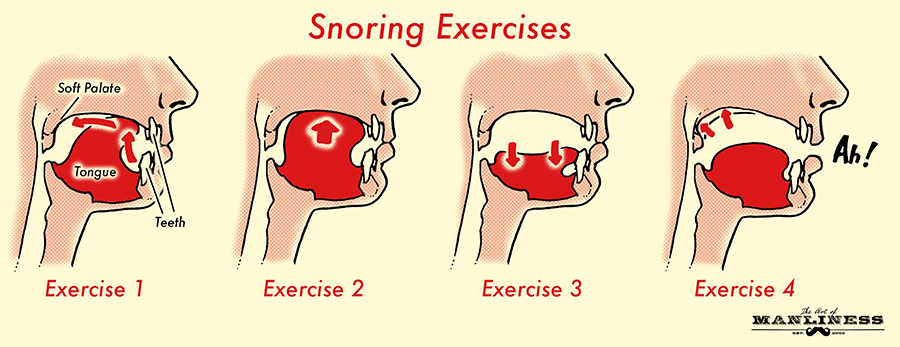
Consumer Reports recommends this daily routine; each exercise is performed 20 times a day:
snoring exercises to strengthen jaw throat muscles
  • Exercise 1: Push the tip of the tongue against the roof of the mouth and slide the tongue backward.
  • Exercise 2: Suck the tongue upward against the roof of the mouth and press the entire tongue against the roof of the mouth.
  • Exercise 3: Force the back of the tongue against the floor of the mouth while keeping the tip of the tongue in contact with the bottom front teeth.
  • Exercise 4: Elevate the soft palate (the back of the roof of the mouth) and the uvula (the fleshy protrusion that hangs from the soft palate) while making the vowel sound “Ah.”
These exercises give your mouth and jaw muscles more rigidity, making it less likely they’ll vibrate when breathing at night.

9. Avoid smoking.

Smoking irritates membranes in the nose and throat, inflaming them and causing congestion and blocked airways. As with losing weight, there are numerous benefits to quitting smoking, with decreased snoring being but one.

10. Elevate.

You can use pillows to elevate your head, but be sure you’re not doing it just at the head; elevate your chest some as well. Otherwise you can make your neck crink, giving you both pain and airway blockage that you didn’t bargain for. You can get a mattress that raises up and down, but those are rather expensive. Go the DIY route by putting a few books under your mattress, or under the legs of the bed. Even just being elevated a few inches can help things out.

11. Use a humidifier.

Dry air can irritate the nose and throat, making them swollen, and therefore causing congestion, and snoring in turn. Use a humidifier at night to open things up a bit more.

12. Ask your doc about medications.

Sleep aids and sedatives relax your muscles, making it more likely that they’ll vibrate at night, causing you to snore. Many people rely on sleep aids though, so ask your doctor about it. Other medications can do the same thing and also contribute to snoring. If you’re having real problems, ask your doc about how your prescriptions might be impacting your sleep and your snoring, and what you might be able to do about it.

ResMed Introduces Its First Minimal-contact Full Face CPAP Mask


ResMed (NYSE: RMD) (ASX: RMD) today introduced its first minimal-contact full face CPAP mask, AirFit F30, the latest addition to its AirFit mask portfolio, which helps users reduce facial marks, wear glasses in bed and curl up closer to their bed partner.
Unlike most traditional full face mask cushions, AirFit F30’s sits below the nasal bridge, preventing top-of-the-nose red marks and irritation, and reducing feelings of claustrophobia for some full face wearers.
AirFit F30 also features ResMed’s latest QuietAir vent, so it’s quieter than ambient noise in the bedroom. Plus, magnetic clips make the mask fast and easy to put on and take off, while a one-size-fits-all headgear ensures an accurate, first-time fit.
ResMed AirFit F30 vs. the competition
Compared to the leading minimal-contact tube-down full face mask:
— 80% of users said AirFit F30 was easier to use.1 — 66% of users said AirFit F30 had a more stable fit and better seal.2 — AirFit F30 is quieter, based on published performance (21 vs. 32.5 dBA).3 HME benefits: Fewer SKUs, faster fit
With just two cushion sizes and one headgear, AirFit F30 fit 93 percent of users in a ResMed study.2 Fast and accurate first-time fittings with fewer stock keeping units (SKUs) can help home medical equipment (HME) providers achieve higher patient satisfaction, successful patient setups and simpler inventory management.
“AirFit F30 is a win-win for sleep apnea patients and HMEs, and the perfect addition to ResMed’s portfolio of CPAP masks,” said Jim Hollingshead, president of ResMed’s Sleep business. “It provides an easier, quieter and more stable fit for full face wearers, while HMEs can enjoy faster setups and easier inventory management with a mask designed to fit the first time, every time.”
Availability
AirFit F30 will be available later this year in select countries. It will be on display this weekend at the European Respiratory Society Congress in Paris at ResMed’s Booth J.04.

Quest: Drug Misuse in America 2018; Insights into Changing Opioid Epidemic


Drug Misuse in America 2018, a Quest Diagnostics Health Trends™ report, presents findings from analysis of more than 3.9 million de-identified aggregated clinical drug monitoring tests performed by Quest Diagnostics on patients in all 50 states and the District of Columbia between 2011 and 2017. To our knowledge, this report is the largest of its kind to provide current insights into prescription and illicit drug use and misuse in the United States based on laboratory insights.
To view the report click here.
To view the press release click here.
In this report, we reveal evolving patterns in drug misuse, specifically:
  • The rate of drug misuse remained constant, as it has for several years. The misuse rate in 2017 was 52 percent, unchanged from 2016. This suggests improvements in appropriate drug use have plateaued, and a majority of patients tested continue to present evidence of potential drug misuse.
  • Despite the unchanged rate, the nature of the drug misuse epidemic is shifting. Among patients in general care, rates of misuse of several commonly prescribed opioids and other drugs, as well as certain illicit drugs, declined over the past year. However, rates of misuse of certain drugs, including heroin and non-prescribed fentanyl, skyrocketed among individuals most at risk – those in in addiction treatment centers.
  • Drug mixing, a contributing factor to overdose deaths, is the most frequent form of misuse observed in the Quest data, and it shows no signs of abating. The highly dangerous combination of opioids and benzodiazepines is frequently found in patients tested in primary care and pain management settings.
  • Gabapentin has emerged as a potential concern, with dramatic increases observed in misuse in just one year.
For clinicians, drug monitoring can provide insights into possible forms of misuse including: substance use disorders, dangerous drug combinations, incomplete treatment, and/or “diversion” – instances where the prescribed drug is not found in the patient’s sample, suggesting the patient is possibly filling the prescription but may be diverting the drug to others or opted not to take it.
The intent of this and other Quest Diagnostics Health Trends reports is to provide insights based on objective laboratory data.

Dietary fiber reduces brain inflammation during aging


As mammals age, immune cells in the brain known as microglia become chronically inflamed. In this state, they produce chemicals known to impair cognitive and motor function. That’s one explanation for why memory fades and other brain functions decline during old age. But, according to a new study from the University of Illinois, there may be a remedy to delay the inevitable: dietary fiber.
Dietary fiber promotes the growth of good bacteria in the gut. When these bacteria digest fiber, they produce short-chain-fatty-acids (SCFAs), including , as byproducts.
“Butyrate is of interest because it has been shown to have anti-inflammatory properties on microglia and improve memory in mice when administered pharmacologically,” says Rodney Johnson, professor and head of the Department of Animal Sciences at U of I, and corresponding author on the Frontiers in Immunologystudy.
Although positive outcomes of sodium butyrate—the drug form—were seen in previous studies, the mechanism wasn’t clear. The new study reveals, in old mice, that butyrate inhibits production of damaging chemicals by inflamed microglia. One of those chemicals is interleukin-1β, which has been associated with Alzheimer’s disease in humans.
Understanding how sodium butyrate works is a step forward, but the researchers were more interested in knowing whether the same effects could be obtained simply by feeding the mice more fiber.
“People are not likely to consume sodium butyrate directly, due to its noxious odor,” Johnson says. “A practical way to get elevated butyrate is to consume a diet high in soluble fiber.”
The concept takes advantage of the fact that  convert fiber into butyrate naturally.
“We know that diet has a major influence on the composition and function of microbes in the gut and that diets high in fiber benefit good microbes, while diets high in fat and protein can have a negative influence on microbial composition and function. Diet, through altering , is one way in which it affects disease,” says Jeff Woods, professor in the Department of Kinesiology and Community Health at U of I, and co-author on the study.
Butyrate derived from dietary fiber should have the same benefits in the brain as the drug form, but no one had tested it before. The researchers fed low- and high-fiber diets to groups of young and old mice, then measured the levels of butyrate and other SCFAs in the blood, as well as inflammatory chemicals in the intestine.
“The high-fiber diet elevated butyrate and other SCFAs in the blood both for young and old mice. But only the old mice showed  on the low-fiber diet,” Johnson says. “It’s interesting that young adults didn’t have that inflammatory response on the same diet. It clearly highlights the vulnerability of being old.”
On the other hand, when old mice consumed the high-fiber , their intestinal inflammation was reduced dramatically, showing no difference between the age groups. Johnson concludes, “Dietary fiber can really manipulate the inflammatory environment in the gut.”
The next step was looking at signs of inflammation in the brain. The researchers examined about 50 unique genes in microglia and found the  reduced the inflammatory profile in aged animals.
The researchers did not examine the effects of the diets on cognition and behavior or the precise mechanisms in the gut-brain axis, but they plan to tackle that work in the future as part of a new, almost-$2 million grant from the National Institute on Aging, part of the National Institutes of Health.
Although the study was conducted in , Johnson is comfortable extending his findings to humans, if only in a general sense. “What you eat matters. We know that older adults consume 40 percent less  than is recommended. Not getting enough fiber could have negative consequences for things you don’t even think about, such as connections to brain health and inflammation in general.”
More information: Stephanie M. Matt et al, Butyrate and Dietary Soluble Fiber Improve Neuroinflammation Associated With Aging in Mice, Frontiers in Immunology (2018). DOI: 10.3389/fimmu.2018.01832