Money held in nonbank, peer-to-peer payment apps is not guaranteed for federal deposit insurance protection, which makes the funds more vulnerable, the Consumer Financial Protection Bureau warned Thursday.
The watchdog said the 85% of adults ages 18 to 29 in the U.S. who have used PayPal, Cash App, Zelle and other peer-to-peer apps would be in danger of losing their money if it was stored on one of those platforms and thecompanies failed. None of those platforms appear to be at risk of collapsing, but the CFPB highlighted the protection offered by deposit insurance after three regional banks collapsed since March.
The risks to user funds increase as the applications grow in popularity. More than three-quarters of U.S. adults have used a payment app, according to the Pew Research Center. Millennials made up the bulk of users in 2022 at 94%.
“Popular digital payment apps are increasingly used as substitutes for a traditional bank or credit union account but lack the same protections to ensure that funds are safe,” CFPB Director Rohit Chopra said.
CFPB is also monitoring whether tech companies adhere to fiscal safeguards as they expand into banking and payments, according to Chopra. Tesla mogul Elon Musk began exploring payment functions on Twitter soon after he took over the social media company last fall.
Peer-to-peer applications have proven lucrative. PayPal, the parent company of Venmo, reported $27.5 billion in revenue last year. Block, which owns Cash App, posted $17.5 billion in revenue last year.
The standards for storing consumer funds differ from company to company. Some invest the money in interest-earning loans and bonds instead of depositing into a traditional bank or credit union. This runs the risk of investment losses, interest rate changes, currency exchange rate fluctuations and liquidity issues, the CFPB said.
Other peer-to-peer companies, meanwhile, do not say where consumer money is held or invested.
Others claim to offer “pass-through” insurance that protects funds against the failure of the banking institution where the deposit is held, according to the CFPB. But the insurance is only provided under certain conditions and does not protect users’ money if the parent app collapses.
CFPB said Thursday it will continue coordinating with state and federal regulators to monitor progress on automated funds sweeping into insured banking accounts. Until then, app users must be proactive in moving money into an insured financial facility until a method is adopted, the agency said.
PayPal, Cash App and Zelle did not immediately respond to requests for comment.
Swedish investment firm EQT will take Dechra PharmaceuticalsDPH.Lprivate in a deal with anequity value of 4.46 billion pounds ($5.62 billion), the British veterinary drugmaker said on Friday.
Under the terms of the deal, each Dechra shareholder will receive 3,875 pence in cash, which represents a premium of about 44% to the last closing price before the offer period commenced.
The firms had been in talks for a deal since April.
The enterprise value of the deal is 4.88 billion pounds.
Axsome Therapeutics, Inc. (NASDAQ: AXSM), a biopharmaceutical company developing and delivering novel therapies for the management of central nervous system (CNS) disorders, today announced presentations on Sunosi® (solriamfetol) at SLEEP 2023, the annual meeting of the American Academy of Sleep Medicine and the Sleep Research Society, being held in Indianapolis, Ind., from June 3-7, 2023. The presentations include new data from the SHARP (Solriamfetol’s Effect on Cognitive Health in Apnea Participants During a Randomized Placebo-controlled) study in patients with excessive daytime sleepiness (EDS) associated with obstructive sleep apnea (OSA), demonstrating sustained improvement with Sunosi on measures of cognition across 8-hours with once daily dosing. Additional new data and analyses include real-world data from OSA patients taking Sunosi as part of the SURWEY study in Germany, healthcare resource use in OSA patients with residual EDS, and effect sizes and numbers needed to treat analyses.
Gov. Kathy Hochul announced on Thursday that New York will be offering spots at SUNY and CUNY colleges for all of the state’s graduating high school seniors.
According to the governor’s office, SUNY will soon be sending out letters to roughly 125,000 senior students informing them that they have been automatically accepted to their local community colleges this fall.
“Access to quality higher education is an engine for social mobility and we are taking comprehensive steps to ensure that college is affordable and accessible for students from all backgrounds,” Hochul said in a statement.
“My administration remains committed to removing barriers and easing the pathway to higher education for all high school seniors – lifting up students to build a brighter future for themselves and New York.”
Sending a personalized letter to students is expected to spark their decision to enroll, the governor’s office said.
Gov. Kathy Hochul said 125,000 senior students in New York will receive letters offering enrollment at SUNY universities.William Farrington
Earlier this year, financially struggling CUNY announced a partnership with New York City Public Schools to send 65,000 graduating seniors personalized letters also confirming their acceptance at the city’s university system, according to the governor’s office.
The letters will reveal students’ college options at CUNY, and invite them to send in a CUNY application.
“CUNY is sending seniors and their families the tools they need to find the right program at the right price,” CUNY Chancellor Félix V. Matos Rodríguez said. “This partnership will increase the number of seniors going to college, enhance New York’s workforce and help end systemic inequities.”
Both SUNY and CUNY are ready to assist all students with questions about applying for financial aid, the governor’s office said.
The measure was first proposed by Hochul as part of her 2023 State of the State agenda “to eliminate barriers to higher education.”
The governors of Virginia and West Virginia are the latest Republican state leaders to announce deployments of National Guard troops to assist Texas Gov. Greg Abbott’s border security efforts
On Wednesday morning, Virginia Gov. Glenn Youngkin announced he would deploy 100 of his state’s National Guard troops to Texas.
“The ongoing border crisis facing our nation has turned every state into a border state,” Youngkin said. “As leadership solutions at the federal level fall short, states are answering the call to secure our southern border, reduce the flow of fentanyl, combat human trafficking and address the humanitarian crisis. Following a briefing from Governor Abbott last week, Virginia is joining other states to deliver on his request for additional assistance.”
In a Wednesday morning press conference, West Virginia Gov. Jim Justice also announced he would deploy 50 of his state’s National Guard troops to Texas.
“I know our National Guard will do incredible work, and we’ll wish them Godspeed to get home safe and sound,” Justice said. “I thank them all for their incredible bravery and for stepping up yet again to answer the call.”
Abbott has been using Texas state resources in recent months in a mission to stem the flow of illegal border crossings into the country. In recent weeks, Texas National Guard troops and Department of Public Safety officers have been seen setting up razor fences and turning back people attempting to cross from Mexico into Texas illegally.
Abbott has stepped up this border security effort after President Joe Biden’s administration ended the federal Title 42 immigration policy on May 11. Following the outbreak of COVID-19, U.S. officials had used Title 42 authorities to rapidly turn away and expel illegal immigrants under public health justifications.
On May 16, 24 Republican governors signed a letter pledging to support Abbott’s border security effort, including Youngkin and Justice. Since then, several Republican governors have deployed their state National Guard troops and state police resources to assist border control efforts.
Other States Sending Troops
Florida Gov. Ron DeSantis was among the first Republican governors to pledge specific resources to Abbott’s border security mission. On May 16, DeSantis announced his state would send 800 Florida National Guard soldiers, 200 Florida Department of Law Enforcement officers, 20 Florida Fish and Wildlife Conservation Commission officers, and 20 Emergency Management personnel to Texas. DeSantis also pledged five fixed-wing aircraft, two mobile command vehicles, 17 unmanned aerial vehicles (drones), and 10 watercraft.
On May 17, Mississippi Gov. Tate Reeves announced an unspecified number of troops from the Mississippi National Guard’s 112th Military Police Battalion would deploy to assist U.S. Customs and Border Protection (CBP) officers and agents along the southwest border.
On May 24, Tennessee Gov. Bill Lee announced he had authorized the deployment of 100 Tennessee National Guard troops to the border. Lee said these troops would patrol and provide an added security presence at the border, help staff outposts, and assist in road and route clearance, barrier placement, and debris removal.
“America continues to face an unprecedented border crisis that threatens our nation’s security and the safety of Tennesseans,” Lee said of the deployment.
“The federal government owes Americans a plan to secure our country, and in the meantime, states continue to answer this important call to service,” Lee added. “I am again authorizing the Tennessee National Guard to help secure the Southern border, and I commend these troops for providing critical support.”
On May 24, Nebraska Gov. Jim Pillen also announced he would send 10 Nebraska state troopers to Texas to assist Abbott’s border security mission.
We live in a strange time, one where the formerly unthinkable - skepticism among the "very serious people" about government data veracity - has become mundane. And yet even thoughnumerous bank analysts and strategists, andthis site of course, have repeatedly raised questions and concerns about the credibility of the most important US economic data - the monthly jobs report - nothing ever changes and if it does, itcomes in the form of periodic "seasonal adjustment" resets where we "learn" that all the data that guided markets and central banks, had beenfake, manipulated wrong for years.
But even if one ignores the blatant manipulation of economic data by self-serving administrations, who hope to generate political brownie points by casting the economy in a far stronger light than is merited in reality, there are still various bizarre offshoots within the data which few notice yet which are instrumental to maintaining the fake narrative.
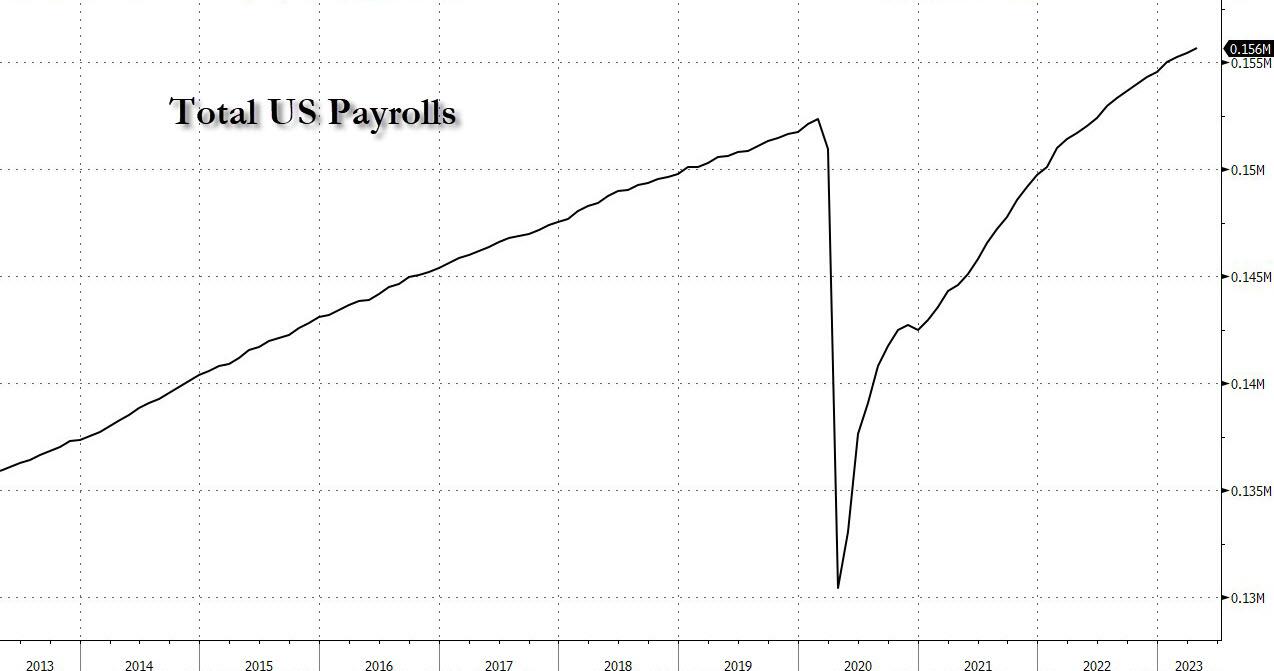
Such as this: readers are probably aware that according to the BLS, there are now roughly 3.3 million more jobs (155.7 million) than there were at the peak just before the covid crash (152.4 million).
On the surface, this is an impressive accomplishment, as a deficit of some 22 million jobs has been erased in under three years.
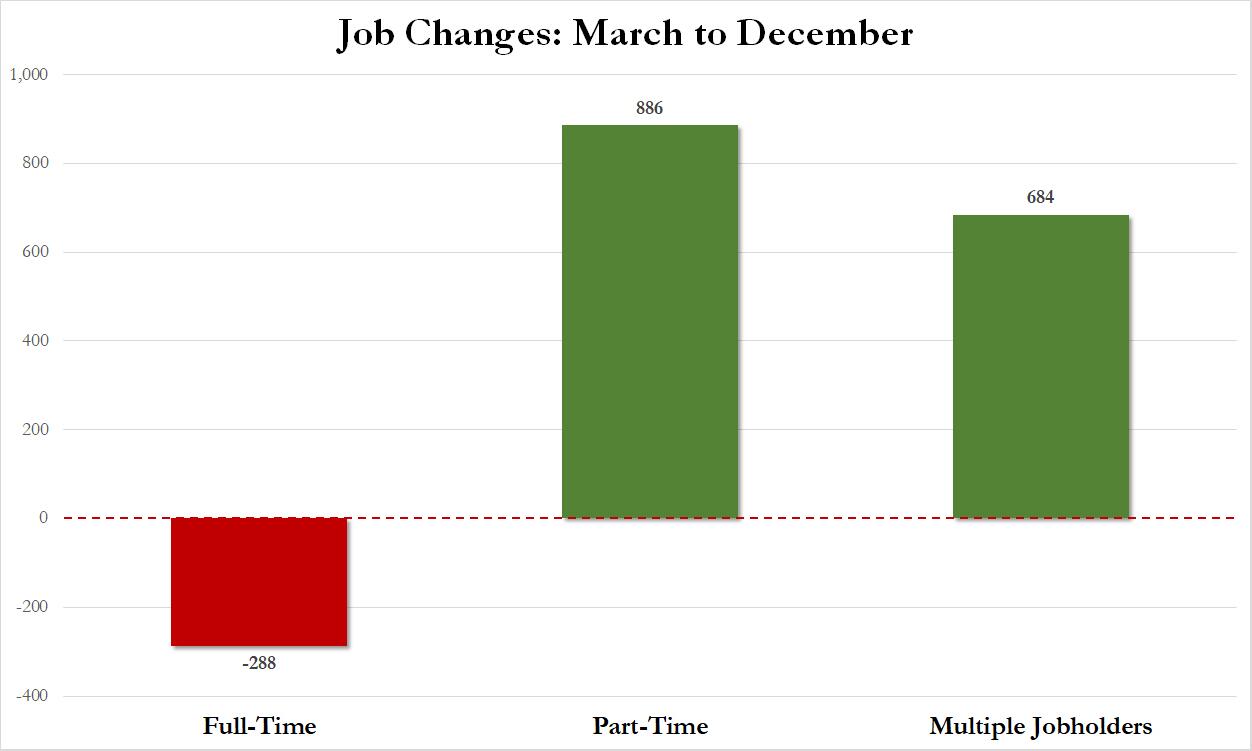
But then, if one starts digging, some peculiarities emerge, like for example that much of jobs created in recent years have gone to "multiple jobholders", meaning that not every "payroll" has been assigned to a unique individual, but instead there are now people who hold two, three or more jobs to make ends meet.
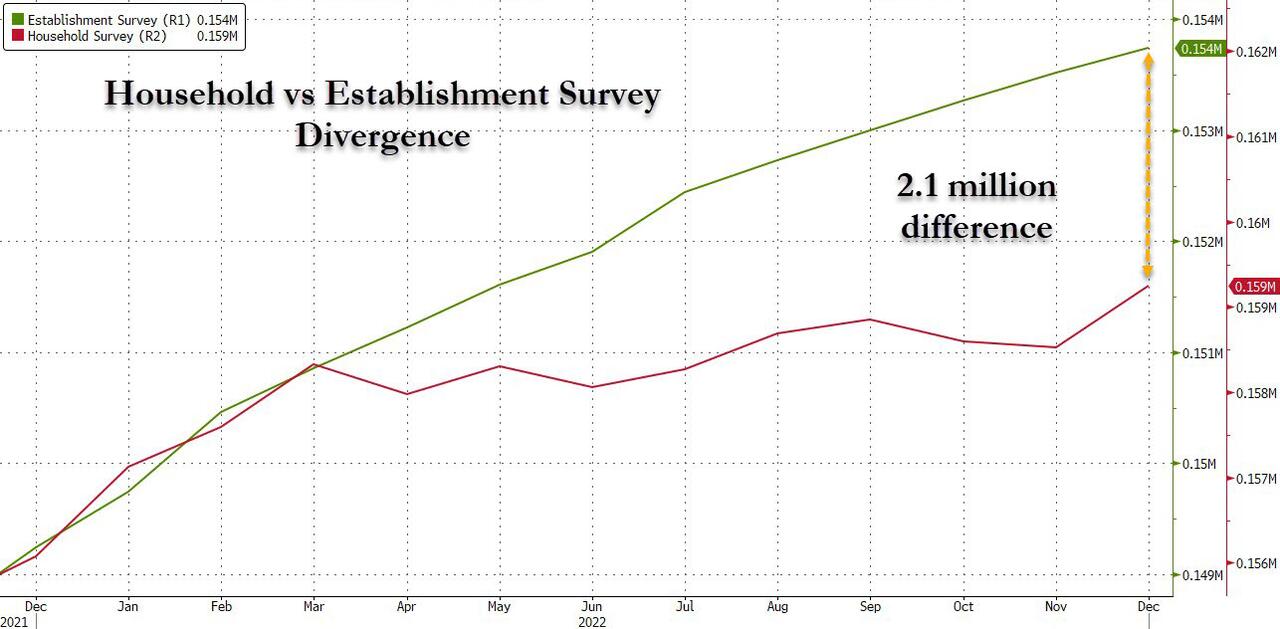
Or that according to the household survey there was virtually no new jobs created for much of 2022 even as the establishment survey indicated that over 2 million new jobs had been added over the same period.
To be sure, it didn't take long after we pointed out these glaring narrative "glitches" and discrepancies for the BLS to notice and to make the appropriate adjustments and historical revisions to the data to make it coherent. After all, bureaucrats are not very diligent and attention oriented, and manipulating bureaucrats are even worse.
Yet one place where the BLS has allowed a glaring data deficiency to persist, is in what will soon be a very politically charged and sensitive data series: where have all the new workers come from.
As noted above, if one believes the BLS, US payrolls are now a record high 155.7 million, or 161 million employed workers according to the Household survey. But if one digs a little deeper, one finds something rather peculiar: all of the jobs created since the covid crash have gone to foreign-born workers!
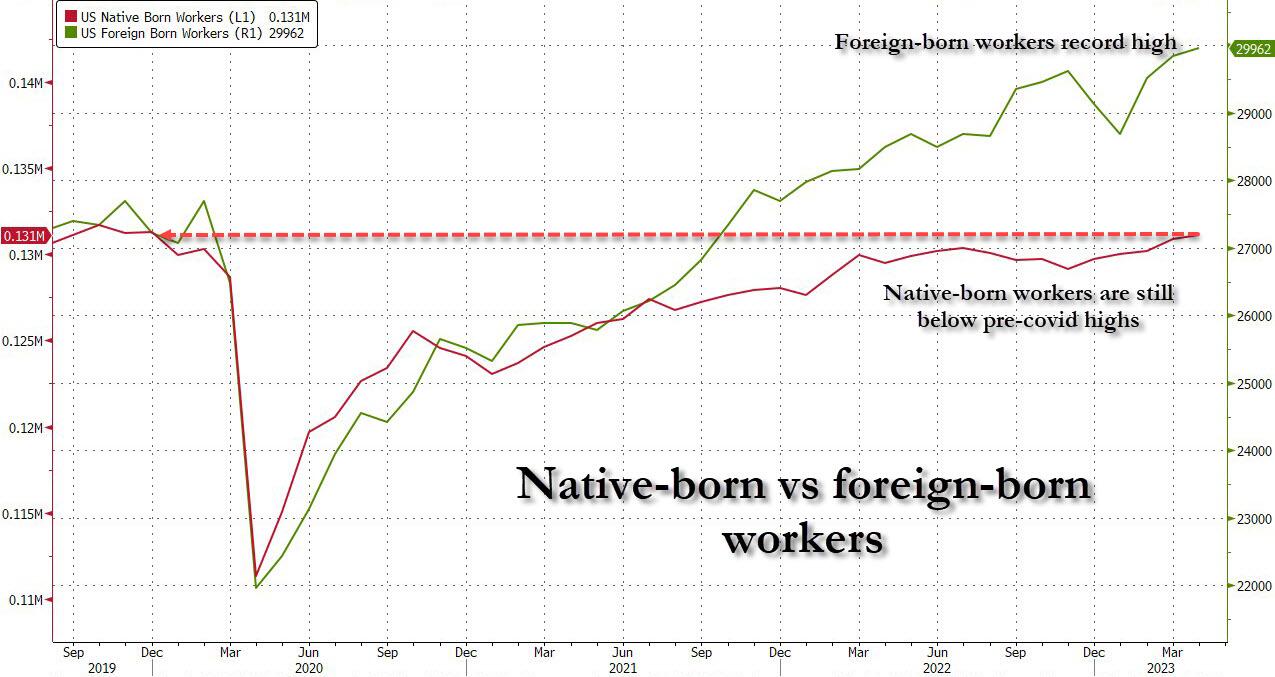
That's right: as shown in the chart below, there are currently 131.1 million native-born US workers, which is down more than half a million from the pre-covid peak of 131.7 million reached in October 2019 (data source: Federal Reserve). Meanwhile, if only looks at the number of foreign-born workers, here the data paints a very different picture: having peaked at 27.8 million in Feb 2019, the number of foreign-born workers has not only recovered its covid crash losses, but has increased by an additional 2.2 million to a record 30.0 million as of April 2023!
This means that all the new job creation since the covid crash has gone to foreign workers, with native-born workers stagnating and still unable to break above pre-covid highs, even though if one merely extends the pre-covid trendline, native-born workers should have long ago surpassed their 2019 highs. Said otherwise, millions of native jobs have quietly gone to (lower paid) foreigners.
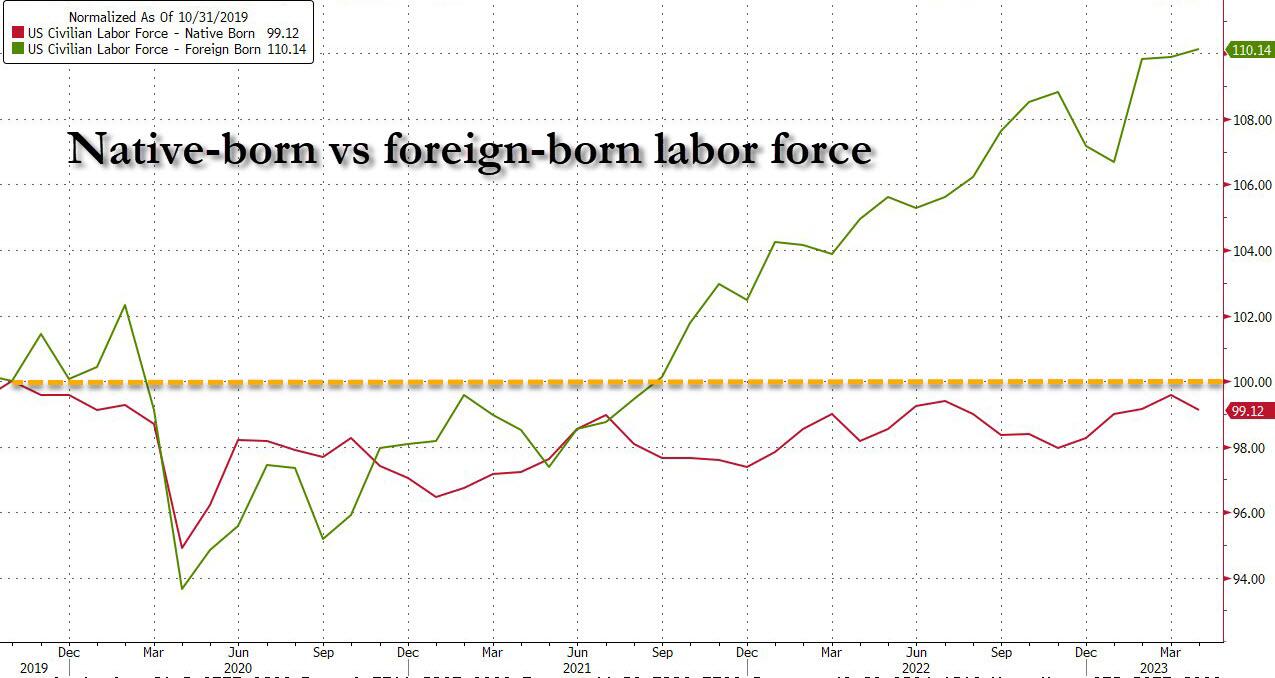
But what if the data shown above is merely a product of uneven distribution of hiring while the labor force growth has been similar. Good question, and to answer that we have looked not at the change in absolute jobs/workers but the change in labor forces, native-born and foreign-born, indexed at 100 as of Oct 2019. The result, shown below, speaks for itself.
And there you have it: both the number of native-born workers and the actual native-born labor force have stagnated, while foreign-born workers have flourished and captured market share or rather employment and wage share from native Americans.
To be sure, there is much to analyze: unfortunately the BLS does not break down the "foreign-born" data set into legally and illegally-immigrated foreign-born workers, although considering that it was virtually impossible for legal foreigners to enter the US - let along work in it - for nearly two years after the covid pandemic broke out, it is rather safe to assume that much of the foreign-born work has gone to illegal immigrants.
Which then begs the question: how does this impact inflation? We already know that wage inflation is supposedly off the charts, but if the bulk of new hiring has gone to foreign-born workers who, for the most part, represent a cheaper labor option for employers, does that mean that wage inflation would be that much higher if most new workers had been native-born? What will happen to inflation if, say, Trump or DeSantis makes it a campaign pledge to focus on hiring native-born workers?
And another question: what does this track record mean for the coming presidential mudslinging campaigns - what impact will it have on the reputation of, say, Joe Biden, when he is asked why all new jobs under his administration have gone to foreign-born workers while native-born Americans have been left to stagnate?
We hope to have the answers soon enough; for now, however, we have another jobs report to focus on in just a few hours. And if the recent track record of the BLS "accuracy and integrity" is any indication of what to expect, tomorrow's numbers should push what are already ridiculous job numbers well into the realm of peak absurdity.
OpenAI aims to reduce AI hallucinations in ChatGPT by enhancing math skills, as process supervision shows promise in improving accuracy.
On May 31, OpenAI announced its efforts to enhance ChatGPT’s mathematical problem-solving capabilities, aiming to reduce instances of artificial intelligence (AI) hallucinations. OpenAI emphasized mitigating hallucinations as a crucial step toward developing aligned AI.
In March, the introduction of the latest version of ChatGPT - ChatGPT-4 - further propelled AI into the mainstream. However, generative AI chatbots have long grappled with factual accuracy, occasionally generating false information, commonly referred to as “hallucinations.“ The efforts to reduce these AI hallucinations were announced through a post on OpenAI’s website.
AI hallucinations refer to instances where artificial intelligence systems generate factually incorrect outputs, misleading or unsupported by real-world data. These hallucinations can manifest in various forms, such as generating false information, making up nonexistent events or people, or providing inaccurate details about certain topics.
OpenAI conducted research to examine the effectiveness of two types of feedback: “outcome supervision” and “process supervision.“ Outcome supervision involves feedback based on the final result, while process supervision provides input for each step in a chain of thought. OpenAI evaluated these models using math problems, generating multiple solutions and selecting the highest-ranked solution according to each feedback model.
After thorough analysis, the research team found that process supervision yielded a superior performance as it encouraged the model to adhere to a human-approved process. In contrast, outcome supervision proved more challenging to scrutinize consistently.
OpenAI recognized that the implications of process supervision extend beyond mathematics, with further investigation necessary to understand its effects in different domains. It expressed the possibility that if the observed outcomes hold in broader contexts, process supervision could offer a favorable combination of performance and alignment compared with outcome supervision. To facilitate research, the company publicly released the complete data set of process supervision, inviting exploration and study in this area.
Although OpenAI did not provide explicit instances that prompted its investigation into hallucinations, two recent occurrences exemplified the problem in real-life scenarios.
In a recent incident, lawyer Steven Schwartz in the Mata vs. Avianca Airlines case acknowledged relying on the chatbot as a research resource. However, the information provided by ChatGPT turned out to be entirely fabricated, highlighting the issue at hand.
OpenAI’s ChatGPT is not the only example of artificial intelligence systems encountering hallucinations. During a demonstration of its chatbot technology in March, Microsoft’s Bing AI chatbot examined earnings reports and generated inaccurate figures for companies like Gap and Lululemon.