Search This Blog

Tuesday, June 17, 2025

Ever-expanding modern vaccination era may be ending

 by Alex Berenson

In the beginning was the smallpox vaccine.

In the late 1700s, an English physician named Edward Jenner realized milkmaids infected with cowpox rarely fell prey to smallpox, a devastating virus. Jenner began deliberately giving people cowpox and found they too became immune to smallpox.

Over the next two centuries, humanity beat back bacterial and viral diseases. The British epidemiologist John Snow realized cholera was spread by sewage. The German scientist Robert Koch and French physician Louis Pasteur invented germ theory. The British bacteriologist Alexander Fleming discovered penicillin. The American physician D.A. Henderson finished Jenner’s work with a global effort to eradicate smallpox.

It is vital not to understate the role vaccines played in this victory over disease, suffering, and death. But it’s vital not to overstate it, too.

The greatest gains against infectious disease came before most modern vaccines were developed. They came from simple and relatively inexpensive improvements in nutrition and public sanitation.

For example, check out American deaths from typhoid fever, a nasty bacterial illness that killed about one-third of the Civil War soldiers it infected, in the first half of the 20th century:
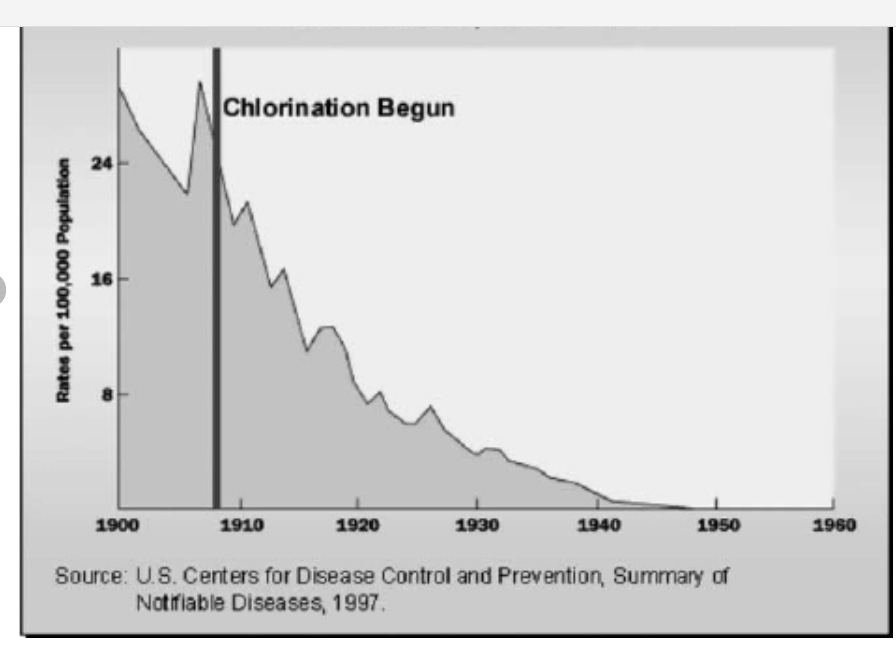
A great success for vaccination? Nope.

The typhoid vaccine is only marginally effective and not even recommended for Americans. As the chart above shows, the great innovation in defeating typhoid came when municipal water systems began adding chlorine to treatment plants. Chlorine kills typhoid, cholera, and other waterborne bacteria and viruses cheaply and effectively.

Of course, not every infectious disease is waterborne. Viruses and bacteria have evolved to use every conceivable method of transmission, from air to blood to touch to intermediate hosts like mosquitoes.

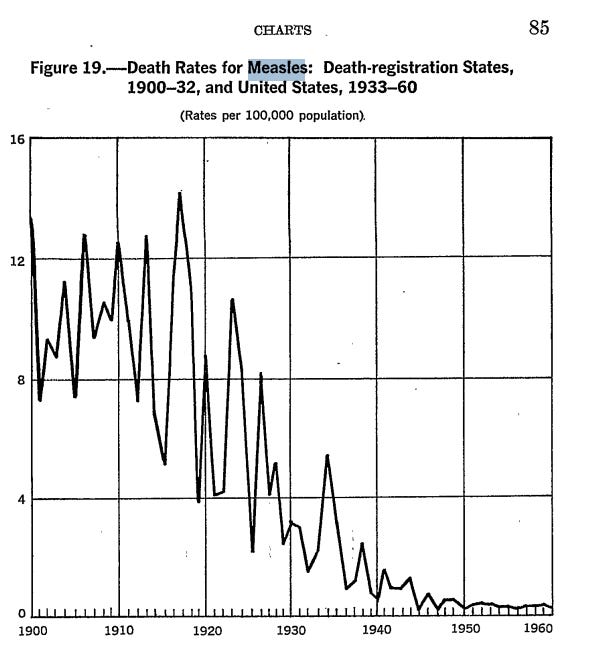
Still, whatever the mechanism of transmission, nearly all infectious diseases have followed the trend of typhoid. For example, deaths from measles in the United States plunged decades before the measles vaccine was introduced in 1963, as the Centers for Disease Control itself noted in 1968:

(Please note this chart ends BEFORE 1963. In other words, the entire mortality decrease occurred before any measles vaccine existed.)
The reason is simple.

Along with improvements in sanitation, we have had massive improvements in nutrition in the last century. People are healthier and have much better access to vitamin- and calorie-rich food. Americans in particular have such easy access to high-calorie diets that our biggest problem now is obesity. Famine essentially does not exist.

The care and treatment of sick people has progressed too, thanks to antibiotics and antivirals. The most notable advance of all on this front is the most recent. When the human immunodeficiency virus arrived around 1980, it was among the most deadly antigens humans had ever seen, killing nearly everyone it infected.

But bench scientists, physicians, and drug companies attacked it. And they won, devising a successful antiviral regimen in less than two decades. They did so with medicines, not a vaccine. HIV has proven remarkably resistant to vaccines.

In other words, even if physicians did not have a single vaccine to give patients, infectious diseases would be far less deadly in the United States and other developed countries than they were a century ago. They would be less deadly in other countries too; lower birth rates and better farming techniques mean that in all but the poorest countries, kids have become notably healthier.

None of this means vaccines are poisons.

Or that they cause autism. Or that we shouldn’t vaccinate kids against measles or other infectious diseases that pose a small though real risk to them, particularly with old-style inactivated-virus vaccines.

The mechanisms of action of those vaccines are well understood, and they have been given to billions of children worldwide for decades, with a very low risk of dangerous side effects. (I know, many of you will argue point to the rise in autism in the United States in the last 30 years as a counterexample. But much if not most of that increase is likely due to the reclassification of mental retardation and other developmental delays as autism, and much of the rest may well come from advancing parental age.)

What it does mean is that the discussion on vaccines has somehow become fetishized.

Epidemiologists, public health bureaucrats, and the media have somehow grown accustomed to promoting vaccines as miracles, our only line of defense from the epidemics of the Middle Ages. In fact, at least in developed countries, they are the fourth and least important bulwark, behind sanitation, nutrition, and medical care.

(The world without vaccines! At least according to Dr. Peter Hotez. Who has a vaccine to sell you.)
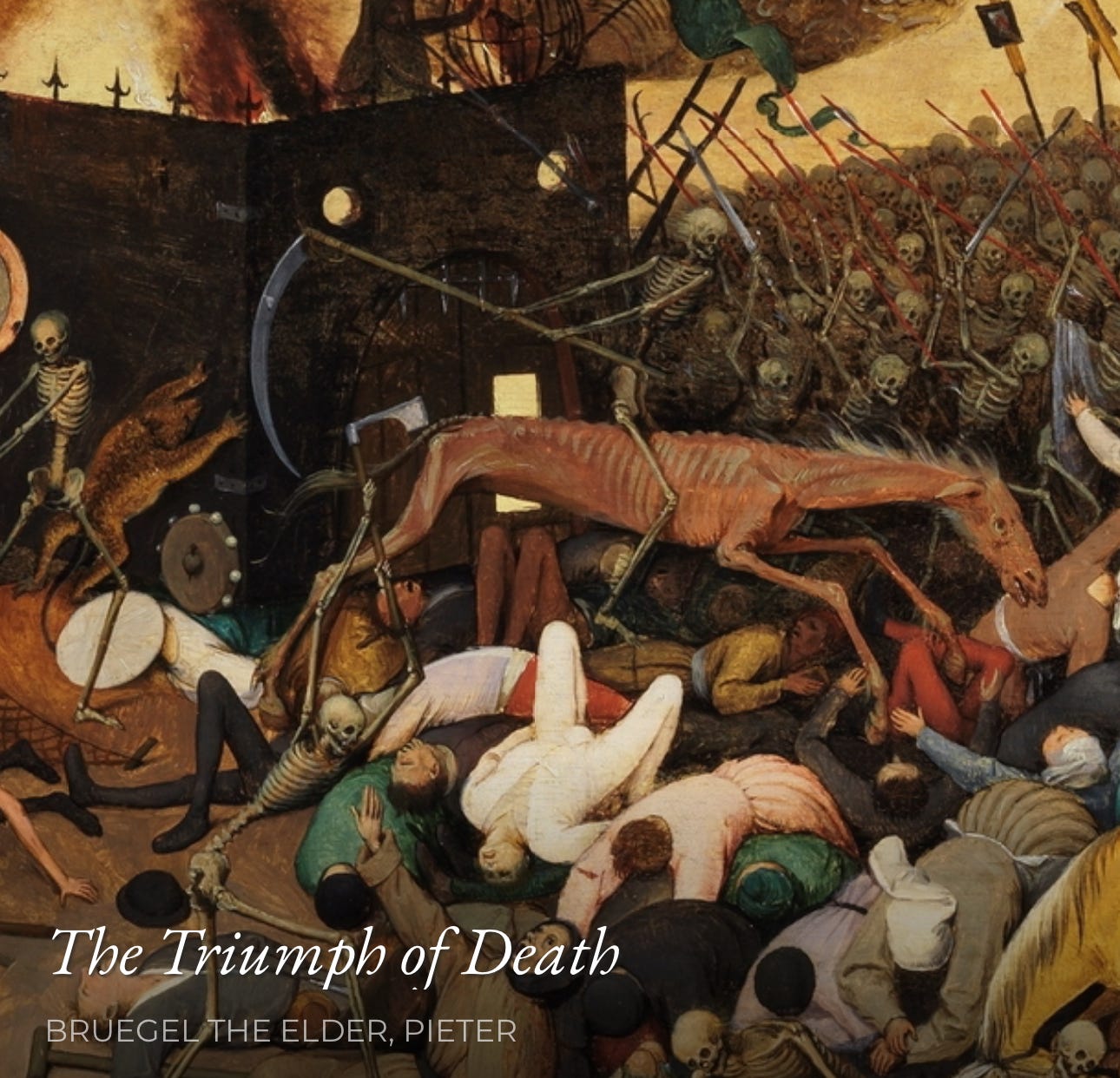
The public health love for vaccines is understandable.

On the sanitation side, the work is done, at least in the United States. And sanitation is both cheap and dirty, outside and beneath medicine. Nobody makes movies about heroic garbage workers or sewage treatment engineers.

Then there’s nutrition. But again, the gains from avoiding famine have been made, and medicine has played little role in those. Encouraging people to lose weight and take better care of themselves is important, but it will do little to save people from infectious disease (Covid’s habit of taking down the morbidly obese notwithstanding). And it’s hard.

Vaccines are easy. A simple jab or two in the arm for everyone. No need to get on a treadmill or eat vegetables. Vaccines are a way for public health bureaucrats — whether or not they have MDs — to feel like they too are heroic, life-saving front-line physicians.

And vaccines fit the left’s conception of itself, I’m from the government and I’m here to help. No accident that so many the first Covid vaccine sites were giant municipally run operations in convention halls.

Never underestimate the power of a good story: a story of cheap, effective, government-provided, readily available cures for deadly infectious diseases.

But in the last 39 years, drug companies, public health experts, and journalists have stretched the truth of that story beyond recognition. And they are angry that anyone, much less someone in a position to stand up to them, like Robert F. Kennedy Jr., is now calling out what they’ve done.

https://alexberenson.substack.com/p/the-ever-expanding-modern-vaccination

Trump administration moves to expand oil and gas leasing in Alaska reserve

 The Department of the Interior today announced a new step to support American energy independence and unleash the vast resource potential of Alaska’s National Petroleum Reserve. A draft analysis released for public comment today supports the selection of a new alternative from the 2020 plan that would reopen up to 82% of the 23-million-acre reserve to oil and gas leasing and development, consistent with the Trump administration’s commitment to Energy Dominance and regulatory reform. 

The proposal advances the Bureau of Land Management’s process to update its Integrated Activity Plan in line with the 2020 framework for managing the reserve. The draft environmental assessment reflects the latest available data and supports Executive Order 14153 and Secretary’s Order 3422, both of which prioritize maximizing Alaska’s vast resources to strengthen America’s energy and economic security. 

“This plan is about creating more jobs for Americans, reducing our dependence on foreign oil and tapping into the immense energy resources the National Petroleum Reserve was created to deliver,” said Acting Assistant Secretary for Land and Minerals Management Adam Suess. “Under President Trump’s leadership, we’re cutting red tape and restoring commonsense policies that ensure responsible development and good stewardship of our public lands.” 

Congress designated the reserve for oil and gas exploration in response to the 1970s energy crisis, recognizing its critical role in national energy strategy. The BLM manages the reserve under the Naval Petroleum Reserves Production Act, which mandates an “expeditious program of competitive leasing” while safeguarding key surface resources. 

This proposed plan also builds on the Department’s efforts to reverse burdensome regulations—such as the planned rescission of the 2024 rule that restricted leasing in the reserve—ensuring the United States can meet current and future energy needs. 

The public is invited to review and comment on the draft analysis through the BLM National NEPA Register. Comments may be submitted online via the “Participate Now” button. The comment period will remain open until July 1, 2025. 

https://www.doi.gov/pressreleases/department-interior-moves-expand-oil-and-gas-development-alaskas-national-petroleum

Top global universities for healthcare research: US News

 U.S. News & World Report published its 11th annual Best Global Universities rankings June 17, evaluating 2,250 top institutions across 105 countries based on their global and regional research reputation and academic research performance.

Two rankings, powered by data and metrics from the Web of Science Core Collection and InCites Benchmarking & Analytics provided by Clarivate, used a methodology that assessed 13 indicators of global research performance, such as global research reputation, as well as reputation indicators such as regional research reputation.

For the overall ranking, the media company said it included bibliometric indicators, such as publications, citations and international collaboration.

In addition to the overall ranking, there are 51 subject rankings, including some that are healthcare-related, each with their own weighting based on academic research performance in that area. More information about the methodology is available here.

Top 10 overall Best Global Universities 

1. Harvard University (U.S.)

2. Massachusetts Institute of Technology (U.S.)

3. Stanford University (U.S.)

4. University of Oxford (U.K.)

5. University of Cambridge (U.K.)

6. University of California Berkeley (U.S.)

7. University College London (U.K.)

8. University of Washington Seattle (U.S.)

9. Yale University (U.S.)

10. Columbia University (U.S.)

Top five global universities for cardiac and cardiovascular systems

(Based on research performance in the field)

1. Harvard University (U.S.)

2. University of Glasgow (U.K.)

3. Imperial College London (U.K.)

4. Duke University (U.S.)

5. Icahn School of Medicine at Mount Sinai (U.S.)

Top five global universities for clinical medicine

1. Harvard University (U.S.)

2. Johns Hopkins University (U.S.)

3. (tie) Stanford University (U.S.) 

3. (tie) University of California San Francisco (U.S.) 

5. University of Toronto (Canada) 

Top five global universities for endocrinology and metabolism

1. Harvard University (U.S.)

2. University of Texas Southwestern Medical Center Dallas (U.S.)

3. University of Toronto (Canada)

4. University of Copenhagen (Denmark)

5. University of Oxford (U.K.)

Top five global universities for gastroenterology and hepatology

1. University of California San Diego (U.S.)

2. Chinese University of Hong Kong (Hong Kong)

3. University of Barcelona (Spain)

4. Harvard University (U.S.)

5. Universite Paris Cite (France)

Top five global universities for immunology

1. Harvard University (U.S.)

2. Massachusetts Institute of Technology (U.S.)

3. Stanford University (U.S.)

4. Johns Hopkins University (U.S.)

5. University of Pennsylvania (U.S.)

Top five global universities for infectious diseases

1. University of Oxford (U.K.)

2. Harvard University (U.S.)

3. London School of Hygiene & Tropical Medicine (U.K.)

4. University of Hong Kong (Hong Kong)

5. Johns Hopkins University (U.S.)

Top five global universities for neuroscience and behavior

1. Harvard University (U.S.)

2. University of California San Francisco (U.S.)

3. Stanford University (U.S.)

4. Massachusetts Institute of Technology (U.S.)

5. University College London (U.K.)

Top five global universities for oncology

1. Harvard University (U.S.)

2. University of California San Francisco (U.S.)

3. Cornell University (U.S.)

4. Johns Hopkins University (U.S.)

5. University of California Los Angeles (U.S.)

Top five global universities for pharmacology and toxicology 

1. Harvard University (U.S.)

2. University College London (U.K.)

3. Fudan University (China)

4. (tie) King Saud University (Saudi Arabia)

4. (tie) Shanghai Jiao Tong University (China)

Top five global universities for psychiatry and psychology

1. Harvard University (U.S.)

2. King’s College London (U.K.)

3. University of Oxford (U.K.)

4. Stanford University (U.S.)

5. Yale University (U.S.)

Top five global universities for public, environmental and occupational health

1. Harvard University (U.S.)

2. London School of Hygiene & Tropical Medicine (U.K.)

3. University of Oxford (U.K.)

4. Johns Hopkins University (U.S.)

5. University College London (U.K.)

Top five global universities for radiology, nuclear medicine and medical imaging

1. Harvard University (U.S.)

2. Stanford University (U.S.)

3. Radboud University Nijmegen (Netherlands)

4. Ruprecht Karls University Heidelberg (Germany)

5. University College London (U.K.)

Top five global universities for social sciences and public health

1. Harvard University (U.S.)

2. University of Oxford (U.K.)

3. University College London (U.K.)

4. Johns Hopkins University (U.S.)

5. University of Toronto (Canada) 

Top five global universities for surgery

1. Harvard University (U.S.)

2. Johns Hopkins University (U.S.)

3. University of Amsterdam (Netherlands)

4. University of Toronto (Canada)

5. (tie) Erasmus University Rotterdam (Netherlands)

5. (tie) Stanford University (U.S.)

Full rankings are available here.

https://www.beckershospitalreview.com/rankings-and-ratings/top-global-universities-for-healthcare-research-us-news/