Search This Blog

Wednesday, June 18, 2025

CSL Wins First Approval for Preventive Hereditary Angioedema Drug


Andembry is the first monthly Factor XIIa inhibitor for the prevention of HAE attacks and will be available to patients “before the end of June,” CSL announced.

The FDA on Tuesday signed off on CSL’s Factor XIIa blocker garadacimab to prevent attacks in patients with hereditary angioedema. The biologic will be marketed under the brand name Andembry.

Andembry’s label, which covers patients aged 12 years and up, marks the first ever regulatory approval in the U.S. for an anti-Factor XIIa prophylactic agent for hereditary angioedema (HAE), according to Tuesday’s release. CSL will launch Andembry “immediately,” working to make the once-monthly drug available to patients “before the end of June.”

Designed to be delivered via an injection under the skin, Andembry is a monoclonal antibody that targets and blocks activated Factor XII. Through this mechanism of action, Andembry “inhibits the top of the HAE cascade by targeting factor XIIa and provides sustained protection from attacks,” CSL said on Tuesday.

Andembry’s approval was backed by data from the pivotal Phase III VANGUARD study. Data, released back in February 2023, showed that 61.5% of patients remained free from HAE attacks after receiving the Factor XIIa blocker. Compared with placebo, Andembry cut the HAE attack rate by 86.5% on average.

Additionally, interim open-label extension data published in October 2024 in the journal Allergy support Andembry’s long-term efficacy and safety. Over nearly 14 months of treatment, 93% of treated patients graded their response to the therapy as “good” or “excellent.” Treatment-related toxicities were documented in 13% of patients, most of which were injection-site reactions.

Andembry, which is the first monoclonal antibody that was discovered and developed entirely by CSL, “offers people with this life-threatening condition long-term control over their disease along with a convenient administration method,” Bill Mezzanotte, head of R&D at CSL, said in the company’s statement.

Tuesday’s approval for Andembry comes just days after the FDA had to delay its target action date for KalVista’s own HAE hopeful sebetralstat. According to the biotech, the agency had to push its decision back by approximately four weeks due to “heavy workload and limited resources.” The FDA’s original target data was June 17.

Also playing in the HAE space is Intellia Therapeutics, which on Monday revealed three-year follow-up findings from an ongoing Phase I/II study of its investigational gene editor lonvoguran ziclumeran. Data presented at the European Academy of Allergy and Clinical Immunology showed a 98% mean decrease in monthly HAE attacks in all 10 dosed patients, who remained attack-free for a median of 23 months.

https://www.biospace.com/drug-development/csl-wins-first-approval-for-preventive-hereditary-angioedema-drug

Over 1/3 of Biotechs Have Under a Year of Cash Left, EY Says


EY’s 2025 Biotech Beyond Borders report provides a sobering snapshot of the industry’s financial health, with more and more companies facing cash runways of less than one year. The analyst firm’s leaders urge a return to basics for biotech.

Some 39% of biotechs assessed in 2024 were set to run out of cash within 12 months, according to EY’s latest industry report published on Wednesday. This marks the highest level this financial health metric has reached in at least six years, up from 31% in 2022 and 2023, and just 18% in 2021.

“That number keeps creeping up,” Arda Ural, EY Americas life sciences leader, told BioSpace.

The startling statistic reflects the “really tough funding environment” facing the sector, Ashwin Singhania, EY-Parthenon partner/principal of life sciences strategy, said during an exclusive roundtable event on June 12.

Those most likely to survive the prolonged capital drought are taking a disciplined approach, Ural said. This includes rethinking investor engagement, tying funding to clearer milestones and narrowing focus to lead assets. Some companies are also exploring non-dilutive options like royalty deals and leaning more on outsourcing to extend runway, noted Rich Ramko, EY Americas life sciences sector and biotechnology leader.

A dwindling cash supply “is also forcing [companies] to consolidate, reverse merge, layoff staff, maybe consolidate their portfolio in addition to consolidating their operations, drop some of their assets . . . and just focus on the lead asset, which is your inflection-value generating asset.”

In light of their findings, EY’s leadership urged industry to return to the basics.

“Biotech leaders have to fundamentally reassess how they allocate capital, communicate with stakeholders and make tough portfolio calls early,” Ural said. “That’s how you navigate [the biotech market] volatility.”

The Looming Cash Risk and Signs of Hope

The high number of companies running out of cash underscores a sharp decline in financial resilience across the industry, according to the 2025 Biotech Beyond Borders report. Over the same period, the share of biotechs with more than five years of cash fell from 24% in 2021 to 18% in 2024.

Despite the alarming cash crunch, the report shows that not all biotech companies are in crisis. The 2025 outlook presents a “mixed bag,” Singhania said.

On the positive side, biotech saw modest top-line growth in 2024, with industry net revenues up nearly 7% compared to 2023, while R&D expenditures increased by almost 12%, signaling continued faith in the long-term promise of scientific innovation, Singhania said. Early-stage venture capital (VC) was another bright spot last year, with $15 billion deployed in 2024—an increase from $12 billion in 2023.

But these gains were not widely distributed across industry. The number of early-stage VC deals dropped 20% year over year, reflecting a trend of larger checks going to fewer firms.

It’s “a tale of the haves and have-nots,” Ramko said.

Across the broader landscape, signs of strain are mounting. The biotech workforce contracted by about 5% in 2024 as companies cut costs and narrowed their focus. 2024 total financing— venture, IPOs, follow-ons and debt—dropped nearly 10% from 2023, down to $73 billion, Singhania said. In Q1 2025, just $17 billion was invested, continuing the downward trend.

With macroeconomic and policy headwinds like President Donald Trump’s drug pricing initiative, the threat of new tariffs and looming patent cliffs still clouding the investment outlook, EY leaders warned that the capital gap is likely to widen.

“There’s no playbook for what’s happening right now,” Ural said. “What got us here won’t get us [to recovery].”

Back to Biotech Fundamentals

Earlier this year, biotech’s funding freefall was likened to a “nauseating roller coaster” that continues to repel even the most risk-tolerant investors. The ups and downs have left many stuck between underperformance and undercapitalization, with few clear paths forward.

Ural, Ramko and Singhania urged the biotech industry to return to fundamentals. Pre-revenue companies should tightly manage resources, cut costs as needed and demonstrate they can reach—and surpass—their next value milestone, they said. Portfolio optimization will be key through the rest of 2025, while revenue-generating biotechs must focus on scenario planning around workforce shifts, manufacturing efficiency and tax-smart supply chains, they added.

During the roundtable, the EY leaders also detailed how biotech companies are recalibrating their approach to fundraising and investor relations in this unforgiving capital environment.

Financing rounds are increasingly tied to strict milestones, Ramko said, with “investors holding management teams’ feet to the fire.” Traunched deals—intended to reduce investors’ risk—along with smaller upfronts and tighter collaboration terms, are becoming the norm. “It’s no longer just about hitting the next inflection point; it’s about having enough cash to get beyond it,” Ramko continued.

Investor expectations are also changing. Ramko noted that in platform companies, funders are zeroing in on the lead asset, often disregarding secondary programs entirely. That dynamic is prompting companies to sharpen operational focus and discipline, Ramko told BioSpace.

In this high-pressure environment, Ural and Ramko found that biotech executives are increasingly turning to outsourcing and managed services. By farming out back-office operations and other non-core functions, companies can reduce overhead and maintain lean teams, while concentrating resources on value-driving R&D efforts, Ramko said.

Amid such strategic shifts and continued volatility in the near term, EY’s leaders caution that crystal-ball forecasts will be difficult. “This year is probably one of the toughest to predict,” Ural said.

https://www.biospace.com/business/more-than-one-third-of-biotechs-have-under-a-year-of-cash-left-ey-finds

Senate Passes 'GENIUS' Stablecoin Bill In Bipartisan Vote

 by Turner Wright via CoinTelegraph.com,

The Guiding and Establishing National Innovation for US Stablecoins, or GENIUS Act, is one step closer to becoming law in the US after the US Senate voted to pass an amended version of the bill.

In a Tuesday vote of 68-30, a majority of the US Senate chose to pass the GENIUS Act roughly six weeks after Tennessee Senator Bill Hagerty introduced the legislation. The bill’s companion, the STABLE Act, may be considered in the House of Representatives next, where it could face additional proposals for amendments.

“With this bill, the United States is one step closer to becoming the global leader in crypto,” said Hagerty from the Senate floor before the Tuesday vote, adding: “Once the GENIUS Act is law, businesses of all sizes, and Americans across the country will be able to settle payments nearly instantaneously rather than waiting for days or sometimes even weeks.”

Source: US Senate

The GENIUS Act initially failed a cloture vote in the Senate in May in response to Democratic opposition to US President Donald Trump’s connections to the cryptocurrency industry. The Trump family has a significant stake in World Liberty Financial, which issued its own USD1 stablecoin in March. 

It’s unclear whether the stablecoin legislation will have enough support to pass in the House, where Republicans also hold a slim majority over Democrats. Trump’s AI and crypto czar, David Sacks, suggested in May that the president would support the bill passed by a Republican-controlled Congress.

Should payment stablecoins be recognized in a US regulatory framework, it could potentially open the floodgates for companies to issue their own tokens. Apple, Google, social media platform X and Airbnb were reportedly looking into the matter amid debate on the GENIUS Act, and two US senators questioned whether Meta might have the same plans if the bill were to pass.

“Recent reporting projects that stablecoins could grow into a $3.7 trillion market by the end of the decade,” said Treasury Secretary Scott Bessent in a Tuesday X post. “That scenario becomes more likely with passage of the GENIUS Act.”

Prior to the vote, Sen. Lummis (R-Wy.) told The Epoch Times that she was “excited about the momentum” regarding Washington’s acceptance of cryptocurrency.

“We just couldn’t in four years, we could get no momentum right here. And finally, we’ve got it. I don’t want to lose it,” Lummis said.

Market structure under consideration in the House

With stablecoin legislation moving closer to Trump’s desk, lawmakers in the House are still waiting for a vote on the CLARITY Act to establish clear market structure rules for digital assets.

Versions of the bill passed through the House Agriculture Committee and House Financial Services Committee last week and are expected to be taken up for a floor vote soon, but face similar pushback from some Democrats on the president’s crypto ties.

“In advancing these bills, lawmakers forfeited their opportunity to confront Trump’s crypto grift — the largest, most flagrant corruption in presidential history,” said Bartlett Naylor, financial policy advocate for consumer advocacy organization Public Citizen, in a statement shared with Cointelegraph on the GENIUS and CLARITY legislation. “These bills serve to legitimize what amounts to a massive scam with the American flag.”

House Financial Services Committee Chairman French Hill (R-Ark.) championed the bill, vowing to work with his lower chamber colleagues “to bring much-needed clarity and protections to the digital asset ecosystem.”

“Clear rules of the road for stablecoins are long overdue, and today we’re one step closer to creating a functional regulatory framework,” Hill said in a statement emailed to The Epoch Times. “I applaud the Senate’s passage of the GENIUS Act and the work of Chairman Scott, Senator Hagerty, and Senator [Cynthia] Lummis to make this historic day a reality.”

Lawmakers, including Sen. Bill Hagerty (R-Tenn.), say the framework will ensure the United States does not fall behind in global competitiveness and protect the dollar hegemony.

“A recent report forecasts that with a well-crafted U.S. regulatory framework, stablecoin issuers could become one of the top holders of U.S. Treasuries by the end of this decade—if not sooner,” Hagerty said on the Senate floor on June 11. “This would strengthen our fiscal position and cement the dollar’s status as the world’s reserve currency.”

Proponents say the Genius Act will make them more ubiquitous - Tether (USDT) and Circle’s USDC dominate the $228 billion market - as it could foster more stablecoins and consumer adoption.

https://www.zerohedge.com/crypto/senate-passes-genius-stablecoin-bill-bipartisan-vote

Biden Judge Blocks Trump's 2 Genders On US Passports, But SCOTUS Says 'No' On Trans Tx For Minors

 Autopen-appointed judge Julia Kobick... 

...issued a ruling Tuesday that temporarily blocks the Trump administration from allowing only two genders, male and female, that align with biological sex, on US passports.

Kobick, a US District Court judge for the District of Massachusetts, expanded a preliminary injunction on Tuesday after she ruled in favor of six plaintiffs who identified as transgender or nonbinary in April.

The plaintiffs were challenging a Trump administration rule change that restricted passport sex to align with birth sex, overturning a State Department policy that allowed people to choose the sex displayed on their passport, including an “X” option for individuals who identify as intersex and non-binary. 

Kobick stated in her ruling that the suit against the Trump administration is likely to succeed because in her opinion, it discriminates on the basis of sex, and is "rooted in irrational prejudice toward transgender Americans."

She wrote that "transgender and non-binary people who possess passports bearing sex markers that conflict with their gender identity and expression are… significantly more likely to experience psychological distress, suicidality, harassment, discrimination, and violence." 

In her April ruling, only the six plaintiffs were allowed to receive passports aligning with their gender identity. Tuesday’s ruling expands that order to grant class certification, pausing enforcement of the rule change nationwide, according to the Epoch Times - which notes further: 

The Trump administration is likely to appeal the decision. In the interim, Kobick’s order prevents the State Department from enforcing the administration’s revised rules.

The U.S. has permitted individuals who identify as transgender and intersex to choose a different sex for their passport than their birth sex since 1992, pending submission of medical documentation, until the rules were changed in 2021 under President Joe Biden. The Biden administration allowed people to self-select their passport sex marker based on gender identity, while non-binary, intersex, and other individuals were allowed to select an “X” marker rather than “M” or “F.”

Executive Order 14168, signed by Trump, set guidelines for his administration’s broad policy toward sex and gender issues: “It is the policy of the United States to recognize two sexes, male and female,” which “are not changeable and are grounded in fundamental and incontrovertible reality.”

Following the executive order, the State Department changed the rules governing passports. Passport sex was restricted by the rule change to align solely with sex assigned at birth, while it removed the “X” passport option entirely.

Leave Those Kids Alone

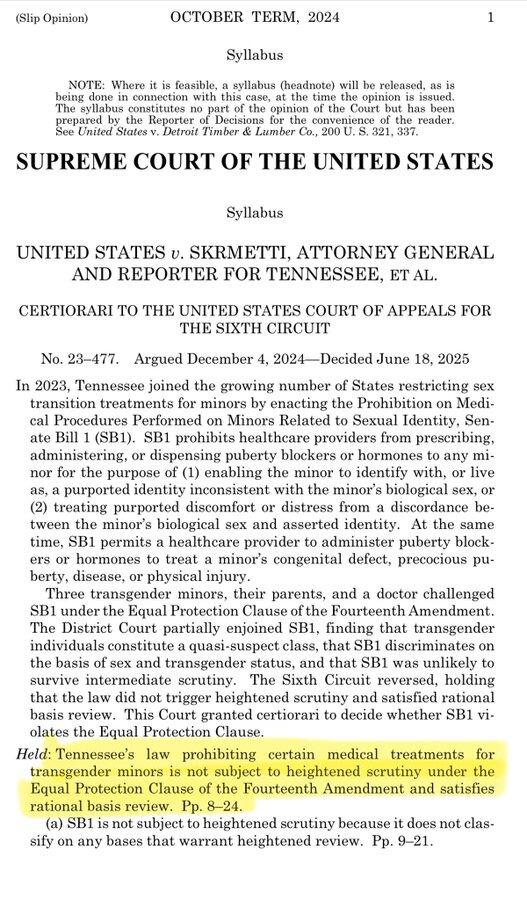
Meanwhile, the US Supreme Court ruled in a 6-3 decision to uphold Tennessee's ban on gender-affirming care for transgender minors, finding that the law doesn't violate the 14th Amendment. 

Screenshot via @adorientem

 The Associated Press characterized the ruling as a "stunning setback to transgender rights." (lol) 

Another 26 states have laws similar to the one in Tennessee. 

In April, the Trump administration sued the state of Maine for refusing to comply with the government's push to ban trans athletes in girls sports. Trump has also sought to block federal spending on gender-affirming care for those under the age of 19 - and instead has advised talk therapy to treat young trannies. 

Meanwhile, the Supreme Court has also allowed Trump to kick trans service members out of the military while legal battles play out in lower courts. 

https://www.zerohedge.com/political/court-expands-block-trump-admin-biological-sex-only-passport-rule

Ayatollah Tells Trump "We Will Never Surrender" In Televised Speech To Nation

 In a rare and important nationally televised wartime speech by Iran's Supreme Leader Ayatollah Ali Khamenei, he warned against American military intervention on behalf of Israel. 

He set out three clear messages: first that Israel's aggression happened when Tehran was engaged in indirect nuclear talks with the US and that there was no sign whatsoever that harsh military action was coming. This is confirmation he and the Islamic Republic were caught completely off-guard.

Axios had claimed that Washington knew about it, and that the talks were a smokescreen to allow Israel the element of total surprise when its warplanes began hitting Iranian nuclear sites.

Second, he asserted that the Americans should know that Iran is not going to surrender and that US entry into the war would bring irreversible destruction. 

A third main point Khamenei maid in the speech, even as bombs are still falling on Tehran and elsewhere, is that the American military's entry into the conflict would be clear sign of weakness for Israel.

"The US President threatens us. With his absurd rhetoric, he demands that the Iranian people surrender to him. They should make threats against those who are afraid of being threatened. The Iranian nation isn’t frightened by such threats," the Ayatollah said according to state translation.

"It isn’t wise to tell the Iranian nation to surrender. What should the Iranian nation surrender to? We will never surrender in response to the attacks of anyone. This is the logic of the Iranian nation. This is the spirit of the Iranian nation."

He continued: "The US entering in this matter [war] is 100% to its own detriment. The damage it will suffer will be far greater than any harm that Iran may encounter." And more:

The harm the US will suffer will definitely be irreparable if they enter this conflict militarily.

The Zionist regime’s malicious attack on our country took place at a time when Iranian officials were indirectly engaged in negotiations with the US side. There was no indication on the part of Iran that signaled a military move.

Speaking on the question of potential direct US involvement already, Khamenei said, "It was already suspected that the US was involved in the malicious move carried out by the Zionist regime, but considering their recent remarks, this suspicion is growing stronger day by day."

Is the US military involved already? One hawkish US Senator from Texas suggests so...

Meanwhile, 

  • Israel says it has struck 40 sites in Iran today, including centrifuge production and weapons facilities, while Iran launched a swarm of drones at Israel. --AJ
  • Both Trump and Israeli Prime Minister Benjamin Netanyahu have raised the idea of assassinating Iran’s supreme leader, Ayatollah Ali Khamenei, with Trump saying yesterday that he was “an easy target.” --NBC

However, he's probably deep in an underground bunker at a secret location which is known only to his closest military aides at this point. Likely lran had long prepared such a location from which he could direct a massive war with Israel.

Currently, there are reports pointing to possible rapid depletion of Israel's Iron Dome defense system, and that many more ballistic and hypersonic missiles are getting through than expected. This reality could force either a direct American response or else a stalemated situation where Israel is at risk of failing in its key objectives. 

https://www.zerohedge.com/geopolitical/ayatollah-tells-trump-we-will-never-surrender-televised-speech-nation

X Ticker Now Available As Nippon Steel Completes $14BN US Steel Deal

 And just like that, the X ticker is available for Elon Musk to purchase and take his social media company public. 

Nippon Steel completed its $14.1 billion acquisition of iconic American peer, US Steel, bringing to a close protracted negotiations which lasted for 18 months amid US political wrangling.

As the Nikkei reported, the Japanese company will acquire 100% of U.S. Steel's ordinary shares, while handing a "golden share" to the U.S. government under a National Security Agreement both companies signed with Washington. 

"Nippon Steel is excited about opening a new chapter of U. S. Steel’s storied history. Building on our investment, the transfer of our advanced technologies, and the unwavering efforts of management and the employees of both companies, Eiji Hashimoto, Nippon Steel’s CEO said in a press release, announcing the completion of the deal late Wednesday night local time.

The deal consolidates Nippon Steel's position as the world's fourth largest steel maker, and comes just a matter of days after U.S. president Donald Trump cancelled the decision by former President Joe Biden to block the Japanese company's acquisition of its American peer.

A golden share typically hands the holder a right to veto certain changes to the company. The golden share in U.S. Steel "prevents" actions like relocating the American company's headquarters from Pittsburgh, changing the name of the company, and closing plants "before certain timeframes" according to the U.S. commerce secretary Howard Lutnick.

The NSA agreement signed by the two companies also stipulates approximately $11 billion in new investments by 2028, including in a greenfield project, and commitments related to production in the U.S. and "trade matters," according to both companies.

Nippon Steel first announced the acquisition back in December 2023 but it quickly became mired in steelworker union opposition and U.S. election-year politics. President Joe Biden issued an order in January this year blocking the purchase, prompting Nippon Steel to respond with a lawsuit against the former leader.

The Japanese company sees the deal as a top priority for its medium- to long-term growth. Steel demand is expected to grow in the U.S. due to factors like the growth of electric vehicles and infrastructure renewal. That contrasts with Japan, where demand is expected to fall due to a shrinking population.

Trump's 50% tariff on all steel imports, an increase from the previous 25%, has made exporting to the U.S. harder, making the acquisition even more pertinent.

The deal will see Nippon Steel's crude production rise to 57.82 million tons from 43.64 million tons, taking the Japanese company closer to the third largest producer, Ansteel Group of China, which produced 59.55 million tons in 2024. However, analysts have raised concerns over the financial burden of the takeover, as well as the promised additional investments.

"We expect an increase in investment costs in the near term owing to funding for the U.S. Steel acquisition, additional investments post-acquisition, and investments in electric furnaces in Japan," said Yuji Matsumoto, analyst at Nomura, in a recent note. "We still think the stock looks undervalued but will lower our target price to reflect the aforementioned financial burden and weak demand in Japan," he added.

Aside from the investment costs, analysts at Jefferies raised concerns over the Japanese company's post-merger integration. "We think that Nippon Steel has a limited track record operating a business of this scope," it said in a note.

Its "success stories" of overseas ventures in the U.S. state of Alabama and in India have "been done with the help of ArcelorMittal," but its "unassisted acquisition of G/GJ Steel in Thailand almost immediately went loss-making after the deal closed," the analysts said.

https://www.zerohedge.com/markets/x-ticker-now-available-nippon-steel-completes-14bn-us-steel-deal

WTI Tumbles On Trump Iran Comments, Despite Massive Crude Inventory Draw

 Crude prices are down modestly this morning despite ongoing attacks between Iran and Israel and API reporting a major crude draw overnight as President Trump said Iran has reached out and wants to negotiate.

When asked about possible Iran strikes, Trump said: “I may do it. I may not do it. Nobody knows what I’m going to do.”

Meantime, Trump also said he told Israel Prime Minister Benjamin Netanyahu to “keep going.”

So geopolitical risk premia are far from over.

Additionally, Russian flows rose only very marginally in the last four weeks, limiting downward price pressures.

API

  • Crude -10.133mm  (-600k exp)

  • Cushing -800k

  • Gasoline -202k

  • Distillates +318k

DOE

  • Crude -11.47mm (-600k exp, -2.8mm Whisper) - biggest build since June 2024

  • Cushing -995k

  • Gasoline +209k

  • Distillates +514k

The offoicial data confirmed API's with a huge crude drawdown (the biggest since June 2024). We also saw a third straight week of product builds...

Source: Bloomberg

Despite the plungng rig count, US crude production remains near record highs (for now)...

Source: Bloomberg

WTI tumbled ahead of the official data on Trump's comments on Iran seeking peace.. bounced very briefly on the huge crude draw...

Source: Bloomberg

...but the main driver for prices right now continues to be the potential for Israel-Iran war escalations. 

https://www.zerohedge.com/energy/wti-tumbles-trump-iran-comments-despite-massive-crude-inventory-draw