I have rarely seen so much disinformation in so few words, only 1,220. I reproduce the article in its entirety, in italics, with my comments.
I do not consider Stat News a reliable news source. It has corporate ties, and despite its name, it has nothing to do with statistics, which I thought for ten years till I looked it up. Stat is short for Statim, which means immediate in Latin.
The two professors have forgotten that professors have an obligation towards society to be honest conveyors of science. Their article is propaganda of the worst kind, which is apparent already in its title and subtitle:
RFK Jr.’s war on antidepressants is coming – and it will cost lives. Kennedy’s rhetoric is not only based on bad science, it fuels distrust in mental health treatments.
It is primitive and a no-go for scientists to raise their voice by using war rhetoric but they continue with this in the first sentence of the article:
While his war on vaccines may be getting more attention, health secretary Robert F. Kennedy Jr. is coming for another important medical tool: antidepressants. In November, he posted on X that the CDC is “finally confronting the long-taboo question of whether SSRIs and other psychoactive drugs contribute to mass violence.” We fear that in 2026, he may turn his rhetoric into action.
Kennedy has not started a war on vaccines.2-6 As health secretary, he has taken rational, much needed, and evidence-based initiatives. He fired the Advisory Committee on Immunization Practices (ACIP) at the Centers for Disease Control and Prevention (CDC) because it rubber-stamped all proposals that came to them and because some members had conflicts of interest in relation to vaccine manufacturers and other drug companies; dropped the much too broad recommendations for the Covid vaccine; cut funding for mRNA vaccines; stopped recommending the hepatitis B vaccine for all newborns; and reduced the huge childhood vaccine schedule that made the US an outlier compared to Europe.
Moreover, it is well documented that SSRIs and other psychoactive drugs can cause violence.7-11 For antidepressants, the violence is dose-related,11 and it is highly relevant to study their role in mass shootings. Unfortunately, the authorities routinely refuse to release information about what drugs the mass murderers were on. It has become taboo to mention that psychiatric drugs kill people, indeed to such an extent that they are the third leading cause of death, after heart disease and cancer (much because elderly people may lose balance, break their hip, and die).12
Kennedy has in particular made skepticism toward antidepressants for adolescents a centerpiece of his public health agenda, even claiming that antidepressants may be harder to quit than heroin — a stance that ignores decades of evidence about their safety and efficacy. Even worse, he is either oblivious to or ignoring strong evidence that vilifying medications in current antidepressant warnings strongly reduces access to all essential mental health care for youth.
Kennedy is correct that it is harder to quit antidepressants than heroin. The abstinence symptoms after stopping are short-lived for heroin but not for antidepressants,13,14 and psychiatrists who have worked with both types of patients consistently say that heroin is the easier one. It can be so hard to quit antidepressants that many patients never succeed14,15 and are therefore doomed to lifelong treatment. This is an important reason why many patients take these drugs for many years.16
This is FDA’s black box warning:
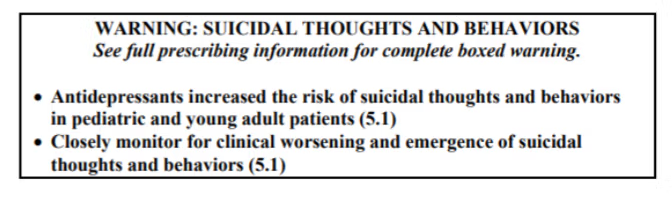
It is ridiculous, dangerous, and irresponsible to argue that the FDA’s warning vilifies the drugs and “strongly reduces access to all essential mental health care for youth.” Children who are depressed are put on antidepressants, which double their risk of suicide.17,18
It is not surprising that the introduction of suicide prevention programmes always increases suicides because they always recommend antidepressants.19 It can therefore only be good for children if the authorities and Kennedy warn against these lethal drugs, so that fewer children come on them.
Kennedy has not only loudly and repeatedly questioned the value of antidepressants for adolescents, but he has also speciously linked them to violent behavior — specifically to a mass shooting — with, again, absolutely no evidence. In a September Washington Post op-ed he decried mental health screening for children, therapy, and, of course, “overprescription of pharmaceuticals for child mental health.”
Soumerai and Lu’s absurdities escalate. It is praiseworthy that Kennedy questions the value of antidepressants for adolescents. These drugs do not have any meaningful effects on depression, neither for kids, nor for adults.8,10 Psychiatrists have documented that the effect is considerably smaller than the least clinically relevant effect. In flawed, industry-sponsored placebo-controlled trials, the difference between drug and placebo was only 2 on the Hamilton Scale,20 and the smallest effect that can be perceived on this scale is 5-6.21 This means that the drugs don’t work.
Kennedy’s criticism of mental health screening for children is also appropriate. It leads to huge overprescription of drugs. The screening test for depression recommended by the WHO is so poor that for every 100 healthy people screened, 36 will get a false diagnosis of depression.22 The criteria for the depression diagnosis are so wide that most of us could get that diagnosis from time to time even when our only problem was a little temporary sadness.8
It is the same with ADHD, which has become a fashion diagnosis. I have lectured a lot for various audiences, both professionals and lay people, and I often ask them to try the recommended test for adult ADHD.8,23 It never fails. Between one-third and one-half test positive. When I lectured for 27 therapists in 2022, 21 tested positive and 10 had a full house, which is six out of six criteria (only four positive replies to the questionnaire are needed for the diagnosis). I told them they were a great audience because some of the most interesting people I have ever met qualify for the ADHD diagnosis, including my wife who also scored a full house. They are dynamic and creative and have difficulty sitting still on their chairs pretending they are listening if the lecturer is dull.
The media as well as healthcare professionals conveniently ignore the science that tells us that amphetamine and amphetamine-related drugs for ADHD don’t solve any problems and are harmful in the long run; are effective growth inhibitors; and increase the risk of violence.7,8 The investigators behind the largest trial ever performed, the MTA trial, and the US National Institute of Mental Health lied about the negative long-term results to circumvent the little problem that methylphenidate doesn’t work.24
Kennedy’s willfully uninformed rhetoric on antidepressants is going to cost lives. The similarity to his anti-vaccine chatter is clear: When you bad-mouth effective, lifesaving vaccines, you end up driving people away from lifesaving medical care.
It has never been shown that antidepressants can save lives but it has been documented that they take very many lives.8,12,17-19 What Kennedy tries to do is to keep people away from lethal healthcare.
Kennedy’s antidepressant rhetoric is not only based on bad science, it fuels distrust in mental health treatments at a time when adolescent depression, anxiety, and suicide rates are at record highs. If Kennedy’s views shape Food and Drug Administration policy — for example, through new or expanded black box warnings — millions of vulnerable patients, including pregnant people and teenagers, could lose access to essential drug treatment and mental health care, even if their availability technically remains the same.
It is agonising to see such blatant disinformation and ad hominem arguments. The truth is the exact opposite of what Soumerai and Lu say. Kennedy’s concerns have nothing to do with rhetoric but are based on good science, and it is more relevant than ever to distrust “mental health treatments” by which Soumerai and Lu clearly mean psychiatric drugs.
Soumerai and Lu fail to realise, even though it is common knowledge, that the reasons why “adolescent depression, anxiety, and suicide rates are at record highs” are that the bar for making psychiatric diagnoses are now so low that many normal people could get a diagnosis, and suicides increase because the routine is to treat most problems with antidepressants.
Why worry if “pregnant people and teenagers” would lose access to “essential drug treatment?” There are no essential psychiatric drugs for these groups – none.
It is suspected that SSRIs can cause foetal abnormalities, and it has been documented that the drugs are harmful for both the mother and the newborn.25,26 Serotonin is everywhere in the body and plays a pivotal role during foetal development. If we use the precautionary principle in drug regulation, which we should always do but that is not how drug regulators think, then we should warn against using depression drugs during pregnancy, just like we warn against drinking alcohol.
How do we know? We have seen before how fear-driven messaging about antidepressants can cause catastrophic harm. In our Health Affairs systematic review, we analyzed the totality of rigorous evidence on the FDA’s existing black box warnings for youth antidepressants. We found that well-intended but mismanaged warnings to doctors, patients, and parents about possible negative impacts have cost several thousand lives.
This is disinformation in the extreme. Moreover, ironically, fear-driven messaging is exactly what Soumerai and Lu excel at in their article and their falsehoods can cause “catastrophic harm.”
They claim they have analysed everything and found that the FDA’s warnings for youth have cost several thousand lives. How can warnings that drugs might kill you through suicide, which is what the randomised trials tell us, lead to thousands of suicides? This is not possible. They published a study in the BMJ in 2014,27 which illustrates the kind of science these two people do. I described their study in my first psychiatry book:8
“Silverbacks all over the world claim that antidepressants protect against suicide (97-99), and some of them struggle hard to convince the FDA to remove its black box warning against suicide in young people. The junk science they refer to seems endless.
The most recent study was published in the BMJ in 2014 (138), but as all the previous ones, it was so flawed that nothing could be inferred from it (139). The US researchers didn’t even study their primary endpoint, suicide attempts on SSRIs, but used a poor surrogate, poisoning with all psychotropic substances. People on SSRIs who attempt suicide don’t usually poison themselves (and cannot really do so with SSRIs); they tend to use violent methods like hanging (49,140).
The researchers also ignored the fact that any dose change with SSRIs increases the risk of suicide. Thus, the risk of suicide increases if people suddenly stop taking SSRIs because of the warning, but this would be due to withdrawal symptoms and not a sign that SSRIs protect against suicide.
The researchers’ assertion that the FDA’s warning had been harmful was completely refuted by other researchers with real data on suicide attempts from five different databases, also from the United States (141).”
There were 26 rapid responses in the BMJ that tore Soumerai and Lu’s garbage-in garbage-out study into pieces and the coup de grace was delivered by three researchers from Harvard – those who had used data from five different databases.28
In 2003 and 2004 the Food and Drug Administration issued several health advisories warning that children and adolescents taking antidepressants were at increased risk of suicidal ideation and behavior. In October 2004 the FDA required a boxed warning of this risk to be on the labels of all antidepressant drugs. Then, in May 2007 the FDA extended the warnings to include young adults.
The basis for those warnings was even at the time contentious. An FDA-solicited meta-analysis suggested a tiny risk for suicidal thoughts for young people starting treatment with antidepressants. However, the trials included in the meta-analysis were never designed to measure the risk of suicidality. And the studies never measured completed suicides.
There is none so blind as she or he who will not see. Although the companies committed massive fraud, which I and others have documented,8,10 the FDA nonetheless found that the drugs double the risk of suicidal events in children and adolescents (P= 0.00005).29
The fraud was very grave. The companies omitted suicides, suicide attempts, and suicidal thoughts on active drug in their placebo-controlled trials, added them to the placebo arm, although they didn’t belong there, or called them something else, e.g. emotional lability.8,10,30
The FDA was complicit in the fraud. In trials of some drugs, there were more suicides (all ages) than in the whole FDA analysis of all the drugs.8 Thomas Laughren, who was responsible for the FDA’s official 2006 meta-analysis, published a paper five years earlier using FDA data where he reported 10 times8 as many suicides per 10,000 patients randomised to depression pills31 than in his 2006 analysis.32 It is amazing that it can be so subjective if people died or not.
The event rate was shockingly high: 2 out of 100 young people experienced suicidality during a few weeks of treatment.32,33 This is what Soumerai and Lu call “a tiny risk!”
Many children who didn’t suffer from any psychiatric disorder have killed themselves because of the unbearable harms of the drugs, which they didn’t recognise, as they thought they had gone mad.8
My research group confirmed how dangerous these drugs are for everyone. We did a meta-analysis of placebo-controlled trials in healthy adult volunteers using precursor events defined by the FDA. We found that SSRIs and SNRIs double the risk of harms related to suicidality and violence, and the number needed to treat to harm one healthy person was only 16 (95% confidence interval 8 to 100).34
As fluoxetine was the first SSRI approved for use in children, psychiatrist David Healy and I did a detailed study of the two placebo-controlled trials in depression that led to the approval. We used the detailed clinical study reports (3.357 pages).10 This was shocking reading. In the first small trial, of 48 vs 48 children, the investigators had omitted two suicide attempts on fluoxetine in their published paper, and 19 versus 6 experienced restlessness (P = 0.005), 9 versus 1 had nightmares (P = 0.02), and 7 versus 4 felt tense inside. These are massive harms because restlessness, including feeling tense inside, and nightmares increase the risk of suicide and violence.
In the other trial, of 109 vs 110 children, one child was severely harmed for every 10 children treated with fluoxetine. Fluoxetine increased the QTc interval on the ECG (P = 0.02), which increases the risk of sudden death, increased serum cholesterol, and was an effective growth inhibitor, reducing the increases in height and weight over 19 weeks by 1.0 cm and 1.1 kg, respectively (P = 0.008 for both).
We also found that fluoxetine didn’t work and concluded that fluoxetine is unsafe and ineffective.
A recent, more thorough analysis of the FDA trial data that included suicidal events in the followup period after the randomised phase ended revealed that antidepressants double suicides, with no age limits.17
Despite this questionable evidence, the FDA advisories and the boxed warning received repeated and widespread media coverage in major newspapers and television falsely suggesting suicide links. Many news stories used anecdotes and emphasized the risk of antidepressant use by children and adolescents. Thus, well-intended safety warnings became frightening alarms to clinicians, parents, and young people. For example, one New York Times headline stated “FDA links drugs to being suicidal,’” and another in the Washington Post reported “FDA confirms antidepressants raise children’s suicide risk.”
Soumerai and Lu are lying. They claim that media coverage falsely suggested suicide links and refer to two newspapers that provided truthful statements. It cannot be any worse than this. Their dishonesty is total.
The warnings’ main goal was to increase physician monitoring of suicidal thoughts. Instead, they backfired: Rates of depression diagnoses and care and antidepressant use all plummeted, and youth suicide attempts and deaths rose. The evidence is overwhelming: The warnings caused tremendous harm without any documented benefit, likely contributing to thousands of preventable adolescent suicides. And no study has found that mental health care improved or that suicidal behavior and deaths went down because of the warning.
Unsurprisingly, there are numerous highly convincing studies that contradict what Soumerai and Lu claim and I have mentioned many of them.8,19
And possibly most damning of all, thousands of teenagers with serious depression stopped going to the doctor for essential mental health care.
This is good news because “essential mental health care” means antidepressants. The mistaken belief that antidepressants work for very severe depression is due to two mathematical artefacts that very few people are aware of and which I have therefore explained.35
Rigorous studies of American adolescents consistently and conclusively show that the black box warnings — which were dramatically amplified in advertisements and in news stories — resulted in dangerous declines in doctor visits and depression diagnosis by about a third. This chilling effect, driven by fear and stigma associated with the new warning, clearly increased suicide risks by preventing teens from getting help, from seeing doctors, even though they were suffering from severe depression.
When people touting psychiatric drugs are short of arguments, they often push the patients in front of them and say that they become stigmatised if we don’t agree with the propagandists. It is absurd to claim that warning patients against very dangerous drugs could lead to stigma. And teens better avoid seeing doctors because doctors are very quick to prescribe antidepressants for virtually everything.8,36 A US study showed that over half the physicians wrote prescriptions after discussing depression with patients for three minutes or less!37
Antidepressants aren’t perfect; no drug or treatment is. But as with vaccines, they are proven to save lives, to be of enormous value, and to have benefits that vastly outweigh any downsides. And again, as with vaccines, once someone in a position of authority sows doubts about efficacy and safety — wrongly and in the face of all evidence — you will drive away teens who need our help.
Soumerai and Lu provide evidence-free claims that are totally wrong. First, antidepressants don’t save lives, they take very many lives.8,12
Second, they are not of “enormous value” with benefits that vastly outweigh their harms; quite the opposite. We have shown that people prefer placebo for antidepressants when they weigh their perceived benefits and harms in trials and decide to drop out to a greater extent when they are on an active drug.38 And the number needed to treat with a psychiatric drug to benefit one patient is an illusion because the number needed to treat to harm one patient is much smaller.39
As faculty members at Harvard and the University of Sydney, we teach Ph.D. students, medical school faculty, and journal editors about the dangers of flawed, untrustworthy studies of health care and policies. Combined with sensational media coverage and advocacy by special interests, such studies have led to ineffective or even harmful national health policies.
Soumerai and Lu’s manipulations1,40 may be harmful, and their approach to science is this one: “If you torture your data long enough, they will tell you whatever you want to hear.”41
It should be alarming to all of us that the man with the loudest megaphone in health care — Kennedy — is using it in ways that study after study have shown to increase anxiety, decrease doctor visits for severe depression, and drive up suicides.
I think I have made it clear that Kennedy is far more trustworthy than Soumerai and Lu.
No comments:
Post a Comment
Note: Only a member of this blog may post a comment.