Emergencies happen anywhere, anytime, and sometimes medical professionals find themselves in situations where they are the only ones who can help. Is There a Doctor in the House? is a Medscape Medical News series telling these stories.
Emily Haley, PA: I was taking an evening flight home from a vacation in Hawaii with my husband and ou
r two boys. We were getting ready to go to sleep when there was a call overhead for a physician. I waited to see if anyone would come forward. Then there was a second call, desperately asking for any medical professional. My husband hit the call button, and a panicked flight attendant hurried over and grabbed me.
We ran up to first class. There was a woman sitting in the lavatory wearing an oxygen mask. She was diaphoretic, clutching her chest. She looked horrible. I started talking to her, and she said she was a physician. I thought, Oh, this is even worse.
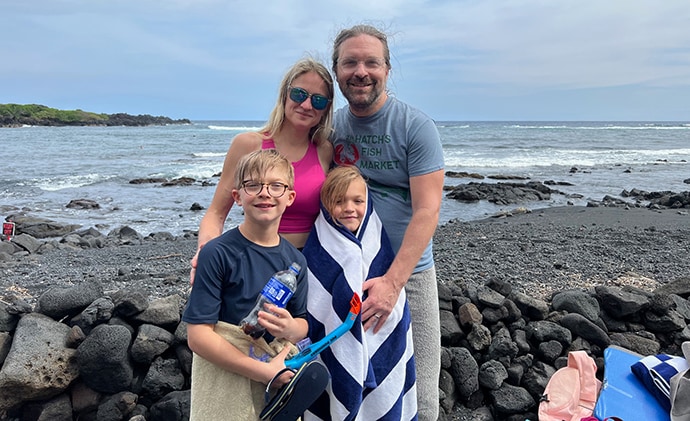
Jacquelyn Lacera, MD: My husband and I were coming back from our honeymoon in Hawaii. I was probably a bit dehydrated, but I had been feeling fine. After dinner, I started to feel a little nauseous. Forty-five minutes later, I was very nauseous. Luckily, we were in first class, so I was close to the bathroom. I ran in there and vomited.
As soon as that happened, I started to develop intense chest pain. I’ve had a child. I know pain. This was 10 out of 10 pain. I was diaphoretic and short of breath. I could feel my heart pounding. It was terrible.
I opened the bathroom door and saw one of the flight attendants. I just said, “Help. I need help.” Her eyes went wide, and she started calling for someone.
I asked my husband to get my Apple Watch from my bag to check my heart rate. But it just kept saying “high.” I thought, Oh my God. What is happening? And then Emily came.
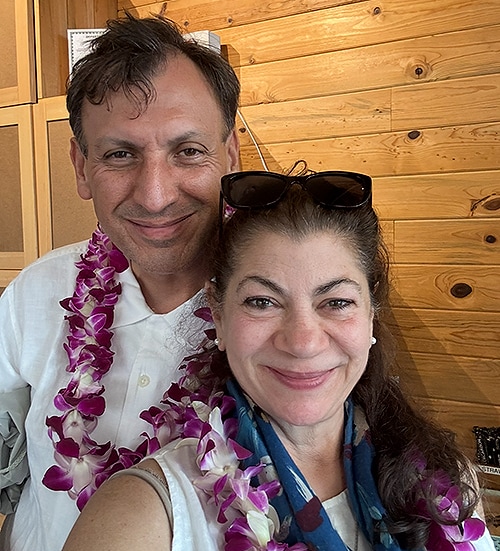
Haley: I had been hoping for somebody having a panic attack, maybe feeling seasick. But with Jacquelyn — a doctor — I knew this was a legitimate emergency. I started talking to her and getting some history. She told me she was a diabetic. I tried to get a pulse on her, and it was very rapid and very irregular.
I asked the flight attendants to bring the plane’s medical kit. It was minimal, to say the least. I tried to get a blood sugar on her, but the glucometer didn’t work. The pulse oximeter didn’t work. There was hardly any medication. I gave her an aspirin, which she ended up vomiting. There was an IV start kit, and I was somehow able to get an IV in her arm. But all they had was 500 cc of fluids.
They had a blood pressure cuff that intermittently worked. When I finally got it to cycle, it said her blood pressure was 60 over 40. My heart just dropped into my stomach.

Lacera: I was so thankful for Emily. She immediately took charge of the situation. You never know who is going to stand up on an airplane. And I had one of the best, someone who had trained and worked for years in emergency medicine. She kept talking to me, making jokes. At one point, she said, “Well, I’ve been off for a few days. So, I was itching to get back in.” She was wonderful.
There was one other gentleman, a retired surgeon, who showed up after a while. He was very nice, but he didn’t do much. Emily was running the show. He helped with the equipment, and as they were taking it out, I kept thinking, What is that?
The stethoscope was the flimsy disposable type that we use in isolation cases. The blood pressure cuff was an old wrist one, the kind I tell my patients not to buy, and it looked dirty. I saw Emily holding the bag of fluid up to the light to see if it was okay to use, and I thought, How old is that? It was all grossly inadequate.
Haley: Jacquelyn was starting to feel worse. Her Apple Watch said her heart rate was 160, and I thought, Oh, this is not good. I had her lie on the floor in front of the first-class cabin. All these faces were just looking at us, horrified.
We tried a couple of basic things, like a Valsalva maneuver, hoping maybe it would convert her back into a regular rhythm. Nothing was helping. I was cycling her blood pressure, palpating her feet to get her pulse, rapidly running out of fluids, and she was starting to become less lucid.
Lacera: I was lying there, and I knew I was close to passing out. My thoughts were slow, and I could feel myself starting to fade away. My brand-new husband was right by my head, and I was thinking about dying, just not being here.
But I could hear Emily repeating the word “rhythm,” saying, “I wish we could see the rhythm.” Suddenly, one of the flight attendants looked at me. I didn’t see what happened next, but she must have run and gotten what she was supposed to bring in the first place — an AED.
Haley: I hooked up the AED and turned it on, hoping it could sense Jacquelyn’s heart rhythm. It said, “Shock advised.” Oh my God. I turned it off right away, because I’m not going to defibrillate a live human!
I turned it back on, and it cycled and said, “no shock advised.” I felt a little better. But then she started to go downhill, and it cycled again and said, “shock advised.”
We were in the middle of the ocean. We couldn’t land. The captain was standing there staring at us. (I have no idea who was flying the plane.) It was the absolute worst-case scenario.
In the emergency room, we’re pretty resourceful in less-than-ideal circumstances. But this was a first. I had no safe antiarrhythmic to give her. They had one vial of lidocaine in the kit. Usually, you need a whole infusion, and that was going to drop her blood pressure, which was already low. I had no more fluids, nothing to help her if she went down. My only option was to defibrillate her.
I knew that if the shock landed on the wrong beat, I could potentially have a dead patient. But I also knew that she wasn’t going to last for the hours that were left in the flight.
I told her, “I think we have to shock you.”
Lacera: When Emily attached the AED, oh my gosh, it was so frightening. And then it said I had a shockable rhythm. I looked at her. She looked at me.
I said, “Do it.”
I knew that I should be sedated. I knew it was going to hurt. It was like asking to be stabbed. They cleared everyone.
Emily hit the button.
I screamed! It was so painful. But guess what? My heart went back into rhythm. I could feel it.
Haley: When Jacquelyn screamed so loudly, I was so relieved. I thought, she’s alive! Suddenly, she stopped screaming and just said, “My God, that really hurt.” Then she said, “Oh. My chest pain is gone. I feel better.” She sat up. It happened so fast. It was incredible.
We stayed on the floor for a while. And then, a flight attendant said, “We need to put you in a seat.” So, Jacquelyn just got up, walked back to her seat, and sat down.
I sat with her, and she asked me, “Do you think I need to go to the hospital?” I said, “You were pulseless! You have to go to a hospital. You are not fixed. Please.”
Lacera: That’s standard procedure, so I’m not sure what was happening in my brain at the time. But the pain dissipated within 20 minutes. When I got up, of course, the whole cabin was staring at me like they were seeing a zombie. A lady sitting behind me said, “I was praying for you.”
After we landed, I was taken to a hospital near the airport, where I spent 3 days getting cardiac testing. I kept hearing people refer to me as an “airplane person.” Finally, I asked what this meant, and a nurse said, “Oh, we get people off the planes all the time. Heart attacks, strokes, blood clots, and PE — we see everything. Anywhere between 2 and 5 per week.”
I thought, Wow, it’s not just me. The equipment on that plane was not okay. Medically trained people are being asked to help someone in a desperate situation without any tools. And despite what the airline told me later, the flight attendants were not trained. I was lying on that floor for 2 hours before they remembered they had an AED. We can do better than this.
Haley: We have tried to bring some attention to this because it’s not an isolated incident. There is no medical standardization for airplanes, and many are ill-equipped to handle emergencies.
I didn’t panic, though — until later. My goal was not to have Jacquelyn panic, or her poor husband. He’s not in medicine, and he was just holding her hand with no idea what to do. I had to think methodically. What are the next steps? If this doesn’t work, where do we go from here? It was a day or two later when I felt the shock. All the emotions came back.
Lacera: I’ve had to work through some PTSD. Near-death experiences really reorder your thinking, and this has been life-changing for me. But miracles do happen. And I’m thankful for so many reasons. I could easily have died. But I survived. Because of God, of course. Because of the AED. And because of Emily.
Haley: On the day we left, I had actually been telling my husband how fortunate I was that I had never been involved in a flight emergency. I think the universe was like, “Hold my beer.”
Emily Haley, MPAS, PA, is a lead physician assistant in the Department of Emergency Medicine at MedStar Franklin Square Medical Center in Baltimore.
Jacquelyn Lacera, MD, is a family medicine physician at Riverside Medical Clinic in Riverside, California.

No comments:
Post a Comment
Note: Only a member of this blog may post a comment.