Search This Blog

Thursday, August 9, 2018

Why Data Matters In The Behavioral Health Care And Recovery Industry


The line of work I’ve chosen is very difficult because it’s so close to my heart. As a person in long-term recovery, I become emotionally invested in my media messaging and business-to-business communications for Infinite Recovery. When I speak about recovery, I have a visible physical reaction. My voice gets louder. I begin speaking with my hands. My leg gets restless, and my feet tap incessantly. My eyes get wider and more alert.
The harsh reality is that the sheer volume of people suffering from substance use disorder, the potency of the substances legally and illegally available, the misconceptions around recovery, the nondisclosure traditions of 12-step anonymous programs and the staggering number of unethical facilities in operation have created a climate for low reporting and subsequently low statistical success of long-term recovery.
Don’t be discouraged: There are a vast number of people recovering from substance use disorder. It’s just more newsworthy to focus on the issues and fatalities. Tragedy equals clicks.
There is mistrust surrounding recovery positioning strategies.
We live in a time where we’ve learned more about mental health than ever before. It’s a truly optimistic era for the industry as we’ve begun to innovate the ways in which people are treated.
There is, however, a certain feeling of mistrust in the industry around positioning strategies. There are responsible ways to market treatment strategies that clearly state the person of concern’s willingness to actively pursue recovery will add to success. Then there are strategies that imply, “This solution is the silver bullet.” Whether it’s a new modality that’s being exploited as a gimmick, an old-school approach or a new scientific innovation, there is a treatment center applying these methods in hundreds of different ways.
How can health care marketers responsibly market and position recovery solutions?
The reality of long-term recovery from substance use disorder and mental illness is that it ebbs and flows. There is no guarantee that any treatment stint or modality will be the one that sticks. In fact, the National Institute of Substance Abuse states that the chronic nature of the disease means that relapsing to drug abuse at some point is not only possible, but likely. The biggest statement from the site that stuck out to me was, “Lapsing back to drug use indicates that treatment needs to be reinstated or adjusted or that another treatment should be tried.”
Treatment providers, private practice clinicians, advocacy groups and mental health professionals have to be transparent about recidivism rates. It’s our ethical responsibility to inform families and loved ones that treatment is as effective as the client’s motivation to change, the support structure that awaits them once leaving a facility and the treatment of co-occurring disorders.
Health care providers are increasingly paying attention to outcomes reporting in their authorization of health care claims, and we as marketing and communications professionals must take note of this. Health care giant Humana has even built its own clinical infrastructure CareHub to turn raw data into actionable health intelligence at the most critical moments for patients and subscribers. What this means for health care providers is what marketing professionals have known all along – client testimonials and raw data can be crafted into beautiful stories of your service’s success and reinforce any communications strategy.
Turning these numbers and statistics into stories takes time and creativity. Simply stating a percentage doesn’t convey the amount of work it takes to get there. What’s been effective for us is compiling data on lengths of sobriety, activities each client participates in, a “cumulative healing” quantitation of family and personal relationships, and assimilation into normal daily life. You can distribute these stories through social media, in video testimonials and blogs to connect with the person and convey their transformation.
Data will drive the future.
Over the past year, the organization I work for has begun diving deep into outcomes, statistics and measurable data points including but not limited to average length of stay, levels of care completed, support system engagement, recidivism rates, etc. We also partner with a third-party organization that supports our outcome-tracking initiatives to support relapse prevention and ensure patients are provided the community and clinical resources necessary to support long-term sobriety.
What we’ve found is when we’re able to compile data and report it in the clearest and most concise manner, we’re not only able to get the families and loved ones to participate; we’re also able to engage the clients in the best circumstances for success. Compiling this data has also helped us identify our key partners for treatment collaboration and form relationships with ethical, high-quality treatment providers.
Best practices that we have identified are:
• Gather as much data as possible. Ask each client as much as they are willing to share to tell a story.
• Make it measurable. So often in behavioral health care, information is subjective. It’s necessary to begin compiling quantitative data so as to make it tangible.
• Consistency is key. Creating a workflow that can be followed and repeated helps remove barriers from the follow-up process and ensure each individual receives attention.
Going forward, our entire attitude will have to shift as an industry to not only reach more people affected with substance use disorder, but to shed stigma and create awareness. There are a large number of ethical and responsible treatment providers with honest communications about their programs, but my hope is that their data will help them leverage even stronger continuing care models and let this speak to the families and health care providers.
Data is the future. We’ve always known this for industries like chemical engineering and technology, but now is the time to apply it to behavioral health care. By simply compiling data and using it to illustrate successful treatment strategies and outcomes, we can more confidently recommend continuums of care to each specific client and create more accurate, measurable depictions of an individual’s trajectory.


Planet Fitness sees 2018 adjusted EPS growth 33%, consensus $1.18

https://bit.ly/2MtZo2G

ICU Medical reports Q2 EPS $2.66, consensus $1.82

https://bit.ly/2Oszg99

How Does Airplane Travel Affect the Human Body?


Airplane travel is an increasingly easy and affordable mode of transportation.
There are a number of effects altitude and airplane travel have on the body, including oxygen deprivation, alteration of sleep patterns, and an increased risk of contracting contagious diseases.
Image Credit:  Volkova Natalia / Shutterstock
Image Credit: Volkova Natalia / Shutterstock

Airplane Travel and Blood Oxygen Saturation

Travelling to high altitudes such as mountains or ski resorts pose a high risk of hypoxemia (oxygen deprivation) due to the decrease in oxygen pressure compared to sea-level. Typically, in-cabin air pressure is equivalent to that seen at 5000 to 8000 ft.
Local hypoxia causes vasodilation (decrease in blood pressure) and increased capillary permeability, as well as increased ventilatory effort and heart rate. One study found a passenger had a blood oxygen saturation of 94% at ground level and 85% at altitude. This study concluded that this hypoxia in conjunction with the dehydration, immobility and low humidity associated with airplane travel could contribute to morbidity during and after airplane travel.
Generally, blood oxygen saturation beneath 90% is not sustainable in the long term. Some respiratory physicians would even suggest oxygen supplementation for patients with blood oxygen saturation of less than 94%.
Airplane travel and sleep disturbances caused by air travel are frequently reported. Passengers who travel regularly are likely to change time zones and can experience circadian rhythm misalignment, leading to jet lag disorder (JLD). The incidence of jet lag increases with the number of time zones crossed.
The symptoms of jet lag are:
  • Insomnia
  • Feeling sleepy during the day
  • Reduced performance
  • Gastrointestinal problems
Generally, the effects of jet lag will wear off within a week. It is caused by a disruption of the circadian rhythm, which is maintained and controlled by melatonin from the pineal gland. Melatonin, when secreted, induces a heavy desire to sleep. Being in strong light stops melatonin secretion, but darkness triggers melatonin secretion, which may be imbalanced by crossing time zones or conditions inside the plane cabin.
Acute sleep deprivation, the main consequence of plane travel, can present the following issues:
  • Reduced attention
  • Altered mood states
  • Reduced memory processing
  • Altered executive functioning (cognitive ability to plan, manage time, direct resources, etc.)

The Effect of Low Humidity

Humidity levels in airplane cabins are around 5% to 20%. Optimal humidity is reported to be around 40% to 70%. The humidity depends on passenger load but can be as low as 2%.
As a result, travelers may experience:
  • Dry nose
  • Dry throat
  • Dryness and discomfort in the eyes
Low humidity levels can make it easier for infections to spread, increasing the risk of contracting communicable diseases.

Health Risks Associated with Airplane Travel

Infection
One important current issue is that of the spread of infectious diseases through air travel. 2014 saw over 3.3 billion passengers travel by air from 41,000 airports, taking 50,000 routes worldwide, and passenger numbers are expected to reach 5.9 billion by 2030. The reported outbreaks of serious airborne diseases include:
  • Tuberculosis
  • Severe acute respiratory syndrome
  • Influenza
  • Smallpox
  • Measles
The risk of passing on or contracting communicable infections is higher when confined in an enclosed space for a long period of time. Infections can be spread by inhaling airborne particles or by coming into contact with contaminated surfaces, body fluids or secretions. To limit and control infection outbreaks in-flight, HEPA filters can be used to remove infectious airborne particles in recirculated air.
On commercial jet aircrafts, the air inside the cabin is a combination of conditioned ambient air and air from the cabin itself that is filtered and recirculated. This is done to lower the number of contaminants in the cabin and to control temperature, pressure and ventilation.
A particular problem is that people are able to travel long distances within the typical 24-hour incubation period for contagious diseases, meaning passengers may remain asymptomatic for their entire journey, leaving any contagious diseases being carried by the passenger undetected until after their journey is complete.
Skin cancer
There have been studies suggesting a higher incidence rate of melanoma in pilots and cabin crew. This is possibly due to higher exposure to cosmic ionizing radiation, of which higher doses are found at altitude, and other recognized carcinogens.
Epidemiological conclusions are still to be made, and whether this increased risk of cancer in pilots and cabin crew is due to occupational or non-occupational factors remains unclear.
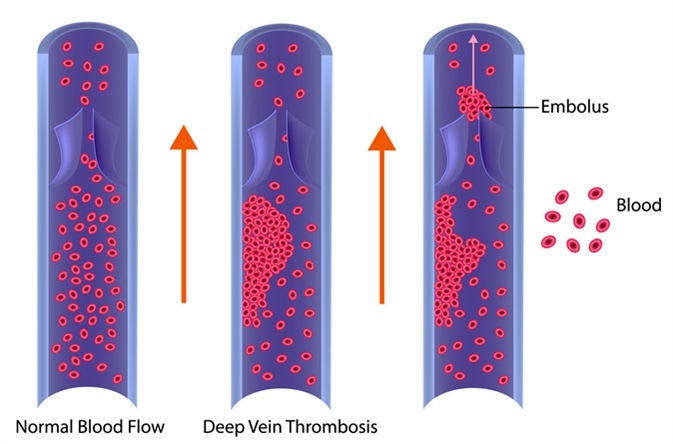
Deep venous thrombosis (DVT)
The risk of DVT is not limited to travel by airplane, and long-distance travelers by car, bus or train are also at risk.
Deep Vein Thrombosis or Blood Clots. Embolus. Image Credit: Sakurra / Shutterstock
In DVT, blood clots form in the deep veins as a consequence of sitting for a long period of time in a confined space. DVT can result in a pulmonary embolism, where a part of the blood clot breaks off and travels to the lungs. Risk factors for DVT are:
  • Increased age
  • Obesity
  • Recent injury or surgery
  • Estrogen-containing contraceptives
  • Hormone replacement therapy (HRT)
  • Pregnancy and postpartum period
  • Family history of blood clots
  • Cancer or recent cancer treatment
  • Varicose veins
  • Catheters placed in large veins
The symptoms of DVT include:
  • Swelling leg or arm
  • Pain or tenderness
  • Warm or red skin

Summary

While there are a number of recognized effects and risks of airplane travel on the body, there is a paucity of information and most information is a result of observational studies. The general consensus is that more research needs to be done to definitively identify the effects and risks of airplane travel on the body. Recognized risks include the spread of communicable diseases, deep vein thrombosis, sleep disruption and blood oxygen saturation levels.

Sanofi, Roche discontinue collaborations with Pieris Pharmaceuticals


Pieris Pharmaceuticals (PIRS) disclosed earlier today in its earings release that it recently received notification of Roche’s (RHHBY) intent to discontinue the companies’ research collaboration and license agreement, effective August 21. The Roche collaboration, signed in 2015, pursued the discovery of Anticalin proteins specific for an exploratory immuno-oncology target selected by Roche. Pieris received an upfront payment of approximately $6.4M for the collaboration. Anticalin proteins generated under the collaboration will be wholly owned by the company. Pieris is “currently reviewing the data generated under this collaboration and will consider its strategic options thereafter,” it added. In addition, Pieris said it recently received notification of Sanofi’s (SNY) intent to return to Pieris all rights to the tetraspecific Anticalin program targeting P. aeruginosa, effective August 23. The program originated from a 2010 collaboration from which Pieris received an upfront payment of EUR 3.5M and three milestone payments totaling EUR 1.2M. Sanofi will transfer all related materials, data, and reports to Pieris, who will gain full control over the program. Pieris intends to “review this data package and consider its strategic options thereafter.” The company added, “We remain on track to update investors with data from all three programs before year end. Our lead IO program, PRS-343, continues to advance apace in a dose-escalation study, and we expect to initiate a trial in combination with atezolizumab later this year. For PRS-060, our inhaled IL-4 receptor alpha antagonist program, we successfully completed the single-ascending dose inhalation phase in healthy volunteers and recently initiated a multiple-ascending dose study in subjects with mild asthma to test for early proof of concept via biomarkers.”

Verastem price target raised to $12 from $7 at Raymond James


https://bit.ly/2OTaMqm

Opioid Use Disorder More Than Quadruples in Moms at Delivery


Opioid use disorder seen at delivery hospitalization more than quadrupled from 1999 to 2014, with rising trends in all states with available data, researchers found.
Prevalence of opioid use disorder skyrocketed from 1.5 per 1,000 delivery hospitalizations in 1999 to 6.5 per 1,000 in 2014 (P<0.05), reported Sarah C. Haight, MPH, of the CDC, and colleagues.
Moreover, 28 states with available data had increasing significant linear trends in opioid use disorder at delivery hospitalizations over time — with prevalence as high as 48.6 per 1,000 in Vermont, the authors wrote in the Morbidity and Mortality Weekly Report.
“Even in states with the smallest annual increases, more and more women are presenting with opioid use disorder at labor and delivery,” said Wanda Barfield, MD, director of the CDC’s Division of Reproductive Health, in a statement. “These state-level data can provide a solid foundation for developing and tailoring prevention and treatment efforts.”
Described as the first-ever multi-state analysis of trends, the researchers examined data from the National Inpatient Sample and the State Inpatient Databases.
The national prevalence of opioid use disorder rose 333% from 1999 to 2014, for an average 0.4 per 1,000 delivery hospitalizations per year, the team found. In 1999, the greatest prevalence of opioid use disorder at delivery hospitalization among the 14 states with available data ranged from 0.1 per 1,000 in Iowa to 8.4 per 1,000 in Maryland. But in 2014, among 25 states with available data, prevalence ranged from 0.7 per 1,000 in Washington, D.C., to 48.6 per 1,000 in Vermont — “prevalence exceeded 30 per 1,000 in Vermont and West Virginia,” the researchers wrote.
When examining the average annual rate increase over the study period, they found that California had the lowest increase (0.01 per 1,000 delivery hospitalizations per year), but the highest average annual rate increases were in Maine, New Mexico, Vermont, and West Virginia.
The authors called these findings “consistent with previously documented national trends in opioid use disorder from 1998-2011” that were published in Anesthesiology.
“There is continued need for national, state, and provider efforts to prevent, monitor, and treat opioid use disorder among reproductive-aged and pregnant women,” Haight and co-authors concluded. They also cited 2016 CDC guidelines and 2017 American College of Obstetricians and Gynecologists (ACOG) guidelines that state that prior to prescribing opioids in pregnancy, clinicians should ensure that opioids are appropriate, review the Prescription Drug Monitoring Program, provide contraception counseling, and discuss the risks of use.
The authors reported having no conflicts of interest.