Search This Blog

Wednesday, June 5, 2019

CVS Turnaround Plan May Be ‘Good Enough,’ But Timeline Is The Question

CVS Health Corp CVS 2.65% laid out its ideas for growing earnings growth from the low single digits expected next year, giving analysts a look at a plan that includes a turnaround in its retail long-term care business, growth at its acquired health insurer Aetna and faster-than-expected ramp up of HealthHUB stores.

Expanding HealthHUB

CVS announced ahead of its investor day on Tuesday that it will open 1,500 HealthHUB stores by the end of 2021. The locations are similar to drug stores, but focused more on health services and some health products, without all the chain drugstore standby products like greeting cards and snacks. The company already has opened three locations in Houston. CVS says it will follow the Houston test market for HealthHUB with three more markets this year.
CVS’s performance improvement plan presented to analysts includes $900 million in synergies at newly acquired Aetna by 2021, and more than $1.5 billion in savings from modernization by 2022.
“Aetna appeared as the most positive business with earnings up high single digits, largely driven by Medicare growth,” Wells Fargo analyst Peter Costa wrote in a note. Costa rates CVS at Market Perform with a $62 price target.
CVS also told analysts its Omnicare long-term care business is stabilizing. The company gave an initial outlook for EPS of at least $7 in 2020 and expects faster growth beyond 2020.

Guidance: Good Enough

While the guidance for 2020 was below consensus, it was “good enough,” said Morgan Stanley’s Ricky Goldwasser, who has an Overweight rating and a $74 price target on the drugstore chain.
CVS offered a bit of a surprise with its confidence in retail reacceleration, Goldwasser said. The company is banking on preferred network agreements, a better product mix, and a turnaround in the company’s long-term care pharmacy services provider, Omnicare.
The turnaround plan at the pharmacy chain does have “a lot more meat on the bone,” noted UBS Global Research analyst Kevin Caliendo.
He said the question, though, is “can investors wait until 2021 to eat?”

Price Reform?

“We suspect investors will wait to see how drug pricing reform shakes out this summer before increasing risk,” Caliendo wrote Wednesday. He continues to have a $67 price target on CVS, and rates the stock a Buy.
Baird Equity Research analyst Eric Coldwell also said the steeper growth curve than expected will keep the Street reluctant.
“There is a lot of hard work ahead to execute on this plan and environmental headwinds remain stiff,” wrote Coldwell, who has a Neutral/Higher Risk rating and a $63 price target on the stock. “With sentiment awful, we wouldn’t be surprised if stock continued to rally modestly on heels of the event. But, 2018-2021 EPS are all implied with a $7-handle. We don’t see a rush to get involved.”

Innovent Updates on Results of Lymphoma Treatment at ASCO

Innovent Biologics, Inc. (Innovent) (HKEX: 01801), a world-class biopharmaceutical company that develops and commercializes high quality medicines, today announced that the research data on the treatment of relapsed or refractory extranodal NK/T cell lymphoma (ORIENT-4) by sintilimab, the anti-PD-1 antibody that co-developed with Eli Lilly and Company, was presented in an oral session at the 55th Annual Meeting of the American Society of Clinical Oncology (ASCO) [Abstract #7504; Tuesday, June 410:57 AM -11:09 AM CDT]. ORIENT-4 is the first clinical study of PD-1 antibody from China that was orally presented at ASCO.
As the top and most influential international oncology conference, ASCO Annual Meeting provides the most important platform for publishing and discussing cutting edge clinical studies. Under the theme “Caring for Every Patient, Learning from Every Patient,” 2019 ASCO Annual Meeting has attracted numerous top oncologists, scholars, staff from regulatory and patient organizations to share the latest updates and achievements in clinical oncology, with the ultimate goal to help deliver more promising medicines and treatment options to cancer patients.
It is worth noting that more and more Chinese companies choose to participate and disclose their programs in ASCO, showcasing the importance of emerging Chinese biotech industry. As a leading Chinese biotech company, Innovent will provide key result update of several clinical studies at the ASCO 2019 Annual Meeting. The results on the treatment of relapsed or refractory extranodal NK/T cell lymphoma (ORIENT-4) with sintilimab will be presented in an oral session by Professor Jianyong Li, Director of Department of Hematology of Jiangsu Province Hospital.
ORIENT-4, the first data released globally for prospective phase II clinical study of PD-1 monoclonal antibody for the treatment of r/r ENKTL, evaluates the efficacy and safety of sintilimab as monotherapy in the treatment of patients with r/r ENKTL.
Patients receive 200 mg sintilimab every 3 weeks until disease progression. Treatment beyond disease progression is allowed. This study includes 28 patients with r/r ENKTL who have progressed after receiving an average of 3 conventional treatments. The primary endpoint is objective response rate (ORR) per LUGANO2014 criteria.
According to the predefined analysis, 19 patients achieved objective response for an ORR of 67.9%, disease control rate (DCR) of 85.7% and 1-year overall survival (OS) rate was 82.1%. (The data cutoff was February 2, 2019 with the median follow-up time of 15.4 months; at which time, 19 patients were still on treatment.)
Extranodal NK/T cell lymphoma is an aggressive malignancy and accounts for more than 20% of the peripheral T-cell lymphoma in Asia. Currently, patients with relapse or refractory disease have few treatment options and poor prognosis. According to historical data, the overall survival is about 6 months, reflecting high unmet medical needs.

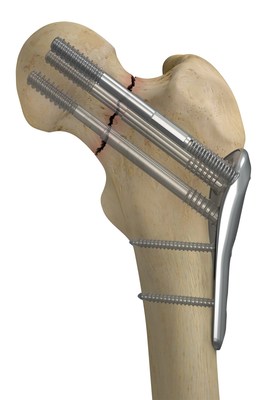
Smith & Nephew Launches CONQUEST FN™ Femoral Neck Fracture System

Smith & Nephew Inc. (LSE: SN, NYSE: SNN), the global medical technology business, has announced the launch of its CONQUEST FN™ system, a new implant solution to treat femoral neck fractures and promote bone preservation.
CONQUEST FN
Irrespective of age and bone quality, femoral neck fractures pose a significant clinical challenge with complication rates reported to be as high as 69% 1 depending on fracture type, patient population and therapeutic intervention. Smith & Nephew designed the CONQUEST FN system to address these challenges by providing a combination of innovative instrument and implant offerings with the intent of providing intra-operative and post-operative reduction control.
Inadequate implant fixation can lead to post-operative complications and secondary procedures. To address this concern, Smith & Nephew collaborated with FX Devices and became the first to utilize their POGO® Technology for femoral neck fractures. The POGO telescoping compression screw is designed to provide continuous fracture compression post-operatively with the intent to decrease hip pain and post-operative complications. Coupled with a proximal femoral locking plate, the system provides surgeons with a new level of control when treating these devastating fractures – dynamic locking fixation.
“Femoral neck fractures in physiologically young patients are significant injuries. I have had positive results in my initial experience with CONQUEST FN. Intra-operatively, it is easy to implant without a threat of loss of reduction; and post-operatively, patients often follow-up very comfortable with minimal pain, and have progressed to weight-bearing more quickly. I feel this speaks to the enhanced stability of the implant,” said Daniel S. Chan, MD, an orthopaedic traumatologist with the Orthopaedic Trauma Institute in Macon, Ga.
The estimated number of hip fractures worldwide will rise from 1.7 million in 1990 to 6.3 million in 2050. 2 Femoral neck fractures represent approximately 50% of these cases.3
“We take pride in designing products that address procedural challenges when treating traumatic injuries and are excited to introduce our CONQUEST FN system to a market that is clearly ready for new solutions. It offers truly differentiating POGO Technology that will help take femoral neck fracture treatment to the next level by offering dynamic locking fixation and promoting bone preservation – key elements in returning patients to pre-fracture function. It further complements our comprehensive hip fracture portfolio to give surgeons and their patients a choice of treatment options,” said Skip Kiil, President of Global Orthopaedics, Smith & Nephew.

Mallinckrodt Agrees In Principle With DOJ On Legacy Questcor Sales, Marketing

Mallinckrodtplc (NYSE: MNK), a global specialty biopharmaceutical company, today reported the company has reached an agreement in principle with the U.S. Department of Justice (DOJ) to resolve the previously disclosed government investigation of Questcor’s legacy sales and marketing activities, which is still subject to the finalization of certain terms. Under the civil False Claims Act settlement, Mallinckrodt expects to pay $15.4 million relating to legacy Questcor activities. While the agreement will not contain any admission of wrongdoing, it believes the agreement is fair and reasonable under the circumstances, and should put to rest these government claims relating to Questcor’s sales and marketing activities.

With respect to allegations in the newly filed DOJ civil complaint covering alleged legacy Questcor charitable foundation conduct between 2010 and 2014, the government is seeking to recover unspecified monetary damages for alleged violations of the False Claims Act and the Anti-Kickback Statute. Contrary to the DOJ’s characterizations in the complaint, the allegations relate to legacy Questcor conduct as all the donations to the Chronic Disease Fund (CDF) referenced in the complaint occurred prior to the acquisition of Questcor or were for grandfathered patients who had been approved by CDF for co-pay assistance prior to the acquisition. Mallinckrodtacquired Questcor in August 2014.
During the applicable period, CDF operated under a U.S. Health and Human Services (HHS) Office of the Inspector General (OIG)-issued advisory opinion, and CDF represented to Questcor that it operated in compliance with that opinion. In addition, the HHS-OIG stated in 2005 that single-donor, single-drug funds may, under prescribed circumstances, be lawful, and the agency reiterated publicly that position nearly a dozen times during the period in the complaint. Mallinckrodt believes Questcor’s relationship with CDF fell within this guidance, and as such was lawful and appropriate. Mallinckrodt denies any wrongdoing on the part of Questcor during the relevant period, and intends to vigorously defend the company in this matter.
Mallinckrodt looks forward to finalizing our settlement agreement with the government relating to legacy Questcor sales and marketing activities. As we have said repeatedly, where we can resolve legacy legal matters in a reasonable and manageable way, we will do so,” said Mark Casey, General Counsel, Mallinckrodt. “Unfortunately, that has not been possible to date regarding the allegations relating to Questcor’s charitable foundation activities, despite what we believe was lawful and appropriate activity. We are confident that the litigation process will focus the contested issues and be a productive step in reaching resolution.”

Bristol-Myers Squibb to Shuffle Execs Once Celgene Acquisition Closes

In April, Bristol-Myers Squibb’s shareholders voted to approve the acquisition of Celgene for about $74 billion. The deal was originally announced on January 3, 2019.
Today, the company announced its leadership team for the combined company. Thomas Lynch Jr., Bristol-Myers’ chief scientific officer, will leave the company in October. Part of Lynch’s responsibilities will be taken over by Rupert Vessey, a Celgene research executive. Vessey will manage the combined company’s drug discovery and early clinical testing, as well as look for possible new drugs to add to the company’s pipeline.

Later-stage development will be managed by Samit Hirawat, the incoming chief medical officer. Previously, Hirawat led cancer development at Novartis.
Bristol-Myers’ commercial activities will be shared by executives reporting to chief executive officer Giovanni Caforio. Nadim Ahmed will oversee the merged company’s hematological oncology business. Nadim is from Celgene. Chris Boerner, presently Bristol-Myers’ chief commercial officer, will handle the rest of the commercial business, including cancer, immunology and cardiology.
Celgene’s chief financial officer, David Elkins, will take on the same role for the merged companies, replacing Charles Bancroft, who will retire in 2020.
Caforio stated, “I would like to thank Charlie for his extraordinary contributions during his 10 years as chief financial officer and for his partnership and support. Charlie has played a significant leadership role in driving our company strategy, leading our transformation and executing important business development activities, including the acquisition of Celgene. I appreciate Charlie’s commitment to lead the integration to help make this combination a reality.”
The company indicates that this restructuring is “to drive the continued growth of a highly successful marketed portfolio, maximizing the six near-term launch opportunities and deliver the value of the combined pipeline, all guided by its continued mission of serving patients with serious disease. The business will be supported by a lean infrastructure to enable efficiency and agility.”
The merged company will have nine $1 billion-plus products on the market and six near-term launch compounds in the pipeline. Its four global franchises will be Oncology, Hematology, Immunology and Cardiovascular.
The merger was not without its drama and critics. One of its biggest shareholders, Wellington Management Company LLP, objected to the acquisition. Wellington owns about an 8% stake in Bristol-Myers. Another BMS shareholder, Starboard Value, also opposed the deal. Starboard has about a 1% stake. In an open letter, Starboard called the deal “poorly conceived and ill-advised.” Another group, Dodge & Cox, also opposed the deal. Dodge & Cox has a 2% stake.
Bristol-Myers and Celgene then went on something of a sales campaign to convince shareholders of the rationale and benefit of the merger.
About 70% of shareholders voted in favor of the deal, with about 98% taking part in the vote.
Much of the criticism of the deal revolved around the patent cliff for Celgene’s multiple myeloma drug Revlimid. The first generic is expected in March 2022. The shareholder criticism argued that Bristol-Myers was buying a company that was going to soon have a much lower revenue because of the drug’s generic competition. Celgene and Bristol-Myers Squibb argued that they have a very promising pipeline with three drugs, fedratinib, ozanimod, and luspatercept already submitted to the U.S. Food and Drug Administration (FDA) and two promising CAR-T immuno-oncology drugs, bb2121 and liso-cel, in late-stage clinical trials.

ResTORbio started at Buy by Guggenheim

Target $28

Sientra upped to Outperform from Market Perform by Wells Fargo

Target to $10 from $8