Search This Blog

Wednesday, November 6, 2019

Apple expands health records app to millions of U.S. veterans

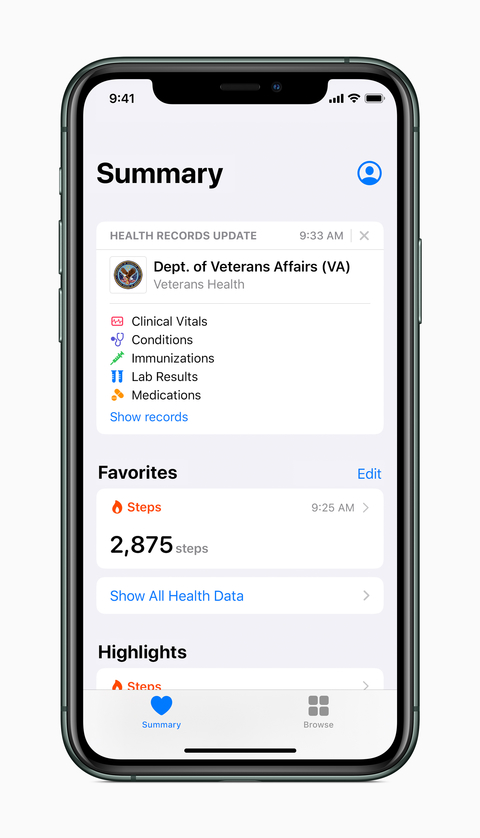
The U.S. Department of Veterans Affairs and Apple collaborated to provide veterans easier access their medical information even if they seek care from multiple providers. (Apple)
The U.S. Department of Veterans Affairs (VA) and Apple announced Wednesday that millions of U.S. veterans will now be able to access their medical records on their iPhones through the tech giant’s health records feature.
The VA has been collaborating with Apple for months to roll out the new health record app after first announcing the initiative back in February. The app makes it easier for veterans to access their medical data across multiple providers by combining their VA health data alongside their health records from community providers, Apple and VA officials said.
The VA is the largest medical system in the U.S., providing service to more than 9 million veterans across 1,243 facilities, including hospitals and clinics.
The VA joins Johns Hopkins, University of California San Diego, Quest Diagnostics, Allscripts and 400 other health care provider organizations, laboratory networks, and electronic health records (EHRs) vendors who support the health records on iPhone feature, Apple executive said in a blog post.

The VA plans to partner with other organizations to bring similar capabilities to other mobile platforms, according to a VA press release.
“Helping veterans gain a better understanding of their health is our chance to show our gratitude for their service,” Jeff Williams, Apple’s chief operating officer, said in a blog post. “By working with the VA to offer Health Records on iPhone, we hope to help those who served have greater peace of mind that their health care is in good hands.”
Through the Health Records for iPhone app, veterans can see all of their health records in one place, including medications, immunizations and lab results. The app continually updates the records, giving VA patients access to a single, integrated snapshot of their health profile, VA and Apple officials said.

Aneesh Chopra, former White House chief technology officer under the Obama administration and president of healthcare company CareJourney, applauded the initiative in a tweet, saying its part of an ongoing effort to open up patient access to health information.
“We have delivered veterans an innovative new way to easily and securely access their health information,” VA Secretary Robert Wilkie said in a statement. “Veterans deserve access to their health data at any time and in one place, and with Health Records on the Health app, VA has pushed the Veterans experience forward.”
This capability was developed through the VA’s Veterans Health Application Programming Interface (Veterans Health API). The VA gradually launched Health Records to select patients this summer and the service now tops 2,000 users, according to the VA.
The Veterans Health API allows private sector organizations to create and deploy digital applications that help veterans access their health records in new ways, the VA said.

Early data on NextCure immuno-oncology lung cancer med delights investors

Shares of freshly public biotech NextCure skyrocketed on Tuesday after the company published an abstract highlighting initial data from an early-stage study of its sole experimental immuno-oncology drug.
The therapy, NC318, is engineered to inhibit Siglec-15 (S15), a key immune suppressor in certain cancer patients whose tumors are resistant to the existing raft of checkpoint inhibitors. S15 is found on certain myeloid cells in the tumor microenvironment and on certain tumor types including lung, ovarian and head, and neck cancers.
Many patients are refractory to checkpoint inhibitors due to the presence of certain immunosuppressive factors in their tumor microenvironment. Researchers have been trying to harness different molecules to stimulate the immune system, including toll-like receptor (TLR) agonists — specialized proteins that initiate an immune response to foreign pathogens or, in this case, cancer cells. NextCure is working on “normalizing” the immune system by snuffing out a factor that thwarts it from performing its defensive duties.
“Different from immune checkpoint blockade, cancer immunotherapy based on normalization aims to restore an impaired immune system to a healthy state, so it detects and destroys cancerous cells and avoids harming healthy cells,” said Lieping Chen, Yale professor and scientific founder of NextCure, in a statement in March. “(W)e identified S15 as a major immune suppressor in B7-H1 (PD-L1) negative tumors, which are resistant to currently approved anti-PD cancer therapies.”
In an abstract for the Society for Immunotherapy of Cancer (SITC) conference — the company disclosed data from a first-in-human trial of NC318, in doses ranging from 8 mg to 800 mg.
As of August, 43 patients including those with non-small cell lung, ovarian, melanoma, breast, and colorectal cancer have been enrolled. Tumor responses were evaluable in 32 patients, although 11 patients have not reached their first assessment, and their efficacy data will be reported on Saturday at SITC.
However, in patients with NSCLC — the biggest (and most lucrative) form of lung cancer, NC318 monotherapy elicited activity in 5 of 7 subjects refractory to PD-1 therapies.
Data showed 1 complete response (ongoing at 41 weeks), 1 partial response (ongoing at 14 weeks), 1 stable disease with tumor reduction (ongoing for 26 weeks), and 2 with stable disease. Overall, the therapy was also well-tolerated, NextCure said.
The Beltsville, Maryland drug developer’s shares $NXTC catapulted on Tuesday, closing up nearly 250% at $92.22. The stock began to correct itself on Wednesday, slipping more than 7% to $85.50 in premarket trading.
“Clearly, there is thirst for clear signals of activity in immuno-oncology (IO) after years of disappointing data from next-generation checkpoints and difficult-to-interpret combination data. While very interesting, two out of seven responders (NSCLC, “refractory” to anti-PD(L)1) is a very early signal, and the abstract did not make note of any single-agent activity in other solid tumors; assuming no responses outside of NSCLC, the overall response rate in the 21 evaluable patients that had reached final assessment would be 9.5%,” SVB Leerink analysts wrote in a note.
“(W)e will be looking for positive signals from the 11 additional patients (three in NSCLC), as well as patient history and biomarker data that is supportive of the biologic mechanism and hypothesis that Siglec-15 immune inhibition is not redundant with PD-1 inhibition.”

Smartphone screening project for kidney disease launched in the Netherlands

A project to screen 15,000 people aged between 45 and 80 using smartphone technology has started in the town of Breda in the Netherlands, focusing on chronic kidney disease (CKD).
The new study is being launched by Israeli start-up Healthy.io, a few weeks after it raised $60 million in a third-round financing to help advance the roll-out of its home-based urine analysis product.
The kit uses a disposable test strip, testing cups and a coloured panel along with a smartphone camera and software to carry out the albumin-to-creatinine (ACR) test used to detect kidney impairment.
A variant of the technology used to detect urinary tract infections and in prenatal care – called Dip.io – has already been approved in the US and Europe, and the company is in the process of seeking approvals for the kidney function test.
The process involves dipping the strip in a urine sample, placing it into the coloured panel, and taking a picture using a smartphone camera. Using artificial intelligence and machine learning techniques, a colorimetric analysis is then carried out by phone – comparing the sample with the colours and patterns on the panel – to give a diagnosis.
In the Netherlands, Healthy.io will work with the Dutch Kidney Foundation and the University Medical Center Groningen (UMCG) to carry out ACR testing on the 15,000 subjects, comparing the smartphone screening to traditional techniques.
In one arm of the study, patients will collect a urine sample at home and send by post to a central lab that will carry out the ACR test. The other arm will rely on the phone-based ACR test, with an immediate result and feedback delivered to the patient at home.
“A total of 1.7 million Dutch people have chronic kidney damage, but half of them do not know this,” says Healthy.io in a statement on the new study. Early detection is key to slowing the progression of CKD but unfortunately often the disease is asymptomatic until it has reached its end stages.
“If kidney damage is detected in the early stages it can be treated faster and possibly prevent kidney failure. The screening can also detect heart and vascular diseases at an early stage,” it adds.
The ACR test has already been put through its paces in a UK assessment that involved almost 2,200 high-risk patients with type 2 diabetes who had not taken an annual test to detect kidney damage, a complication of the disease.
The pilot study found that 10% of those tested had signs of kidney damage and according to Healthy.io suggested that if the approach was scaled up nationally it could prevent more than 11,000 cases of end-stage kidney disease and save the NHS £660 million.
It is estimated that only 30% of people with high blood pressure – another group at risk of kidney damage – and 66% of type 2 diabetics take up annual testing. That means up to one million people in the UK may have undiagnosed CKD.

Daiichi Sankyo and Seattle Genetics are Headed to Court Over ADC Worth Billions

Daiichi Sankyo is taking Seattle Genetics to court over the technology the two companies used to develop antibody-drug conjugates during a partnership that spanned seven years. At the core of the argument is a drug candidate that means billions of dollars for the Japan-based company and Seattle Genetics believes it is entitled to a share.
In March, Daiichi Sankyo and AstraZeneca signed a development and commercialization deal for an ADC called trastuzumab deruxtecan (DS-8201) that had its background in the partnership between Daiichi Sankyo and Seattle Genetics. DS-8201 is the lead compound in the ADC franchise of the Daiichi Sankyo Cancer Enterprise and targets HER2-expressing cancers. In addition to the partnership with AstraZeneca, Daiichi Sankyo’s compound is being paired with multiple flagship drugs from companies like Bristol-Myers Squibb and Merck. In March, AstraZeneca paid Daiichi Sankyo $1.35 billion in upfront monies as the U.K. company sees significant potential for DS-8201 as a treatment for HER2-positive breast and gastric cancers. If certain developmental and regulatory milestones are hit, Daiichi Sankyo could receive up to $6.9 billion from the deal with AstraZeneca.
Seattle Genetics believes it is entitled to a share of that money. DS-8201 had its genesis in Seattle Genetics’ cytotoxin and linker technology from that collaborative relationship the two companies had from 2008 to 2015. When Daiichi Sankyo and AstraZeneca signed the deal, Seattle Genetics communicated its belief that its intellectual property was used in the development of DS-8201, which makes it the rightful owner of the drug that is potentially worth billions of dollars. Daiichi Sankyo disagrees with that notion and is taking the company to court over it.
This week, Daiichi Sankyo filed a Declaratory Judgement in response to a communication from Seattle Genetics. Daiichi Sankyo said any claim to certain intellectual property rights for DS-8201 by Seattle Genetics has no merit. In a brief announcement this week, the company said it will “vigorously defend its position that our ADC technology patents are the exclusive intellectual property of Daiichi Sankyo.”
Between July 2008 and June 2015, Seattle Genetics and Daiichi Sankyo collaborated in an exclusive, worldwide development agreement focused on ADCs which are distinct from ADC products currently being developed in the Daiichi Sankyo pipeline, the Japanese company said in its announcement.
In response, Seattle Genetics disagreed with the assessment made by Daiichi Sankyo and said that DS-8201 as well as other product candidates, “rightfully belong to Seattle Genetics” under terms of the agreement the two companies struck in 2008.
“The linker and other ADC technology used in these drug candidates are improvements to Seattle Genetics’ pioneering ADC technology, the ownership of which are automatically assigned to Seattle Genetics under the terms of the agreement,” Seattle Genetics said in response to Daiichi Sankyo. “Seattle Genetics is committed to protecting the company’s intellectual property rights as it continues to find revolutionary new treatments for cancer patients.”

Judge shields OxyContin-maker Purdue from litigation until April

Purdue Pharma LP and the company’s Sackler family owners will be shielded until April 8, 2020, from sprawling opioid litigation to give the maker of OxyContin time to try to reach a legal settlement the company says is worth $10 billion.

U.S. Bankruptcy Judge Robert Drain said on Wednesday he would approve an order extending a stay on more than 2,600 lawsuits that accuse Purdue and the Sacklers of fueling a crisis that contributed to 400,000 U.S. deaths between 1999 and 2017.
Drain, whose court is in White Plains, New York, ordered a brief stay of the litigation in October.
While the litigation is on hold, Purdue and the Sacklers committed to share information with the states, municipalities, Native American tribes, hospitals, individuals and others who have sued.
Purdue filed for bankruptcy in September to try to corral the parties to one court and build support for its proposed settlement, which will now be evaluated through the discovery process with the company and the Sacklers.
The bulk of the parties that have sued Purdue support the settlement, and the main opposition comes from about two dozen state attorneys general.
At Wednesday’s hearing, a lawyer for the official creditors committee said the billionaire Sackler family was being slow to respond to demands for financial records.
Drain warned that the family runs the risk of being exposed to litigation when his order expires if they do not cooperate.
“This is not a free pass,” he said.
Under the proposed deal, control of Purdue will be transferred to the parties suing it. The Sackler family will contribute at least $3 billion to the deal, and in return will be released from further lawsuits, the deal says.
The company has also committed to appointing an independent monitor during ongoing negotiations to ensure it ceased practices that allegedly contributed to the addiction crisis, such as promoting its drugs and rewarding sales teams.
In addition to Purdue, several manufacturers, distributors and pharmacy chains have been sued by the same groups over the opioid crisis.
In October, distributors AmerisourceBergen Corp, Cardinal Health Inc and McKesson Corp, drugmaker Teva Pharmaceutical Industries Inc, and Johnson & Johnson proposed settling the litigation against them for $48 billion.

Genmab A/S reports Q3 results

Genmab A/S (NASDAQ:GMAB): Q3 GAAP EPS of DKK8.28.
Revenue of DKK1.04B (+73.7% Y/Y)

Abbott researchers find new strain of HIV

Scientists at Abbott (ABT +0.9%) have found a new strain of HIV, called Group M, subtype L, the 10th in the M group.
Group M strains are the most common, responsible for ~90% of global human infections.
The discovery is not expected to alter the current way HIV is treated or diagnosed.
Abbott intends to make the DNA sequence publicly available for study. It has no plans to develop a diagnostic test.