Ultra-thinly traded nano cap BioCorRx (OTCQB:BICX+7.7%) is up, albeit on only 700 shares, in reaction to encouraging preclinical data on VDM-001, its candidate for the reversal of opioid overdose that it says is an alternative to naloxone.
The company cites early preclinical data that supports the potential ability of VDM-001 to completely prevent the effects of fentanyl, an opioid that is up to 100x as potent as morphine that is commonly found in illicitly manufactured oxycodone and responsible for many overdose deaths.
The candidate, being developed by subsidiary BioCorRx Pharmaceuticals and VDM Biochemicals, is a 100% synthetic antagonist that BioCorRx says should be easier and quicker to make than naloxone (whether an injectable or nasal spray formulation is not provided).
Immunomedics (IMMU+1.3%) bucks the broad market selloff, albeit on below-average volume, with its resubmission of a U.S. marketing application seeking accelerated approval to use antibody-drug conjugate sacituzumab govitecan to treat patients with metastatic triple-negative breast cancer (TNBC) who have received at least two prior lines of therapy.
The company received a CRL in January in response to its initial filing.
Lexicon Pharmaceuticals (LXRX+5.7%) is up, albeit on below-average volume, on the heels of a safety review of the initial run-in cohort in a Phase 2 clinical trial, TELE-ABC, evaluating telotristat ethyl, combined with first-line chemo, for the treatment of patients with advanced biliary tract cancer.
The company says data on first six participants who completed at least one 21-day treatment cycle, combined with cisplatin and gemcitabine, support continued enrollment with no adjustments in the dosing regimen.
Six-month progression-free survival data on the first 20 patients should be available in 2020.
Telotristat ethyl, an oral typtophan hydroxylase inhibitor branded as Xermelo, was approved in the U.S. in February 2017 for carcinoid syndrome diarrhea in patients with metastatic neuroendocrine tumors (combined with somatostatin analog therapy).
Related ticker: Ipsen S.A. (OTCPK:IPSEY) (owns commercialization and licensing rights ex-U.S. and Japan).
Investors appear disappointed that Protagonist Therapeutics (PTGX-25.5%) did not announce more definitive results from a Phase 2 clinical trial, TRANSCEND, evaluating PTG-300 in patients with transfusion-dependent beta thalassemia, a blood disorder characterized by chronic anemia and iron overload.
The company says preliminary data showed dose-related drug exposure and reductions in serum iron and transferrin saturation levels from baseline for the 40 mg and 80 mg weekly doses. There were some clinical responders as measured by reductions in transfusion burden, but “continued evaluation at higher doses will be required” to definitively assess the rate and durability of the effects. Additional data, including results from longer follow-up periods and additional dosing regimens, should be available in 2020.
On the safety front, the most frequent treatment-related adverse event was transient erythema (reddening of the skin) (12%, n=4/33).
PTG-300 is an injectable hepcidin mimetic peptide. Hepcidin is a peptide hormone that plays a key role in regulating iron absorption, recycling and utilization. It has Orphan Drug and Fast Track status in the U.S. for the indication.
DarioHealth Corp. (NASDAQ: DRIO) announced today the launch of the Dario-powered digital diabetes program on Walmart.com.
Walmart is the largest retailer in the world and is the second largest e-commerce retailer in the U.S. It is also an innovator in healthcare, piloting several initiatives such as opening its own Walmart Health centers and creating a Home Health Care section on Walmart.com.
The Dario digital diabetes app is among the most downloaded and highest rated healthcare apps, with a 4.9/5.0 star rating and over 8,000+ reviews on the Apple store. Its Net Promoter Score (NPS), a measure of willingness of customers to recommend a company’s products or services to others, is +77, considered “world class” and the highest in its category, on a -100 – +100 scale.
“Walmart strives to offer its shoppers health solutions that will help them manage their own health in the most efficient way possible. We are excited to access Walmart’s online distribution channel given the extremely high volume of annual visitors. We will offer Walmart’s consumers MyDario™, our complete digital solution to manage diabetes, hypertension, nutrition and exercise. Our system is affordable and supported by a large body of clinical evidence that we believe demonstrates that Dario significantly and quickly improves the health and wellness of its users. We believe that the positive results seen while using our system reinforces engagement and are part of the reason why users rate Dario as one of the best solutions for managing chronic conditions,” said Olivier Jarry, DarioHealth’s President and Chief Commercial Officer.
BridgeBio (BBIO+1.4%) launches its rolling NDA filing with the FDA seeking approval to use fosdenopterin (BBP-870/ORGN001) to treat patients with an ultra-rare inherited metabolic disorder called molybdenum cofactor deficiency type A (MoCD Type A), characterized by irreversible brain damage in newborns.
Fosdenopterin is a cyclic pyranopterin monophosphate (cPMP) substrate replacement therapy designed to reduce the buildup of toxic sulfites thereby alleviating central nervous system symptoms in MoCD Type A sufferers. It has Orphan Drug, Rare Pediatric Disease Designation and Breakthrough Therapy status in the U.S. for the indication.
Wait for it. Wait for it. That’s what the world has been doing ever since 1984 with the “it” being an effective and safe HIV vaccine. That year Margaret Heckler, then the U.S. Secretary of Health and Human Services, said in a press conference, “we hope to have a vaccine ready for testing in about two years,” and added, “”yet another terrible disease is about to yield to patience, persistence and outright genius.” Those words offered some encouragement that an HIV vaccine could have been available for use before the end of the 1980’s. Well, that prediction turned out to be off by oh about 30 years and counting. But after years of “wait for it,” there is optimism that the legendary arrival of a real HIV vaccine could happen as soon as 2021.
That’s because there are now, count them, three different late-stage human clinical trials of HIV vaccine candidates underway. That’s three more than in 1984, when scientists had just identified the human immunodeficiency virus (HIV) to be the cause of acquired immunodeficiency syndrome (AIDS). Ah, the 1980’s were a time of naive optimism in more ways than one. Identifying a virus by no means guarantees that an effective and safe vaccine can be developed anytime soon.
But here we are, after decades of disappointments, eyeing three clinical trials named HVTN 702, Imbokodo, and Mosaico. If you are wondering what HVTN is, besides being an unpronounceable string of consonants, it is an acronym for the HIV Vaccine Trials Network. Here’s where each of these three trials currently stands:
Beginning in October 2016, this is a Phase III/IIb clinical trial to study the efficacy, safety, and tolerability of a vaccine candidate called ALVAC-HIV (vCP2438) + Bivalent Subtype C gp120/MF59. This may sound like an amazingly effective password to use but actually represents two types of intramuscular injections.
The first type includes a re-engineered canarypox virus combined with pieces of HIV that can’t cause HIV infection on their own. This is the priming part of the vaccine, the portion that primes or alerts your immune to the virus, telling your immune system, “this is your enemy, this is what you should be defending against.” It is, in a way, the canarypox in the coal mine that warns your defense system. The second type of injection consists of pieces of the protein envelope that surround the HIV along with M59, an adjuvant that uses an organic compound called squalene. An adjuvant is a substance that doesn’t on its own generate immune responses but instead can boost your immune system’s responses to parts of the virus. This is the boost part of the so-called “prime-boost” strategy. Once the the immune system is alerted to the virus, this part boosts the troops, which are your immune system’s B cells. Kind of like recruiting Captain Marvel, Ant Man, and others to the cause to fight Thanos.
The setting for the trial is South Africa, which according to UNAIDS has at least 7,700,000 people living with HIV. Already 5,400 HIV-negative adults from 18 years to 35 years old are enrolled. They will be followed for 24 to 36 months to determine if they develop any new HIV infections after enrollment. Participants will receive a series of intramuscular injections of either the vaccine or a placebo that is basically just salt water. Currently, the trial is expected to conclude July 2021. The National Institute of Allergy and Infectious Diseases (NIAID) is sponsoring this trial.
This Phase IIb study began in November 2017 and completed enrollment in May 2019 of 2,600 sexually-active women between the ages of 18 and 35 in five southern African countries: Malawi, Mozambique, South Africa, Zambia, and Zimbabwe. Like the vaccine used in HTVN 702, the vaccine for the Imbokodo Study consists of two different types of injections, albeit with different ingredients, and uses a “prime-boost” approach as well. The prime injection (called Ad26.Mos4.HIV) includes an adenovirus, a virus that typically causes the common cold, that’s been re-engineered and combined with pieces of HIV. The boost injection consists of pieces of the HIV protein envelope along with an aluminum phosphate adjuvant. Like the HVTN 702 trial, this trial will randomly assign participants to receive either the vaccine or a salt water placebo and follow them to see if they get infected with HIV in locations where HIV prevalence is high. The trial is expected to conclude February 2022. Janssen Vaccines & Prevention B.V., a division of Johnson and Johnson, is the sponsor for this trial. If you are wondering what “Imbokodo” means, it is “rock” in Zulu, the largest ethnic group in South Africa.
Unlike the other two trials, this Phase III trial will proceed in multiple sites in North America, South America and Europe rather than in southern Africa. The study just launched in July of this year and will aim to enroll 3,800 HIV-negative men and transgender people who are between 18 and 60 years old and have sex with either men or transgender people. The Mosaico trial will use the same vaccine as the Imbokodo trial. Janssen Vaccines & Prevention B.V. is the sponsor for this trial as well with NIAID providing funding. The Fred Hutchinson Cancer Research Center and the U.S. Army Medical Research and Development Command (USAMRDC) are also involved.
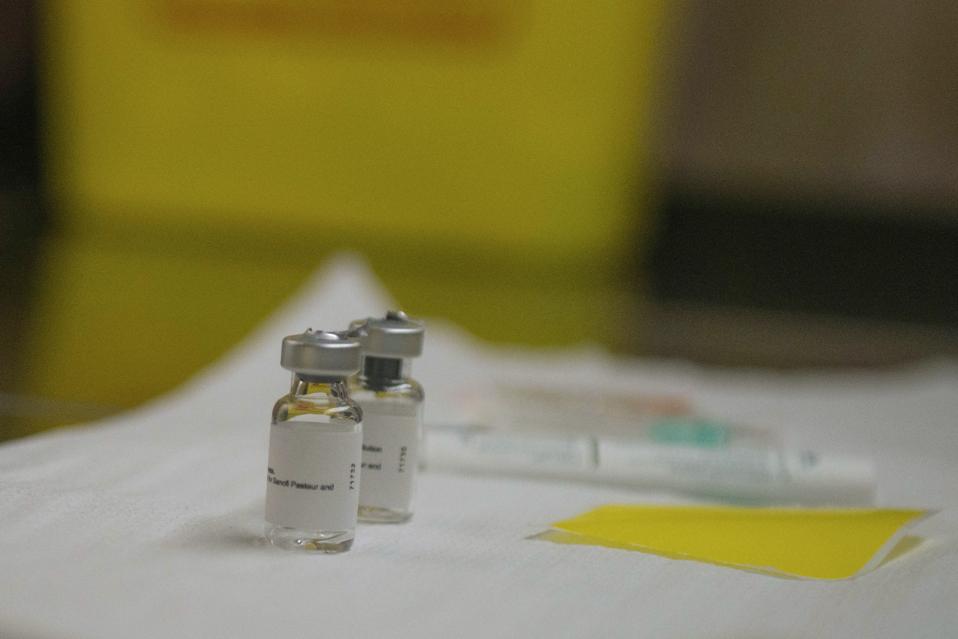
Pictured here are vials of the vaccine used in the HVTN 702 trial. (Photo credit should read MUJAHID … [+]
AFP VIA GETTY IMAGES
Another Reason for Optimism
By late 2020, we should have a much better sense of how at least two of these three trials are going. An additional reason for optimism is that the HVTN 702 trial is using a modified regimen and adjusted version of a vaccine candidate that showed some success in preventing HIV infections in the previous completed RV144 clinical trial. That trial, which had nothing to do with recreational vehicles, included over 16,000 study participants in Thailand and concluded in 2009. Although the findings were encouraging, showing the vaccine to reduce HIV infections by about 30%, scientists didn’t consider such a protection level high enough to merit moving forward with the vaccine as it was. They subsequently made changes bringing us to the vaccine and regimen that’s now part of HVTN 702.
Why Developing an HIV Vaccine Has Been So Challenging
While the world is closer to an HIV vaccine than it’s ever been, don’t forget that HIV is a tough, tough villain. HIV has a number of features that make it difficult to vaccinated against. One is that it doesn’t naturally stimulate enough of an immune response when it infects you. As Seth Berkley, CEO of Gavi, explained in this TED-Ed talk, HIV uses various methods to distract and hide from your immune system:
That has meant that scientists have had to find clever ways to prod your immune system to marshal its troops. Secondly, HIV is a bit like Loki or Mystique, coming in many different forms. An immune response against one form may not be effective against other forms. Third is lack of correlates of protective immunity. These are ways to measure your level of immunity against HIV. For example, if you want to check your immunity against the measles after vaccination, you can measure levels of antibodies in your blood to the measles virus. The equivalent is not there for HIV.
Finally, an HIV vaccine has to offer a high enough level of protectionc. After all, people may become more lax with other HIV prevention measures such as practicing safe sex if they believe the vaccine is supposed to offer a certain level of protection. Offering a vaccine with relatively low protective levels could be like giving you a set of clothes that may or may not dissolve. Thinking that you are fully clothed, you may blithely go to work or on a date, when, oops. A modeling study by Jan Medlock from the Carlson College of Veterinary Medicine at Oregon State University and Abhishek Pandey, Alyssa S. Parpia, Amber Tang, Laura A. Skrip, and Alison P. Galvani from the Yale School of Medicine and Yale School of Public Health and published in PNAS showed how a vaccine with 50% protective efficacy could help quell the HIV epidemic.
All of these challenges means that you should “wait for it” and see what actually happens with these three trials before making bold predictions about 2021. The world has never been closer to a real HIV vaccine. So there is indeed reason for optimism. HIV is a really tough foe, but if a vaccine can emerge that offers at least 50% protection against HIV infection along with being acceptably safe, 2021 could be legendary.