Roche (OTCQX:RHHBY)’s gantenerumab failed to demonstrate a statistically treatment effect in the same platform study, DIAN-TU, that also evaluated Eli Lilly’s solanezumab in people autosomal dominant Alzheimer’s disease (AD) (accounts for less than 1% of all AD cases).
Specifically, treatment with gantenerumab,
designed to bind to aggregated forms of beta-amyloid and remove
beta-amyloid plaques, did not slow the rate of cognitive decline
compared to placebo.
The data will be presented at the AAT-AD/PD Focus Meeting in April.
Thinly traded nano cap Valeritas Holdings (NASDAQ:VLRX) jumps 51% premarket on increased volume in reaction to Zealand Pharma A/S’s (NASDAQ:ZEAL) $23M cash offer under the terms of a “stalking horse” asset purchase agreement.
Valeritas, maker of a wearable insulin delivery
device called V-Go, filed for Chapter 11 bankruptcy protection
yesterday, February 9.
Eli Lilly (NYSE:LLY) slips 4% premarket on light volume in reaction to its announcement that solanezumab failed to achieve the primary endpoint in a Phase 2/3 platform trial, DIAN-TU, in people at risk for or with dominantly inherited Alzheimer’s disease (AD) (caused by rare gene mutations).
Results will be presented at the Advances in Alzheimer’s and Parkinson’s Therapies (AAT-AD/PD) Focus Meeting in April.
The company has come up empty with the candidate. In November 2016, a Phase 3 study, EXPEDITION3, failed as well.
Solanezumab is a monoclonal antibody that binds to a type of protein called amyloid beta after it is produced, allowing it to be cleared from the brain before forming amyloid plaques,
the accumulation of which is associated with AD. Drug candidates
targeting amyloid plaques have struggled to demonstrate a statistically
valid functional treatment benefit, however.
China-based voice-recognition technology firm iFlytek Co. (002230.SZ)
Monday said it has applied to the U.S. Department of Commerce seeking
an exemption from a ban to purchase medical supplies to stem the
coronavirus outbreak in China.
iFlytek was among several Chinese tech companies put on a U.S.
blacklist last year which bans American suppliers from exporting
U.S.-origin technology to them without a license.
iFlytek also said the U.S. ban has caused no significant impact on
its operations as it has shifted to Chinese suppliers after being
blacklisted by the U.S. https://www.marketscreener.com/IFLYTEK-CO-LTD-6500190/news/Iflytek-China-s-iFlytek-Seeks-Exemption-From-U-S-Ban-to-Buy-Medical-Supplies-29968029/
Five Wuhan university dorms were converted into quarantine centers for coronavirus patients as the city struggles to contain the disease.
Over the weekend, major cities such as Guangzhou, Shenzhen, and
Tianjin have joined a list of over 80 Chinese cities that have enacted
isolation measures to prevent the virus from spreading.
University Dorms
On Feb. 7, Hu Yabo, vice mayor of Wuhan City, where the virus first broke out, said
at a daily press conference that the city and provincial governments
would convert student dorms at four universities and the new campus of
the Hubei Province Communist Party training school, all located in
Wuhan.
In total, these colleges would supply 5,400 patient beds to quarantine coronavirus patients with mild symptoms.
Hu also said the city needs medical supplies desperately, including
41,400 protective suits, 56,800 N95 masks, and 19,200 goggles.
Netizens who said they were students at those universities began sharing photos
on social media, where workers can be seen pulling plastic tarp over
students’ beds and throwing students’ belongings onto the floor.
Students from Hanjiang University complained on social media that
they were not notified by the school that their dorms were going to be
converted into a quarantine center.
At 8:41 a.m. Feb. 8, the school announced the news on its official social media account. Many students commented under the post, complaining about the decision.
“Why use our dorm? Why don’t you use the stadium instead?,” said one
user. “Who can protect my belongings?,” another questioned. “How will
you disinfect our dorm before the new semester starts?,” another
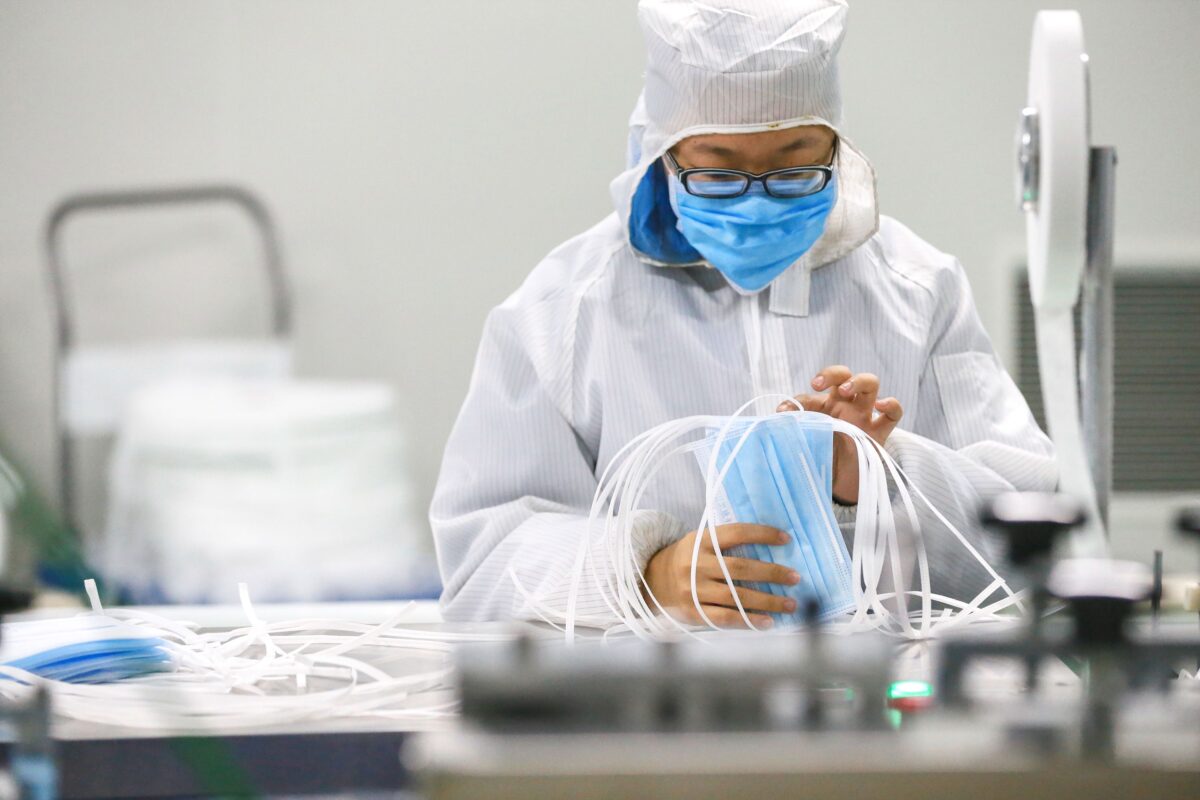
worried. A worker produces protective face masks at a factory in Qingdao, China on Feb. 6, 2020. (STR/AFP via Getty Images)
Isolation
Netizens have also shared
videos of conflicts between residents and security personnel, as many
Chinese in cities held under lockdown begin to feel frustrated that they
cannot move around freely.
More than 80 Chinese city governments have launched some form of quarantine measures.
The most strict one is in Huanggang
City, also located in Hubei Province. It shut down all public
transportation and private vehicles’ travel on roads. It also mandated
that only one person from each family household can go outdoors to shop
for basic necessities. In addition, that designated person can only go
out once every two days.
The most common rule issued by governments
is to close down residential areas and villages, but leave an emergency
passageway for residents to enter and leave the premises. The
passageway is guarded by security personnel; anyone who leaves or enters
the area must fill out a form and have their body temperatures scanned.
On Feb. 5 and 6, the northeastern province of Liaoning and Jiangxi Province in the east announced
that both locales will be quarantined—meaning residents will not be
allowed to attend social gatherings. In addition, only one person per
household can go outdoors, once every two days.
Quickly Spreading
Tianjin, one of the four directly-governed municipalities in China, issued isolation measures on Feb. 6, after a 66 year-old woman who shopped at a local department store died from the coronavirus.
Mao Jinsong, director of the Baodi district government in Tianjin, said
at a Feb. 7 press conference that 23 residents in the district have
been diagnosed or suspected to be coronavirus patients. They all visited
the same department store.
Mao added that roughly 9,200 people visited the store between Jan. 19
and Jan. 25, when the woman had visited. All 194 store staff are now
being isolated at a quarantine center, while the 9,200 store patrons
will be required to self-isolate at home.
In Jinjiang City of Fujian Province, more than 4,000 people are under
quarantine after they came into contact with an infected person.
According to Chinese state-run media, a man returned home to Fujian on Jan. 20 after visiting Wuhan, but lied and said he had come back from the Philippines. He attended several parties afterwards.
On Jan. 23, the man started to feel sick. He was diagnosed with the
coronavirus on Jan. 27. Seven people who had contact with him were also
diagnosed.
The son of a former top Chinese official told
the Chinese-language Epoch Times on Feb. 5 that some family members of
senior Party officials have been infected with the coronavirus and are
receiving treatment at the China-Japan Friendship Hospital in Beijing.
The 2019 Novel Coronavirus (2019-nCov) first broke out in Wuhan in
early December 2019. Tens of thousands have been infected within China,
while dozens of countries are also reporting cases. https://www.theepochtimes.com/more-than-80-chinese-cities-under-quarantine-due-to-coronavirus-as-wuhan-converts-school-dorms-into-isolation-centers_3231532.html
President Donald Trump is expected to release a $4.8 trillion budget
Monday that charts a path for the start of a potential second term,
proposing steep cuts to social-safety-net programs and foreign aid and
higher outlays for defense and veterans.
The plan would increase military spending 0.3%, to $740.5 billion for
fiscal year 2021, which begins Oct. 1, according to a senior
administration official. The proposal would cut nondefense spending by
5%, to $590 billion, below the level Congress and the president agreed
to in a two-year budget deal last summer.
A White House budget reflects an administration’s priorities and
represents the opening bid in spending negotiations for the next fiscal
year. The new budget is unlikely to become law, however, as Democrats
control the House and spending bills in the GOP-led Senate need
bipartisan support.
The White House proposes to cut spending by $4.4 trillion over a
decade. Of that, it targets $2 trillion in savings from mandatory
spending programs, including $130 billion from changes to Medicare
prescription-drug pricing, $292 billion from safety-net cuts — such as
work requirements for Medicaid and food stamps — and $70 billion from
tightening eligibility access to federal disability benefits. https://www.marketwatch.com/story/trumps-proposed-48-trillion-budget-will-seek-cuts-to-medicare-medicaid-2020-02-09?siteid=rss&rss=1