Here are seven updates on Franklin, Tenn.-based Community Health
Systems’ recent hospital divestitures, lawsuits and financial
performance reported by Becker’s Hospital Review since Jan. 1.
1. CHS fights securities fraud case: ‘There is not a whiff of evidence’
Community Health Systems and Quorum Health say there is no evidence to
support a lawsuit brought by shareholders alleging Quorum’s stock was
trading at an inflated price after its spinoff from CHS due to the
companies concealing financial information.
2. CHS buys more time for turnaround with $1B debt tender offer, Fitch says
Community Health Systems announced Jan. 23 that it will offer more than
$1 billion of senior secured notes due in 2025.CHS said it intends to
use the proceeds from
the $1.46 billion offering of notes to purchase outstanding senior
secured notes due in 2021, redeem all 2021 notes not tendered and pay
related fees and expenses.
3. CHS nears end of divestiture spree after shedding more than 90 hospitals
Community Health Systems has been busy selling, spinning-off and
closing hospitals over the past four years. CHS is near the end of its
hospital sell-off spree, according to the company’s presentation at
the J.P. Morgan Healthcare Conference in San Francisco on Jan. 15. CHS
officials said they expect the remainder of the divestitures to close by
mid-2020.
4. CHS shares surge after releasing preliminary financial results
Shares of Community Health Systems surged Jan. 15 after the company
offered a preliminary look at its 2019 financial results and provided
guidance for 2020.
5. CHS reaches $53M deal in class-action stock drop lawsuit
Community Health Systems agreed to pay $53 million to resolve a class-action lawsuit filed by pension funds and shareholders.
6. CHS pilots VR program to improve clinical leadership
A pilot program launching at Community Health Systems will use virtual
reality technology to strengthen clinical leadership in emergency
resuscitation situations.
7. CHS divests 3 Virginia hospitals, appoints new CFO
Community Health Systems no longer operates hospitals in Virginia after
selling three hospitals to Cincinnati-based Bon Secours Mercy Health.
https://www.beckershospitalreview.com/finance/7-updates-on-community-health-systems.html
Wednesday, February 12, 2020

6 hospital, health system construction projects costing $300M or more
Six hospitals and health systems have advanced, completed or started
facility expansions and renovations with price tags of $300 million or
more in the last two weeks:
1. Dell Children’s to invest $300M in upgrades, expansions
Austin, Texas-based Dell Children’s Medical Center plans to invest more than $300 million over the next three years to expand.
2. Mount Sinai Health System gets state OK on $1B campus upgrade
A state planning council has approved Mount Sinai Health System’s plan to invest $1 billion in facility upgrades and expansions in downtown New York City.
3. Oregon health system plans $1B in expansions
Medford, Ore.-based Asante Health System plans to invest $1 billion in renovation and construction projects across its network.
4. Rutgers to invest $750M in cancer pavilion, renovations
Rutgers Cancer Institute in New Brunswick, N.J., plans to invest $750 million to renovate portions of it and build a pavilion that will consolidate cancer services into one building.
5. Main Line Health plans $327M hospital modernization
Philadelphia-based Main Line Health plans to invest $327 million to upgrade Riddle Hospital in Media, Pa.
6. Seattle hospital proposing $1.7B in upgrades
A planning group for Seattle-based Harborview Medical Center has recommended $1.74 billion in upgrades for the hospital.
https://www.beckershospitalreview.com/facilities-management/6-hospital-health-system-construction-projects-costing-300m-or-more-2.html
1. Dell Children’s to invest $300M in upgrades, expansions
Austin, Texas-based Dell Children’s Medical Center plans to invest more than $300 million over the next three years to expand.
2. Mount Sinai Health System gets state OK on $1B campus upgrade
A state planning council has approved Mount Sinai Health System’s plan to invest $1 billion in facility upgrades and expansions in downtown New York City.
3. Oregon health system plans $1B in expansions
Medford, Ore.-based Asante Health System plans to invest $1 billion in renovation and construction projects across its network.
4. Rutgers to invest $750M in cancer pavilion, renovations
Rutgers Cancer Institute in New Brunswick, N.J., plans to invest $750 million to renovate portions of it and build a pavilion that will consolidate cancer services into one building.
5. Main Line Health plans $327M hospital modernization
Philadelphia-based Main Line Health plans to invest $327 million to upgrade Riddle Hospital in Media, Pa.
6. Seattle hospital proposing $1.7B in upgrades
A planning group for Seattle-based Harborview Medical Center has recommended $1.74 billion in upgrades for the hospital.
https://www.beckershospitalreview.com/facilities-management/6-hospital-health-system-construction-projects-costing-300m-or-more-2.html
Google Health now has more than 500 employees
Once scattered across the company, Google’s (GOOG, GOOGL)
healthcare projects are starting to come together under one team
working out of the Palo Alto offices formerly occupied by Nest, according to several employees.
The hope is that Google Health – which represents
the first major new product area at Google since hardware – will drive
revenues for the “new business” categories as growth slows at its core
digital advertising division.
Sundar Pichai has even said healthcare offers the
biggest potential for Alphabet to use artificial intelligence to improve
outcomes over the next decade.
https://seekingalpha.com/news/3540892-google-health-now-500-employeesU.S. judge drops some charges against Theranos’s Holmes, leaves wire fraud
A federal judge late on Tuesday dismissed some charges against Theranos Inc founder Elizabeth Holmes, but let stand wire fraud charges accusing her and an associate of misleading patients about the abilities of her company’s blood tests.
The court ruled that since the tests were paid by their medical
insurance companies the patients were not deprived of any money or
property in taking Theranos blood testing services.
It also said there was no evidence to show that Holmes and the company’s former president Ramesh “Sunny” Balwani directed doctors to make misrepresentations to their patients.
However, the federal court refused to dismiss the charge of wire fraud.
According to the indictment, Holmes and Balwani encouraged doctors and patients to use the company’s blood testing services even though they knew Theranos was not capable of consistently producing accurate and reliable results for certain blood tests.
Holmes and Balwani were indicted in June 2018 on 11 counts of conspiracy and wire fraud. They have pleaded not guilty.
Holmes, a Stanford University dropout, started Theranos at age 19. Questions were first raised about the accuracy and reliability of the company’s signature blood-testing device in a series of articles in the Wall Street Journal in 2015.
It also said there was no evidence to show that Holmes and the company’s former president Ramesh “Sunny” Balwani directed doctors to make misrepresentations to their patients.
However, the federal court refused to dismiss the charge of wire fraud.
According to the indictment, Holmes and Balwani encouraged doctors and patients to use the company’s blood testing services even though they knew Theranos was not capable of consistently producing accurate and reliable results for certain blood tests.
Holmes and Balwani were indicted in June 2018 on 11 counts of conspiracy and wire fraud. They have pleaded not guilty.
Holmes, a Stanford University dropout, started Theranos at age 19. Questions were first raised about the accuracy and reliability of the company’s signature blood-testing device in a series of articles in the Wall Street Journal in 2015.
https://www.marketscreener.com/news/U-S-judge-drops-some-charges-against-Theranos-s-Holmes-leaves-wire-fraud–29983421/?countview=0
Tuesday, February 11, 2020
With The New Coronavirus, Should You Avoid Large Meetings Like The MWC?
Novel mobile technology may be desirable. But a novel mobile virus? Not so much.
Concerns about the latter, namely the new coronavirus (2019-NCoV),
are apparently keeping some major tech companies like Amazon and Sony
from attending this year’s edition of the Mobile World Congress (MWC).
Indeed, what’s billed as “the largest mobile event in the world” may
not be so large this year if fears of infection keep enough people away.
So, the big question is, “Alexa, does this make sense? Are such fears
really founded? Is avoiding such mass gatherings now a good idea?”If you have somehow been on the toilet since mid-December 2019 without access to any mobile devices and are wondering “what outbreak,” here’s what’s been dominating the news: the ongoing 2019-NCoV outbreak. It started in Wuhan, China, at the end of last year and has already resulted in over 42,000 people being infected and over 1,000 dying. The rapid spread of this newly discovered and still rather mysterious virus has raised real legitimate concerns around the world. At the same time, it has sparked some unjustified panic, uncovered some, surprise, surprise, racism, and spawned a whole lot of misconceptions, as I described previously for Forbes.
The outbreak has also prompted Sony to make the following decision: “Sony has been closely monitoring the evolving situation following the novel coronavirus outbreak, which was declared a global emergency by the World Health Organization on January 30th, 2020. As we place the utmost importance on the safety and well-being of our customers, partners, media and employees, we have taken the difficult decision to withdraw from exhibiting and participating at MWC 2020 in Barcelona, Spain.”
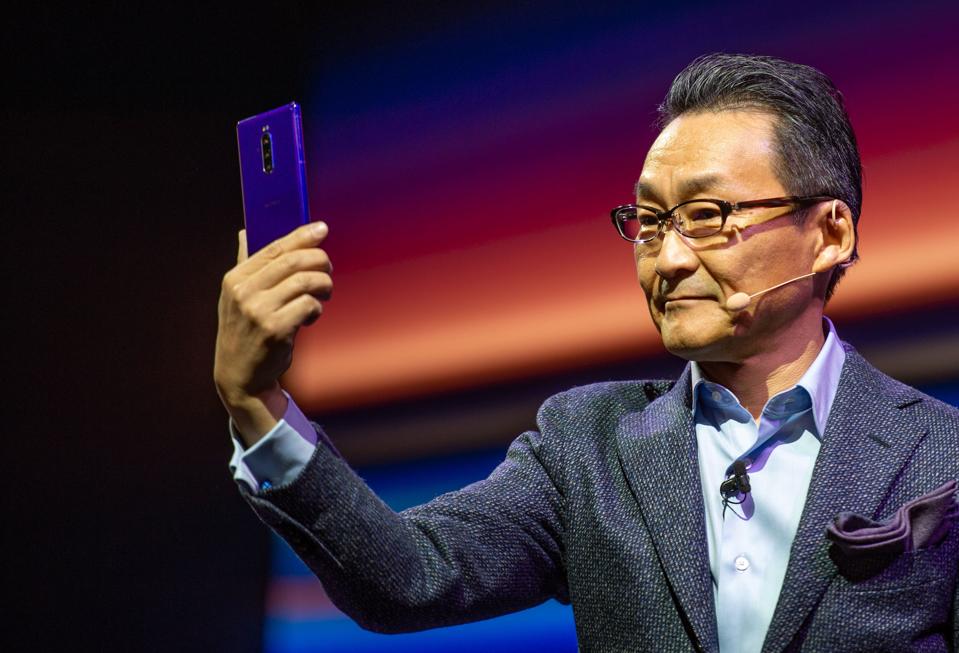
During last year’s Mobile World Congress, Mitsuya Kishida, head of Sony’s mobile division, presented … [+]
picture alliance via Getty ImagesFor example, one set of precautions will be trying to keep anyone who has a higher risk of being infected away from the event. This is reasonable as long as the screening criteria are scientifically-based and not something like “anyone who looks Asian.” Indeed, the screening criteria put forth by the GSMA are more based on a person’s history, which makes sense. If you are from China’s Hubei province, the epicenter of the outbreak, time to make other plans. You won’t be allowed into the MWC. That also applies if you’ve been in China, anywhere in China, within 14 days prior to the start of the MWC. That’s soon enough to be infected but not yet manifest symptoms.
Being from China shouldn’t be the only criteria, because after all the virus has spread beyond the country. Therefore, regardless of where you are from, you’ll still have to “self-certify” that you haven’t been in contact with anyone who’s infected. Oh, and if you are hot, meaning fever-wise and not looks-wise, routine temperature screening at the meeting may keep you from entering.
That’s not all. The GSMA has promised to do more cleaning and disinfecting than usual, especially in areas that get touched more often, and provide ways for attendees to clean and disinfect themselves. If you are wondering what this “wash your hands” thing is, the MWC will provide cleaning and hygiene reminders and training. Oh, and this should be welcome news if you’ve ever had to speak after a prior speaker “got to first base” with the microphone. The GSMA will have a “microphone disinfecting and change protocol for all speakers.” Yeah, having to use a moist microphone that smells like saliva isn’t too fun. All of these steps should become more standard at meetings in general.
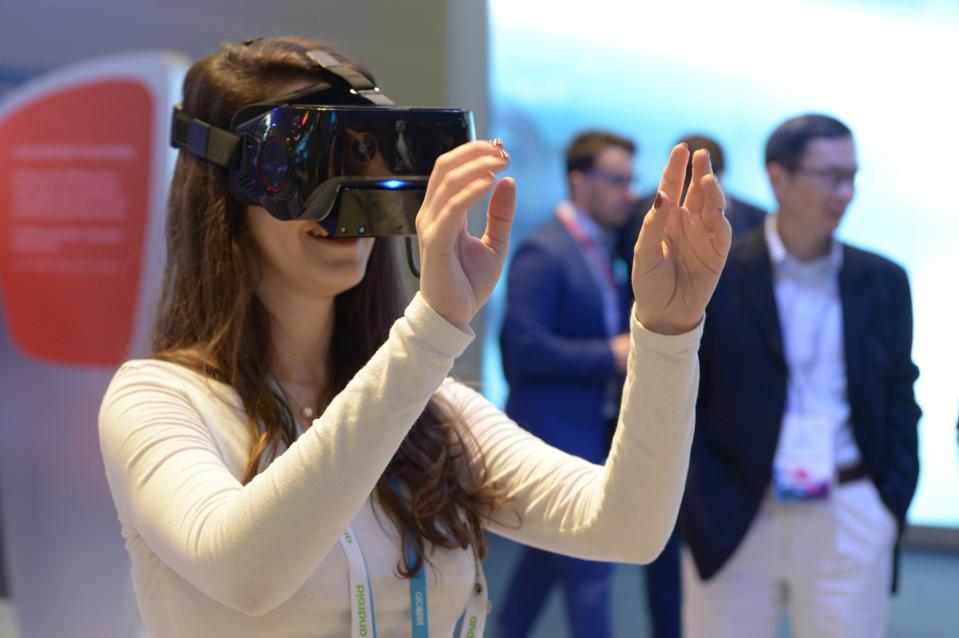
The MWC will include lots of product demos, which will then require proper cleaning and disinfecting … [+]
picture alliance via Getty ImagesAre all of these precautions comforting enough for you? Or will you go the way of Amazon and skip all such mass gatherings? Certainly, going to mass gatherings in Wuhan City would not be the wisest thing to do right now and may not even be possible given the quarantines that are occurring there. But, how about something like the MWC? If you haven’t figured it out from a map or your Uber app, Barcelona, Spain, is not right next to Wuhan, China. It is about 9,407 km away, which would be a really expensive Uber ride. The question then is should you avoid all mass gatherings, even those that are far, far away from the epicenter of the 2019-nCoV outbreak?
Well, let’s look at what’s actually happening with the outbreak. Sure, the 2019-nCoV has already spread beyond China as shown by the following AFP News Agency tweet :
And, yes, the numbers have been growing. But keep in mind, the vast majority of cases have still been in China. Twelve cases in the U.S., seven in Canada, four in Britain, 14 in Germany, one in Belgium, and 18 in Taiwan aren’t exactly huge numbers.
Plus, the MWC is far from the only mass gathering that will be occurring this month. Sporting events, church services, parties, massive Tinder gatherings, and other conferences will continue to bring together strangers to mix. For example, the World Clown Association Convention seems to be still on for early March. Surely, Amazon and other companies won’t be pulling their employees out of every meeting and gathering for all of February and beyond until the outbreak passes.
Are people more concerned about the MWC because of this statistic mentioned on the GSMA press release: typically 5-6% of all MWC attendees (that’s 5,000 to 6,000 people) have come from China? Perhaps. Remember, though, China has over 1.39 billion people living on a piece of land that is over 9.38 million square miles. While there have been over 40,000 cases of infection in China, that is still only a small fraction of all the people in China. Believing that everyone from China may be infected with 2019-nCoV would be like believing that everyone from America puts Tide Pods in their mouths, not that the two are related.
Additionally, avoiding or cancelling mass gatherings may not do a whole lot to slow or mitigate epidemics caused by highly contagious respiratory viruses like the 2019-NCoV. As long as other interactions are still occurring at workplaces, schools, and the community, viruses that can be transmitted via respiratory droplets can still find other venues to spread. Just look at what our computational modeling found during the 2009 H1N1 influenza pandemic. For example, a publication in BMC Public Health detailed a study that was a collaboration between our PHICOR team and a team that at the time was at Georgia Tech University (Pengyi Shi, PhD, Pinar Keskinocak, PhD, and Julie L Swann, PhD). The study entailed developing a computer model that simulated the population of Georgia (the state and not the country) and their daily activities and movements to and from different locations. Simulation experiments then introduced a novel flu virus into the population. No one had vaccine-induced immunity to this virus, which meant that the virus could spread rather rapidly, sort of like the new coronavirus but not exactly. We ran simulation experiments with and without canceling all mass gatherings at varying times. That’s all large meetings, concerts, and sporting events in the state of Georgia. In most situations, canceling such events did little to slow or reduce the spread of the virus. They proved useful only when the cancellations occurred within the 10-day time period before the peak of the epidemic occurred. In such cases, canceling such gatherings couldn’t really stop the epidemic but could decrease the number of people who get infected by as much as 10%.
At this point in time, with most of the cases still being in China, canceling or avoiding mass gatherings far away from the epicenter may not be the most effective way of preventing the spread of the virus. Instead, it’s probably better to have more universal adoption of the strategies outlined by the GSMA. Again, this includes identifying those who may be at greater risk for carrying the virus based on their history, enhanced cleaning and disinfecting, encouraging hand washing, and minimizing activities that may transfer the virus such as trading disgusting, spit-drenched microphones and dirty, dirty handshakes.
When determining whether to go to a mass gathering, look at all the risks. If you are still mixing with other people in other ways, you may not be really decreasing your risk of getting infected by that much. And currently, your risk of catching the 2019-NCoV is still pretty low if you are not close to Wuhan, China. Practicing good infection control measures and not staying weirdly close to people remain the best ways to protect yourself regardless of where you go. Like it or not, our world is already too heavily connected and mobile to make avoiding certain groups of people the smart thing to do.
https://www.forbes.com/sites/brucelee/2020/02/10/new-coronavirus-and-mobile-world-congress-withdrawals-should-you-avoid-mass-gatherings/#1617e08d4c73
Ligand to Acquire Icagen Assets, Partner Programs, Tech, Updates Outlook
Ligand Pharmaceuticals Incorporated (NASDAQ: LGND) announces
the signing of an agreement whereby Ligand will acquire the core assets
of Icagen, Inc.’s North Carolina operations, including partnered
programs, proprietary ion channel screening and assay platforms, x-ray
fluorescence capabilities, custom screening technologies and novel
unpartnered preclinical-stage molecules for $15 million in cash. Icagen
will also be entitled to receive up to an additional $25 million of cash
payments based on certain revenue achievements.
The acquired assets include Icagen’s partnered programs with Roche focused on neurological diseases, and with the Cystic Fibrosis Foundation (CFF) focused on cystic fibrosis. Ligand is also acquiring six Icagen preclinical-stage internal programs targeting diabetes, Parkinson’s disease, pain and other disorders.
“This is an ideal transaction for Ligand, providing a valuable technology platform with high-value partnerships within a cash-flow positive and profitable business. Icagen has built deep expertise focused on ion channels and transporters to support target identification and evaluation, and has an established track record in ion channel drug discovery from screening to lead optimization,” said John Higgins, Chief Executive Officer of Ligand. “We expect these capabilities will be synergistic across multiple technology platforms at Ligand, particularly with Vernalis and in novel OmniAb antibody discovery targeting ion channels and transporters. We are very pleased with how 2020 is starting, and we look forward to delivering more opportunities with investment in our business and further acquisitions.”
Richard Cunningham, Chief Executive Officer of Icagen, commented, “I am excited that Ligand will be continuing to advance the progress Icagen has made with our technologies, and am proud of our entire team’s accomplishments to date. In addition to the expertise in ion channel drug discovery, the expertise that Ligand is acquiring from Icagen in medicinal chemistry, in silico and computational chemistry will complement and expand the drug-discovery efforts currently ongoing at Ligand.”
This transaction is subject to certain closing conditions, including a vote of Icagen stockholders, and is expected to close in April 2020. Slides that provide additional information related to this transaction are available here on the Ligand website.
Including this acquisition, Ligand now expects 2020 total revenues to be $128 million, up from $121 million projected previously. This new guidance assumes approximately $7 million of revenue from the Icagen business in 2020. In 2020, adjusted earnings per diluted share is now projected to be $3.45, up from $3.40 previously.
The contribution of the acquired Icagen assets and business to Ligand is currently expected to increase in 2021, with revenues of approximately $12 million and adjusted earnings per diluted share of approximately $0.25.
https://www.ligand.com/news-events/press-releases/detail/405/
The acquired assets include Icagen’s partnered programs with Roche focused on neurological diseases, and with the Cystic Fibrosis Foundation (CFF) focused on cystic fibrosis. Ligand is also acquiring six Icagen preclinical-stage internal programs targeting diabetes, Parkinson’s disease, pain and other disorders.
“This is an ideal transaction for Ligand, providing a valuable technology platform with high-value partnerships within a cash-flow positive and profitable business. Icagen has built deep expertise focused on ion channels and transporters to support target identification and evaluation, and has an established track record in ion channel drug discovery from screening to lead optimization,” said John Higgins, Chief Executive Officer of Ligand. “We expect these capabilities will be synergistic across multiple technology platforms at Ligand, particularly with Vernalis and in novel OmniAb antibody discovery targeting ion channels and transporters. We are very pleased with how 2020 is starting, and we look forward to delivering more opportunities with investment in our business and further acquisitions.”
Richard Cunningham, Chief Executive Officer of Icagen, commented, “I am excited that Ligand will be continuing to advance the progress Icagen has made with our technologies, and am proud of our entire team’s accomplishments to date. In addition to the expertise in ion channel drug discovery, the expertise that Ligand is acquiring from Icagen in medicinal chemistry, in silico and computational chemistry will complement and expand the drug-discovery efforts currently ongoing at Ligand.”
This transaction is subject to certain closing conditions, including a vote of Icagen stockholders, and is expected to close in April 2020. Slides that provide additional information related to this transaction are available here on the Ligand website.
Including this acquisition, Ligand now expects 2020 total revenues to be $128 million, up from $121 million projected previously. This new guidance assumes approximately $7 million of revenue from the Icagen business in 2020. In 2020, adjusted earnings per diluted share is now projected to be $3.45, up from $3.40 previously.
The contribution of the acquired Icagen assets and business to Ligand is currently expected to increase in 2021, with revenues of approximately $12 million and adjusted earnings per diluted share of approximately $0.25.
https://www.ligand.com/news-events/press-releases/detail/405/
CDC releases nearly 200 Americans from quarantine
The Centers for Disease Control and Prevention (CDC) released 195
Americans from quarantine on Tuesday, two weeks after they were
evacuated from Wuhan, China, the epicenter of a coronavirus outbreak.
The individuals, who are mostly State Department employees and their family members, were quarantined at March Air Reserve Base in Riverside, Calif.
“Today is the 14th day of the quarantine of the individuals who were on the first charter flight returning from Wuhan province and they are currently being assessed to make sure they remain symptom-free, and then we hope they will be released to travel to their home today,” Dr. Anne Schuchat, principal deputy director of the CDC, told reporters Tuesday ahead of the release.
The State Department has evacuated more than 800 individuals from
China since the outbreak began last month. Many of those individuals
have been quarantined at military bases throughout the country.
More than 40,000 cases of the coronavirus have been confirmed throughout the world, with only 319 cases occurring outside of China.
Thirteen cases have been confirmed in the U.S., but 11 of those individuals had recently traveled to China.
The CDC has implemented a number of aggressive measures to prevent the virus from spreading in the U.S., including quarantining of Americans arriving from Wuhan and banning foreign nationals from entering the country if they have recently traveled within China.
These measures “[have] slowed the arrival of this virus” into the U.S., Schuchat said Tuesday.
https://thehill.com/policy/healthcare/482567-cdc-expects-to-release-nearly-200-americans-from-quarantine-tuesday
The individuals, who are mostly State Department employees and their family members, were quarantined at March Air Reserve Base in Riverside, Calif.
“Today is the 14th day of the quarantine of the individuals who were on the first charter flight returning from Wuhan province and they are currently being assessed to make sure they remain symptom-free, and then we hope they will be released to travel to their home today,” Dr. Anne Schuchat, principal deputy director of the CDC, told reporters Tuesday ahead of the release.
More than 40,000 cases of the coronavirus have been confirmed throughout the world, with only 319 cases occurring outside of China.
Thirteen cases have been confirmed in the U.S., but 11 of those individuals had recently traveled to China.
The CDC has implemented a number of aggressive measures to prevent the virus from spreading in the U.S., including quarantining of Americans arriving from Wuhan and banning foreign nationals from entering the country if they have recently traveled within China.
These measures “[have] slowed the arrival of this virus” into the U.S., Schuchat said Tuesday.
https://thehill.com/policy/healthcare/482567-cdc-expects-to-release-nearly-200-americans-from-quarantine-tuesday
Subscribe to:
Posts (Atom)