Search This Blog

Saturday, February 15, 2020

Corvus Updates Clinical Data from Phase 1b/2 Trial at ASCO GU 2020

Corvus Pharmaceuticals, Inc. (CRVS), a clinical-stage biopharmaceutical company focused on the development and commercialization of precisely targeted oncology therapies with biomarker patient enrichment selection, announced updated results from its Phase 1b/2 clinical trial of ciforadenant, an adenosine A2A receptor antagonist, in patients with metastatic castration resistant prostate cancer (mCRPC). The data were presented today in a poster presentation at the American Society of Clinical Oncology 2020 Genitourinary Cancers Symposium (ASCO-GU) in San Francisco by Lawrence Fong, M.D., study investigator and leader of the Cancer Immunotherapy Program at the University of California, San Francisco (UCSF) Helen Diller Family Comprehensive Cancer Center.
“We are pleased to see activity in mCRPC both with ciforadenant monotherapy and in combination with atezolizumab,” said Richard Miller M.D., chief executive officer of Corvus. “The results from this study and prior results reported with CPI-006, our anti-CD73 antibody, indicate that prostate cancer is another potential disease that is amenable to therapy with adenosine blockade. Many prostate cancers express CD73 and contain adenosine that is produced by multiple biochemical sources. Our recently published adenosine signature allows us to identify tumors where adenosine is playing an immunosuppressive role and where adenosine blockade may be clinically useful. We plan to pursue the mCRPC indication further and we anticipate additional data to be presented at the ASCO annual meeting in late May/June. Overall, these results continue to demonstrate our leading position in the development of agents targeting the adenosine pathway.”
https://finance.yahoo.com/news/corvus-pharmaceuticals-presents-updated-clinical-130010083.html

Bayer to Highlight Data of Expanding Cancer Portfolio at 2020 ASCO G

  • New data to be presented on the effect of Nubeqa® (darolutamide) on cerebral blood flow in men with non-metastatic castration-resistant prostate cancer (nmCRPC)
  • Presentations feature data on Xofigo® (radium Ra 223 dichloride), including real-world analyses and investigational combination therapies in men with certain types of prostate cancer
Bayer announced today data from the Company’s evolving oncology portfolio will be presented at the 2020 American Society of Clinical Oncology Genitourinary (ASCO GU) Cancers Symposium, taking place February 13-15, 2020 in San Francisco, California. The presentations across the latest research for Bayer’s marketed and pipeline therapies highlight the company’s ongoing commitment to exploring the potential of its therapies across different indications and treatment settings.
New data on the effect of Nubeqa® (darolutamide) on cerebral blood flow compared to enzalutamide in men with non-metastatic castration-resistant prostate cancer (nmCRPC) will be presented. Nubeqa, an androgen receptor inhibitor (ARi) jointly developed by Bayer and Orion Corporation, is approved in the U.S., Japan and Brazil, and recently received a positive CHMP opinion in the European Union (EU).
The research presented from Bayer’s prostate cancer portfolio will also include several presentations that feature real-world and combination studies with Xofigo® (radium Ra 223 dichloride) in men with certain types of prostate cancer. Among these is the first presentation of investigational data from a randomized Phase II study of sipuleucel-T (SipT) with or without Xofigo in men with asymptomatic metastatic castration-resistant prostate cancer (mCRPC).
https://finance.yahoo.com/news/bayer-highlight-data-expanding-cancer-130000706.html

ASCO GU 2020: Financial Toxicity and Quality of Life for Cancer Patients

As always, the Keynote Address is always a highly anticipated talk GU ASCO, and this year Dr. David Penson from Vanderbilt University provided an overview of financial toxicity and quality of among oncology patients.
Dr. Penson started by highlighting the goals of any new treatment for cancer, as quoted from Dr. Ian Tannock: We want the patient to live longer and better, and in the end what matters to patients is overall survival and quality of life. Defining quality of life is challenging as there are numerous definitions available in the literature but none that do a great job of capturing the concept. The National Cancer Institute’s definition of quality of life is “the overall enjoyment of life” – not exactly easy to measure. A relevant model to help define health-related quality of life is provided by Dr. Penson in the following figure:
ASCO GU 2020 health related quality of life model
The taxonomy of financial hardship in cancer is comprised of three arenas:
  1. Material conditions: for example, out-of-pocket expenses, missed work, reduced/lost income, and medical debt/bankruptcy
  2. Psychological response: for example, feeling of distress due to costs of cancer care, and concern about wages/income meeting expenses related to costs of cancer care
  3. Coping behaviors: for example, taking less of or skipping medication or delaying or missing a physician visit
Dr. Penson’s goals for his presentation are to (i) introduce the concept of financial toxicity in cancer therapy and make people aware of the negative impact this has on all patient-centered outcomes, and (ii) to review the financial toxicity of common GU malignancies. He hopes that we will be aware of the negative effects of financial toxicity of our therapies on quality of life, and that this will generate a desire to start a discussion with our patients around the cost of treatment and a willingness to understand their non-clinical financial situation. Furthermore, he hopes we think twice before ordering costly interventions which may have little impact on clinical course but large impact on the patient’s finances and quality of life.
The scope of the financial burden is that out-of-pocket costs are a side effect of medical care. In a study of data from the 2011 National Cancer for Health Statistics, Americans <65 years of age noted that 40-50% had financial burden from medical care, and was still 20-25% in those ≥65 years of age.1 Specific to financial toxicity of cancer survivors, data from the 2013-2016 National Health Interview Survey suggests that 16-27% of patients have problems paying their medical bills, 44-52% are worried about paying medical bills, and 9-14% delayed medical care secondary to financial worries. In Dr. Penson’s opinion, these data are only going to get worse.
When looking further at the median monthly out of pocket expenses, Dr. Penson highlighted a 2013 pilot study assessing the financial toxicity of cancer treatment.2 Among 254 participants, Zafar et al. conducted baseline and follow-up surveys regarding the impact of health care costs on well-being and treatment among cancer patients who contacted a national copayment assistance foundation along with a comparison sample of patients treated at an academic medical center. There were 75% of patients that applied for drug copayment assistance. Forty-two percent of participants reported a significant or catastrophic subjective financial burden, 68% cut back on leisure activities, 46% reduced spending on food and clothing, and 46% used savings to defray out-of-pocket expenses. Shockingly, to save money, 20% took less than the prescribed amount of medication, 19% partially filled prescriptions, and 24% avoided filling prescriptions altogether. Annual out-of-pocket costs do not fare much better. Among 1,409 Medicare beneficiaries (median age, 73 years [IQR 69-79 years]; 46.4% female and 53.6% male) diagnosed with cancer, the type of supplementary insurance was significantly associated with mean annual out-of-pocket costs incurred after cancer diagnosis:3
  • $2116 among those insured by Medicaid
  • $2367 among those insured by the Veterans Health Administration
  • $5976 among those insured by a Medicare health maintenance organization
  • $5492 among those with employer-sponsored insurance
  • $5670 among those with Medigap insurance coverage
  • $8115 among those insured by traditional fee-for-service Medicare but without supplemental insurance coverage
For Medicare beneficiaries, the Affordable Care Act (ACA) will close the Part D coverage gap (doughnut hole), which will reduce cost sharing from 100% in 2010 to 25% in 2020 for drug spending above $2,960 until the beneficiary reaches $4,700 in out-of-pocket spending. To assess this impact, Dusetzina and Keathing4 used the Medicare July 2014 Prescription Drug Plan Formulary, Pharmacy Network, and Pricing Information Files from the Centers for Medicare & Medicaid Services for 1,114 stand-alone and 2,230 Medicare Advantage prescription drug formularies. The average price per month for included medications was $10,060 (range, $5,123 to $16,093). In 2010, median beneficiary annual out-of-pocket costs for a typical treatment duration was $12,160 (IQR $12,102 to $12,262) for sunitinib. With the assumption that prices remain stable after the doughnut hole closes, beneficiaries will spend approximately $2,550 less. As such, out-of-pocket costs for Medicare beneficiaries taking orally administered anticancer medications are high and will remain so after the doughnut hole closes.
According to data from UNC Chapel Hill, financial toxicity is a possible cause of poor compliance. In a study of 134 bladder cancer patients, 33 (24%) endorsed financial toxicity (defined as “to pay more for medical care than you can afford”). Participants who were younger (p = 0.02), black (p = 0.01), reported less than a college degree (p = 0.01) and had noninvasive disease (p = 0.04) were more likely to report financial toxicity.5 Patients who endorsed financial toxicity were more likely to report delaying care (39% vs 23%, p = 0.07) due to the inability to take time off work or afford general expenses. Furthermore, those with financial toxicity reported worse physical and mental health (p = 0.03 and <0.01, respectively), and lower cancer specific health related quality of life (p = 0.01), physical well-being (p = 0.01) and functional well-being (p = 0.05). In a study looking at the impact of cancer on a patient’s net worth and debt, Gilligan et al.6 assessed 9.5 million estimated new diagnoses of cancer from 2000-2012. At two years after diagnosis, 42.4% depleted their entire life’s assets, with higher adjusted odds associated with worsening cancer, requirement of continued treatment, demographic and socioeconomic factors (ie, female, Medicaid, uninsured, retired, increasing age, income, and household size), and clinical characteristics (ie, current smoker, worse self-reported health, hypertension, diabetes, lung disease). The average losses were $92,098. At four years past diagnosis, financial insolvency extended to 38.2%, with several consistent socioeconomic, cancer-related, and clinical characteristics remaining significant predictors of complete asset depletion.
Financial toxicity also affects general quality of life. Data from the 2011 Medical Expenditure Panel Survey suggested that among 19.6 million cancer survivors (1,329 patients completed the survey), 28.7% reported at least one financial problem.7 Furthermore, 7.6% borrowed money, 11.5% could not afford to cover the cost of medical care visits, and 20.9% worried about paying their medical bills. Financial toxicity is also associated with worse survival. Looking at data from the Western Washington SEER registry (1995-2009) linked to federal bankruptcy records, patients who filed for bankruptcy were more likely to be younger, female, and nonwhite, to have local- or regional- (vs distant-) stage disease at diagnosis, and have received treatment.8 After propensity score matching, 3,841 patients remained in each group (bankruptcy v no bankruptcy). The adjusted hazard ratio for mortality among patients with cancer who filed for bankruptcy versus those who did not was 1.79 (95% CI, 1.64-1.96). Hazard ratios varied by cancer type, including colorectal, prostate, and thyroid cancers with the highest hazard ratios. Importantly, excluding patients with distant-stage disease from the models did not have an effect on results.
According to Dr. Penson, we have an opportunity to communicate costs to our patients. Looking at the breast cancer literature, 2,293 members of the American Society of Breast Surgeons were surveyed, with a 25% response rate [9]. Shockingly, only 6% of providers included out-of-pocket costs among the top three most influential factors in clinical decision making. As follows is the reasons for why providers were hesitant to discuss the impact of out-of-pocket cost:
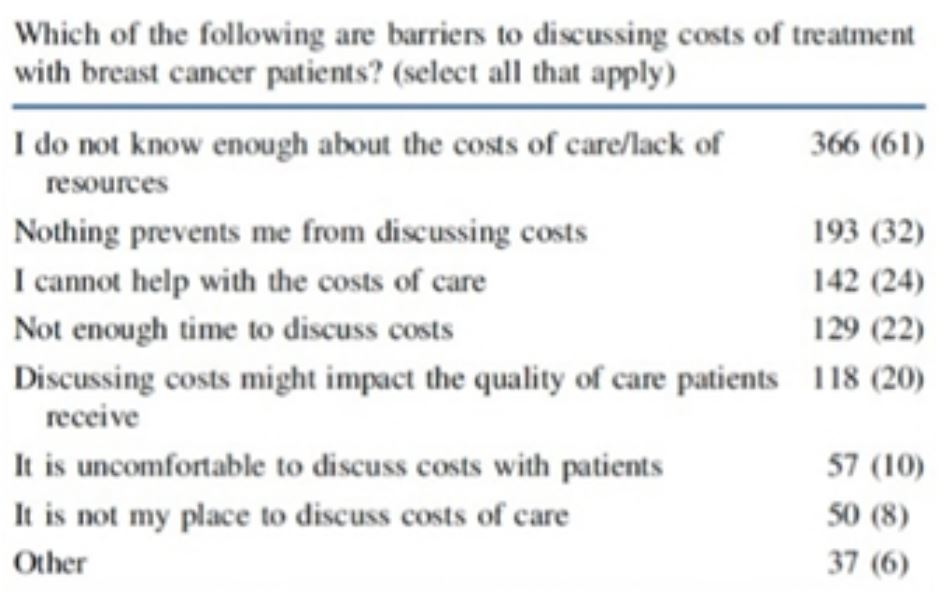
ASCO GU 2020 impact of out of pocket cost table
Summarizing the financial toxicity among all cancer patients, Dr. Penson highlighted the following points:
  • The scope of the problem is greater than many providers appreciate
  • Patients cope by avoiding necessary care to save money, and/or going into debt
  • Financial toxicity has a negative impact on other clinical outcomes
  • Cost communication is not routinely part of the doctor-patient interaction
  • We need to start by: acknowledging the problem, learning more about costs so we can inform our patients, begin a discussion of financial toxicity with patients, and include financial toxicity as a potential adverse event in future studies and in shared decision-making discussions.
Dr. Penson then discussed the highlighted each of prostate, bladder and kidney cancer and the impact of financial toxicity, starting with prostate cancer. A study from 2010 assessed out-of-pocket costs among 512 patients newly diagnosed with prostate cancer and undergoing either radical prostatectomy or radiation therapy.10 Participants completed self-reported generic and prostate-specific HRQoL and indirect-cost surveys at baseline and at 3, 6, 12, and 24 months follow-up. Total mean out-of-pocket costs varied between radical prostatectomy and EBRT groups at 3-month ($5576 vs. $2010), 6-month ($1776 vs. $2133), 12-month ($757 vs. $774), and at 24-month follow-up ($458 vs. $871). Linear mixed models indicated that radical prostatectomy was associated with lower medication costs (OR 0.61, CI 0.48-0.89) and total out-of-pocket costs (OR 0.71, CI 0.64-0.92). Prostate-specific HRQoL items of urinary function (OR 0.72; adjusted-CI = 0.58-0.84), bowel function (OR 0.96; adjusted-CI = 0.78-0.98), sexual function (OR 0.85; adjusted-CI = 0.72-0.92), urinary bother (OR 0.79; adjusted-CI = 0.67-0.83), and sexual bother (OR 0.88; adjusted-CI = 0.76-0.93) were inversely related to out-of-pocket costs. Surgical approach may be a way to temper cost, as robotic prostatectomy has been associated with a $138 decreased out of pocket cost to the patient compared to open radical prostatectomy. Importantly, this is not a problem among prostate cancer patients unique to the United States: both Australia and Canada have reported financial toxicity among prostate cancer patients.
Indeed, bladder cancer is an expensive disease to treat, with an annual cost of nearly $4 billion per year, however little is known about the financial toxicity among bladder cancer patients. As mentioned earlier in the talk, the UNC study5 showed that 24% of patients endorsed financial toxicity (defined as “to pay more for medical care than you can afford”). Participants who were younger (p = 0.02), black (p = 0.01), reported less than a college degree (p = 0.01) and had noninvasive disease (p = 0.04) were more likely to report financial toxicity. Beyond this one study, Dr. Penson notes that there are no other studies assessing financial toxicity in this expensive, complex, morbid disease.
According to Dr. Penson, kidney cancer financial toxicity is all about the drugs. Over the past two decades, there has been an explosion of new therapies for renal cell carcinoma. These drugs have inherently changed the way we approach the disease and have resulted in benefit in terms of prolonging survival. These agents, however, are quite costly with annual wholesale costs of these agents ranging from $75,000 to $200,000 per year. The risk of financial toxicity in this setting is considerable and often not considered in medical decision making. While other components in healthcare will contribute to financial toxicity, Dr. Penson believes that the drugs are the key drivers here. A study from 2015 assessed the associated costs for mRCC in the US using the LifeLink Health Plan Claims Database.11 A total of 1,527 mRCC patients were analyzed; in 2010, nine unique treatment regimens were used for first-line treatment, 8 for second-line treatment, and 8 for third-line treatment. For 767 patients receiving modern therapy who were < 65 years old, and stratifying by whether the first-line treatment was oral or intravenous, drug cost per patient with ancillary services was $59,664 versus $86,518, respectively (p = 0.001). Total costs and drug out-of-pocket costs per patient during the first year increased by the number of medication switches: $111,680 to $2355 for no switches, $149,994 to $2538 for 1 switch, and $196,706 to $3524 for 2 or more switches. Impressively, in 2004 the median drug cost was $11,458, while by 2010 it rose to $68,660.
Dr. Penson concluded this talk on financial toxicity with the following summary points:
  • Financial toxicity should be considered an adverse event of therapy, similar to other side effects of treatment
  • This patient-centered endpoint can have a profound effect on our patient’s quality of life and daily existence
  • While perhaps not completely avoidable, financial toxicity and its effect on our patients must be minimized
How can we help minimize financial toxicity?
  • Discuss it upfront with our patients, creating an environment where it is acceptable to talk about it. If you don’t know the specifics, identify someone in your institution that dose
  • Treat financial toxicity as another possible side effect when undertaking shared-decision making
  • Think about the financial impact on the patient before you – do not order discretionary testing or follow-ups that may not change management, and do not initiate therapies that may have little or no proven clinical benefit to the patient
  • Consider the cost to the patient when choosing medical therapy for GU cancers
Presented by: David Penson, MD, MPH, Vanderbilt University, Nashville, Tennessee
Written By: Zachary Klaassen, MD, MSc – Assistant Professor of Urology, Georgia Cancer Center, Augusta University/Medical College of Georgia @zklaassen_md at the 2020 Genitourinary Cancers Symposium, ASCO GU #GU20, February 13-15, 2020, San Francisco, California
References:
1. Ubel PA, Abernethy AP, Zafar SY. Full disclosure—out-of-pocket costs as side effects. N Engl J Med 2013 Oct 17;369(16):1484-1486.
2. Zafar SY, Peppercorn JM, Schrag D, et al. The financial toxicity of cancer treatment: A pilot study assessing out-of-pocket expenses and the insured cancer patient’s experience. Oncologist 2013;18(4):381-390.
3. Narang AK, Nicholas LH. Out-of-pocket Spending and Financial Burden Among Medicare Beneficiaries with Cancer. JAMA Oncol 2017 Jun 1;3(6):757-765.
4. Dusetzina SB, Keating NL. Mind the Gap: Why closing the Doughnut Hole is Insufficient for Increasing Medicare Beneficiary Access to Oral Chemotherapy. J Clin Oncol 2016 Feb 1;34(4):375-380.
5. Casilla-Lennon MM, Choi SK, Deal AM, et al. Financial toxicity among patients with bladder cancer: Reasons for Delay in Care and Effect on Quality of Life. J Urol 2018 May;199(5):1166-1173.
6. Gilligan AM, Alberts DS, Roe DJ, et al. Death or Debt? National Estimates of Financial Toxicity in Persons with Newly-Diagnosed Cancer. Am J Med 2018 Oct;131(10):1187-1199.
7. Kale HP, Carroll NV. Self-reported financial burden of cancer care and its effect on physical and mental health-related quality of life among US cancer survivors. Cancer 2016 Apr 15;122(8):283-289.
8. Ramsey SD, Bansal A, Fedorenko CR, et al. Financial Insolvency as a Risk Factor for Early Mortality Among Patients with Cancer. J Clin Oncol 2016 Mar 20;34(9): 980-986.
9. Greenup RA, Rushing CN, Fish LJ, et al. Perspectives on the costs of cancer care: A Survey of the American Society of Breast Surgeons. Ann Surg Oncol 2019 Oct;26(10):3141-3151.
10. Jayadevappa R, Schwartz JS, Chhatre S, et al. The burden of out-of-pocket and indirect costs of prostate cancer. Prostate 2010 Aug;70(11):1255-1264.
11. Geynisman DM, Hu JC, Liu L, et al. Treatment patterns and costs for metastatic renal cell carcinoma patients with private insurance. Clin Genitourin Cancer 2015 Apr;13(2):e93-100.
https://www.urotoday.com/conference-highlights/asco-gu-2020/asco-gu-2020-bladder-cancer/119188-asco-gu-2020-financial-toxicity-and-quality-of-life-understanding-and-improving-patient-centered-outcomes-in-genitourinary-malignancies.html

ASCO GU 2020: Proton Pump Inhibitors- Prostate Cancer Specific Death Link

Proton pump inhibitors (PPIs) are a commonly prescribed class of medications. Although in-vitro and in-vivo data have shown PPIs to have anti-tumor effects, more recent studies suggest an increased cancer risk in several solid organs, including an association with increased risk of gastric, colorectal, pancreatic, and prostate cancer. Pantoprazole, a commonly prescribed PPI, has been shown to harbor a protective effect in human prostate cancer cells. Presented during the Prostate Cancer Session at the 2020 American Society of Clinical Oncology Genitourinary Cancers Symposium (ASCO GU), Hanan Goldberg, MD reported results assessing the effect of pantoprazole and other PPIs on prostate cancer-specific death and additional prostate cancer outcomes.
This study was a retrospective, population-based cohort study of data incorporated from the Institute for Clinical and Evaluative Sciences in Ontario, Canada to identify all men aged 66 and above with a history of a single negative prostate biopsy between 1994 and 2016. In Ontario, medication prescriptions are freely available to everyone 65 years and older through the Ontario Drug Benefit program, allowing accurate capture of all provided prescriptions in this population. The authors used multivariable Cox regression models with time-dependent covariates, to assess the effect of PPIs on prostate cancer diagnosis, androgen deprivation therapy (ADT) use, and prostate cancer-specific death. All models included other medications with a putative effect on prostate cancer. All models were adjusted for age, rurality, comorbidity, and year of patient study inclusion.
This study included 21,512 men with a mean follow-up time of 8.06 years (SD 5.44 years). A total of 10,999 patients (51.1%) used a PPI during the study period with 4,377 patients using pantoprazole and 6,622 patients using other PPIs. A total of 5,187 patients (24.1%) were diagnosed with prostate cancer, 2,043 patients (9.5%) were treated with ADT, and 805 patients (3.7%) died from prostate cancer. Pantoprazole was associated with a 3.0% (95% confidence interval [CI] 0.3%-6,0%) increased rate of being treated with ADT for every six months of cumulative use, while any use of all other PPIs was associated with a 39.0% (95% CI 18.0%-64.0%; hazard ratio [HR] 1.39, 95% CI 1.18-1.64) increased prostate cancer-specific mortality. No significant association was found with a prostate cancer diagnosis. The following graph depicts the percentage of prostate cancer diagnosis, any use of ADT, and prostate cancer-specific death, stratified by age:
the percentage of prostate cancer diagnosis
Dr. Goldberg acknowledged several limitations of this study, including (i) this study being a retrospective population-based analysis with its inherent selection bias and health administrative database associated inaccuracies, (ii) the data being limited to men older than 66, and containing 20-year old data, (iii) lacking information regarding ethnicity, disease stage and grade, pertinent family history, and personal genetic risk, (iv) the risk of unaccounted residual confounding.
Dr. Goldberg concluded this epidemiological study assessing PPI and association with prostate cancer outcomes with the following conclusions:
  • In prostate cancer patients, use of PPIs was associated with increased prostate cancer-specific mortality (PCSM)
  • The reported potential long-term impact of these medications on prostate cancer outcomes need to be confirmed in additional studies
  • If these findings are validated, the broad use of PPIs in prostate cancer patients may need to be reconsidered
Presented by: Hanan Goldberg, MD, Urology Department, SUNY Upstate Medical University, Syracuse, New York, New York
Co-Authors: Faizan Moshin, Refik Saskin, Girish S. Kulkarni, Alejandro Berlin, Miran Kenk, Christopher J.D. Wallis, Thenappan Chandrasekar, Zachary Klaassen, Olli Saarela, Linda Penn, Shabbir M.H. Alibhai, Neil Eric Fleshner; Department of Urology, SUNY Upstate, Syracuse, NY; Dalla Lana School of Public Health, University of Toronto, Toronto, ON, Canada; Institute for Clinical Evaluative Sciences, Toronto, ON, Canada; Division of Urology, Princess Margaret Cancer Center, University Health Network, University of Toronto, Toronto, ON, Canada; Radiation Medicine Program, Princess Margaret Cancer Centre, University Health Network, Toronto, ON, Canada; Princess Margaret Cancer Centre, University Health Network, Toronto, ON, Canada; Division of Urology, Princess Margaret Cancer Centre, University Health Network, University of Toronto, Toronto, ON, Canada; Department of Urology, Thomas Jefferson University, Philadelphia, PA; Division of Urology, Medical College of Georgia at Augusta University, Georgia Cancer Center, Augusta, GA; University of Toronto, Toronto, ON, Canada; Princess Margaret Cancer Centre, Toronto, ON, Canada; Princess Margaret Hospital, University Health Network, Toronto, ON, Canada; Division of Urologic Oncology, Princess Margaret Cancer Centre, University Health Network, Toronto, ON, Canada
Written by: Zachary Klaassen, MD, MSc, Assistant Professor of Urology, Georgia Cancer Center, Augusta University/Medical College of Georgia, Twitter: @zklaassen_md at the 2020 Genitourinary Cancers Symposium, ASCO GU #GU20, February 13-15, 2020, San Francisco, California
https://www.urotoday.com/conference-highlights/asco-gu-2020/asco-gu-2020-prostate-cancer/119138-asco-gu-2020-the-deleterious-association-between-proton-pump-inhibitors-and-prostate-cancer-specific-death.html

China factories try for back to normal as virus persists, far from business as usual

  • In many parts of China, businesses were scheduled to resume work this past Monday, but a variety of data indicates progress has been slow as the virus remains an unresolved concern.
  • “The lockdown measures, together with the substantial extension of the (Lunar New Year) holiday, have significantly delayed resumption of business and production,” Ting Lu, chief China economist at Nomura, said in an email Friday.
  • “Even though a significant share of China’s manufacturing plants have resumed operation this week, many plants are still operating at far below capacity due to labour force shortages,“ Rajiv Biswas, APAC chief economist, IHS Markit, said in an email Friday.
Two weeks after the Lunar New Year holiday was originally supposed to end, Chinese businesses are still getting up to speed as the country deals with disruptions from a highly contagious virus.
The new coronavirus that began to grab national attention in mid-January has killed more than 1,300 people in mainland China. More than half of the provinces delayed the resumption of work from the first week of February by at least a week in an effort to keep people from interacting and spreading the virus.
In many places, businesses were scheduled to resume work this past Monday, but a variety of data indicates progress has been slow as the virus remains an unresolved concern. Many local governments have also imposed strict restrictions on entering certain areas and requiring quarantines of at least two weeks for people who have returned from out-of-town.
“The lockdown measures, together with the substantial extension of the (Lunar New Year) holiday, have significantly delayed resumption of business and production,” Ting Lu, chief China economist at Nomura, said in an email Friday.
He noted that given unique factors in China’s political economic system, many local government officials are making containment of the virus the top priority. “Poor coordination among local governments leads to excessive roadblocks which result in logistical nightmare for most enterprises,” Lu said, adding that there’s still a severe shortage of the face masks needed for employees to resume work at factories and offices.
In other cases, people are working from home. Shenzhen-based Tencent extended its work-from-home mandate until the end of Friday, Feb. 21. Beijing-based artificial intelligence company Megvii has told employees to work remotely until Monday, Feb. 17.
Here’s a look at what some data indicates about China’s economic activity so far:
Daily power coal consumption of six major power generation groups on Wednesday was 42.2% lower from the same post-Lunar New Year holiday period last year, Morgan Stanley economist Robin Xing and his team pointed out in a note Thursday. That’s up 3% from the prior day.
As of Monday, work had resumed at just over half, or 57.8%, of coal mines, according to data from 22 key provinces disclosed by Cong Liang, secretary general, member of the leading party group of the National Development and Reform Commission.
The number of people who have returned to major Chinese cities remains at about a quarter what it was a year ago, according to Lu’s analysis of data from Baidu, an operator of a major map app and other apps. Cities with a low return rate include Guangzhou, the capital of China’s largest province by exports.
The Lunar New Year marks a rare period of the year in China when the majority of businesses are closed and millions of people return to their hometowns for about a week or more. This year, authorities have encouraged people to stay put or return to their places of work in phases.
“Even though a significant share of China’s manufacturing plants have resumed operation this week, many plants are still operating at far below capacity due to labor force shortages,“ Rajiv Biswas, APAC chief economist at IHS Markit, said in an email Friday.
“Many migrant workers have still not been able to return to their workplace due to lockdowns of some cities as well as quarantine requirements for workers moving from one town to another,” he said. “This is likely to heavily disrupt industrial output for the remainder of Q1 2020.”
There’s also the worry that resuming operations at this point could lead to more infections, and further halts to business operations.
In southwestern China, a factory belonging to Pangang Chongqing Titanium Industry had to close after three workers were infected on Monday, Feb. 10, the industrial park confirmed in a phone call, noting about 130 people were in close contact with the three confirmed cases. The factory is now under quarantine, and a notice from the committee said the company did not fully comply with virus prevention procedures before resuming production.

E-commerce merchants get hit

Technology and e-commerce giant Alibaba gave a glimpse into how far-reaching the disruptions are in its earnings call on Thursday.
“Merchant operations have not returned to normal and a significant number of packages were not able to be delivered on time,” CEO Daniel Zhang said of the two weeks since the holiday, according to a transcript seen by CNBC.
The company’s CFO Maggie Wu added that while it’s too early to quantify the impact of the virus, it would likely negatively hit overall revenue growth for the March quarter.
On Monday, Alibaba announced an array of financial measures and other benefits to support affected merchants. The moves echo a slew of supportive polices from the national and local governments for helping privately run, smaller businesses, which contribute to more than half of economic growth in China but often operate at a disadvantage in the state-dominated system.
To emphasize the severity of the situation, Nomura’s Lu pointed to a recent survey released Wednesday by the Postal Savings Bank of China and Economic Daily, which said more than 90% of the more than 2,200 small and medium-sized enterprises surveyed have delayed their resumption of business.
About half of the respondents have pushed back the beginning of work for more than two weeks, and a “considerable proportion” have not decided when to resume operations, Lu pointed out.
More concerning for China’s longer-term growth is that more than half of the businesses surveyed said they would likely not be able to survive for three months on their current level of capital if the virus persists.
Last week, Moody’s issued a report noting that the spread of the virus is a credit negative for Chinese banks, given the greater potential for increased loan delinquencies.
“If you just look at the virus, of course it has a negative impact on asset quality and China’s economic growth,” Yulia Wan, vice president and senior analyst at Moody’s Investors Service, said in a phone interview this week, according to a CNBC translation of her Mandarin-language remarks.
But she also noted the significant number of new, targeted government support policies. Like other analysts, Wan said it’s how long the virus persists that will ultimately determine how significant its impact will be.
https://www.cnbc.com/2020/02/14/china-coronavirus-its-still-far-from-business-as-usual.html

Sanders faces rare union opposition in Nevada over ‘Medicare for All’

Sen. Bernie Sanders‘s (I-Vt.) support for his signature “Medicare for All” proposal has created an unexpected divide between the White House hopeful and his usually reliable labor union base.
Sanders faces scrutiny from the powerful Nevada Culinary Workers Union, which is warning that his goal of overhauling the nation’s health care system would put an end to private plans for union members.
But the labor group stopped short of endorsing one of Sanders’s Democratic rivals. On Thursday, the union declined to back a candidate, leaving the field wide open for the remaining contenders heading into the state’s Feb. 22 caucuses.
Union Secretary-Treasurer Geoconda Argüello-Kline did not directly attack Sanders when pressed repeatedly at a press conference, saying only that the union believes people have the right to make their own health care choices.
The union is a key force in elections in the state and is a highly sought-after endorsement on the road to the White House. The labor group for hospitality workers has a reputation for funding a massive turnout effort and can be a game changer, especially for a candidate seeking support from Latino voters.
On the flip side, any negative messaging from the group could pose a setback for a campaign.
The union endorsed then-Sen. Barack Obama (D-Ill.) ahead of the state’s 2008 caucuses, but did not endorse a candidate in 2016. Former Secretary of State Hillary Clinton won the caucuses in 2016, with Sanders a close second at 47 percent.
While the union has once again decided against endorsing a candidate, Sanders nonetheless took a hit.
Earlier this week, the Culinary Union distributed a flyer to its 60,000 members that said his health care plan would “End Culinary Healthcare.” Under Medicare for All, private health insurance would be replaced across the board with a government-run plan.
The Culinary Union drew swift backlash online from Sanders supporters, so much so that the group issued a statement on Wednesday denouncing the candidate’s backers for “viciously” attacking the union.
That, in turn, prompted many of Sanders’s opponents to seize momentum on the public feud.
“I stand with the working men and women of @Culinary226 because supporting labor means supporting our unions,” tweeted former Vice President Joe Biden, an opponent of Medicare for All.
Fellow moderates Sen. Amy Klobuchar (D-Minn.) and former South Bend, Ind., Mayor Pete Buttigieg, fresh off strong showings in the New Hampshire primary, also jumped to the union’s defense.
“I stand with @Culinary226 and let’s be clear: attacks on the union are unacceptable. I come from a family of proud union members and I know when unions are strong, America is strong,” Klobuchar tweeted.
Buttigieg, meanwhile, took the opportunity to appeal to unions and promote his own health plan.
“There are 14 million union workers in America who have fought hard for strong, employer-provided health benefits,” Buttigieg tweeted. “Medicare for All Who Want It protects their plans and union members’ freedom to choose the coverage that’s best for them.”
Even Tom Steyer joined the fray on Thursday, releasing a statement calling on Sanders to disclose the price tag of Medicare for All. Steyer said his own proposal would “protect the the health plans that unions have fought hard to secure for their members, especially here in Nevada.”
Sanders has been trying to smooth over some of the tensions between the union and his supporters ever since news of the union’s flyer was first reported by the Nevada Independent.
Sanders’s campaign initially responded to the flyer by saying it was incorrect and that Medicare for All coverage would be as good or better than what unions currency receive.
Sanders has noted his Medicare for All bill includes a provision that would enable companies to push savings they obtain from Medicare for All to workers in the form of either higher wages or other benefits. But some unions have been skeptical.
In an interview with MSNBC’s Chris Hayes on Wednesday, Sanders touted his labor bona fides.
“I have a lot more union support than Pete Buttigieg has or I think ever will have,” Sanders said, adding that “many, many unions in this county … absolutely understand that we have to move to Medicare for All.”
Sanders said in a statement the following day that he agreed with the Nevada union’s key goals.
“As someone who has the strongest lifetime pro-labor record of anyone in Congress, I would never do anything to diminish the health care that unions and workers have fought for,” he said.
Sander also addressed the online harassment from some of his supporters.
“Harassment of all forms is unacceptable to me, and we urge supporters of all campaigns not to engage in bullying or ugly personal attacks,” he said. “We can certainly disagree on issues, but we must do it in a respectful manner.”
Sanders enjoys the most labor support of all the 2020 Democratic candidates, with more than 15 endorsements, including National Nurses United and Postal Workers Union, as well as a handful of local chapters of Unite Here, the national organization of Nevada’s Culinary Union.
National Nurses Union cited the Medicare for All plan as one of the reasons for its endorsement.
Yet while some unions have supported the ambitious health care overhaul, others are not on board.
The Culinary Union plays a unique role in its members’ health care, and there are concerns about the role it would play under a Medicare for All system.
Union members receive insurance through a nonprofit trust, funded mainly by the employers under contract with Unite Here unions — like casinos and hotels. It offers coverage for more than 130,000 members and their dependents.
At Thursday’s press conference, Argüello-Kline held back on further criticisms of Sanders and instead referred back to the flier describing the candidates’ positions.
“We will endorse our goals, we’re not going to endorse a political candidate,” Argüello-Kline said. “We respect every single political candidate right now.”
https://thehill.com/policy/healthcare/483057-sanders-faces-rare-union-opposition-in-nevada-over-medicare-for-all

US to evacuate Americans from cruise ship in Japan

The U.S. will send a chartered flight to Japan this weekend to evacuate Americans quarantined on a cruise ship due to coronavirus cases on board, the U.S. Embassy in Tokyo announced Saturday.
More than 400 U.S. citizens have been among those quarantined on the Diamond Princess cruise ship in Japan since Feb. 5. The ship, which has more than 3,000 passengers, had the densest concentration of confirmed coronavirus cases outside of China at 218.
Though the ship was in quarantine for nearly two weeks to prevent the spread of the disease to mainland Japan, passengers on board feared it could put more of them at risk.
“We recognize this has been a stressful experience, and we remain dedicated to providing all the support we can and seeing you safely and expeditiously reunited with family and friends in the United States,” read a letter from the U.S. Embassy in Tokyo.
The embassy said that a chartered plane would arrive in Japan on Sunday night, with passengers bussed from the ship to the aircraft. Passengers will be screened for symptoms and will try to get treatment in Japan if necessary, the letter said. The chartered plane will then head to Travis Air Force Base in California before continuing on to Lackland Air Force Base in Texas, where passengers will undergo an additional two weeks of quarantine.
The passengers returning from the ship will be held in separate facilities from those already in quarantine from evacuation flights from Wuhan, China, according to the Centers for Disease Control and Prevention (CDC).
“We understand this is frustrating and an adjustment, but these measures are consistent with the careful policies we have instituted to limit the potential spread of the disease,” the U.S. Embassy said.
The letter warned that Americans who opted not to fly back on the plane would be unable to return to the U.S. for “a period of time.”
“From firsthand accounts, we are concerned about the existing level of care available on the ship, particularly to the 428 U.S. citizens aboard, as well as the national security concerns posed by reported quarantine conditions,” the letter said.
“While we understand this is a fluid situation because of the fast-moving nature of the outbreak, we are writing to strongly encourage you to test asymptomatic U.S. citizens as soon as possible and evacuate and quarantine those who test negative for the coronavirus in a U.S.-based facility.”
The news comes after a group of House lawmakers called on the Trump administration to evacuate the American passengers in a letter earlier this week.
https://thehill.com/policy/international/asia-pacific/483223-us-to-evacuate-some-americans-from-cruise-ship-in-japan