China will build a national supply and purchase system for emergency
supplies as well as a complete epidemic emergency response system, state
broadcaster CCTV reported on Friday, citing comments made by Chinese
President Xi Jinping.
His comments come as China is battling a coronavirus outbreak, which has killed 1,523 so far.
https://www.reuters.com/article/us-china-health-supplies/china-will-build-a-complete-epidemic-emergency-response-system-cctv-idUSKBN2090EM
Saturday, February 15, 2020

Solo lunches and masks: Chinese return to work, grapple with coronavirus
Chinese government employee Jin Yang returned to work in Beijing this
week to find his usual workplace rules upended as China battles a
coronavirus epidemic.
His office has banned the practice of eating lunch in its canteen
with colleagues, in favor of boxed meals, packaged in house and eaten at
desks, he said.
“It’s anything but normal,” the 28-year-old told Reuters.
Meetings are held online, instead of in person. Employees must wear masks all day and report their temperatures twice a day.
Jin is one of millions of workers who began streaming back this week from Lunar New Year holidays extended by 10 days in China’s struggle to rein in the virus, which has killed 1,380 people and infected nearly 64,000.
But streets and subways are largely deserted in major cities such as Beijing, the capital, and the business hub of Shanghai, with many shops and restaurants empty or shut, while lots of office employees work from home.As many places still enforce containment measures, companies are adopting rules to prevent infection and banish employees’ fears of catching it, such as keeping them as widely separated as possible.
Not all companies have resumed work. Many that have are asking
employees returning from trips overseas or other provinces to quarantine
themselves at home for up to 14 days.
A manager at one foreign multinational said staff were concerned, particularly after China’s tough step in locking down Wuhan, the central city of 11 million people where the outbreak began.
“They want no contact,” said the manager, who sought anonymity as she was not authorized to speak to media.
“Some want people to sit with empty chairs between them at meetings, toilet visits to be assigned at staggered times, and no sharing of the water dispenser,” she added, listing the precautions staff want followed.
Chinese media have posted photographs of office canteens where
plastic sheets and wooden boards divide up tables to form segregated
dining cubicles.
An industrial zone in the central city of Changsha has started using unmanned robots to deliver meals, the state-run People’s Daily newspaper said.
Automaker GAC (601238.SS), which has joint ventures with Toyota (7203.T) and Honda (7267.T), said no more than half its employees are allowed to work each day at its headquarters in the southern city of Guangzhou, with lunchtimes divided into four slots of 15 minutes each.
It also rearranged its canteen, and shifted tables to an outdoor terrace, with each spaced 2 meters (7 ft) apart. It has also swapped its previous buffet service for a menu of pre-arranged options.
E-commerce firm Pinduoduo (PDD.O)
said its employees must complete a daily health-check form. It
disinfects offices at least twice a day, and provides meals for everyone
to minimize exposure.
On the Weibo messaging app, the term “hardcore armor for returning to work” has drawn 140 million views, with users sharing safety tips, using videos and pictures.
Some images showed people wearing motorcycle helmets at their desks with others in costumes similar to space suits traveling on public transport and some in homemade protective gear fashioned from plastic bottles.
https://www.reuters.com/article/us-china-health-work/solo-lunches-and-masks-chinese-returning-to-work-grapple-with-coronavirus-idUSKBN20810Q
“It’s anything but normal,” the 28-year-old told Reuters.
Meetings are held online, instead of in person. Employees must wear masks all day and report their temperatures twice a day.
Jin is one of millions of workers who began streaming back this week from Lunar New Year holidays extended by 10 days in China’s struggle to rein in the virus, which has killed 1,380 people and infected nearly 64,000.
But streets and subways are largely deserted in major cities such as Beijing, the capital, and the business hub of Shanghai, with many shops and restaurants empty or shut, while lots of office employees work from home.As many places still enforce containment measures, companies are adopting rules to prevent infection and banish employees’ fears of catching it, such as keeping them as widely separated as possible.
A manager at one foreign multinational said staff were concerned, particularly after China’s tough step in locking down Wuhan, the central city of 11 million people where the outbreak began.
“They want no contact,” said the manager, who sought anonymity as she was not authorized to speak to media.
“Some want people to sit with empty chairs between them at meetings, toilet visits to be assigned at staggered times, and no sharing of the water dispenser,” she added, listing the precautions staff want followed.
An industrial zone in the central city of Changsha has started using unmanned robots to deliver meals, the state-run People’s Daily newspaper said.
Automaker GAC (601238.SS), which has joint ventures with Toyota (7203.T) and Honda (7267.T), said no more than half its employees are allowed to work each day at its headquarters in the southern city of Guangzhou, with lunchtimes divided into four slots of 15 minutes each.
It also rearranged its canteen, and shifted tables to an outdoor terrace, with each spaced 2 meters (7 ft) apart. It has also swapped its previous buffet service for a menu of pre-arranged options.
On the Weibo messaging app, the term “hardcore armor for returning to work” has drawn 140 million views, with users sharing safety tips, using videos and pictures.
Some images showed people wearing motorcycle helmets at their desks with others in costumes similar to space suits traveling on public transport and some in homemade protective gear fashioned from plastic bottles.
https://www.reuters.com/article/us-china-health-work/solo-lunches-and-masks-chinese-returning-to-work-grapple-with-coronavirus-idUSKBN20810Q
Toyota to resume China output at three plants next week
Toyota Motor Corp (7203.T) said on Saturday it plans to resume output at three of its four main auto plants in China next week.
The resumption of production had initially been slated for Feb. 3 following the Chinese Lunar New Year holidays, but was delayed because of the new coronavirus outbreak in China.
Operations at Toyota’s plant in Changchun, Jilin province, and another plant in Guangzhou, Guangdong province, will restart on Monday, while a factory in the northern Chinese port city of Tianjin will resume operations on Tuesday, Toyota said.
It has yet to be fixed when Toyota’s Chengdu plant in Sichuan province will restart output, the Japanese automaker said.
https://www.reuters.com/article/us-china-health-toyota/toyota-to-resume-china-output-at-three-plants-next-week-idUSKBN2090PF?il=0
The resumption of production had initially been slated for Feb. 3 following the Chinese Lunar New Year holidays, but was delayed because of the new coronavirus outbreak in China.
Operations at Toyota’s plant in Changchun, Jilin province, and another plant in Guangzhou, Guangdong province, will restart on Monday, while a factory in the northern Chinese port city of Tianjin will resume operations on Tuesday, Toyota said.
It has yet to be fixed when Toyota’s Chengdu plant in Sichuan province will restart output, the Japanese automaker said.
https://www.reuters.com/article/us-china-health-toyota/toyota-to-resume-china-output-at-three-plants-next-week-idUSKBN2090PF?il=0
The catalyst that removes CO2 and produces hydrocarbons
Water is split into hydrogen and oxygen by electrolysis, but if CO2
is also added to the mixture, compounds can be generated to make
textiles, diapers and even spirits. American scientists, led by a
Spaniard, have developed a catalyst that accelerates this reaction,
while also removing a greenhouse gas.
A team of researchers from Canada and the U.S. has developed a catalyst that quickly and efficiently converts carbon dioxide into simple chemicals. In this way, they transform the most important greenhouse gas into useful products for industry.
“The technology of water electrolysers is well known: they transform water and electricity into hydrogen and oxygen, but in our case, we add CO2 to the cocktail and, instead of producing hydrogen, we can generate various hydrocarbons, such as ethylene, which is the most widely used organic compound worldwide,” researcher F. Pelayo García de Arquer, of the University of Toronto (Canada), has told SINC.
“Thus,” he explains, “we can obtain raw materials for the manufacture of products such as construction materials, textiles, paints, electronic device components, diapers… or even spirits.”
The key to the new device is a polymer coating that facilitates the transport of CO2 through the surface of the metal or electrode of the catalyst. Carbon dioxide, generally speaking, has difficulty penetrating aqueous solutions and reaching the entire surface of this material; so when the flow of electrons (electric current) is increased to carry out the reaction, there is not enough CO2 to be transformed.
But the authors, who have published their study in Science magazine, show that this limitation can be overcome: “We have discovered that a certain configuration of ionomers (polymers that conduct ions and water to the catalyst) allows us to considerably increase the ease with which CO2 is distributed along the catalytic surface, thus allowing us to achieve higher productivity,” García de Arquer points out.
This ionomer coating contains hydrophobic (water-repellent) and hydrophilic (water-attracting) parts and is grouped together to form an ultra-thin layer of about 10 nanometres that helps to maintain the reaction where, from the CO2 gas and the hydrogen in the water (H+ protons), the hydrocarbon is built.
“About two years ago, CO2 electrolysis systems were limited to electrical outputs or currents of tens of milliamps per square centimetre, meaning that only a few molecules of this gas can be transformed into something useful,” says the researcher, “but our discovery allows them to operate at currents a hundred times higher, more than one ampere per square centimetre. In this way, many more CO2 molecules can be transformed, reaching activities that were unthinkable a few years ago.”
Another benefit that García de Arquer highlights is that the source of electricity needed for the process “can be perfectly renewable, such as solar, wind or hydraulic energy, so it is a way of building likewise renewable hydrocarbons.”
The researchers are now working on further increasing the efficiency of the system and its stability, which, although now at about tens of hours, is still far from the thousands of operating hours of the water electrolysers.
F. Pelayo García de Arquer et al. “CO2 electrolysis to multicarbon products at activities greater than 1 A cm-2.” Science, February 2020.
https://www.eurekalert.org/pub_releases/2020-02/f-sf-tct021420.php
A team of researchers from Canada and the U.S. has developed a catalyst that quickly and efficiently converts carbon dioxide into simple chemicals. In this way, they transform the most important greenhouse gas into useful products for industry.
“The technology of water electrolysers is well known: they transform water and electricity into hydrogen and oxygen, but in our case, we add CO2 to the cocktail and, instead of producing hydrogen, we can generate various hydrocarbons, such as ethylene, which is the most widely used organic compound worldwide,” researcher F. Pelayo García de Arquer, of the University of Toronto (Canada), has told SINC.
“Thus,” he explains, “we can obtain raw materials for the manufacture of products such as construction materials, textiles, paints, electronic device components, diapers… or even spirits.”
The key to the new device is a polymer coating that facilitates the transport of CO2 through the surface of the metal or electrode of the catalyst. Carbon dioxide, generally speaking, has difficulty penetrating aqueous solutions and reaching the entire surface of this material; so when the flow of electrons (electric current) is increased to carry out the reaction, there is not enough CO2 to be transformed.
But the authors, who have published their study in Science magazine, show that this limitation can be overcome: “We have discovered that a certain configuration of ionomers (polymers that conduct ions and water to the catalyst) allows us to considerably increase the ease with which CO2 is distributed along the catalytic surface, thus allowing us to achieve higher productivity,” García de Arquer points out.
This ionomer coating contains hydrophobic (water-repellent) and hydrophilic (water-attracting) parts and is grouped together to form an ultra-thin layer of about 10 nanometres that helps to maintain the reaction where, from the CO2 gas and the hydrogen in the water (H+ protons), the hydrocarbon is built.
“About two years ago, CO2 electrolysis systems were limited to electrical outputs or currents of tens of milliamps per square centimetre, meaning that only a few molecules of this gas can be transformed into something useful,” says the researcher, “but our discovery allows them to operate at currents a hundred times higher, more than one ampere per square centimetre. In this way, many more CO2 molecules can be transformed, reaching activities that were unthinkable a few years ago.”
Another benefit that García de Arquer highlights is that the source of electricity needed for the process “can be perfectly renewable, such as solar, wind or hydraulic energy, so it is a way of building likewise renewable hydrocarbons.”
The researchers are now working on further increasing the efficiency of the system and its stability, which, although now at about tens of hours, is still far from the thousands of operating hours of the water electrolysers.
###
References:F. Pelayo García de Arquer et al. “CO2 electrolysis to multicarbon products at activities greater than 1 A cm-2.” Science, February 2020.
https://www.eurekalert.org/pub_releases/2020-02/f-sf-tct021420.php
Reducing your risk of automotive death
Last week
we talked about how we can often conflate the frequency and severity of
accidents. We may mistakenly believe that the chances of dying are
greater in the air than on the road because the severity of aviation
accidents can be devastating. Compare that to automotive accidents where
the probability of dying in a given automotive accident is about one
half of 1 percent. Here’s the rub, unfortunately: nearly 18,000
automotive accidents occur every day in the US, on average. This
frequency multiplied by the low severity still amounted to nearly 37,000
automotive fatalities in 2018. To put this difference into perspective,
between 2000 and 2018 there were 778 fatalities from US scheduled air
travel. Over the same time span, there were 723,530 automotive
fatalities—almost 1,000 times greater than the number of fatalities from
scheduled air travel.
These numbers should scare anyone. If I die in the next 10 years, the most probable “murder weapon” is my vehicle or another vehicle on the road. Is there anything I can do to lower the chances of dying in a car or from a car? Of course, never stepping foot in a car again would drastically lower my chances, but there are trade-offs in life. Before I get into my risk-reduction strategy, a few statistics are in order to inform it. Also, a caveat: for this analysis, I’m only interested in the driver and what he or she can do to lower the risk of death. I care a lot about pedestrians and other occupants in the vehicle, but to do this analysis, I must remove them from the equation.
Of all drivers killed in US automotive accidents in 2017, 18% occurred on a freeway. This is actually lower than I expected. I think this speaks to a more controlled environment where an interstate must meet federal standards and includes fully controlled access (i.e., entering and exiting is confined to on and off ramps) and a median width of at least 50 feet.1
Perhaps the biggest reason why we don’t see more fatal crashes on freeways is that there are no intersections on them (with a few exceptions). In fact, there are more drivers killed in intersections (20%) than on freeways.
After accounting for freeways (18%) and intersections and junctions (20%), we’re still left with more than 60% of drivers killed in automotive accidents left accounted for.
It turns out that drivers killed on rural roads with 2 lanes (i.e., one lane in each direction divided by a double yellow line) accounts for a staggering 38% of total mortality. This number would actually be higher, except to keep the three categories we have mutually exclusive, we backed out any intersection-related driver deaths on these roads and any killed on 2-lane rural roads that were classified as “freeway.” So, to recap, 3 of out every 4 deaths in a car occur on the freeway, at an intersection/junction, or on a rural road with a single lane in each direction.
Let’s double-click on each one of these categories and see if we can answer two very important questions:
In the cases where drivers are killed on freeways, 31% of them have alcohol in their system and nearly 85% of these drivers were over the legal limit of 0.08 g/dL. Furthermore, 29% of all driver deaths involved speeding, and just under 1 in 10 involved distracted driving. It’s difficult to get mutually exclusive and collectively exhaustive data here, and there are often multiple related factors. For example, it’s not uncommon for a driver to die on a freeway while speeding and over the legal limit of alcohol.
The primary conditions that lead to fatalities, then, are: alcohol, speeding, and distraction leading to a loss of control or contact with another vehicle.
Who is likely to be at fault on a freeway, the driver that was killed, or another driver on the road? It’s not exactly clear from the data, but that doesn’t change our strategy.
Why? I think the steps below make it clear.
Rule #1: Consider the conditions above as your not-to-do list to reduce the risk of accidental suicide: Do not drive with alcohol in your system, even if you are (or think you are) below the legal limit. Do not speed. Do not text and drive. Do not get behind the wheel if you are sleep-deprived.
Rule #2: Assume others are not adhering to Rule #1. In particular, assume one person awoke today with the explicit instruction to kill you with their car. If you knew this, how vigilant would you be? How much more closely would you pay attention to each other driver around you? That person swerving around or braking too late? That person looking at their phone? That person speeding up behind you? Look for the killer. Be vigilant at all times, and make sure today is not his day
§
Let’s move to the next category of fatalities—intersections and T-junctions.
I learned something from one of my best friends in high school who is a long haul truck driver. Talk about someone having a front-row seat to vehicular manslaughter. He told me many years ago that when approaching an intersection, with the right of way, he always looks left first, then right, before entering. Why? The data below show you what his intuition suggested and his experience crystalized.
Let’s start with intersections. A driver is most likely going to be struck near the driver’s side by another vehicle, otherwise known as a broadside or T-bone crash. Figure 1 illustrates the different crash scenarios. If a driver is heading through an intersection, with the right of way, the most common cause of his death is the driver on his left, where both cars cross paths, as scenario #2 in Figure 1 most clearly depicts.
Scenario #5, in which two cars go straight through the intersection, has the highest severity. While the figure shows the vehicle heading left to right struck by the one heading up, it’s often the case where the vehicle heading up is struck by the other heading left to right, running a traffic signal or stop sign.
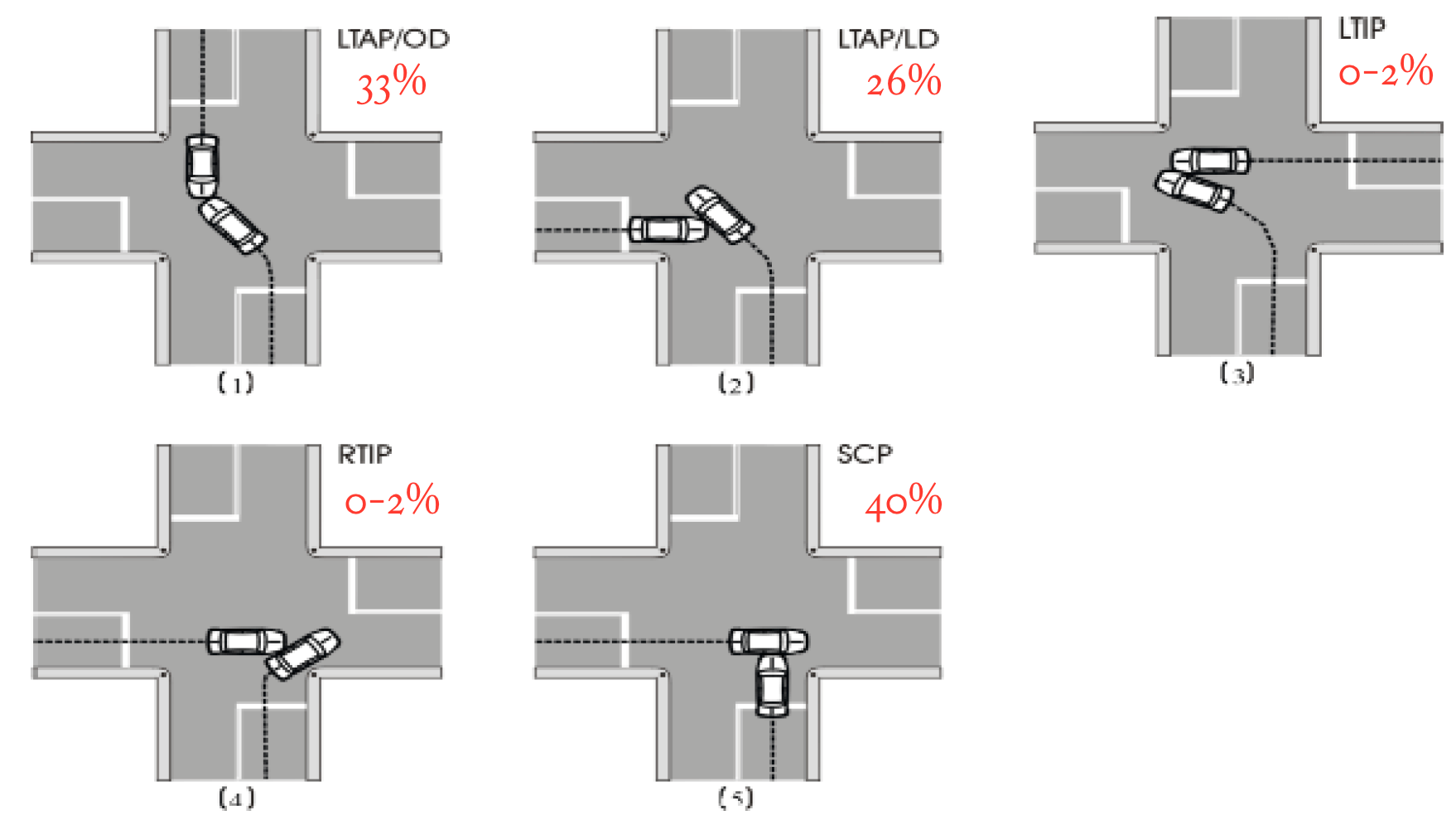
Figure 1. Schematics of, and percent of fatal crashes, Common Crossing Path Crash Scenarios. Fatal crashes include intersections and T-junctions. Figure from the US Department of Transportation.
Legend:
(1) Left Turn Across Path – Opposite Direction Conflict (LTAP/OD)
(2) Left Turn Across Path – Lateral Direction Conflict (LTAP/LD)
(3) Left Turn Into Path – Merge Conflict (LTIP)
(4) Right Turn Into Path – Merge Conflict (RTIP)
(5) Straight Crossing Paths (SCP)
Who is most likely to be at fault when a fatal driver crash occurs at an intersection? It’s often the driver that dies who is the one not at fault. They’re more likely to be obeying the rules of the road, with the right of way, when someone blows a stop sign or traffic light and strikes the victim on the driver’s side, or at an angle.
However, the fault is often shifted to the driver in fatalities occurring at T-junctions. In this case, the driver that’s going to be killed reaches the junction (i.e., traveling up the stem of the “T”) where the road intersects, and proceeds to make a turn before it is safe to do so and is most often struck on the left side by the car traveling in the lateral direction (i.e., heading left-to-right on the horizontal line of the “T”) with the right of way. This type of accident resembles scenario #2 in Figure 1. The second most common way to get killed is when traveling right-to-left on the “T” and turning left into the stem of the “T” and the vehicle is struck by another heading in the opposite direction. This accident looks like scenario #1 in Figure 1 (you need to rotate the figure 90 degrees left in your mind’s eye for it to match my “T” description for it).
§
Lastly, let’s turn our attention to the final, and largest, category of deaths. Determining who’s more likely at fault in driver deaths on 2-lane rural roads may be a little bit harder to pinpoint, but we have some clues. In about 10% of drivers killed in this category, prior to the crash, also referred to as the pre-crash critical event, another vehicle heading in the opposite direction crossed the left lane (i.e., the double yellow line) into the victim’s lane. I think it’s safe to assume that the other driver was responsible for the crash.
However, more often (17% of cases), a driver that is killed on this type of road is the one crossing the lane to his left and encroaching on the opposite lane of travel as the pre-crash critical event. In drivers killed on 2-lane rural roads, 50% involved a driver not wearing a seat belt. Close to 40% have alcohol in their system and nearly 90% of these drivers were over the legal limit of 0.08 g/dL. About one-third involved speeding, and 16% did not have a valid driver’s license. I think this suggests that driver error plays a larger role rather than another driver at fault. At the least, it suggests that there are some simple things we can do to lower the driver death rate. Which brings me to the larger point of this post.
What are some of the things you can do to improve your chances of not becoming a statistic on the road?
The first thing you should do is understand what you should not do.
How can you drive more carefully? The best place to start is to look at the factors in the list above and take an honest inventory. As I discussed in the previous email, while there’s no assurance that what I do in a car will keep me alive, I think I can reduce the odds of that happening, beyond simply avoiding these factors, as important as they are. But, and here’s the key point, assume someone like this person is on the road at all times, and his sole purpose is to kill you. He’s a serial killer and uses his vehicle as his murder weapon. His killing statistics eerily resemble the overall fatal crash statistics. He does a lot of his killings at intersections, but isn’t shy about hopping on the freeway and taking people out there, too.
On the freeways, he may suddenly leave his lane and enter yours within inches of your front bumper, or he’s side by side trying to make contact with your vehicle. Be on the lookout for this maniac.
At intersections, he really likes being on your left and he loves running red lights and stop signs. If you’re going through a green light or a road that intersects with stop signs, look left before you enter and cross the intersection. If you’re at a red light that turns green or proceeding through a stop sign, first look left to make sure the killer isn’t there.
On rural 2-lane roads, he’s been known on occasion to travel in the opposite direction of his victim, leave his lane and force his distracted victims, who traveled these roads so many times they think they can drive them in their sleep, into an avoidance maneuver that results in them driving off the road and rolling their vehicle. This is where you need to remind yourself that even though you’ve driven these roads countless times without a scratch, it does not give you a pass to be more complacent and lose your focus.
Remind yourself every day to take these measures every time you get behind the wheel. Most of these are obvious and you’ve heard them before, but if you look at the data, my hope is that it makes the steps you can take more tangible.
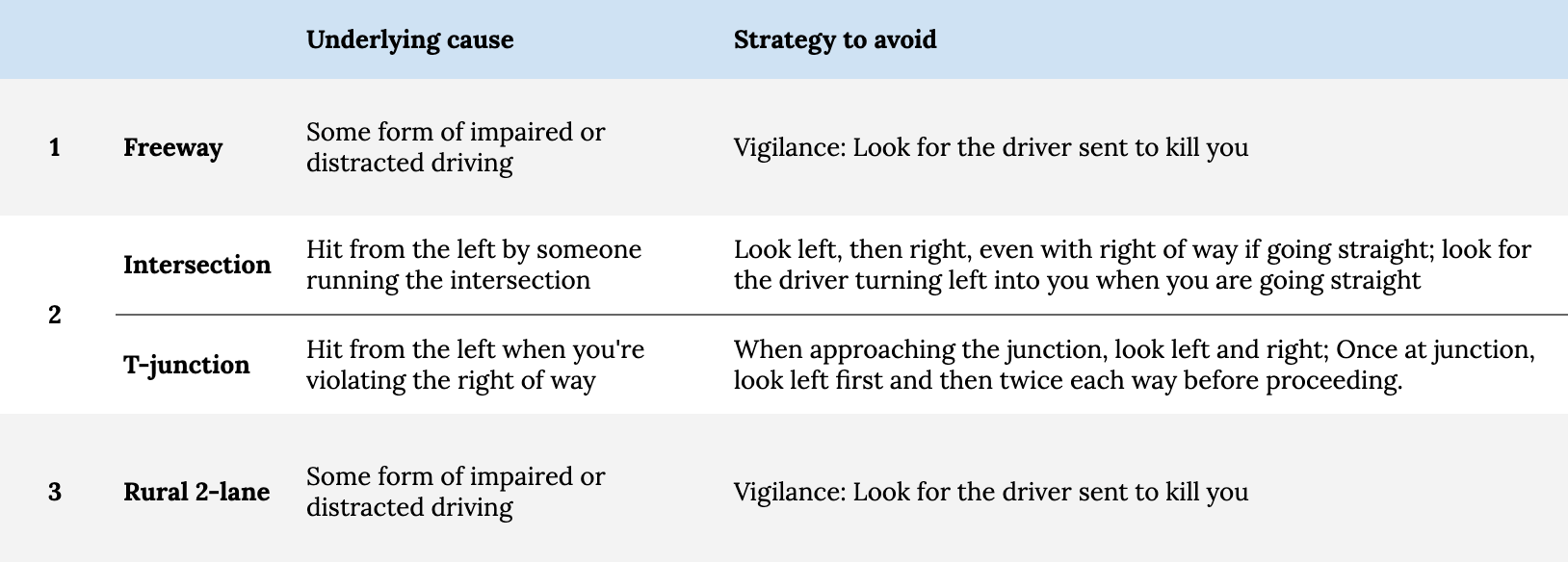
Here in Table 1, I summarize the primary locations of US automotive fatalities, the underlying causes, and most importantly, the steps you can take to reduce your risk of succumbing to them beyond the obvious (Rule #1, above, the so-called not-to-do list).
Table 1. Common causes of driver deaths and additional strategies to reduce their risk.
Before closing this morbid email, one of my patients, who is himself a very frequent helicopter passenger, sent me his rules of engagement for safer flying after reading last week’s email. With his permission, I’m listing them here.
These numbers should scare anyone. If I die in the next 10 years, the most probable “murder weapon” is my vehicle or another vehicle on the road. Is there anything I can do to lower the chances of dying in a car or from a car? Of course, never stepping foot in a car again would drastically lower my chances, but there are trade-offs in life. Before I get into my risk-reduction strategy, a few statistics are in order to inform it. Also, a caveat: for this analysis, I’m only interested in the driver and what he or she can do to lower the risk of death. I care a lot about pedestrians and other occupants in the vehicle, but to do this analysis, I must remove them from the equation.
Of all drivers killed in US automotive accidents in 2017, 18% occurred on a freeway. This is actually lower than I expected. I think this speaks to a more controlled environment where an interstate must meet federal standards and includes fully controlled access (i.e., entering and exiting is confined to on and off ramps) and a median width of at least 50 feet.1
Perhaps the biggest reason why we don’t see more fatal crashes on freeways is that there are no intersections on them (with a few exceptions). In fact, there are more drivers killed in intersections (20%) than on freeways.
After accounting for freeways (18%) and intersections and junctions (20%), we’re still left with more than 60% of drivers killed in automotive accidents left accounted for.
It turns out that drivers killed on rural roads with 2 lanes (i.e., one lane in each direction divided by a double yellow line) accounts for a staggering 38% of total mortality. This number would actually be higher, except to keep the three categories we have mutually exclusive, we backed out any intersection-related driver deaths on these roads and any killed on 2-lane rural roads that were classified as “freeway.” So, to recap, 3 of out every 4 deaths in a car occur on the freeway, at an intersection/junction, or on a rural road with a single lane in each direction.
Let’s double-click on each one of these categories and see if we can answer two very important questions:
- What driving error resulted in the fatality?
- Who is most likely to be at fault and what was the underlying cause of the error? (One way to think about this question is through the lens of manslaughter versus accidental suicide—was the driver effectively killed by someone else making a mistake, or by a mistake they made?)
In the cases where drivers are killed on freeways, 31% of them have alcohol in their system and nearly 85% of these drivers were over the legal limit of 0.08 g/dL. Furthermore, 29% of all driver deaths involved speeding, and just under 1 in 10 involved distracted driving. It’s difficult to get mutually exclusive and collectively exhaustive data here, and there are often multiple related factors. For example, it’s not uncommon for a driver to die on a freeway while speeding and over the legal limit of alcohol.
The primary conditions that lead to fatalities, then, are: alcohol, speeding, and distraction leading to a loss of control or contact with another vehicle.
Who is likely to be at fault on a freeway, the driver that was killed, or another driver on the road? It’s not exactly clear from the data, but that doesn’t change our strategy.
Why? I think the steps below make it clear.
Rule #1: Consider the conditions above as your not-to-do list to reduce the risk of accidental suicide: Do not drive with alcohol in your system, even if you are (or think you are) below the legal limit. Do not speed. Do not text and drive. Do not get behind the wheel if you are sleep-deprived.
Rule #2: Assume others are not adhering to Rule #1. In particular, assume one person awoke today with the explicit instruction to kill you with their car. If you knew this, how vigilant would you be? How much more closely would you pay attention to each other driver around you? That person swerving around or braking too late? That person looking at their phone? That person speeding up behind you? Look for the killer. Be vigilant at all times, and make sure today is not his day
§
Let’s move to the next category of fatalities—intersections and T-junctions.
I learned something from one of my best friends in high school who is a long haul truck driver. Talk about someone having a front-row seat to vehicular manslaughter. He told me many years ago that when approaching an intersection, with the right of way, he always looks left first, then right, before entering. Why? The data below show you what his intuition suggested and his experience crystalized.
Let’s start with intersections. A driver is most likely going to be struck near the driver’s side by another vehicle, otherwise known as a broadside or T-bone crash. Figure 1 illustrates the different crash scenarios. If a driver is heading through an intersection, with the right of way, the most common cause of his death is the driver on his left, where both cars cross paths, as scenario #2 in Figure 1 most clearly depicts.
Scenario #5, in which two cars go straight through the intersection, has the highest severity. While the figure shows the vehicle heading left to right struck by the one heading up, it’s often the case where the vehicle heading up is struck by the other heading left to right, running a traffic signal or stop sign.
Figure 1. Schematics of, and percent of fatal crashes, Common Crossing Path Crash Scenarios. Fatal crashes include intersections and T-junctions. Figure from the US Department of Transportation.
Legend:
(1) Left Turn Across Path – Opposite Direction Conflict (LTAP/OD)
(2) Left Turn Across Path – Lateral Direction Conflict (LTAP/LD)
(3) Left Turn Into Path – Merge Conflict (LTIP)
(4) Right Turn Into Path – Merge Conflict (RTIP)
(5) Straight Crossing Paths (SCP)
Who is most likely to be at fault when a fatal driver crash occurs at an intersection? It’s often the driver that dies who is the one not at fault. They’re more likely to be obeying the rules of the road, with the right of way, when someone blows a stop sign or traffic light and strikes the victim on the driver’s side, or at an angle.
However, the fault is often shifted to the driver in fatalities occurring at T-junctions. In this case, the driver that’s going to be killed reaches the junction (i.e., traveling up the stem of the “T”) where the road intersects, and proceeds to make a turn before it is safe to do so and is most often struck on the left side by the car traveling in the lateral direction (i.e., heading left-to-right on the horizontal line of the “T”) with the right of way. This type of accident resembles scenario #2 in Figure 1. The second most common way to get killed is when traveling right-to-left on the “T” and turning left into the stem of the “T” and the vehicle is struck by another heading in the opposite direction. This accident looks like scenario #1 in Figure 1 (you need to rotate the figure 90 degrees left in your mind’s eye for it to match my “T” description for it).
§
Lastly, let’s turn our attention to the final, and largest, category of deaths. Determining who’s more likely at fault in driver deaths on 2-lane rural roads may be a little bit harder to pinpoint, but we have some clues. In about 10% of drivers killed in this category, prior to the crash, also referred to as the pre-crash critical event, another vehicle heading in the opposite direction crossed the left lane (i.e., the double yellow line) into the victim’s lane. I think it’s safe to assume that the other driver was responsible for the crash.
However, more often (17% of cases), a driver that is killed on this type of road is the one crossing the lane to his left and encroaching on the opposite lane of travel as the pre-crash critical event. In drivers killed on 2-lane rural roads, 50% involved a driver not wearing a seat belt. Close to 40% have alcohol in their system and nearly 90% of these drivers were over the legal limit of 0.08 g/dL. About one-third involved speeding, and 16% did not have a valid driver’s license. I think this suggests that driver error plays a larger role rather than another driver at fault. At the least, it suggests that there are some simple things we can do to lower the driver death rate. Which brings me to the larger point of this post.
What are some of the things you can do to improve your chances of not becoming a statistic on the road?
The first thing you should do is understand what you should not do.
- Speeding is the biggest related factor, involving an estimated 30% of all drivers killed.
- Next is being under the influence of alcohol (as well as drugs or medications, the most common being stimulants, that may make drivers more aggressive and reckless, and cannabinols, that may slow coordination, judgment, and reaction times), where 33% have at least some alcohol in their system and nearly 90% of these drivers were over the legal limit of 0.08 g/dL.
- After that comes distracted driving (8%), which of course involves the use of mobile phones, failure to keep in the proper lane or running off the road (7%), failure to yield the right of way (7%), and careless driving (6%). I would argue that all of these factors are a form of careless driving (with the exception of some of the crashes involving running off the road).
How can you drive more carefully? The best place to start is to look at the factors in the list above and take an honest inventory. As I discussed in the previous email, while there’s no assurance that what I do in a car will keep me alive, I think I can reduce the odds of that happening, beyond simply avoiding these factors, as important as they are. But, and here’s the key point, assume someone like this person is on the road at all times, and his sole purpose is to kill you. He’s a serial killer and uses his vehicle as his murder weapon. His killing statistics eerily resemble the overall fatal crash statistics. He does a lot of his killings at intersections, but isn’t shy about hopping on the freeway and taking people out there, too.
On the freeways, he may suddenly leave his lane and enter yours within inches of your front bumper, or he’s side by side trying to make contact with your vehicle. Be on the lookout for this maniac.
At intersections, he really likes being on your left and he loves running red lights and stop signs. If you’re going through a green light or a road that intersects with stop signs, look left before you enter and cross the intersection. If you’re at a red light that turns green or proceeding through a stop sign, first look left to make sure the killer isn’t there.
On rural 2-lane roads, he’s been known on occasion to travel in the opposite direction of his victim, leave his lane and force his distracted victims, who traveled these roads so many times they think they can drive them in their sleep, into an avoidance maneuver that results in them driving off the road and rolling their vehicle. This is where you need to remind yourself that even though you’ve driven these roads countless times without a scratch, it does not give you a pass to be more complacent and lose your focus.
Remind yourself every day to take these measures every time you get behind the wheel. Most of these are obvious and you’ve heard them before, but if you look at the data, my hope is that it makes the steps you can take more tangible.
Here in Table 1, I summarize the primary locations of US automotive fatalities, the underlying causes, and most importantly, the steps you can take to reduce your risk of succumbing to them beyond the obvious (Rule #1, above, the so-called not-to-do list).
Table 1. Common causes of driver deaths and additional strategies to reduce their risk.
Before closing this morbid email, one of my patients, who is himself a very frequent helicopter passenger, sent me his rules of engagement for safer flying after reading last week’s email. With his permission, I’m listing them here.
- Always fly a twin engine. Two engines are better than one. Statistically, yes, and obvious.
- Always “try” to get two pilots. Not because one might have a heart attack (also possible) but to help for visual aid. Watch next time you are in the New York harbor. One pilot is always frantically looking around to avoid the heavy traffic.
- If on a crowded helicopter – and they don’t weigh everyone – ask why? It’s actually mandatory on the best-run helicopters.
- Always ask for instrument capable pilot and guidance systems.
- Always try to avoid bad weather with limited visibility.
The killer(s) on the road: reducing your risk of automotive death
Hubei Docs: Even-Deadlier Coronavirus Reinfection Spurs Sudden Heart Attacks
Doctors working on the front lines of the novel coronavirus (COVID-19) outbreak have told the Taiwan Times that it’s possible to become reinfected by the virus, leading to death from sudden heart failure in some cases.
“It’s highly possible to get infected a second time. A few people recovered from the first time by their own immune system, but the meds they use are damaging their heart tissue, and when they get it the second time, the antibody doesn’t help but makes it worse, and they die a sudden death from heart failure,” reads a message forwarded to Taiwan News from a relative of one of the doctors living in the United Kingdom.
Notably, one of the ways coronaviruses cripple the immune system is
via an HIV-like attachment to white blood cells, which triggers a ‘cytokine storm‘
– a term popularized during the avian H5N1 influenza outbreak – in
which an uncontrolled release of inflammatory ‘cytokines’ target various
organs, often leading to failure and in many cases death.
How do coronaviruses enter the body?
With SARS (sudden acute respiratory syndrome), another coronavirus, researchers discovered that one of the ways the disease attaches itself is through an enzyme known as ACE2, a ‘functional receptor’ produced in several organs (oral and nasal mucosa, nasopharynx, lung, stomach, small intestine, colon, skin, lymph nodes, thymus, bone marrow, spleen, liver, kidney, and brain).
ACE2 is also “abundantly present in humans in the epithelia of the lung and small intestine, which might provide possible routes of entry for the SARS-CoV,” while it was also observed “in arterial and venous endothelial cells and arterial smooth muscle cells” – which would include the heart.
This has led some to speculate that Asians, who have higher concentrations of ACE2 (per the 1000 genome project) may be affected to a greater degree than those of European ancestry, who produce the least of it – and have largely been the asymptomatic ‘super spreaders‘ such as Diamond Princess coronavirus victim Rebecca Frasure.
And so while more research on COVID-19 is urgently needed – we know
that coronavirus can target ACE2 receptors, which are found in the
cardiovascuar system. And we have seen evidence of both sudden collapses and neurological damage from footage pouring out of Wuhan, China.
If the virus can reinfect patients and cause cytokine storms and sudden death – possibly exacerbated by therapeutic intervention – treating the coronavirus which CDC director Dr. Robert Redfield says will become widespread throughout the United States ‘this year or next,’ it is vitally important to understand exactly how COVID-19 works, and how to treat it. That would require cooperation from China and a CDC team on the ground in the epicenter. For some unknown reason, however, China still refuses to grant US scientists access to ground zero.
https://www.zerohedge.com/health/hubei-doctors-warn-even-deadlier-coronavirus-reinfection-causing-sudden-heart-attacks
“It’s highly possible to get infected a second time. A few people recovered from the first time by their own immune system, but the meds they use are damaging their heart tissue, and when they get it the second time, the antibody doesn’t help but makes it worse, and they die a sudden death from heart failure,” reads a message forwarded to Taiwan News from a relative of one of the doctors living in the United Kingdom.
The source also said the virus has “outsmarted all of us,” as it can hide symptoms for up to 24 days. This assertion has been made independently elsewhere, with Chinese pulmonologist Zhong Nanshan (鍾南山) saying the average incubation period is three days, but it can take as little as one day and up to 24 days to develop symptoms.
Also, the source said that false negative tests for the virus are fairly common. “It can fool the test kit – there were cases that they found, the CT scan shows both lungs are fully infected but the test came back negative four times. The fifth test came back positive.” –Taiwan Times
The cytokine storm is best exemplified by severe lung infections, in which local inflammation spills over into the systemic circulation, producing systemic sepsis, as defined by persistent hypotension, hyper- or hypothermia, leukocytosis or leukopenia, and often thrombocytopenia.According to the 2012 study, “Cytokine storms are associated with a wide variety of infectious and noninfectious diseases and have even been the unfortunate consequence of attempts at therapeutic intervention.”
…
In addition to lung infections, the cytokine storm is a consequence of severe infections in the gastrointestinal tract, urinary tract, central nervous system, skin, joint spaces, and other sites. (Tisoncik, et. al, Into the Eye of the Cytokine Storm)(2012)
How do coronaviruses enter the body?
With SARS (sudden acute respiratory syndrome), another coronavirus, researchers discovered that one of the ways the disease attaches itself is through an enzyme known as ACE2, a ‘functional receptor’ produced in several organs (oral and nasal mucosa, nasopharynx, lung, stomach, small intestine, colon, skin, lymph nodes, thymus, bone marrow, spleen, liver, kidney, and brain).
ACE2 is also “abundantly present in humans in the epithelia of the lung and small intestine, which might provide possible routes of entry for the SARS-CoV,” while it was also observed “in arterial and venous endothelial cells and arterial smooth muscle cells” – which would include the heart.
This has led some to speculate that Asians, who have higher concentrations of ACE2 (per the 1000 genome project) may be affected to a greater degree than those of European ancestry, who produce the least of it – and have largely been the asymptomatic ‘super spreaders‘ such as Diamond Princess coronavirus victim Rebecca Frasure.

If the virus can reinfect patients and cause cytokine storms and sudden death – possibly exacerbated by therapeutic intervention – treating the coronavirus which CDC director Dr. Robert Redfield says will become widespread throughout the United States ‘this year or next,’ it is vitally important to understand exactly how COVID-19 works, and how to treat it. That would require cooperation from China and a CDC team on the ground in the epicenter. For some unknown reason, however, China still refuses to grant US scientists access to ground zero.
https://www.zerohedge.com/health/hubei-doctors-warn-even-deadlier-coronavirus-reinfection-causing-sudden-heart-attacks
Chinese leader reportedly aware of coronavirus earlier than thought
Chinese President Xi Jinping was aware of the deadly coronavirus that
is ravaging his country much earlier than originally thought, according
to a new report.
Xi gave unspecified internal orders about the virus on Jan. 7 during a meeting of the country’s Politburo Standing Committee, according to the New York Times, which noted the remarks came two weeks earlier than his first public comments on Jan. 20.
The revelation came in a speech Xi gave on Feb. 3 that was published Saturday in a Community Party journal.
Jinping spoke about his involvement in combating the crisis which started in the city of Wuhan in the Hubei Province.
“I clearly demanded that Hubei Province exercise comprehensive, strict control over the outflow of individuals,” Xi said in the speech, according to the Times.
The coronavirus has killed at least 1,527 people and sickened more than 67,000 others. The first death was reported in Europe Saturday in an elderly tourist from China who died in France.
https://nypost.com/2020/02/15/chinese-leader-reportedly-aware-of-coronavirus-earlier-than-thought/?utm_source=NYPTwitter&utm_medium=SocialFlow&utm_campaign=SocialFlow
Xi gave unspecified internal orders about the virus on Jan. 7 during a meeting of the country’s Politburo Standing Committee, according to the New York Times, which noted the remarks came two weeks earlier than his first public comments on Jan. 20.
The revelation came in a speech Xi gave on Feb. 3 that was published Saturday in a Community Party journal.
Jinping spoke about his involvement in combating the crisis which started in the city of Wuhan in the Hubei Province.
“I clearly demanded that Hubei Province exercise comprehensive, strict control over the outflow of individuals,” Xi said in the speech, according to the Times.
The coronavirus has killed at least 1,527 people and sickened more than 67,000 others. The first death was reported in Europe Saturday in an elderly tourist from China who died in France.
https://nypost.com/2020/02/15/chinese-leader-reportedly-aware-of-coronavirus-earlier-than-thought/?utm_source=NYPTwitter&utm_medium=SocialFlow&utm_campaign=SocialFlow
Subscribe to:
Comments (Atom)