Search This Blog

Tuesday, February 18, 2020

Changing From the Ground Up: The Power of Microhabits

What if you created just one microhabit?
A microhabit is a very specific pattern of thought, feeling, and behavior that you enact at a particular time.  The key to success behind a microhabit is to make it highly circumscribed and perform it faithfully and regularly.  For example, one of the microhabits that I’ve developed is writing for a few minutes in a personal journal each morning.  I write whatever comes to mind and let it flow, stream of consciousness.
That’s it.  Each journal entry is short and unplanned.  So it’s easy to do no matter where I am or what I have scheduled later that day.
What happens with the microhabit is that it leads to unexpected consequences.  For instance, writing the short blurb in the journal gets me in the mood to do more writing and stimulates me to work on related projects.  Ideas that crop up in the journal writing inspire me to tackle a problem in a new way.  Challenges that I’ve placed on the back burner come up in the journal writing and provide a fresh motivation to get them done.
In short, instead of changing from the top down by setting big goals, we can change from the ground up with small habits that reverberate across our lives.
What is a positive microhabit you might incorporate into your trading?  How might that impact other aspects of what you do in markets?  One trader I worked with made a slight change to how he enters positions, giving him slightly better reward relative to risk.  That led to spontaneous changes in other aspects of his position management that contributed further to his profitability.
Perhaps, by achieving very small changes, we internalize the sense of being able to change, inspiring us to make other changes. 
Maybe we internalize our self concepts one action, one thought pattern at a time.
Maybe who we are–and who we become–is constructed from the ground up.
This is a promising area of trading psychology that I’ll be developing in coming posts.
http://traderfeed.blogspot.com/2020/02/changing-from-ground-up-power-of.html

Russia Becomes First Country To Ban All Chinese From Entering

Update (1410ET): In an interview with Fox News, the CDC's Dr. Anthony Fauci said the risk to Americans of contracting COVID-19 is relatively low right now, but that "could change" given the chaotic and unpredictable situation.
"The risk clearly is relatively low right now, but that could change. So we're telling our American citizens to not be fearful, to not be afraid, but to keep an eye on it."
Dr. Fauci added that the federal government has quarantined every known case of the virus.
"The people in this country that were aware of being infected they've been contacted, isolated and made aware that this is the case."
Just in case any get through, the US is starting 'sentinel surveillance' of patients around the country who go to the hospital to report flu-like symptoms, as we reported yesterday.
"That will give us a better idea of whether there are any cases that we haven't identified or noticed," the doctor added.
Update (1300ET): In a landmark decision, Russia has temporarily banned Chinese from entry as of Feb. 20, becoming the first country to ban all Chinese from entry in response to the coronavirus outbreak, according to Russian news agency TASS.
This is only the latest step from Russia, which has already closed most entry points along its 4,200-kilometer border, suspended e-visas and work visas for Chinese nationals.
Russia has already reported two cases of coronavirus - the only cases confirmed in the country so far - both involving Chinese nationals.
Though there haven't been many cases, there have been a number of interesting virus-related headlines out of Russia in recent weeks. Two men in the city of Chelyabinsk were fined for hooliganism after they filmed a prank video where they pretended to shoot a man infected with the virus in a park. The men wore white hazmat suits and face masks while simulating the shooting of the third person, who wasn't actually infected.
— Russia discharged a Chinese national from the hospital in the Siberian city of Chita on Wednesday after he recovered from a coronavirus infection, the second of Russia's two confirmed cases of coronavirus to recover. The other victim, also a Chinese national, was also said by authorities to have recovered and been released from quarantine in Siberia's Tyumen region.
Meanwhile,apropos of nothing, BNO News shared one of the latest videos out of Hubei Province, which we'd like to now share with you.
This could be an Olympic Sport (if they don't cancel the Olympics, that is).
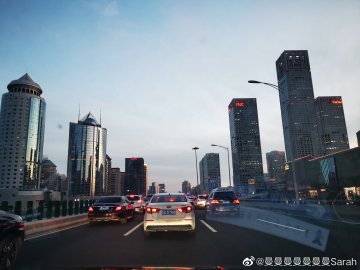
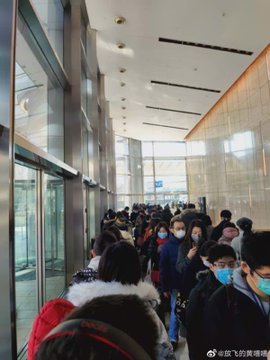
As a handful of brave foreign correspondents continue to report on the outbreak inside mainland China, the Epoch Times' reporter Jennifer Zeng revealed on Tuesday that 71 people from one workplace in Beijing have been placed under quarantine after one employee was infected by COVID-19.
We're glad to see China's shift back to work is going so well.
* * *
Update (0840ET): Global Times editor Hu Xijin, a government mouthpiece whose tweets were closely followed during the 'Phase 1' trade-deal negotiations, is touting China's dubious data as a sign that the Communist Party is winning the 'People's War' against COVID-19.
Hu Xijin 胡锡进 @HuXijin_GT
 
Daily new infection cases outside Hubei fell below 100 for the first time according to data released on Tuesday. We are on the way to the victory. People are in a better mood and cities are recovering the vitality. I myself is also very happy.

Last night, the western press exposed the Americans for breaking Japan's quarantine on the 'Diamond Princess' by ferrying some 14 infected individuals to the US. But with one day left to go before the Japanese government ends its quarantine and releases thousands of terrified and paranoid passengers into the streets of Tokyo.
On Tuesday, another 88 passengers from the Diamond Princess were diagnosed with the virus, bringing the total to 542.
Jake Sturmer @JakeSturmer
 
: Another 88 confirmed new cases from on board the Diamond Princess @abcnews
Japan has completed tests for all passengers and crew aboard the ship as of Monday, but the results for the last batch of tests aren't expected until Wednesday, the day that the quarantine is slated to end. So far, results are back for 2,404 passengers and crew, out of the 3,711 who were  on board the ship when the quarantine began on Feb. 5.
Japanese Health Minister Katsunobu Kato said Tuesday that people who have tested negative for the virus would start leaving on Wednesday, but that the process of releasing passengers and crew won't be finished until Friday, according to the Washington Post.
The remaining 61 American passengers on the DP who opted not to join the evacuation will not be allowed to return to the US until March 4, according to the American embassy in Tokyo. The governments of Australia, Hong Kong and Canada have also said they would evacuate passengers.
Elsewhere, Japan confirmed three more cases of the virus. This time, they were confirmed in Wakayama, a prefecture in eastern Japan.
In the latest indication that the 14-day quarantine simply wasn't enough to kill the virus, a British couple has tested positive for the virus just one day before Japanese authorities are set to release everybody from quarantine, according to the Guardian.
"David and Sally Abel, a British couple onboard the Diamond Princess cruise liner in Japan, have tested positive for coronavirus, a day before passengers who tested negative were due to start leaving the ship after spending two weeks in quarantine."
Including all of the cases announced overnight, there are now 73,336 confirmed cases of the virus worldwide, compared with 1,874 deaths.
As the battle against the virus rages in Wuhan, Liu Zhiming, 51, a neurosurgeon and the director of the Wuchang Hospital in Wuhan, became the latest high-profile medical worker to succumb to the virus, as we noted last night. Late last week, China confirmed that nearly 2,000 medical workers had been infected.
The Commission overseeing China's virus response has released a statement commemorating Liu's life and honoring his death.
"From the start of the outbreak, Comrade Liu Zhiming, without regard to his personal safety, led the medical staff of Wuchang Hospital at the front lines of the fight against the epidemic," the commission said. Dr. Liu "made significant contributions to our city’s fight to prevent and control the novel coronavirus," it added.
In Beijing, senior officials including President Xi continued to play down the economic blowback from the virus. During remarks on Tuesday, Xi insisted that China could still meet its 2020 economic targets - which called for a doubling of the size of the Chinese economy in 10 years - despite the outbreak.
RANsquawk @RANsquawk
 
We cross live to the Chinese Statistics Bureau as President Xi says China can still meet 2020 economic targets despite coronavirus
49
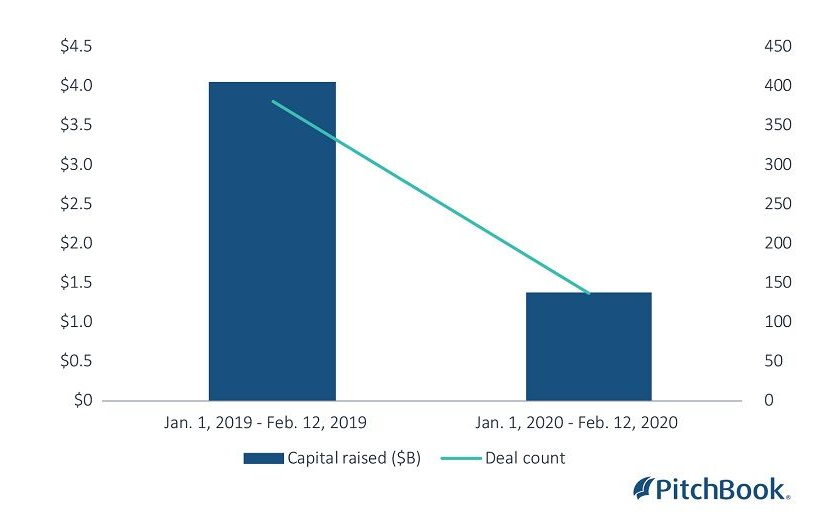
Of course, China' goalseeked economic data has never offered a truly accurate reflection of the world's second-largest economy. And a report by PitchBook warns that Chinese startups are struggling to raise money as the epidemic complicates deal talks an deals a serious blow to the country's 'venture capital' scene.
From the start of the year through Feb. 12, venture capital activity in China fell from 381 to 137 deals, and the capital raised declined from $4.05 billion to $1.37 billion, compared to the same period last year.

Prior outbreaks like SARS and swine flu also weighed on investment activity.
Moving south to Seoul, South Korean President Moon Jae-in called for South Korea to take "emergency steps" to prepare for a more widespread outbreak of COVID-19.
In contrast to Xi, Moon warned the coronavirus could have a "bigger and longer-lasting impact" on his country's economy than the 2015 MERS outbreak, which prompted South Korea to roll out a supplemental budget while the central bank cut rates, WaPo reports. Speculators are now betting on a rate cut at the Bank of Korea's meeting next week. Singapore also announced on Tuesday that it had earmarked $2.8 billion for virus relief measures to help stabilize its economy and assist workers.
Over in the Philippines, 25,000 stranded workers can now return to work.
French Health Minister Olivier Veran said Tuesday there was a "credible risk" that the virus could transform into a pandemic, Reuters reports.
"This is both a working assumption and a credible risk," Veran told France Info radio, when asked about the possibility of the coronavirus spreading globally.
Taking a brief break from the news, our disturbing video of the day comes from Xinjiang, the far-flung province that's home to millions of Uyghur Muslims.
In this video, shared by the Epoch Times' Jennifer Zeng, a police officer suddenly collapses while walking. His current status is unknown.

曾錚 Jennifer Zeng @jenniferatntd
 
Zhou Shunxin, a police officer in , suddenly collaspes while walking. Officail report says vaguely that he "passed out" at the frone line of control, and sent to the hospital, but doesn't talke about why he collasped or his current status.
 
 
https://www.zerohedge.com/geopolitical/japan-confirms-88-more-cases-aboard-diamond-princess-one-day-quarantine-set-end

Medtronic Raises 2020 Guidance, Sets 4Q Outlook

Medtronic PLC on Tuesday raised its fiscal 2020 adjusted-earnings guidance and set its outlook for the fourth quarter, which it expects the coronavirus outbreak to weigh on but can’t yet quantify the effect.
Excluding the effect of the coronavirus outbreak, the medical-device company expects adjusted earnings of $5.63 a share to $5.65 a share, compared with its prior outlook of $5.57 a share to $5.63 a share. The outlook includes a seven-cent foreign-exchange effect, the company said.
Medtronic shares fell 0.8% in premarket trading after it reported higher third-quarter results, though sales were lower than expected.
For the fourth quarter, Medtronic said it is “comfortable” with the Wall Street consensus of an organic-revenue growth of about 4.5% and earnings of $1.64 a share, excluding the outbreak’s effect. It expects fourth-quarter revenue growth to be hurt 0.8% to 1.4% if current exchange rates hold.
For the fourth quarter, analysts polled by FactSet expect earnings of $1.33 a share, or $1.64 a share on an adjusted basis. They see fourth-quarter revenue of $8.5 billion.
Analysts expect full-year earnings of $4.13 a share, or $5.60 a share on an adjusted basis, on revenue of $31.51 billion.

Merck KGaA Chosen to Produce Liquid Biopsy Kits

Merck KGaA said Tuesday that it has signed a contract to manufacture liquid biopsy kits for Swedish diagnostics business Elypta.
The kits will be used to detect biological markers for cancer, the German company said.

Coronavirus dents bookings for Holiday Inn owner IHG

InterContinental Hotels(IHG) warned on Tuesday that fewer travellers are booking its rooms in China because of the coronavirus outbreak.

The owner of the Holiday Inn chain has been highlighted by analysts as among the European companies most directly exposed to the epidemic.
The group had begun to see an impact on bookings in late January and has now closed or partially closed 160 of its 470 hotels in Greater China, it said on Tuesday.
The company’s annual results on Tuesday showed that revenue per available room (RevPAR) had already declined by 4.5% last year in Greater China while performance in European and U.S. markets was little changed.
Based on current disruption the impact equates to about $5 million a month for IHG’s mainland China business, Chief Executive Keith Barr said on an analysts call, describing the decline as “a short-term blip”.
Barr added that the region contributes less than 10% of group profit.
IHG last month said that up to Feb. 29 it would allow customers to change or cancel stays in mainland China, Hong Kong, Macau and Taiwan at no additional cost. Rival Airbnb last week extended its suspension of bookings in Beijing until April 30.
Rival Hilton Worldwide has shut roughly 150 hotels in China, which could hit adjusted core profit in the first quarter by between $10 million and $20 million, Chief Executive Christopher J. Nassetta said this month.
One yardstick for the impact of the crisis on the company is the previous SARS outbreak, which cut IHG’s RevPAR in the Asia Pacific region by 27% in the three months to June 2003.
There is more at stake this time. In 2003 IHG had little more than 40 hotels in China. Now more than 400 of its almost 6,000 hotels worldwide are in Greater China and it is constructing almost as many again.
The company has been investing heavily in China, its fastest-growing market, and has revamped rooms at Holiday Inns to woo local business travellers. It plans to open 393 hotels in China and operates four hotels in Wuhan, the centre of the coronavirus outbreak.
“It (Greater China) is, though, a smaller part of our business overall, representing 15% of our open rooms and less than 10% of our operating profit,” said IHG finance chief Paul Edgecliffe-Johnson.

China’s Real-Estate Market Is Coronavirus Latest Victim

China’s home-price growth slowed to an 18-month low in January, but it looks set to fall a lot further as Beijing’s long-running attempts to rein in the property market meet with effects from the coronavirus outbreak.
The coronavirus, which has halted business across the country, is raising concerns about a rare contraction in house prices in the world’s second-largest economy and forcing developers to scramble in response.
On Monday, the National Bureau of Statistics reported that the average price of new homes in 70 Chinese cities increased 6.45% in January from the same period last year, the lowest growth rate since July 2018, according to Wall Street Journal calculations.
But the January data largely failed to reflect the impact of the coronavirus, which has shut down commerce and kept much of the country holed up at home.
Though the virus is believed to have first emerged from the central Chinese city of Wuhan in December, it didn’t begin to affect consumer behavior until after authorities ordered Wuhan’s shutdown on Jan. 23.
Since then, home sales in China likely plunged by nearly 90% compared with a year earlier, according to Hong Kong-based property consultancy Centaline, as property developers closed sales centers across the country.
That means February will likely be the first full month to bear the brunt of the disruptions from the virus, which has sickened more than 70,000 people and killed more than 1,770 in mainland China alone.
“There will certainly be a nationwide large-scale price reduction in February,” said Zhang Dawei, a Beijing-based analyst for Centaline.
Price growth was already slackening in recent months as regulators tightened policy in an attempt to engineer a gradual slowdown in home-price increases.
Even before the outbreak, many property developers had trimmed their sales-growth target for 2020 to between 10% and 20% from a range of between 20% and 50% during the headier years.
Now, developers are bracing for a deeper and more prolonged period of pain — and turning to creative sales tactics to offset the challenges. One of China’s largest developers, China Evergrande Group, late Sunday began promoting discounts online, slashing prices by 25% for all residential properties, starting Tuesday through the end of the month. For March, the discount will be 22%.
The fire sale follows a promotion launched by Evergrande last week, in which home buyers need a refundable down payment of only 5,000 yuan, or about $715, to claim an apartment unit. That helped Evergrande rack up 47,500 commitments in a span of three days.
The aggressive sales pitches highlight the precarious balance sheets of many Chinese property developers, of which Evergrande is one of China’s most indebted, with a debt pile of $132.5 billion as of June 2019, according to Moody’s estimates.
Evergrande, with a market capitalization of more than $32 billion, has often turned to creative marketing techniques to sell units, but even so, the magnitude of the discounting this time is unprecedented, the company said.
The coronavirus is expected to take a toll not just on unit sales, but also on home building, as the widespread lockdowns prevent construction workers from returning to building sites.
Last week, several Chinese cities and provinces, including Shanghai, Xi’an and Zhejiang, promulgated policies aimed at reducing the burden on developers. The measures include credit support, a delay in payment deadlines for parcels of land and a loosening of presale conditions.
Economists said the epidemic is likely to hit China’s economy harder than 2003’s outbreak of severe acute respiratory syndrome, or SARS.
“The SARS epidemic in 2003 was relatively concentrated in duration and in affected areas, and only had a small and short-term impact on the real-estate market. The situation of the coronavirus is more severe,” noted Xia Dan, a senior researcher at Bank of Communications.
For now, Monday’s monthly data release showed slowing home-price gains in January, both compared with a year ago and with the previous month. Compared with December, the January increase of 0.26% was slower than December’s 0.35% price gain compared with November.
Prices of new homes also increased in 66 of 70 cities in January from a year earlier, compared with 68 in December.
Analysts at S&P Global Ratings said in a report earlier this month that they expect overall sales volume to tumble if the epidemic stretches into the second or third quarter of the year.
“We believe national residential sales are at risk of a contraction,” they wrote.
Other analysts are taking a more sanguine view, predicting only a short-term impact.
“The market will be disturbed in the short term, but it does not mean that house prices will fall sharply in 2020,” said Xu Xiaole, chief analyst of Beike Real Estate Research Institute. “Most home buyers are just postponing demand, and the delay will last no longer than six months.”
One question that remains is whether or not policy makers will step in to boost home sales — a tried-and-true response to previous bouts of economic uncertainty.
Goldman Sachs analysts suspect the answer is no this time, pointing to Chinese policy makers’ recent commitment to prudence in the property sector.
“We do not expect nationwide easing in the property market,” the investment bank told clients in a note earlier this month.

Executive resignations latest red flag at NMC Health

Arab News reports that NMC Health (OTC:NMMCF N/A) founder and non-executive chairman B.R. Shetty, director Abdulrahman Basaddiq and executive director and chief investment officer Hani Buttikhi have resigned.
UK stock market regulators are investigating the company, the largest private health insurer in the UAE, triggered by Mr. Shetty’s inaccurate disclosure of his ownership stake. The company subsequently disclosed “a series of complex shareholder dealings” involving the founder and another top investor, Saeed Butti Al-Qebaisi.
Noted bear Carson Block of Muddy Waters says, “We strongly suspect that today’s resignations are due to more than misreported share ownership. We believe the share ownership and pledge debacle is a symptom of systemic rot and corruption at NMC. We note in particular that resigning director Basaddiq had been a partner at NMC’s auditor, EY, for many years and we remind investors that we voiced concerns about the relationship between NMC and EY.“
Shares were up 5.5% in London today.