Search This Blog

Sunday, February 14, 2021

Why Are Wait Times for Donor Kidneys Not Improving?

 Despite widespread efforts to increase access and awareness, new research shows there's been virtually no change in the number of people on waiting lists for potentially lifesaving kidneys over the past two decades.

For their study, scientists analyzed information on more than 1.3 million adults with kidney failure listed in the United States Renal Data System from 1997 to 2016, and found no improvement in rates of waitlist placement and consistently low rates among more vulnerable populations, including those in poorer communities. The findings were published Feb. 11 in the Journal of the American Society of Nephrology.

But things may turn the corner due to an executive order signed by former President Donald Trump in July 2019. It aims to get more people placed on waitlists for new kidneys and doubles the number of kidneys available for transplant by 2030.

Kidney transplantation is the best treatment for people with kidney failure, but not everyone is placed on waitlists for kidneys or even made aware of the possibility of transplants. Instead, these folks receive dialysis indefinitely. With dialysis, a machine takes over for your kidneys and filters and purifies your blood. This can be done at home or in a medical facility.

"Many more people could benefit from kidney transplants if they understood the benefits of transplantation versus going on maintenance dialysis," said study author Jesse Schold, director of outcomes research for the Kidney and Kidney/Pancreas Transplant Program at the Cleveland Clinic.

Some dialysis facilities are better at referring people for kidney transplants than others, he said. "It's likely that referral rates are better with greater social support, greater access to insurance and other resources," Schold said.

Thanks to the Trump executive order, dialysis centers will start to receive higher reimbursements from Medicare when they refer individuals to transplant waitlists, he said.

Another way to improve access across the board would be to have people opt out of kidney transplant waitlists instead of opting in, Schold suggested. "This way, they are automatically referred as the default," he explained.

The stagnant waitlist is one part of the problem, but there is also a significant kidney supply issue, Schold said. "The major risk factors for kidney disease are obesity, diabetes and older age, all of which are increasing in the country, so to try and provide kidneys for all patients who could benefit is a very formidable challenge," he said.

Still, there are ways to try to increase supply so it better keeps pace with growing demand, Schold said.

As much as 20% of donated kidneys are currently discarded. But "if they were sent directly to places where they are most likely to be used, this percentage would decrease," he said.

And United Network for Organ Sharing (UNOS), the nonprofit organization that manages the U.S. organ transplantation system, is currently making such changes to their allocation process. Some transplant centers are more likely to take organs that may not be perfect but are still viable.

"We want to look back historically or use machine learning to direct organs where they are most likely to be used," explained Darren Stewart, a UNOS principal research scientist who was not involved in the new study. "We will continue to build in smarter ways to order the list so we don't get a lot of refusals, transplant more organs and are less likely to have a discard."

In the past, transplant centers were highly scrutinized by regulators for their outcomes and success rates and less likely to perform riskier transplants as a result, but the U.S. Centers for Medicare & Medicaid Services (CMS) has rolled back these regulations.

"Transplant centers will now become a little more willing to accept higher-risk organs," Schold noted.

Stewart pointed out that kidney transplant rates are actually increasing already, and that racial and ethnic disparities in receiving new kidneys are decreasing.

"The issue is getting on the waitlist in the first place and this involves a referral from a dialysis center, and that has been stagnant for two decades," Stewart said. "We will start to see these numbers budge as CMS rolls out new payment models that encourage dialysis centers to refer patients for evaluation and kidney transplant waitlist placement."

All in all, there's reason for hope, agreed Dr. Stephen Pastan, medical director of the Kidney and Pancreas Transplant Program at the Emory Transplant Center in Atlanta.

Many of the systems are much better aligned than they have been in the past, said Pastan, who was not involved in the study.

"UNOS is doing things to make organ placement more efficient so organs are discarded less frequently, and there are new payment models so that dialysis centers would receive higher reimbursements if they refer patients for transplants," he said. "We should see improved transplantation rates and access to transplants in the future."

More information

The National Kidney Foundation offers more on the kidney transplant waitlist process.

SOURCES: Jesse Schold, PhD, director, outcomes research, Kidney and Kidney/Pancreas Transplant Program, Cleveland Clinic, Ohio; Darren Stewart, MS, principal research scientist, UNOS, Richmond, Va.; Stephen Pastan, MD, professor, medicine, Emory University School of Medicine; and medical director, Kidney and Pancreas Transplant Program, Emory Transplant Center, Atlanta; Journal of the American Society of Nephrology, Feb. 11, 2021, online

https://consumer.healthday.com/2-11-why-are-waits-for-donor-kidneys-not-improving-2650330934.html

'The Coming High-Pressure Economy': Morgan Stanley Sees Imminent Spike In Inflation

 By Chetan Ahya, Morgan Stanley chief economist

The Coming High-PressureEconomy

After hunkering down for much of 2020, people are eager to make up for lost time. Much the same can be said of policy-makers, who are taking action to recoup lost economic output and return to maximum employment as quickly as possible. To get there, we think they are aiming for a high-pressure economy – an environment of stronger-than-average economic growth that helps to reduce unemployment. That’s exactly where we think the US economy is headed in the coming quarters.

Based on the experience of the past cycle, policy-makers believe that a high-pressure economy can help them to achieve a broad-based and inclusive economic growth environment. With the low rates of headline unemployment during 2017-19 came better employment opportunities for lower-income households. Even undershooting the estimated natural rate of unemployment failed to produce substantial inflationary pressures, and the natural rate of unemployment saw regular downward revisions.

This belief has spawned a regime shift in both monetary and fiscal policy. The Fed has moved to a flexible average inflation targeting framework, making a temporary overshoot of the 2%Y inflation target an explicit policy goal. The Fed has also redefined its employment mandate from full to maximum employment, which Chair Powell called a more "broad-based and inclusive goal." Similarly, fiscal policy is being deployed to address the pre-existing issue of inequality – witness the large-scale government transfers to low- and middle-income households.

While any counter-cyclical policy response should be sizeable enough to fill the output hole, this time around, policy-makers have done much more. Cumulatively, the Covid-19 recession has cost US households US$400 billion in income, but they have already received more than US$1 trillion in transfers (even before the late December and forthcoming rounds of stimulus). Households have already accumulated US$1.5 trillion in excess saving, which is set to rise to US$2 trillion (9.5% of GDP) by early March once the additional fiscal package is enacted. These policy-making regime shifts also mean that policy-makers will tighten much later in the recovery than in the previous cycle.

In the last cycle, a common complaint was that while the monetary policy response was aggressive, it didn’t transmit to the real economy. Risk-aversion meant that the boost in liquidity didn’t spur credit growth, instead ending up as excess reserves. In this cycle, critics are making a similar argument that despite fiscal transfers boosting excess saving, households will ultimately hold on to these funds.

In contrast, we have argued that the policy response has averted significant scarring effects. Moreover, the impact of the exogenous shock is likely to fade, and we foresee a surge in demand as the economy reopens this spring. Spending patterns indicate that households have been forced to accumulate excess saving as restrictions on mobility have limited their opportunities to go out and spend. With warmer temperatures coming and vaccinations set to cover a large part of the vulnerable population, we are confident that the relaxation of restrictions, which has begun in the states with the tightest controls, will pick up speed as spring approaches.

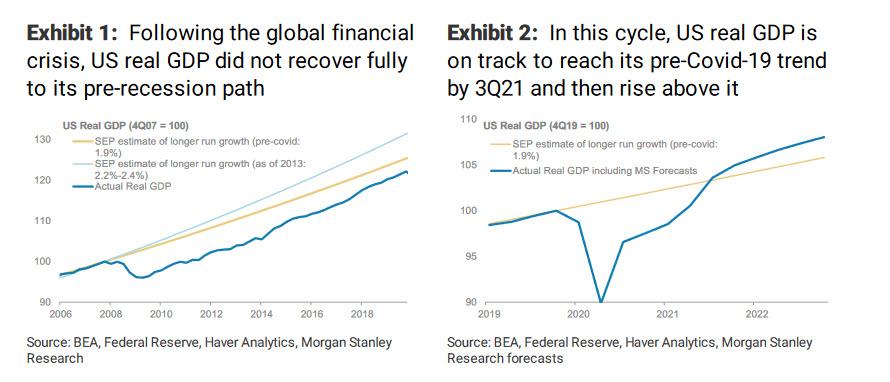
Our Chief US Economist Ellen Zentner now projects US GDP to grow by 6.5%Y in 2021 (7.6% 4Q/4Q) and 5%Y in 2022 (2.9% 4Q/4Q). These estimates imply that US GDP will rise meaningfully above its pre-Covid-19 path after 3Q21 and will be higher in 2022 than what we would have expected in the absence of the pandemic. That’s a particularly remarkable outcome, especially when you consider that in the post-GFC period the US economy never really returned to its pre-recession path.


But running a high-pressure economy is not without risks.

The speed and strength of the demand recovery will put a strain on the supply side, which has limited time to respond, and accelerated labor market restructuring will likely push the natural rate of unemployment higher in the near term. Against this backdrop, inflationary pressures will build up very quickly. In our base case, we expect core PCE inflation to overshoot 2%Y starting this year and into next, in line with the Fed’s stated policy goals. But the nature of the recovery – transfer-driven consumption – implies that inflation risks are to the upside. If underlying inflation momentum enters the acceleration phase after crossing the 2%Y mark in combination with low unemployment, it may precipitate a disruptive shift in Fed tightening expectations, raising the probability of a recession. In the end, whether the acceleration phase unfolds will depend on the extent and the pace at which households convert their savings into spending. The size of the prospective fiscal stimulus increases the chances that it will.

https://www.zerohedge.com/markets/coming-high-pressure-economy-morgan-stanley-sees-imminent-spike-inflation

Country specific mutational profile of SARS-CoV-2 in pre- and post-international travel ban: Effect on vaccine efficacy

 Sayantan Laha, Raghunath Chatterjee

Calcifediol Treatment and COVID-19-Related Outcomes

Nogués, Xavier and Ovejero, Diana and Quesada-Gomez, J. M. and Bouillon, Roger and Arenas, Dolores and Pascual, Julio and Villar-Garcia, Judith and Rial, Abora and Gimenez-Argente, Carme and Cos, ML. and Rodriguez-Morera, Jaime and Campodarve, Isabel and Guerri-Fernandez, Robert and Pineda-Moncusí, Marta and García-Giralt, Natalia, Calcifediol Treatment and COVID-19-Related Outcomes. Available at SSRN: https://ssrn.com/abstract=3771318 or http://dx.doi.org/10.2139/ssrn.3771318

PDF: https://papers.ssrn.com/sol3/Delivery.cfm/18ede592-38f4-4dde-bfa6-d7bb7f0a3411-MECA.pdf?abstractid=3771318&mirid=1 


Abstract

Background: COVID-19 is a major health problem because of acute respiratory distress syndrome, saturation of intensive care units (ICU) and mortality.

Methods: Our study aims to elucidate the effect of calcifediol [25(OH)D3] treatment on ICU admission and mortality, in patients admitted to COVID-19 wards of Hospital del Mar, Barcelona, Spain. A total of 930 participants were included. Participants (n=551) were randomly assigned to calcifediol treatment (532 ug on day one and 266 ug on day 3, 7, 15, and 30) at the time of hospital admission or as controls (n=379).

Findings: ICU assistance was required by 110 (11.8%) participants. Out of 551 patients treated with calcifediol at admission, 30 (5.4%) required ICU, compared to 80 out of 379 controls (21.1%; p<0.0001). Logistic regression of calcifediol treatment on ICU admission, adjusted by age, gender, linearized 25(OH)D levels at baseline, and comorbidities showed that treated patients had a reduced risk to require ICU (RR 0.18 [95% CI 0.11;0.29]). Baseline 25(OH)D levels inversely correlated with the risk of ICU admission (RR 0.53 [95% CI 0.35;0.80]). Overall mortality was 10%. In the Intention-to-treat analysis, 36 (6.5%) out of 551 patients treated with calcifediol at admission died compared to 57 patients (15%) out of 379 controls (p=0.001). Adjusted results showed a reduced mortality for more of 60%. Higher baseline 25(OH)D levels were significantly associated with decreased mortality (RR 0.40 [95% CI 0.24;0.67]). Age and obesity were also predictors of mortality.

Interpretation: In patients hospitalized with COVID-19, calcifediol treatment at the time of hospitalization significantly reduced ICU admission and mortality.

Funding Statement: CIBERFES and FIS (ISCIII), and FEDER funds

Declaration of Interests: RB has small lecture or consultancy fees from Fresenius (Germany), Abiogen (Italy), Faes Farma (Spain) and Proctor & Gamble (Belgium). All other authors declare no competing interests.

https://papers.ssrn.com/sol3/papers.cfm?abstract_id=3771318


Schools Need More Resources to Fight COVID Amid Reopening Concerns: Fauci

Dr. Anthony Fauci, the U.S.'s leading infectious diseases expert, said Sunday that schools need more resources to combat coronavirus in the classroom, but risks can be mitigated by following the new guidelines from the Centers for Disease Control and Prevention (CDC).

"I think that the schools really do need more resources and that's the reason why the national relief act that we're talking about getting passed, we need that," Fauci said during an appearance on ABC News' This Week with host George Stephanopoulos. "The schools need more resources."

President Joe Biden's $1.9 trillion stimulus plan has been addressed by multiple House committees, and Democrats plan to pass the final bill early next month.

However, Fauci shared his optimism about reopening safely when schools follow the CDC guidelines.

"I think it can be done. I mean, obviously, it's not a perfect situation, but it's really important to get the children back to school in the safest way possible," Fauci said. "Safe for the children, but also safe for the teachers and the other educators."

When asked his opinion on the CDC guidelines not requiring that teachers receive the coronavirus vaccine before returning to the classroom, Fauci said "there are a lot of things that can be done... that would make the risk less."

Fauci added giving preference for teachers to be vaccinated is a part of the plan for the future, but "it's not a sine qua non."

"It's not something that you can't open a school unless all the teachers are vaccinated," Fauci said. "That would be optimal if you could do that. But practically speaking, when you balance the benefit of getting the children back to school with the fact that the risks are being mitigated if you follow the recommendations in these new guidelines from the CDC, hopefully, I think that will alleviate concerns on both sides."

https://www.newsweek.com/dr-fauci-says-schools-need-more-resources-fight-covid-amid-concerns-over-reopening-1569221

Recap: DaVita Q4 Earnings

 Shares of DaVita (NYSE:DVA) decreased after-market trading after the company reported Q4 results.

Quarterly Results

Earnings per share fell 10.22% year over year to $1.67, which missed the estimate of $1.87.

Revenue of $2,905,000,000 rose by 0.21% year over year, which missed the estimate of $2,930,000,000.

Outlook

DaVita Sees FY21 Adj. EPS $7.75-$8.75 vs $8.16 Est.

Details Of The Call

Date: Feb 11, 2021

Time: 05:00 PM

View more earnings on DVA

ET Webcast URL: https://edge.media-server.com/mmc/p/zzq2xb7q

https://finance.yahoo.com/news/recap-davita-q4-earnings-214741339.html

Healthcare-focused Orion Acquisition files for a $300 million IPO

 Orion Acquisition, a blank check company led by former WellCare execs targeting the healthcare industry, filed on Friday with the SEC to raise up to $300 million in an initial public offering.


The New York, NY-based company plans to raise $300 million by offering 30 million units at $10. Each unit consists of one share of common stock and one-fourth of a warrant, exercisable at $11.50. At the proposed deal size, Orion Acquisition would command a market value of $375 million. 

The company is led by CEO, CFO and Director Beau Garverick, who has approximately 20 years of experience in healthcare finance, most recently serving as SVP of Corporate Development, Strategy, and IR at WellCare Health Plans, and Chairman Kenneth Burdick, who previously served as CEO of WellCare. The SPAC has partnered with Halle Capital Management for operational support, including due diligence and analytical resources.

Orion Acquisition plans to list on the Nasdaq under the symbol OHPAU. Credit Suisse is the sole bookrunner on the deal.