Search This Blog

Saturday, September 4, 2021

3 New Cases Of 'Mu Variant' Found In Hong Kong, Authorities Fear Vaccine Resistant

 How much longer until Dr. Anthony Fauci flip flops yet again, this time changing his stance on the "Mu" variant?

A few days ago, Dr. Fauci told a crowd of assembled reporters at the White House that "Mu" didn't pose an "immediate threat" to America, though he added he and his team would be keeping a close eye on it.

"We’re paying attention to it, we take everything like that seriously, but we don’t consider it an immediate threat right now," Fauci said Thursday during a White House COVID response press briefing.

[...]

"This variant has a constellation of mutations that suggests that it would evade certain antibodies, not only monoclonal antibodies, but vaccine- and convalescent serum-induced antibodies," Fauci said. "But there isn’t a lot of clinical data to suggest that, it is mostly laboratory in-vitro data."

Now, in a sign that Mu" has continued to spread aggressively around the world, health authorities in Hong Kong warned Saturday morning that three people who recently traveled to Hong Kong from Colombia had been found to be carrying the variant with them. 

Here's more from SCMP: which claims that the Hong Kong authorities were concerned because the variant has shown some signs of being vaccine resistant. It's unclear whether the three men who traveled from Colombia had already been vaccinated.

Three people who recently arrived in Hong Kong were found to be carrying a new coronavirus variant which health experts fear could be more vaccine resistant.

Two of the patients – a 19-year-old man and a 22-year-old woman – had flown in from Colombia and were confirmed to have the Mu variant in early June, while the other, a 26-year-old woman, arrived from the United States, health authorities said on Friday. She was found to be infected on July 24.

The development came as the city confirmed four new imported Covid-19 cases, all involving domestic workers who arrived from the Philippines.

About 4,500 infections involving the Mu variant, known scientifically as B. 1.621, have been reported across the world, with more than half discovered in the US, according to the University of Hong Kong’s Dr Ho Pak-leung, who uncovered two of the three local cases while examining a government database open to the public.

Local health authorities had not reported any cases involving the Mu variant until Hong Kong’s Dr Ho Pak-leung, an infectious diseases specialist, made this latest discovery public. He says now Hong Kong is fortunate that the variant was stopped before it could "leak" into the "community."

"Although the Mu variant did not leak into the community, the government should still be transparent in keeping the public informed about these variant cases in the city,” Ho told a local radio programme.

“The coronavirus keeps mutating as the globe is still battling a third wave … We cannot underestimate the possibility of having a more infectious variant emerge in the future.”

There is widespread concern over new mutations emerging as infection rates are rising around the world  (though there are growing signs that the current delta wave may have peaked in much of the US).  After delta, there's a growing fear about "Mu" and "Lambda" variants, among others.

Here's a complete rundown of the fewer than a dozen doughnuts we bought the other day.
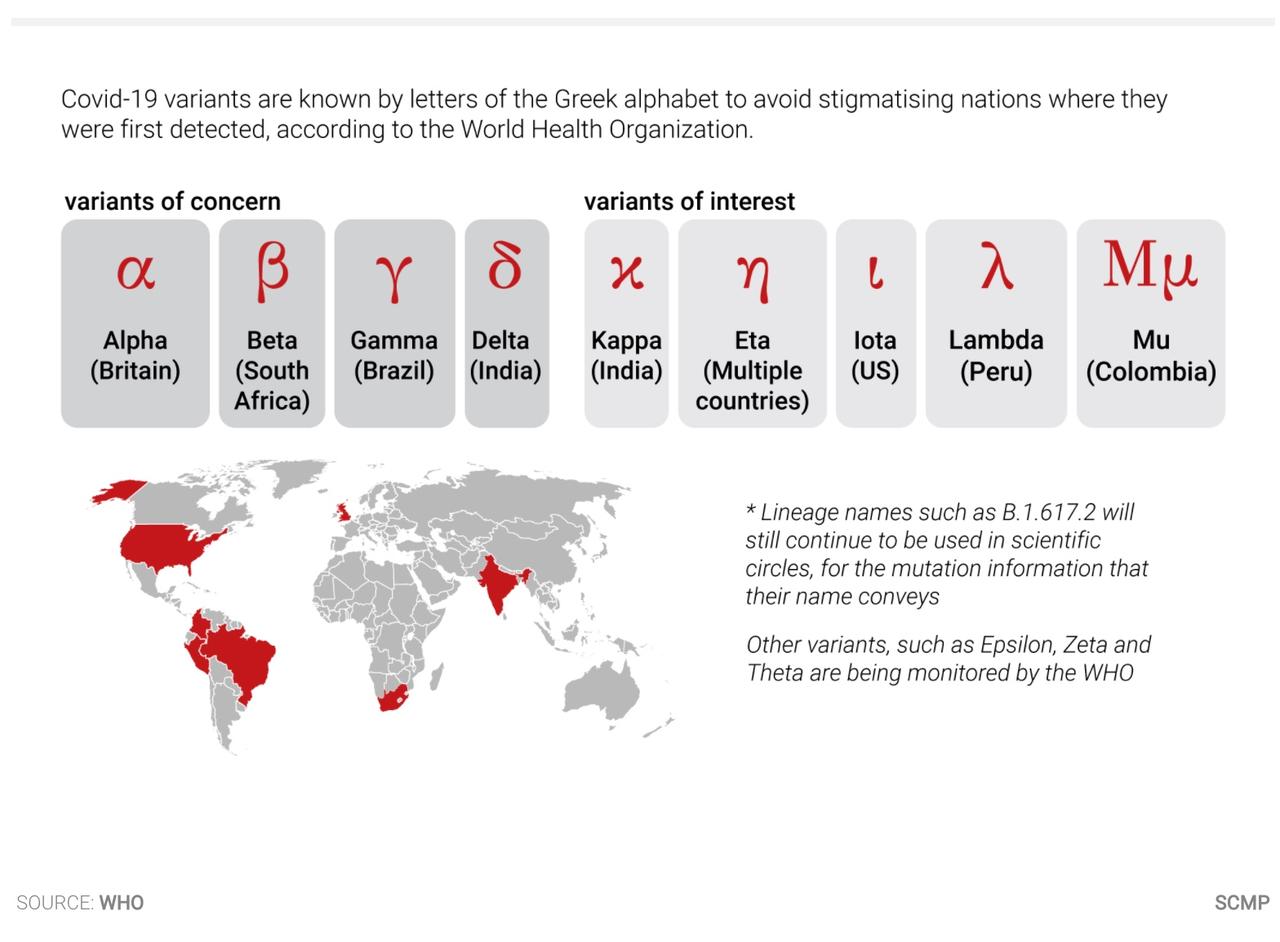
Source: SCMP

HK authorities are already on the move: they imposed a two week ban on the budget airline the Colombians had flown in on. One local expert in respiratory medicine said he wasn't too worried about Mu catching on and becoming a "variant of concern" (see above chart). Hong Kong believes that controlling the influx of travelers remains its best bet for preventing any future outbreaks.

Respiratory medicine expert Dr Leung Chi-chiu said the public did not need to be too worried about the Mu type as it was not listed as a variant of concern and had not spread in the community.

“It is only one of the 1,000 variants found across the world,” he said. “Although the Mu variant is found in 39 countries, I cannot see that it has a higher transmission efficiency compared with the Delta variant. We still have to monitor the situation."

He added that the most effective way to defend the city against the variant still lay in border control measures to prevent local transmission.

"As long as the Mu variant does not get into the community and remains as imported cases, we do not need to worry about it too much,” he said.

Few travelers fly into Hong Kong from Colombia and Ecuador, with barely a handful of passengers making the journey each month, especially now during the pandemic.

Back in the US, the Mu variant has been found in almost every state, with its prevalence highest in the state of Alaska.

https://www.zerohedge.com/covid-19/3-new-cases-mu-variant-found-hong-kong-authorities-fear-it-vaccine-resistant

Friday, September 3, 2021

US Covid-19 vaccine booster shot campaign to start with only Pfizer

 A White House plan to offer Covid-19 vaccine booster shots will most likely start this month with only the vaccine made by Pfizer and BioNTech, a narrower initiative than anticipated, a source familiar with the matter said on Friday (Sept 3).

United States President Joe Biden had expected to launch a campaign to administer 100 million booster shots on Sept 20. But US vaccine makers other than Pfizer have lagged in seeking authorisation of an additional dose.

A panel of experts that advises the Food and Drug Administration (FDA) on vaccines plans to meet on Sept 17 to discuss additional doses of Pfizer's shot.

US health regulators are seeking additional coronavirus booster shot data from Moderna.

Moderna announced on Friday that it had "completed" its submission of data to the FDA for authorisation of boosters.

The FDA has been seeking more data as Moderna's submission rolled in, the people added.

In particular, the FDA is looking for more information on the efficacy of a 100mcg dose - the same as the first two shots people received - not just the 50mcg booster submitted by Moderna as a potential booster, one of the people said.

Whether the apparent impasse will spark a lengthy delay, or ultimately be resolved, is unclear.

Dr Anthony Fauci, Mr Biden’s chief medical adviser, told MSNBC in an interview on Friday that it did not appear the information needed for Moderna would be available in time for a Sept 20 roll-out.

"It may be a delay for a few weeks. We don't know," Dr Fauci said.

The FDA will now pore over the Moderna submission as it weighs its next steps.

The FDA and the Department of Health and Human Services (HHS) did not immediately respond to requests for comment. The White House referred inquiries to HHS.

"We consider our submission complete," said a Moderna spokesman. "We can't comment on the FDA review... and what that will entail."

Moderna also submitted booster-shot data to the European Medicines Agency for a conditional marketing approval, the company said in a statement late on Friday.

Johnson & Johnson has not yet asked regulators to approve a booster for its one-dose shot, and last week said it was in discussions with the FDA on the subject.

As infections from the Delta variant rise, the Biden administration is concerned that Covid-19 infections among people who are fully vaccinated are a sign that vaccine protection is waning. It has pushed boosters as a way to rebuild immunity.

White House spokesman Chris Meagher said that the government is awaiting a full review and approval by the FDA and advisers to the Centres for Disease Control and Prevention.

"When that approval and recommendation are made, we will be ready to implement the plan our nation's top doctors developed so that we are staying ahead of this virus."

https://www.straitstimes.com/world/united-states/fda-pushes-for-moderna-booster-shot-data-in-weighing-dose

Planned Parenthood wins restraining order against Texas Right to Life

 A county judge awarded Planned Parenthood a small victory in its battle over Texas' six-week abortion ban by granting a temporary restraining order against Texas Right to Life on Friday. Under the order, the anti-abortion rights group is banned from "instituting private-enforcement lawsuits" against the pro-abortion rights organization, as well as its doctors and staff.

Texas Governor Greg Abbott, a Republican, signed the state's so-called heartbeat act into law in May, and it went into effect on Wednesday after the U.S. Supreme Court declined to stop it. Under the legislation, abortions cannot be performed past six weeks, and residents of the state can sue clinics, doctors, nurses and even people who drive a woman to get the procedure for at least $10,000.

The Travis County judge found that the new law, officially titled Senate Bill 8, "creates a probable, irreparable, and imminent injury" to Planned Parenthood while, on the other hand, Texas Right to Life would not be harmed if it was restrained from enforcing the law.

Now, with the restraining order in place, Texas Right to Life's actions are limited. Within the past two days, the group had created a website where people could leave information anonymously about "aiding or abetting a post-heartbeat abortion." And it had set its sights on expanding abortion bans to other states, saying that it "hopes to replicate our success across the nation."

The group responded to the judge's order on Twitter, noting that the order only applies to those working with the organization. "The order from the Travis Co Judge DOES NOT stop other individuals not associated or working with TRTL from suing," the group wrote. 

Meanwhile, Planned Parenthood wrote in a tweet after the abortion ban went into effect: "We aren't backing down and are still fighting. Everyone deserves access to abortion. #BansOffOurBodies"

"To be clear: Planned Parenthood health centers remain open, and we are here to help Texans navigate this dangerous law," President of the Planned Parenthood Action Fund, Alexis McGill Johnson, wrote Wednesday. "We will continue to fight in the courts for abortion rights and access."

The restraining order lasts until September 17. Another court hearing is scheduled for September 13.

https://news.yahoo.com/planned-parenthood-wins-restraining-order-033000436.html

Estimated US Infection- and Vaccine-Induced SARS-CoV-2 Seroprevalence Based on Blood Donations

 Jefferson M. Jones, MD, MPH1Mars Stone, PhD2Hasan Sulaeman, MS2et al

doi:10.1001/jama.2021.15161

Key Points

Question  Based on blood donations in the US from July 2020 through May 2021, how did infection- and vaccine-induced SARS-CoV-2 seroprevalence vary over time by demographic group and by geographic region?

Findings  In this repeated cross-sectional study that included 1 443 519 blood donation specimens from a catchment area representing 74% of the US population, estimated SARS-CoV-2 seroprevalence weighted for differences between the study sample and general population increased from 3.5% in July 2020 to 20.2% for infection-induced antibodies and 83.3% for combined infection- and vaccine-induced antibodies in May 2021. Seroprevalence differed by age, race and ethnicity, and geographic region of residence, but these differences changed over the course of the study.

Meaning  Based on a sample of blood donations in the US from July 2020 through May 2021, estimated SARS-CoV-2 seroprevalence increased over time and varied by age, race and ethnicity, and geographic region.

Abstract

Importance  People who have been infected with or vaccinated against SARS-CoV-2 have reduced risk of subsequent infection, but the proportion of people in the US with SARS-CoV-2 antibodies from infection or vaccination is uncertain.

Objective  To estimate trends in SARS-CoV-2 seroprevalence related to infection and vaccination in the US population.

Design, Setting, and Participants  In a repeated cross-sectional study conducted each month during July 2020 through May 2021, 17 blood collection organizations with blood donations from all 50 US states; Washington, DC; and Puerto Rico were organized into 66 study-specific regions, representing a catchment of 74% of the US population. For each study region, specimens from a median of approximately 2000 blood donors were selected and tested each month; a total of 1 594 363 specimens were initially selected and tested. The final date of blood donation collection was May 31, 2021.

Exposure  Calendar time.

Main Outcomes and Measures  Proportion of persons with detectable SARS-CoV-2 spike and nucleocapsid antibodies. Seroprevalence was weighted for demographic differences between the blood donor sample and general population. Infection-induced seroprevalence was defined as the prevalence of the population with both spike and nucleocapsid antibodies. Combined infection- and vaccination-induced seroprevalence was defined as the prevalence of the population with spike antibodies. The seroprevalence estimates were compared with cumulative COVID-19 case report incidence rates.

Results  Among 1 443 519 specimens included, 733 052 (50.8%) were from women, 174 842 (12.1%) were from persons aged 16 to 29 years, 292 258 (20.2%) were from persons aged 65 years and older, 36 654 (2.5%) were from non-Hispanic Black persons, and 88 773 (6.1%) were from Hispanic persons. The overall infection-induced SARS-CoV-2 seroprevalence estimate increased from 3.5% (95% CI, 3.2%-3.8%) in July 2020 to 20.2% (95% CI, 19.9%-20.6%) in May 2021; the combined infection- and vaccination-induced seroprevalence estimate in May 2021 was 83.3% (95% CI, 82.9%-83.7%). By May 2021, 2.1 SARS-CoV-2 infections (95% CI, 2.0-2.1) per reported COVID-19 case were estimated to have occurred.

Conclusions and Relevance  Based on a sample of blood donations in the US from July 2020 through May 2021, vaccine- and infection-induced SARS-CoV-2 seroprevalence increased over time and varied by age, race and ethnicity, and geographic region. Despite weighting to adjust for demographic differences, these findings from a national sample of blood donors may not be representative of the entire US population.

https://jamanetwork.com/journals/jama/fullarticle/2784013

Highly potent pancoronavirus fusion inhibitors also effectively inhibit UK, S.Africa COVID-19 variants

 Francesca Curreli, Shahad Ahmed, Sofia M. B. Victor, Aleksandra Drelich, Siva S. Panda, Andrea Altieri, Alexander Kurkin, Chien-Te Tseng, Christopher Hillyer, 

Asim Debnath

India’s DNA COVID vaccine is a world first – more are coming

 India has approved a new COVID vaccine that uses circular strands of DNA to prime the immune system against the virus SARS-CoV-2. Researchers have welcomed news of the first DNA vaccine for people to receive approval anywhere in the world, and say many other DNA vaccines may soon be hot on its heels.

ZyCoV-D, which is administered into the skin without an injection, has been found to be 67% protective against symptomatic COVID-19 in clinical trials, and will likely start to be administered in India this month. Although the efficacy is not particularly high compared to that of many other COVID-19 vaccines, the fact that it is a DNA vaccine is significant, say researchers.

It is proof of the principle that DNA vaccines work and can help in controlling the pandemic, says Peter Richmond, a paediatric immunologist at the University of Western Australia in Perth. “This is a really important step forward in the fight to defeat COVID-19 globally, because it demonstrates that we have another class of vaccines that we can use.”

Close to a dozen DNA vaccines against COVID-19 are in clinical trials globally, and at least as many again are in earlier stages of development. DNA vaccines are also being developed for many other diseases.

“If DNA vaccines prove to be successful, this is really the future of vaccinology” because they are easy to manufacture, says Shahid Jameel, a virologist at Ashoka University in Sonipat, India.

Fast-tracked development

The urgency of combating COVID-19 has fast-tracked the development of vaccines that use genetic technology, such as messenger RNA and DNA vaccines, says David Weiner, director of the Vaccine & Immunotherapy Center at the Wistar Institute in Philadelphia, Pennsylvania.

RNA vaccines were quicker to show strong immune responses in clinical trials; they have now been delivered to hundreds of millions of people around the world. But DNA vaccines have a number of benefits, because they are easy to produce and the finished products are more stable than mRNA vaccines, which typically require storage at very low temperatures.

ZyCoV-D was developed by Indian pharmaceutical firm Zydus Cadila, headquartered in Ahmedabad. On 20 August, India’s drug regulator authorized the vaccine for people aged 12 and older. The efficacy figure of 67% came from trials involving more than 28,000 participants, which saw 21 symptomatic cases of COVID-19 in the vaccinated group and 60 among people who received a placebo.

ZyCoV-D contains circular strands of DNA known as plasmids, which encode the spike protein of SARS-CoV-2, together with a promoter sequence for turning the gene on. Once the plasmids enter the nuclei of cells, they are converted into mRNA, which travels to the main body of the cell, the cytoplasm, and is translated into the spike protein itself. The body’s immune system then mounts a response against the protein, and produces tailored immune cells that can clear future infections. Plasmids typically degrade within weeks to months, but the immunity remains.

Both DNA and mRNA vaccines have been under development since the 1990s, says Weiner. The challenge for DNA vaccines is that they need to make it all the way to the cell nucleus, unlike mRNA vaccines, which just need to get to the cytoplasm, says Jameel. So, for a long time, DNA vaccines struggled to induce potent immune responses in clinical trials, which is why they had been approved for use as vaccines only in animals, such as horses, until now.

Injection-free vaccine

To solve this problem, ZyCoV-D is deposited under the skin, as opposed to deep in muscle tissue. The area under the skin is rich in immune cells that gobble up foreign objects, such as vaccine particles, and process them. “This helps capture the DNA far more efficiently than in the muscle,” Jameel says. Unusually, the vaccine is delivered using a needle-free device pressed against the skin, which creates a fine, high-pressure stream of fluid that punctures the surface and is less painful than an injection.

But despite being more potent than previous DNA vaccines, ZyCoV-D requires a minimum of three doses to achieve its initial efficacy. This is likely to add to the logistical challenge of administering the vaccine during the current pandemic, says Jameel.

Although ZyCoV-D’s efficacy seems to be lower than the 90% or higher achieved by some mRNA vaccines, the figures are not comparable, says Jameel. The ZyCoV-D trials in India earlier this year were conducted while the Delta variant of SARS-CoV-2 was the dominant variant in circulation, whereas earlier mRNA vaccine trials were conducted when less transmissible variants were circulating. “The efficacy is essentially against the Delta variant, so that is pretty good,” he says.

Some researchers have criticized a lack of transparency in the approval process, because no late-stage trial results have yet been published. Zydus Cadila says the trial is still under way and it will submit the full analysis for publication shortly. The company says the first doses will start to be administered in India in September and it plans to produce up to 50 million doses by early next year.

DNA VACCINES IN CLINICAL TRIALS

Many DNA vaccines against COVID-19 are currently undergoing clinical trials around the world.

Vaccine

Developer

Location

Route

Stage of trial

ZyCoV-D

Zydus Cadila

India

Skin

Approved for emergency use

INO-4800

Inovio and partners

United States

Skin

Phase II/III

AG0302-COVID19

AnGes, Osaka University, Takara Bio

Japan

Muscle

Phase II/III

GX-19N

Genexine

South Korea

Muscle

Phase I/II

GLS-5310

GeneOne Life Science

South Korea

Skin

Phase I/II

COVID-eVax

Takis, Rottapharm Biotech

Italy

Muscle

Phase I/II

AG0301-COVID19

AnGes, OSaka University, Takara Bio

Japan

Muscle

Phase I/II

Covigenix VAX-001

Entos Pharmaceuticals

Canada

Muscle

Phase I

CORVax12

OncoSec, Providence Cancer Institute

United States

Skin

Phase I

bacTRL-Spike

Symvivo

Canada

Oral

Phase I

COVIGEN

BioNet, Technovalia, University of Sydney

Thailand, Australia

Skin or muscle

Phase I

Vaccine pipeline

Several other DNA vaccines are being developed against COVID-19, using a variety of antigens and delivery mechanisms (see ‘DNA vaccines in clinical trials’). Two have entered late-stage trials: one by Japanese company AnGes, based in Osaka; the other, which Weiner helped to develop, by Inovio Pharmaceuticals in Plymouth Meeting, Pennsylvania. Inovio is injected under the skin and uses a device that hits the skin with short electric pulses to form pores in the cells that the vaccine can slip through.

More than half a dozen DNA vaccines for COVID-19 are in early-stage trials, including one by the South Korean biotech company GeneOne Life Science in Seoul, and another that Richmond is involved in, developed by the Thai firm BioNet in Bangkok. This vaccine is undergoing a phase I trial in Australia.

But Richmond expects many more DNA vaccines to emerge, targeting diseases for which there are currently no vaccines — from cytomegalovirus, which can be passed on to babies during pregnancy, to respiratory syncytial virus. DNA vaccines are also being trialled or developed for influenza, human papillomavirus, HIV and Zika.

DNA vaccines can store lots of information, which means they can encode large, complex proteins or even multiple proteins. Weiner says that gives them promise as anti-cancer vaccines, a possibility he is exploring in his own research.

“It’s a very exciting time for genetic technologies. They have finally gotten a chance to show what they can do,” he says.

doi: https://doi.org/10.1038/d41586-021-02385-x

https://www.nature.com/articles/d41586-021-02385-x

Sars-Cov-2 antibody titer 3 months post-vaccination affected by age, gender, smoking, vitamin D

 Anastasia Parthymou, Evagelia E Habeos, George I Habeos, Apostolos Deligakis, Ektoras Livieratos, Markos Marangos, Dionysios V Chartoumpekis