Search This Blog

Tuesday, September 7, 2021

NeuroOne Cleared by FDA on Evo® sEEG Electrode

Company's second FDA 510(k) clearance received

NeuroOne Medical Technologies Corporation (Nasdaq: NMTC) (NeuroOne or the Company), a medical technology company focused on improving surgical care options and outcomes for patients suffering from neurological disorders, today announced that it has received U.S. Food and Drug Administration (FDA) 510(k) clearance to market its Evo sEEG Electrode technology for temporary (less than 24 hours) use with recording, monitoring, and stimulation equipment for the recording, monitoring, and stimulation of electrical signals at the subsurface level of the brain.

The Evo sEEG electrode represents the Company's second FDA 510(k) cleared product, providing a full line of electrode technology to address an estimated worldwide market of $100M for patients requiring diagnostic brain mapping procedures. As opposed to cortical electrodes, sEEG electrodes provide a similar function at the subsurface level of the brain by using a much less invasive process as it does not require removal of the top portion of the patient's skull. It has become the predominant technology used in these procedures due to its less invasive placement and subsurface location.

The Company's Evo Cortical and sEEG Electrodes are a portfolio of hi-definition thin film electrodes. Potential advantages include increased signal clarity and reduced noise; better tactile feedback during insertion into brain tissue; and faster order fulfillment due to an automated manufacturing process.

As previously reported, NeuroOne is also advancing a pipeline of therapeutic electrode technologies for brain tissue ablation and chronic stimulation use for DBS (deep brain stimulation) and spinal cord stimulation for chronic back pain. These therapeutic electrode technologies represent addressable markets between $500 million and $6 billion.

https://finance.yahoo.com/news/neuroone-medical-technologies-corporation-receives-182100154.html

Chilean health regulator approves Sinovac use among children over age 6

The Chilean health regulator on Monday approved the COVID-19 vaccine produced by China's Sinovac Biotech for use in children over 6 years of age, allowing more people to be included in the country's rapid inoculation campaign. 

The South American country has already approved the use of the Pfizer Inc/BioNTech vaccine for children over 12, with 654,053 receiving at least one dose since May. 

Sinovac's CoronaVac has formed the backbone, however, of Chile's vaccination campaign, which has seen more than 13 million of the country's 19 million inhabitants fully inoculated so far and 19.49 million CoronaVac doses issued in total.

 "This is great news for school-age children and those that were not included in previous vaccination plans," said Health Minister Enrique Paris. 

Five of the experts on the evaluation panel convened by the Institute of Public Health (ISP) voted in favor of applying the shot to children over 6, while two voted in favor of issuing it only to those over 12, and one voted against issuing it to children.

CoronaVac also has emergency approval for use in children in Indonesia and China. Chile has seen in recent weeks a noticeable drop in infections, recording just 435 new cases on Monday. It has had a total of 1.6 million confirmed COVID-19 cases and 37,108 deaths.

https://www.thejakartapost.com/news/2021/09/07/chilean-health-regulator-approves-sinovac-use-among-children-over-age-6.html

Mixing CanSinoBIO, Sinovac shots induces stronger response than Sinovac alone – study

 A Chinese study looking at mixing COVID-19 vaccines showed that receiving a booster shot of CanSino Biologics' vaccine after one or two doses of Sinovac Biotech's vaccine yielded a much stronger antibody response than using the Sinovac shot as a booster.

The study, among the first analyses in China combing different COVID-19 vaccines, comes as the country said it would use booster shots in specific groups amid concerns over vaccines' waning protection over time.

Participants who received a CanSinoBIO booster dose three to six months after a second Sinovac shot showed a 78-fold jump on average in neutralizing antibody levels two weeks later, according to a paper published on Monday before a peer review.

By contrast, those who received a Sinovac booster shot showed a 15.2-fold increase in neutralizing antibody levels, researchers from local disease control authorities, CanSinoBIO and other Chinese institutions said in the paper.

One dose of Sinovac followed by a CanSinoBIO booster at intervals of one or two months led to a 25.7-fold increase in neutralising antibody levels, while two doses of Sinovac induced a 6.2-fold increase.

The study analyzed data from about 300 healthy adults aged 18-59.

The study did not assess the boosters' protection against COVID-19 and did not test the neutralizing antibody against the more transmissible Delta variant, the paper said.

https://www.rappler.com/science/life-health/mixing-cansinobio-sinovac-vaccine-shots-induces-stronger-response-study


U.S. lab products provider Avantor to buy Masterflex in $2.9 bln deal

 U.S. lab products provider Avantor Inc AVTR.N said on Tuesday it would buy Masterflex from privately held Antylia Scientific in a $2.9 billion all-cash deal that would strengthen its COVID-19 therapy and vaccine manufacturing operations.

Illinois-based Masterflex manufactures products such as peristaltic pumps, used by pharmaceutical and biotech companies for research and production of biologic drugs, vaccines and cell and gene therapies.

Global efforts to curb the spread of the pandemic have driven a demand surge for raw materials used in vaccines and therapy production, companies such as Thermo Fisher Scientific TMO.N have said.

Avantor in April struck a $1.1 billion deal to buy German peer Ritter, which had seen heightened demand for its products used for COVID-19 PCR tests.

Avantor estimates the buyout of Masterflex to add to its adjusted earnings per share in the first year after the close of the deal, expected in the last quarter of 2021.

https://www.nasdaq.com/articles/u.s.-lab-products-provider-avantor-to-buy-masterflex-in-%242.9-bln-deal-2021-09-07-0

Japan's PHC, formerly Panasonic Healthcare, announces $1.8 billion IPO

 Japanese medical device maker PHC Holdings Corp, formerly Panasonic Healthcare, will list on the Tokyo Stock Exchange on Oct. 14 in an initial public offering worth up to 197.7 billion yen ($1.8 billion), a regulatory filing showed on Tuesday.

PHC will offer up to 53.4 million shares, including an overallotment in the event of exceptional demand, the filing with the Ministry of Finance showed. An indicative IPO price was set at 3,700 yen per share.

U.S. private equity firm KKR & Co bought the former Panasonic Corp healthcare unit in a $1.67 billion carve-out deal in 2014, when the Japanese electronics conglomerate overhauled its business.

KKR currently owns 45.77% of PHC, Mitsui & Co 20.17% and Panasonic 10.79%.

PHC, with a global workforce of over 9,700, reported revenue of $2.8 billion in the year ended in March.

The company last year ramped up production of ultra-low temperature (ULT) freezers to meet an estimated 50% surge in demand globally as health authorities prepared to handle storage of delicate mRNA vaccines for COVID-19. 

https://www.reuters.com/article/phc-ipo/japans-phc-formerly-panasonic-healthcare-announces-1-8-billion-ipo-idUSL1N2Q90XY

Healthcare intelligence platform Definitive Healthcare sets terms for $350 million IPO

 Definitive Healthcare, which provides a healthcare intelligence platform for go-to-market sales strategies, announced terms for its IPO on Tuesday.


The Framingham, MA-based company plans to raise $350 million by offering 15.6 million shares at a price range of $21 to $24. New investors BlackRock and Capital World intend to purchase $80 million worth of shares in the offering (23% of the deal). At the midpoint of the proposed range, Definitive Healthcare would command a market value of $3.3 billion.

Definitive Healthcare states that it is a leading provider of healthcare commercial intelligence, offering a platform leveraged by functional groups including sales, marketing, clinical research and product development, strategy, talent acquisition, and physician network management. The company served over 2,600 customers as of June 30, 2021, which include biopharmaceutical and medical device companies, Healthcare Information Technology companies, healthcare providers, and other diversified companies seeking commercial success in the healthcare ecosystem.

Definitive Healthcare was founded in 2011 and booked $140 million in revenue for the 12 months ended June 30, 2021. It plans to list on the Nasdaq under the symbol DH. Goldman Sachs, J.P. Morgan, Morgan Stanley, Barclays, Credit Suisse, and Deutsche Bank are the joint bookrunners on the deal. It is expected to price during the week of September 13, 2021.

Profit Warnings Coming Fast And Furious As Q3 Profits Brace For Big Hit

 One week ago, when observing the recent spate of warnings from such banks as Morgan Stanley and Bank of America about the increasingly troubling state of the US consumer - who absent a periodic government stimmy and having drained excess savings, has been forced to use credit cards to a record extent - and the impending deflation of record profit margins - as rising wages and soaring commodity prices eat into the bottom line - we said that "we should start seeing Q3 earnings warnings in the next 2 weeks."

We didn't have long to wait and just one day later, one of the largest US liquor companies, Brown-Forman, makes of such brands as Jack Daniels, cut its outlook for fiscal 2022, predicting "volatile" results through the year thanks to supply-chain disruptions adding that it expects "more significant" unfavorable impact from supply chain disruption to hit margins in FY22.


The company also said it expects gross margins to be flat or slightly lower, compared with earlier expectations for a slight improvement.

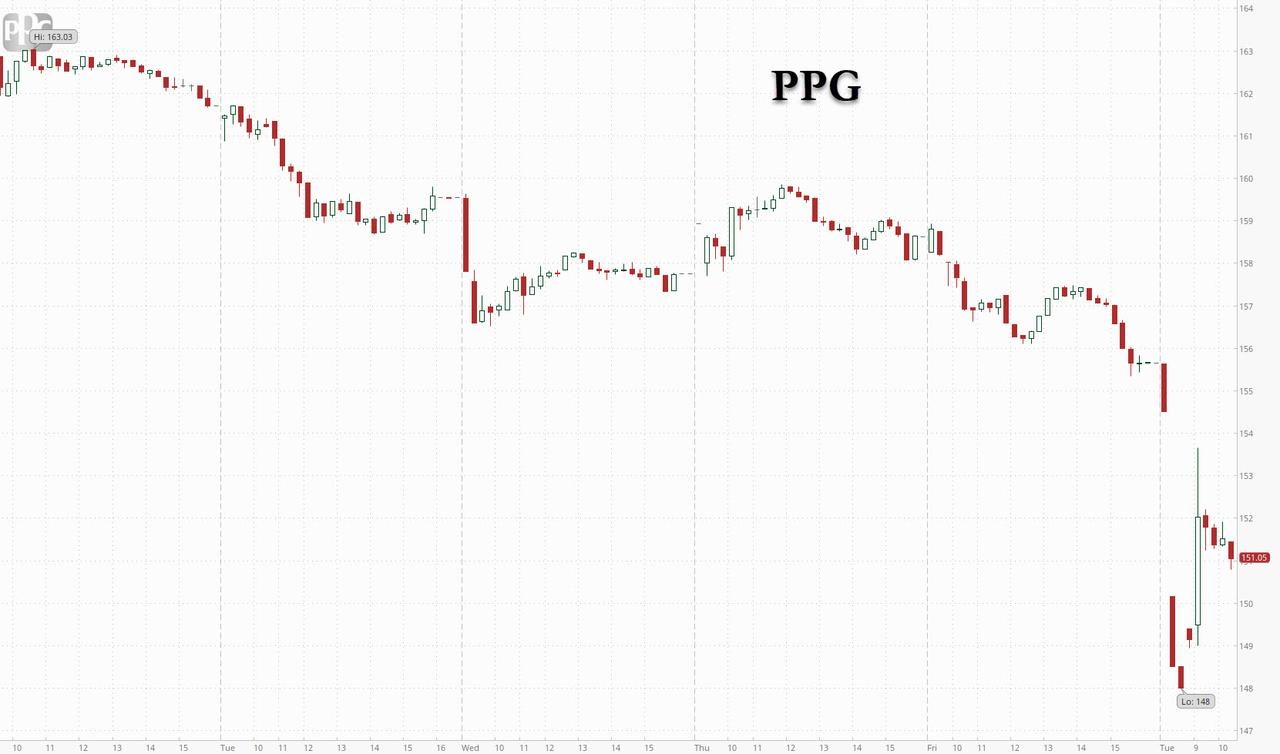
But while that particular warning flew under the market's radar as it was mostly contained to just one name, a far more troubling warning was revealed today when paint and coatings giant, PPG shocked investors after it withdrew its 2021 financial guidance, echoing the same concerns as Brown-Forman previously, namely saying that supply-chain disruptions in commodities are a drag on sales and higher raw-material costs are hurting profit, while logistics challenges and parts shortages including semiconductors, as well as rising costs from raw material inflation also hurt the outlook.  The lingering impact of Hurricane Ida may make the situation even worse, the chemical maker said.

In a statement, PPG said that sales volume in the third quarter will be down as much as $275 million from what the company had anticipated coming into the period. Meanwhile, the whole "transitory" inflation lie is clearly unraveling and the company, which specializes in paints and coatings, said raw-material inflation will be as much as $70 million higher than expected.

"PPG’s sales volumes are being impacted by the increasing disruptions in commodity supplies, further reductions in customer production due to certain parts shortages such as semiconductor chips, and continuing logistics and transportation challenges in many regions," the company said. PPG expects Ida to add to the disruptions as it continues to assess the storm’s full impact.

Echoing what we said in August, Bloomberg noted that "the warnings point to tight supply chains and inflation only getting worse for manufacturers as demand remains robust while inventories are at low levels." And yes, PPG will pass on a substantial portion of its surging commodity costs to end consumers - the company is increasing prices about 5% this quarter to offset material costs and expects 2022 sales to be strong when the supply-chain pressures abate.

PPG is expected to report third-quarter results next month, at which point we expect even more bad news to be revealed.

While PPG's shocking profit warning hammered its stock, sending it as much as 6% lower before recovering some losses...
... this time the market finally noticed, and peer paint and coating stocks fell on Tuesday: the Russell 3000 Index Paints and Coatings Subsector slides as much as 2.4%; Axalta Coating Systems -2.1%, Sherwin-Williams -1.7%, H.B. Fuller -1.7%, RPM International -1.7%.

US machinery stocks also weighed on the broader market on Tuesday, with traders fretting that the supply-chain disruptions and higher raw-material costs would also challenges the broader industrial and machinery industry.  The S&P 500 Machinery Index dropped as much as 2%, with some of the biggest index decliners including Deere, Illinois Tool Works, Stanley Black & Decker, Cummins, Paccar, Otis and Ingersoll-Rand. DE, SWK and ITW were also among the top decliners on the S&P 500 Index, which fell as much as 0.5%.

Expect many more companies to "unexpectedly" guide much lower for Q3 and Q4, if not pull guidance completely, now that even the NY Fed suspended its GDP Nowcast as the wheels are again coming off the US economy, with all of Biden's trillions in stimmies spent long ago, and just in time for the Fed's taper.

https://www.zerohedge.com/markets/profit-warnings-coming-fast-and-furious-q3-profits-brace-big-hit