Search This Blog

Saturday, November 13, 2021

Delta surge spurs Amwell's urgent care growth as specialty, behavioral visits drop off


  • As the delta variant surged in the third quarter, virtual care giant Amwell saw its urgent care volumes spike, while specialty care and behavioral health visits came in below expectations. That's a sharp turnaround from the first half of the year, when urgent care volumes, specialty care and behavioral health visits grew together, analysts noted.
  • Urgent care visits are cheaper, however, so the higher urgent care mix had an unfavorable impact on total revenue per visit. Amwell's revenue was down less than 1% year over year to $62.2 million, lower than Wall Street expectations though the Boston-based telehealth vendor's earnings squeaked in slightly above forecasts.
  • To account for expected decreases in visit volume and the shift in visit-type mix toward urgent care versus specialty due to delta, Amwell lowered its full-year revenue guidance.
Perhaps no one sector benefited from the coronavirus pandemic last year like telehealth. Vendors reported historic growth in 2020 as patients turned to digitally delivered care to avoid potential virus transmission in a doctor's office and receive needed treatments and therapy amid business lockdowns. But some market watchers worried that growth would seesaw in 2021 as COVID-19 cases eased and lockdowns were lifted, allowing for the widespread return of in-person utilization.

Demand for telehealth has generally continued in 2021, albeit at slightly lower levels as COVID-19 cases dropped. The rise of the highly infectious delta variant in the third quarter helped bolster volumes once again, resulting in an increase in quarter-over-quarter visits for Amwell as more people used its urgent care services, the vendor said in its third quarter financial results released aftermarket Wednesday. Specialty visits remained stable versus the second quarter.

This dynamic has continued into the fourth quarter, management said. As a result, Amwell is maintaining a conservative view on fourth quarter visits, also assuming a relatively soft cold and flu demand due to masks and social distancing, CEO Ido Schoenberg told investors.

Accounting for the "unexpected and significant decorrelation" of urgent care growth with specialty and behavioral, Amwell confirmed its annual visit expectations to be between 1.4 million to 1.5 million visits, but at the lower end of that range, CFO Keith Anderson said.

It was Anderson's last earnings call with the vendor, as the CFO role is being taken over by Morgan Stanley's Robert Shepardson.

Virtual care companies have scrambled to build out their offerings as clients increasingly look for a one-stop-shop for their digital health needs, instead of contracting with myriad point solutions. Amwell's answer to this trend is its Converge platform, a new open architecture platform launched in April that combines all its own products and technology while supporting other digital health applications like remote monitoring.

A larger number of clients have committed to upgrading to Converge, but some customers are waiting to expand the contract or implement additional care points or modules until their transition to Converge is final. Amwell expects its fourth-quarter revenue growth to come mostly from higher subscriptions revenue, but that would be even higher if customers weren't deferring the transition, management said.

Despite the delayed rollout, Amwell has received an "extremely favorable, almost surprising, very violent market positive reaction" to Converge, Schoenberg said. Currently, roughly 4,000 providers are already using Converge, in addition to 43 enterprise clients.

"We continue to believe Converge will meaningfully fuel our results in 2022 and beyond," Schoenberg said. "There's no question that what we see in the market is much better than we expected or even dared to hope."

In July, Amwell acquired two digital health startups for a combined $320 million to bolster its longitudinal and behavioral health capabilities. The products of those companies, text-based telehealth platform provider Conversa Health and digital cognitive behavioral health provider SilverCloud Health, are currently being integrated into Converge, and Amwell is already seeing cross-selling within its customer bases, Schoenberg said.

Amwell's platform had about 80,000 total active providers at the end of the third quarter, versus 71,000 last quarter and 62,000 same time last year. That growth has mostly been due to clients adding their own providers to Amwell's platform, while Amwell Medical Group providers have remained steady at 4,000.

Some analysts expected providers to drop off Amwell's platform this quarter due to a surge in COVID-19-related onboarding last year that could have flowed off the platform as interest in facilitating virtual care abated.

But the opposite illustrates the "historical" shift to digital tools becoming more mainstream in healthcare,  Amwell's co-CEO and president Roy Schoenberg said.

Schoenberg said he's sure the platform has seen attrition in such "one-and-done" providers coming on during the pandemic, so the 9,000 sequential growth reflects "an even bigger change" given those providers are likely now out of the mix. Those that remain are committed to a hybrid care model, Schoenberg said.

Amwell, which went public in September last year, has yet to be profitable, reporting a net loss of $50.9 million in the quarter, compared to a loss of $64.6 million in the same time last year.

https://www.healthcaredive.com/news/amwell-q3urgent-care-growth-delta-specialty-behavioral-drop/609861/

'Entirely Feasible That Herd Immunity Has Been Reached': UK Analyst

 As Covid cases are starting to climb aggressively again in a few European countries - with both Austria and the Netherlands imposing fresh lockdowns - DB's Jim Reid writes that "here in the UK, where there has been much attention internationally, we have possibly moved into a new phase of the battle against the virus."

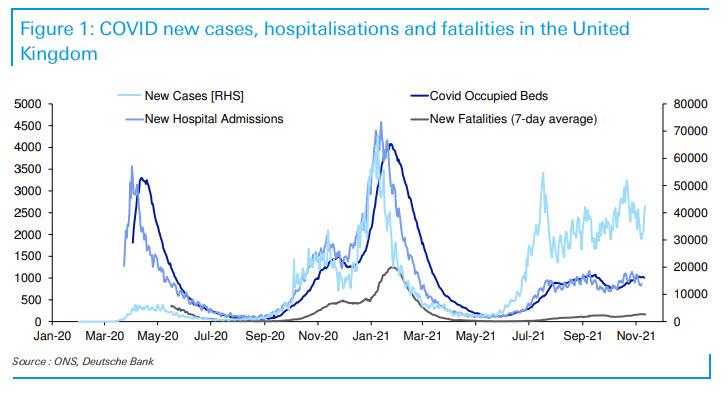
According to the credit strategist, while cases have been fairly high since the summer, from around the time of the European football championships and the lifting of restrictions on July 19th, the UK has not seen the exponential rise that could overwhelm the health service that many have warned about for months. Furthermore, evidence from the ONS suggests over 90% of adults have antibodies, whilst 80% of the 12+ population have had two vaccine doses now.

Instead of rising exponentially, new cases have been going through mini-waves, likely due to unvaccinated school children returning in September, the colder weather and then the on and off of half-term. After trending down for the last 2 and a half weeks new cases are starting to pick up again, but with booster jab momentum starting to accelerate after a slow start (a huge 532k yesterday), high antibody levels and some evidence that around 80% of 5-14yr olds  have been infected (the highest of any age group), its entirely feasible that herd immunity has been reached in the current environment and that new case levels will continue to be range bound.

Indeed, new admissions to hospitals are trending 20-25% of the level they were in January of this year even though cases have been at similar levels; fatalities are 10-15% of these peak levels.

And while the credit strategist notes that we may be faced with waning immunity that changes this equation in the quarters ahead, it is also possible that the virus (outside of a surprise new mutation) has less impact on a continually jabbed or covid exposed population. Meanwhile, new medicines in the pipeline like the Merck and Pfizer anti-viral pills should only help further.

As Reid concludes, "there is certainly lots of criticism you could lay at the door of UK for how they’ve handled the pandemic but it is currently showing one template out of Covid. It could have enough immunity through vaccines and infections to get through this winter better than others and without further restrictions." And while the strategist concedes that these are famous last words, it is certainly the case that most of the scare stories of the last few months have not materialized in the UK which gives other heavily countries hope too.

https://www.zerohedge.com/markets/its-entirely-feasible-herd-immunity-has-been-reached-current-environment

Sepsis-related deaths highest among older people: CDC

 In 2019, three-fourths of the country's 201,092 sepsis-related deaths were among people aged 65 and older, according to a report from the CDC's National Center for Health Statistics published Nov. 10. 

Four more findings: 

1. Overall, these deaths declined from 2000 to 2019 among adults aged 65 and older. 

2. Sepsis-related death rates increased with age and were nearly five times higher among adults aged 85 and older at 750 per 100,000 people, compared to the rate among adults aged 65-74 at 150.7 per 100,000. 

3. Among those aged 65 and older, sepsis deaths in 2019 were highest among Black adults at 377.4 per 100,000 people. The death rates for white, Hispanic and Asian adults were 275.7, 245.4 and 180 per 100,000 people, respectively. 

4. Overall, rural areas saw higher sepsis-related death rates in 2019 among adults aged 65 and older compared to urban areas. 

To view the full report, click here. 

https://www.beckershospitalreview.com/patient-safety-outcomes/sepsis-related-deaths-highest-among-older-people-cdc-finds.html

Moderna founder unveils new drug company focused on different kind of RNA

 Long before we knew how they did it, human cells had refined the process for making proteins, the microscopic workers needed for pretty much everything our bodies do.

First, a special enzyme finds the instructions for a protein in our DNA. It then produces a piece of genetic information called messenger RNA, or mRNA, that acts as a template for another part of the cell, the ribosome, telling it what building blocks are required for the protein and what order they go in.

At the tail end of this operation are transfer RNAs, which, as the name suggests, carry and ultimately hand off the correct building blocks — known as amino acids — to the ribosome. But despite their crucial role, these molecules haven't attracted as much attention as other types of RNA. An article published not too long ago in the journal Cell Research claimed tRNA is "generally not on the mind of most research scientists, unless they meet it through chance encounter."

Theonie Anastassiadis, a principal at Flagship Pioneering, the startup incubator that founded mRNA specialist Moderna, noticed this lack of interest, too, when she began learning more about tRNA biology several years back. "I was so fascinated and blown away, and I questioned why no one else in this area was exploring it," she said.

The answer, according to Anastassiadis, was there were barely any tools to address some of the field's most basic scientific questions, like how to synthesize tRNAs or measure them. That need, along with what Flagship saw as an opportunity to create new medicines, led to the 2018 formation of a drug company focused exclusively on tRNA.

Now named Alltrna, the company officially launched Tuesday with an initial commitment of $50 million from Flagship. The firm's origination partner, Lovisa Afzelius, is serving as Alltrna's founding CEO, while Anastassiadis, in addition to being a co-founder, is taking on the role of chief innovation officer.

Lovisa Afzelius, Alltrna
Courtesy of Alltrna
 

"Transfer RNA is the last critical step of protein translation," Afzelius said. "Without tRNA, there is no protein being made. And yet, it has been completely overlooked."

The launch gives Alltrna a chance to put tRNA in the spotlight, as well as the technology it's been working on for the past few years. According to Afzelius, the platform can engineer tRNA molecules so they spot erroneous genetic code and replace it with the correct amino acid, thereby restoring protein production and treating disease.

Alltrna executives aren't yet disclosing what diseases the company will go after, though they note how different genetic disorders — from the ultra rare to the more common — are of interest.

Another important aspect of tRNA molecules, according to Anastassiadis, is that they can break apart into new units with functions beyond translating protein code. Research indicates those roles can range from affecting gene expression to the transcription of retroviruses.

"When you start really thinking about that whole field, you realize you can not only design novel [ways of programming] tRNA medicines, but you can also leverage this completely understudied biology," Anastassiadis said.

Like other Flagship companies, Alltrna has set up a wide assortment of preclinical programs to allow it to test various payloads, delivery methods and tissue targets. While Afzelius declined to provide specifics, she said that in the "not too distant future," Alltrna could reach the stage where it asks regulators for permission to begin human testing.

Theonie Anastassiadis, Alltrna
Courtesy of Alltrna
 

Also like other Flagship companies, Alltrna has big ambitions, claiming each tRNA medicine it develops could have applications across many diseases.

Yet, successfully advancing a drug for more than a small number of related diseases is a rarity in the pharmaceutical industry, even for the most prolific developers. Proving a new technology is harder still, often requiring many years of work to refine how it can be safely used in the body.

Flagship, though, appears confident in its latest investment. Afzelius said the firm is "extremely committed" to helping establish a tRNA platform, and that Alltrna "will have access to the capital we need in order to do so." Flagship CEO and Moderna chairman Noubar Afeyan is also one of Alltrna's co-founders.

Alltrna follows in the footsteps of two other RNA startups from Flagship. The more widely known of them, Moderna, has become a household name and one of the most valuable biotech companies since developing a highly effective coronavirus vaccine. The other, Laronde, is researching so-called endless RNA, and recently raised more than $440 million in funding.

While RNA has come into focus for both drugmakers as well as investors, the field has taken decades to mature. Moderna's road to coronavirus vaccine success, for instance, was lengthy and not without its share of setbacks and skepticism. Just last week even, the company revealed that it won't be advancing an antibody treatment viewed by some as important to instilling confidence in its work outside of vaccines.

Still, Afzelius sees Flagship's experiences with Moderna and Laronde as a major advantage for her company. "We can leverage that depth of RNA knowledge from within the ecosystem," she said.

https://www.biopharmadive.com/news/flagship-alltrna-transfer-rna-biotech-launch/609706/

Cortexyme plans path forward for Alzheimer's drug that failed study

 Faced with the failure of a key clinical trial, a California-based biotech is pressing ahead with plans to test its experimental Alzheimer's drug in another study, convinced that signs of benefit observed in some patients are proof its treatment works.

Last month, the company, Cortexyme, reported the drug missed both main goals of a late-stage trial, showing no significant difference versus placebo on tests that measured participants' cognition and physical function. Yet Cortexyme claimed the negative results had a silver lining, noting that, among a smaller subgroup, the drug appeared to slow cognitive decline by a substantial margin.

The new study, which is still being designed, would test whether that effect was a statistical mirage or representative of a real treatment benefit for mild-to-moderate Alzheimer's patients. Cortexyme will most likely pick the lower of two doses Cortexyme used in the failed trial, as the higher dose was more frequently associated with side effects, particularly those indicating liver damage.

Cortexyme disclosed its plan's preliminary details on Thursday, alongside a presentation of study results by the company's chief medical officer at the Clinical Trials on Alzheimer's Disease conference. The presentation offered the fullest accounting yet of the trial; last month's disclosure came via a company press release.

The added detail showed that, overall, participants given either dose of Cortexyme's drug declined at virtually the same rate as those on placebo when measured using a cognitive testing scale known as ADAS-Cog11. On another scale, designed to evaluate daily living activities, patients on Cortexyme's drug appeared to decline slightly more than those on placebo over the 48-week treatment period.

"As it stands, the trial was negative as both primary endpoints failed to show a benefit of the drug," said David Knopman, a neurologist at the Mayo Clinic who specializes in Alzheimer's and dementia, in an email.

Last month and again on Thursday, Cortexyme focused instead on a subset of roughly one-third of the study's 643 participants that had detectable DNA in their saliva of the bacteria P. gingivalis, which causes gum disease. Cortexyme's hypothesis, which breaks with much of the Alzheimer's field but is supported by intriguing research, is that infection with P. gingivalis can cause the disease in some cases.

While all participants in the study had blood antibodies that indicated prior exposure to the bacteria, Cortexyme also planned ahead of time to analyze results based on several different tests for P. gingivalis infection. Looking only at those with DNA in their saliva, treatment with Cortexyme's drug slowed the rate of cognitive decline by 42% versus placebo at the low 40 milligram dose and by 57% at the higher 80 milligram dose.

Cortexyme has heavily emphasized these findings, touting them as validation of the role played by P. gingivalis infection and the potential for its drug to block its harmful effects.

"These results open a new door to our understanding of Alzheimer's," said Michael Detke, Cortexyme's top doctor, on Thursday. Marwan Sabbagh, a professor of neurology at the Barrow Neurological Institute and the lead investigator for Cortexyme's study, offered an even more optimistic take: "We are confident that these findings are a true positive," he said in the same presentation.

But other Alzheimer's experts aren't convinced the findings offer more than a starting point for the trial Cortexyme now intends to run.

The results represent an "interesting new direction," said Constantine Lyketsos, a professor of psychiatry and an Alzheimer's specialist at Johns Hopkins University, in an email. But there are "still many challenges and uncertainties," he added.

Knopman, of the Mayo Clinic, took a similar view: "This is an interesting result that unfortunately, like all claims from post hoc analyses, requires validation in a new cohort." (Cortexyme said its analysis was pre-specified.)

"The data support following this study with a new one in which only patients with detectable P. gingivalis would be enrolled," he added.

Cortexyme still needs to the meet with the FDA and other regulators to firm up its plans for a confirmatory trial. "Details of future study designs are to be determined, based on regulatory interactions," a spokesperson said in an email, but noted that a study "will almost certain focus" on the lower 40 milligram dose and only include people with detectable P. gingivalis in saliva.

That the 40 milligram dose is Cortexyme's focus is likely a reflection of the drug's safety results, which raise some concerns.

Fifteen percent of participants given the higher 80 milligram dose experienced elevations in liver enzymes that were three times the upper limit of normal — a warning sign for liver toxicity. Two also had elevations in a liver compound known as bilirubin. Together, these spikes can sometimes suggest patients are at risk of drug-induced liver injury.

Cortexyme said "virtually all" study participants with liver enzyme elevations were asymptomatic and that an outside panel of experts indicated the issue could be addressed by adjusting the dose through a process known as titration.

Sizable numbers of patients given Cortexyme's drug also dropped out of the study, however: roughly 40% in each drug arm, compared to 25% in the placebo arm. "Some" of these discontinuations were due to abnormal laboratory values, Detke said in his presentation.

Five patients on the higher dose and one patient on the lower dose died, although investigators determined none were related to Cortexyme's drug. Two died of worsening Alzheimer's disease, and one each of COVID-19, heart attack, sepsis and lung cancer.

https://www.biopharmadive.com/news/cortexyme-alzheimers-detailed-study-data-ctad/609920/

Life science SPAC BioPlus Acquisition lowers deal size by 18% ahead of $180M IPO

 BioPlus Acquisition, a blank check company targeting the life sciences industry, lowered the proposed deal size for its upcoming IPO on Friday.


The New York, NY-based company now plans to raise $180 million by offering 18 million units at $10. The company had previously filed to offer 22 million units at the same price. Each unit now consists of one share of common stock and one-half of a warrant, exercisable at $11.50. Each unit previously contained one-third of a warrant. At the revised deal size, BioPlus Acquisition will raise -18% less in proceeds than previously anticipated.

BioPlus Acquisition is led by Chairman and CBO Jonathan Rigby, the Group CEO of autoimmune and allergy biotech Revolo Biotherapeutics, and CEO, CFO, and Director Ross Haghighat, the Founding Partner of Jasper Capital Partners and Chairman of Triton Systems. The company aims to leverage management's experience to target the life sciences industry.

BioPlus Acquisition was founded in 2021 and plans to list on the Nasdaq under the symbol BIOS.U. Cantor Fitzgerald is the sole bookrunner on the deal.

States rush ahead of feds on boosters

 Faced with rising coronavirus infections, some states are pushing ahead of the federal government and making booster shots available to anyone who wants one, turbocharging the rollout in hopes of blunting a potential winter spike. 

This week, Colorado Gov. Jared Polis (D) signed an executive order declaring everyone over the age of 18 eligible for a booster dose. Hospitals in the state are once again full of COVID-19 patients, and officials are scrambling to slow the spread of the virus before winter.  

According to the Centers for Disease Control and Prevention (CDC), only about 45 percent of fully vaccinated adults 65 and older in Colorado have received a booster shot.  

In California, where cases are also rising, health officials are encouraging boosters for everyone who has been vaccinated for at least six months. Only about 34 percent of people over age 65 have received a booster in the state. 

"If you think you will benefit from getting a booster shot, I encourage you to go out and get it," California Health Secretary Mark Ghaly said during a press conference. 

The current federal guidance for boosters is fairly broad — the people who should get a booster are those over age 65 and anyone at high risk because of work, where they live or those with an underlying medical condition.   

Vaccine providers are not supposed to ask questions or turn anyone away, relying on self-attestation for eligibility. Still, the Food and Drug Administration and the CDC stopped short of recommending boosters for everyone, which puts Colorado and California at odds with federal guidance.

Monica Gandhi, an infectious disease expert and professor of medicine at the University of California, San Francisco, said federal health officials haven't been clear. 

Chaotic and at times disparate messaging from administration health officials over the past two months culminated in a complicated set of recommendations about who should be getting booster shots and why. 

"We have the CDC director saying one thing, [Anthony Fauci] saying another thing, the president saying another thing, and that is causing massive confusion, and that's why public health officers are taking it upon themselves," Gandhi said. 

"In my mind, the data is very clear. Get it if you're over 65, get it if you're immunocompromised, and then otherwise I think we don't have good evidence for it," she added.

The Biden administration has promised and encouraged booster doses for months, and federal officials are currently evaluating a request by Pfizer to authorize a booster dose for all adults over the age of 18.

When asked during a press briefing if other states should follow California and Colorado, CDC Director Rochelle Walensky demurred, stating they are encouraging everyone eligible for a booster to get one, but the agency's goal is to make sure everyone gets their primary doses.

White House Press Secretary Jen Psaki on Friday said local officials should continue to follow federal guidelines. 

"This isn't currently the guidance that's being projected by our health and medical experts, and we would continue to advise leaders across the country to abide by public health guidelines coming from the federal government," she said.

Celine Gounder, an epidemiologist and infectious diseases specialist at New York University and Bellevue Hospital, said states ought to be following the federal recommendations, but it's a problem when the administration hasn't articulated why boosters are necessary.  

"This is really only going to have an impact at that population level. It doesn't make sense to have this individual free for all, which is the situation ...  the California and Colorado governors are reinforcing," Gounder said.

Gounder, who advised the Biden transition team on COVID-19, said she thinks health officials are searching for anything to try to improve protection since there are still so many people who aren't vaccinated. 

"I think where this is coming from is this feeling that they're really frustrated," Gounder said. "They've done everything possible to try to encourage unvaccinated people to get vaccinated, starting with incentives and then incrementally moving towards mandates. ... It's sort of an act of desperation where it's like, well, what else are we supposed to do?"

Experts and federal officials agree that boosters are not going to end the pandemic.  

But when only about 70 percent of people over the age of 18 are fully vaccinated, boosters may be the only thing they can do. 

In Colorado, officials argued that because transmission is so widespread, everyone is at risk of infection, and so everyone is eligible for a booster shot. 

"Because disease spread is so significant across Colorado, all Coloradans who are 18 years of age and older are at high risk and qualify for a booster shot," Polis said in his order. 

During a press briefing on Friday, Polis also noted that if vaccinated people can get a booster, it will decrease the risk of a breakthrough infection spreading to someone older and vulnerable. 

But Gounder said boosters won't help Colorado's overwhelmed hospitals, and any additional protection may just be temporary. A concentrated effort to get boosters in nursing homes, she argued, would help a lot more. 

"Your risk as a vaccinated person is still proportional to the level of transmission in the community," Gounder said. "And so the best protection is actually from getting the unvaccinated vaccinated, not by getting additional doses."

https://thehill.com/policy/healthcare/581372-states-rush-ahead-of-federal-guidelines-with-boosters-for-all