Search This Blog

Saturday, July 2, 2022

Biotech Investors: Mark Your Calendar For These July PDUFA Dates

 The biotech sector is poised to end June on a positive note, despite largely disappointing regulatory decisions scheduled during the month, thanks to a reversal in broader market sentiment.

Only one new molecular entity (NME) has been approved thus far in June. NMEs are a key measure of drug innovation as they contain active ingredients yet to be approved by the Food and Drug Administration (FDA). Alnylam Pharmaceutical Inc's 

 RNAi therapeutic Vutrisiran received approval for treating polyneuropathy of hereditary transthyretin-mediated amyloidosis in adults.

Acer Therapeutics Inc 

 and partner Relief Therapeutics Holding AG 
RLFTF
 received a  complete response letter for their urea cycle disorder drug


Bristol-Myers Squibb Co 
BMY-0.16%+ Free Alerts
 received approval for its supplemental biologics license application (sBLA) for Breyanzi for large B-cell lymphoma, while it withdrew its application for Reblozyl as a treatment option for anemia in adults with non-transfusion dependent beta-thalassemia.

Spero Therapeutics Inc's 

 new drug application (NDA) for its complicated urinary-tract infection candidate was shot down by the FDA with a CRL.

On the other hand, Regeneron Pharmaceuticals Inc. 

 and Sanofi  received approval for expanding the label of Dupixent to treat atopic dermatitis in children. Rhythm Pharmaceuticals, Inc.'s  rare, genetic obesity and hunger treatment received FDA approval.

Here are the key regulatory decisions scheduled for July:


Horizon Therapeutics Seeks Label Expansion For Gout Treatment

Company:  Horizon Therapeutics Ltd. 

Type of Application:  sBLA

Candidate:  Krystexxa

Indication:  gout

Date:  July 7

Krystexxa, developed by Savient, received its first approval in 2010 for treating gout in adult patients Savient was subsequently bought by Crealta Holdings, which in turn was bought by Horizon in 2015.

Horizon is now seeking to expand the label of Krystexxa, which would allow the company's commercial team to promote the drug, plus methotrexate, to physicians for gout. The application has a priority review status.

Gout is a more commonly found and complex form of arthritis that results from the crystallization and deposition of uric acid in the joints.

In 2021, Krystexxa fetched the company $565.5 million in sales, representing a 39% year-over-year growth.


Can BeiGene Snag First Overseas Approval For Anti-PD-1 Antibody?


Company:  BeiGene Ltd. 

Type of Application:  BLA

Candidate:  tislelizumab

Indication:  esophageal squamous cell carcinoma

Date: July 12

Tisleizumab is China-based biopharma BeiGene's anti-PD-1 antibody, and the drug has received approvals for five indications in China. The company filed its first excluding-China application with the U.S. FDA for treating patients with unresectable, recurrent, locally advanced esophageal squamous cell carcinoma after prior system therapy.

Tisleizumab is also under regulatory review in China for the same indication.

Esophageal cancer is the most common malignant tumor in the digestive tract, with over 18,400 new cases diagnosed each year in the U.S., according to statistics shared by the company.


Regeneron Awaits Full Approval For COVID-19 Antibody Cocktail


Company:  Regeneron

Type of Application:  BLA

Candidate:  REGEN-COV

Indication:  COVID-19

Date:  July 13

REGEN-COV is an antibody cocktail, comprising casirivimab and imdevimab, and Regeneron is seeking full approval for using it in hospitalized COVID-19 patients and for prophylactic treatment in some individuals.

The earlier Prescription Drug User Fee Act (PDUFA) date was extended by three months to July 13, as the regulator required more time to review the additional data Regeneron submitted to support pre-exposure prophylactic use.

REGEN-COV has been available to U.S. patients since November 2020 under emergency use authorization (EUA). The EUA was amended in January 2022 to exclude its use in geographic regions, where infection or exposure is likely due to a variant that is not susceptible to the treatment.


Go Or No-go For Incyte's Opzelura In Expanded Indication?


Company: Incyte Corporation 

Type of Application:  sNDA

Candidate:  Opzelura (ruxolitinib cream)

Indication:  vitiligo

Date:  July 18

Opzelura is a novel cream formulation of Incyte's selective JAK1/JAK2 inhibitor ruxolitinib. It is the first and only topical JAK inhibitor approved for use in the U.S. for the topical short-term and non-continuous chronic treatment of mild to moderate atopic dermatitis in non-immunocompromised patients 12 years of age and older.

The company is now seeking approval of the same for vitiligo, an autoimmune disorder. The skin loses its pigment cells in a person afflicted with vitiligo, which causes discolored patches.


Will Arcutis Get Its Maiden Approval?


Company: Arcutis Biotherapeutics, Inc. 

Type of Application:  NDA

Candidate:  roflumilast cream

Indication:  plaque psoriasis

Date:  July 29

Roflumilast cream, according to Arcutis, is a once-daily cream formulation being developed for plaque psoriasis and atopic dermatitis. The application for clearing the investigational treatment for plaque psoriasis was accepted for review in December 2021, with a PDUFA goal date of July 29, 2022.

The company said in an investor presentation in March that about 9 million people suffer from plaque psoriasis in the U.S. alone, with 90% of them treated with topical drugs. Existing topical therapies have several shortcomings related to safety and tolerability.

Arcutis' roflumilast could be the first topical cream formulation to be approved in the U.S. for plaque psoriasis.

https://www.benzinga.com/general/biotech/22/06/27883687/attention-biotech-investors-mark-your-calendar-for-these-july-pdufa-dates

Over 400,000 High-Priority Incidents In Chicago In 2021 (52%) Had 'No Police Available To Send'

 by Matt Rosenberg via Wirepoints.org,

As crime continues to roil economic and social life in post-George Floyd, post-COVID Chicago, getting policing and criminal justice right are crucial. City officials are failing at that task.

We’re already seen anemic rates of arrest and prosecutions in Chicago, accompanied by finger-pointing between politicians over crime and the court system. And years of no support from city leadership, anti-policing legislation and the damaging rhetoric of the “defund” movement have taken a toll on Chicago police morale and manpower.

All that has spread the police force so thin that, in 2021, one of law enforcement’s most basic functions, responding to high-priority emergency service calls in a timely manner, was regularly beyond their capacity.

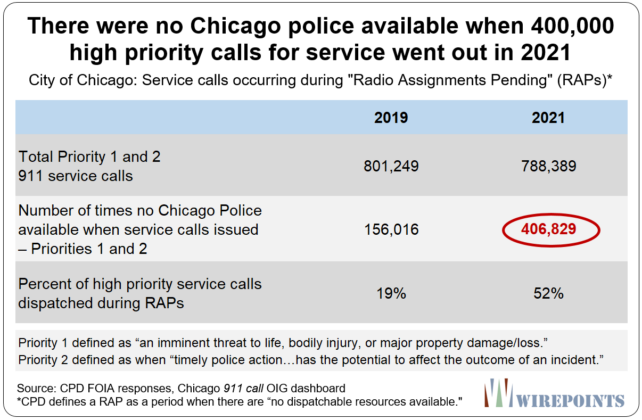
New data uncovered by Wirepoints through public records requests to the Chicago Police Department (CPD) reveal that in 2021 there were 406,829 incidents of high-priority emergency service calls for which there were no police available to respond.

That was 52 percent of the 788,000 high-priority 911 service calls dispatched in 2021.

High priority calls include Priority Level 1 incidents, which represent “an imminent threat to life, bodily injury, or major property damage/loss,” and Priority Level 2 incidents when “timely police action…has the potential to affect the outcome of an incident.”

In pre-George Floyd, pre-COVID 2019, there were only 156,016 such instances for which dispatchers had no police available to send – 19 percent of the total number of high priority 911 service calls made that year. We have requested parallel data for 2020.

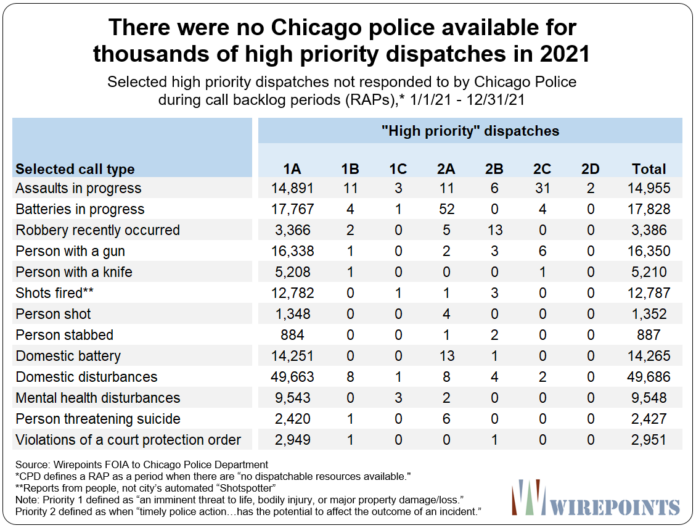
The 2021 high priority numbers include, among many other calls:

  • 14,955 – assaults in progress. 

  • 17,828 – batteries in progress. 

  • 16,350 – person with a gun.

  • 5,210 – person with a knife.

  • 12,787 – shots fired (reports from people, not the city’s automated “Shotspotter”)

  • 1,352 – person shot.

  • 887 – person stabbed. 

  • 14,265 – domestic battery. 

Nor were there police available for 49,686 domestic disturbances or 9,458 mental health disturbances. Or 3,386 dispatches for a robbery that had just occurred. Or the 2,427 dispatches about someone threatening suicide and the 2,951 dispatches stemming from reported violations of a court protection order. (For the full list of service calls, see the CPD’s FOIA response below).

Emergency police dispatches and call backlogs

Chicago police handled about 1.3 million dispatched 911 calls for service each year between 2019 and 2021. The data comes from a dashboard kept by the city’s Office of the Inspector General (OIG). OIG numbers come straight from the Office of Emergency Operations and Communications, which runs the city’s 911 center. 

About 800,000 of the calls for service each year are high priority (priorities 1 and 2), about 60 percent of the total.

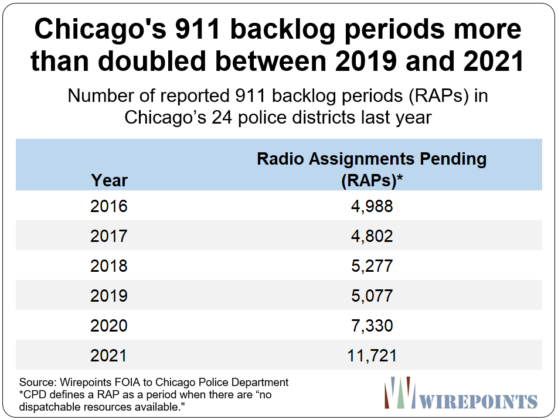
While the number of emergency calls for service has remained consistent, there has been a considerable jump in the number of periods in which 911 dispatchers could find no takers for urgent calls of help needed. 

Those periods of backlogged dispatches are known by the somewhat misleading name of radio assignments pending or “RAP”.

RAPs occur and are tracked on a police district-by-district basis (there are 24 separate police districts in Chicago). It’s important to note that a RAP is not one delayed response to one dispatch. Instead, police representatives informed Wirepoints it is “a range of time in which no dispatchable resources are available in the District/dispatch group.”

A RAP is declared over only after all delayed responses to high-priority 911 dispatches have been cleared by police arriving on scene.

The numbers of annual reported RAPs grew from 5,077 in 2019 to 11,721 in 2021, up more than 130 percent. 

RAPs are to be avoided if at all possible, according to CPD’s own directive to staff on using its radio communications system. It says field supervisors should repeatedly check all available patrol and special unit personnel on duty to see if they can redeploy to new and high-priority dispatch requests, and that supervisors can deny lunches, personal breaks, and station assignments until the backlog ends.

As the number of RAP periods have grown, so, too, have the volume of high-priority, incident-specific 911 dispatches that weren’t answered in a timely manner. As mentioned above, there were 156,000 high-priority incidents in 2019, but more than 400,000 in 2021.

Waiting for help

High priority dispatches can wait as long as an hour, even two hours, for a response during RAPs. 

Last summer, a Chicago 911 dispatcher working the violent 11th Police District on the West Side was captured by Chicago Scanner’s Twitter account in revealing audio of backlogged dispatch call-outs. 

Listen to the audio here from Chicago Scanner via crime news website CWB Chicago

Listening to the audio, Wirepoints could clearly discern details of 36 specific languishing dispatch requests. There were three noise complaints, two burglar alarm calls, four batteries in progress, eight instances of shots fired and seven domestic disturbances. 

Also backlogged with no timely response were a theft, a robbery, a stabbing, a domestic battery, a violation of a protection order, a suspicious person, a mental health disturbance, a large crowd disturbance, drag racing, another disturbance, an EMS vehicle needed, and “a citizen waiting for an assist for 102 minutes at Roosevelt and Central Park.”  

Of the response lag times of the 36 audible incidents reported, 13 were close to or in excess of two hours; 12 were close to or in excess of an hour; and most of the rest were clustered at 20 to 40 minutes each. 

Unfortunately, Wirepoints can’t determine just how long RAPs typically last. In a recent FOIA for 911 backlog details, Wirepoints asked for the average length of backlog periods in recent years. CPD said no such data existed. 

Although field supervisors are instructed under a CPD directive to “note in the supervisor’s management log (CPD-11.455) the time the RAP started, efforts made to end the RAP, and the time the RAP ended,” those records are paper only, not electronic, and they are reportedly not retained.

*  *  *

To many observers in Chicago, the increase in RAPs is one more indication of the need to restore police manpower to previous levels. The count of active sworn officers has fallen to 11,638 in June of this year, down from 13,251 in July of 2019, according to an OIG dashboard

But Chicago politicians, Cook County judges, prosecutors and state lawmakers will have to make policing a far more attractive proposition than it is today to repair the damaged morale that’s helping drive the ongoing exodus of sworn officers. 

Appendix

CPD 1st FOIA response: Count of Service Calls Occurring During Radio Assignments Pending, 2021

CPD 2nd FOIA response: Count of Service Calls Occurring During Radio Assignments Pending, 2019

3-step guide to addressing difficult issues and creating mutual solutions

 Oliver Stohlmann’s Corporate Survival Hacks series draws on his experiences of working in local, regional and global life science communications to offer some little tips for enjoying a big business career. This post, which includes references to Marshall B. Rosenberg’s psychological concept of Nonviolent Communication, shares a simple three-step method to solving conflicts without spoiling foundational human relationships – and sometimes even improving them.

We face them every day: issues obscuring progress at work, hard-to-get-on-with peers, relatives with aggressively different opinions, that nagging neighbour complaining about every leaf blown onto their drive from our tree, or something – or someone – else getting on our nerves big style.

Situations, certain behaviours, established routines that should be improved … things we’d like to be able to address openly, but when we do that, there’s a risk of offending the other person, escalating a disagreement into a full-blown conflict, and/or destroying their morale and earning mediocre collaboration and performance in return.

But how could we address issues candidly without spoiling the underlying relationships; or even strengthen the latter through a constructive conflict resolution process?

You have a choice

Difficult situations and people ‘happen’. That’s life. Yet you have a choice: you can either ignore these and let them linger, hoping the issue or discomfort will reduce and perhaps vanish over time; or that you’ll learn to live with it. And, frankly, for many, an insignificant problem that is not a bad strategy. Since we should not fear a mountainous challenge every time we spot a molehill.

However, there will be moments when letting things flow isn’t a good plan: a major project outcome at stake, someone’s health in jeopardy, a partnership or close friendship at risk. In these and many other circumstances, I find it’s worth a try to jointly improve or even remove the issue and protect, if not strengthen, the relationship.

A ‘nonviolent’ approach to communication

As a student of Communications, a book that fascinated me early on in life was ‘Nonviolent Communication: A Language of Life’ by clinical psychologist Marshall B. Rosenberg. Based on his clinical experience in person-centred therapy, he offers an enlightening look at how peaceful communication can create compassionate connections with family, friends, work colleagues, and other acquaintances.

Rosenberg does not position his approach as a technique to end disagreements but rather as a method designed to increase empathy and improve the quality of life. Over time, while the entire book of around 250 pages is a fascinating reading and inspiration, I distilled and mixed the essence of Rosenberg’s book with my own experiences and those from coaching other individuals, into what since I’ve called my simple three-step guide to conflict resolution without spoiling the underlying relationship – and often even improving the latter.

Tough conversations are … tough

In my first job, a few months after college graduation, I got promoted to leading a small team of two. We were a young PR agency with an enthusiastic workforce. Collaborating closely with my new team in the office, I noticed that one of them, a student in his early 20s, constantly carried a strong odour of sweat. My gut reaction was to ignore this, certainly not stick my nose into something as delicate as a smell. Until others started talking about it, among each other and to me as the person’s manager. The twist was that he was otherwise a really well-liked chap, hard-working, helpful and extremely successful. We didn’t want to offend and risk losing him, through careless feedback or a clumsily led conversation.

Yet something had to be done about this issue, which increasingly led to others keeping a distance not wanting to work on projects with this particular team member. The task of providing feedback fell to me. I dreaded having to have this kind of conversation. Anything – but not this.

Marshall Rosenberg and my three-step approach rescued me.

Share facts without judgement

Here’s what you do: First, create empathy by asking permission to share an observation you’d like to bring to the other’s attention. They may or may not be aware. However, you’ve decided to seek an open conversation to make sure they become aware of something that needs to be solved or improved. Have this conversation one-to-one. It’s something that stays between the two of you.

Once the other has agreed – they typically will – do share what you and/or others have been observing. Get straight to the point. Just share the facts without judgement nor emotions. The latter is key – if the person receiving feedback feels singled out, unfairly blamed, attacked or worse, they will not partner in solving the matter.

Create ownership

Secondly, in similar brevity, clarity and empathy, describe the consequence/s of the current status or behaviour you’ve just been addressing. Again, keep emotions and judgement out – just state the facts.

Lastly, and here’s where your feedback ends, and you widen the monologue to a proper, two-way conversation: Ask the other person what ideas they may have to resolve the situation, unilaterally or jointly, in a mutually beneficial way. Reassure them that you are invested in a material outcome and that they can count on your full support and partnership. The critical point, however, is that the resolution plan comes from them – not you. You might help them shape it; you may have an active part in that plan – but it needs to be their plan.

This is based on my fundamental experience from coaching business clients, that almost any solution imposed on a person from the outside ultimately fails or isn’t seriously attempted in the first place; while self-derived ideas typically come with a feeling of ownership, accountability, and personal investment. They stand a much higher chance of implementation – and to succeed.

The three-step conversation will keep them constructive

For instance, my difficult conversation with the ‘sweaty’ colleague would have run along these lines. You can translate this into nearly any other business or personal context:

Step 1: “May I provide you feedback about something I think you should be aware of? The aim of this conversation is to help you be aware of, and manage, a situation that myself and colleagues have been noticing lately. If that’s alright, I’ll cut to the chase in a moment. But let me first reassure you that we all absolutely love working with you. You’re an asset to our agency, and I would hate to lose you. However, we’ve been observing through recent weeks a distinct, strong odour of sweat each time you’re in the office.”

Step 2: “As a consequence, you may have noticed that several people keep a distance. Although you’re such a well-liked, spirited colleague and everyone benefits from your creativity and energy, people also tell me they find it difficult to work physically close to you. I’m sorry to say this is beginning to impact our business. Last week, [a team member] refused to work in the office, and therefore, we weren’t able to complete that mock-up in time for the client pitch.”

Step 3: “As I said, we really want to keep you on board. You are a stellar contributor and driver for the entire team, and I see a bright future for you. But given this observation, what do you think you might be able to do about it?” And here, the hard part: pause. Let them come. Be comfortable with a long silence or other reaction. They need to digest, they need to process. In nine out of ten cases, however, they will come round to be very constructive.

Creating and keeping empathy

Nonviolent communication, according to Marshall Rosenberg, is a tool with the goal of firstly creating empathy in the conversation. The idea is that once there is empathy between the parties, it will be much easier to talk about solutions that satisfy everyone’s fundamental needs. The goal is interpersonal harmony and to avoid coercive forms of discourse, gather facts through observing without evaluating, let alone judging, and genuinely and concretely expressing feelings and needs to formulate effective and empathetic requests.

For me – and this is perhaps why I created my own variation on Rosenberg’s model – it’s also important to be able to conduct a simple enough conversation and follow through on it. It’s not easy to be tough on someone, to not get distracted nor caught up in lengthy side tracks e.g. if the other person gets distraught or argumentative. When you embark on this kind of conversation, you want to be able to follow it through with discipline, clarity and a focus on the important third step: viable suggestions for resolving the issue at hand.

How did that difficult conversation described above wind up? My team member had no inclination of the issue and turned out most grateful that someone was telling him. We knew he was an avid tennis player, but what we didn’t appreciate was that he had recently changed his practice from evenings to early mornings, to then proceed to the office without taking a shower for it would cause a delay he thought he couldn’t afford. His – own – path to resolving the issue couldn’t be simpler: from now on, he would take showers after tennis practice … and we would all live happily ever after.

  • Step 1:
    • Create empathy by asking permission to share an observation
    • Have the conversation one to one
    • Share the issue factually, without judgement nor emotions
  • Step 2:
    • Describe the consequence/s of the current status or behaviour
    • Be brief, clear, and emphatic
    • Keep emotions and judgement out – just state the facts
  • Step 3:
    • Ask the person for ideas to resolve the situation
    • Reassure them you are invested in a material outcome
    • Assure them of your full support and partnership
    • Make sure the resolution plan comes from them – not you

About the author

Oliver Stohlmann is a communications leader with more than 20 years’ experience of working at local, regional, and global levels for several of the world’s premier life-science corporations. Most recently, he was Johnson & Johnson’s global head of external innovation communication.

https://pharmaphorum.com/sales-marketing/a-3-step-guide-to-addressing-difficult-issues-and-creating-mutual-solutions/

Some medical debt is being removed from US credit reports

 Help is coming for many people with medical debt on their credit reports.

Starting Friday, the three major U.S. credit reporting companies will stop counting paid medical debt on the reports that banks, potential landlords and others use to judge creditworthiness. The companies also will start giving people a year to resolve delinquent medical debt that has been sent to collections before reporting it — up from six months previously.

Next year, the companies also will stop counting unpaid medical debt under at least $500.

The companies say these moves will wipe out nearly 70% of the medical debt listed on consumer credit reports.

Patient advocates call that a huge advance. But they question whether medical debt should be on credit reports at all, given that many see it as a poor indicator of whether someone is trustworthy for a loan or rent.

“These aren’t people who bought shoes they couldn’t afford,” said Amanda Dunker, of the nonprofit Community Service Society of New York. “They went to a doctor because they were sick or needed help with an injury.”

Brooke Davis had about $1,300 in medical debt from a breast cancer scare that lingered for years on her credit report.

The 48-year-old McDonough, Georgia, resident said that made it difficult to rent an apartment, and she needed a co-signer for a car loan.

“You can’t get anything, you can’t even get a credit card if you have bad credit,” she said.

The non-profit RIP Medical Debt relieved Davis’s debt last fall. But more health problems and the loss of a job have pushed Davis back into debt. She’s currently stuck with a swollen knee for which she can’t see her doctor.

“I don’t have the money to really go for my knee right now, so I’ve just been suffering with it,” she said.

The federal Consumer Financial Protection Bureau has said its research shows mortgages and credit cards are better predictors than medical bills of whether someone will repay a debt.

The agency, which monitors banks, lenders and other financial institutions, has noted that people often don’t have time to shop for the best price when they seek care and may have little control over the progress of a serious illness.

Medical billing errors can wind up on credit reports. And patients are sometimes unsure about what they owe or whether an insurer will eventually pay it.

The agency said earlier this year it estimates that 58% of the debt in collections and on credit records is from medical bills, and past-due medical debt is more prevalent among Black and Hispanic people.

The bureau is trying to determine whether unpaid medical bills should be included on credit reports.

John McNamara, an assistant director with the bureau, declined to estimate when the agency might make a decision. It could propose a rule, after hearing from all sides on the issue, that would end the practice.

Credit reporting companies also are considering whether medical debt should remain on the reports, said Justin Hakes, a vice president with the Consumer Data Industry Association.

The three national credit reporting agencies — Experian, Equifax and TransUnion — announced the medical debt changes in March, after the bureau said it would hold those companies accountable for the accuracy of their reports.

Patient advocates said those changes will help a lot of people.

The wait in reporting delinquent debt will give patients time to figure out how to resolve a bill, noted Chi Chi Wu, an attorney with the National Consumer Law Center.

“It gives more breathing room to deal with the insurance company or your provider,” Wu said. “Everybody has a story about that.”

Much of the medical debt that landed on Melina Oien’s credit report several years ago was for bills that were under $500. The Tacoma, Washington, resident said she was living in an expensive place, Hawaii, where her former husband was stationed for the military. They were getting care for a daughter who had health issues that included a rare condition that affected her metabolism.

“We would zero out our checking account with living expenses every month,” she said. “When you are counting out $5 for gas until the next payday, how do you pay a $30 bill?”

A severance package from the military eventually helped them pay their medical debt a few years ago. Oien said her credit score jumped about 70 points just from that.

But before that happened, they had to deal with higher interest rates on any loans they took out, and they could only get a mortgage after her sister gave them money to pay down some debt.

“It was embarrassing, it was very stressful,” said Oien, who now works as a patient advocate.

https://apnews.com/article/science-health-government-and-politics-f2a2bd91adf052338db45ec9c01c1af9

For now, wary US treads water with transformed COVID-19

 The fast-changing coronavirus has kicked off summer in the U.S. with lots of infections but relatively few deaths compared to its prior incarnations.

COVID-19 is still killing hundreds of Americans each day, but is not nearly as dangerous as it was last fall and winter.

“It’s going to be a good summer and we deserve this break,” said Ali Mokdad, a professor of health metrics sciences at the University of Washington in Seattle.

With more Americans shielded from severe illness through vaccination and infection, COVID-19 has transformed — for now at least — into an unpleasant, inconvenient nuisance for many.

“It feels cautiously good right now,” said Dr. Dan Kaul, an infectious diseases specialist at the University of Michigan Medical Center in Ann Arbor. “For the first time that I can remember, pretty much since it started, we don’t have any (COVID-19) patients in the ICU.”

As the nation marks July Fourth, the average number of daily deaths from COVID-19 in the United States is hovering around 360. Last year, during a similar summer lull, it was around 228 in early July. That remains the lowest threshold in U.S. daily deaths since March 2020, when the virus first began its U.S. spread.

But there were far fewer reported cases at this time last year — fewer than 20,000 a day. Now, it’s about 109,000 — and likely an undercount as home tests aren’t routinely reported.

Today, in the third year of the pandemic, it’s easy to feel confused by the mixed picture: Repeat infections are increasingly likely, and a sizeable share of those infected will face the lingering symptoms of long COVID-19.

Yet, the stark danger of death has diminished for many people.

“And that’s because we’re now at a point that everyone’s immune system has seen either the virus or the vaccine two or three times by now,” said Dr. David Dowdy, an infectious disease epidemiologist at Johns Hopkins Bloomberg School of Public Health. “Over time, the body learns not to overreact when it sees this virus.”

“What we’re seeing is that people are getting less and less ill on average,” Dowdy said.

As many as 8 out of 10 people in the U.S. have been infected at least once, according to one influential model.

The death rate for COVID-19 has been a moving target, but recently has fallen to within the range of an average flu season, according to data analyzed by Arizona State University health industry researcher Mara Aspinall.

At first, some people said coronavirus was no more deadly than the flu, “and for a long period of time, that wasn’t true,” Aspinall said. Back then, people had no immunity. Treatments were experimental. Vaccines didn’t exist.

Now, Aspinall said, the built-up immunity has driven down the death rate to solidly in the range of a typical flu season. Over the past decade, the death rate for flu was about 5% to 13% of those hospitalized.

Big differences separate flu from COVID-19: The behavior of the coronavirus continues to surprise health experts and it’s still unclear whether it will settle into a flu-like seasonal pattern.

Last summer — when vaccinations first became widely available in the U.S. — was followed by the delta surge and then the arrival of omicron, which killed 2,600 Americans a day at its peak last February.

Experts agree a new variant might arise capable of escaping the population’s built-up immunity. And the fast-spreading omicron subtypes BA.4 and BA.5 might also contribute to a change in the death numbers.

In the next weeks, deaths could edge up in many states, but the U.S. as a whole is likely to see deaths decline slightly, said Nicholas Reich, who aggregates coronavirus projections for the COVID-19 Forecast Hub in collaboration with the Centers for Disease Control and Prevention.

“We’ve seen COVID hospitalizations increase to around 5,000 new admissions each day from just over 1,000 in early April. But deaths due to COVID have only increased slightly over the same time period,” said Reich, a professor of biostatistics at University of Massachusetts Amherst.

Unvaccinated people have a six times higher risk of dying from COVID-19 compared with people with at least a primary series of shots, the CDC estimated based on available data from April.

This summer, consider your own vulnerability and that of those around you, especially in large gatherings since the virus is spreading so rapidly, Dowdy said.

“There are still people who are very much at risk,” he said.

https://apnews.com/article/covid-science-health-infectious-diseases-fb25f987bab09a11be31a32e832dd9de