Search This Blog

Sunday, October 23, 2022

New Guidelines for Bariatric Surgery Are 'an Important Reset'

In a new statement, two metabolic and bariatric surgery societies recommend expanding eligibility for bariatric surgery to include individuals with a body mass index (BMI) lower than the current threshold, among other updates.

The statement recommends that the threshold for metabolic and bariatric surgery should be a BMI ≥ 35 kg/m2, regardless of comorbidities.

In contrast, providers, hospitals, and insurers currently use BMI thresholds of ≥ 40 kg/m2, or ≥ 35 kg/mwith an obesity-related comorbidity (such as hypertension or heart disease), to define patients eligible for metabolic and bariatric surgery based on criteria established in a 1991 consensus statement by the US National Institutes of Health (NIH).

A joint statement issued today by the American Society for Metabolic & Bariatric Surgery (ASMBS) and International Federation for the Surgery of Obesity and Metabolic Disorders (IFSO) updates the indications for surgery to reflect the progress in the field over the past 30 years.

"In light of significant advances in the understanding of the disease of obesity, its management in general, and metabolic and bariatric surgery specifically," leaders of the ASMBS and IFSO, which represents 72 national societies, "convened to produce this joint statement on the current available scientific information on metabolic and bariatric surgery and its indications," the document authors write.

The statement was presented today at the International Congress on Obesity (ICO) 2022 in Melbourne, Australia, and simultaneously published online in the journals Surgery for Obesity and Related Diseases and Obesity Surgery.

'Long Overdue,' 'Time to Remove Barriers'

This reset in the threshold for eligibility for metabolic and bariatric surgery is long overdue, according to the presidents of the ASMBS and IFSO.  

"The 1991 NIH consensus statement on bariatric surgery served a valuable purpose for a time, but after more than three decades and hundreds of high-quality studies, including randomized clinical trials, it no longer reflects best practices and lacks relevance to today's modern-day procedures and population of patients," Teresa LaMasters, MD, president, ASMBS said in a press release.

"It's time for a change in thinking and in practice for the sake of patients. It is long overdue," she noted.

"The ASMBS/IFSO guidelines provide an important reset when it comes to the treatment of obesity," added Scott Shikora, MD, president, IFSO.  

"Insurers, policymakers, healthcare providers, and patients should pay close attention and work to remove the barriers and outdated thinking that prevent access to one of the safest, effective, and most studied operations in medicine," he observed.

The document authors explain that when the 1991 consensus statement was issued, the main bariatric procedures were vertical banded gastroplasty, which is no longer performed, and Roux-en-Y gastric bypass (RYGB), whereas sleeve gastrectomy and RYGB together now account for about 90% of all worldwide operations.

Over the past three decades, the understanding of obesity and metabolic and bariatric surgery has grown significantly based on clinical experience and research studies, and long-term research has consistently demonstrated superior weight loss with surgery compared to nonsurgery treatments.

Major New Recommendations

The following are some of the key new recommendations.

BMI ≥ 35 kg/m2: Given the presence of high-quality scientific data on safety, efficacy, and cost-effectiveness of metabolic and bariatric surgery in improving survival and quality of life in patients with BMI ≥ 35 kg/m2, surgery should be strongly recommended in these patients regardless of presence or absence of evident obesity-related comorbidities.

BMI 30-34.9 kg/m2: Metabolic and bariatric surgery should be considered for individuals with metabolic disease and a BMI of 30-34.9 kg/mwho do not achieve substantial or durable weight loss or comorbidity improvement using nonsurgical methods.

BMI ≥ 30 kg/m2 and type 2 diabetes: Metabolic and bariatric surgery is recommended for these patients.

Lower BMI thresholds for Asian individuals: The prevalence of diabetes and cardiovascular disease is higher at a lower BMI in Asian than non-Asian individuals. In Asian individuals, a BMI ≥ 25 kg/m2 suggests clinical obesity, and those with a BMI ≥ 27.5 kg/mshould be offered metabolic and bariatric surgery.

Appropriately selected children and adolescents: Children and adolescents with a BMI > 120% of the 95th percentile and a major comorbidity or a BMI > 140% of the 95th percentile should be considered for metabolic and bariatric surgery after evaluation by a multidisciplinary team in a specialty center.

Bridge to other treatment: Metabolic and bariatric surgery is an effective treatment of clinically severe obesity in patients who need other surgeries, such as hip or knee replacement, abdominal wall hernia repair, or organ transplantation.

Older population: There is no upper age limit for metabolic and bariatric surgery; however, older patients should be carefully assessed. Frailty, rather than age alone, is independently associated with higher rates of postoperative complications.  

ICO 2022. Presented October 21, 2022.  

Surg Obes Relat Dis. Published October 21, 2022. Full text

https://www.medscape.com/viewarticle/982827

'Electronic Medical Records Are Strangling American Medicine'

 Last month, 15,000 nurses went on strike in Minnesota in the largest private-sector nursing strike in U.S. history. They were protesting understaffing and overwork at a time when provider burnout has reached epidemic proportions -- approximately 63% of physicians and 80% of nurses now report symptoms of burnout. Meanwhile, healthcare continues to struggle with overwhelming cost pressures. We still spend more money for worse outcomes than any other developed country. As a surgical resident, I've heard too many structural explanations for cost and burnout problems that overlook a specific, fixable culprit: Our electronic medical records (EMRs) are still hopelessly broken.

In 2022, software is suffocating American medicine.

The 2009 HITECH Act kicked off the modern era of the EMR with federal incentives for EMR use. Unfortunately, the legislation also favored established firms over smaller competitors with its many requirements and short timeframe. Today, many of the top-ranking hospitals use EMRs from one of two vendors, Epic Systems or Cerner Corporation (now part of Oracle). Epic alone has medical records on 250 million people, while Cerner won a $16 billion contract to introduce its EMR to the Veterans Health Administration. These businesses had a combined revenue of nearly $10 billion in 2021, with both reporting double-digit year-over-year growth.

Despite ballooning funding, I haven't experienced any significant upgrades to the Epic or Cerner EMR systems in the last 8 years. I find the interfaces to be comically inelegant. I'm frequently staring at screens with over 30 tabs, and when I click one, the system stutters and lags before showing a result. This flawed user experience slows providers down drastically. In one study of a North Carolina orthopedic clinic, the adoption of Epic's EMR increased physician documentation time by 230% and increased labor costs per visit by 25%. Family medicine physicians have it worse: many spend a whopping 6 hours a day on the EMR. Nurses often spend more time charting in the EMR than on any other task. Multiply this out by the whole healthcare system and the idea that an extra MRI here and there is driving our cost crisis seems laughable. Every day, expensive physician and nursing labor is squandered through unnecessary clicking and scrolling.

Compounding the day-by-day slowdown, time spent away from patients and increased clerical burden lead to the combination of exhaustion, cynicism, and decreased effectiveness known as burnout. Over 8,000 nurses surveyed last year gave their EMR an average grade of "F" in usability, and usability correlated directly with burnout symptoms. Among physicians who reported using an EMR, 70% reported EMR-related stress, with "high" usage doubling the odds of burnout. Why does burnout matter? Because burnout begets more burnout, as well as rising costs, and worsening care. Under conservative estimates, the reduced clinical hours and physician turnover due to burnout costs us $4.6 billion a year. Quality of care worsens when nurses report symptoms of burnout, independent of the practice environment. Burned out providers sometimes leave the workforce altogether, worsening staff-to-patient ratios and inducing further burnout in a vicious cycle. In large part because some clunky, mind-numbingly slow software consumes much of our time.

The inefficiency with current EMRs sometimes gets attributed to poor training. The Veteran's Health Administration delayed its implementation of Cerner's EMR because providers were proving challenging to train. This is bogus. Well-designed software for data entry and retrieval should be intuitive enough to require no dedicated training. No one needs training to figure out how to filter millions of housing listings on Airbnb, flights on Kayak, or local businesses on Yelp. You can find what you want, check availability, and even submit a review, all within seconds. The information I need as a physician is no more complicated. I need to see a focused list of patients, then a neat grid of their numerical information. I need to browse text entries and scroll through images, then start typing at a blinking cursor. That's it. It should happen instantaneously, without me having to think about it.

Instead, it takes 3 minutes to order an x-ray, 60 seconds to pull up the image, 5 minutes to find background facts, and 90 seconds for an MRI to load. After that, there are 2 minutes left to see the patient. What's needed is not "training" but rather design thinking and approaching the problem from first principles. What do doctors need? What do nurses need? How might they like to see information presented? How might they want to enter information?

Take the example of another well-known software company, Google. Google has tested what users want, and returned again and again to a one word answer: speed. As little as a 400-millisecond delay in search speed leads to a drop in search volume, while four out of five users click away when a video stalls while loading. For Google, "speed isn't just a feature, it's the feature." Google engineers work with a fixed "budget" for how much total time (say 1 second) is acceptable to require for users to complete a single step. EMR creators should take the same approach: measure how long every action takes and speed it up. Simplify the interface. Store data more efficiently. Whatever it takes.

To fix EMRs, one suggestion has been to put money on the line by fining hospitals for EMR burden the way fines are imposed for infections or bedsores. This would be a welcome change, but passing healthcare policy that undermines established interests is incredibly challenging, and it cannot be the only strategy. While advocating for legislation, we also need to build the EMR of the future. We need an explosion of the types of simple, fast tools that tech innovators are now adept at creating. To achieve this, professional societies and hospital groups should fund an EMR X-prize of sorts to super-charge innovation. Projects should be graded on speed, ease of use, and interoperability -- everything current EMR companies have failed at for the past decade. Just focusing on policy will keep the actual solution, a better product, in the realm of abstraction. Instead, build it first, and show doctors, nurses, and patients what is possible.

Dane Brodke, MD, MPH, is chief resident physician in orthopedic surgery at the University of California Los Angeles.

https://www.medpagetoday.com/opinion/second-opinions/101354

Why isn't inflation falling?

 These are the past 7 annual inflation prints by month:

  • March 8.5%
  • April 8.3%
  • May 8.6%
  • June 9.1%
  • July 8.5%
  • August 8.3%
  • September 8.2%

That’s 7 months in a row of inflation above 8%. This hasn’t happened since the early-1980s.

So what gives?

The Fed has been raising rates aggressively, supply chains are improving, oil prices have fallen by a third and gas prices are well off their highs.

I could walk you through each individual component of the inflation calculation but there are econ wonks who can explain the intricacies of owners’ equivalent rent and such much better than I can.

Let me offer two simple explanations without having to get too much into the weeds about economic data calculations.

(1) Everyone got wealthier during the pandemic.

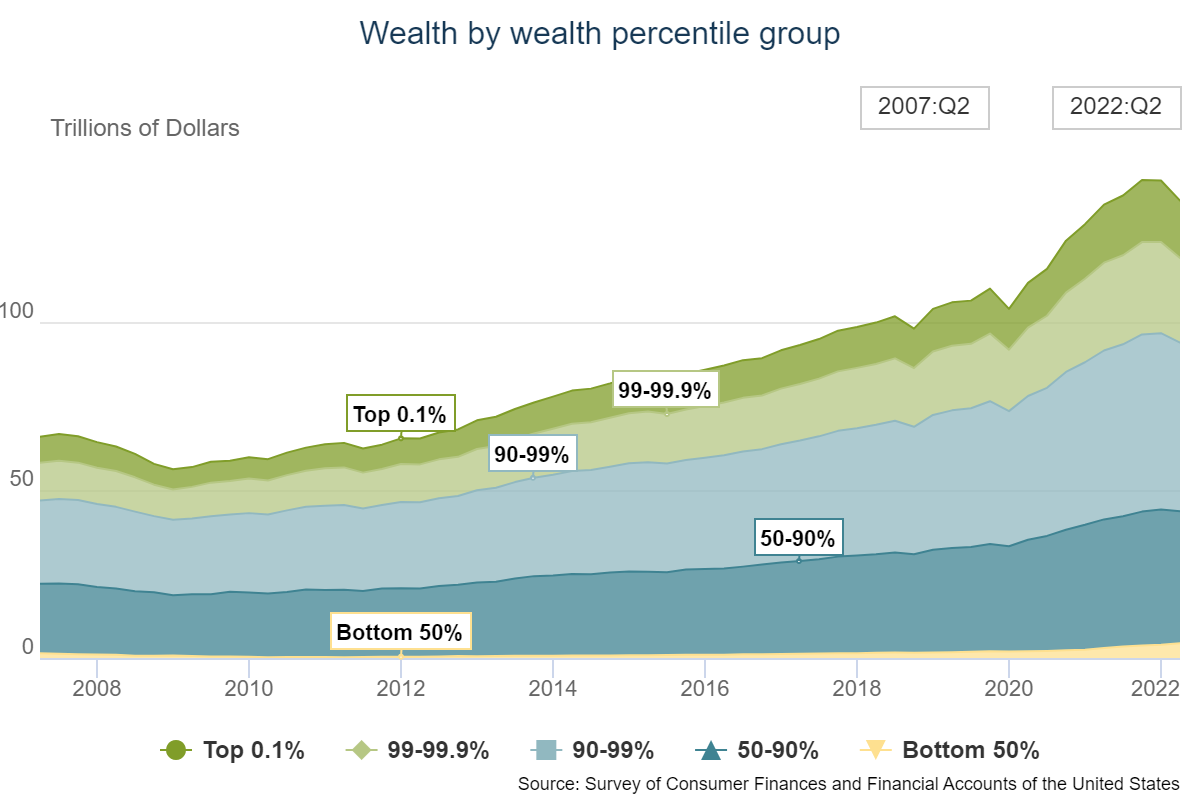
OK, maybe not everyone but the royal we is far wealthier. Collectively, U.S. households got much richer during the pandemic.

The net worth of U.S. households coming into 2020 was just shy of $110 trillion.

By the end of the second quarter net worth was up to more than $135 trillion, after hitting an all-time high of nearly $142 trillion coming into this year.

From the end of the first quarter in 2020 through the first quarter of 2022, the net worth of Americans increased by 37%, by far the biggest increase on record since the Fed began tracking this data in 1989.

That was from the Covid low through the post-pandemic high but even if we start from pre-pandemic levels, the 30% increase is by far the largest 2 year increase in net worth on record before this period.

And for once, it’s not just the top 10% or the top 1% that’s benefitted.

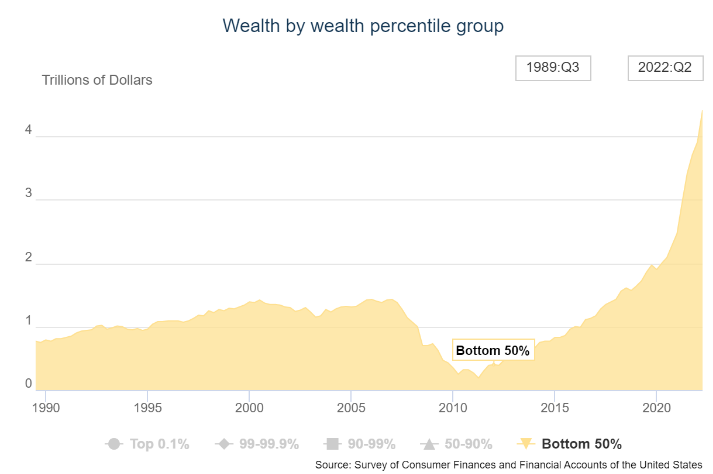
Take a look at the change in net worth of the bottom 50% over time:

From 1989 to the pre-GFC 2007 peak, the net worth of the bottom 50% went from $773 billion to $1.4 trillion.

So in a little less than 20 years, the net worth of this group rose by more than $620 billion.

The bottom 50% was devasted by the financial crisis and housing crash with the total net worth of this group declining to $190 billion.

By the end of 2019, it had come all the way back and then some, up to almost $2 trillion.

It’s now $4.4 trillion.

So the net worth of the bottom 50% has increased by $2.4 trillion since the start of the pandemic in early 2020, meaning it has more than doubled in less than 3 years.

This group of households tends to spend a greater percentage of their income than those with more financial assets so it shouldn’t come as a surprise that people continue to spend in the face of higher inflation.

The U.S. consumer has likely never been more prepared for high inflation (and a potential recession) than they were coming into this period of higher prices.

No one likes inflation but we love to spend money in this country. So most people have simply decided to complain but still spend through the pain of higher prices.

(2) Corporations are doing just fine with inflation.

Inflation was caused by some combination of the pandemic, government spending in response to Covid, supply chain problems, consumer spending, Russia invading Ukraine and the Fed.

I may have missed something but that gets you pretty close to the root causes.

But at the end of the day higher prices come from businesses raising prices.

Corporations didn’t cause inflation but they are sure as hell taking advantage of it.

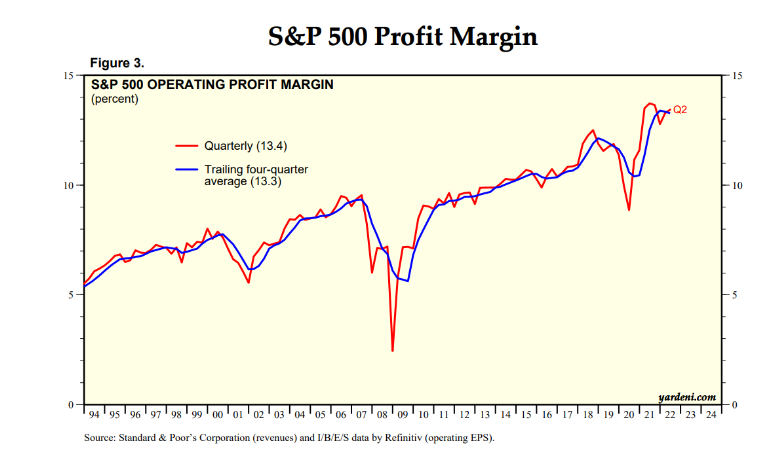
Just look at the operating profit margins for S&P 500 companies:

They’ve been going up even as inflation has gone skyward.

So you’ll hear CEOs complain about higher input costs, higher wages, a labor shortage and supply chain issues but do not shed a tear for them.

They responded by increasing prices to such a degree that their margins have hit all-time highs.

While households have been forced to pay higher prices at the pump and grocery store, corporations have been able to pass along cost increases to consumers.

Again, inflation was not caused by corporations and business owners. And there have certainly been many businesses impacted by higher input costs.

But while workers get blamed for demanding higher wages and the government gets blamed for a spending binge and the Fed gets blamed for keeping rates low for too long, corporations have somehow sidestepped blowback despite record profit margins.

And do you think these businesses will lower prices as their costs fall?

I’m not holding my breath.

The Fed may very well put an end to these trends by throwing us into a recession.

But as long as businesses pass along cost increases to consumers and consumers continue to spend down their savings, it’s possible inflation will remain sticky for a little while.

https://awealthofcommonsense.com/2022/10/why-isnt-inflation-falling/

Texas AG Ken Paxton sues Google over biometric data collection

 Texas Attorney General Ken Paxton (R) announced on Thursday that his office had sued Google over its collection of biometric data, or measurements of human bodies and characteristics.

“The lawsuit alleges that Google, in yet another violation of Texans’ privacy, has collected millions of biometric identifiers, including voiceprints and records of face geometry, from Texans through its products and services like Google Photos, Google Assistant, and Nest Hub Max,” wrote Paxton’s office in the announcement.

Paxton says that Google has failed to obtain millions of Texans’ informed consent before collecting biometric data, violating the state’s Capture or Use of Biometric Identifier Act (CUBI).

CUBI outlaws the capture of biometric identifiers by people or companies without obtaining consent beforehand as well as the unauthorized sale of biometric data.

“Google’s indiscriminate collection of the personal information of Texans, including very sensitive information like biometric identifiers, will not be tolerated,” said Paxton of Thursday’s lawsuit.

“I will continue to fight Big Tech to ensure the privacy and security of all Texans.” 

The attorney general, who has been criticized for his conservative approaches to laws dealing with abortion and LGBTQ+ issues, has sued Google multiple times for alleged privacy infringements.

Paxton announced two lawsuits against the web company last January, one for misleading endorsements and another for tracking consumers’ locations without consent.

“Whether you’re Republican or Democrat, people can see what’s going on with these big companies, Big Tech companies. And the power and the levers that they exert over everyday Americans is a little bit scary,” Paxton told The Hill last month, addressing his efforts against Big Tech.

The Texas attorney general, who began his tenure in 2015, led the charge on an antitrust case against Google filed by 16 states and Puerto Rico.

A U.S. District Judge Kevin Castel doubled down on the case, first announced in December 2020, in September when he struck down Google’s attempt to dismiss it.

“Here, the court is absolutely right to reject Google’s attempt to throw out our case,” Paxton said at the time.

“We look forward to a jury hearing how this Big Tech giant abused its monopoly power by harming consumers to reap billions in monopoly profits.”

Google faces civil penalties of up to $25,000 per violation if convicted of violating CUBI, according to Thursday’s lawsuit, which was especially critical of facial recognition technology as “inherently biased against women and racial minorities.”

https://thehill.com/policy/technology/3698232-texas-ag-ken-paxton-sues-google-over-biometric-data-collection/

Neuralink's 'show & tell' delayed by one month

 Billionaire Elon Musk said in a tweet on Sunday pushed back by a month the date for Neuralink's "show & tell" event to Nov. 30 and did not provide further information.

The chief executive of electric car maker Tesla Inc and rocket developer SpaceX said in August that the event would be held on Oct. 31.

Co-founded by Musk in 2016, San Francisco-based Neuralink aims to implant wireless brain computer chips to help cure neurological conditions like Alzheimer's, dementia and spinal cord injuries and fuse humankind with artificial intelligence.

Musk said in a 2019 presentation that Neuralink was aiming to receive regulatory approval for trials to implant chips into humans by the end of 2020, but the company has yet to receive such an approval or bring a product to market.

Musk approached brain chip implant developer Synchron Inc about a potential investment after he expressed frustration to Neuralink employees over their slow progress to win regulatory clearance for its devices.

https://www.marketscreener.com/quote/stock/TESLA-INC-6344549/news/Neuralink-s-show-tell-delayed-by-one-month-Elon-Musk-says-42065976/

Trading Psychology Advice - 1: Get the Right Kind of Help

 Many times traders fail to reach their potential because they seek the wrong kinds of help.  Early in a trading career, what is needed is mentoring, not primarily psychological coaching.  Consider a young person who is early in their development as a baseball player.  The most helpful help will come from mentors who are familiar with the game and can teach proper ways to stand in the batter's box, pitches to swing at and let go, ways of adjusting the swing to the placement of the defensive players, ways of recognizing different kinds of pitches, etc. etc.  In copying the guidance of a mentor, the novice performer learns the fundamentals of performance.  Only later in their development do they modify those basic actions based upon experience.  It makes little sense to focus on self-help, psychological advice if performance problems are due to a lack of mastery of basics.

Conversely, the experienced player doesn't necessarily need to be shown basics.  The problem is implementing those basics with consistency.  This requires coaching from one familiar with the performance domain.  For instance, an experienced trader might have difficulty adapting to a new set of volatile market conditions and become frustrated when losses are larger than expected.  Coaching in such a situation might include techniques for mastering frustration as well as solution-focused efforts to reduce trading size, structure trades for better risk/reward, improve diversification, etc.

Here's a good way to think of ways to get the right kind of help:

If you lack experience, you need a mentor to show you what to do and how to do it.

If you have trouble drawing upon the experience you have, you need a coach to help you identify what you already do well and how to expand that.

Many developing traders have never seen a bear market, have never traded consistently volatile markets, and have never traded proper trends.  They need to go back to basics and obtain mentoring from those who have been there and done that.  


Experienced traders facing a new environment need to maintain a constructive mindset, focus on what they do best, and figure out how to adapt their strengths to current market conditions.  The right coaching helps the experienced professional become their best version of themselves.  

Turning trading around begins with seeking the right kind of help.  This is an important reason why success rates of traders at top trading firms are so much higher than among traders who try to develop entirely on their own.  When we are part of a team or trading community, we can learn from each other and achieve both mentoring and coaching.  Think of performance domains:  in sports, in the arts, in the military.  There is always mentoring and coaching to further the process of development.  It is very difficult, if not impossible, to find world-class athletes or musicians who are entirely self-taught.  That should tell traders something.

COVID-19 one of the main causes of spike in pregnancy-related deaths: GAO

 Pregnancy-related deaths soared nearly 80% since 2018, driven by COVID-19 and disproportionately affecting Black and Hispanic women, according to a report (PDF) from the Government Accountability Office (GAO).

Using data from the Centers for Disease Control and Prevention (CDC), GAO researchers found that “pregnant women with COVID-19 are more likely to experience pregnancy complications, severe illness, or death. Research also shows racial and ethnic disparities in maternal deaths. For example, Black or African-American (not Hispanic or Latina) women experienced maternal death at a rate 2.5 times higher than White (not Hispanic or Latina) women in 2018 and 2019.”

pregnancy-related deaths
(Government Accountability Office)

COVID-19 was a factor in 1,178 maternal deaths last year. In addition, the percentage of preterm and low-birthweight babies also went up for the first time in years. The report states that “the rates of preterm and low birthweight births were significantly higher for infants born to women with COVID-19 during pregnancy (12.2 percent and 9.0 percent, respectively) compared with those without COVID-19 (9.9 percent and 7.9 percent, respectively).”

Carolyn Yocom, a director at the GAO, told Fierce Healthcare that “all of the deaths related to pregnancy or childbirth related conditions, or conditions made worse by pregnancy/childbirth, COVID-19 was listed as a contributing factor for one-fourth of these outcomes.”

More women reported symptoms of depression while pregnant or postpartum, according to the report. Estimated rates of depression symptoms had been rising from 2016 to 2019 and continued to increase into 2020, the first year of the pandemic.

“Pregnancy is a period of mental risk more so than nonpregnant times in a person’s life,” Karen Tabb Dina, Ph.D., a maternal health researcher at the University of Illinois Urbana-Champaign, told Fierce Healthcare. “To experience mental health problems such as depression, suicide ideation, anxiety, panic—these happen disproportionately to pregnant people.

“And now we have COVID-19 to add to our mortality pregnancy crisis. … And you won’t see that ending anytime soon because we are still living this collective trauma as a society. We’re still in COVID-19. We haven’t completely let up in terms of our restrictions. In terms of how difficult it is to be able to practice medicine.”

The average number of monthly maternal deaths was 55 in 2018 and 63 in 2019. Then came COVID-19.

“During the pandemic, from January 2020 through December 2021, the number of monthly maternal deaths averaged 85 deaths, and peaked in late summer of 2021,” the report found. “The number of maternal deaths in August (155 deaths) and September (173 deaths) of 2021 was higher compared to that of prior months, according to our analysis of CDC data."

CDC noted that the delta variant became the predominant COVID-19 variant in the U.S. in July 2021, and the risk of death for pregnant women was more than three times greater during this time (June 27, 2021, through Dec. 25, 2021) as compared with previous months.

While the omicron variant’s infectiousness led to it killing more people overall than delta, delta is more lethal, said medical experts.

The report noted that social determinants of health also contributed to the spike in pregnancy-related deaths. It cites lower education, exposure to pollution, lack of access to care, being uninsured or on Medicaid and chronic health conditions as factors in pregnancy-related deaths.

Yocom says that “disparities in outcomes were increasing already before COVID-19 became a factor. So, that would suggest that addressing disparities in health care is necessary to bring the death rate down.”

Racism is also a factor that contributes to worsened maternal health outcomes. “For example, chronic stress associated with racism can cause physiological changes and adverse health conditions,” the report states.

Discrimination within the healthcare system can curtail communication between providers and patients.

“For example, pregnant women may be reluctant to ask questions about their condition if they faced discrimination from their provider,” the report states. “In addition, the COVID-19 pandemic has highlighted racial and ethnic health disparities. For example, among COVID-19 cases with known race and ethnicity reported to CDC, Hispanic persons have generally had a higher rate of cases throughout the pandemic as compared with non-Hispanic persons.”

https://www.fiercehealthcare.com/providers/covid-19-called-one-main-causes-spike-pregnancy-related-deaths