Search This Blog

Monday, October 24, 2022

Kids routine covid shots could cut vax rates for truly dangerous diseases, like polio and measles

 On Thursday, the CDC’s advisory committee on vaccines voted unanimously—15 to 0—to add the Covid-19 vaccine to the country’s childhood immunization schedule. 

This schedule of vaccines—which includes the vaccines for measles, mumps and rubella (MMR); tetanus, diphtheria, pertussis (Tdap); and inactivated polio—serves as the roadmap of routinely recommended vaccines for children across the nation. That’s among the many reasons the committee’s vote is consequential: State and local governments turn to the CDC’s guidance when deciding public health policy. The CDC has yet to adopt this guidance, but likely will in the coming weeks.

I believe it was both bad medicine and bad policy to add the Covid-19 vaccine to this list. I come to that conclusion for four reasons:

1. Parents are frustrated with the CDC and its Covid-19 guidance. And for very good reason. During the pandemic, many parents believed that CDC recommendations—on quarantine, for instance—resulted in local officials locking kids out of school for too long or unnecessarily, which resulted in devastating learning loss. But when those parents complained to the schools, education officials said they were simply following CDC recommendations. So now, while the CDC may be technically correct that inclusion of the Covid-19 vaccine on the immunization schedule is not a mandate, it feels to many parents like more buck-passing from this influential agency.

Covid-19 and the question of when—if ever—to vaccinate kids has become among the most politicized topics in the country. Many municipalities, private schools, and day care centers in left-leaning areas will see the CDC’s imprimatur as an opportunity to institute mandates.

Mandates are concerning for two reasons. First, it is not clear they are ethical. The standard rule in medicine is simple: We do not intrude upon individual autonomy unless that intervention provides sufficient benefit to third parties. This means there must be a large benefit to others— enough so the loss of autonomy is acceptable. Given that the Covid-19 vaccine does not halt virus transmission, the prerequisite is not met. 

The second reason is that mandates will harm vulnerable kids. As of July, the Kaiser Family Foundation found that in several states, black and Hispanic children under 12 years old were less likely to be vaccinated than white children, as the chart below illustrates:
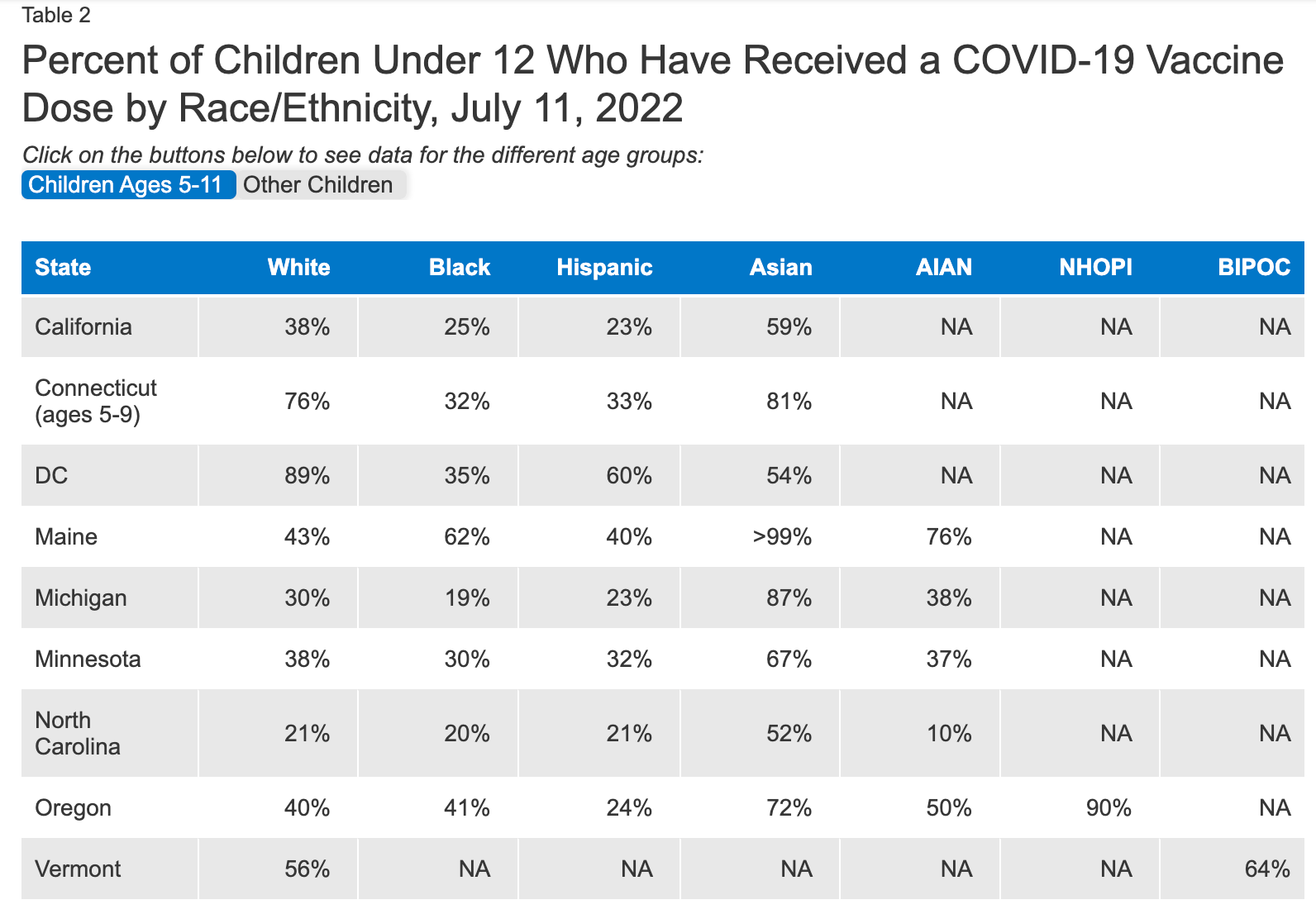
If mandates become the norm, unvaccinated children will be displaced to virtual school, home school, or perhaps no school at all. The harm to kids from substandard education—after nearly two years of disruption—far exceeds any gains from compliance. And that harm will disproportionately hurt poor, black kids. The same is true for mandates that prevent kids from participating in school sports. Being sedentary is far more damaging for children’s health than not getting this shot.

2. The CDC’s gamble could very well hurt vaccination rates more generally. In an effort to encourage Covid-19 vaccination, the CDC may wind up lowering vaccination rates for polio and measles. Why? Because by adding Covid-19 shots to the schedule, the CDC is tacitly implying that this new vaccine is as important to kids as the combination MMR one. This is absolutely false. 

Measles can be a devastating childhood illness, but vaccination provides durable, sterilizing immunity. When vaccination rates are high, measles outbreaks can be averted. Covid-19 vaccines, as millions have learned, do not prevent you from getting Covid-19. Right now the CDC director Rochelle Walensky has Covid, despite being boosted with the bivalent booster just one month ago.

Covid vaccines do work to lower the risk of severe disease. But for healthy kids, the risk of severe disease is already extremely low. Once a child recovers from Covid, having had the disease itself provides immunity equivalent to—or perhaps better than—the vaccine. Currently, the CDC estimates that at least 86 percent of American children have had Covid. For this reason, I, along with policy makers in many advanced nations, think it is reasonable for a parent to vaccinate their child against Covid, and also reasonable not to.  

One of the worst outcomes of the CDC Covid-19 vaccination recommendation would be if parents decide it is unnecessary for their children to get the Covid shot, they will also skip vital vaccines that have been saving lives for decades.  

3. The U.S. is profoundly out of step with peer nations. For example, Denmark has ceased to offer vaccination in healthy kids under the age of 18, and does so only when deemed medically necessary.  That’s because kids very rarely become seriously ill with Omicron. Sweden has just abandoned its recommendation for vaccinating healthy children above the age of 12 (it had never recommended vaccination for kids 5 to 11), and will only vaccinate children with medical problems. In making their new recommendation, the CDC fails to acknowledge the legitimate debate about what is best for children among our peer nations. (For males aged 10 to 40 myocarditis caused by the vaccine is an important safety concern. But this appears less common in younger children, and is not an issue for the childhood vaccination guidelines).

4. The CDC is also at odds with parents’ preferences. Data presented by the CDC show that only 6.9 percent of kids between the ages of six months and four years old have gotten even a single dose of the vaccine. Just 38.6 percent of kids between 5 and 11 have gotten one dose. Most parents have chosen not to give the Covid-19 vaccination to their kids. The CDC’s endorsement further puts the public health establishment not just out of step with other nations, but with most American parents. This risks deepening the lack of trust and authority in the agency. 

To this day, the CDC advises Americans who were exposed to Covid to wear a mask in their own home for 10 days around others. It’s no wonder that the CDC has badly lost credibility with many Americans.

In 1998, the Lancet published a deeply flawed study that should never have appeared claiming vaccines were linked to autism.  Eventually it was found to be fraudulent. Nevertheless, parents and activists ran wild with it. It has taken decades to fight the false connection between vaccines and autism—and it is still a battle not fully won. We need the public to believe in medically essential vaccines and be willing to give them to their children. To add an unnecessary and controversial vaccine to this list—at the risk of some states or local actors mandating it—undermines the broader good of public health.


Hematology Oncology Medicine Health Policy Epidemiology Associate Professor

https://www.commonsense.news/p/covid-vaccines-shouldnt-be-routine

NovoCure cut to Neutral from Overweight by Piper

 Target to $70 from $90

https://finviz.com/quote.ashx?t=NVCR&p=d

ACIP Backs Recs for New Pneumococcal Vax in Previously Immunized Adults

 The CDC's vaccine advisors updated their recommendations to clarify when to administer the 20-valent conjugate pneumococcal vaccine (PCV20; Prevnar 20) in adults who previously received the 13-valent conjugate vaccine (PCV13; Prevnar 13).

In adults 65 and up who have completed their vaccine series with both the PCV13 and 23-valent polysaccharide vaccine (PPSV23; Pneumovax 23), the Advisory Committee on Immunization Practices (ACIP) voted 13-2 to recommend shared decision-making to determine whether to give PCV20 at least 5 years after their last dose of pneumococcal vaccine.

For those under 65 with certain underlying conditions or risk factors who have received both the PCV13 and PPSV23 vaccines but have not completed their full vaccine schedule, ACIP voted 14-1 to recommend one dose of PCV20 at least 5 years after their last dose, or otherwise PPSV23 as previously recommended, to complete their vaccine series.

Finally, for individuals who previously received the PCV13 vaccine only, the committee voted unanimously to recommend a dose of PCV20 at least 1 year later, or otherwise PPSV23 as previously recommended, to complete their vaccine series.

Last year, ACIP streamlined its recommendations for pneumococcal vaccine in adults who have not yet received a conjugate vaccine: all older adults, as well as younger adults with certain underlying medical conditions or risk factors, should receive one dose of PCV20, or otherwise the 15-valent conjugate vaccine (PCV15; Vaxneuvance) followed by PPSV23.

With Thursday's new recommendations, the committee addressed the use of PCV20 in adults with a vaccine history that includes PCV13.

Miwako Kobayashi, MD, MPH, the ACIP work group lead for pneumococcal vaccines, explained that conjugate vaccines are expected to have a longer duration of protection than polysaccharide vaccines. In addition, she noted in her presentation, "limited effectiveness of PPSV23 has been reported in adults with immunocompromising conditions."

Adults 65 and Older

Not all ACIP members were on board with the shared decision-making aspect of the new recommendation for adults 65 and older, with Helen "Keipp" Talbot, MD, of Vanderbilt University in Nashville, arguing the language be dropped in favor of a full recommendation. An amendment for a full recommendation failed to garner enough votes (6 for, 9 against), with cost considerations weighing on some members.

Cost-effectiveness estimates from CDC suggested a range of $153,000 to $414,000 per quality-adjusted life year with a full recommendation, which would apply to about 17 million older adults, Kobayashi said.

ACIP member Beth Bell, MD, MPH, of the University of Washington in Seattle, said that while she is sympathetic to wanting to save as many lives as possible, it is still important to consider the costs.

"I don't feel like it's a good idea to endorse something which involves ... essentially re-vaccinating a very large number of people for a very small incremental benefit," said Bell.

"It's a huge benefit," countered Talbot.

"Many older adults are still working," she continued. "Some of them are at the table with us, and we would like to keep them working because they have brilliant minds and should be able to continue to contribute."

Oliver Brooks, MD, of Watts HealthCare in Los Angeles, said he found the cost-effectiveness data "compelling," but noted that rates of pneumococcal disease are higher in African Americans with serotypes that aren't covered by PCV13, and suggested that shared decision-making was unlikely to benefit this group.

Younger Adults With Underlying Conditions

A sticking point for some committee members was the 5-year wait to administer PCV20 in younger adults (19 to 64) with certain underlying conditions or risk factors -- such as immunocompromising conditions, cochlear implants, or cerebrospinal fluid leaks -- who have received both PCV13 and PPSV23 but have yet to complete their full vaccine series.

Talbot argued for recommending the PCV20 dose 1 year later, noting that the effectiveness of polysaccharide vaccines wanes quickly. Efficacy data presented during the two-day ACIP meeting suggested a decline with PPSV23 as early as 2 years, while no decline had been observed in the first 5 years with a conjugate vaccine.

ACIP member Camille Kotton, MD, of Massachusetts General Hospital in Boston, agreed, noting that 3% of the U.S. population is immunocompromised and pointing out that this group has up to an 18 times higher risk for invasive pneumococcal disease.

However, Sarah Long, MD, of St. Christopher's Hospital for Children in Philadelphia, said the working group determined that a conjugate vaccine together with PPSV23 allowed recipients to be "pretty well protected for 5 years," and giving another dose so soon after the previous one would add "very little" benefit.

An amendment to recommend a 1-year wait before a PCV20 dose in this population failed to pass by a vote of 2-13.

All recommendations from ACIP are not considered final until they are published in the Morbidity and Mortality Weekly Report.

https://www.medpagetoday.com/infectiousdisease/vaccines/101366


Atoss gets FDA OK to start Phase 2 breast cancer study, halts covid program

 Atossa Therapeutics, Inc. (Nasdaq: ATOS), a clinical-stage biopharmaceutical company seeking to develop innovative medicines in areas of significant unmet medical need in oncology with a current focus on breast cancer, announced today that the U.S. Food and Drug Administration (FDA) has lifted the clinical hold and authorized initiation of its Phase 2 neoadjuvant clinical study of (Z)-endoxifen in premenopausal women with early-stage estrogen receptor positive (ER+) and human epidermal growth factor receptor 2 negative (HER2-) breast cancer. This is the first study of Atossa’s proprietary (Z)-endoxifen in the United States.

At this time, Atossa also announced that it is discontinuing its COVID-19 program (AT-301) so that it can refocus resources on this critical study in breast cancer.

https://finance.yahoo.com/news/atossa-therapeutics-inc-receives-authorization-131500114.html

Tricida misses top line in Phase 3

 Tricida, Inc. (NASDAQ: TCDA) announced today the top-line results from its VALOR-CKD renal outcomes clinical trial, designed to evaluate veverimer’s ability to slow CKD progression in patients with metabolic acidosis and chronic kidney disease (CKD).

Primary Endpoint Analysis

The VALOR-CKD trial did not meet its primary endpoint, which was defined as the time to the first occurrence of any event in the composite endpoint of renal death, end-stage renal disease (ESRD), or a confirmed greater than or equal to 40% reduction in estimated glomerular filtration rate (eGFR), also known as DD40. One hundred forty-nine veverimer-treated patients versus 148 placebo-treated patients experienced a DD40 primary endpoint event, representing a veverimer to placebo hazard ratio of 0.99 [95% CI, 0.78, 1.24; (p=0.898)] over the 26.7 months median duration of treatment.

Tricida will host a conference call and webcast that will include a slide presentation at 8:00 am Eastern Time to discuss the results of the VALOR-CKD clinical trial:

The VALOR-CKD Clinical Trial Results Conference Call

Monday, October 24, 2022

8:00 am Eastern Time

Webcast:

IR.Tricida.com

Dial-in:

(800) 715-9871

International:

(646) 307-1963

Conference ID:

2832909

A replay of the webcast will be available on Tricida’s website approximately two hours following the completion of the call and will be available for up to 90 days.

https://finance.yahoo.com/news/tricida-reports-topline-results-valor-110000893.html

Syncona to Acquire Applied Genetic Technologies

 Upfront consideration in cash of $0.34 per share representing a premium of approximately 42% over AGTC’s closing stock price on October 21, 2022

Total consideration of up to $1.07, including up to $0.73 per CVR, representing a premium of up to approximately 344% over AGTC’s closing stock price on October 21, 2022

AGTC’s Board has examined all alternative options for the future of AGTC and believes this transaction clearly delivers the best value for shareholders

Given the state of equity and other funding markets, AGTC sees significant challenges in funding ongoing operations beyond 2022

Syncona and AGTC to host conference call on October 24, 2022 at 7:30 a.m. ET

Syncona and AGTC will host a conference call and webcast to review the details of the transaction on October 24, 2022 at 7:30 a.m. ET. To access the call, dial 877-407-6184 (U.S. participants) or 201-389-0877 (non-U.S. participants). A live webcast will be available in the Events and Presentations section of AGTC’s Investor Relations site at http://ir.agtc.com/events-and-presentations.

Please log in approximately 10 minutes prior to the scheduled start time. The archived webcast will be available in the Events and Presentations section of AGTC’s website following the call.

https://finance.yahoo.com/news/syncona-acquire-applied-genetic-technologies-020500963.html

ViewRay Meets Primary Endpoint for Ablative Doses of Radiation to Pancreatic Cancer

 Study's primary objective of low grade 3+ toxicity was met; exploration of secondary outcomes underway to confirm local control rates and patient outcomes with MRIdian SMART

ViewRay, Inc. (NASDAQ: VRAY) announced today that the findings from the first Phase II prospective international multi-institutional study to deliver ablative doses of radiation to pancreatic cancer patients will be presented at the 64th Annual Meeting of the American Society for Radiation Oncology (ASTRO), being held October 23-26, 2022, at the Henry B. Gonzalez Convention Center in San Antonio. The results will be featured as part of the Special Session of Late-Breaking Abstracts and will take place on Tuesday, October 25, at 3:00 p.m. Central Time. The data will be presented by Parag Parikh, M.D., study's principal investigator and Director of GI Radiation Oncology and MR-Guided Radiation Therapy at the Henry Ford Cancer Institute in Detroit.

https://www.biospace.com/article/releases/viewray-announces-primary-endpoint-outcome-from-first-prospective-multi-institutional-study-to-deliver-ablative-doses-of-radiation-to-pancreatic-cancer-patients/