Search This Blog

Wednesday, February 8, 2023

House Oversight Hearing On Twitter Suppression Of Hunter Biden Laptop Story

 The House Oversight Committee on Wednesday is hearing testimony from three former, top Twitter employees over the company's handling of the Hunter Biden laptop story.

House Oversight Chairman James Comer (R-K), who has launched a broad investigation into the Biden family dealings, is probing the social media giant following revelations from new Twitter owner Elon Musk, who released internal communications from Twitter staff about their censorship efforts.


WITNESSES:

  •     Vijaya Gadde, Former Chief Legal Officer of Twitter
  •     James Baker, Former Deputy General Counsel of Twitter
  •     Yoel Roth, Former Global Head of Trust & Safety of Twitter

Watch live:

In anticipation of today's testimony, White House spokesman Ian Sams blasted the GOP for pulling a "bizarre political stunt."

"This appears to be the latest effort by the House Republican majority’s most extreme MAGA members to question and relitigate the outcome of the 2020 election," he said in a statement, adding "This is not what the American people want their leaders to work on."

"As the president has said and made his focus, the American people expect their leaders to work together in a bipartisan way on the issues that most impact their lives and their families, not attack his family with long-debunked conspiracy theories."

Mr. Biden’s campaign branded the now-authenticated laptop as Russian disinformation, a theory that was peddled by more than 50 former U.S. senior intelligence officials in an open letter to the public.

Rep. Jamie Raskin of Maryland, the top Democrat on the committee, accused Republicans of pursuing “already debunked and hyperpartisan conspiracy theories about President Biden, his family and the so-called deep state.” -Washington Times

The hearing is the first of many focusing on "protecting speech from government interference and social media bias," according to the committee.

"Immediately following the story’s publication, America witnessed a coordinated campaign by social media companies, mainstream news and the intelligence community to suppress and delegitimize the existence of Hunter Biden’s laptop and its contents," Comer will say. "We owe it to the American people to provide answers about this collusion to censor information about Joe Biden’s involvement in his family’s business schemes."

https://www.zerohedge.com/political/watch-live-house-oversight-hearing-twitter-suppression-hunter-biden-laptop-story

Fed, Biden 'using the 70s inflation playbook' to solve supply problem

 Weighing in on whether Federal Reserve Chair Jerome Powell and the Biden administration have the inflation situation under control, Federated Hermes chief investment officer of equities Stephen Auth warned they’re "relatively clueless" Wednesday.

"They're just not focused on the supply driven problems in the economy, the lack of labor or the lack of investment in commodities and energy. Everything they've done has been the opposite of that," Auth said on "Mornings with Maria."

"I think Biden has figured out, though, that he's got a supply problem. I think [Powell] understands that much more than the president does," he continued. "And he's got the 70s playbook in front of him now."

In a televised interview Tuesday, Powell discussed the state of the economy just hours before President Joe Biden’s State of the Union address where the recent jobs report and various spending bills were touted by the president.

Powell had claimed the U.S. finds itself in "very early stages" of disinflation, or the rate at which inflation decreases, calling for a "bumpy" ride ahead. Auth responded to the chairman’s comments, saying it fits with the idea of a rocky inflation landing.

"We think we're getting the back half of this rocky landing, but we don't have the Fed cutting anytime soon. We're not sure when they stop. And we think the market's going to be kind of trading in a range here between 3,400 on the downside and 4,400 on the upside," Auth explained. "So we're telling investors: tune in to stocks, stay cautious, though, and stay defensive in stock portfolios."

Recent corporate earnings reports indicate a "difficult period" for the markets, according to Auth, who further argued that growth stocks likely won’t recover anytime soon.

placeholder

While Americans won’t see a "harsh financial crisis" like 2007-08, Auth noted tech stocks are "doing terrible" and there’s more "negative surprises" to come in earnings season.

"We think there's at least another leg out there," the CIO said. "So those stocks, which are still a big hunk of the market cap of the indices, we think have some more down legs in them and valuation wise are expensive. So we're leaning into defensive stocks here, dividend payers."

Wednesday morning, Zoom announced it will lay off 15% of its workforce, preparing for what the company called uncertainty of the global economy. Buy-and-sell platform eBay is reportedly cutting 4% of its workforce for similar reasons.

As the labor sector starts getting squeezed, Auth doesn’t believe investors or lawmakers will see a policy pivot from the Fed.

"I think we're in an environment here of rates higher for longer," the market expert said. "I'm not buying the pivot or anything like that. So I think growth stocks are going to struggle, but I think you can do okay with dividend-paying stocks."

Projections from the Fed's December meeting show that most officials expect rates to peak around 5.1%, which would imply quarter-point increases at their March and May meetings. No officials forecast rate cuts this year.

Powell – along with other Fed officials – have indicated they are willing to go higher if the data suggests the economy is still too high, a message he reiterated again on Tuesday.

https://www.foxbusiness.com/economy/fed-biden-using-70s-inflation-playbook-solve-supply-problem-market-expert-says

Senators probe telehealth companies for tracking and monetizing sensitive health data

 bipartisan group of senators fiercely criticized several prominent telehealth startups for failing to protect sensitive health information, citing an investigation by STAT and The Markup which found dozens of telehealth companies sharing patient data with Facebook, Google and other major advertising platforms.

“This data is extremely personal, and it can be used to target advertisements for services that may be unnecessary or potentially harmful physically, psychologically, or emotionally,” wrote Sens. Amy Klobuchar (D-Minn.), Susan Collins (R-Maine), Maria Cantwell (D-Wash.) and Cynthia Lummis (R-Wyo.) in letters sent this month to telehealth companies Monument, Workit Health, and Cerebral requesting information on their data sharing policies.

The investigation by STAT and The Markup examined the data-sharing practices of 50 direct-to-consumer telehealth companies, including Workit, Monument, and Cerebral. Specifically, the investigation examined what data is shared as companies use trackers from big tech companies — including Meta, Google, TikTok, Microsoft, and Twitter — to target advertisements and follow consumer browsing and buying patterns online.

For patients visiting online health care platforms, that data can be deeply personal. On 13 of the 50 websites, STAT and The Markup found at least one tracker from major social media and search engine companies that collected patients’ answers to medical questions. Trackers on 25 sites informed at least one big tech platform when users added prescription drugs and other items to their cart, or when they checked out with a subscription for a treatment plan.

Patients who visited Workit’s website seeking addiction treatment, for example, were presented with a simple intake form that asked about current opioid and alcohol use, self-harm, and methadone use. The investigation found responses to that survey, along with other personal information, were sent to Facebook. Presented with those findings, Workit said it adjusted how it was using the trackers.

The letters come just days after the Federal Trade Commission reached a $1.5 million settlement with the telehealth services market GoodRx for sharing users’ health data with Facebook, Google and others for advertising. And it follows a lawsuit filed Jan. 5 against another telehealth company examined in the STAT and The Markup investigation, Hey Favor, as well as FullStory, Meta, and ByteDance, the company behind TikTok.

Much of the information shared by such trackers is not protected by the Health Insurance Portability and Accountability Act, the decades-old patient privacy law that was crafted long before virtual care was an option. Still, health privacy experts and former regulators said sharing such sensitive medical information with advertising platforms undercuts patient privacy and trust — and in some cases, could run afoul of fair business laws.

In letters to executives at the three companies, the lawmakers demanded a list of all third-party platforms they’ve shared user information with over the past three years, along with details about what types of user information they shared. On 35 of the 50 websites, STAT and The Markup found trackers sending individually identifying information to at least one tech company, including names, email addresses, and phone numbers.

Two of the companies targeted by lawmakers — Workit Health and Cerebral — offer online prescriptions of controlled substances, which has been allowed under loosened federal rules during the pandemic. Under federal law, some addiction treatment providers are held to patient privacy standards even stricter than those set out in patient privacy law HIPAA. For example, the physician group Workit uses for patient care states it is forbidden from acknowledging “to anyone outside of the program that you are a patient or disclos[ing] any information identifying you as a substance use disorder patient” except in narrow situations.

The senators — who gave a deadline of Feb. 10 for the companies to respond — explicitly asked all three companies whether they have ever shared information with a third-party service that could identify their users as someone seeking treatment for addiction, substance use disorder, or a mental health condition.

They also noted that telehealth is an increasingly popular option to expand access to health care for rural and underserved patient communities.

“This access should not come at the cost of exposing personal and identifiable information to the world’s largest advertising ecosystems,” they wrote.

This article was copublished with The Markup, a nonprofit newsroom that investigates how powerful institutions are using technology to change our society.

https://www.statnews.com/2023/02/07/telehealth-privacy-cerebral-workit-monument-data-congress/

NORAD Pleads Incompetence Over Failure To Spot Trump-Era Chinese Spy Balloons

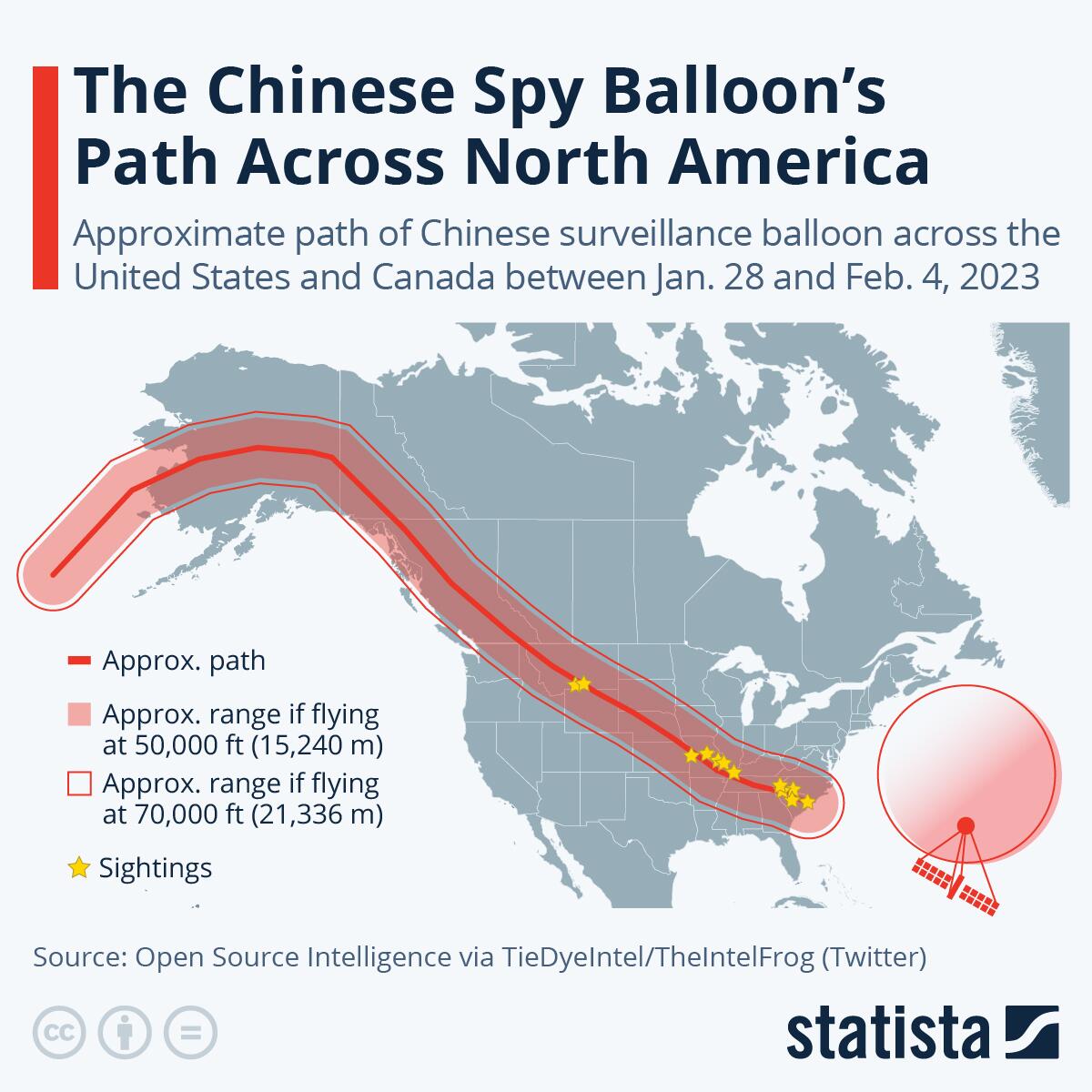
 As the Biden administration came under fire last week for allowing a Chinese spy balloon to cross the entire United States before shooting it down off the coast of South Carolina, an anonymous US Defense Department official said over the weekend that spy balloons transited over US territory during the Trump administration.

Trump, and his former administration officials, collectively called bullshit on the report - saying it 'never happened.'

"Now they are putting out that a Balloon was put up by China during the Trump Administration, in order to take the ‘heat’ off" the Biden administration, Trump wrote Sunday. "China had too much respect for ‘TRUMP’ for this to have happened, and it NEVER did."

In response to the entire Trump administration's lack of knowledge of these alleged incursions, Rep. Marjorie Taylor Greene (R-GA) on Monday called for a congressional investigation into why the US intelligence community failed to inform the sitting administration of foreign spy craft transiting over US airspace.

"If it’s true the Pentagon purposely did NOT tell President Trump of Chinese Spy Balloons during his administration then we had a serious breach in command during the Trump admin," Greene tweeted. "The POTUS is the Commander in Chief. We must investigate and hold accountable those who broke rank."

"Defense officials now claim that Chinese Spy Balloons briefly flew over the U.S. during the Trump admin, but if true, WHY is this just now being reported?" she asked earlier in the day.

Former Trump national security adviser John Bolton told CNN on Monday that it would be a "serious problem" if there was "any actual knowledge that these balloons were over the United States and higher authority wasn’t told."

"As far as I know, every Trump administration official who has been asked, has said they didn’t know anything about it," Bolton continued.

Other members of Congress also had questions;

"Allowing a spy balloon from the Communist Party of China to travel across the entire continental United States before contesting its presence is a disastrous projection of weakness by the White House," said Senate Armed Services ranking member Roger Wicker (R-MI). "It is clear that standard protocol for defense of U.S. airspace was ignored."

And so, with their back up against the wall - the 'deep state' is now suggesting that they're simply incompetent when it comes to detecting foreign spy balloons in real time.

On Monday, NORAD commander Gen. Glen VanHereck told reporters that spy balloons entered US airspace three times during the Trump administration, but "that we did not detect those threats," calling it a "domain awareness gap."

"Every day as a NORAD commander, it’s my responsibility to detect threats to North America. I will tell you that we did not detect those threats," VanHereck said. "And that’s a domain awareness gap that we have to figure out, but I don’t want to go into further detail."

VanHereck then said that the US intelligence community was able to determine the Trump-era transits after the fact "from additional means that made us aware of those balloons that were previously approaching North America or transited North America."

MeanwhileCNN (who else?) has seen an alleged April 2022 report, titled "People’s Republic of China High-Altitude Balloon," which found that a Chinese spy balloon "circumnavigated the globe" in 2019 at an altitude of around 65,000 feet, and "drifted past Hawaii and across Florida before continuing its journey."

The Air Force assessment obtained by CNN states that a spy balloon was “launched and controlled” by China in 2019, showing the country was capable of navigating a high-altitude balloon across the globe as far back as the Trump administration.

China has “deployed multiple HABs [high altitude balloons] that can operate at 65,000ft – 328,000 ft and for months at a time,” the assessment adds. -CNN

And of course; "it is not clear from the documents when US officials first became aware of the Chinese flights or what they assessed regarding their purpose."

Really?

https://www.zerohedge.com/markets/norad-pleads-incompetence-over-failure-spot-trump-era-chinese-spy-balloons

Federal agencies push for insider trading crackdown on their own officials

 Several federal agencies are pushing for stricter rules on trading and even for investigations into suspicious trading by officials, the Wall Street Journal reported Wednesday.

Some U.S. lawmakers have placed a heightened focus on insider trading by members of Congress, but the executive branch has been largely untouched by proposed legislation. 

The Federal Deposit Insurance Corp. (FDIC) and Commodity Futures Trading Commission (CFTC) are exploring plans to beef up their ethics rules, and the Securities and Exchange Commission is looking to update its ethics program as well. Finally, the Commerce Department and Agriculture Department have also pointed to internal investigations of officials who break the rules, the WSJ reported Tuesday.

Rules against insider training vary wildly across the executive branch, with the only universal rule being that officials cannot work on issues they've made major investments in financially, the outlet reported.

One instance cited by WSJ saw an unnamed SEC official fail to report his financial holdings for seven years. When the matter was referred to the Justice Department (DOJ), it declined to prosecute. Ultimately, the individual was reportedly suspended for a week and lost 16 hours of paid leave.

Sen. Josh Hawley, R-Mo., has proposed legislation seeking similar crackdowns on members of Congress who show conflicts of interest in their financial holdings. The Senate firebrand introduced the Pelosi Act in late January.

The bill directly references revelations from last year that former Speaker Nancy Pelosi's husband, Paul Pelosi, traded between $1 million and $5 million of stocks for semiconductors just days before Congress allocated $52 million to the industry. The stocks were later sold at a loss to remove the appearance of impropriety.

The legislation would require that any profits made by a lawmaker during his or her term be returned to American taxpayers. Hawley’s bill excludes mutual funds, exchange-traded funds and Treasury bonds purchases, however.

Josh Hawley with phone in hand

Sen. Josh Hawley has proposed legislation cracking down on insider trading by members of Congress. ( Al Drago/Bloomberg via / Getty Images)

Hawley's proposal came after a similar bipartisan bill, put forward by Reps. Chip Roy, R-Texas, and Abigail Spanberger, D-Va., arose in the House of Representatives. The legislation would have much the same effect as Hawley's.

"Strengthening our democracy and building true resilience against corruption is not just about preventing unethical decisions, but it is also about addressing the feeling among many Americans that their elected officials and government don’t work for them. This perception is damaging to our democracy, and the Trust in Congress Act would help build trust and assure the public that members of Congress are not serving their own financial interests," Spanberger said in January.

https://www.foxbusiness.com/politics/federal-agencies-push-insider-trading-crackdown-own-officials

FTC's Non-Compete Law Could Propel Rise in Trade Secrets Lawsuits

 rade secrets litigations and disputes have been on the rise in recent years, especially in fields with increased competition and sensitive data like the biopharma industry. 

Given the Federal Trade Commission’s recent proposal to ban all non-compete agreements nationwide, the trend is likely to continue. If passed, the rule would force biotech companies to find another way to protect themselves against the unlawful sharing of confidential information. 

In the past year alone, trade secrets lawsuits involving industry leaders like Roche and Pfizer have graced headlines, but million-dollar suits filed by large pharma companies are only the tip of the proverbial iceberg.

What is - and isn’t - a Trade Secret 

report published by investment bank and advisory firm Stout showed that in 2020, federal cases pertaining to trade secret disputes yielded $3 billion in damages. 

The authors of the report predicted litigation activity will continue to expand in the coming years due in part to an increase in technological advancement and the digitization of information. They also cited the Defend Trade Secrets Act of 2016 (DTSA) as a cause. 

Gregory Bombard, legal expert and trial lawyer at Greenberg Traurig, called the DTSA “the most significant change in trade secret law in the last 10 years.” 

He told BioSpace that previously, trade secrets cases were litigated in state courts under state law. The act brought a uniform definition and protection for trade secrets across the U.S.

The United States Patent and Trademark Office (USPTO) states that under federal law, a trade secret:

  • is information that has either actual or potential independent economic value by virtue of not being generally known,

  • has value to others who cannot legitimately obtain the information, and

  • is subject to reasonable efforts to maintain its secrecy. 

Bombard said the phrase “reasonable efforts,” meant to describe an employer’s actions to protect their confidential information, is one of the primary points contested in a trade secrets lawsuit.

“That definition is relatively malleable,” he said. “As long as the court finds that a plaintiff has taken reasonable measures to keep the information secret, that information can qualify as a trade secret.” 

Nicholson Price, a professor of law at the University of Michigan law school, told BioSpace that one of the most common reasonable measures employers take is requiring employees to sign non-compete agreements, effectively stopping the sharing of information before it can begin. 

“Non-competes are another way of achieving that goal by saying that you can't even put yourself in a position to use our secret information, because for some period of time, you can't work for a company where that information would be useful,” Nicholson said. 

However, if the FTC’s ban on non-competes goes into effect, companies will have to rely on other measures, such as non-disclosure agreements and restricting access to sensitive information altogether.

The Burden of Proof

Once the information has met all the requirements to be protected under trade secret law, the plaintiff must then prove the defendant is guilty of misappropriation. 

In some cases, of course, there is hard evidence, like a hard drive or computer filled with sensitive information that a former employee gave to their new employer. 

But in others, the case must be built based on circumstantial evidence, often presented in the form of a product or research that the plaintiff believes the company in question could not have produced on its own.

These cases include myriad challenges for the court, especially when life sciences companies are involved.

By nature, a trade secret is meant to be just that - secret. But when a plaintiff is presenting their case in court, they walk a tightrope between proving sensitive information has been shared and not revealing said information to the public. 

For example, in 2021, Oakwood Laboratories brought its case against Dr. Bagavathikanun Thanoo to the Third Circuit Court of Appeals after a district court had dismissed the company’s complaint four separate times. 

The information in question was related to a microsphere technology, which cost Oakwood $130 million dollars and took over 20 years to develop. In contrast, it took Aurobindo Pharma, the company that employed Thanoo, only a few years, much less money and a much smaller pool of resources to develop the same technology. 

The district court argued that even though Oakwood submitted over 16 exhibits describing the information that was misappropriated, it did not adequately define the trade secrets in question. 

The Third Circuit overturned this ruling. It wrote that the district court’s demand for further precision in the pleading was “misplaced,” and “ignore[d] the challenges a trade secret plaintiff commonly faces when only discovery will reveal exactly what the defendants are up to.”

Shades of Gray

Bombard called these types of cases “gray in nature.” They often contain multiple shades, as even after a plaintiff shows the court that confidential information was, in fact, shared, they then have to prove exactly who shared it. 

This is difficult for life sciences companies, as there is often an overlap between the skills and knowledge that researchers and scientists gain throughout their careers and the sensitive information they acquire in their time in a specific role.

“The court has to try to distinguish between what information in that person's head is confidential or secret information belonging to their old employer and what comes from their own general skill and knowledge as a scientist,” Bombard said. “Those can be very challenging questions to work out.”

Still, the same report that added up the billions in damages from trade secrets cases also showed that well over half (68%) of the cases studied were ruled in favor of the plaintiffs.

This shows that though the burden of proof is heavy, as long as pharma companies take reasonable precautions, the court is likely to rule in their favor. 

https://www.biospace.com/article/ftc-s-non-compete-law-could-propel-rise-in-trade-secrets-lawsuits-/

FDA AdComm Sets Date to Assess GSK’s Plans for Jemperli in Rectal Cancer

 The FDA has set a Feb. 9 meeting for its Oncologic Drugs Advisory Committee (ODAC) to discuss whether GSK’s clinical development plans for Jemperli (dostarlimab) could support accelerated approval.

Jemperli is an IgG4 humanized monoclonal antibody blocking the PD-1 receptor. The drug is approved for use in mismatch repair-deficient (dMMR) endometrial cancer and dMMR recurrent or advanced solid tumors.

GSK is now hoping to expand Jemperli’s label to include treatment-naïve dMMR locally advanced rectal cancer (LARC). For this, the company is proposing two single-arm trials. The first, a single-center study, is set to enroll 30 patients, while the second will recruit 100 patients across several study sites.

In both trials, patients will be treated with 500 mg intravenous Jemperli every three weeks for nine cycles.

Jemperli’s efficacy will primarily be evaluated as the 12-month clinical complete response rate (cCR), a composite of no residual disease by endoscopy or rectal-specific MRI and no evidence of metastatic disease one year after the first cCR evaluation.

GSK plans to use cCR results as the clinical endpoint to support a supplemental Biologics License Application for Jemperli’s accelerated approval in this indication.

To verify the clinical benefit of Jemperli in this patient population, the company also plans to evaluate cCR and event-free survival after three years of follow-up. GSK also proposes to include a randomized controlled trial comparing Jemperli against the standard of care in Stage II/III dMMR colon cancer as supportive confirmatory evidence.

FDA Red Flags

Previously, Jemperli had already shown its promise in gastric cancer when it elicited a 100% cCR in a June 2022 study. With just 12 patients completing treatment, Alan P. Venook, M.D., colorectal cancer physician, University of California, San Francisco, called the study “unheard-of.”

The FDA appears to be skeptical, however.

In its briefing documents published before the ODAC meeting, the regulatory body flagged “the unprecedented use of cCR as the major endpoint to support an approval in oncology.”

In particular, the agency pointed out that there are currently no evidence-based guidelines to support the use of cCR as an efficacy metric in clinical practice or clinical trials.

“The use of cCR in LARC clinical decision-making is based on small, mostly retrospective, uncontrolled studies that vary in design” and other factors such as treatment regimen and monitoring protocol, the FDA wrote.

The agency is also asking for expert input regarding the appropriateness of GSK’s single-arm trial designs and the proposed confirmatory data to support Jemperli’s clinical benefit.

https://www.biospace.com/article/fda-adcomm-to-assess-gsk-s-development-plans-for-jemperli-in-rectal-cancer/