Search This Blog

Saturday, April 15, 2023

The Biden Economy and How It Could Be Fixed

 The following is adapted from a talk delivered on February 22, 2023, at a Hillsdale College National Leadership Seminar in Indian Wells, California.

Just about everybody on Wall Street knows, despite what you read in the financial press, that the Biden administration’s economic policies are driving our economy into a recessionary ditch. In a recent Wall Street Journal survey of 23 large financial institutions that do business directly with the Federal Reserve, 16 predicted a recession in 2023 and two predicted a recession in 2024, while only five predicted that we would avoid a recession—although even those five predicted we’d have only one-half percent economic growth, well below the 2.1 percent average over the past 20 years and dangerously close to what has traditionally been considered a recession.

A recession is defined, traditionally, as two consecutive quarters of negative economic growth. At least it was defined that way before the financial press redefined it prior to the 2022 midterms, ensuring that despite two consecutive quarters of negative growth, President Biden’s policies couldn’t be labeled recessionary. But regardless of the definition, this negative growth meant declining standards of living, fewer job opportunities, lower wages, and increased poverty for the American people. Overall, we have become a far less vibrant and far less prosperous society on the verge of a serious recession.

The hard economic times we are experiencing are especially striking as they come on the heels of the Trump boom, which opened our eyes again to American economic potential when we have low taxes, reduced regulation, and a bountiful supply of domestic energy. Everybody, particularly minority and low-wage earners, reaped the benefits in the Trump years of abundant job opportunities, increasing wages, historic highs in family income, and historic lows in rates of poverty and unemployment.

Consider some of the metrics. In 2019, the last year before the pandemic, median family income grew to nearly $73,000. It went up $4,600 in that year alone, a 6.4 percent increase over 2018—the largest annual increase going back to 1967. That amounted to 45 percent more growth in one year than the $3,200 increase that the Obama administration achieved in eight years. And contrary to what would become an election year talking point, the economic benefits were widespread. Every racial group experienced a record high median family income level: for white Americans it rose 5.7 percent; for black Americans, 7.9 percent; for Hispanic Americans, 7.1 percent; and for Asian Americans, 10.6 percent.

As incomes grew in 2019, the poverty rate plummeted 1.3 percentage points to a 60-year low of 10.5 percent—the lowest poverty rate since the government started reporting the statistic in 1959. This lifted 4.1 million people out of poverty. For comparison purposes, during the eight years of the Obama administration, the number of people living in poverty increased by 787,000. And again, the decrease in the poverty rate under Trump disproportionately benefited minorities: the poverty rate decreased eight-tenths of a percentage point for whites, two percentage points for blacks, 1.8 for Hispanics, and 2.8 for Asians.

The year 2019 should be remembered as the year of the worker. And that wasn’t due to mandated wage increases, racial reparations, climate regulations, tax increases, or any other redistributionist policy. Working class Americans saw their circumstances materially improve in 2019 because of policies that encouraged economic freedom.

Turning the clock ahead, since March 2021, two months after Biden took office and began reversing Trump’s economic policies, the Consumer Price Index—the average in prices paid by consumers for goods and services, by which inflation is commonly measured—has surged. And it continues to surge. When representatives of the Biden administration say that inflation is coming down, they are playing word games. From month to month, inflation may be going up at a somewhat slower rate—that is, the rate at which inflation is increasing might be down from previous highs. But the increases are cumulative so the dollar impact of each monthly increase adds to the prior months’ increases. And even though the rate of increases is moderating, it still remains well above levels seen prior to the Biden presidency. The Federal Reserve aims to keep inflation around two percent—which is roughly where it was during the Trump administration. It is now at 6.4 percent, having at one point since 2021 hit nine percent.

Granted, the Federal Reserve has to take some of the blame. It failed to react in a timely manner when inflation started to set in. Remember when everyone insisted that the inflation we were experiencing was “transitory”? It turned out to be anything but. For that reason, since last year, the Federal Reserve has been increasing interest rates at the fastest pace since the 1980s. It intends to continue raising rates because inflation has proven so persistent and widespread. And the longer these interest rate hikes continue, the more inevitable it becomes that we will suffer a deep recession.

This situation has not come about on its own. It was engineered. When the pandemic ended, all we needed to do to create dynamic economic growth again was to leave in place the policies we had before the pandemic. But of course we didn’t.

Coming out of the pandemic, we knew two things. First, we knew people had accumulated a lot of money. The savings rate had surged in an unprecedented way during the pandemic, and when the pandemic was over this resulted in an increased demand for goods. This surge in the savings rate wasn’t a mystery: the federal government handed out $5 trillion during the pandemic, and people had very little opportunity to spend it since they weren’t traveling, eating out, going shopping, etc. So in 2021, Americans had a lot of cash.

The second thing we knew coming out of the pandemic was that fewer people were working. If you tried to get anything done around your house back then, you will remember that. First you couldn’t get anybody to do the work. Then if you found someone, you couldn’t get the goods or materials you needed because they weren’t being produced. People were not working and businesses were unable to anticipate future demand. The result was a low supply of goods.

Excess demand and low supply: this was the situation when Biden took office in 2021. And as any student of elementary economics knows, when demand exceeds supply you get inflation. Isn’t it pretty obvious what should be done in that situation? You should adopt policies that juice supply and avoid adopting policies that juice demand. Instead, the Biden administration proceeded to do the exact opposite.

Although the pandemic recession was the shortest recession on record, the economic chaos it created was incredible. And as Milton Friedman said in 1964, the deeper the recession, the greater the recovery. Coming into office in January 2021, the Biden administration was witnessing the beginnings of a dynamic recovery, and perhaps they thought it would continue no matter what they did—that Americans would flock back to work, spend money, travel, go back to restaurants, and so on. So the administration and the Democrats in Congress saw it as a prime opportunity to enact legislation to remake America.

This shouldn’t come as a surprise. A New York Times Magazine headline following Biden’s inauguration read: “The Biden Team Wants to Transform the Economy. Really.” During the campaign, Biden himself said of his plans: “I truly think that if we do this right, we have an incredible opportunity to not just dig out of this crisis, but to fundamentally transform the country.” That’s how the Democrats saw the pandemic—as an opportunity for radical change. So, a little more than a month into the Biden presidency, on a totally partisan basis, the Democrats in Congress passed and Biden signed a $1.9 trillion spending bill they called “The American Rescue Plan.”

Talk about a misnomer! This so-called rescue plan handed out more cash to American consumers, further increasing demand, and discouraging work, further decreasing supply. That this was economic suicide wasn’t only obvious to conservative free-market types like myself. Larry Summers, who served as Secretary of the Treasury under President Clinton and as head of the Council of Economic Advisors under President Obama—a former president of Harvard and a well-respected liberal economist—called this the least responsible economic policy in 40 years. All you needed to understand this was a simple familiarity with the laws of supply and demand vis-à-vis inflation.
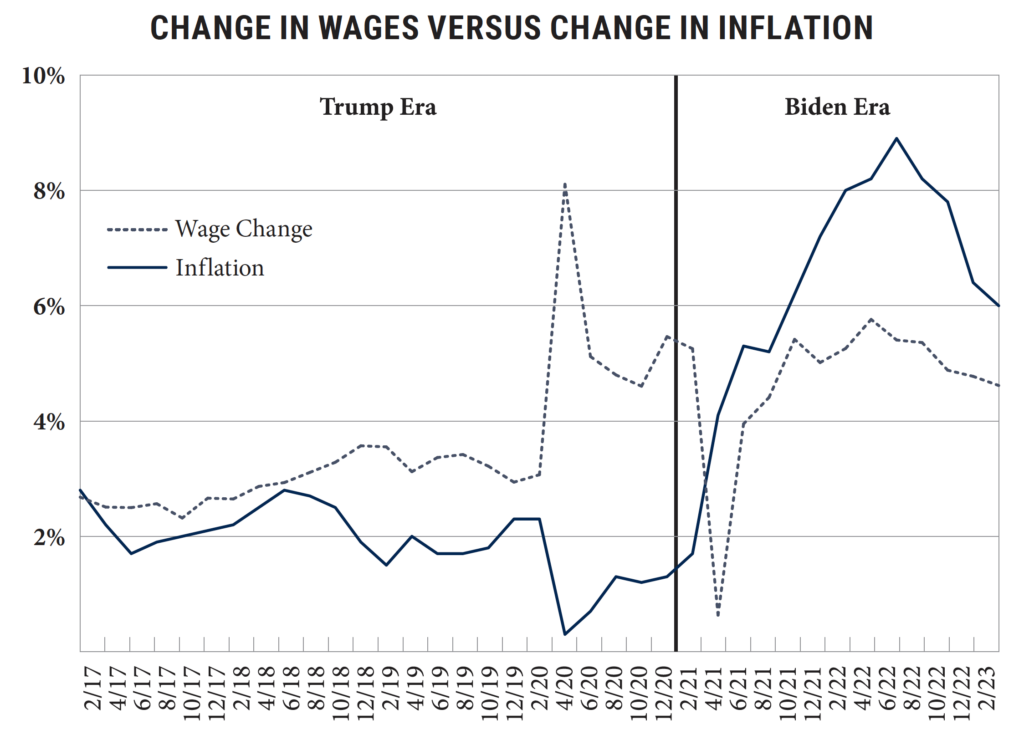
The negative impact on American workers has been tremendous. The chart above traces wages (or income) versus inflation as reflected in the Consumer Price Index. The dotted line is wage growth and the solid line is inflation. The big surge where the dotted line jumps way up reflects the federal spending during the pandemic. To the left of that jump, we see that during the Trump administration, wages were up about three percent and inflation about two percent. To the right on the chart, we see what happened after Biden took office. Within a couple of months, inflation shoots way up above wages—indeed, the month inflation crossed over wages was March 2021, the very month Congress passed The American Rescue Plan.

But there’s even more bad news. Since so many people are not working and wages have been declining for those who are working due to inflation, savings have now declined to historic lows—in fact, to the lowest level we’ve seen going back to 1959. People are running out of cash, and as a result they are using credit cards. Credit card debt when Biden took office was at $748 billion and it stayed there until May 2021—again, until shortly after the passage of The American Rescue Plan—at which point it began to shoot way up to what is now $986 billion, the highest level of credit card debt in our history. And this is happening at a time when the Federal Reserve is compelled to continue raising interest rates to try to battle inflation.

To sum up, with wage growth unable to keep up with inflation, savings melting like an ice cube in the summer sun, and credit card debt rising to historic highs, we’re facing higher interest rates, declining job opportunities, and increasing economic pain for American families.

So is there anything the Biden administration could do?

To repeat, inflation is the result of demand exceeding supply. The Federal Reserve, with its hikes in interest rates, is trying to drive down demand. But if it has to drive demand all the way down to where supply is right now, it’s going to cause incredible misery for the American people. So from an economic standpoint, if the Biden administration wanted to lessen the misery and hasten recovery, it would do whatever it could to increase supply. And there are two areas where it could have a significant positive impact on the supply side: the cost of energy and the cost of labor.

Energy and labor impact virtually everything in our economy. Thousands of products have a petroleum component, and even those that don’t have to be delivered, which requires oil and gas. And you can’t build, manufacture, deliver, or install anything without labor—labor affects the price of everything. So if your goal were to fight inflation, you would implement policies to drive down energy and labor costs.

This is elementary. It’s simple. The problem is ideological. Here’s Biden responding to a young person during the 2020 campaign: “Kiddo,” he said, “I want you to just take a look. Okay? You don’t have to agree, but I want you to look in my eyes. I guarantee, I guarantee we’re going to end fossil fuel.” And this wasn’t one of Biden’s all-too-common gaffes. At a rally in February 2020, his prepared remarks contained the same pledge. And he has advanced this goal as president by, among other things, killing oil pipeline projects, failing to grant oil leases, failing to approve drilling permits, and limiting the ability of energy companies to obtain financing. He has done everything in his power to reduce America’s domestic energy production, cripple our energy sector, and increase our dependence on expensive foreign oil.

The cost of labor has also continued to surge. The increase in wages that Biden crows about is normally a good thing. But it makes no economic sense to ignore the impact of inflation on the value of wages. It is simply a fact that workers are better off if inflation is up two percent and their wages are up three percent than if inflation is up six percent and their wages are up five percent. They are making more money in the second case, but the money is worth less. That’s the situation we have now, and it’s disastrous for workers.

Why are labor costs surging? Very simply—we have all seen the “help wanted” signs outside businesses all over America—it’s because employers can’t find workers. Two years after the pandemic ended, there are still 2.8 million workers missing from the labor force. Why? A recent study headed by University of Chicago economist Casey Mulligan, “Paying Americans Not to Work,” found that in 24 states, unemployment benefits and Obamacare subsidies for a family of four with no one working are equal to or above national median household income. In three of those states, a family of four with no one working can receive over $100,000 per year in cash and benefits. In 14 states, that number is at least $80,000, which is more than the average salary for a construction worker or an electrician. In other words, two years after the pandemic, we’re still paying people not to work at a time when businesses and our economy desperately need workers.

In the Trump economy, increased wages resulted from businesses competing with other businesses for workers. Today, increased wages are the result of businesses competing with government benefits. If increasing people’s dependence on government is your goal, this is a great approach. It is a dreadful approach if your goal is bringing inflation to heel and sparking a dynamic economic recovery.

The bottom line is this: to address inflation and avoid a deep recession, Biden should, first, tell American bankers, asset managers, bureaucrats, and environmentalists to get out of the way of the energy industry because America needs oil now. Second, he should work with Congress to reduce or eliminate the work-discouraging programs that are keeping able-bodied Americans out of the workforce. We should not cut programs for those who need assistance, but we should reduce benefits for those who are able to work but are choosing not to work. With abundant energy and a vibrant workforce, we could make significant headway against inflation and quickly improve the lives of the American people.

This isn’t rocket science. But let’s be realistic. The problem isn’t that the policymakers in the Biden administration don’t understand the basic principles of economics. The problem is that they have different goals than most Americans. When Biden spoke during the campaign about transforming America, he meant it. The goal animating current policy is not the goal of creating widespread prosperity by means of a dynamic and productive economy. The goal animating current policy is the transformation of America’s economy and our way of life in accordance with a Leftist political agenda, using so-called emergencies like climate change as a rationale. The Biden administration is not going to take the simple measures needed to increase American energy production and get people back in the workforce, because that’s not in line with their goals.

Americans need to open their eyes to the fact that our elected leaders across the political spectrum understand clearly what policies will lead to prosperity and freedom for the American people, but that only some of those leaders consider prosperity and freedom the goal. We need more of them.


Andrew F. Puzder served as the chief executive of CKE Restaurants from 2000 to 2017. He received his B.A. from Cleveland State University and his J.D. from the Washington University School of Law. He serves as chairman of the board at 2ndVote Advisers, an investment firm formed in response to the stakeholder capitalism and ESG movements, and is a fellow at the Pepperdine University School of Public Policy, the Heritage Foundation, and the America First Policy Institute. An economic adviser for former President Trump’s 2016 presidential campaign, he has written for several publications, including The Wall Street JournalFOX Business, and Real Clear Politics. His books include Job Creation: How It Really Works and Why Government Doesn’t Understand It and The Capitalist Comeback: The Trump Boom and the Left’s Plot to Stop It.


https://imprimis.hillsdale.edu/the-biden-economy-and-how-it-could-be-fixed/

Study Suggests Narrow Excision Margins Safe in Early Melanoma Resection

 Current U.S., European, and Australian guidelines recommend 10-mm safety margins for radical excision of primary melanomas, but for patients with early-stage cutaneous melanoma in critical areas of the body, excision with 5-mm margins may not significantly increase risk for recurrence or melanoma-specific mortality (MSM), results of a retrospective study suggest.

Among 1,179 patients with stage T1a melanomas near the face, scalp, external genitalia, or other critical areas, the weighted 10-year local recurrence rate for patients who underwent resection with 10-mm margins was 5.7%, compared with 6.7% for those who had resections with 5-mm margins, a nonsignificant difference.

Weighted 10-year melanoma-specific mortality was 1.8% for patients treated with wide margins, vs. 4.2% for those treated with narrow margins, also a nonsignificant difference. Patients treated with narrow margins did have significantly fewer reconstructive surgeries than patients treated with wide margins, reported Andrea Maurichi, MD, and colleagues at the National Cancer Institute of Italy in Milan.

"Because this association was found in melanomas of the head and neck, acral, and genital sites, there is no plausible reason why it could not be extrapolated to other locations. The findings also support the need for prospective randomized clinical trials to definitively answer the important question about appropriate excision margins for T1a melanoma," they wrote in the study, published online in JAMA Dermatology.

The authors also found, however, that Breslow thickness greater than 0.4 mm and mitotic rate greater than 1/mm­­2 were associated with worse MSM, and that acral lentiginous melanoma, lentigo maligna melanoma, and increasing Breslow thickness were associated with a higher incidence of local recurrence.

A melanoma expert who was not involved in the study said that despite these findings, wider margins are always preferable.

"There is always a conversation around these general [critical] areas, but as a rule we try to get larger margins," said Ryan J. Sullivan, MD, of Mass General Cancer Center in Boston.

In an interview, Dr. Sullivan said that the finding about lower frequency of reconstructive procedures in the narrow margins groups may be more of a concern for younger patients than for the elderly.

Study design

The investigators conducted a retrospective cohort study of consecutive patients aged 18 or older at the National Cancer Institute of Milan who were diagnosed with T1a cutaneous melanoma close to critical areas from 2001 through 2020.

Patients with primary cutaneous melanoma of the head and face areas with functional or cosmetic considerations, acral areas (plantar, palmar, digital and interdigital areas), external genitalia, or periumbilical and perineal areas were eligible for inclusion.

The cohort comprised 1,179 patients with a median age of 50 and equal sex distribution. Of these patients, 626 (53%) had a wide excision, of whom 434 had a linear repair, and 192 had a flap of graft reconstruction. The remaining 553 patients had narrow excisions, 491 with linear repair, and 62 with flap or graft reconstruction.

Analyses were adjusted to account for imbalances between the surgical groups.

The study was supported by the nonprofit foundation Emme Rouge. The authors and Dr. Sullivan reported having no relevant conflicts of interest to disclose.

https://www.medscape.com/viewarticle/990789

Spinal Cord Stimulation May Help Diabetic Neuropathy

 Both pain relief and neurological improvements persisted in patients with diabetic neuropathy 2 years after they began receiving treatment with 10 kHz of spinal cord stimulation, according to research that released early, prior to its presentation at the annual meeting of the American Academy of Neurology.

Dr Erika Petersen

The data represent the longest follow-up available for spinal cord stimulation at a frequency higher than the 60 Hz initially approved for diabetic neuropathy by the Food and Drug Administration, according to lead author Erika A. Petersen, MD, a professor of neurosurgery and the residency program director at the University of Arkansas for Medical Sciences, Little Rock.

"You would expect that somebody who continues to have diabetes for 24 months and has neuropathy would have worse neuropathy after 2 years, and what we're seeing is that people were stable or better in terms of their nerve function at 2 years," Dr. Petersen said in an interview. "So that's really revolutionary."

Encouraging preliminary findings

The findings are "promising and preliminary," John D. Markman, MD, a professor in neurology and neurosurgery, vice chair for clinical research, and director of the Translational Pain Research Program at the University of Rochester (N.Y.) Medical Center, said in an interview. Dr. Markman, who was not involved in this study, said that, though the results are encouraging, it's "less clear how much of [the pain improvement] is due to what we would consider to be on-target, pain-relieving benefit from stimulation versus other factors like expectation." The crossover rate and amount of reduction in pain intensity are promising, but "I think that excitement is weighed against the fact that this is an open-label study."

An underused treatment

Although spinal cord stimulation has been around since the late 1960s, its use only picked up steam in the 2000s, when it became more frequently used to treat chronic nerve damage related to neuropathic pain syndromes, Dr. Petersen explained. The FDA approved the treatment's new indication for diabetic neuropathy in 2015, and data from Abbott and Medtronic have shown benefits from spinal cord stimulation at 60 Hz, but some patients are uncomfortable with the vibration or tingling feelings the devices can cause at that frequency.

"They describe creepy crawlies or ants crawling over the feet, or pins and needles, and painful sensitivity," Dr. Petersen said. "You create a vibration feeling in the same zone where they already have those feelings of buzzing and pain and vibration, and it's sometimes actually even more uncomfortable and less satisfying to them in terms of relief" with the spinal cord stimulation at 60 Hz, she said, "so there's a lot of attrition in terms of who will actually use it."

At 10 kHz, however, "people don't feel any vibration or tingling associated with it; it just jams the signal of the pain," she said. The difference between the frequencies is like that between "a lifeguard whistle and a dog whistle."

Testing high-frequency stimulation

The new findings included the 24-month follow-up data from a randomized controlled trial that assessed the effectiveness of high-frequency spinal cord stimulation for painful diabetic neuropathy. The original 216 participants enrolled in the trial had diabetic neuropathy symptoms for at least 12 months and either could no not tolerate or did not respond to medications. Enrollment criteria also included lower-limb pain intensity of at least 5 on a 0-10 visual analogy scale and hemoglobin A1c of no more than 10%.

For the first 6 months of the trial – before crossover was offered – participants were randomly assigned to receive either 10 kHz of spinal cord stimulation along with conventional medical management or to receive conventional medical management alone. The 6-month data from 187 patients, as reported in April 2021 in JAMA Neurology, revealed that 79% of those receiving spinal cord stimulation experienced at least 50% improved pain relief without worsening of their baseline neurologic deficits, compared with only 5% of those receiving only conventional treatments.

Average pain levels increased 2% in the control participants compared with a decrease of 76% in those with the spinal cord stimulation devices. In addition, 62% of the patients receiving spinal cord stimulation demonstration neurologic improvement in reflexes, strength, movement and sensation, compared with 3% of those in the control group. The study's findings led the FDA to approve the device using 10 kHz.

At 6 months, 93% of control patients crossed over to receiving spinal cord stimulation while none with the devices opted to stop their spinal cord stimulation. The 12-month data revealed that 85% of those receiving spinal cord stimulation experienced at least 50% pain relief, with the average pain relief at 74%. Patients also reported statistically significant improved quality of life as well as less interference with sleep, mood, and daily activities from pain.

Two years after baseline, patients' pain relief was maintained with average 80% improvement, and 66% of patients showed neurologic improvement since baseline. Though no patients had devices removed because of ineffectiveness, five patients' devices were removed because of infection while infections in three other patients resolved.

"Being able to offer something that is not a pharmaceutical, without the side effects, that shows an even longer durability to that response is a really important finding at this point," Dr. Petersen said.

Surgical considerations

Among the estimated 37 million Americans with type 1 or 2 diabetes, approximately one quarter of them experience some level of painful diabetic neuropathy, but medication and other medical management strategies are not always adequate in treating their pain. After a 1-week trial of spinal cord stimulation, the devices are implanted under the skin and rechargeable through the skin for up to 10 years, after which they can be replaced.

An appropriate candidate for spinal cord stimulation would be someone for whom existing non-invasive pain relief options, including medications, are ineffective or intolerable, Dr. Petersen and Dr. Markman both said. An adequate trial of medication is not "one size fits all" and will vary by each patient, added Dr. Markman, who is also interested in whether this study's participants were able to have a reduction in use of pain relief medications.

"I think there's a significant number of patients out there who can benefit from this, so I think that's why it's promising and exciting," Dr. Markman said. "I do think it's important to see if this actually allows them to be on less medication or whether stimulation turns out to be another treatment in addition to their baseline treatments." The challenge is identifying "which patients are most likely to be benefiting from this and which are most likely to be harmed."

Aside from infection from implantation, other possible risks include pain at the battery site and, in rare cases, a need for reoperation because of migration of the leads, he said.

Improvement in symptom severity and quality of life

After the wound from the implant has completely healed, Dr. Petersen said patients using the devices do not have any activity restrictions outside of magnetic interference, such as MRIs. "I've had people go back-country kayaking, scuba diving, fishing with their grandkids, all sorts of all sorts of things. If patients need to go through a scanner of any kind, they should ask whether it's safe for pacemakers since these devices are like a "pacemaker for pain.

"I had a patient bring solar chargers with him so that he could recharge his battery in the backwoods while kayaking because that's the level of improvement in pain that he got – from barely being able to walk down the hall to feeling comfortable being off the grid and active again," Dr. Petersen said. "Those kinds of improvements in quality of life are massive."

The study findings may also suggest that spinal cord stimulation can benefit a broader population of patients experiencing neuropathic pain, Dr. Markman said.

"There's an extraordinary unmet need for treatments for neuropathy, and one important question here is the extent to which diabetic peripheral neuropathy and the response that we're seeing here is a proxy for a broader effect across many neuropathies that are caused by other conditions other than diabetes," Dr. Markman said. "There's a lot of reason to think that this will be helpful not just for diabetes-related neuropathic pain, but for other types of neuropathic pain that have similar clinical presentations or clinical symptom patterns to diabetic peripheral neuropathy."

The study was funded by Nevro, who manufactures the devices. Dr. Petersen and Dr. Markman both reported consulting with, receiving support from, holding stock options with, and serving on the data safety monitoring boards and advisory boards of numerous pharmaceutical companies.

https://www.medscape.com/viewarticle/990791

Not Too Old to Start Strength Training

 Aging may be the greatest threat to your freedom and independence you'll ever know, only because of what it does to your muscles.

"The anabolic hormones that are responsible for maintaining muscle decline with age," says Brandon Grubbs, PhD, assistant professor of exercise physiology and co-leader of the Positive Aging Consortium at Middle Tennessee State University. "Older adults also tend to be less active and consume less protein, which is important for muscle mass."

Not only that, but the "satellite cells" responsible for muscle repair become less responsive, says Grubbs, and the muscle fibers hold on to fewer of them. So growing muscle gets harder too.

Research shows we begin losing muscle around age 35, and the process picks up after we hit 60. While many of us are dreaming up fun plans for retirement, we're also losing as much as 3% of our muscle per year.

But the loss of muscle due to aging, known as sarcopenia, affects more than your reflection in the mirror. It can greatly influence your health and well-being.

Sarcopenia has been linked to type 2 diabeteshigh blood pressure, and obesity. It may increase the risk for heart disease and stroke, and take years off your life. It also jeopardizes your freedom to live on your own, not to mention travel, spend time with grandkids, or do so many of the things that make older adulthood joyful and fulfilling.

"Physical frailty," says Grubbs — that is, weakness, slowness, unintentional weight loss, and fatigue — "is intertwined with sarcopenia." If your body starts wasting, so does your ability to go about your daily life and do things you enjoy.

Luckily, there is a powerful remedy: lifting weights.

"Strength training mitigates the loss of muscle function that occurs with age," says Grubbs. "It stimulates muscle growth and enhances muscle tissue quality, meaning you can generate more force with a given amount of muscle."

Strength training boosts connective tissue strength and bone mineral density, Grubbs adds. "It can extend someone's ability to remain living independently and reduce the risk of falls and fractures. It's also good for one's psychological well-being."

Yet, only 9% of people over 75 perform strength training regularly — that is, at least two times per week. It's not hard to see why.

Strength training can be intimidating for anyone, especially if you're north of 60 and you've never held a dumbbell in your life. Health problems, pain, fatigue, fear of injury — all can keep older adults out of the weight room. Other barriers include a lack of social support and available exercise facilities.

But here's the thing: Being old by itself is not a limiting factor — so it's no excuse to avoid exercise. Actually, nothing is.

Both the National Strength and Conditioning Association (NSCA) and the American College of Sports Medicine (ACSM) recommend strength training for older adults, noting that programs can be adapted for those with frailty or chronic conditions.

That's not news. The ACSM's original Position Stand on Exercise and Physical Activity for Older Adults put it plainly: "In general, frailty or extreme age is not a contraindication to exercise, although the specific modalities may be altered to accommodate individual disabilities." The presence of disease states commonly associated with aged populations — ranging from arthritis, cardiovascular disease, and diabetes to dementia, osteoporosis, and stroke — "is not by itself a contraindication to exercise" either, even if all are present within a single individual.

"For many of these conditions," says the ACSM, "exercise will offer benefits not achievable through medication alone." And despite the common fear of pain or injury: "Sedentariness appears a far more dangerous condition than physical activity in the very old."

A 2022 study found that healthy older men who lifted weights strengthened the connections between their nerves and muscles, helping them maintain physical function. The subjects' average age was 72, but they were just kids compared to participants in a landmark 1990 trial that looked at frail, institutionalized people as old as 96.

The study was small — just 10 participants — but significant because of their age (86 to 96) and the remarkable results: After 8 weeks of resistance training, they improved their strength by 174% while adding 9% more muscle to their mid thighs. These were residents of a long-term care facility; they were not acutely ill but not especially healthy, either. One 86-year-old man stopped at 4 weeks due to a "straining sensation during training at the site of a previously repaired inguinal hernia," the study notes. "The attendance rate was 98.8% for the 8-week program in the 9 subjects who completed the study. No cardiovascular complications were seen."

"That study demonstrated that even the oldest of the old can improve strength and muscle mass," says Grubbs. "I'm not aware of an age where one can't improve those outcomes.

"There are bodybuilders who still compete in their 70s," Grubbs adds. "Older adults don't gain muscle and strength as well as younger ones — the training response may be slower — but significant improvements in strength and muscle can be achieved with the right program."

Okay, So What Is the "Right" Strength Program for Older Adults?

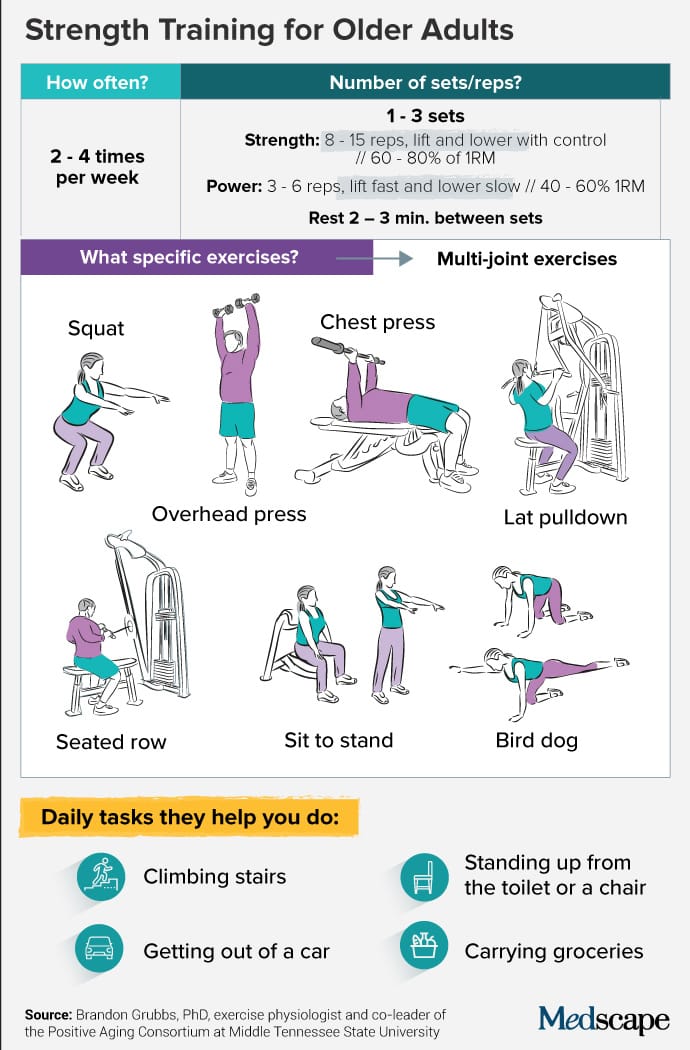
The ACSM recommends that people ages 65 and up train two to four times per week in sessions lasting 30 to 60 minutes. Grubbs says just one workout per week is enough to start; a 2019 study in participants over 75 suggests that as little as an hour of strength training per week can improve walking speed, leg strength, and one's ability to stand up out of a chair.

Trainees should perform one to three sets of 8 to 15 repetitions per exercise, going as heavy as 80% of their "one-repetition maximum," or one-rep max (the greatest amount of weight you can lift one time). A one-rep max is difficult and potentially dangerous to test, so it's OK to estimate it conservatively. (Really, you just want a weight you can lift 8 to 15 times that's challenging enough but not so heavy that you sacrifice proper form.)

Do multi-joint exercises, Grubbs recommends — traditional strength moves like the squat, overhead press, chest press, seated row, and lat pulldown. These better prepare you for the activities of daily living than isolation exercises (those that target a specific muscle) or machine movements do — although machines may be more appropriate for people with balance issues or other difficulties that make multi-joint, free-weight exercises problematic.

Keep in mind that any move can be made easier to suit your fitness level. You may not need to drop into a deep squat if a quarter-squat (squatting only a quarter of the way) feels challenging enough.

Rest between sets can be 2 to 3 minutes.


Focus on Power Training

Interestingly, while traditional resistance training will build muscle and strength, Grubbs suggests that older adults focus more on power — the skill of applying force quickly. "Power is better related to older adults' ability to perform activities of daily living," he says, including walking speed, and going from sitting to standing.

In fact, a 2022 review showed that power training may be more effective than traditional strength training in improving older adults' "functional performance." Meaning you'll have an easier time climbing stairs, getting out of a car, and standing up from a chair or the toilet.

The good news is power training is no more complicated than strength work, and it actually feels less challenging. With power, speed of movement is the focus, so you choose a light weight — around 40% to 60% of your one-rep max, or really any load you can move quickly — and lift it as fast as you can (but safely, and with control). Take a second or two to lower the weight and reset. Repeat for three to six repetitions, or until you feel your form may be compromised, or you've lost significant speed. Do one to three sets.

What kind of moves are "power" moves? You can do the same ones you use for strength, just faster. If you want to maximize your results, Grubbs says you can cycle your workouts, keeping the same movements but changing the speed at which you perform them and the level of weight you use to build muscle, strength, and power. For instance, you can train with heavier weights one day to focus more on strength, and then use lighter weights with faster rep speeds in your next workout to promote power. Keep going back and forth from there.

According to Laura Grissom, the Health and Wellness Education Coordinator at St. Clair Senior Center in Murfreesboro, TN, one exercise that all older adults should practice is the "sit to stand," which is just what it sounds like.

"Sit at the edge of a chair, with your feet on the floor, and cross your arms over your chest," says Grissom. "Lean back until your back touches the back of the chair, brace your abs, and then come forward and stand up." That's one rep. Take it easy at first, with three sets of 10, and then work on doing it faster, as power training.

How to Get Started

If you're brand-new to exercise, you may consider working with a physical therapist, who can help you come up with a customized plan, educate you on proper form, and advise how hard you should be working. If you have a medical condition, talk to your doctor, too. Medicare may cover physical therapy with a doctor's referral.

A personal trainer can be great if you have the budget. (Some are specially certified to train older adults, such as those with the National Academy of Sports Medicine's Senior Fitness Specialization.) But if not, look into group fitness classes like the kind Grissom runs. Your local senior center may offer them, Grissom says. You can also search for a SilverSneakers class near you. Designed just for adults 65-plus, SilverSneakers fitness programs are available in thousands of gyms and community centers nationwide (and virtually via Zoom), and the cost is covered by many Medicare plans.

Working out in a group setting may be one of the best ways to see that you continue to work out at all. A study in Health Psychology found that adults 65 and up who exercised together in a program designed to foster a sense of social connectedness had greater adherence to their workouts.

"People don't come to our seniors' classes just to exercise," says Grissom. "It's a social event. When a person is retired, they find themselves with more time on their hands and not around other people as much. But when they come to class, they make friends and have accountability. If someone doesn't show up to a class a couple of times, someone else in the class is going to call them and ask if everything's OK. Once they get into the camaraderie of the classes, most people come back again."

Seeing the benefits can help keep you motivated, as well.

"So many people have told me over the years that they've been able to stop taking medication because they came to my class," says Grissom. "They'll say, 'My blood sugar and cholesterol went down.... The pain in my shoulder went away....' If you have a health problem, the best thing you can do is exercise."

No matter how old you are.

https://www.medscape.com/viewarticle/990794

AstraZeneca, Gilead get new challenger as Pyramid deviates from TRK to bag antibody-drug conjugate

 Pyramid Biosciences’ current pipeline is built around the kinase TRK. But the biotech has now struck a deal that will take it down a new path, paying $20 million upfront and betting $1 billion in biobucks for the ex-greater China rights to a would-be challenger to Gilead’s antibody-drug conjugate (ADC) Trodelvy.

New Jersey-based Pyramid is giving GeneQuantum Healthcare the money in return for a TROP2-directed ADC, GQ1010. The drug candidate “has shown a highly differentiated preclinical profile,” Pyramid said, and is on course to enter the clinic in the next year. GeneQuantum used a novel site-specific conjugation technology and linker-payload in GQ1010 to increase its stability, safety and potency.

Based on the preclinical data, Pyramid thinks GQ1010 may have a broader therapeutic margin than more advanced TROP2 ADCs and therefore may also possess a superior efficacy and safety profile. The ADC will need differentiating characteristics if it is to make a mark on the TROP2 space.

Gilead paid $21 billion to buy Immunomedics for the first-in-class, TROP2-directed ADC Trodelvy in 2020. Sales of the drug increased (PDF) 79% last year, climbing to $680 million, as Gilead made inroads into the U.S. and European breast cancer markets. AstraZeneca, which paid Daiichi Sankyo to co-develop a TROP2 ADC in 2020, is threatening to curb Gilead’s progress with a rival therapy that is in phase 3 development.

The presence of commercial products and advanced clinical candidates, in the hands of deep-pocketed drugmakers, has failed to dissuade Pyramid from trying to make its mark on the TROP2 market. Pyramid sees a range of opportunities for the ADC across breast, lung, pancreatic, ovarian and prostate cancers.

Bolting GQ1010 onto the pipeline moves Pyramid outside of its traditional area of focus. Prior to the ADC deal, the biotech constructed a pipeline around its knowledge of TRK, taking its pan-TRK kinase inhibitor PBI-200 into the clinic in solid tumors and joining the small club of companies to explore the potential of the target in dermatological conditions such as psoriasis.

https://www.fiercebiotech.com/biotech/astrazeneca-gilead-get-new-challenger-pyramid-deviates-trk-bag-antibody-drug-conjugate

J&J, Legend tap Novartis to help make CAR-T drug Carvykti amid supply constraints

 Struggling to meet demand for CAR-T med Caryvkti, Johnson & Johnson and Legend Biotech have reached out to another cell therapy expert for help manufacturing their multiple myeloma treatment.

Novartis has signed a three-year contract to manufacture Carvykti, also known as cilta-cel, Legend said in a securities filing Friday.

In a statement to Fierce Pharma, Novartis confirmed that it will supply Caryvkti from its cell therapy site in Morris Plains, New Jersey, which is about 20 miles from J&J and Legend’s CAR-T facility in Raritan, New Jersey.

The agreement only covers Carvykti supply for clinical trials outside of China, Legend CEO Ying Huang, Ph.D., told Fierce Pharma via email. Ying declined to offer additional details on the deal’s financial terms or the specific manufacturing capacity involved.

The contract manufacturing deal took effect on Wednesday. But technology transfers can take as long as 18 months, and first, the new manufacturing plan must get a separate FDA go-ahead, Ying said.

Even though Novartis won’t take part in commercial manufacturing for Caryvkti, the extra clinical capacity could help J&J and Legend channel more resources toward ramping up commercial supply.

Despite their phased launch starting at just a few large hospitals, J&J and Legend have had difficulties meeting demand for Carvykti, partly thanks to a global shortage of viral vectors that are used to deliver cell and gene therapies. In contrast to long waiting lists and what J&J CEO Joaquin Duato described as a “strong demand,” Carvykti’s sales plateaued in the fourth quarter at $55 million, the same as its haul in the third quarter.

J&J also scrapped a plan to launch Carvykti in the U.K. Last month, local health organization Myeloma UK suggested that the company simply couldn’t produce enough supply to support the rollout.

Meanwhile, the partners have been busy expanding their capacity. Last year, J&J and Legend unveiled a plan to invest an additional $250 million in their Raritan facility over the next few years to scale up production.

“It’s worth pointing out that, even though we have onboarded Novartis as a [contract manufacturer], we remain focused on providing the product in a reliable and consistent manner through continuous improvement of processes, building a state-of-the-art Belgium facility and expanding internal lentivirus production,” Ying said.

Looking forward, a recent phase 3 success could catapult Carvykti into earlier treatment of myeloma, potentially giving the therapy a larger patient pool and further tightening the supply-demand bottleneck.

Novartis is in a different situation. After a surprise phase 3 flop in earlier treatment of large B-cell lymphoma, Novartis’ CAR-T therapy Kymriah has recently lost its momentum. In 2022, Kymriah sales declined 2% at constant currencies to $536 million.

But as one of the first manufacturers of CAR-T therapies, Novartis has plenty of experience in making these complicated, personalized treatments. Without the extra demand from Kymriah, the Swiss pharma can spare some of its production capacity.

Novartis’ overall contract manufacturing business is expanding, as well. In 2022, revenues from Novartis' manufacturing services nearly doubled to $214 million.

https://www.fiercepharma.com/manufacturing/jj-legend-tap-novartis-help-make-car-t-therapy-carvykti-amid-supply-constraint

MedPAC Approves Recommendations on Part B Drug Payment and Site-Neutral Payment

 The Medicare Payment Advisory Commission (MedPAC) on Thursday approved draft recommendations on some Part B drug reimbursement and site-neutral payment issues for inclusion in its upcoming June report, but not without some disagreement.

The discussion about the proposals for Medicare Part B reimbursementopens in a new tab or window, which covers drugs that clinicians buy ahead of time and dispense in their offices, proceeded fairly smoothly.

The draft recommendation, which was approved unanimously by the commission's 17 members, called for Congress to require the HHS secretary to cap payments for Part B drugs and biologics approved under FDA's accelerated approval program if postmarketing confirmatory trials aren't finished by the deadline set by FDA and the manufacturer, if the product's clinical benefits aren't confirmed in postmarketing trials, or if the product is covered under Medicare's "coverage with evidence development" policy.

The draft recommendation also called for Congress to let the HHS secretary cap Part B reimbursement for drugs approved via accelerated approval if "their price is excessive relative to the upper bound estimates of value."

MedPAC members also unanimously voted for three other draft recommendations asking Congress to allow the HHS secretary to:

  • Set a single payment -- based on the average sales price (ASP) -- for Part B drugs and biologics with similar health effects
  • Reduce the "add-on" payment -- an administration fee -- for expensive Part B drugs and biologics in which the fee is based on the ASP
  • Eliminate add-on payments for Part B drugs and biologics that are based on wholesale acquisition costs

At the commission's March meeting, MedPAC members agreed that they would like to get rid ofopens in a new tab or window the current system, in which for most Part B drugs, doctors are paid an additional fee of 6% of the ASP to cover their administrative costs; concerns were expressed that this formula gives clinicians an incentive to prescribe a higher-priced drug. Commission staff proposed a three-part structure for dealing with this issue, in which clinicians would be paid, for example, an add-on fee of 6%, 3% + $24, or $220, whichever is less.

"I have experienced the perversion that [ASP + 6%] creates among clinicians, and I would love to get rid of it," commission member Greg Poulsen, MBA, of Intermountain Healthcare in Salt Lake City, said at the March meeting. Noting that more expensive drugs often have higher inventory and other costs associated with them than cheaper drugs, Poulsen said he'd prefer to offer only the percentage-plus-flat-fee alternative, but "if we decide not to go down that path, and stick with the language and the examples that we have, I would still say that's a big step in the right direction."

On Thursday, commissioners had little to say about the Part B draft recommendations before their unanimous votes, aside from suggesting wording changes. However, they were more vocal when it came to a draft recommendation on site-neutral Medicare payment for certain outpatient procedures and services, which said that "Congress should more closely align payment rates across ambulatory settings for selected services that are safe to provide in all settings and when doing so does not pose a risk to access."

During his presentation on the draft recommendation

opens in a new tab or window, MedPAC senior analyst Dan Zabinski, PhD, noted that of 169 outpatient payment classifications, the staff had identified 66 categories in which payments could be made neutral no matter where the service was delivered, whether in a physician's office, hospital outpatient department, or ambulatory surgery center. Often, payments are higher for services rendered in hospital outpatient departments, which have higher facility expenses.

For those 66 services and procedures, both Medicare and beneficiaries would pay less overall, but budget neutrality rules would mean that Medicare payments and beneficiary cost-sharing would have to increase for the other 103 payment groups to make up for it, he said. In all, about $7.7 billion would be moved from the 66 services and procedures to the other 103.

Zabinski emphasized that the payment changes likely wouldn't negatively affect rural beneficiaries, for several reasons: first, because the changes wouldn't affect critical access hospitals, which are paid under a different system; second, because other federal payment programs support rural providers like rural emergency hospitals and rural health clinics; and third, because concerns about specific rural providers could be addressed with policies targeted to help them.

But several commissioners disagreed. "I don't think that there's evidence to support that reducing payment to rural providers will not affect access," said Lynn Barr, MPH, of the Barr-Campbell Family Foundation in Incline Village, Nevada. "I think maternal health is a great example of where Medicaid -- not Medicare -- paid so little for maternal services that we've lost maternal services over much of rural [America] today. So we have evidence that by reducing payment, it will affect access."

Robert Cherry, MD, of UCLA Health in Los Angeles, had other concerns. "I continue to struggle with the draft language; I was hoping that the term 'safe and appropriate' could actually be utilized," he said, adding that he was worried about the policy's unintended consequences, "specifically with respect to the clinical safety of individual patients who may benefit for a more resource intensive setting such as a hospital outpatient department," adding that "safe and appropriate" would allow Medicare "to consider modifiers to established billing codes [in which] patient acuity requires greater resource intensity compared to healthier patients."

In the end, all the commissioners voted to approve the draft recommendation except for Cherry, who abstained. The commission meets again on Friday to discuss draft reports on telehealth and behavioral health.

https://www.medpagetoday.com/practicemanagement/reimbursement/104007