Search This Blog

Saturday, April 15, 2023

'Disinformation' network blacklisting conservative news hides tax forms over 'harassment'

 Two U.S. nonprofit groups tied to the Global Disinformation Index, a British entity blacklisting conservative media outlets, are refusing to disclose key details about their operations, citing an obscure federal exemption law on "harassment," according to a Washington Examiner investigation.

The private AN Foundation, also known as the Disinformation Index Foundation, and its affiliated public charity, Disinformation Index Inc., provided the Washington Examiner with heavily redacted copies of their 2021 IRS tax returns. A lawyer for the two entities is alleging that these redactions were made because the groups are the target of a coordinated "harassment campaign," a claim that multiple tax experts warn does not allow them to hide information on officers, board members, and, in the case of one group, omit the source of a donation.

"I don't think I've ever seen a 990 that excludes the names of officers and directors," said Alan Dye, a partner at Webster, Chamberlain, & Bean who has specialized in nonprofit law since 1975. “And I’ve looked at hundreds.”

Redaction-riddled disclosures

The lack of transparency on tax forms filed by the GDI groups could result in lawmakers and watchdog groups propelling their investigations into the purported "disinformation" tracking network, which has come under fire ever since a Washington Examiner report on Feb. 9 detailed its efforts to feed blacklists of conservative websites to advertisers. Several Republican members of Congress, including House Oversight and Accountability Committee Chairman James Comer (R-KY), have demanded answers from the State Department for steering grant money to GDI between 2020 and 2021.

On March 31, the Washington Examiner obtained physical copies of 2021 tax forms filed by the AN Foundation and Disinformation Index after a written request to GDI was made. But the documents, which combined total 56 pages, redact or omit various information that is raising major legal and ethical red flags among a handful of lawyers specializing in nonprofit groups.

Previously filed annual disclosures, which are public, give an idea of who is running the two GDI nonprofit groups. GDI CEO Clare Melford and its executive director, Daniel Rogers, are listed interchangeably in Delaware corporate records filed in 2021 and 2022 as officers and directors. The charity's 2020 federal tax forms list its treasurer as Jo Jenks, who possessed its books and records, Melford as secretary, and Rogers as president.

But the federal 2021 forms provided to the Washington Examiner by the charity, which posted over $1.1 million in revenue after its $345,000 haul in 2020, as well the private foundation, which disclosed $367,000 in revenue, notably conceal who prepared the documents, who its books are in the care of, and the names of officers and directors.

The private foundation even omitted the source of a $115,000 donation it received that year, even though such entities are ordinarily required under federal law to publish such information, according to the IRS.

Screenshot 2023-04-12 at 11.34.44 AM.png

There are no visible redactions on prior federal disclosures filed by either group, prior to them coming under the spotlight due to multiple Washington Examiner reports. Both groups also partially redacted their Maryland area code phone numbers on 2021 federal forms, despite them being available in the past.

"This is outrageous," said Paul Kamenar, counsel to the National Legal and Policy Center, a conservative watchdog that plans to file an IRS complaint against both nonprofit groups.

An alleged 'harassment campaign'

Upon inquiring about omissions on the sets of tax forms, a lawyer representing the GDI groups sent the Washington Examiner a letter on April 6, which appears to have also been sent to the IRS and tax administration inspector general for the Treasury Department. The attorney, Marcus Owens of the firm Loeb & Loeb, said that the groups are "withholding" details from their disclosures due to federal codes and regulations concerning "harassment campaigns" against groups.

"The Index’s personnel and their families have received multiple threats and hacking attacks, including threats of violence against their children," Owens, who directed the Exempt Organizations division at the IRS between 1990 and 2000, wrote in the letter. "As such, the organization is working [with] appropriate law enforcement authorities, telecommunications and Internet organizations; has appropriately withheld information that could lead to furtherance of this behavior."

Owens did not reply to follow-up requests on Thursday and Monday for an IRS ruling in connection to the alleged campaign and details on whether the Washington Examiner was deemed as part of it. It’s unclear who else may be part of the alleged campaign.

One IRS rule that Owens cited allows a tax-exempt group not to fulfill disclosure requests "that it reasonably believes" are part of a "coordinated effort to disrupt" its operations. Groups that may receive drastic and overwhelming increases in requests for the 990s could claim a campaign exists, according to tax experts.

It’s unclear if other entities or news organizations have also sought to obtain tax forms from the GDI groups. The IRS, for instance, issued a ruling back in 2011 holding that a tax-exempt group could not claim a harassment exemption due to there only being a single requester for its disclosures, according to a document obtained by the Washington Examiner.

Still, the IRS rule, 6104(d)-3, makes no mention of tax-exempt groups being allowed to provide their disclosures to a requester with redactions, according to tax experts. Therefore, it’s unclear how the statute would even apply in this case, according to Jeff Tenenbaum, a Washington, D.C., nonprofits attorney.

"While there are exceptions where the organization posts the Form 990 on its website, or where the organization is the subject of a harassment campaign by opponents and the IRS determines that the purpose of the group requests is to disrupt the operations of the organization rather than to obtain information, this exception does not provide for redactions and would not apply merely because certain board members or staff are individually the target of harassment campaigns unrelated to requests for Forms 990," he told the Washington Examiner.

Tenenbaum added, "And even if the IRS had made such a ruling, the only disclosure exception that would apply would be in connection with the Form 990 disclosure harassment campaign, not generally to other Form 990 disclosure requests such as yours."

imgonline-com-ua-twotoone-KXUdVCoiPQL8yv.jpg

Patrick Sternal, an attorney who worked at the IRS between 2012 and 2020, including as an adviser at its chief counsel office for exempt organizations, also said that the provision doesn't permit redaction.

"It's a very narrow exception to the general rule that requires disclosure when you have dozens of requests for your 990 returns," he told the Washington Examiner. "It's not just general harassment."

The Washington Examiner sent detailed questions to the IRS asking whether it determines that a nonprofit group may selectively redact information. However, the agency declined to provide any specific context on how the law should be applied.

"6103 of the Internal Revenue Code prevents the IRS from commenting on specific taxpayer situations," said an IRS spokesperson. "The IRS does not issue rulings through the media about matters of tax law."

 'Transparency' issue

The revelation involving GDI's disclosures comes amid outcry from Congress and other groups over its level of secrecy. Two watchdog groups launched a Freedom of Information Act investigation in February to obtain documents in relation to the government's funding of GDI.

The British group has not announced which conservative media outlets are on its "dynamic exclusion" blacklist, which comprises who it deems as the foremost "disinformation" peddlers and is fed to advertising companies. GDI has said that the 10 "riskiest" news outlets for "disinformation" are the American Spectator, Newsmax, the Federalist, the American Conservative, One America News, the Blaze, the Daily WireRealClearPolitics, Reason, and the New York Post.

The Washington Examiner only learned through sources in the ad industry that it was on this blacklist and was never directly informed by GDI.

Moreover, GDI quietly scrubbed its website, after reporting on its blacklist, of advisory panel members. The panel, which is said partially to oversee its exclusion list, has included the likes of Finn Heinrich, a division director at the George Soros-funded Open Society Foundations grant-making network, according to his LinkedIn account.

GDI’s decision to redact its tax forms is only the latest in a string of transparency lapses, according to Dye, the partner at Webster, Chamberlain, & Bean.

"The organization purports to assess the reliability of other organizations," he said. "In order to assess their reliability, you need to know who they are."

Kamenar concurred.

“It’s kind of ironic that a group whose mission is transparency is withholding the names of its officers,” said the lawyer for the National Legal and Policy Center.

https://www.washingtonexaminer.com/news/disinformation-inc-network-blacklisting-conservative-news-hides-tax-forms-harassment

2-Year Anniversary of Declining Real Wages for American Workers

 This week marks the two-year anniversary of declining real wages for ordinary American workers due to ongoing high inflation. The latest consumer price index, released this week, shows prices grew 20% faster than wages over the last 12 months. 

This sad anniversary is the result of President Biden and Congressional Democrats' reckless spending that has diluted the value of the currency already in existence. 

The two-year decline in living standards for ordinary Americans proves once and for all that Democrats are America's anti-worker party. Their easy fiscal and monetary policy, known as Modern Monetary Theory, has been wholly discredited by this prolonged erosion of the dollar's value and workers' quality of life. 

Yet still, they demand more massive deficit spending that would put upward pressure on prices. For instance, Biden's recently announced budget would raise the deficit from $1.4 billion in 2022 to $1.6 trillion in 2023 and $1.8 trillion in 2024. The total deficit would increase by $17 trillion over ten years – more than the entire national debt held by the public before Covid-19. 

Democrats refuse to negotiate any spending cuts in return for raising the debt ceiling, accepting the dangerous status quo of around $1 trillion wasted in debt interest payments each year. 

While the mainstream media is promoting this month's slowdown in CPI, they ignore how inflation under Biden's presidency is approximately 15%. Those on fixed incomes are one-sixth poorer today than when Biden took office. And core inflation actually increased compared to last month, demonstrating the inflation battle is far from won.

The worst may be yet to come. Under Biden's nose, nations across the globe are rapidly replacing the dollar as their trading currency. One reason the U.S. has been able to print trillions of dollars without even faster inflation is that other countries inherently value the U.S. dollar as the world's reserve currency. If they no longer need it to conduct their trade, demand for dollars will plummet along with its long-inflated value and American living standards. This could turn today's high inflation hyper. 

This threat is growing along with the economies of the BRICS nations, whose combined GDPs recently overtook the G7 nations' for the first time. 

Inflation also remains high enough to continue posing a severe threat to banks whose balance sheets are full of low-interest mortgage and Treasury debt. Who wants a 3% mortgage bond in an inflationary environment around twice as high? This dynamic threatens another Silicon Valley Bank-style run. 

According to economist Peter Schiff, banks are rapidly selling their mortgage bonds. Sound familiar?

Small businesses face the one-two punch of elevated inflation and banks that have stopped lending to preserve liquidity. Small enterprises generally operate on thin profit margins that high inflation erodes. Small businesses can't simply raise their prices in response because their consumers are price sensitive. There's only so much consumers are willing to pay for drycleaning and pizzas. 

"Small businesses are struggling... [to] get the funds to grow, to hire, to buy the equipment that they need," says Kryson Bratton, owner of Piper Whitney Construction in Houston, who can't get credit to purchase a new tractor. According to the Federal Reserve, U.S. bank lending fell by the most on record at the end of March.

The only way out of this unstable economic environment is to end the fiscal madness and empower small businesses through pro-growth policies like those in Job Creators Network's American Small Business Prosperity Plan

This may not be as exciting as the culture wars, but it has a much bigger impact on the lives of ordinary Americans – as demonstrated by Democrats' destruction of Americans' growing living standards birthright. 

Alfredo Ortiz is president and CEO of Job Creators Network and author of The Real Race Revolutionaries: How Minority Entrepreneurship Can Overcome America's Racial and Economic Divides.

https://www.realclearpolicy.com/articles/2023/04/14/two-year_anniversary_of_declining_real_wages_for_american_workers_893930.html

Bidenflation Rises To 14.8%, Hurting Americans

 This week in a press conference, Treasury Secretary Janet Yellen stated that the U.S. economy is doing exceptionally well. "As I mentioned, the United States is doing extremely well economically, with inflation coming down in a strong labor market, and Europe is doing better than was feared at our last meeting."

Contrast this to what real Americans think. In a recent IBD/TIPP Poll, over one-half (55%) believe the economy is in a recession, and another 56% (57% in March) think the economy is not improving.

We welcome any good news.

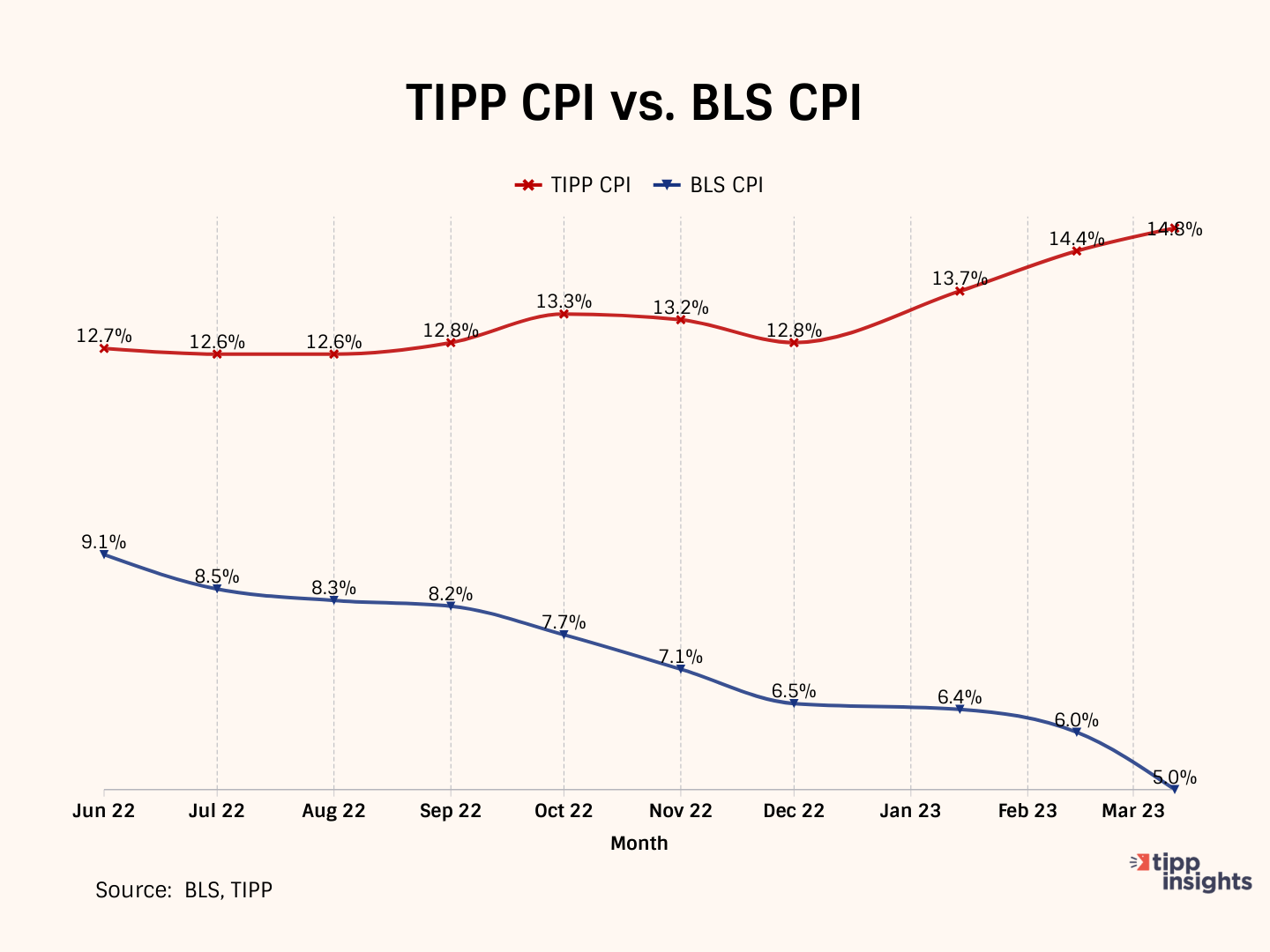
We always take Yellen's pronouncements with a pinch of salt. Recall that in mid-2021, she double-teamed with Fed Chairman Powell, leading us to believe that U.S. inflation was "transitory," defying commonsense. Even backbenchers knew inflation was taking a stronghold, which peaked at 9.1%.

Based on our experience, we thought it was appropriate to call her "Janet Yellen – The Modern Nero." Despite her impressive academic resume, she lacks direct business experience. She can't relate to the struggles of most Americans. As a team player, she plays a vital role on Biden's economic team as the go-to person for selling Pollyanna's ideas to the American public. But she is not very convincing.

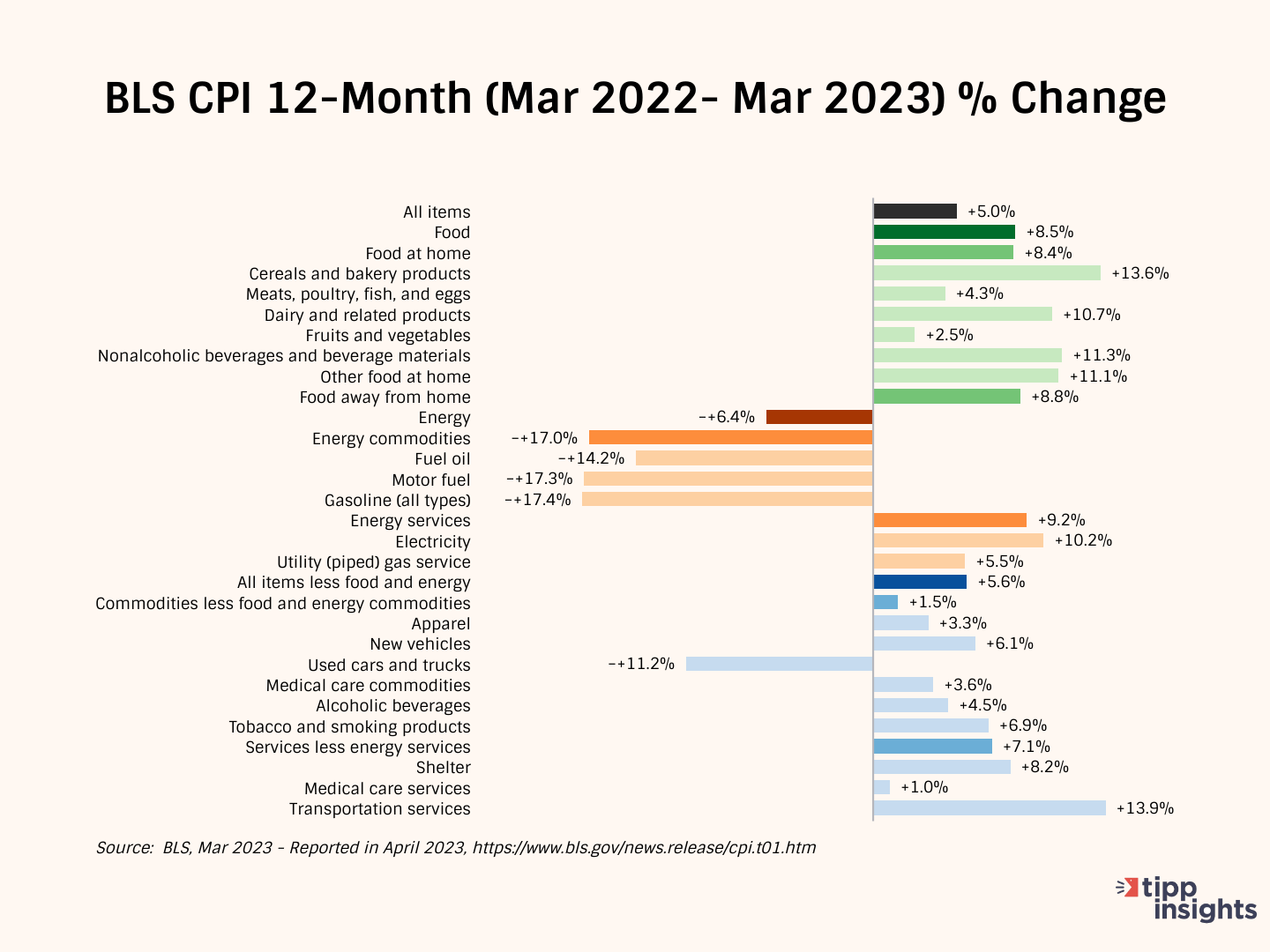
The Consumer Price Index (CPI) released by the government on Wednesday showed a 5.0% year-over-year increase in prices from March 2022 to March 2023, edging down from a rate of 6.0% in February and 6.4% in January. The CPI has declined steadily from a 40-year high of 9.1% in June to 5.0% in March.

The media headlines read:

Inflation slowed to 5% in March, a nearly 2-year low, but core consumer price gains accelerated.

Inflation rose just 0.1% in March and 5% from a year ago as Fed rate hikes took hold.

But few media outlets provided context, partly because doing so would shed the Biden administration in a terrible light. So, we are happy to oblige and fill in the gaps.

The CPI inflation rate measures how much more expensive things are getting over time. The government calculates the increase in the CPI rate over 12 months, so the base for March 2023 is March 2022, and for February 2023 is February 2022.

In March 2023, the CPI index was 301.836, 5.0% higher than its base of 287.504 for March 2022. And in February 2023, the CPI index was 300.840, 6.0% higher than its base of 283.716 for February 2022.

Between February 2022 and March 2022, the base increased sharply by 3.788 points or 1.34%. Even though the CPI index increased by 0.33% between February and March 2023, the headline CPI rate dropped from 6.0% to 5.0% because of the "base effect."

In other words, the rate seemed lower than it actually was because the base was higher in March 2022. Things were getting more expensive but more expensive at a slower rate than the previous year. Only in Washington is this good news.

TIPP CPI

We developed the TIPP CPI, a metric that uses February 2021, the month after President Biden's inauguration, as its base. We measure the rate of change in the economy from this base. All TIPP CPI measures are anchored to the base month of February 2021, making it exclusive to the economy under President Biden's watch.

We use the relevant Bureau of Labor Statistics (BLS) underlying data but recalibrate it to arrive at the TIPP CPI. CPIs are index numbers that give Americans a sense of common understanding about how prices impact their lives, much like the Dow Jones Industrial Average is a bellwether of the stock market.

But we convert index numbers to percent changes when we refer to TIPP CPI and BLS CPI.

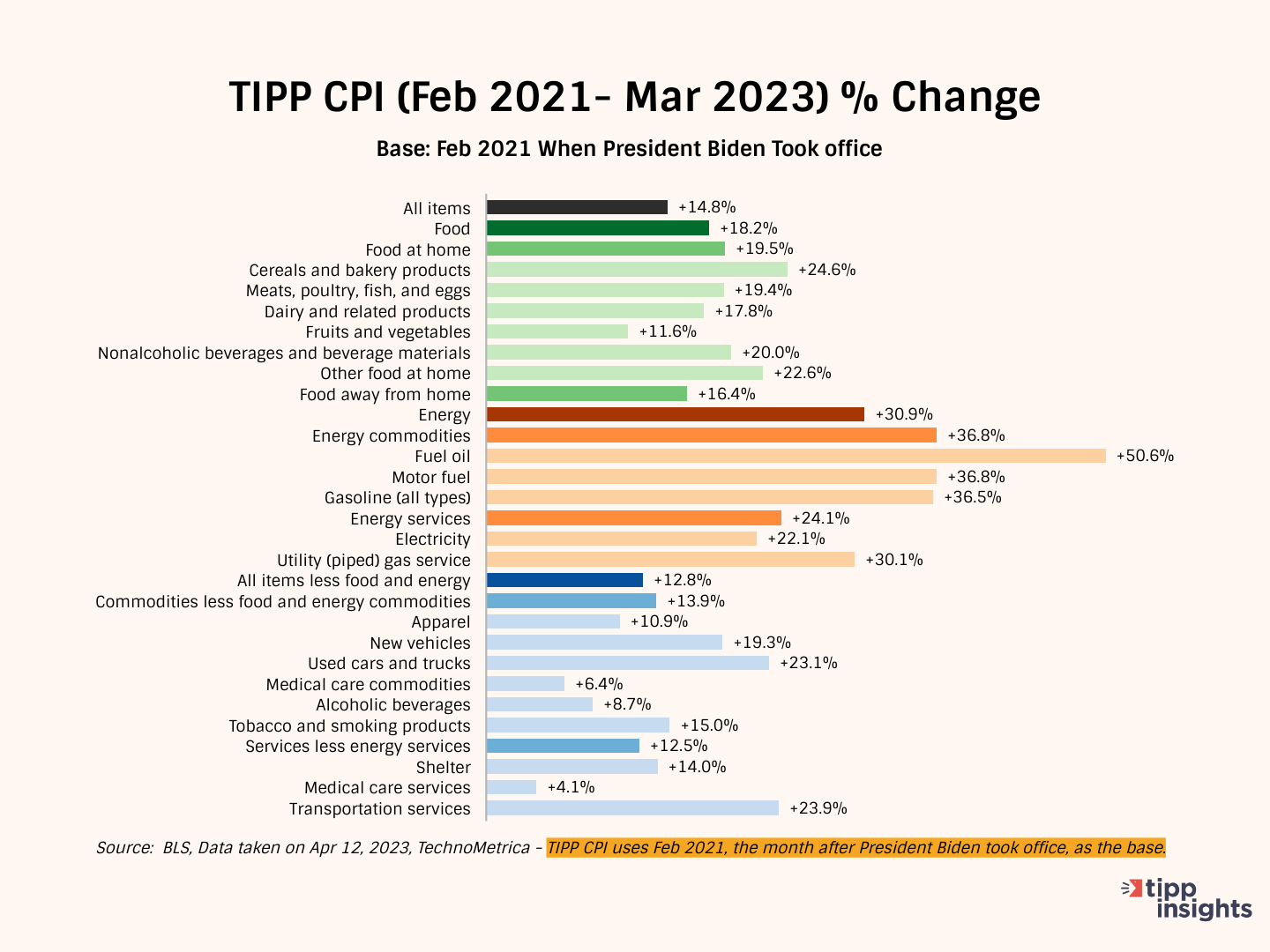
Bidenflation, measured by TIPP CPI using the same underlying data, stood at 14.8% in March. It was 14.4% in February, 13.7% in January, and 12.8% in December.

Significant inflation had already set in by the middle of 2021. In March 2022, CPI inflation was 8.5 percent. The official CPI year-over-year increases will compare prices to inflated bases in the coming months. The year-over-year calculation may moderate the statistics, but you will still feel the pinch of inflation.

TIPP CPI vs. BLS CPI

The following four charts present details about the new metric.

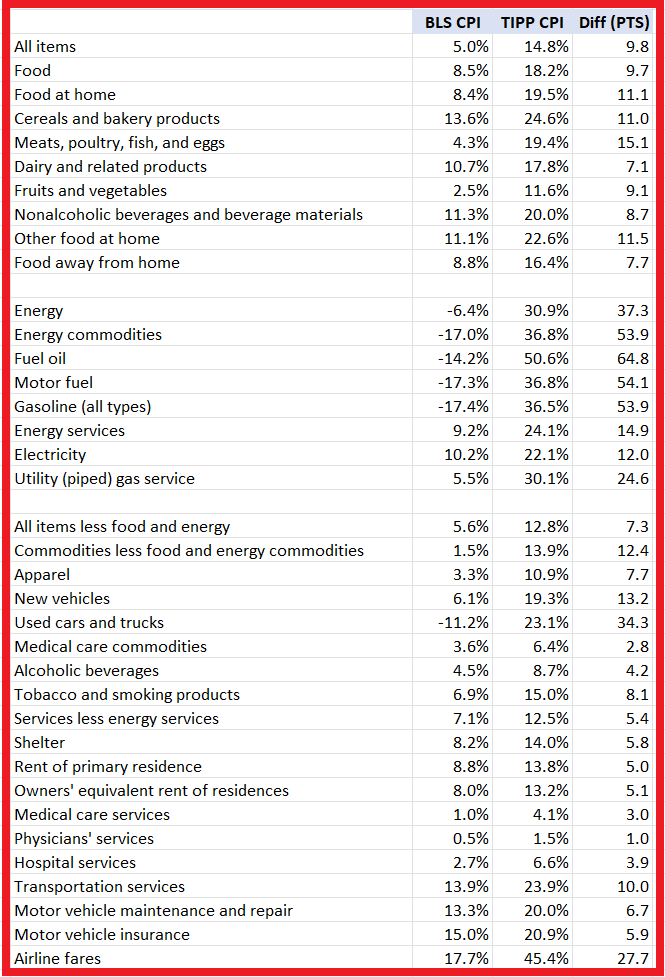
The annual CPI increase reported by BLS is 5.0% for March 2023. Compare this to the TIPP CPI of 14.8%, a 9.8-point difference. Prices have increased by 14.8% since President Biden took office. On an annualized basis, TIPP CPI is 6.83%.

Food prices increased by 18.2% under President Biden's watch compared to only 8.5% as per BLS CPI, a difference of 9.7 points. The variation is significant and, by design, ignored by Yellen because it would present a more accurate picture of an economy in trouble.

TIPP CPI data show that energy prices increased by 30.9%. But in Yellen's fantasy world, energy prices declined by 6.4%, according to the BLS CPI. The difference between the two is a whopping 37.3 points.

The Core CPI is the price increase for all items, excluding Food and Energy. The Core TIPP CPI was 12.8% compared to 5.6% BLS CPI in the year-over-year measure, a 7.3-point difference.

Further, gasoline prices have increased by 36.5% since President Biden took office, whereas the BLS CPI shows that gasoline price has improved by 17.4%, a difference of 53.9 points.

Used car prices have risen by 23.1% during President Biden's term. The BLS CPI shows that the prices have dropped by 11.2%, a difference of 23.1 points.

Inflation for air tickets under President Biden is 45.4% compared to the BLS CPI finding of 17.7%, a difference of 27.7 points.

Americans' Concerns

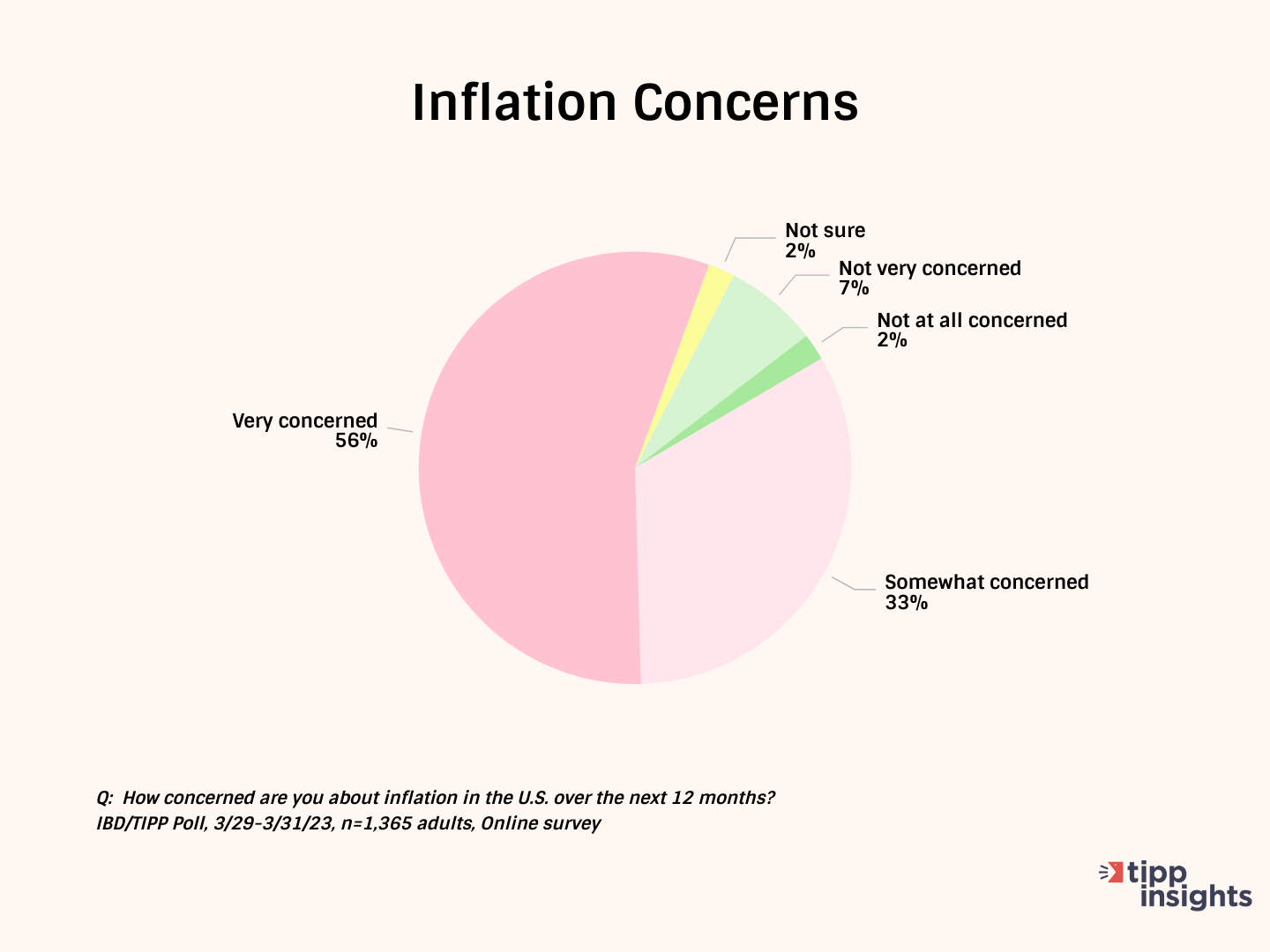
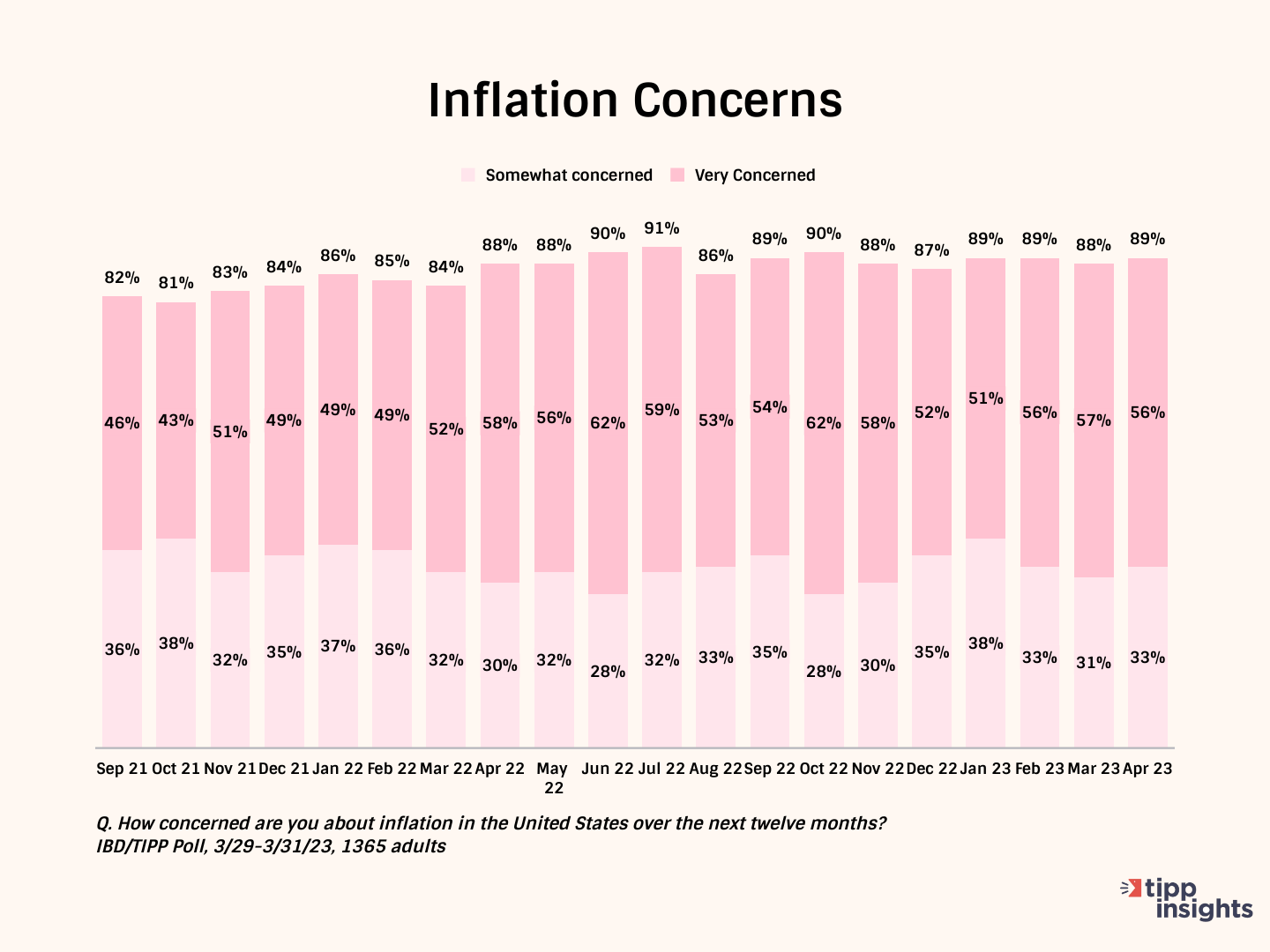
The latest Investor's Business Daily/TIPP Poll, completed earlier this month, shows that nine in ten (89%; 88% in March) survey respondents are concerned about inflation. Throughout the past year, inflation concerns have stayed above 80%. The share of "very concerned" has been over 50% for twelve consecutive months.

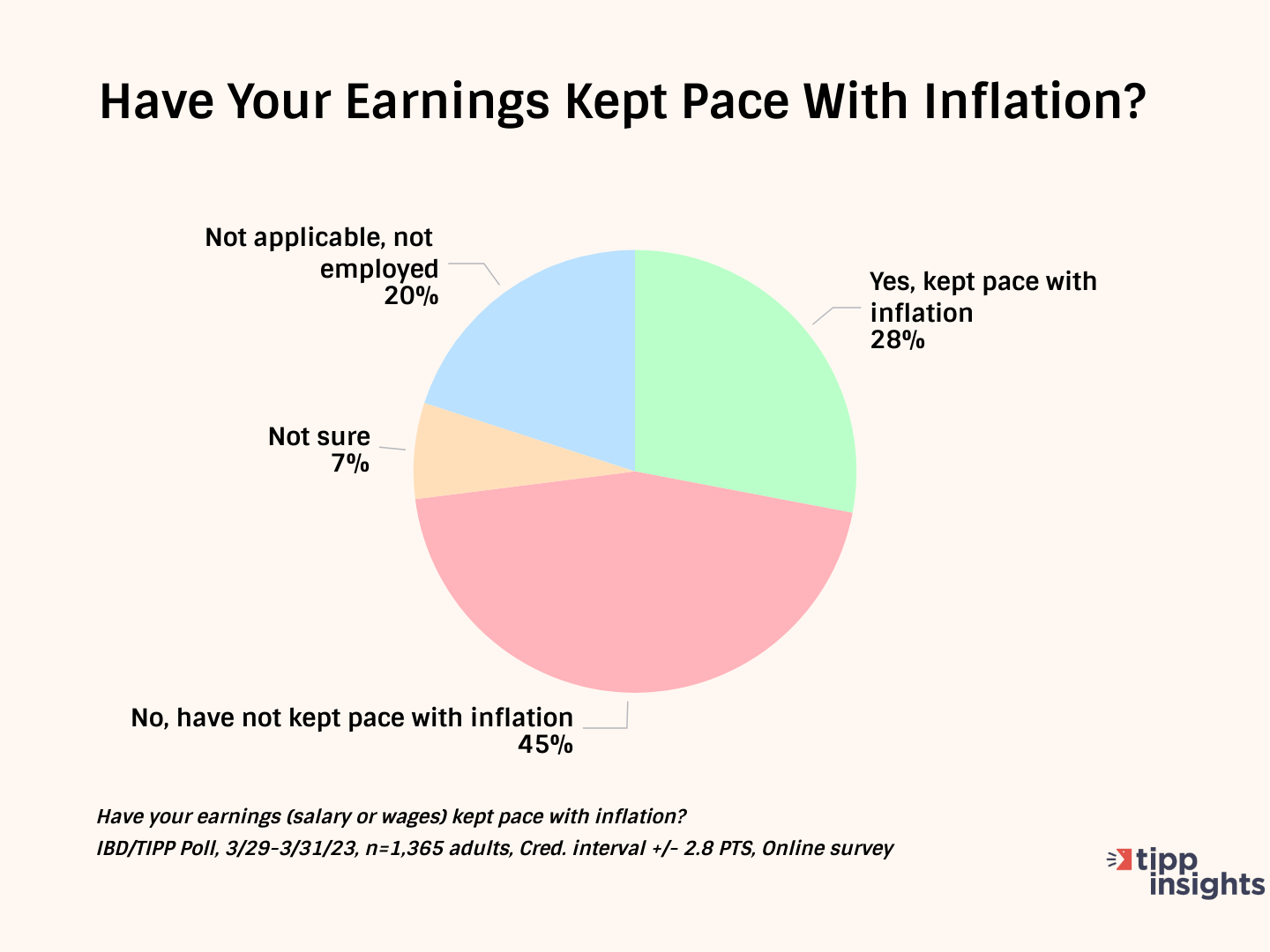
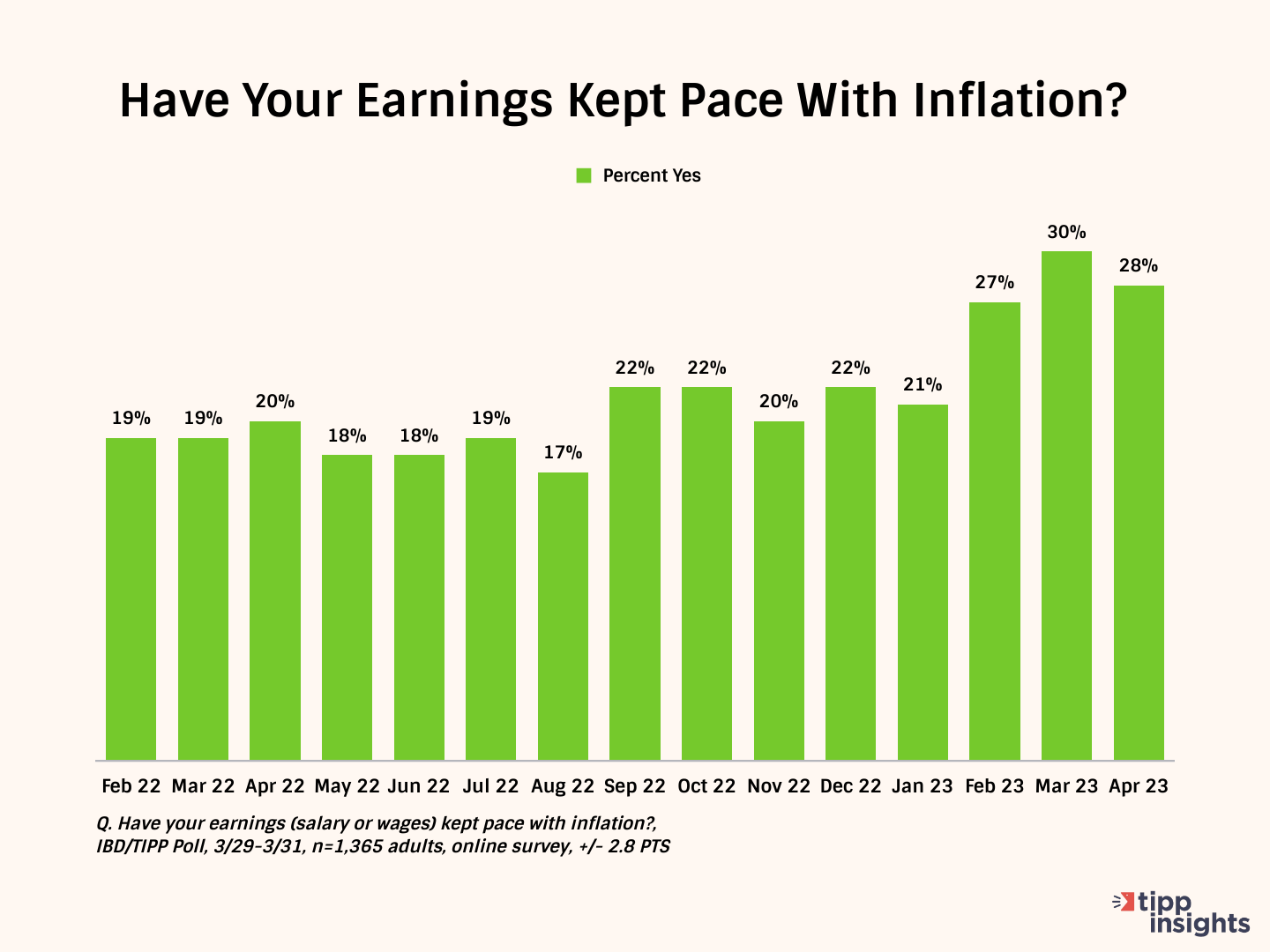
Over two in five ( 45%, 44% in March) say their wages have not kept pace with inflation. Only 28% (30% in March) say their income has kept pace with inflation. This statistic hovered in the low twenties for most of the last year. The positive change in the recent three months may denote the start of a new trend.

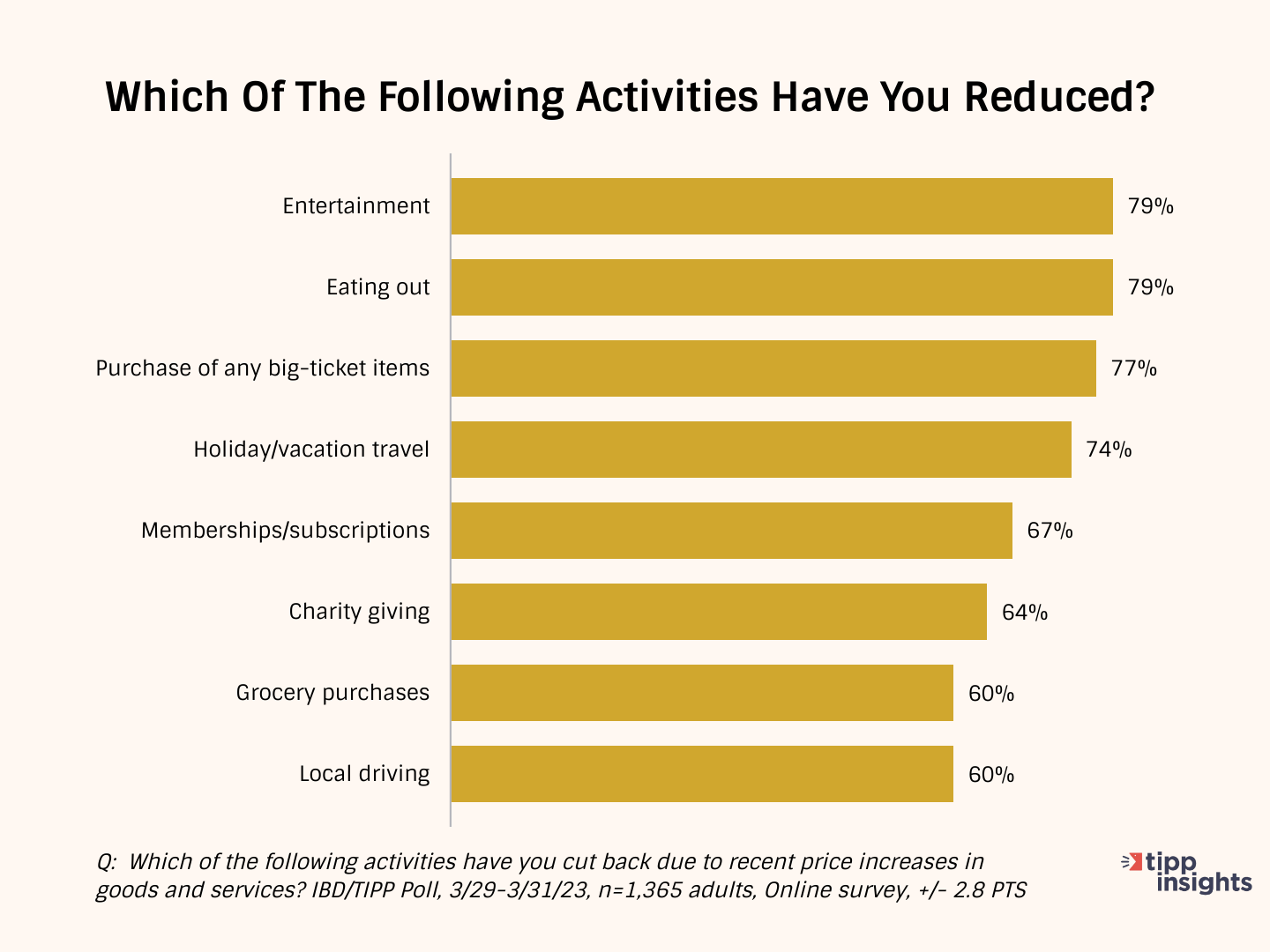
As a result of inflation, Americans are cutting back on household spending - cutting back on entertainment (79%), eating out (79%), purchasing big-ticket items (77%), holiday/vacation travel (74%), and memberships/subscriptions (67%). Many (64%) are cutting back on even good causes such as charity giving. Nearly three out of every five (60%) households spend less on groceries. The high gasoline prices forced 60% to cut back on local driving.

Inflation Direction

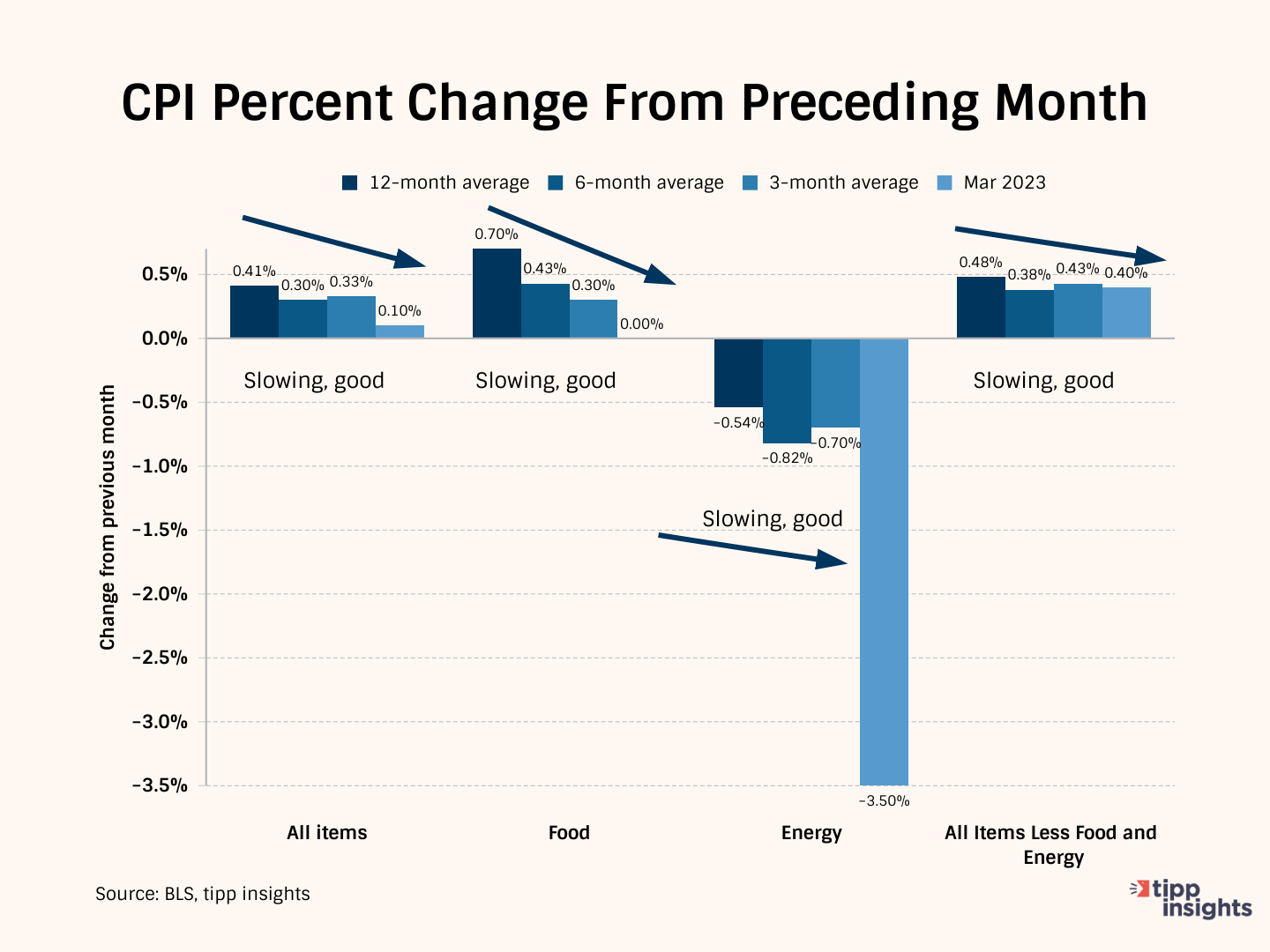
The chart below compares the 12-month average of monthly changes against the 6-month and the 3-month averages. We also show the reading for March 2023.

The 12-month average considers 12 data points and presents a long-term reference, while the six-month and three-month averages consider recent data points.

To better understand, compare the three-month average to March 2023 data. For "all items," the three-month average was 0.33% vs. 0.1% in March 2023. It is decreasing, and hence it is good.

The March reading for Food (0.00%) is lower than the 3-month average of 0.30%, lower than the 6-month average of 0.43%, and the 12-month average of 0.7%. The downward trend shows improvement.

Similarly, for Energy, the rate is decreasing. The decrease in March 2023 (-3.5%) exceeded the three-month moving average of -0.70%, indicating improvement.

For "all items less food and energy," the March reading of 0.40% is lesser than the three-month average of 0.43%, indicating improvement relative to the past three months. However, the 3-month average of 0.43% is greater than the 6-month average of 0.38% showing inflation pickup.

We interpret this as a mixed situation.

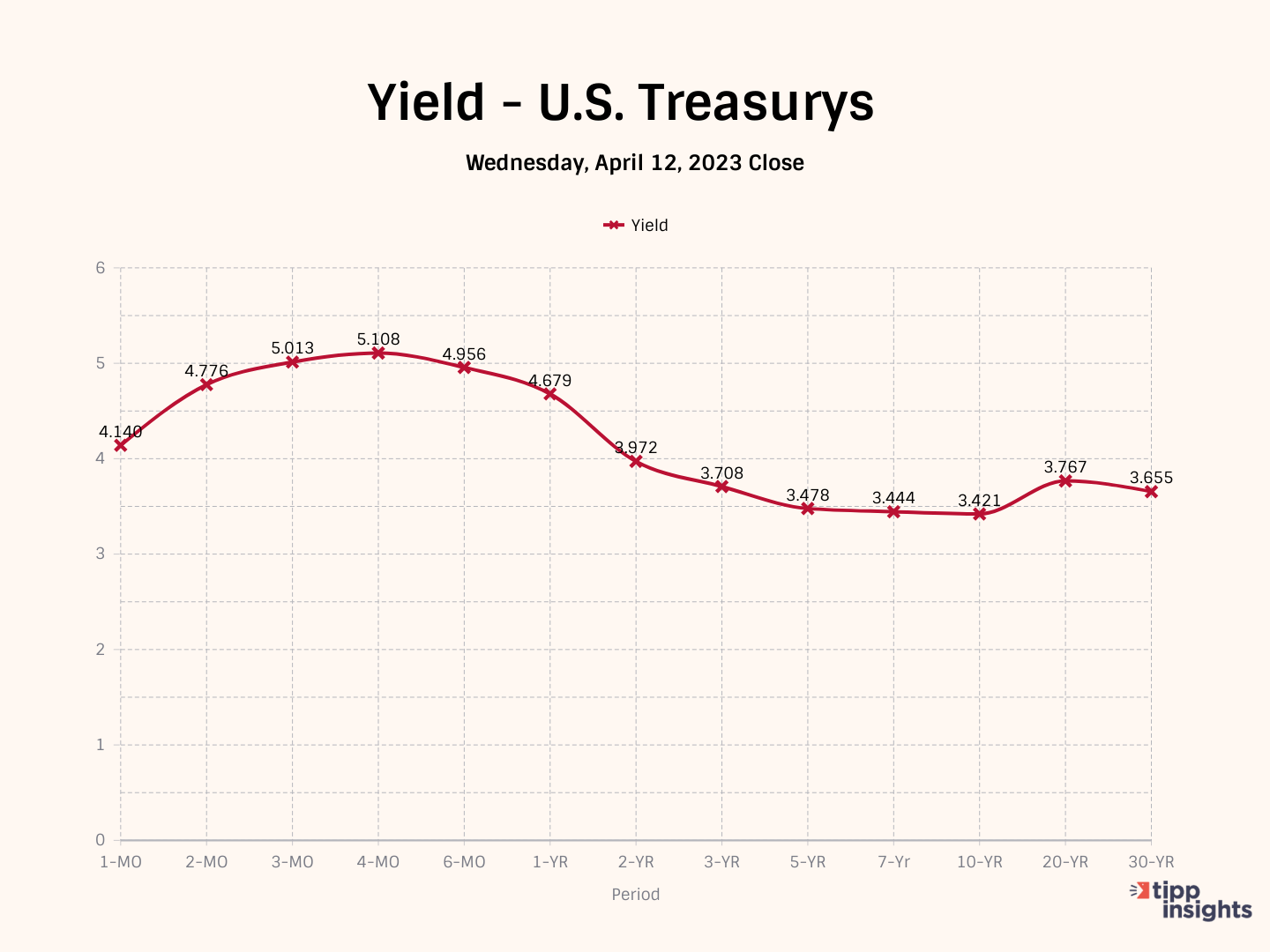
With an inverted yield curve, short-term U.S. treasuries pay higher interest rates than long-term U.S. treasuries. The closing yields on Wednesday were:

  • 5.013% for the 3-month Treasury bill
  • 4.956% for the 6-month Treasury bill
  • 3.972% for the 2-year Treasury
  • 3.421% for the 10-year
  • 3.655% for the 30-year

The inverted yield curve is a leading indicator of lower inflation but also a leading indicator of recession.

Most Americans (55% in April, 53% in March) believe the economy is in a recession, and another 56% (57% in March) think the economy is not improving.

To access the TIPP CPI readings each month, you can visit tippinsights.com. We'll publish the TIPP CPI and our analysis shortly after the release of the official Bureau of Labor Statistics (BLS) report.

The upcoming release of TIPP CPI is on May 11, 2023. We'll also post a spreadsheet in our store for download.


https://tippinsights.com/bidenflation-rises-to-14-8-hurting-americans/

The Surveillance State Is on the March

 As a working principle, the conviction that things are always worse than they seem is hard to beat.

Along with the observation from William Dean Howells that the problem for a critic isn’t making enemies but keeping them, that mournful conviction that things are worse than they seem has the twin clarifying advantage of being psychologically helpful and empirically true.

Both have stood me in good stead.

That is to say, if Johnny Mercer was right that one should “accentuate the positive,” one should also avoid the attitude of Dr. Pangloss who, Leibnizian that he was, taught that this is “the best of all possible worlds.”

As readers of “Candide” will recall, that rose-colored sentiment didn’t do much to protect Cunégonde.

I was reminded of this constellation of mottos while reading Jacob Siegel’s long and meticulously researched “Guide to Understanding the Hoax of the Century.”

Siegel’s brilliant if melancholy overview shows in exhaustive detail how the U.S. government, abetted by the mainstream media and what has come to be called “elite” or “ruling class” opinion generally, has repurposed surveillance tools developed to combat terrorism and turned them against the American people.

I know that sounds dramatic.

It’s actually an understatement.

We have been vouchsafed glimpses of life behind the curtain for a while now.

Siegel focuses mostly on developments in the United States.

But it’s worth noting that the story he unravels is an international concession, proceeding, for example, with initiatives such as the Davos-inspired “Great Reset.”

I have written about various aspects of the phenomena that Siegel aggregates in his sinewy and alarming essay.

For example, I wrote about Matt Taibbi’s exposé of “Hamilton 68,” a shadowy group of anti-Trump activists who succeeded in publicly branding anyone or anything they didn’t like as emanating from “Russian disinformation.”

“Instead of tracking how ‘Russia’ influenced American attitudes,” Taibbi notes, “Hamilton 68 simply collected a handful of mostly real, mostly American accounts, and described their organic conversations as Russian scheming.”

Simply in terms of volume, Taibbi estimates that Hamilton 68 “may go down as the single greatest case of media fabulism in American history.”

Virtually every major news organization in America was involved: NBC, CBS, ABC, PBS, CNN, MSNBC, The New York Times, and The Washington Post.

Even fact-checking sites such as Politifact and Snopes, Taibbi notes, “cited Hamilton 68 as a source.”

The people at Hamilton 68 simply targeted individuals they didn’t like, individuals such as Devin Nunes, Mike Flynn, Tulsi Gabbard, or Donald Trump—and then smeared them as witting or unwitting stooges of Vladimir Putin.

The whole scheme, Taibbi shows, was a splendid example of “digital McCarthyism, taking people with dissident or unconventional opinions and mass-accusing them of ‘Un-American activities.’”

But Siegel shows this was the but the tip of the censorship iceberg.

His essay shows that kindred developments stood behind the state narrative about COVID-19, the Hunter Biden laptop scandal, the Jan. 6 protest at the Capitol, “domestic terrorists,” as well as anything having to do with Donald Trump.

A critical moment was Jan. 6, 2017.

It was then, in the waning days of the Obama administration, that Jeh Johnson, Obama’s head of the Department of Homeland Security, placed the property of all 8,000 election jurisdictions under the control of the DHS.

“It was a coup,” Siegel notes, that Johnson had been aiming at since 2016.

At first, he was blocked by local authorities who explained that, as the Constitution stipulates, running elections was the sole responsibility of state legislatures.

Johnson justified his action by invoking the emergency of (totally spurious) “Russian interference.”

His success meant that in the final weeks of the Obama administration, “the new counter-disinformation apparatus scored one of its most significant victories: the power to directly oversee federal elections that would have profound consequences for the 2020 contest between Trump and Joe Biden.”

But Siegel shows that the rot began much earlier.

Remember the “Global War on Terror” mounted by the Bush administration following the terrorist attacks of 9/11?

It was then that the Patriot Act and kindred initiatives licensed the construction of a sprawling surveillance network, ostensibly focused on foreign bad guys but soon repurposed in a way that “suspended constitutional rights and placed millions of Americans under a shadow of mass surveillance.”

“The seamless transition from the war on terror to the war on disinformation,” Siegel writes, “was thus, in large measure, simply a matter of professional self-preservation. But it was not enough to sustain the previous system; to survive, it needed to continually raise the threat level.”

And raise the threat level “it”—the deep state—has consistently done such that anyone who challenges its diktats is regarded as an enemy.

How did this happen?

Americans didn’t choose to give up their liberties and Constitutional rights.

The choice was made for them.

As Siegel writes, “Americans are no longer presumed to have the right to choose their own leaders or to question decisions made in the name of national security. Anyone who says otherwise can be labeled a domestic extremist.”

Siegel’s essay is a tour de force whose richness and detail I can only hint at here.

If I had to summarize his findings, I would emphasize three points.

First, that “after the pretense of fighting a foreign threat fell away, what was left was the core mission to enforce a narrative monopoly over truth.”

We see that everywhere, whether the subject is Trump, Jan. 6, COVID, Russia, the joys of transexuality, or the brittleness of the Constitution in the face of the perpetual emergency foisted upon us by the permanent state.

The second point follows that brittleness: “The pattern in these cases is that the ruling class justifies taking liberties with the law to save the planet but ends up violating the Constitution to hide the truth and protect itself.”

And that brings me to the third and most fundamental principle that Siegel has uncovered in this harrowing piece of work: That the ruling class, the elite that officiates over the ceremonies, perquisites, and directives of the deep state, are bound by one overriding conviction.

“As a class,” Siegel concludes, “their highest principle is that they alone can wield power.”

No one who reads this essay can doubt that this is true.

As I say, things are always worse than they seem.

Roger Kimball is the editor and publisher of The New Criterion and publisher of Encounter Books. His most recent book is “The Critical Temper: Interventions from The New Criterion at 40.”

https://www.theepochtimes.com/the-surveillance-state-is-on-the-march_5190604.html