Search This Blog

Sunday, April 16, 2023

Biden administration will hang on to some Covid pandemic emergency powers

 Even though the Biden administration is ending its highest-profile Covid-19 emergency declaration next month, it’s still going to hold on to some pandemic-era powers.

The Department of Health and Human Services gave governors a heads-up on Friday that it is planning to keep pharmacists’ ability to administer Covid-19 and flu vaccines past the end of the public health emergency.

The legal definition of the Covid-19 emergency is a complex web of different laws that control different areas of the pandemic response. The White House and HHS are in the process of winding those powers down, but they all operate separately from another.

“While COVID-19 is not over, we are in a position to end the emergency phase of our response because of the Administration’s whole-of-government approach to combatting the virus,” HHS Secretary Xavier Becerra wrote in a letter to governors.

While the Covid-19 public health emergency will end on May 11, HHS is choosing to extend some powers related to a separate law called the Public Readiness and Emergency Preparedness Act, which offers extra protections to companies and providers making, distributing, and administering medicines and vaccines in times of emergency.

The rules that let pharmacists, pharmacy technicians, and pharmacy interns give Covid-19 vaccines and tests and seasonal flu vaccines will stay in place through December 2024, the letter says. The White House’s “Test to Treat” program that allows pharmacists to test people for Covid-19 and prescribe the antiviral Paxlovid will also continue.

Normally, pharmacists have the ability to administer some vaccines, but the details of which products they can give patients vary from state to state. HHS’ declaration ensures that the policy will be uniform, at least for the next two years.

However, HHS is also letting some emergency flexibilities expire, since vaccines and treatments will soon be available through the normal health care system instead of being bought by the government directly.

Providers that are retired and medical students will no longer be able to administer vaccines, and pharmacists will have to be licensed in the states that they are administering the shots. There was a time that these providers may have been needed to staff mass vaccination sites during the height of the Biden administration’s vaccination push, but that time has largely passed, an administration official said.

It’s unclear when the next wave of Covid-19 vaccinations will be recommended, as the Food and Drug Administration has not yet officially announced its plans for recommending another round of booster shots.

The HHS notice on Friday doesn’t have any bearing on emergency use authorizations for vaccines or treatments, the administration official said.

https://www.statnews.com/2023/04/14/biden-covid-emergency-power/

Demand for home health aides is soaring. So why are they still so undervalued?

 On most days around 2 p.m., home health aide Duane Crichlow can be found in an apartment in Sunset Park, Brooklyn, playing catch with his client — a man in his 30s with a developmental disability who is quick to give Crichlow hugs and kisses. If it’s nice outside, Crichlow will walk his client, who is nonverbal and in a wheelchair half the time, down three flights of stairs, hauling the wheelchair back and forth separately.

A 49-year-old Trinidadian who lives in Bed-Stuy, Brooklyn, Crichlow works for St. Nicholas Alliance Home Care, where he earns between $17-$18 per hour. His client likes it when Crichlow imitates Mojo Jojo, a character from the TV series “The Powerpuff Girls,” or tries out Cardi B’s signature catchphrase, “Okurr.” “I do different characters that make him laugh. As long as he’s happy, I’m happy,” Crichlow said.

But while Crichlow loves his client, he’s faced a number of hardships over more than two decades working as a home health aide. There are the untenable hours, long commutes, and constant stress: He frequently works 12-hour shifts, from 10 a.m. to 10 p.m., along with a one-hour commute each way involving two trains and sometimes a bus.

Then there are the humiliations, insults, and verbal attacks. On a past fill-in shift, while waiting on the street outside a packed bus, Crichlow’s client, who is white and in a wheelchair, told the bus driver that Crichlow, who is Black, wasn’t his home attendant after Crichlow suggested they wait for the next bus. “He was mean and bullying me,” said Crichlow. Over a decade ago, shortly after Crichlow’s parents passed away, a regular client of eight years told him, “F— your dead parents” on two separate occasions. That same client, on Crichlow’s last day of work, told him to “scram!”

The stress of the job often follows Crichlow home, where he struggles to sleep. In the past, Crichlow tried psychotherapy for multiple sessions. It helped, and he thought he didn’t need it anymore. But as time went on, he said, “I started to kind of mentally fall apart a little bit.” At the same time, talking about his experiences can be hard. “I don’t want to keep thinking about it, because it’s going to make me more miserable.”

At a time where 75% of adults want to age in place, home health aides are likely to play a key role in the future of U.S. health care. The number of home health aide jobs is expected to increase 25% between 2021 and 2031 — much faster than average, according to the U.S. Bureau of Labor Statistics.

But it’s a job that can take a toll on workers. Roughly 21% of home health care workers report poor mental health, according to a survey of close to 3,000 workers published in the American Journal of Public Health in 2021. Low household income, a history of depression, and trouble accessing health care because of costs all contribute to their health issues, according to the survey by lead author Madeline Sterling, an internist and assistant professor at Weill Cornell Medicine, and her team. The survey also found that home health care workers had worse general, physical, and mental health compared with low-wage workers in other industries.

A 2019 paper, meanwhile, found that most home health aides reported feeling isolated and alone on the job. And a 2019 study found that verbal abuse, which has been linked to negative health outcomes ranging from sleep problems to depression and heightened stress, is commonly experienced by home health aides.

Experts say that improving the mental health and working conditions of home health aides isn’t just important for the workers themselves — it will also go a long way toward ensuring that patients get the best possible care.

“Home care workers work long hours and pick up extra shifts because a lot of companies are short-staffed,” said Victoria Higgins, who worked as a home health aide for four years. “That can make some caregivers miserable that aren’t normally. If they’re tired, overworked, and underpaid, they may not do the best they can. It’s the clients that ultimately suffer.”

While working as a home health aide for two private companies, Higgins, 36, a single mother of five who stands 5-foot-2, often felt nervous before overnight shifts. She’d confronted plenty of potentially dangerous and high-pressure moments, from encountering unexpected strangers in her clients’ homes to getting tasked with moving a patient twice her size or facing a medical emergency for which she hadn’t been trained.

“I felt like crying every time,” Higgins said. “But of course, I did my best, because I want to make sure that I’m taking care of this person — not only because the family is paying top dollar, but because this is a human being who deserves nothing but the best.”

The work of professional caregiving, Higgins explained, involved prioritizing another person’s needs and, often, burying her own — all while working 10- to 12-hour shifts for $10 per hour.

Not once did the companies Higgins worked for acknowledge her safety concerns or the exhausting demands of the job. She once asked for a $2 raise to bring her wages to $12 an hour — a request her company balked at, opting for a raise of 25 cents per hour instead.

Peer support programs could help alleviate at least some of the pressures that home health aides face. In 2020, a team of Cornell researchers tested a six-week virtual peer coaching program for almost 20 home health workers to address their mental health needs. The researchers found the programs to be a boon for supporting home care workers, in large part because they enabled aides to meet one another and give voice to the despair and abuse they often experience. One participant told researchers how much they appreciated talking to someone “to have a second opinion, to give you support, to make you feel like what you’re doing is valid. Evidence from a 2023 paper also shows that peer support programs are particularly effective at reducing depressive symptoms among home health aides. 

Institutions ranging from labor union SEIU’s 119 Training and Employment Fund to the Oregon Institute of Occupational Health Sciences have also piloted and tested the efficacy of peer support programs to support the health of the home health aide workforce. And Sterling’s team will start recruitment in late 2023 or early 2024 for a clinical trial to test the use of peer support to improve depressive symptoms, stress, and loneliness among home health aides.

But the benefits of peer support programs only go so far. In order to support aides’ overall mental and emotional well-being, extensive policy changes must address everything from their pay, benefits, and job security to their need for greater support from employers and unions, according to Emma Tsui, an associate professor at the CUNY School of Public Health and lead author of a study testing the benefits of emotional support calls to home health aides during the Covid-19 pandemic.

For too long, Tsui said, aides have been literally and figuratively devalued. “One of the real pain points of this job is having a felt experiential day-to-day sense of why this work is so important,” she said. “And then feeling societally that it is invisible and not recognized.”

Improving the working conditions of home health aides is paramount in a system that’s decided that “allowing for care to be done in the comfort of someone’s home is the more effective, better way to go,” said Ariel Avgar, a professor at the School of Industrial and Labor Relations at Cornell University who frequently collaborates with Sterling. “That’s a great approach. The only thing is it relies on an entire workforce [that’s] ignored and invisible.”

“Many of my studies have demonstrated where workers are treated better, where workers have better working conditions, where the practices that guide their work are more progressive, the outcomes for patients are better,” said Avgar. “Investments in workers and investments in working conditions are tools to drive better care.”

Without these changes, it’s inevitable that home health aides will keep burning out and leaving their jobs. The median caregiver turnover rate was 64% in 2021, according to data shared by home care training agency Home Care Pulse, compared to a median 22% turnover rate among registered nurses as of last year, according to a survey by the recruitment company NSI Nursing Solutions.

Higgins eventually returned to working as a teacher’s aide where she earns more money, though she still works as a home health aide one afternoon per week for a 90-year-old man she considers a friend in Riegelsville, Pa., who has heart issues and peripheral neuropathy in his legs, offering him companionship, shuttling to appointments, and taking care of light housework. Higgins said she continues to take pride in “helping people in their most vulnerable times.”

Crichlow, meanwhile, cares for an elderly client once a week in Harlem, and continues to travel to Sunset Park four days a week. From breakfast to bedtime, he tends to the client who he says is like a brother to him: Showering him in the shower chair, putting him on the toilet, pureeing breakfast, lunch, and dinner. Still, Crichlow says, family members of his client sometimes tell him, “You’re not doing a good job. Hurry up. Hurry up.”

“That can be very stressful,” Crichlow said. “I’m trying to do the best I can.”

This reporting was supported by the International Women’s Media Foundation’s Howard G. Buffett Fund for Women Journalists.

https://www.statnews.com/2023/04/14/home-health-aides-mental-health/

Blinken says cooperation with allies ‘not affected’ by document leak

 Secretary of State Antony Blinken said cooperation between the United States and its allies was not affected by the classified documents leak that detailed information about the war in Ukraine and U.S. intelligence operations. 

Blinken said during a press availability from Hanoi, Vietnam, on Saturday that the U.S. has engaged its allies and partners in the aftermath of the leaks to make clear its commitment to “safeguarding intelligence” and “our security partnerships.” 

“What I’ve heard so far at least is an appreciation for the steps that we’re taking, and it’s not affected our cooperation,” he said. “I just haven’t seen that. I haven’t heard that.”

Many pieces of information became public after about 100 classified documents were leaked on online platforms in recent months. The documents included information analyzing both sides of the war between Ukraine and Russia and that the U.S. was conducting spying on several countries, including some allies. 

A test of the relationship between the U.S. and its allies might come as Blinken travels to Japan on Sunday for three days of talks among foreign ministers from the Group of Seven, a group of the world’s most advanced economies and democracies. 

Blinken noted that the suspect was in custody for the leak and added that measures were being taken to ensure U.S. information is safe from further leaks. 

“But to date, based on the conversations I’ve had, I have not – not heard anything that would affect our cooperation with allies and partners,” he reiterated.

The documents also included assessments of internal arguing in countries like Israel, South Korea and the United Kingdom and Taiwan’s defense capabilities against a Chinese attack. 

The suspect, 21-year-old Jack Teixeira, has been charged with violating the Espionage Act and another law that prohibits the unauthorized removal of classified documents. Prosecutors believe he shared the documents in a group on Discord, a messaging app. 

Teixeira is a member of the Massachusetts Air National Guard and could face a long prison sentence if convicted.

https://thehill.com/homenews/administration/3952700-blinken-says-cooperation-with-allies-not-affected-by-document-leak/

Press conferences now extinct as Biden lets TikTokers do the talking

 It has been more than 150 days since President Biden held a formal press conference at the White House. For context, the average person could walk across the continental U.S. in less time. 

Let that sink in: The U.S. president has refused to speak with any reporter who isn’t pre-approved from a very short list in the past five months. And his advisers certainly seem to want no part of a press conference format, which can be wide-ranging and (if journalists do their job right) uncomfortable. 

For context, George H.W. Bush held 90 solo press conferences in his term as president.

Bill Clinton had 59 over two terms; George W. Bush, 49 over his eight years; Barack Obama, 64 from 2009-2016; and Donald Trump held 44 from 2017-2021. 

But Joe Biden? He’s held just 11 during his 26 months in office, putting him on pace to hold 20-22 press conferences, or about half the number Trump provided, and about one-third the number of Obama. 

The American press is mostly forgiving of the 46th president, especially when compared to the hostile posture it took with Trump. But the lack of access has finally prompted some pushback, as evidenced by a testy exchange between Gray Television’s Jon Decker and White House press secretary Karine Jean-Pierre. 

“Is the administration trying to protect the president from our questions? Please answer that question,” Decker asked earlier this week. 

“Absolutely not. Absolutely not,” Jean-Pierre replied.

“Then why the lack of any interaction in a formal setting to have a press conference?” Decker followed. 

After some back and forth, Jean-Pierre said that Biden has taken their questions “many times” and even suggested that he’s taken more “shouted questions” than any other president in history. White House correspondents groaned at the absurdity of that statement.

In a related story, Biden did not have a press conference during his trip to Ireland, nor is he expected to hold one back home anytime soon. 

It doesn’t help that the media don’t seem all that interested in Biden, preferring to focus on Biden’s click-generating and ratings-boosting predecessor.

Avoiding the press worked out just fine for Biden in 2020. Back then, he had a ready excuse for avoiding the press when COVID-19 was at its peak. But this time, Biden will have to make his case for reelection (if he runs) both on the campaign trail and in the East Room, where formal press conferences are held and invariably lead the news cycle.

The president’s advisers have another communications strategy they are set to unveil: Using TikTok influencers to coax Millennials to the polls. Yes, that’s the same Chinese-owned TikTok that many lawmakers, including many Democrats, see as a major national security risk.

The American public are largely on board with banning the app, with 50 percent supporting a ban, according to Pew, and just 22 percent opposing it.

But a deeper dive into the numbers tells a more nuanced story: While just 15 percent of those between the ages of 50-64 oppose banning TikTok, that number jumps to 46 percent opposition for those between the ages of 18 and 29, with just 29 percent supporting a ban. 

This may be the reason the White House is reluctant to join many members of Congress in calling for a ban. In fact, just last month, Biden joined boy-band One Direction’s lead singer Niall Horan on a TikTok video just after he publicly expressed national security concerns about the app. It was classic Biden, where his actions contradicted his words. 

From a political perspective, TikTok apparently is seen as essential in getting more young people to vote. One journalist labeled the app “a necessary evil” for Democratic campaigns in general. 

A Tufts University study found that turnout in the 2022 midterms was the second highest on record, with 31 percent of voters between 18 and 29 turning out in key battleground states. (Only 2018 saw higher numbers.) Historically, per the study, turnout among this age group has been around 20 percent, so we’re talking more than a 50 percent increase.

For now, two things are certain: 

1) Joe Biden won’t be the leading voice of his own presidential campaign. Press conferences will be a rare occurrence, held only when

the news cycle is very favorable. 

2) TikTok isn’t going anywhere, as a Democratic presidential campaign can benefit from it.

TikTok may be a national security nightmare for the U.S., but it’s a dream for Team Biden, who see it as a key to securing a second term.

Joe Concha is a media and politics columnist.

https://thehill.com/opinion/campaign/3952271-press-conferences-now-extinct-as-biden-lets-tiktokers-do-the-talking/

Scientists in Italy develop edible battery made of almonds for use in ingestible medical devices

 And on the menu at the Italian Institute of Technology (IIT), an entirely edible battery.

Researchers in Milan have developed the rechargeable prototype out of common-place food stuffs with the hopes of revolutionising ingestible medical devices.

"The core of the device is represented by a couple of electrodes... To have it working we are using two materials, two molecules. For the anode, we are using riboflavin which is a vitamin we can find in almonds... and for the Cathode we are using quercetin. It’s sold as a food supplement and can be found in capers,” explained Mario Caironi, the coordinator of the project.

Potential applications

Ingestible devices like biosensors, cameras, and drug delivery systems already exist but typically cannot be digested by the human body. Therefore, if complications arise during the digestion process, surgical intervention can be required to remove the device.

The advantage of this gadget made from almonds, capers, activated charcoal, seaweed, gold leaf and beeswax, is that it can be digested completely without any health risks.

Other potential applications aside from health devices could include food quality monitoring and edible soft robotics.

The battery prototype operates at 0.65 volts, which is too low to cause problems inside the human body. It provides a current of 48 microamps for up to 12 minutes and can power a small LED or other miniature electronic devices.

The team is now working to boost capacity as well as shrink the device into a pill-sized container that would be easier to swallow.

The proof-of-concept battery cell was described recently in a paper published in the journal Advanced Materials.

https://uk.sports.yahoo.com/news/scientists-italy-develop-edible-battery-121706827.html

How to Assess the Personality of the Stock Market

 Unsuccessful traders look for markets to trade in a style that fits *their* personality.  They look for momentum or trend or reversals of "overbought" or "oversold" moves.  By imposing their biases on markets, they become inflexible and unable to adapt when the market's personality changes.  


Lately, we've seen the stock market's personality shift literally from day to day, as range-bound action has alternated with strong directional moves.  Traders who expect the market to follow themes related to macro and fundamental developments (shifts in inflation, interest rates, economic data, earnings, etc.) have found this rapid shifting of market action to be challenging.  Many traders look for consistency from day to day--thematic continuity--when the market is behaving more like a market of stocks than a unified stock market.  Consider:  over 70% of consumer discretionary stocks (XLY) and energy shares (XLE) closed over their respective five-day moving averages on Friday, but that was true for only a bit over 30% of consumer staples stocks (XLP) and only 20% of real-estate shares (XLRE).

The opposite of a trending stock market is not a choppy market.  The opposite of a trending market is a rotational market.  Many times, the market will indeed follow themes, but the themes play themselves out in relative terms.  Perhaps growth stocks are outperforming defensive sectors; perhaps small caps are outperforming large cap stocks.  The patterns of what is strong and what is weak define the themes for a given market session.  

Part of the challenge of short-term trading is that we cannot blindly assume that yesterday's patterns of strength and weakness will play themselves out today.  Rather, we have to first sit back and observe the various components of the market and how they're behaving to identify today's market personality.  This is key to trading psychology:  an active trader (as opposed to an investor) does not attempt to predict market action based on top-down criteria.  The active trader waits to see the bottom-up activity that reveals the patterns of trading here and now.

Several tools are helpful in assessing the market's personality from day to day:

1)  Volume (and especially relative volume) - How does the volume at a give time of day today compare to yesterday's volume at that time of day and the usual volume at that time of day?  If volume expands meaningfully, we want to see how stocks are behaving with the new market participation.  This will tell us who is participating and whether that participation is showing up in trending behavior or in the relative strength of one market segment vs. another.  Conversely, when volume dries up, we want to see how different parts of the market are impacted by the lack of participation.  What moves directionally in a quiet market tells us an important story.

2)  NYSE TICK - How many stocks are trading on upticks vs. downticks as we move forward in the session and--most crucially--how is the upticking or downticking impacting the price of various segments of the market?  We recently had a range-bound day in the morning that displayed strong selling pressure with negative TICK numbers.  Many parts of the market failed to make new lows on this selling.  The absorption of the selling pressure alerted the savvy trader that sellers would be trapped and, sure enough, their covering helped create a trending move during the day.  Very often, new extremes in the TICK numbers alert us to strong buying or selling interest--and how that interest moves the market (and different parts of the market) tells an important story.

3)  Short-term overbought/oversold readings - I use the adaptive moving average system from John Ehlers, which shows how shorter-term moving averages cross below and above longer-term ones.  The adaptive part is that the readings for short-term and longer-term change depending upon the cyclical character of the market.  As Ehlers has pointed out, this helps remove whipsaws from the indicator.  Basically I want to see short-term oversold levels occurring at successively higher price lows or short-term overbought levels occurring at successively lower price highs.  When sector ETFs show different patterns of overbought and oversold, that highlights a rotational market.  In a strongly trending market, the cyclical quality of the price action will break down and we will get prolonged overbought or oversold readings across multiple market sectors.

An important edge comes from being quicker than other participants to see how the market's character is playing itself out--and how it might be changing over time.  Many traders underperform because they fail to see relative themes playing out in real time.  If your trading is habitually bullish or bearish, you know that you're not doing a good job of assessing and following the personality of the market.


http://traderfeed.blogspot.com/2023/04/how-to-assess-personality-of-stock.html

US savers get savvy ditching and switching banks

 A wave of transfers is hitting US banks, as a sharp rise in interest rates after years of low borrowing costs creates more opportunity for savers - and new challenges for banks.

Until recently, software engineer Claire Long stashed all her money in a checking account she had opened years ago as a university student. She let thousands of dollars build up there despite its paltry interest rate.

The prospect of earning 4% or more shook her out of her complacency. This month, she transferred $20,000 (£18,000) to a different bank offering a higher interest rate.

"I never paid attention. I just left my money in the account," says the 26-year-old, who lives in Massachusetts and credits a personal finance podcast with alerting her to better options.


"I don't want my money to just sit in one place. I want to make the most out of it."

Banks have paid notoriously low rates on savings for years - something that has yet to change at many of the biggest firms, despite the US central bank hiking its benchmark rate from near zero to more than 4.75% in just a year.

But there are signs that the sharp climb may be starting to shake up the status quo - unsettling a financial system accustomed to relying on low-cost deposits as a key source of funding and profits.


"It's a competitive market," Jeremy Barnum, chief financial officer of JPMorgan Chase told investors on Friday, as the firm reported that average deposits had fallen 8% from a year ago.

Roughly 30% of US bank customers moved money from their primary account to another bank in March, up from 27% in the previous year, according to a survey by consumer intelligence firm JD Power.

A third said they were making the switch for higher rates, up from a quarter a year earlier.

That's a "slow climb", says Paul McAdam, JD Power's senior director of banking. "But extrapolate this across millions of consumers and it makes a difference."

Questions about how banks will handle the change sharpened last month after the US was hit by the two biggest bank failures since the 2008 financial crisis.


In the weeks following the collapse of Silicon Valley Bank and Signature Bank, billions of dollars in deposits shifted hands, jolting a system accustomed to savings serving as a stable source of funding.

While that rush appears to have subsided, many banks say they expect consumers to continue to hunt for the best deals, as online banking makes shifting funds easier than ever and rapid price inflation makes people unusually sensitive to erosion in the power of their savings.

"Consumers are more aware of how their returns stack up against the loss of buying power," says Greg McBride, chief financial analyst at Bankrate.com, which has tracked interest rates offered to consumers for decades. "They have taken notice of the higher returns available at some banks and not others and have moved their savings accordingly."

Many people, like Claire, are switching allegiances to open new high-yield or money market savings accounts, which can pay interest rates of 3.5% or more, compared to the 0.24% average interest rate on a traditional savings account, according to data collected by Bankrate.

Others are shifting their money out of banks entirely, opting for other kinds of investments, such as US government bonds or money market mutual funds, which buy relatively low-risk short-term government and corporate debt and can offer rates north of 4.5%, but offered little advantage over a savings account when interest rates were low.


The moves led deposits held by banks in the US to fall last year for the first time in decades, dropping more than $200bn at the end of December from a year earlier, according to data from the Federal Reserve. Fitch expects deposits to decline by another $1.6 trillion this year.

"Banks and policymakers were ready for the deposit outflows that were happening through February. What is definitely the case now is we have increased uncertainty as to whether outflows will turn out to be bigger than historical norms," says Alexi Savov, professor of finance at New York University's Stern School of Business.

The decline in deposits so far is still consistent with what typically happens when interest rates rise.

Overall, the banking system remains flush with cash, reflecting the unprecedented surge in deposits during the pandemic, as savings rates increased and government assistance programmes fattened people's accounts.

But worries abound about what lies ahead for the economy as the funds available for lending shrink.

Analysts say some banks, especially the biggest, can afford to lose some of their outsize deposits, without a major hit to profit or activity.

But Prof Savov says the outflows will put pressure on others, especially smaller regional firms, squeezing profits and leading them to pull back their lending - with potentially serious ramifications for local economies and some business sectors, such as commercial property, where regional banks play a big role.

The recent bank failures caused a sharp acceleration in outflows from those smaller players, he notes.

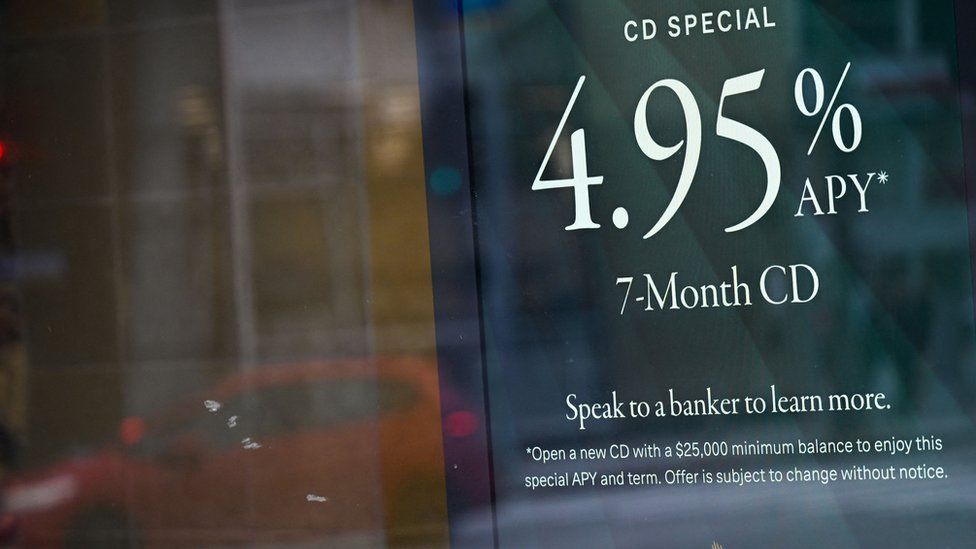
Signage for Certificate of Deposit interest rates is displayed outside of a First Republic Bank branch in Santa Monica, California on March 20, 2023.IMAGE SOURCE,GETTY IMAGES
Image caption,
Some banks are paying more to keep hold of depositors

"It creates a much bigger risk of a bumpy landing, potentially a recession," Prof Savov says. "It's just such a live ball."

The growth of money market funds, which saw their holdings surge in the weeks after the banking crisis, has sharpened the removal of money from the economy, since the funds do not play a direct role in lending, while having the option of parking their holdings with the US central bank, says Steven Kelly, senior research associate at the Yale School of Management's programme on financial stability

Their growth also risks making the financial system more unstable, since the firms in charge of such investments are quick to flee at signs of trouble, unlike everyday depositors, who can count on the government to guarantee accounts up to $250,000, he adds.

"An insured depositor maybe won't run at the first sign of bad news," he says, but a money market fund is likely to "just disappear overnight".

If the economy encounters serious problems, the US central bank is expected to cut rates - a scenario many investors see as happening sooner following the bank panic.

That means the reshuffling of deposits, as people like Claire seek more for their savings, could prove short-lived too.


https://www.bbc.com/news/business-65180130