Search This Blog

Monday, July 3, 2023

ESG Investing Isn't Doing Much For The Environment; Yale Study Confirms

 When companies with poor environmental credentials are starved of capital thanks to investors obsessed with ESG, they become dirtier to avoid bankruptcywrites City AM's Matthew Lesh

  • There are examples of large oil producers offloading older assets to improve their green credentials, only for their mines and oil rigs to become dirtier in the hands of new owners

  • When brown, or not so green companies are starved of capital, they become dirtier to avoid bankruptcy.

  • Ultimately it will take big investments, including by ‘dirty’ industry, energy producers and newer green start-ups to solve our environmental challenges.

ESG or environmental, social and governance investing is facing troubles. Higher bond yields drove an astonishing £304m out of the sector in May. This largely reflects a natural market dynamic – investors are chasing higher returns by moving from shares to bonds. Yet perhaps there should be some deeper angst at play. Is ESG investing really everything it is cracked up to be?

It’s easy to understand the underlying appeal. Putting your savings into “good” companies, rather than those amoral profit-seeking entities, feels righteous. But it’s worth unpacking what that means in practice.

The companies that score the highest on ESG metrics, particularly on the environmental side, are the ones that have a relatively low level of carbon per pound of revenue. That means the likes of financial services, healthcare and digital are “green”. By contrast, companies that produce building materials, fertiliser or energy are “brown”. The result of ESG investing is the transfer of capital from good to bad companies – thus it is meant to incentivise “brown” companies to reduce their emissions.

But, in an ironic twist, a new study indicates that ESG investing is counterproductive in practice. Kelly Shue of Yale University and Samuel M. Hartzmark of Boston College investigated the environmental impact of over 3,000 large companies between 2002 and 2020. They find that green companies’ lower cost of capital does not lead to reduced emissions. This makes sense since the likes of Spotify or a hospital are not particularly heavy emitters and have little capacity to reduce emissions; brown companies produce 260 times higher environmental impact. By contrast, when brown companies are starved of capital, they become dirtier to avoid bankruptcy.

“When you punish brown firms, they become more short-termist,” Shue writes.

This all means much less capital available for green technologies.

The green investing agenda may also have other unintended consequences. For example, there are examples of large oil producers offloading older assets to improve their green credentials, only for their mines and oil rigs to become dirtier in the hands of new owners, who operate them for longer. It’s the same principle for the UK, where efforts to prevent new domestic oil and gas production have only resulted in importing expensive hydrocarbons (often from less-than-democratic places like the Middle East or Russia).

We must be realistic that humanity’s impact on the environment cannot turn to zero overnight. Humanity still needs the goods produced by environmentally unfriendly companies and, even under the most optimistic net zero scenarios, this will be the case for some time. The likes of fertiliser are necessary to feed billions of people. 

Building materials are needed to solve our dire housing crisis. Even the “green” companies still need electricity and transport. Meanwhile, according to the World Health Organization, 3.2 million people die yearly from household air pollution caused by burning fuels like kerosene for heating and cooking. That’s because they don’t have electricity. For these people, even dirty coal-fired power stations would be a better alternative.

Ultimately it will take big investments, including by ‘dirty’ industry, energy producers and newer green start-ups to solve our environmental challenges. There is a central role of government in ensuring that pollution costs are properly accounted for in production, particularly to incentivise innovation, through the likes of carbon taxes. But sometimes even the most apparently virtuous behaviour, like investing in ESG funds, may not quite get us to the desired results.

https://www.zerohedge.com/markets/esg-investing-isnt-doing-much-environment-yale-study-confirms

Former Anheuser-Busch Executive Asks Current CEO To Step Down: "He's Been Paralyzed"

 by Frank Fang via The Epoch Times (emphasis ours),

A former Anheuser-Busch executive is calling on Brendan Whitworth, the beer company’s U.S. chief executive officer, to step down from his position over his handling of Bud Light’s partnership with transgender influencer Dylan Mulvaney.

Anson Frericks, who once was president of sales and distribution for Anheuser-Busch, wrote in a column published by The Daily Mail on July 1 that Whitworth “has clearly shown himself to be incapable of solving the Mulvaney crisis.”

He’s had multiple chances and he’s failed,” Frericks wrote. “It’s time he did the right thing and stepped aside to make way for someone capable of righting the sinking Bud Light ship.”

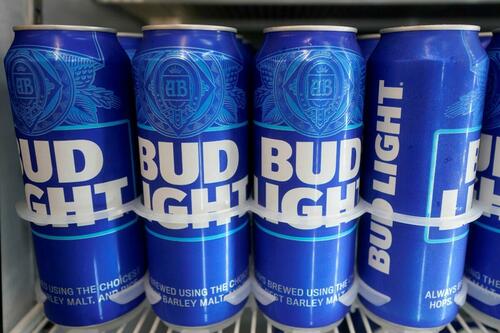
Cans of Bud Light chill in a refrigerator in Oakland, Calif., on April 28, 2023. (Jeff Chiu/AP Photo)

The controversy surrounding Bud Light started in April after the company rolled out a personalized beer can featuring the face of Mulvaney. The marketing fiasco has cost Bud Light billions in sales and the beer company lost its top position in the U.S. beer market in May, dethroned by Modelo Especial.

“After all, the beer company’s decision to make trans-activist Dylan Mulvaney the face of Bud Light has cost a staggering $20 billion–and counting–in lost market cap value,” Frericks wrote.

Mulvaney

Frericks criticized Anheuser-Busch for giving a “weak and indecisive” response recently, following Mulvaney’s outcry slamming Bud Light for failing to provide support amid the backlash. Frericks added, “Mulvaney did something Whitworth should have had the wisdom to do weeks ago–cut ties.”

Mulvaney, in an Instagram video published on June 29, said, “For a company to hire a trans-person and then not publicly stand by them is worse, in my opinion, than not hiring a trans-person at all because it gives customers permission to be as transphobic and hateful as they want.”

In response to Mulvaney’s remarks, Anheuser-Busch said, “We remain committed to the programs and partnerships we have forged over decades with organizations across a number of communities, including those in the LGBTQ+ community,” without mentioning Mulvaney by name.

“As we move forward, we will focus on what we do best—brewing great beer for everyone and earning our place in moments that matter to our consumers,” Anheuser-Busch added.

“What does that mean?” Frericks asked about Anheuser-Busch’s response. “Absolutely nothing. And it will only deepen the chasm between the brand and its customers.

“As such—and I take no pleasure in passing this judgement—it’s clear to me that it’s time for the shareholders and board of Anheuser-Busch to ask Whitworth to step down.”

https://www.zerohedge.com/political/former-anheuser-busch-executive-asks-current-ceo-step-down-hes-been-paralyzed

Krystal starts Phase 1 for cystic fibrosis

  Krystal Biotech, Inc. (the “Company”) (NASDAQ: KRYS), a biotechnology company focused on developing and commercializing genetic medicines for patients with debilitating diseases, announced today that the first patient has been dosed at the Cystic Fibrosis Institute of Chicago in the Company’s Phase 1 CORAL-1/US study evaluating KB407, an engineered HSV-1-based, aerosol-delivered, mutation agnostic, genetic medicine for the treatment of patients with cystic fibrosis (CF).

https://www.marketscreener.com/quote/stock/KRYSTAL-BIOTECH-INC-37797982/news/Krystal-Biotech-Announces-First-Patient-Dosed-in-Phase-1-Clinical-Trial-of-KB407-for-the-Treatment-o-44252085/

Alnylam Eyes AdComm Sept. 13 for Cardiomyopathy Med

 Alnylam Pharmaceuticals, Inc. (Nasdaq: ALNY), the leading RNAi therapeutics company, today announced that the U.S. Food and Drug Administration (FDA) has set a date of September 13, 2023 for the meeting of the Cardiovascular and Renal Drugs Advisory Committee to review the supplemental New Drug Application for patisiran, an investigational treatment for the cardiomyopathy of transthyretin-mediated (ATTR) amyloidosis.

As previously announced, the FDA has set an action date of October 8, 2023 under the Prescription Drug User Fee Act. An advanced display of the public notice is available in the Federal Register here.

Patisiran is the established name for ONPATTRO, which is currently approved by the U.S. FDA for the treatment of the polyneuropathy of hereditary ATTR amyloidosis in adults.

https://www.marketscreener.com/quote/stock/ALNYLAM-PHARMACEUTICALS-8322/news/Alnylam-Announces-Date-of-Planned-FDA-Advisory-Committee-Meeting-for-ONPATTRO-for-the-Treatment-of-t-44252974/

Capricor: Positive 24-Month Results from Ongoing Label Extension Study in Duchenne

 Capricor Therapeutics (NASDAQ: CAPR), a biotechnology company focused on the development of transformative cell and exosome-based therapeutics for the treatment and prevention of muscular and other select diseases, today announced positive 24-month safety and efficacy results from its ongoing HOPE-2 open label extension (OLE) study with its lead asset, CAP-1002, for the treatment of Duchenne muscular dystrophy.

Data from the OLE study demonstrated that the majority of patients had an improvement in left ventricular ejection fraction (LVEF), after two years of CAP-1002 treatment, which suggests preservation of cardiac function. Additionally, patients continue to show statistically significant benefit (p=0.021) after two years of treatment in the Performance of the Upper Limb (PUL v2.0) scale when compared to the original rate of decline of the placebo group from HOPE-2 after one year. Furthermore, the OLE study continues to show a favorable safety profile for long-term treatment of CAP-1002. These data will be featured in an oral presentation being webcast today at this year's Parent Project Muscular Dystrophy (PPMD) Annual Conference.

'The results from this two-year open label study are tremendously impactful for DMD patients showing cardiac and skeletal functional benefits, which underscores the potential long-term benefits of CAP-1002 treatment in DMD,' said Linda Marban, Ph.D., Capricor's chief executive officer. 'Importantly, the natural history of DMD cardiomyopathy suggests a steady decline in cardiac function as measured by ejection fraction, however, in HOPE-2-OLE, we observed improvements in heart function in six of nine patients. Furthermore, as the HOPE-2-OLE data highlights the disease modifying potential of CAP-1002, we believe it is imperative to start treatment as early as possible to prevent the irreversible loss of muscle. Taken together with the favorable safety/tolerability profile, these data position CAP-1002 as a potential anchor therapy for DMD patients. We thank the patients, their families, caregivers, and the broader Duchenne community for continuing to work with us on this promising therapy.'

https://www.marketscreener.com/quote/stock/CAPRICOR-THERAPEUTICS-IN-59394636/news/Capricor-Therapeutics-Announces-Positive-24-Month-Results-from-Ongoing-HOPE-2-Open-Label-Extension-S-44253018/

Walgreens Boots: Morgan Stanley downgrades PT to $27 from $37.

 Maintains underweight rating.

https://www.marketscreener.com/quote/stock/WALGREENS-BOOTS-ALLIANCE-19356230/

LifeMD started at Buy by Wainwright

 Target $9

https://finviz.com/quote.ashx?t=LFMD&p=d