Search This Blog

Thursday, July 6, 2023

Public wants NHS patient data stored in UK amid security concerns

 A VMware study has revealed that over half of the UK public trust the NHS to store and analyse their patient data safely, but where that data is stored is of pressing concern. Interestingly, 56% do not trust the NHS to use AI to analyse their data – even if it would help to deliver results faster.

Indeed, 87% of the UK public (of a study of 2,000 citizens) believes it is important that their NHS patient data be stored within the United Kingdom. However, 39% think data being stored in the country’s national borders would ensure it complies with UK data privacy regulations, and 22% do not trust other countries to safeguard their data to the same standard as the UK.

Meanwhile, 21% think their data will be less susceptible to foreign cybersecurity threats or access to foreign entities if stored within the UK.

Overall, the VMware study has revealed a good level of trust in the NHS when it comes to storing and analysing patient data, with 59% confident in the NHS’s ability to safeguard their sensitive information – welcome news to hear as the National Health Service marks its 75th year.

It is not just individuals who feel thus, either. According to recent IDC research, businesses share a similar attitude, with 42% of business leaders “very or extremely concerned” about critical data being managed by US cloud providers.

Of note is that 62% have expressed that their current clouds do not meet data sovereignty requirements. Indeed, many NHS and social care providers use non-national public clouds, meaning that patient data isn’t necessarily hosted in the UK or a national border, but by “a provider currently deemed adequate by the UK”. This means that the data could be subject to external jurisdictional control. Only last month, NHS England awarded a new contract to US data analytics company Palantir to transition existing NHS projects into a new federated data platform (FDP).

Guy Bartram, cloud evangelist EMEA at VMware, said: “This consumer opinion matters, as it echoes business sentiment. These findings demonstrate the increasing importance of data integrity and sovereignty in helping the NHS, among other highly regulated countries, realise and unlock the true value of their sensitive and critical data.”

Bartram continued: “By embracing cloud sovereignty, the NHS can build public trust and assertively maintain governance, fortify data protection, and help unlock the true value of critical and sensitive patient data in delivering patient services.”

Darren Adcock, senior product manager at Redcentric, noted: “While there are vast rewards to be harvested through applying AI to healthcare data, we have to remember that each datapoint relates to a patient, and every patient should trust that their privacy is maintained.”

Adcock further commented: “By harnessing the power of AI and advanced technologies within a secure and sovereign cloud framework, the NHS ensures groundbreaking advancements in healthcare never compromise patient privacy and trust. Sovereign clouds serve as a pivotal enabler, allowing the NHS to drive progress responsibly, ethically, and with the utmost dedication to patient well-being.”

However, the general public hold diverse opinions when it comes to AI in healthcare, with 45% fine with its use for improved services, and 44% happy if the NHS uses it to process their patient data to speed up diagnostic test results, but concerns remain: 25% stated outright that they are against the NHS using AI to process their patient data.

https://pharmaphorum.com/news/public-want-data-stored-uk-amid-security-concerns

Horizon: Positive new phase 3 MRI data in myelitis trial

 Horizon Therapeutics Plc presented positive new MRI data from the phase 3 clinical trial of UPLIZNA (inebilizumab) at the 9th Congress of the European Academy of Neurology (EAN) in Budapest, showing a reduction in the formation of subclinical (asymptomatic) transverse myelitis lesions in people with neuromyelitis optica spectrum disorder (NMOSD), a rare and debilitating disease of the central nervous system.

The N-MOmentum pivotal trial (NCT02200770) is the largest phase 3 clinical trial in NMOSD and the only phase 3 trial that collected MRI data, which was incorporated into its attack adjudication criteria. The new post-hoc analysis of MRI findings demonstrated that subclinical spinal cord lesions were associated with future NMOSD attacks, as well.

UPLIZNA is the first and only targeted CD19+ B-cell-depleting therapy that is approved by the US FDA, the European Commission, and the Brazilian Health Regulatory Agency (ANVISA) for the treatment of NMOSD in adults who are anti-aqauporin-4 immunoglobulin G seropositive (AQP4-IgG+).

NMOSD is a unifying term for neuromyelitis optica (NMO) and related syndromes. NMOSD is a rare, severe, relapsing, neuroinflammatory autoimmune disease that attacks the optic nerve, spinal cord, brain, and brain stem. Approximately 80% of all patients with NMOSD test positive for anti-AQP4 antibodies.

During the phase 3 trial, MRI imaging was conducted on the spinal cord, optic nerve, and brain/brain stem to quantify the frequency, prognosis, and response to treatment with UPLIZNA of subclinical lesions.

Of the 134 pivotal trial participants with full neuroaxis MRI and no new NMOSD symptoms at the end of the 28-week randomised control period (RCP), 20 (15%) were found to have asymptomatic MRI lesions on the spinal cord – these were shorter than attack-associated lesions and, importantly, were less frequent among those receiving UPLIZNA.

Indeed, subsequent MRI findings showed a decrease in these lesions as treatment with UPLIZNA continued.

Friedemann Paul, study author and group leader of the Clinical Neuroimmunology Department of NeuroCure Clinical Research Centre at the Charité, Berlin, said: “It is encouraging to see that UPLIZNA reduced the formation of these lesions. Future studies evaluating subclinical findings will help offer additional clarity on their relationship with disease activity.”

Dr Kristina Patterson, senior medical director of neuroimmunology medical affairs at Horizon – with whom pharmaphorum spoke in January this year – explained: “Attack prevention is a priority in managing NMOSD, as just one attack can lead to life-altering vision loss and mobility challenges.”

NMOSD occurs more commonly in women and may be more common in individuals of African and Asian descent.

Amgen takeover

Meanwhile, as of last month, Amgen was still struggling to push through an acquisition of Horizon Therapeutics in the face of pushback from the Federal Trade Commission (FTC), which had viewed it as a way to help plug a looming revenue gap.

In May, rumours that the US financial regulator was planning to block Amgen’s $28 billion takeover of Horizon Therapeutics had turned out to be true, the FTC filing a lawsuit to try to stop the deal from taking place, as it would "enable Amgen to stifle competition for thyroid eye disease (TED) and chronic refractory gout treatments."

https://pharmaphorum.com/news/positive-new-phase-3-mri-data-uplizna-trial-nmosd

Tesla Signs EV Truce With Chinese Rivals To Prevent Further Price War

 One month after Elon Musk met with top Chinese officials, praised the country's technology development, and visited Tesla's Shanghai factory, the world's richest man signed a truce with Chinese automakers to end the yearslong brutal electric vehicle price war. 

Musk was among 16 EV company executives who signed the truce to create stability in the world's largest EV market. 

The signing event occurred at the China Auto Forum in Shanghai on Thursday. It included execs from China FAW, Dongfeng Motor, SAIC Motor, Changan Automobile, BAIC, GAC, China National Heavy Duty Truck, Chery, JAC, Geely, Great Wall Motor, BYD, NIO, Li Auto, and XPeng Motors. Tesla was the only foreign brand to sign.

Below is an excerpt that outlines the four points to which each automaker has pledged to rein in the price war:

First, we will abide by the rules and regulations of the industry, regulate marketing activities, maintain a fair competition order, and not disrupt the fair competition order of the market with abnormal prices.

Second, we will pay attention to marketing methods, will not exaggerate or conduct false marketing, not to mislead consumers to attract attention and increase customer acquisition.

Third, we will put quality first, use quality-oriented, high-quality products and services to meet the people's needs for a better life.

Fourth, we will actively fulfill our social responsibility, and take an active role in helping to stabilize economic growth, increase confidence and prevent risks, and work together to make a contribution to national economic growth.

The truce follows a yearslong EV price war after Tesla reduced prices on its Model 3 and Model Y last year in the face of rising domestic competition.  

Bloomberg noted, "The Ministry of Industry and Information Technology directed the China Association of Automobile Manufacturers to bring the 16 companies together to sign the pact." 

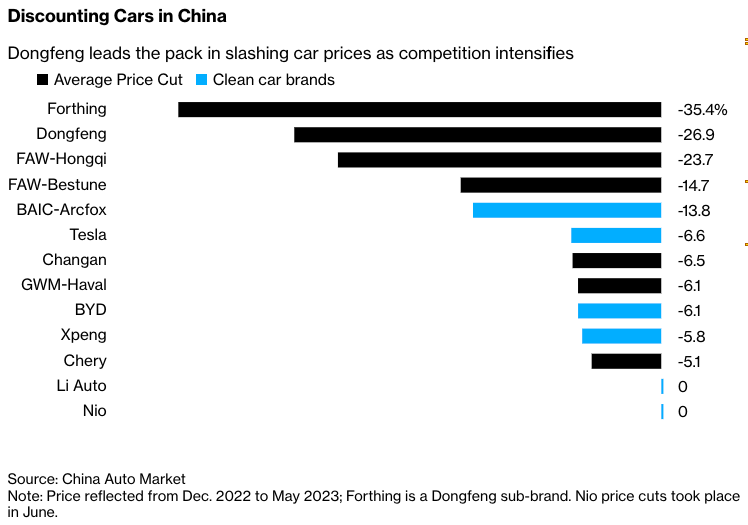
Here's the latest EV price discounting by brand: 

The price war also unleashed a wave of anger among Tesla customers who "complained at stores and distribution centers, with some even ransacking a so-called Experience Center," Bloomberg said. 

Tesla has also slashed prices in the US, unleashing a price war in the second-largest EV market

https://www.zerohedge.com/markets/tesla-signs-ev-truce-chinese-rivals-prevent-further-price-war

Vaxart: Positive Topline Data in Phase 2 Norovirus Vaccine Study

 Met all primary endpoints: Vaccine was well-tolerated with robust immunogenicity

Continue to expect topline data from Phase 2 GI.1 challenge study in Q3 2023

https://www.biospace.com/article/releases/vaxart-announces-positive-preliminary-topline-data-from-dose-ranging-phase-2-study-of-its-bivalent-norovirus-vaccine-candidate/

Celldex Starts Phase 2 for Eosinophilic Esophagitis

  Celldex Therapeutics, Inc. (NASDAQ:CLDX) today announced that the first patient has been dosed in the Company’s Phase 2 subcutaneous study of barzolvolimab in eosinophilic esophagitis (EoE). EoE is the most common type of eosinophilic gastrointestinal disease, a chronic inflammatory disease of the esophagus. Several studies have suggested that mast cells may be an important driver in this disease. Barzolvolimab is a humanized monoclonal antibody that specifically binds the receptor tyrosine kinase KIT with high specificity and potently inhibits its activity, which is required for the function and survival of the mast cell.

“There is a growing body of literature that suggests that eosinophilic esophagitis may be a misnomer for this difficult to treat disease and that other cell types, including mast cells, may play an important role in the disease process,” said Diane C. Young, M.D, Senior Vice President and Chief Medical Officer of Celldex Therapeutics. “This is further supported by the finding that mast cells are present in the biopsy tissue of some patients who continue to suffer from EoE even after eosinophils have been fully depleted. We look forward to exploring the role of our mast cell depleting agent, barzolvolimab, in this setting and believe learnings from this study may inform expanded development into other GI disorders in the future.”

The randomized, double-blind, placebo-controlled, parallel group Phase 2 study is evaluating the efficacy and safety profile of subcutaneous barzolvolimab in patients with active EoE. Approximately 60 patients will be randomly assigned on a 1:1 ratio to receive subcutaneous injections of barzolvolimab at 300 mg every 8 weeks or placebo during a 16-week placebo-controlled treatment phase. Patients then enter a 12-week active treatment phase, in which all patients will receive barzolvolimab 300 mg every 8 weeks. Patients then enter a follow-up phase for an additional 16 weeks. The primary endpoint of the study is reducing esophageal intraepithelial infiltration of mast cells as assessed by peak esophageal intraepithelial mast cell count. Secondary endpoints include the reduction of symptoms of dysphagia and esophageal intraepithelial infiltration of eosinophils and safety. When all clinical trial sites are open, the study will include approximately 60 clinical trial centers across 8 countries, including the United States.

EoE, the most common type of eosinophilic gastrointestinal disease, is a chronic inflammatory disease of the esophagus characterized by the infiltration of eosinophils. This chronic inflammation can result in trouble swallowing, chest pain, vomiting and impaction of food in the esophagus – a medical emergency. Currently, there are limited treatment options for EoE. Several studies have suggested that mast cells may be an important driver in the disease. Given the lack of effective therapies for EoE and barzolvolimab’s potential as a mast cell depleting agent, Celldex believes EoE is an important indication for study. For additional information on this trial (NCT05774184), please visit www.clinicaltrials.gov.

https://www.biospace.com/article/releases/celldex-announces-first-patient-dosed-in-phase-2-study-of-barzolvolimab-in-eosinophilic-esophagitis/

Ultragenyx starts Phase 3 for bone fracture condition therapy

 Ultragenyx Pharmaceutical Inc. (NASDAQ: RARE) today announced that the first patients have been dosed in both of its late-stage clinical trials evaluating setrusumab in pediatric and young adult patients with OI sub-types I, III and IV. The Phase 3 portion of the pivotal Phase 2/3 Orbit study is evaluating the effect of setrusumab compared to placebo on annualized clinical fracture rate in patients aged 5 to <26 years. The newly initiated Phase 3 Cosmic study is an active-controlled study evaluating setrusumab compared to intravenous bisphosphonate (IV-BP) therapy on annualized total fracture rate in patients aged 2 to <5 years.

"I am extremely encouraged by the recent data from the Phase 2 portion of the Orbit study, which includes improvement in biochemical markers and bone density measures that reflect the clinical response we have observed in study participants," stated Thomas Carpenter, M.D., professor of Pediatrics (Endocrinology) and of Orthopaedics and Rehabilitation, Yale School of Medicine. "We are looking forward to evaluating the full clinical potential of setrusumab as this important Phase 3 program moves forward, with hopes for improving therapeutic outcomes in OI."

“Data from the Phase 2 portion of the Orbit study demonstrated increases in bone formation and bone mineral density, which are important markers of bone strength, as well as early indications of improved bone health from our investigators,” said Eric Crombez, M.D., chief medical officer at Ultragenyx. “Our comprehensive Phase 3 program is designed to study the impact of setrusumab on clinical fracture risk reduction. The two Phase 3 trials will evaluate patients over a broad age range, including the younger pediatric population, where the risk of fracture is higher and where we can potentially have the greatest impact on their future health.”

Ultragenyx is leading the clinical development of setrusumab as part of a collaboration and license agreement with Mereo BioPharma Group plc (NASDAQ: MREO), a clinical-stage biopharmaceutical company focused on rare diseases. The companies recently announced positive data from the dose-selection Phase 2 portion of the Orbit study showing that setrusumab rapidly induced bone production in OI-affected patients.

U.S. residents can learn more by visiting ultraclinicaltrials.com.

https://www.biospace.com/article/releases/ultragenyx-announces-first-patients-dosed-in-phase-3-program-evaluating-setrusumab-ux143-for-the-treatment-of-osteogenesis-imperfecta-oi-/

Keytruda Keeps Racking Up Approvals and Clinical Wins in ’23

 First approved by the FDA in 2014, Keytruda is the undisputed cornerstone of Merck’s oncology portfolio. With 35 approvals across 16 types of cancer and two tumor-agnostic indications, the PD-1 inhibitor is projected to become the world’s top-selling drug by 2025.

But it might be the last of its kind in the oncology space, Jayson Slotnik, partner at Health Policy Strategies, told BioSpace in June, due to the effects of the Inflation Reduction Act (IRA).

Passed by President Joe Biden in August 2022, the IRA gives the Secretary of Health & Human Services (HHS) the power to negotiate lower prices on some top-selling drugs on behalf of Medicare.

Under the IRA, small molecule drugs—such as Keytruda (pembrolizumab)—come up for negotiation nine years after the first FDA approval, while biologics enjoy 13 years of exclusivity.

“Merck would never spend the time and the money to continue to invest in other indications for a Keytruda because . . . [the Centers for Medicare & Medicaid Services] is negotiating the drug from the first day of FDA approval,” Slotnik said. 

In a lawsuit filed against the Biden administration in June challenging the part of the IRA pertaining to drug negotiation, Merck stated it expects Keytruda to ultimately be subject to these negotiations. In the meantime, the blockbuster has been on quite a run in 2023, racking up approvals in adjuvant non-small cell lung cancer (NSCLC) and bladder cancer and posting positive clinical data in more indications.

Here’s a look at some of Keytruda’s most recent approvals and clinical results.

Adjuvant NSCLC

Merck didn’t have to wait long to announce its first Keytruda approval of 2023, as the FDA gave the drug its blessing in adjuvant NSCLC on Jan. 27l. Keytruda was specifically approved to treat patients with stage IB, II or IIIA NSCLC after resection or platinum-based chemotherapy. The approval was Keytruda’s fifth in NSCLC, giving Merck a significant slice of this market. Keytruda is also the only immunotherapy approved for both metastatic and adjuvant NSCLC, regardless of PD-L1 expression status. The most recent approval followed data from the Phase III KEYNOTE-091 trial, in which adjuvant treatment with Keytruda reduced the risk of disease recurrence or death by 27% compared to placebo.

First-Line Urothelial Carcinoma

In April, the FDA greenlit Keytruda—in combination with Seagen and Astellas’s Padcev (enfortumab vedotin-ejfv)—for the first-line treatment of locally advanced or metastatic urothelial carcinoma. The Keytruda/Padcev combo is the first therapeutic regimen in the U.S. that combines a PD-1 blocker (Keytruda) and an antibody-drug conjugate (Padcev) in this indication, according to Merck. The duo elicited a 68% objective response rate in the Phase Ib/II KEYNOTE-869 study, along with complete and partial response rates of 12% and 55%, respectively.

Biliary Tract Cancer

At the American Association for Cancer Research (AACR) 2023 Annual Meeting in April, Merck presented Phase III data showing that Keytruda significantly improved overall survival (OS) compared to chemotherapy alone in patients with biliary tract cancer (BTC). A rare type of cancer that develops in the bile ducts and gallbladder, BTC is often diagnosed at the advanced stages, making it particularly deadly. In the randomized trial, 1,069 patients with metastatic or unresectable BTC were assigned to receive either gemcitabine and cisplatin alone or in combination with Keytruda. After being followed for a median 25.6 months, patients taking Keytruda had a 17% lower risk of death than those who received chemotherapy alone and a mean overall survival advantage of 1.8 months. The FDA accepted Merck’s supplemental Biologics License Application on June 8 and set a PDUFA date of Feb.7, 2024.

Desmoplastic Melanoma

Also at AACR, Keytruda improved clinical responses in desmoplastic melanoma—a rare type of skin cancer that accounts for less than 4% of primary cutaneous melanomas, according to the National Institutes of Health. Of 27 patients with unresectable metastatic desmoplastic melanoma given Keytruda every three weeks for two years, 89% demonstrated a clinical response, with 33% seeing a complete response. As for safety, 25% of participants had a serious adverse event. Merck plans to evaluate the drug’s long-term efficacy, including overall survival and progression-free survival. Keytruda is already FDA-approved for the first-line treatment of patients with unresectable metastatic melanoma, and continued efficacy data could ultimately secure Merck another piece of this market.  

Keytruda/Vaccine Combo in High-Risk Melanoma

Merck and Moderna’s therapeutic cancer vaccine gambit is beginning to bear clinical fruit. The companies presented data at AACR from a Phase II trial of the vaccine, mRNA-4157/V940, in combination with Keytruda in high-risk melanoma following complete resection, showing a 44% reduction in the risk of recurrence or death compared with Keytruda alone. It was the first randomized, controlled trial to show benefit from this type of cancer vaccine, Jeffrey Weber, deputy director of NYU Langone’s Perlmutter Cancer Center and the study’s senior investigator, told NBC News at the time. The partners plan to initiate a Phase III study in patients with adjuvant melanoma at some point in 2023.

Perioperative NSCLC

This Fall, Merck will learn the fate of its sNDA for Keytruda in perioperative stage II, IIIA or IIIB NSCLC. In June at the 2023 American Society of Clinical Oncology annual meeting, the company presented highly anticipated data that could bolster its case. In a Phase III trial, Keytruda plus chemotherapy significantly improved event-free survival (EFS) and reduced the risk of disease recurrence, progression or death by 42% in this setting. This set Keytruda apart from its rival, AstraZeneca’s Imfinzi (durvalumab), which showed a 32% EFS rate in the same setting. The FDA is expected to make a decision on or before Oct. 16.

https://www.biospace.com/article/keytruda-keeps-racking-up-approvals-and-clinical-wins-in-23-/