Search This Blog

Thursday, July 6, 2023

AbbVie trims full-year profit forecast on higher R&D expenses

 AbbVie Inc cut its full-year profit forecast on Thursday, citing $280 million in milestone and in-process research and development expenses during the second quarter.

The company now expects adjusted profit between $10.57 and $10.97 per share, compared with $10.72 to $11.12 it previously expected.

Analysts on average were expecting full-year earnings of $10.97 per share, according to Refinitiv IBES data.

AbbVie also trimmed adjusted profit for the second quarter by $0.15 per share and expects to post adjusted profit of $2.75 to $2.85 per share.

The company is scheduled to report second-quarter results on July 27.

https://finance.yahoo.com/news/1-abbvie-trims-full-profit-210238702.html

Sensus Partners with MIS Healthcare to Distribute SRT Systems in UK, Ireland

 Full line of Sensus’ SRT products for the non-invasive treatment of non-melanoma skin cancer and keloids now available to MIS Healthcare customers

Sensus Healthcare, Inc. (Nasdaq: SRTS), a medical device company specializing in highly effective, non-invasive, minimally-invasive and cost-effective treatments for oncological and non-oncological conditions, announces a partnership with MIS Healthcare to distribute Sensus’ superficial radiation therapy (SRT) products in the United Kingdom and Ireland.  This agreement includes the company’s SRT-100, SRT-100+ and SRT-100 Vision systems for the treatment of non-melanoma skin cancer and keloids.

“Our new partnership with MIS Healthcare provides Sensus with greater exposure in the United Kingdom and Ireland, and opens new markets for our SRT products.  Having received the CE mark for our SRT system in 2011, we look forward to this new opportunity with a highly capable partner and a shared commitment to the highest level of customer service,” said Joe Sardano, chairman and chief executive officer of Sensus Healthcare.

Each day nearly 600 people are diagnosed with non-melanoma skin cancer in the United Kingdom and Ireland.  The SRT family of products offers them a new treatment option that is non-invasive and painless.  In addition, unlike Mohs surgery, with SRT there is no post-procedure downtime for recovery and healing.

“The Sensus team looks forward to working with MIS Healthcare to expand the reach of our innovative products for the non-invasive treatment of non-melanoma skin cancer and keloids,” said Benson Suen, Vice President of International Sales at Sensus Healthcare.  “MIS Healthcare has an excellent reputation as a distributor of the highest quality medical devices, and brings a broad and growing network of relationships within the public and private healthcare sectors to support an effective market entry.”

Biden's SAVE Student Loan Relief Measure Another Way Of Canceling Debt, Critics Say

 by Andrew Moran via The Epoch Times,

Following the Supreme Court’s recent ruling to block the current administration’s student loan forgiveness proposal, President Joe Biden announced that his administration would pursue different avenues to offer relief to millions of borrowers.

“I’m not going to stop fighting to deliver borrowers what they need, particularly those at the bottom end of the economic scale,” Mr. Biden said in a White House address on June 30.

“So, we need to find a new way. And we’re moving as fast as we can.”

According to the White House, the Department of Education initiated a regulatory rulemaking process to pave a path for debt relief and finalized “the most affordable repayment plan ever created” using the authority found under the Higher Education Act.

As part of this law, Congress put together various federal programs to support borrowers who struggle to keep up with their student loans.

As a result, officials have finalized the Saving on a Valuable Education (SAVE) plan, an income-driven repayment (IDR) scheme limiting borrowers’ monthly payments to a percentage of their income.

Under the president’s SAVE scheme, borrowers with undergraduate loans would only make payments equal to 5 percent of their discretionary income instead of 10 percent, which the administration estimates would save borrowers approximately $1,000 per year. Moreover, student loan forgiveness would be provided to borrowers with balances of $12,000 or less after ten years of payments rather than the original 20 years.

It is not expected to be available until July 2024 because the White House intends to institute the program in phases, with sign-ups that could start as early as this summer.

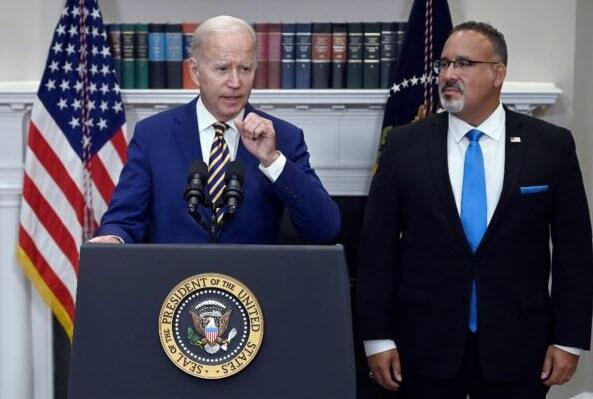
President Joe Biden announces student loan relief with Education Secretary Miguel Cardona (R) in the Roosevelt Room of the White House in Washington on Aug. 24, 2022. (Olivier Douliery/AFP via Getty Images)

This is just another form of debt cancellation, said Caleb Kruckenberg, an attorney at Pacific Legal Foundation.

“What they’re saying is, we’re not transferring any debt, we’re just changing the terms of repayment on the amount you have to repay everything,” Mr. Kruckenberg told The Epoch Times.

“But at the same time, if you look at the policy, it’s saying, well, from a large number of borrowers, your monthly payment is going to be $0. And after a certain number of payments, we’ll forgive your loans. I mean, that’s a more complicated way of saying we’re canceling debt.”

The Education Department estimates the cost would be $138 billion over a decade. However, the Penn Wharton Budget Model suggests that the price tag could be between $333 billion and $361 billion over the decade-long window. It might even be higher because “these estimates do not yet include the effects of students increasing their borrowing, which is subject to future research.”

Other estimates have varied.

The Congressional Budget Office (CBO) was slightly more conservative in its forecasts, projecting that the total cost would be about $230 billion.

But the Foundation for Government Accountability (FGA) placed the final tally at $471 billion.

Tuition Inflation Fears

But while the Biden administration is marketing these relief efforts as a way to help working and middle-class borrowers, critics assert that these programs will have “negative effects for everybody.”

Some experts believe this is another campaign that would result in as much as $1 trillion in additional federal expenditures over the next decade.

“We have a student loan system that assumes that people are going to pay their debt back, and instead, it’s just this massive government spending policy that has negative effects for everybody,” Mr. Kruckenberg said, adding that it is a concept aimed at well-educated potential Democratic voters.

First, taxpayers will be on the hook for this “gigantic government handout” at a time of high inflation.

Second, it exacerbates tuition inflation, Mr. Kruckenberg noted, because it sends the wrong message that colleges can continue to raise the cost of higher education and take advantage of these federal programs.

“Because every college knows that if there’s more funding, more free money, the best way to take advantage of that is to raise tuition for everybody,” he said.

Guaranteeing Student Loans

The U.S. government started guaranteeing student loans offered by banks and non-profit lenders in 1965 as part of a federal initiative now identified as the Federal Family Education Loan (FFEL) program.

Today, the average annual cost of tuition at a public four-year college is roughly 37 times higher than in 1963. Bureau of Labor Statistics (BLS) figures show that tuition inflation has steadily climbed for the last 45 years. Meanwhile, according to National Center for Education Statistics (NCES) data, average tuition, and fees were about 10 percent higher in 2020-2021 than in 2010-2011, totaling $9,400. At private non-profit four-year post-secondary institutions, average tuition and fees were $37,600 in 2020-2021, up 19 percent from 2010-2011.

When the administration first proposed this change last year, some economists feared that IDR would subsidize low-quality and low-value programs and “guts” current accountability practices.

“IDR can work if designed well, but this IDR imposed on the current U.S. system of higher education means programs and institutions with the worst outcomes and highest debts will accrue the largest subsidies,” wrote Adam Looney, a non-resident senior fellow at Brookings Institution.

Mr. Looney also purported that this policy is regressive, meaning it primarily benefits students from upper-class families and “preserves gaps between more and less advantaged groups instead of closing them.”

But if the president’s original student loan forgiveness was legally challenged, could SAVE endure the same fate?

Mr. Kruckenberg anticipates challenges but noted that it is going to be difficult to argue in court that this policy harms anyone in any way.

https://www.zerohedge.com/political/bidens-save-student-loan-relief-measure-another-way-canceling-debt-critics-say

'Cost of extreme heat in U.S.? 235,000 ER visits, $1B health-care bills just this summer'

 An extremely hot June gave way to an even steamier July, with this week setting the record for the steepest global average temperatures.

That means a jump in costly emergency-room visits and other longer-term health impacts that could only worsen as man-made climate change makes temperature extremes more common.

The global average temperature reached 17.18 degrees Celsius (62.9 degrees Fahrenheit) on Wednesday, according to the University of Maine's Climate Reanalyzer, a tool that uses satellite data and computer simulations. That matched a record set Tuesday of 17.18 degrees Celsius (62.9 degrees Fahrenheit) and hits just after a previous record of 17.01 degrees Celsius (62.6 Fahrenheit) was recorded Monday.

Keep in mind those are global averages. For comparison, in early June, far north Buffalo, New York, set daily temperature records on consecutive days to start off the month at 90 degrees Fahrenheit. Fargo, in North Dakota, hit 97 degrees, according to National Weather Service data. And an extreme heat wave broke temperature records in Puerto Rico, where cooling ocean winds weren't to be found. Puerto Rico's heat index, a measure of how temperatures feel to the human body, reached 125 degrees Fahrenheit on parts of the island.

And this week? Typically temperate Portland, Ore., hit a sweltering 98 degrees, according to the NWS, breaking the city's daily record high by two degrees. El Paso, Texas, broke a daily record at a whopping 107 degrees. Those temps don't include the "real feel," which adds in humidity.

Scientists had already warned that 2023 could see record heat as human-caused climate change, driven largely by the burning of fossil fuels like coal, natural gas and oil, warmed the atmosphere. But there's another factor to layer on. La Niña, the regular, natural cooling of the ocean that had acted as a counter to that warming is turning into an El Niño, the reverse phenomenon marked by warming oceans. The north Atlantic Ocean has logged record warmth this year.

Costs add up a couple of ways

When temperatures soar as they have early this summer, scientists, economists and policy-makers stress the heat-related costs that can accumulate on individuals, households, communities and companies.

Often that cost is measured almost solely in lost productivity, meaning extreme temperatures can (and should) restrict outdoor work at a construction site, for instance.

The Adrienne Arsht-Rockefeller Foundation Resilience Center says the current figure on U.S. economic losses tied to heat is purposefully conservative when it is limited to productivity, but that it needs to paint a broader picture. Pegged at $100 billion annually, estimated heat-linked economic losses focus solely on worker productivity. When factors like health care, damage to infrastructure, lost tourism and, yes, worker productivity are considered all at once, climate change's heat impact will reach $200 billion annually as soon as 2030, the group predicts.

And because high health-care costs already burden some U.S. families more than others, recent climate-change research has drilled down on heat and health.

A new report from the public policy research group Center for American Progress estimates extreme heat will create $1 billion in health care-related costs in the U.S. this summer alone.

Heat exposure is high risk for human health and leads to a rise in hospitalizations for cardiovascular, kidney and respiratory diseases, including asthma, particularly among the urban poor. These residents can often lack access to air conditioning, particularly in rentals, and may find the green spaces providing natural cooling lacking.

The Center for American Progress says projects that excessive heat will prompt roughly 235,000 emergency department visits and more than 56,000 hospital admissions for conditions related to increased body temperature across the country this summer.

"As the number of heat-event days increases, the probability that people are going to get rushed to the emergency room or get hospitalized increases," Steven Woolf, a senior fellow at the Center for American Progress, a professor of family medicine and population health at Virginia Commonwealth University School of Medicine, and a coauthor of the report told Grist, which got a first look at the data. "We were interested in trying to quantify how big a risk that is," he said.

The researchers over four-plus years logged "heat-related illnesses" that they defined as heat cramps, heat exhaustion and heat stroke, as well as "heat-adjacent illness" -- dehydration, rapid pulse, dizziness or fainting.

In Virginia, extreme heat spurred some 400 outpatient care visits for heat-related illness, 4,600 emergency room visits for heat-related or heat-adjacent illness and 2,000 heat-related hospital admissions each summer. These are likely underestimates, the report's authors noted, since many patients with higher body weight or organ diseases such as heart disease, for example, experience complications during heat waves that could be classified as heat-adjacent illnesses but are rarely formally diagnosed as such by their physicians. And many victims of extreme heat don't seek medical care at all, which further obscures the true burden of heat-related illness.

The authors extrapolated Virginia's data to reach the conclusion that extreme heat will inflate health-care costs across the nation by at least $1 billion every summer for the foreseeable future. The authors also found that the burden of extreme heat will be shouldered unequally by Americans. The costs will be felt most acutely in low-income and historically marginalized communities, where access to cooling resources such as air conditioning is patchy, electricity bills harder to pay and green spaces are scarce.

Justin Mankin, an assistant professor in Dartmouth University's geography department who was not involved in this report and published a separate study last year, told Grist that he'd like to see research widen its timeline, namely to include the health insurance claims tied to high heat that could pile up in the months and years following an extreme event.

Climate change and heat: Heading higher?

Extreme heat historically has attracted less attention than the destruction of hurricanes, wildfires or floods, because the visual shock can be less or the dangerous effects slower to take hold. But the impact of climate change in creating longer, drier summers, which, in the case of 2023, come on top of an El Niño, is increasingly throwing up alarms.

Climate-change mapping nonprofit First Street has added extreme heat to its tool called Risk Factor, accessible free of charge, and increasingly incorporated into real estate listings, specifically through a partnership with Realtor.com.

The researchers look at how the frequency, duration and intensity of extremely hot days will expand over the next 30 years from a changing climate at a given location.

Risk factors, which are searchable by property, or ZIP code or state, are meant to help homeowners, real estate agents and eventually, insurers, get a better handle on how climate change is impacting home values and the cost of homeownership.

Groups working with the Adrienne Arsht-Rockefeller Foundation Resilience Center are pushing for a standard practice of naming and ranking heat waves globally -- just as tropical storms are named -- so that communities and people can communicate about the emergency, adequately prepare and evacuate when needed.

https://www.morningstar.com/news/marketwatch/20230706639/the-cost-of-extreme-heat-in-the-us-235000-er-visits-and-1b-in-health-care-bills-just-this-summer

First Alzheimer's drug to slow disease, Leqembi, gets full FDA OK, upping accessibility

 The U.S. Food and Drug Administration on Thursday granted traditional approval to the Alzheimer's drug Lecanemab, brand name Leqembi, after an accelerated approval was issued earlier this year. 

"Today's action is the first verification that a drug targeting the underlying disease process of Alzheimer's disease has shown clinical benefit in this devastating disease," Teresa Buracchio, acting director of the Office of Neuroscience in the FDA's Center for Drug Evaluation and Research, said in a news release. 

Leqembi, from drugmakers Eisai and Biogen, is the first medication that's been shown to slow the progression of Alzheimer's disease, including declines in memory and thinking, by targeting the disease's underlying biology. 

"Today marks a breakthrough in the treatment of Alzheimer's disease, and we are proud to be at the forefront of ushering in a new era of advances for a disease that was previously considered untreatable," Biogen president and CEO Christopher A. Viehbacher said in a statement.

He said the company will be "working alongside Eisai with the goal of making [Leqembi] accessible to eligible patients as soon as possible."

The FDA's initial approval in January was based on one mid-stage study in 800 people with early signs of Alzheimer's who were still able to live independently or with minimal assistance. Eisai later published the results of a larger 1,800-patient study that the FDA assessed as part of the full approval process.

The larger study tracked patients' results on an 18-point scale measuring memory and other cognitive functions. Results showed a difference of less than half a point after 18 months, sparking debate over whether this qualifies as a meaningful improvement. 

According to the latest news release, the decision was unanimous, with all committee members voting that the study results verified the drug's benefit. Buracchio noted in her statement: "This confirmatory study verified that it is a safe and effective treatment for patients with Alzheimer's disease."

"This drug is not a cure. It doesn't stop people from getting worse, but it does measurably slow the progression of the disease," Dr. Joy Snider, a neurologist at Washington University in St. Louis, told The Associated Press in January. "That might mean someone could have an extra six months to a year of being able to drive."

Snider said that Leqembi (pronounced "leh-KEM-bee") also comes with downsides, including the need for twice-a-month infusions and possible side effects like brain swelling. Other reported side effects are infusion-related reactions and headaches, according to the Alzheimer's Association.

Access is another issue, with the drug expected to be priced at about $26,500 for a typical year's worth of treatment, without insurance. 

On Thursday, the head of the Centers for Medicare and Medicaid Services, Chiquita Brooks-Lasure, pledged to "cover this medication broadly while continuing to gather data that will help us understand how the drug works" —  a decision that will make it more affordable for many. Brooks-Lasure called the FDA's approval "welcome news for the millions of people in this country and their families who are affected by this debilitating disease."

Her office had previously said it expected to extend coverage once full FDA approval was granted.

The FDA defines Alzheimer's disease as "an irreversible, progressive brain disorder affecting more than 6.5 million Americans that slowly destroys memory and thinking skills and, eventually, the ability to carry out simple tasks."

In a news release from the initial approval, the FDA called the medication "an important advancement in the ongoing fight to effectively treat Alzheimer's disease."

"Alzheimer's disease immeasurably incapacitates the lives of those who suffer from it and has devastating effects on their loved ones," Dr. Billy Dunn, former director of the Office of Neuroscience in the FDA's Center for Drug Evaluation and Research, said in the release. "This treatment option is the latest therapy to target and affect the underlying disease process of Alzheimer's, instead of only treating the symptoms of the disease."

The decision on Leqembi follows controversy over the FDA's handling of a previous Alzheimer's drug, Aduhelm, which was also developed by Biogen and Eisai. Aduhelm won approval in 2021 despite warnings from independent medical advisers that it had not been shown to be effective and carried significant risks. The FDA later updated labeling to significantly limit the drug's use.

https://www.cbsnews.com/news/first-alzheimers-drug-slow-disease-leqembi-gets-full-fda-approval/

Cannabis Use Disorder Raises Risk of Perioperative Complications

 Adults with cannabis use disorder had a moderately increased risk of morbidity and in-hospital mortality after major elective surgery compared with those without cannabis use disorder, a large retrospective study found.

Among 12,422 hospitalized patients, a composite outcome of perioperative complications and mortality occurred in 7.73% of the cannabis use disorder group and 6.57% of a matched control group (adjusted OR 1.19, 95% CI 1.04-1.37, P=0.01), reported Paul Potnuru, MD, of the University of Texas Health Science Center in Houston, and co-authors in JAMA Surgeryopens in a new tab or window.

"Probably the biggest takeaway is to consider cannabis as a not harmless substance," Potnuru told MedPage Today. "It does have real impacts on health. We don't fully know what they are yet, but now there's enough evidence that it can be harmful."

A number of smaller studies have suggested cannabis use may affect anesthesia in surgery, postoperative nauseaopens in a new tab or window, or use of pain medicineopens in a new tab or window. One study found minimal differences in postoperative complications between cannabis users and non-cannabis users among patients from 2006 to 2015opens in a new tab or window. "Between increased use and maybe increased potency, our guess was we would probably start to notice some differences" now, Potnuru said.

It's difficult to design a randomized trial of cannabis because of federal regulatory restrictions but it's important to interpret population-level studies like this one with caution, said Samer Narouze, MD, PhD, of Northeast Ohio Medical University in Rootstown, who wasn't involved with the study.

"We cannot build up a good patient story just from an Excel sheet," because details about a patient could be lost, Narouze told MedPage Today. How cannabis was administered and the amount of time since a patient last used it may have clinical implications, he noted. "Even smoking within 2 hours of surgery leads to a higher risk of heart attack from surgery," he said.

Postoperative pain may be more severe for regular cannabis users due to "rebound pain" or "paradoxical pain" (cannabinoid hyperemesis) and withdrawal from cannabis during surgery, he added.

New guidelines fromopens in a new tab or window the American Society of Regional Anesthesia and Pain Medicine call for screening all surgery patients for cannabis use, which may capture details about how and when cannabis was used and help patients and physicians better manage risk factors, Narouze pointed out.

The study from Potnuru and colleagues used National Inpatient Sample data from 2016 to 2019 to identify adults ages 18 to 65 who were hospitalized for major, noncardiac, non-obstetric elective surgeries: cholecystectomy, colectomy, inguinal hernia repair, femoral hernia repair, mastectomy, lumpectomy, hip arthroplasty, knee arthroplasty, hysterectomy, spinal fusion, and vertebral discectomy.

Overall, 44% of participants were female, 70% were white, and the median age was 53 years. A cohort of 6,211 patients with cannabis use disorder defined by ICD-10 codes was matched with 6,211 patients without cannabis use disorder.

The primary outcome was a composite of perioperative morbidity and in-hospital mortality. Secondary outcomes included individual components of the primary outcome. Some occurred more frequently in the cannabis use disorder group, including in-hospital mortality, myocardial ischemia, acute kidney injury, stroke, respiratory complications, venous thromboembolism, hospital-acquired infection, and surgical procedure-related complications. After adjustment, however, no statistically significant differences between groups on the individual components remained.

Hospital length of stay was a median of 2 days for both groups. Total hospital costs were 6% higher in the cannabis use disorder group (adjusted cost ratio 1.06, 95% CI 1.03-1.09, P<0.001).

The study had several limitations, the researchers acknowledged. It relied on an administrative database that did not capture certain aspects of cannabis use like dose or route, or whether cannabis was used recreationally or medicinally. "It's just a big black box of things you don't know," Potnuru said.

Administrative records may be more likely to identify moderate-to-severe cannabis use disorder cases and miss mild cases, the researchers added. Unmeasured confounders may have influenced results, and findings cannot be generalized to other kinds of surgical procedures that were not studied.

Disclosures

No conflicts of interest were reported.

Primary Source

JAMA Surgery

Source Reference: opens in a new tab or windowPotnuru PP, et al "Cannabis use disorder and perioperative complications" JAMA Surg 2023; DOI: 10.1001/jamasurg.2023.2403.


https://www.medpagetoday.com/surgery/generalsurgery/105347

Twitter lawyer tell Meta there are 'serious concerns' about Threads and Twitter IP

 In a letter addressed to Meta Platforms Inc.'s (META) Chief Executive Mark Zuckerberg, Elon Musk's lawyer Alex Spiro said Thursday that Twitter had "serious concerns" that Meta has engaged in "systematic, willful, and unlawful misappropriation" of Twitter's "trade secrets" and other intellectual property. Twitter has hired "dozens" of former Twitter employees who may have access to confidential information, Quinn Emmanuel's Spiro said. Twitter intends to "strictly enforce its intellectual property rights," he wrote. Meta did not immediately return a request for comment. The Facebook parent launched Threads late Wednesday, a day earlier than planned, and Zuckerberg said in a post Thursday the platform already had 30 million users

https://www.morningstar.com/news/marketwatch/20230706633/twitter-lawyer-tell-meta-there-are-serious-concerns-about-threads-and-twitter-ip