Search This Blog

Saturday, July 8, 2023

The Green Deal in the EU Goes Unfunded, Expect a Total Collapse

 The European Commission put a cost on its Green deal estimate. It’s €620 billion. The EC has allocated €82.5 billion. Guess what.

Unfunded Green New Deal

Hooray! the EU finally has an agreement on a Green New Deal. However, Eurointelligence reports the deal is largely unfunded.

If we had to pinpoint a single tragic error in the modern history of European integration, it is the moment sometime during the euro crisis when pro-Europeans gave up on eurobonds and a fiscal union. Instead, they adopted Angela Merkel as their new role model, the pragmatist-in-chief. What made their plight even more tragic was the mistaken idea that they were in possession of a clever and legally watertight funding mechanism, which gave rise to the Sure unemployment reinsurance programme, and later the recovery fund.

FAZ tells us this morning why this strategy is not working. The Commission has put a figure on the annual costs of the Green deal, a whopping €620bn. The Commission itself has only allocated €82.5bn towards this, via the social climate fund. You can add a few euros here and there from various other pots, but this is not going to come close. Thierry Breton wanted a debt-financed €350bn funds for green investments, to match the size of the US inflation reduction act. That would have done the heavy lifting. But this was killed off by member states.

When the EU launched the recovery fund in 2020 we expressed scepticism about whether it could form a blueprint for future lending. There is simply no consensus in the EU for a perpetuation of a financial instrument that is ultimately secured by the member states themselves. What is also not helping is that the financial markets are not bestowing top-notch valuations to EU-issued debt for the simple reason that it is not sovereign. You can package a bunch of mortgages into a collateral debt obligation. But you can’t repackage or reclassify sovereign debt. What characterises a sovereign borrower is the power to raise funds through taxes. For as long as the EU is reliant on the kindness of member states, it is not in a position to fund some of these giant programmes. What the EU needs, dare we say it, is the real thing: a eurobond. Or else, it has to admit that it cannot do as much as it wants, for lack of funds.

The Green deal is not the only unfunded programme. The project for a greater geopolitical role for the EU is in the same category. In addition, there is the cost of the reconstruction of Ukraine, which the Commission puts at €384bn a year.

Since there is no way they can fund this out of their own resources, we believe that more smoke-and-mirror tricks are on the way. No prizes for guessing where this will leave the substance of the Green deal.

The EU’s climate deal is 13 percent funded. How’s that going to work?

The Eurobond Idea Surfaces Again

Eurointelligence founder Wolfgang Münchau comments “What the EU needs, dare we say it, is the real thing: a eurobond.”

I disagree with most of Münchau’s ideas. He wants commingled budgets and a United States of Europe. Nonetheless, I like Münchau. He is very straight shooter. He also sees the issues and does not sugarcoat them.

The Euro is fatally flawed, and other than freedom of movement, the EU is mostly a failure. There are too many cultural differences, work rule discrepancies, productivity differences etc., for the Euro to ever smoothly work. The Italian banking system is insolvent and the Northern states led by Germany do not want to bail out Italy or Greece, neither of which belonged in the EU under budget rules anyway.

French president Emmanuel Macron wants a European army. Germany doesn’t. Why bother when the US is stupidly willing to pay for Europe’s defense with massive injections of cash and equipment to Ukraine while Germany did not lift a finger.

Germany does not fund NATO, will not fund an army, and will not pony up its share of €384 billion a year to reconstruct Ukraine. Germany will not lift a finger to help Southern Europe.

Attitudes Must Change First

EMU, the European Monetary Union, is an alliance of the 20 European states that belong to the European Union and have introduced a common currency, the euro.

Every one of those nations would have to agree to a eurobond. The unanimous agreement to change much of anything is in and of itself a fatal flaw in the construction of the Euro.

Meanwhile, one size does not fit all when it comes to interest rate policy, and it never will, until Italy, Germany, France, and Spain have similar work rules, legal systems, property rights, productivity, and tax structures.

The Euro founders thought that once the Euro was in place, attitudes would converge. They didn’t and won’t. France has veto power over agricultural policy and that won’t change either.

Curiously, this idea came up yesterday regrading a BRIC alliance. I bet most failed to spot it. Let’s take a look.

More Gold Backed BRIC Currency Silliness on Dethroning the Dollar

Please consider, or reconsider my post yesterday, More Gold Backed BRIC Currency Silliness on Dethroning the Dollar

Thorsten Polleit, chief economist at Degussa, told Kitco, “For making the new currency as good as gold, a truly sound currency, it must be convertible into gold on demand. I am not sure whether this is what Brazil, Russia, India, China and South Africa have in mind.”

Marc Chandler, managing director of Bannockburn Global Forex, told Kitco “Talk of BRICS gold backed currency seems like an echo chamber. They do not have the gold to back a currency meaningfully. Have we not learned anything from the EMU experience of monetary union without fiscal union. Color me profoundly skeptical.

What precisely do Brazil, Russia, India, and China have in common other than a desire to escape the dollar?

BRIC Expansion List

Bloomberg reports the BRIC Expansion List is now up to 19.

South Africa joined in 2010. That was sure meaningful, wasn’t it?

Saudi Arabia and Iran have formally asked to join. Other nations expressing interest include Argentina, the United Arab Emirates, Algeria, Egypt, Bahrain and Indonesia, along with two undisclosed nations from East Africa and one from West Africa.

Perhaps they can concoct a way to avoid SWIFT, a dollar payment construct that makes it difficult to avoid US sanctions. If so, I will cheer, and that will be useful. But the EU announced such plans and failed.

US dollar use will decline naturally if and when emerging markets finally emerge, and BRICs won’t have much to do with it. It will simply be more cross border trading.

As for dethroning the dollar, I have to laugh. Egypt and undisclosed nations in Africa do not matter. How many times has Argentina defaulted?

How much do any of these nations trade with each other?

That’s a trick question because nations don’t trade, individuals do.

Yet, the recent announcement from Russia mentioned a “trading currency“. What does that even mean?

Let’s see the details on how this will work in practice, whether the currency is convertible on demand, how much gold backing there is, and who gets to use it.

Expect to be underwhelmed, but expect more hype anyway. Hype is sexy. So is predicting the collapse of the dollar.

With that, let’s return to the headline theme.

The Ever Growing Trillions of Dollars Per Year Demands to Fight Climate Change

Please note the The Ever Growing Trillions of Dollars Per Year Demands to Fight Climate Change

  • An expert group under the auspice of the UN estimates that investments have to reach the order of $1 trillion per year until 2030 to respond to the climate and biodiversity crisis.
  • Oxfam estimated that $3.9 trillion per year will be needed over the same time period to fight poverty, inequality and climate change.
  • The World bank estimated that it takes $4 trillion per year to build the infrastructure for this.

That’s a mere $8.9 trillion per per year until 2030, a 7-year cost of $62.3 trillion. Who will fund that?

Germany Turns Against Green New Deal

Also recall my May 23, Germany is Turning Against the EU’s Green New Deal, Common Sense to the Forefront

Absent a Eurobond, don’t expect 20 nations that have little in common other than proximity to do much of anything in a united way.

The same applies to the BRICs who do not even have proximity in common other than Russia, India, and China.

RIC anyone? RIC bonds? Gold-backed RIC bonds when the yuan doesn’t even float and none of the countries have much of any bond market? What a hoot.

https://mishtalk.com/economics/the-green-deal-in-the-eu-goes-unfunded-expect-a-total-collapse/

NY to deploy shark-monitoring drones to beaches following reported attacks

 New York will deploy shark-monitoring drones on its beaches following a recent series of reported attacks. 

Gov. Kathy Hochul (D) announced in a release on Friday that the drones will be sent to beach communities on Long Island and New York City, and the New York State Office of Parks, Recreation and Historic Preservation and the Department of Environmental Conservation (DEC) have increased their surveillance of the waters in response to increased shark sightings. 

“Ahead of the busy summer season, we developed new tools and strategies to monitor marine wildlife and protect the health and safety of New Yorkers. These new drones will increase the shark monitoring capacity of local governments across Long Island and New York City, ensuring local beaches are safe for all beachgoers,” Hochul said. 

The release states that the drones will be provided to all downstate municipalities, and the state parks office will provide funding to cover the costs of training local personnel to operate them. 

Two swimmers were seemingly attacked by sharks off of Long Island on Tuesday, the day after two other swimmers reported the same. A drone on one beach had found about 50 sand sharks near a popular park on Tuesday, causing the beach to have a delayed opening. 

The governor’s office said swimming is suspended when shark sightings or interactions between sharks and swimmers occur, and it is not allowed to resume until one hour after the last sighting. Lifeguards, park police and staff continue to patrol the waters for shark activity during this time. 

Basil Seggos, the commissioner of the state environmental conservation department, said New York’s shores support an annual shark migration to the state’s coastal waters. 

“While human-shark interactions are rare, DEC encourages the public to follow shark safety guidance to help minimize the risk of negative interactions with sharks this summer,” Seggos said. 

The department said swimmers should avoid areas with seals, schools of fish or diving seabirds and murky water to reduce the risk of interacting with a shark. They should also avoid swimming at dusk, night and dawn, follow lifeguards’ instructions, stay close to the shore and swim in groups.

https://thehill.com/homenews/state-watch/4086719-new-york-to-deploy-shark-monitoring-drones-to-beaches-following-reported-attacks/

'When is the optimal time for Biden to drop out'

 Like a magician setting up a trick in one hand while distracting the audience with the other, the Biden White House and its allies are desperately trying to distract the attention of the American people from President Biden’s age, his obvious frailty and his increasing verbal and mental gaffes.

It has now gotten to the point where I have had a number of Democrats — including staunch supporters of the president — tell me it makes them “nervous,” “uncomfortable,” “sad” or gives them a feeling of “foreboding” anytime they watch President Biden speak in public, interact with guests or walk up or down the stairs to Air Force One.

Many I speak with honestly care about the president and want the best for Joe Biden, the human being. They all understand that every person on earth — rich or poor, famous or not — ages out. It is a reality and finality of life which unites us all.

As stated in this space in the past, I don’t believe Biden will be the Democratic nominee in 2024. Now, while the president, his White House and his allies may predictably denounce such speculation as ridiculous or wishful thinking, what if I and others turn out to be correct?

That possibility raises a critically important question: When would be the optimal time for President Biden to announce he’s dropping out of the race to give the Democratic Party the best chance to retain the White House?

A very strong case can be made for: immediately. If the Democratic National Committee is going to open up the primary to other candidates, the sooner the better.

Of course, a Democratic president dropping out of the race for reelection is not without precedent, or irony in this case. 

On March 31, 1968, President Lyndon B. Johnson went on national television to make two shocking announcements. The first was that he was halting the U.S. bombing of North Vietnam. The second was that he would not seek his party’s nomination for president.

The ironic part of those announcements made 55 years ago is that both may have been forced in part by the words and deeds of then–New York Sen. Robert F. Kennedy — the father of the man now challenging President Biden for the nomination. 

By the time Johnson made those announcements, he was already viewed with deep suspicion by Republicans as the architect of “Big Government,” while many on the left, especially those in college, viewed him as a warmonger spot-welded to the military industrial complex.

Prior to his March 31 remarks, Johnson had shrugged off such criticism. None of that cut deeply. 

But then the shadow of Robert F. Kennedy fell across his path. First, via his withering attacks against Johnson on Vietnam. One such rhetorical attack occurred on Feb. 8, when Kennedy declared: “Our enemy, savagely striking at will across all of South Vietnam, has finally shattered the mask of official illusion with which we have concealed our true circumstances, even from ourselves, unable to defeat our enemy or break his will — at least without a huge, long and ever more costly effort.”

Kennedy, who truly despised Johnson for a number of reasons, called for the United States to enter into immediate negotiations with North Vietnam to end the war. Next, on March 16, Kennedy declared that he was running to challenge Johnson for the Democratic nomination for president. That announcement came just four days after Johnson barely beat Sen. Eugene McCarthy in the New Hampshire primary.

Fifteen days after Kennedy declared for the presidency, Johnson withdrew. He had had enough.

Johnson was quickly aging out of the job. Between riots in American cities; the quagmire of the war in Vietnam; his failing poverty programs; his stumble in the New Hampshire primary; and his cloak of inevitability shredding, Johnson was a ball of conflicting insecurities. On top of all that, his public approval rating was hovering around 36 percent. Simply brutal.

Now, over a half a century later, we have President Biden with his very low approval rating being challenged by Robert F. Kennedy, Jr. 

There is one striking difference between Johnson then and Biden now. When he decided in 1968 that he could not handle the stress of the rest of the election cycle — or the uncertainty of what was to come — the 6’4”, physically imposing Lyndon Johnson was only 59 years old; 21 years younger than our current president. 

A question some Democrats had in 1968 was whether Johnson waited too long to drop out of the race. One reason for that question was a lack of confidence in then–Vice President Hubert Humphrey to retain the White House should he become the Democratic nominee. That concern was of course realized when Humphrey became the nominee and got crushed in the general election by Republican Richard Nixon.

Some now reasonably worry if history is repeating itself.

If Biden does drop out of the race, will he wait too long to do so? And, should that be the case, will Vice President Kamala Harris — whom few Democrats truly have confidence in — get crushed in the general election by the Republican nominee?

Timing is often as important as strategy. Johnson waited until the last day of March 1968 to drop out. If Biden dropped out now, he would give potential candidates like California Gov. Gavin Newsom, Secretary of Transportation Pete Buttigieg or even Michelle Obama an extra nine months to prepare for November 2024. 

“It’s now or never” may prove to be a cliché that defines the upcoming election.

Douglas MacKinnon, a political and communications consultant, was a writer in the White House for Presidents Ronald Reagan and George H.W. Bush, and former special assistant for policy and communications at the Pentagon during the last three years of the Bush administration.

https://thehill.com/opinion/campaign/4086058-when-is-the-optimal-time-for-biden-to-drop-out-of-the-race/

Biden’s Treasury Department slammed as ‘wasteful’ for woke equity expansion

 President Biden’s Treasury Department is expanding its own bureaucracy — hiring woke functionaries bent on chasing the “diversity, equity, and inclusion” goals espoused by lefty mega-investors — instead of building up America’s wealth and economic health, critics told The Post.

Self-described intersectional economist Diane Lim announced Monday that she will head the department’s “Equity Hub” — a new role created to “coordinate efforts to advance equity in all of Treasury’s work,” paying up to $203,700 a year.

Her job description is almost identical to that of another Biden-created post. Counselor for Racial Equity Janis Bowdler — a former activist with the National Council of La Raza — earns $161,813 to “coordinate all offices and workstreams intended to advance equity,” the department’s website states.

“This is just another example of the unprecedented level of wasteful spending by the Biden Administration that’s fueled inflation and cost American taxpayers money,” said Rep. Nicole Malliotakis (R-NY).

Worse, experts say, the department’s equity obsession undermines its actual purpose — the protection and expansion of national prosperity for all.

“Equity, as defined by the architects of critical race theory, means the government must treat individual Americans unequally in order to attain equal outcomes as measured by race,” Heritage Foundation fellow Mike Gonzalez told The Post. “That is very worrisome when it comes to finance or anything else that Treasury does.”

“This push for equity takes no account of an economy that generates wealth and jobs and prosperity,” Gonzalez added. “All it cares about is equal outcomes – which is the Soviet standard, not the American standard — as measured by race.”

The department’s new apparatchiks are layered atop a phalanx of existing civil-rights officials — at least 19 executive-level employees, plus 25 unpaid members of the Treasury Advisory Committee on Racial Equity, another creation of the Biden administration.

Lorraine Cole earns $199,300 as director of the Office of Minority and Women Inclusion, while Tina Lancaster, acting director of the Office of Civil Rights and Equal Employment Opportunity, takes home $176,300 annually.

Meanwhile, 17 separate EEO directors – one for each Treasury bureau – are paid similarly hefty salaries, with staffs to match.

“They’re creating a whole deep state of equity officers,” said Ted Frank, a public interest attorney with the Hamilton Lincoln Law Institute.

The bureaucratic bloat is overseen by Deputy Treasury Secretary Wally Adeyemo, Secretary Janet Yellen’s woke point man.

Adeyemo, the onetime president of the Obama Foundation, is a former protege of BlackRock CEO Larry Fink — whose giant investment-management company has made a concerted effort to strong-arm American corporations into supporting leftist causes, The Post has reported.

Adeyemo has pushed Treasury to “center racial equity” in distributing cash from Biden’s $1.9 trillion COVID relief law, and is urging the IRS to correct “racial and ethnic disparities” in its audit rates.

The department has also “revised” federal procurement rules to “prioritize equity and supplier diversity,” it boasted last year — ditching old regulations that put “efficiency and savings” in the forefront.

The policies all stem from an executive order signed by Biden within hours of his 2021 inauguration, directing his agencies to pursue “an ambitious whole-of-government equity agenda.”

Last week, before heading off to Beijing to schmooze with Communist Party officials, Yellen stopped in at the annual Essence Festival in New Orleans.

There, she told a largely black audience that Treasury had pumped $1.4 billion into “black-owned and operated banks and credit unions” and doled out $200 million in “prime contracts” to African-American businesses — “a 60 percent increase from 2020,” she said.

“It’s just raw politics … boondoggles and racial spoils,” Frank said. “In practice, ‘equity’ generally translates into finding ways to give government largess, or to use government enforcement, to benefit prominent Democratic voting blocs.”

“If this is Bidenomics,” Gonzalez said, “then it really is a disaster.”

https://nypost.com/2023/07/08/bidens-treasury-department-slammed-for-woke-equity-expansion/

"Why Do You Support Child Trafficking?" Rolling Stone Hit On Negative 'Sound Of Freedom' Review

 The pedo-loving propagandists at the once-great Rolling Stone are at it again, this time seemingly defending child traffickers with a scathing review of Jim Caviezel's anti-child-trafficking film, Sound of Freedom - which they described as a "QAnon-tinged thriller about child-trafficking" which is "designed to appeal to the conscience of a conspiracy-addled boomer."

Authored by pothead journalist Miles Klee, the review attacks Caviezel as "a prominent figure on the conspiracist right," and slams the actor's past claims over elite pedophile rings that kidnap, rape and murder children to harvest adrenochrome, a compound produced in the brain that reportedly contains psychedelic effects, as featured in the movie Fear and Loathing in Las Vegas. Apparently Caviezel's beliefs invalidate the premise of the film, which was inspired by the very real work of Tim Ballard, founder of Operation Underground Railroad.

Klee writes of the film;

"It’s a stomach-turning experience, fetishizing the torture of its child victims and lingering over lush preludes to their sexual abuse. At times I had the uncomfortable sense that I might be arrested myself just for sitting through it..." [ZH: and why would that be, Miles?]

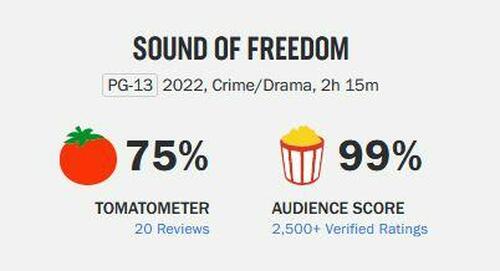
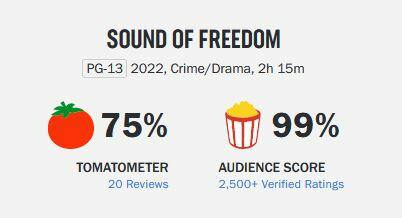
Back to reality, the Sound of Freedom currently enjoys a 99% user rating on Rotten Tomatoes, and 75% from 'Hollywood type' professional reviewers (if ya know what we mean).

Screenshot, rottentomatoes.com

The rag's tweet received a blistering response;

Oh look, it's not just Rolling Stone...

Why is establishment media attacking an anti-child-trafficking film?

https://www.zerohedge.com/markets/why-do-you-support-child-trafficking-rolling-stone-slammed-over-negative-sound-freedom 

EU's Mass Censorship Regime Is Almost Fully Operational. Will It Go Global?

 by Nick Corbishley via NakedCapitalism.com,

Government censorship of public online discourse in the West’s ostensibly liberal democracies has been largely covert until now, as revealed by the Twitter Files. But thanks to the EU’s Digital Services Act, it is about to become overt. 

Next month, a little-known development will occur that could end up having huge repercussions for the nature of public discourse on the Internet all over the planet. August 25, 2023 is the date by which big social media platforms will have to begin fully complying with the European Union’s Digital Services Act, or DSA. The DSA, among many other things, obliges all “Very Large Online Platforms”, or VLOPs, to speedily remove illegal content, hate speech and so-called disinformation from their platforms. If not, they risk fines of up to 6% of their annual global revenue.

The Commission has so far compiled a list of 19 VLOPs and VLOSEs (Very Large Online Search Engines), most of them from the US, that will have to begin complying with the DSA in 50 days’ time:

  • Alibaba AliExpress

  • Amazon Store

  • Apple AppStore

  • Booking.com

  • Facebook

  • Google Play

  • Google Maps

  • Google Shopping

  • Instagram

  • LinkedIn

  • Pinterest

  • Snapchat

  • TikTok

  • Twitter

  • Wikipedia

  • YouTube

  • Zalando

Very Large Online Search Engines (VLOSEs):

  • Bing

  • Google Search

Smaller platforms will have to begin tackling illegal content, hate speech and disinformation from 2024 onwards, assuming the legislation is effective.

Ominously, as Robert Kogon reports for Brownstone.org (granted, not the most popular source of information on NC, but it’s a good, well researched piece), the DSA “includes a ‘crisis response mechanism’ (Art. 36) that is clearly modeled on the European Commission’s initially ad hoc response to the conflict in Ukraine and which requires platforms to adopt measures to mitigate crisis-related ‘misinformation.'”

In a speech in early June, EU Vice-President for Values and Transparency, Věra Jourová, made it crystal clear which country is the current prime target of the EU’s censorship agenda (no points for guessing):

Cooperation among signatories and the high number of new organisations willing to sign the new Code of Practice show that it has become an effective and dynamic instrument to fight disinformation. However, progress remains too slow on crucial aspects, especially when it comes to dealing with pro-Kremlin war propaganda or independent access to data…

As we prepare for the 2024 EU elections, I call on platforms to increase their efforts in fighting disinformation and address Russian information manipulation, and this in all Member States and languages, whether big or small.

Meet the “Enforcer”

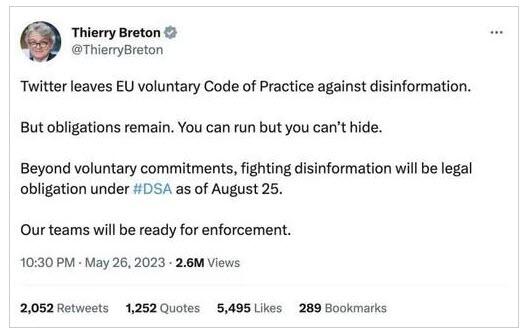
The EU is offering tech companies little in the way of wiggle room. When Twitter withdrew from the EU’s Code of Practice on Disinformation in late May, the EU’s Internal Market Commissioner, Thierry Breton, issued a fiery reprimand as well as an unveiled threat — on Twitter of all places:

Jourová also laid into Twitter, saying the platform had mistakenly chosen the path of “confrontation.”

Days later, Breton announced he was visiting Silicon Valley to “stress test” US tech giants, including Twitter, to see how well prepared they are for the launch of the Digital Services Act on August 25. Calling himself the “enforcer”, serving the “will of the state and the people” (as if the two were the same things), Breton remind tech platforms that the EU’s DSA would transform its code of practice on mis- and disinformation into a code of conduct. From Politico:

“We are going there, but don’t want to be vocal before because I don’t want to speak too much. But we offer this and I’m happy that some platforms took our proposal,” Breton said of the non-binding compliance checks. “I am the enforcer. I represent the law, which is the will of the state and the people.”

“It’s a voluntary basis, so we don’t force anyone” to join the code of practice on disinformation, Breton said. “I just reminded (Musk and Twitter) that by August 25, it will become a legal obligation to fight disinformation.”

While Twitter may have left the EU’s voluntary code of practice, many of its other actions suggest it is complying with, rather than defying, the EU’s new rules on disinformation. After all, many other Big Tech platforms have not signed the code of practice, including Amazon, Apple and Wikipedia, but will be subject to the DSA’s obligatory requirements, as long as they want to continue operating in Europe. Also, as Kogon documents, recent programming that has gone into the Twitter algorithm includes “safety labels” to restrict the visibility of alleged “misinformation”:

The general categories of “misinformation” used exactly mirror the main areas of concern targeted by the EU in its efforts to “regulate” online speech: “medical misinfo” in the context of the COVID-19 pandemic, “civic misinfo” in the context of issues of electoral integrity, and “crisis misinfo” in the context of the war in Ukraine.

In its January submission to the EU (see reports archive here), in the section devoted precisely to its efforts to combat Ukraine-war-related “misinformation,” Twitter writes (pp. 70-71):

“We … use a combination of technology and human review to proactively identify misleading information. More than 65% of violative content is surfaced by our automated systems, and the majority of remaining content we enforce on is surfaced through regular monitoring by our internal teams and our work with trusted partners.”

Moreover, some Twitter users recently received notices informing them that they are not eligible to participate in Twitter Ads because their account has been labelled “organic misinformation.” As Kogon asks: “Why in the world would Twitter turn away advertising business?”:

The answer is simple and straightforward: because none other than the EU’s Code of Practice on Disinformation requires it to do so in connection with the so-called “demonetization of disinformation.”

Ultimately, Kogon notes, once the DSA comes into full effect, in 50 days’ time, if Elon Musk stays true to his word on freedom of speech and chooses to defy the EU’s “permanent task force on disinformation”, the Commission will mobilise the entire arsenal of punitive measures at its disposal, in particular the threat or application of fines of 6% of the company’s global turnover. In other words, the only way for Twitter to actually defy the EU is to leave the EU.

That is something most tech platforms can but will not do, due to the huge impact it would have on their bottom line. One possible exception to this rule appears to be the Toronto-based streaming platform Rumble, which in November disabled access to its services in France after the French government demanded the multinational company remove Russian news sources from its platform.

EU Commission: Judge and Jury

So, who in the EU will get to define what actually constitutes mis- or disinformation?

Surely it will be the job of an independent regulator or a judicial authority with at least clear procedural parameters and no or few conflicts of interest. At least that is what one would hope.

But no.

The ultimate decider of what constitutes mis- or dis-information, possibly not just in the EU but across multiple jurisdictions around the world (more on that later), will be the European Commission. That’s right, the EU’s power-hungry, conflict-riddled, Von der Leyen-led executive branch. The same institution that is in the process of dynamiting the EU’s economic future through its endless backfiring sanctions on Russia and which is mired in Pfizergate, one of the biggest corruption scandals of its 64-year existence. Now the Commission wants to take mass censorship to levels not seen in Europe since at least the dying days of the Cold War.

In this task the Commission will have, in its own words, “enforcement powers similar to those it has under anti-trust proceedings,” adding that “an EU-wide cooperation mechanism will be established between national regulators and the Commission.”

The Electronic Frontier Foundation (EFF) broadly supports many aspects of the DSA, including the protections it provides on user rights to privacy by prohibiting platforms from undertaking targeted advertising based on sensitive user information, such as sexual orientation or ethnicity. “More broadly, the DSA increases the transparency about the ads users see on their feeds as platforms must place a clear label on every ad, with information about the buyer of the ad and other details.” It also “reins in the powers of Big Tech” by forcing them to “comply with far-reaching obligations and responsibly tackle systemic risks and abuse on their platform.”

But even the EFF warns that the new law “provides a fast-track procedure for law enforcement authorities to take on the role of ‘trusted flaggers’ and uncover data about anonymous speakers and remove allegedly illegal content – which platforms become obligated to remove quickly.” The EFF also raises concerns about the dangers posed by the Commission’s starring role in all of this:

Issues with government involvement in content moderation are pervasive and whilst trusted flaggers are not new, the DSA’s system could have a significant negative impact on the rights of users, in particular that of privacy and free speech.

And free speech and a free press are the foundation stones of any genuine liberal democracy, as notes the American Civil Liberties Union (ACLU):

The First Amendment protects our freedom to speak, assemble, and associate with others. These rights are essential to our democratic system of governance. The Supreme Court has written that freedom of expression is “the matrix, the indispensable condition of nearly every other form of freedom.” Without it, other fundamental rights, like the right to vote, would cease to exist. Since its founding, the ACLU has advocated for broad protection of our First Amendment rights in times of war and peace, to ensure that the marketplace of ideas remains vigorous and unrestricted.

A Transatlantic “Wish List”

The DSA and the Biden Administration’s proposed RESTRICT Act (which Yves dissected back in April) were among the topics discussed during Russell Brand’s recent interview of Matt Taibbi. Both bills, said Taibbi, are essentially a “wish list that has been passed around” by the transatlantic elite “for some time,” including at a 2021 gathering at the Aspen Institute:

The governments want absolute, full and complete access to all data that these platforms provide. And then they want a couple of other things that are really important. They want to have the authority to come in and moderate or at least be part of the process of moderation. And they also want people who are called trusted “flaggers” — that’s how they’re described in the European law — to have access to these platforms as well. What they mean by that are these outside quasi-governmental agencies who tell these platforms what they can and cannot print about things like vaccine safety.

In other words, the legal environment for free speech is set to become even more hostile in Europe. And possibly not just Europe. As Norman Lewis writes for the British online news website Spiked, the DSA will not only force the regulation of content on the Internet, but could also become a global standard, not just a European one:

In recent years, the EU has largely realised its ambition to become a global regulatory superpower. The EU can dictate how any company worldwide must behave if it wants to operate in Europe, the world’s second-largest market. As a result, its strict regulatory standards often end up being adopted worldwide by both firms and other regulators, in what is known as the ‘Brussels effect’. Take the General Data Protection Regulation (GDPR), a privacy law which came into force in May 2018. Among many other things, it requires individuals to give explicit consent before their data can be processed. These EU regulations have since become the global standard, and the same could now happen for the DSA.

The GDPR is not the only EU regulation that has gone global. A few weeks ago, the World Health Organization announced that it will be adopting the EU’s expiring digital vaccine passport as a global standard, as we warned would happen over a year ago.

Of course, when it comes to mass digital censorship Washington is on a similar path to the EU (albeit in the face of stiffer public and judicial resistance). So too is the UK government, which was recently ranked in the third tier of the Index on Censorship, behind countries such as Chile, Jamaica, Israel and virtually all other western European states, due to the “chilling effect” of government policies and the policing, intimidation and, in the case of Julian Assange, imprisonment of journalists.

If approved by the House of Lords, the Online Safety Bill would give telecoms regulator Ofcom the power to force chat app makers and social media companies to monitor conversations and posts before they are sent for what is permissible to say and send and what is not. It will essentially put an end to end-to-end encryption, which allows only the senders and recipients of a message to access the human-readable form of the content.

“That is a precedent that authoritarian regimes are looking to the UK to set, to point to a liberal democracy that was the first to expand surveillance, Meredith Whittaker, president of not-for-profit secure messaging app Signal, told Channel 4 News. “In the terms of the UN human rights commissioner, this is unprecedented paradigm-shifting surveillance. And paradigm shifting not in a good way.”

“We would absolutely exit any country if the choice were between remaining in the country and undermining the strict privacy promises we make to the people who rely on us,” Signal CEO Meredith Whittaker told Ars Technica. “The UK is no exception.”

All of this is as dark as it is ironic. After all, one of the main justifications for the Collective West’s increasingly aggressive posture in other parts of the world — the so-called Jungle, as the EU’s chief diplomat Josep Borrell calls it — is to stem the drift toward authoritarianism being led by China, Russia, Iran and other strategic rivals that are encroaching on the West’s economic turf. Yet back at home (or as Borrell would say, the Garden), the Collective West is, if anything, drifting faster in that direction through its wholehearted embrace of digital censorship, surveillance and control.

https://www.zerohedge.com/political/eus-mass-censorship-regime-almost-fully-operational-will-it-go-global