Search This Blog

Friday, August 11, 2023

25 Medicare Part D drugs that have skyrocketed in price

 Medicare Part D drug prices have increased by an average of 226% since market entry. These 25 drugs are responsible for $80.9 billion in total Part D spending in 2021.

The new report (PDF) from AARP’s Public Policy Institute shows that high pharmaceutical drug prices are placing an unwelcome burden on customers. Overall, lifetime price increases among 25 name-brand drugs have increased by 20% to 739%, with just one drug exceeding the annual rate of inflation over the same period of time.

“There is no justification for drug companies to engage in these types of price increases every year that they’re on the market, particularly increases that are so much higher than the price increases for other products and services,” said Leigh Purvis, a senior director of healthcare costs and access for AARP, during a press briefing. “Our analysis shows that drugs that have been in the market for 20 years or more have seen an average lifetime price increase of 592%.”

For Enbrel, a drug that entered the scene in 1998 and is used to treat rheumatoid arthritis and psoriatic arthritis, the price has increased 701%. The diabetes drug Januvia has risen 275% in price.

Even for newer drugs, like Eliquis (2012) or Imbruvica (2013), the drugs’ prices increased 124% and 108%, respectively. If those drugs had kept in line with the rate of inflation, their prices would have only increased by about 30%. Even Ozempic has exceeded inflation by 16% since being introduced on the market in 2017.

AARP looked at the cost for 25 Part D drugs. In all almost all cases, the cost of the drugs exceeded inflation, except for Trelegy Ellipta.
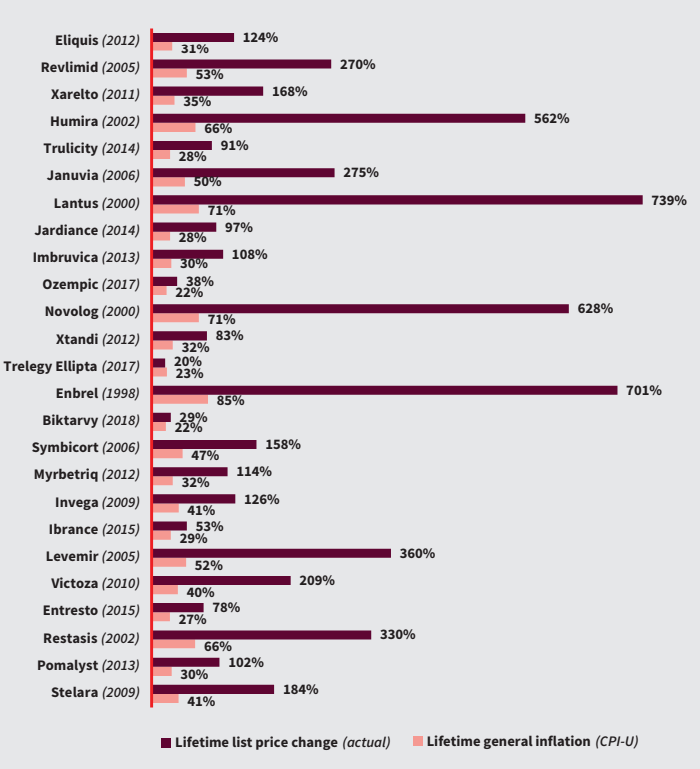
Lifetime list price increases greatly exceeds corresponding rate of inflation.png
(AARP Public Policy Institute analysis of data from the CMS' Medicare Part D Spending by Drug Dashboard and Medi-Span Price Rx Pro.)

“A lot less attention is paid to how those price increases are often building on top of a long line of price increases, and how those relentless price increases add up over time,” said Purvis.

Among the 25 drugs analyzed, prices were shown to increase more dramatically the longer they are on the market. Drugs sold for 20 or more years rose in price by 592%, while drugs on the market for less than 12 years accounted for a 58% increase in price.

Drug list prices increase dramatically the longer a product is on the market
(AARP Public Policy Institute analysis of data from the Centers for Medicare & Medicaid Services’ Medicare Part D Spending by Drug Dashboard and Medi-Span Price Rx Pro.)

She said that people on Medicare prescription drug plans take, on average, four to five prescription drugs per month. These drugs are often covered using coinsurance, or people are bearing the full responsibility on their own if they do not have health insurance. Oftentimes, with such staggering price increases resulting in drug costs to rise by thousands of dollars, customers must choose between medication or food and gas.

To address these choices customers must make, Congress passed the Inflation Reduction Act, which includes a provision that requires drug companies to pay a rebate to Medicare if their prices increase faster than inflation. This will reduce enrollee and Medicare spending by billions of dollars.

The analysis was released on the backdrop of the Centers for Medicare & Medicaid Services' upcoming announcement that it's expected to name the first 10 drugs to be negotiated by Medicare.

https://www.fiercehealthcare.com/payers/here-are-25-medicare-part-d-drugs-have-skyrocketed-price

J&J Janssen Akeega Gets FDA Approval to Treat Prostate Cancer

 Janssen Pharmaceutical said Friday that the Food and Drug Administration approved Akeega as a treatment for a specific type of prostate cancer.

Akeega, or niraparib and abiraterone acetate, was approved as a treatment for BRCA-positive metastatic castration-resistant prostate cancer, the Johnson & Johnson unit said. About 10% to 15% of patients with mCRPC have BRCA gene alterations, making them more likely to experience poor outcomes and a shorter survival time, the company said.

The approval was based on results from a Phase 3 study. The company said in BRCA-positive patients treated with Akeega plus prednisone, 47% risk reduction was observed for radiographic progression-free survival.

https://www.marketscreener.com/quote/stock/JOHNSON-JOHNSON-4832/news/Janssen-Pharmaceutical-Akeega-Gets-FDA-Approval-to-Treat-Prostate-Cancer-Patients-44595994/

Kura Oncology started at Buy by B of A

 Target $31

https://finviz.com/quote.ashx?t=KURA&ty=c&ta=1&p=d

Procept started at Overweight by Piper

 Target $42

https://finviz.com/quote.ashx?t=PRCT&ty=c&ta=1&p=d

Marinus cut to Perform from Outperform by Oppenheimer

 Target to $9 from $14

https://finviz.com/quote.ashx?t=MRNS&ty=c&ta=1&p=d

Apellis Pharmaceuticals Unusual Options Activity For August 11

 Someone with a lot of money to spend has taken a bullish stance on Apellis Pharmaceuticals 

.

And retail traders should know.

We noticed this today when the big position showed up on publicly available options history that we track here at Benzinga.

Whether this is an institution or just a wealthy individual, we don't know. But when something this big happens with APLS, it often means somebody knows something is about to happen.

Today, Benzinga's options scanner spotted 10 options trades for Apellis Pharmaceuticals.

This isn't normal.

The overall sentiment of these big-money traders is split between 80% bullish and 20%, bearish.

Out of all of the options we uncovered, there was 1 put, for a total amount of $43,200, and 9, calls, for a total amount of $449,577..

What's The Price Target?

Taking into account the Volume and Open Interest on these contracts, it appears that whales have been targeting a price range from $25.0 to $50.0 for Apellis Pharmaceuticals over the last 3 months.

Volume & Open Interest Development

In terms of liquidity and interest, the mean open interest for Apellis Pharmaceuticals options trades today is 2394.5 with a total volume of 7,262.00.

In the following chart, we are able to follow the development of volume and open interest of call and put options for Apellis Pharmaceuticals's big money trades within a strike price range of $25.0 to $50.0 over the last 30 days.

Apellis Pharmaceuticals Option Volume And Open Interest Over Last 30 Days

Biggest Options Spotted:

SymbolPUT/CALLTrade TypeSentimentExp. DateStrike PriceTotal Trade PriceOpen InterestVolume
APLSCALLSWEEPBULLISH09/15/23$25.00$106.8K757199
APLSCALLSWEEPBULLISH08/18/23$30.00$81.1K2.6K1.4K
APLSCALLTRADENEUTRAL09/15/23$25.00$48.6K757364
APLSCALLSWEEPBEARISH09/15/23$35.00$46.5K2.4K400
APLSCALLSWEEPBULLISH08/18/23$35.00$43.3K4.5K1.6K

Where Is Apellis Pharmaceuticals Standing Right Now?

  • With a volume of 5,858,001, the price of APLS is up 14.24% at $30.86.
  • RSI indicators hint that the underlying stock is currently neutral between overbought and oversold.
  • Next earnings are expected to be released in 87 days.

What The Experts Say On Apellis Pharmaceuticals:

  • HC Wainwright & Co. downgraded its action to Buy with a price target of $82
  • Citigroup has decided to maintain their Buy rating on Apellis Pharmaceuticals, which currently sits at a price target of $80.
  • Baird has decided to maintain their Outperform rating on Apellis Pharmaceuticals, which currently sits at a price target of $70.
  • Wedbush has decided to maintain their Neutral rating on Apellis Pharmaceuticals, which currently sits at a price target of $29.
  • HC Wainwright & Co. downgraded its action to Buy with a price target of $82

Cause of Common Gastrointestinal Symptoms in Diabetes?

 Exocrine pancreatic insufficiency (EPI) may be more common in both type 1 and type 2 diabetes than is currently appreciated, a new literature review suggests.

The condition ― in which the pancreas fails to produce sufficient enzymes to fully digest food ― can cause gastrointestinal symptoms, including steatorrhea or other stool changes, bloating, and/or abdominal pain. The gold standard test for diagnosis is a 72-hour fecal fat quantification test, but fecal elastase-1 is a less invasive and reliable alternative; values of less than 200 Ig/g indicate EPI. Treatment is pancreatic enzyme replacement therapy (PERT), taken with every meal.

EPI occurs in up to 90% of people with cystic fibrosis and chronic pancreatitis and is commonly associated with acute pancreatitis, autoimmune pancreatitis, and pancreatic cancer. However, those conditions are relatively rare compared to diabetes, yet the EPI association with diabetes is less well-studied, Dana M. Lewis, BA, points out in her review article.

While the data vary across studies, owing to differences in inclusion and exclusion criteria, the overall median prevalence of EPI was 33% among patients with type 1 diabetes (range, 14% to 77.5%) and 29% among patients with type 2 diabetes (range, 16.8% to 49.2%), Lewis reports in the article, which was published recently in Diabetes Technology and Therapeutics.

"Cumulatively, this suggests there may be significant numbers of people with diabetes with EPI who are undiagnosed. People with diabetes who present with gastrointestinal symptoms ― such as steatorrhea or changes in stool, bloating, and/or abdominal pain ― should be screened for EPI. Diabetes specialists, gastroenterologists, and primary care providers should be aware of the high rates of prevalence of diabetes and EPI and recommend fecal elastase-1 screening for people with diabetes and GI symptoms," Lewis writes.

Since the publication of her aricle, Lewis told Medscape, "I've gotten feedback from multiple diabetes and general providers that they will be changing their practice as a result of this paper, by screening people with diabetes who have GI symptoms for EPI, which is wonderful to hear."

In addition, she noted that since she began blogging about EPI and diabetes last year following her own delayed diagnosis, "I have had at least half a dozen people with diabetes tell me that they've since sought screening for EPI after years of GI symptoms and ended up being diagnosed with EPI as well."

Asked to comment, Romesh Khardori, MD, PhD, told Medscape Medical News, "it would be prudent to investigate EPI and treat it when confirmed. Consultation with a gastroenterologist colleague may be helpful. Treatment is quite rewarding."

Data Limitations; and Don't Forget Celiac Disease and Gastroparesis

However, as does Lewis, Khardori points to the limitations of the current literature.

"This review suffers from the lack of uniformity amongst the studies in terms of diagnosis and documentation of exocrine pancreatic insufficiency. Many studies lack a control group to draw any meaningful conclusions. Correlations with duration of diabetes, age of onset, symptoms and glycemic control were mostly lacking," says Khardori, now retired but formerly professor of medicine: endocrinology and metabolism at Eastern Virginia Medical School in Norfolk.

In general, the data suggest that PERT is safe and effective for people with diabetes and that it may reduce glycemic variability. However, "there are not many studies looking at glucose outcomes in detail, and only one study that has used CGM [continuous glucose monitoring] data, so this is a big area of need for future study," Lewis told Medscape.

Lewis also reviewed the literature on the prevalence of two other diabetes-related gastrointestinal conditions, celiac disease and gastroparesis, "because anecdotally, it seems as though diabetes care providers and people with diabetes are more aware of those as causes of GI symptoms."

In type 1 diabetes, the prevalence of both celiac disease and gastroparesis are reported at about 5%, in contrast to the 33% for EPI. Similarly, in type 2 diabetes, the reported prevalence of these two conditions are 1.3% and 1.6%, respectively, vs 29% for EPI.

"This suggests to me that there is likely disproportionate screening for things like celiac [disease] and gastroparesis in diabetes, and that screening for EPI when people with diabetes present with GI symptoms is warranted," Lewis said.

However, Khardori cautioned that those conditions may also be missed, noting, "Celiac disease often is undiagnosed and gastropathy or gastroparesis may be overlooked in a busy primary care clinic where most patients with diabetes mellitus get their care."

Lewis and Khardori have disclosed no relevant financial relationships.

Diabetes Technol Ther. Published online July 13, 2023. Abstract

https://www.medscape.com/viewarticle/995377