Search This Blog

Monday, August 28, 2023

Migrant smugglers wearing body armor and shooting at border agents: officials

Migrant smugglers are growing increasingly desperate and violent — heavily arming themselves, donning body armor and even firing at US border agents — to get their illegal customers from Mexico to California.

The recent uptick in drastic tactics by coyotes, or people-smugglers for hire, includes an Aug. 18 incident in which a Border Patrol agent tried to stop a group of migrants crossing into California through the Otay Mountain Wilderness, US authorities said.

A suspected smuggler fired multiple shots at the agent, US Customs and Border Protection said in a statement, claiming the criminals’ desperation is being driven by the agency’s efforts to crack down.

When fellow agents responded to the shots, they could see the muzzle flashes coming from the migrant group, with a second volley of gunfire aimed at the officers, authorities said.

The agents quickly took cover as the migrant group ran back into Mexico. No agents were reported injured as a result of the incident.

“Smuggling organizations are becoming desperate and escalating their level of violence because of the work being performed by U.S. Border Patrol agents,” said San Diego Sector Chief Patrol Agent Patricia McGurk-Daniel in a statement.

Armed individuals have been repeatedly spotted along the Otay Mountain Wilderness border fence in California.
Customs and Border Protection
A group of migrants were dropped off by smugglers along the southern border last Wednesday.
Daniel William McKnight

“Our agents are preventing smugglers from conducting their illicit business and this is their very dangerous response,” McGurk-Daniel said. “This callous display clearly shows that smugglers do not care about the safety of migrants or law enforcement.”

Just days after the shooting incident, on Aug. 22, a US National Guard officer spotted an armed individual climbing over the border fence in the Otay Mountain Wilderness.

Then a day later, two more armed suspects were seen in the area. But a sweep by border agents came up empty.

Officials have warned that as the crackdown on illegal crossing intensifies, so too does the response from people smugglers.
Daniel William McKnight
Both US and Mexican border patrol officers have seen an increase in armed smugglers bringing migrants across the border.
Both US and Mexican border officers have seen an increase in armed smugglers bringing migrants across the border.
Mark Peterson

US and Mexican officials said they are coordinating to try to capture the armed individuals.

“These incidents and individuals pose a significant danger to agents patrolling the area as well as migrants attempting to illegally enter,” McGurk-Daniel said.  

The joint effort comes as Mexico’s Institute of Migration warned that its agents cracking down on illegal border crossings have come across heavily armed smugglers in recent months, adding that they, too, have seen coyotes fire at border agents.

Earlier this month, a trio of men were spotted crossing the border into Texas wielding rifles and outfitted with body armor.

In a similar incident in June, five suspected members of the Cartel Del Noreste were arrested in the same area after illegally crossing the border armed with rifles and tactical gear. 

https://nypost.com/2023/08/28/migrant-smugglers-becoming-desperate-don-body-armor-and-shoot-at-border-agents-officials/

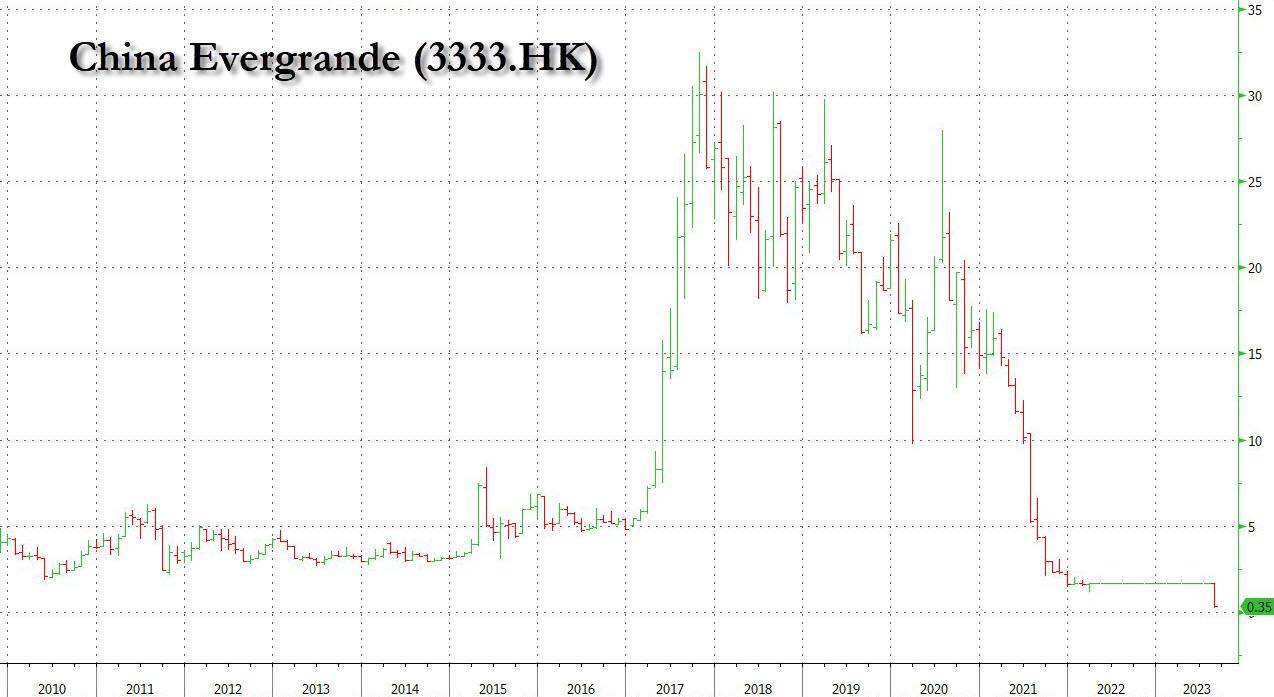
Bankrupt Evergrande Crashes As Much As 87% After Resuming Trading Following 17 Month Halt

 Shares of bankrupt (former) Chinese property giant, Evergrande Group, crashed 79% on Monday, their first trading day following a suspension of more than 17 months. The stock of the embattled real estate developer - which trade in Hong Kong under what was supposed to be the "lucky" ticker 3333 - opened 87% lower and ended the day at 0.35 Hong Kong dollars. Trading had been halted since March 21, 2022, when shares were priced at HK$1.65. Evergrande was the most traded stock in Hong Kong on Monday, with about 1.85 billion shares changing hands.

Evergrande said that a meeting with creditors to discuss offshore debt restructuring has been pushed back from Monday to Sept. 26 citing various reasons for the delay, including "numerous media reports which have wholly mischaracterized the restructuring recognition under Chapter 15" of the U.S. bankruptcy code.

As reported previously, the company filed for bankruptcy protection in a New York court on Aug. 17, a technicality since the company had defaulted on its debt almost two years earlier. The company's bonds remain frozen and do not trade in the secondary market.

Evergrande was once China's largest real estate developer but defaulted on a number of debt obligations, leaving homeowners with unfinished homes and suppliers with unpaid bills. As Nikkei reports, the company applied for the trading suspension to be lifted on Friday evening after it said it had cleared various conditions set by the Hong Kong Exchange, including the release of financial reports.

The results for the first six months of the year were announced Sunday night, with the company reporting a net loss of 33.01 billion yuan ($4.53 billion), better than the 66.35 billion yuan loss a year ago, but still catastrophic. Then again since Evergrande is bankrupt and insolvent, it hardly matters.

The distressed developer posted long-overdue annual earnings reports for the last two years on Aug. 16, revealing a combined net loss of a record 581.94 billion yuan, a reversal from 8.07 billion yuan in net profit in 2020 prior to a crackdown by Beijing on the industry.

The company said in its Sunday night filing that its financial status is still precarious. Its total cash and cash equivalents, including restricted cash, was 13.38 billion yuan as of the end of June, while net current liabilities were 713.10 billion yuan. The company also said that "it is involved in various litigation and arbitration cases for various reasons."

Its electric vehicle unit China Evergrande New Energy Vehicle Group on Friday night separately announced a net loss of 6.86 billion yuan for the first six months of the year, compared to a net loss of 13.36 billion yuan a year ago. Similar to its parent, the EV subsidiary's financial position remains strained, as its cash and cash equivalents including restricted cash came to 117 million yuan as of the end of June, while its net current liabilities stood at 36.61 billion yuan.

The company also revealed that it has 9.34 billion yuan of unpaid debt and 3.59 billion yuan of overdue commercial bills, and has 48 pending litigation cases involving 10.88 billion yuan.

As part of the financial restructuring, China Evergrande Group has proposed selling part of the EV unit to NWTN (Zhejiang) Automobile, a Nasdaq-listed, Dubai-headquartered mobility product company founded by Chinese entrepreneur Alan Nan Wu.

NWTN is willing to acquire 27.5% of the enlarged share capital of Evergrande's EV unit for HK$3.88 billion to "support [the] business recovery and growth" of Evergrande Group. The new shares will be issued at HK$0.6297 apiece, representing a 63% discount to the stock price when the agreement was signed on Aug. 14.

Evergrande Group and its major shareholders, including founder Xu Jiayin, also known as Hui Ka-yan, have also agreed to convert their loans into a total of 5.44 billion new shares, at a price of HK$3.84 a piece. The Hong Kong-listed shares of the EV unit closed at HK$1.22 on Monday.

https://www.zerohedge.com/markets/bankrupt-evergrande-crashes-much-87-after-resuming-trading-following-17-month-halt

'Number of People With Long COVID Could Be Vastly Underestimated'

 It's been estimated that up to one third of people who survive acute SARS-CoV-2 infection will suffer a post-viral syndrome with lingering neurologic and other symptoms — now known as long COVID or neurological postacute sequelae of SARS-CoV-2 infection (Neuro-PASC).

However, new research suggests that may be an underestimate and that far more people may be suffering from long COVID without ever having tested positive for the virus. Researchers found a significant proportion of patients in their small study who had never tested positive for COVID-19 but who were having symptoms of long COVID nevertheless showed evidence of immune responses consistent with previous exposure.

"We estimate that millions of people got COVID in the US during the first year of the pandemic and then developed long COVID, yet they did not get a positive COVID diagnosis because of testing limitations," Igor J. Koralnik, MD, of Northwestern Medicine Comprehensive COVID-19 Center in Chicago, Illinois, told Medscape Medical News.

He noted that many post-COVID-19 clinics in the US don't accept people with long COVID symptoms who do not have a positive test result.

Patients with long COVID symptoms but without laboratory evidence of prior infection, "who have often been rejected and stigmatized, should feel vindicated by the results of our study," Koralnik said.

"We think that those patients deserve the same clinical care as those with a positive test, as well as inclusion in research studies. This is what we are doing at Northwestern Medicine's Comprehensive COVID[-19] Center," Koralnik added.

The study was published online August 23 in the journal Neurology: Neuroimmunology & Neuroinflammation.

Delayed Care

The researchers measured SARS-CoV-2-specific humoral and cell-mediated immune responses against nucleocapsid protein and spike proteins, which indicate a prior COVID-19 infection, in 29 patients with post-viral syndrome after suspected COVID-19, including neurologic symptoms such as cognitive impairment, headache, and fatigue, but who did not have a confirmed positive COVID-19 test.

They did the same in 32 age- and sex-matched people with long COVID with confirmed Neuro-PASC and 18 healthy controls with none of the symptoms of long COVID and no known exposure to SARS-CoV-2 or positive test result.

They found that 12 of the 29 patients (41%) with post-viral syndrome (but no positive COVID-19 test) had detectable humoral and cellular immune responses consistent with prior exposure to SARS-CoV-2. Three-quarters harbored antinucleocapsid and 50% harbored antispike responses.

"Our data suggest that at least 4 million people with post-viral syndrome similar to long COVID may indeed have detectable immune responses to support a COVID diagnosis," Koralnik said in a news release.

The 12 patients with post-viral syndrome but without a confirmed COVID-19 test had similar neurologic symptoms as those with confirmed Neuro-PASC. 

However, lack of a confirmed COVID-19 diagnosis likely contributed to the 5-month delay in the median time from symptom onset to clinic visit, the researchers said. They were evaluated at a median of 10.7 months vs 5.4 months for Neuro-PASC patients.

Koralnik told Medscape Medical News the "most important take-home message" of the study is that patients with post-viral syndrome often present with similar clinical manifestations as confirmed patients with Neuro-PASC, suggesting that a positive result by commercially available SARS-CoV-2 diagnostic test should not be a prerequisite for accessing care.

Patients with post-viral syndrome may benefit from the same clinical care as confirmed patients with Neuro-PASC, and the absence of a positive SARS-CoV-2 test should not preclude or delay treatment, he added.

The study had no specific funding. The authors report no relevant financial relationships.

Neurol Neuroimmunol Neuroinflammation. Published online August 23, 2023. Full text.

https://www.medscape.com/viewarticle/995895

'Severe COVID May Cause Long-Term Cellular Changes: Study'

 Severe COVID infections may lead to lasting damage to the immune system, new research finds.

The small study, published in Cell and funded by the National Institutes of Health, details how immune cells were analyzed through blood samples collected from 38 patients recovering from severe COVID and other critical illnesses, and from 19 healthy people. Researchers from Weill Cornell in New York and the Jackson Laboratory in Connecticut found, through isolating hematopoietic stem cells, that people recovering from severe bouts of COVID had changes to their DNA that were passed down to offspring cells.

The research team, led by Steven Josefowicz, PhD, of Weill Cornell's pathology department, and Duygu Ucar, PhD, an associate professor at The Jackson Laboratory for Genomic Medicine, discovered that this chain reaction of stem cell changes caused a boost in the production of monocytes. The authors found that, due to the innate cellular changes from a severe case of COVID, patients in recovery ended up producing a larger amount of inflammatory cytokines, rather than monocytes — distinct from samples collected from healthy patients and those recovering from other critical illnesses.

These changes to patients' epigenetic landscapes were observed even a year after the initial COVID-19 infection. While the small participant pool meant that the research team could not establish a direct line between these innate changes and any ensuing health outcomes, the research provides us with clues as to why patients continue to struggle with inflammation and long COVID symptoms well after they recover.

While the authors reiterate the study's limitations and hesitate to make any clear-cut associations between the results and long-term health outcomes, Wolfgang Leitner, PhD, from the NIH's National Institute of Allergy and Infectious Diseases, predicts that long COVID can, at least in part, be explained by the changes in innate immune responses.

"Ideally, the authors would have had cells from each patient before they got infected, as a comparator, to see what the epigenetic landscape was before COVID changed it," said Leitner. "Clear links between the severity of COVID and genetics were discovered already early in the pandemic and this paper should prompt follow-up studies that link mutations in immune genes with the epigenetic changes described here."

Leitner said he had some initial predictions about the long-term impact of COVID-19, but he had not anticipated some of what the study's findings now show.

"Unlike in the case of, for example, influenza, where the lungs go into 'repair mode' after the infection has been resolved — which leaves people susceptible to secondary infections for up to several months — this study shows that after severe COVID, the immune system remains in 'emergency mode' and in a heightened state of inflammation," said Leitner.

"That further aggravates the problem the initial strong inflammation causes: even higher risk of autoimmune disease, but also, cancer."

Commenting on the findings, Eric Topol, MD, editor-in-chief of Medscape Medical News, said the study presents "evidence that a key line of immune cells are essentially irrevocably, epigenetically altered and activated."

"You do not want to have this [COVID]," he added.

The study also highlights the researchers' novel approach to isolating hematopoietic stem cells, found largely in bone marrow. This type of research has been limited in the past because of how costly and invasive it can be to analyze cells in bone marrow. But, by isolating and enriching hematopoietic stem cells, the team can decipher the full cellular diversity of the cells' bone marrow counterparts.

"This revelation opened the doors to study, at single-cell resolution, how stem cells are affected upon infection and vaccination with a simple blood draw," representatives from the Jackson Lab said in a press release.

https://www.medscape.com/s/viewarticle/995905

More Weight Loss Linked With More Benefit in STEP-HFpEF Trial

 The more weight patients lost while on weekly semaglutide treatment in the STEP-HFpEF trial, the better their outcomes, suggesting that weight loss by itself was a major reason why the treatment improved a broad range of prespecified study outcomes, including symptoms and physical limitations, exercise capacity, and inflammation, new analyses from the trial show.

At the 2023 Congress of the European Society of Cardiology where he presented these new findings, Mikhail N. Kosiborod, MD, also posited that weight loss produced by weekly subcutaneous injections of 2.4 mg semaglutide (Wegovy) for 52 weeks in the study does not fully explain the multiple mechanisms that may be involved in producing this intervention's effects in the STEP-HFpEF trial.

His report earlier at the Congress and in a simultaneously published report of the trial's primary outcomes established a role for medically induced weight loss in managing patients with obesity-phenotype HFpEF in a total of 529 randomized individuals with HFpEF and obesity but without diabetes.

The new analyses showed that for one of the two primary endpoints — the change from baseline in patients' assessment on the Kansas City Cardiomyopathy Questionnaire Clinical Summary Score (KCCQ), the placebo-adjusted average change was a 16.1-point improvement in the 51 people with a 5%–10% weight loss during the 1-year study, and a 21.6-point improvement in the 58 who had at least a 20% weight loss, a between-group average 5.5 point difference that represents a clinically meaningful incremental improvement in this validated metric of symptoms and functional limitations.

Similar weight-related differences in benefit also occurred for the secondary outcomes of changes from baseline in 6-minute walk distance and in levels of C-reactive protein (CRP), a measure of systemic inflammation.

In an adjusted regression model, every 10% drop from baseline body weight was significantly linked with a 6.4-point improvement in KCCQ score, a 14.4 meter improvement in 6-minute walk distance, and a 28% relative reduction from baseline in CRP, reported Kosiborod, a cardiologist and co-director of the Haverty Cardiometabolic Center of Excellence at Saint Luke's Mid America Heart Institute in Kansas City, Missouri.

These new, prespecified analyses also showed that people with obesity and HFpEF responded roughly the same to semaglutide treatment compared with placebo-treated controls regardless of their starting BMI, including people with class 1 (30-34 kg/m2), class 2 (35-39 kg/m2), and class 3 (≥40 kg/m2) obesity.

Simultaneously with Kosiborod's report at the Congress, these findings also appeared in a report posted online in Nature Medicine.

Not Every Benefit Was Fully Mediated by Weight Loss

These analyses "do not tell us how much of the benefit was mediated by weight loss, but the data do say that the more weight a person lost, the more benefit they got," Kosiborod explained in an interview. "That is not the same as saying that everything is mediated by weight. It doesn't say that nothing beyond weight loss matters."

He and his associates are planning a mediation analysis of data from STEP-HFpEF that will more directly address this issue.

"It's likely that people who lost more weight with semaglutide also had greater benefits from other effects of semaglutide at the same time. Weight loss is a good surrogate marker" for the range of effects that a person receives from treatment with semaglutide, a glucagon-like peptide-1 (GLP-1) receptor agonist, Kosiborod said.

"GLP-1 receptor agonists may have direct effects on atherosclerosis, as well as other effects that are uncoupled from weight loss," such as proven anti-inflammatory effects, he added.

Another exploratory effect from semaglutide treatment in the study and reported by Kosiborod was a significant reduction in serum levels of N-terminal pro brain natriuretic peptide, an association never previously seen with weight loss in people with heart failure.

"The outcomes we've already seen in STEP-HFpEF were largely symptomatic, which are extraordinarily important, but there may be a completely different relationship between weight and clinical events," commented John E. Deanfield, PhD, a professor of cardiology at University College Hospital, London, who was not involved in the study.

Deanfield noted that important prognostic markers such as cholesterol levels and blood pressure reductions are usually not temporally related to weight loss. "The idea that [the benefits seen in STEP-HFpEF] are purely from weight loss is something we need to be careful about," he said.

"My gut feeling is that at least 75% of the effect [in STEP-HFpEF} was due to weight loss," commented Naveed Sattar, PhD, professor of metabolic medicine at the University of Glasgow, who was not associated with the research.

STEP-HFpEF was funded by Novo Nordisk, the company that markets semaglutide (Wegovy). Kosiborod has been a consultant and advisor to and has received honoraria from Novo Nordisk. He has also been a consultant to numerous other companies, received research grants from AstraZeneca, Boehringer Ingelheim, and Pfizer, honoraria from AstraZeneca, and is a stockholder in Artera Health and Saghmos Therapeutics. Deanfield has been a consultant to Novo Nordisk as well as to Aegerion, Amgen, Bayer, Boehringer Ingelheim, Merck, Novartis, Pfizer, Sanofi, and Takeda, and has received research funding from Aegerion, Colgate, MSD, Pfizer, and Roche. Sattar has been a consultant to Novo Nordisk as well as to Abbott, Amgen, AstraZeneca, Boehringer Ingelheim, Lilly, Novartis, Pfizer, and Roche Diagnostics.

European Society of Cardiology Congress 2023. Presented August 27, 2023.

New Engl J Med. Published online August 25, 2023. Abstract

Nat Med. Published online August 27, 2023. Full text


https://www.medscape.com/viewarticle/995903

THC Dose of Edible Cannabis Tied to Degree of Toxicity in Young Kids

 The tetrahydrocannabinol (THC) dose of edible cannabis correlated to the degree of toxicity in children under 6 years, a retrospective review showed.

Among 80 kids with a median age of 2.9 years, THC weight-based dose was a significant predictor of severe toxicity (adjusted OR 2.9, 95% CI 1.8-4.7) and prolonged toxicity (aOR 3.2, 95% CI 1.6-6.5), while patient age and sex were not, reported Lesley Pepin, MD, of Denver Health and Hospital Authority, and colleagues.

The area under the curve (AUC) was 92.9% for severe toxicity and 87.3% for prolonged toxicity, they noted in Pediatrics

opens in a new tab or window.

THC ingestions of at least 1.7 mg/kg can predict severe toxicity, with a sensitivity of 97.3%, and prolonged toxicity, with a sensitivity of 75.4%, they said.

"Ultimately, we propose that exposures exceeding 1.7 mg/kg of THC would benefit from being managed where pediatric services and prolonged observation or admission capabilities are available," Pepin and colleagues wrote. "Transfer to a tertiary facility could be avoided in children with smaller ingestions who do not require interventions beyond observation."

"Home observation through poison center guidance may require a larger safety margin and likely widespread improvement in cannabis regulations," they added.

Ingestion is the most common route of cannabis exposure in young children, the authors noted. Edible cannabis products are often sold in forms that may be difficult to distinguish from non-cannabis items, and include gummies, chocolate, candy, and baked goods.

rise in overall cannabis exposures

opens in a new tab or window in young children from 2017 through 2021 was largely due to ingesting edible cannabis products, "during which time a higher proportion of children required hospital admission, which suggests an increase in toxicity from these exposures," Pepin and colleagues wrote, noting that cannabis edibles "pose a heightened risk in this age group."

"Based on our bedside experience managing these cases as a toxicology service, we were surprised by the THC dose that predicts more severe and prolonged effects from cannabis," Pepin told MedPage Today in an email. "The 1.7 mg/kg threshold was lower than we expected."

"In Colorado, where we performed the study, the maximum THC content for a single recreational gummy edible is 10 mg," she noted. "A 3-year-old in the 50th percentile for weight may reach the 1.7 mg/kg threshold with only 2.5 edible gummies."

"It is important to note that regulations around cannabis products are very state/region dependent," she added. "Medicinal products can also have their own regulations. If a product was intended for medicinal use, a single edible may have a much higher THC content. If a product was purchased online or illegally, there is also a chance the labeled THC dose is unreliable."

Among the 80 cases of edible cannabis ingestion, 43% of patients did not require medical interventions; 76% of these patients ingested 2 mg/kg of THC or less. However, severe toxicity was present in 46% of cases. The median THC dose was 5.4 mg/kg in these patients, and the median duration of symptoms was 20.3 hours. Gummy edibles were responsible for 57% of these cases.

In 88% of cases, the child obtained a cannabis edible from home. In six cases, an edible was mistaken for a non-cannabis product and given to the child, and in two cases, there was co-exposure to another medication.

The median length of stay was 6.1 hours for patients who were discharged from the emergency department, and 24 hours for patients who were admitted.

Sedation or lethargy was the most commonly reported symptom, affecting 85% of patients. No patients received gastrointestinal decontamination.

Timing of signs or symptoms was estimated in 83% of 72 symptomatic patients, with a median onset time of 1 hour.

Neurologic effects accounted for 76% of presentations among patients with severe toxicity. Sixty-five percent of patients had more than one system that met the severe toxicity definition, and the remaining 13 patients had supplemental oxygen requirements (four), hypotension requiring intravenous fluids (two), and severe neurologic effects (seven).

Median onset to severe toxicity was estimated in 84% of cases, and was within 2.3 hours. Seventy-four percent of patients demonstrated prolonged toxicity, with a median THC dose of 3.7 mg/kg.

"The THC dose ingested can be used to risk stratify patients in this age group, with ingestions exceeding 1.7 mg/kg being more likely to develop severe and prolonged toxicity," Pepin and colleagues concluded.

"This threshold should be considered in both medical management decisions and development of marijuana regulations," they added.

Of 325 pediatric hospital network encounters for cannabis exposures in kids under age 6 from January 2015 through October 2022, 80 patients met inclusion criteria for this study. Median patient age was 2.9 years, and the group was split evenly by sex. THC dose ranged from 0.2 mg/kg to 69.1 mg/kg, with a median dose of 2.1 mg/kg. Of the edible cannabis types, 61% were gummies and 23% were chocolate.

The study population reflected the most common pediatric age group that unintentionally ingests edibles, but excluded other age groups, Pepin and team noted, which was a limitation.

Additionally, there may have been errors in parent or guardian reporting, and though there are quality mandates in place for THC dose accuracy, the FDA has not approved federal testing requirements or standards, they added.

Furthermore, not all patients had confirmatory testing to prove cannabis exposure, and the retrospective study design was limited by the completeness of medical chart documentation.

Disclosures

This study had no external funding.

Pepin had no disclosures. A co-author disclosed relationships with the Cannabis Research and Policy Project through the University of Colorado School of Public Health and UpToDate, in addition to being a co-investigator/consultant for NIH-funded work on assessing cannabis-impaired driving.

Primary Source

Pediatrics

Source Reference: opens in a new tab or windowPepin LC, et al "Toxic tetrahydrocannabinol (THC) dose in pediatric cannabis edible ingestions" Pediatrics 2023; DOI: 10.1542/peds.2023-061374.


https://www.medpagetoday.com/pediatrics/generalpediatrics/106069

Bronny James has congenital heart defect, expected to return 'in very near future'

 USC freshman guard Bronny James, the son of Los Angeles Lakers star LeBron James, is expected to return to the court "in the very near future" after suffering cardiac arrest during a workout in July, a family spokeswoman said in a statement Friday.

The likely cause of Bronny James' cardiac arrest was a congenital heart defect, which was identified after an initial evaluation at Cedars-Sinai Medical Center in Los Angeles and follow-up evaluations at the Mayo Clinic and the Atlantic Health-Morristown Medical Center in New Jersey, according to the spokeswoman.

A congenital heart defect is a broad term referring to any abnormality of heart structure that is present from birth, which results when the heart, or blood vessels near the heart, doesn't develop normally before birth.

"It is an anatomically and functionally significant Congenital Heart Defect which can and will be treated," the family spokeswoman said. "We are very confident in Bronny's full recovery and return to basketball in the very near future. We will continue to provide updates to media and respectfully reiterate the family's request for privacy."

James was discharged from Cedars-Sinai in Los Angeles three days after going into cardiac arrest July 24 at USC's Galen Center.

The incident happened nearly a year to the day after Trojans center Vincent Iwuchukwu collapsed during a workout because of a heart ailment. Iwuchukwu returned to the court in January and played in 14 games as a freshman.

James, who arrived at USC in May as a five-star prospect, was projected to be a first-round pick in next summer's NBA draft and possibly play with his father at the next level.

The Trojans are expected to compete for a Pac-12 title and a spot in the NCAA tournament. Along with the arrival of James, USC returns veteran Boogie Ellis and added Isaiah Collier, who was ESPN's No. 1 recruit in the 2023 class.

https://www.espn.com/mens-college-basketball/story/_/id/38260006/bronny-james-cardiac-arrest-caused-congenital-heart-defect