Search This Blog

Tuesday, August 29, 2023

CMS Names First 10 Drugs for Medicare Drug Price Negotiations

 The Centers for Medicare and Medicaid Services identified on Tuesday the first 10 prescription medicines that will be affected by Medicare’s Drug Price Negotiation Program under the Inflation Reduction Act.

Signed into law by President Joe Biden in August 2022, the Inflation Reduction Act (IRA) aims to generate some $25 billion in drug cost savings for the U.S. government over the next eight years. To this end, the IRA enables CMS to renegotiate prices for some of the most widely prescribed medications, which will take effect in 2026.

Tuesday’s list of the first 10 prescription medicines that will be affected by the Drug Price Negotiation Program—in order of gross Medicare Part D spending from June 2022 to May 2023—includes:

  • BMS’ Eliquis (apixaban), used for the prevention and treatment of blood clots
  • Eli Lilly’s Jardiance (empagliflozin), indicated for heart failure and diabetes
  • J&J’s Xarelto (rivaroxaban), also used for blood clots and for reducing stroke risk
  • Merck’s Januvia (sitagliptin), a diabetes drug
  • AstraZeneca’s Farxiga (dapagliflozin), also for heart failure and diabetes, as well as chronic kidney disease
  • Novartis’ Entresto (sacubitril/valsartan), a heart failure drug
  • Amgen’s Enbrel (etanercept), approved for psoriasis, rheumatoid arthritis and psoriatic arthritis
  • J&J’s Imbruvica (ibrutinib), used to treat blood cancers
  • J&J’s Stelara (ustekinumab), also indicated for psoriasis and psoriatic arthritis, as well as Crohn’s disease and ulcerative colitis
  • Novo Nordisk’s Fiasp and NovoLog, insulin products indicated for diabetes

“For the first time, the law provides Medicare the ability to directly negotiate the prices of certain high expenditure, single source drugs without generic or biosimilar competition,” CMS said in Tuesday’s announcement.

In choosing these medicines, the agency looked at therapies that had the highest total Part D gross coverage, particularly those without generic or biosimilar competition. Collectively, these medicines cost the U.S. government some $50 billion from June 2022 to May 2023, according to a CMS factsheet posted Tuesday.

J&J in an emailed statement to BioSpace said the IRA’s price control provisions “will constrain medical innovation, limit patient access and choice, and negatively impact overall quality of care,” adding that “seniors could face bureaucratic barriers to access and potentially higher out of pocket costs even with the IRA’s out-of-pocket cost limits for Part D drugs.”

While Novo Nordisk in statement said it “supports policies to ensure patients can afford their medicines,” the company has “seen CMS take aggressive steps to carry out unilateral price setting without consideration for the impact on patients living with chronic disease or the overall healthcare system.”

In an emailed statement to BioSpace, Merck said that these “price-setting provisions are bad policy that will stifle the U.S. biopharmaceutical sector’s research and development and have potentially devastating consequences for the millions of patients who need new therapeutic options.” 

However, Mara Goldstein, managing director of Mizuho Securities, told BioSpace in an emailed comment that the impact of the Medicare Drug Price Negotiation Program on Merck would likely be “limited” given that Januvia is set to lose its exclusivity in 2026.

“We’d note that other drugs on this list also lose exclusivity suggesting minimal commercial impact,” Goldstein said. “Our expectation was that the list would be focused on metabolic/diabetes and other chronic use medications so we were not surprised to see the complexion of this list.”

CMS also excluded certain orphan drugs and products coming from small biotech companies from its initial list.

Biopharma companies have challenged the IRA’s Drug Price Negotiation Program, by questioning the law’s constitutionality and flagging its potentially chilling effects on innovation. Merck started the legal salvo in June 2023 when it filed the first lawsuit seeking to block the program. It has since been followed by BMSJ&J and AstellasBoehringer Ingelheim and AstraZeneca.

Novartis shared a similar sentiment in an emailed statement to BioSpace calling the IRA’s negotiation provision “unconstitutional.”

https://www.biospace.com/article/cms-names-first-10-drugs-for-medicare-drug-price-negotiations/

Walmart cuts pharmacist pay, hours while workload piles up

 Walmart is asking some of its 16,000 pharmacists across the U.S. to voluntarily take pay cuts by reducing their working hours in a bid to lower costs, a person familiar with the matter told Reuters.

The cuts, which haven't been previously reported and are aimed at pharmacists in higher wage brackets, highlight the new pressures at Walmart pharmacies, where shoppers are lining up to buy weight-loss drugs that drag on profits, despite their high price.

Walmart also has agreed to pay $3.1 billion as its share of an opioid-related legal settlement, which is adding to its legal costs this year.

The retailer's shares were up nearly 1% in afternoon trading on Tuesday. The company's shares have risen 12% this year, far outperforming the broader Dow Jones Industrial Average's 4.26% increase over the same period, as it becomes the retailer of choice for bargain-minded shoppers navigating steep inflation.

At a meeting in May, senior Walmart field leadership asked 20 market leaders - directors of 10 to 15 stores in a given area - to start asking pharmacists to voluntarily reduce their base salary hours, the source told Reuters.

For example, a pharmacist could go from an 80-hour, two-week pay period to one lasting 64 or 72 hours, said the source, who attended the meeting and spoke on condition of anonymity.

The market leaders who attended the meeting represented Arkansas, Tennessee, Missouri, Alabama, Georgia, Florida and Louisiana, though the move was presented as a nationwide one, the person said.

Leaders were asked to start hiring pharmacists at lower base salaries, the source said, adding that the moves were being led by Davey Lavergne, Walmart's vice president of Health and Wellness.

On average, the Bentonville, Arkansas-based retail chain pays its pharmacists more than $140,000 a year, excluding bonuses and incentives, according to Walmart.

Walmart confirmed to Reuters that it was reducing the amount of hours it was offering some pharmacists, citing a dropoff in demand for drugs during the summer and requests from pharmacists for a better work-life balance.

Tivic Health Signs Agreement with AmerisourceBergen for Retail Pharmacy Customers

 Tivic Health® Systems, Inc. ("Tivic", "Company", Nasdaq: TIVC), a health tech company that develops and commercializes bioelectronic medicine, today announced that the Company has entered into a non-exclusive agreement with AmerisourceBergen, soon to be Cencora, to make Tivic’s products available on AmerisourceBergen’s third-party marketplace.

Tivic’s patented ClearUP bioelectronic sinus pain relief device will be offered on AmerisourceBergen Marketplace, the company’s new third-party marketplace, which launched on August 8. Marketplace seamlessly integrates into AmerisourceBergen’s existing ABC Order eCommerce platform, with the goal of creating a faster, more convenient shopping experience for its retail pharmacy customers to procure their storefronts. Tivic joins more than 50 verified suppliers on the Marketplace platform, which offers eligible pharmacies a variety of unique products in categories such as beauty, snacks, toys, personal care, and other everyday essentials all in one place.

https://finance.yahoo.com/news/tivic-health-signs-agreement-amerisourcebergen-130000958.html

iCoreConnect Clarification Regarding Trading of Common Stock, Warrants and Preferred

  iCoreConnect Inc. (Nasdaq: ICCT) (“iCore” or the “Company”), a leading cloud-based software and technology company focused on increasing workflow productivity and customer profitability through its enterprise and healthcare workflow platform, previously announced the closing of its business combination with FG Merger Corp. (“FGMC”) (Nasdaq: FGMC), a special purpose acquisition corporation.

As part of the business combination:

  • ICCT shares on the OTC Market have been converted into shares of common stock of the combined entity, which will operate as iCoreConnect Inc. and will commence trading on The Nasdaq Capital Market under the ticker symbol “ICCT” on August 28, 2023.

  • Every 29.84 shares of ICCT outstanding prior to the closing received one share of the combined company, an equivalent share price of $5.71 based on the August 25, 2023 close price of $0.19 per share for ICCT common stock.

  • FGMC common stock that was not redeemed in connection with the business combination was exchanged for preferred stock of the combined company that will trade on the OTC market. Details of the preferred stock include:

    • 12% coupon payable in (a) cash or paid-in-kind for the first 24 months after the close of the transaction and (b) cash thereafter.

    • The initial conversion price from common stock to preferred stock was at a conversion price of $10.00 per share.

    • Investors holding the preferred stock have downside protection for the first 12 months, as the conversion price will be reset based on the trading price of ICCT common stock after one year. The reset price can be no greater than $10.00 per share, and no less than $2.00 per share (the calculation of the reset price will be 20% above the simple average of the volume weighted average price on the 20 trading days following the first 12 months of the preferred stock).

    • The preferred stock is perpetual and investors will not be forced to convert unless, after 24 months from the closing of the business combination, the common stock of the combined entity exceeds 140% of the conversion price then in effect.

    • Downside protection is further reinforced by a $10 per share liquidation preference (plus any accrued and unpaid dividends) that places preferred stock holders above common stock holders in the event of a sale or liquidation scenario.

  • FGMC warrants have been converted into warrants for preferred stock of the combined company that will trade on the OTC market.

  • Common stock, warrants and preferred stock of the combined company will each begin trading under a new CUSIP and ISIN (International Securities Identification Number) on August 28, 2023. The new identifiers are:

Axcella Granted Patent for Long COVID Fatigue Treatment

 Axcella Therapeutics (Nasdaq: AXLA), a clinical-stage biotechnology company focused on pioneering a new approach to address the biology of complex diseases using compositions of endogenous metabolic modulators (EMMs), today announced that the U.S. Patent and Trademark Office (USPTO) has granted U.S. Patent No. 11,737,999 with claims covering methods of use of Candidate AXA1125, for treating a subject having post-acute sequelae of COVID-19 (PASC), a/k/a Long COVID, particularly fatigue. The patent was issued on August 29, 2023, with anticipated expiration in 2042.

"Today’s issuance expands our global patent portfolio and Axcella’s protection of its lead candidate, AXA1125," said Paul F. Fehlner, J.D., Ph.D., Senior Vice President, Chief Legal Officer of Axcella. "These patents and our entire portfolio are fully owned by Axcella."

AXA1125 is a novel composition of EMMs designed to simultaneously support metabolic, inflammatory and fibrotic pathways associated with fatigue. Axcella was previously granted patents related to AXA1125 with claims covering methods of use and compositions. In particular, Patents Nos. 10,201,513, 10,471,034, 11,129,804, and 11,602,511 cover the AXA1125 compositions, including pharmaceuticals and nutritional supplements. These previously granted patents have an anticipated expiration date in 2037.

"In addition to further strengthening Axcella’s global intellectual property position regarding its proprietary composition of amino acids in AXA1125, today’s patent issuance further validates AXA1125’s formulation and its tie to treating PASC or Long COVID, explicitly symptoms of fatigue," said Bill Hinshaw, President and Chief Executive Officer of Axcella. "We are pleased to have this additional designation as we pursue options to bring our investigational product forward for the benefit of the millions of people who continue to suffer from Long COVID Fatigue. The understanding of the disease continues to advance and show the importance of mitochondrial function and how a mitochondrial activator like AXA1125 has the potential to impact the issues these patients face."

Chinese investors rush to offshore funds to offset domestic risks

 Disillusioned with a weak stock market at home, geopolitical risks and a falling currency, Chinese investors are pouring money into investment products with exposure to overseas assets that will also help diversify their portfolios.

Retail money has gushed into exchange traded funds (ETFs) and mutual funds issued under the Qualified Domestic Institutional Investor (QDII) programme, one of the few channels for Chinese money to be invested abroad, leaving managers of these funds scrambling for more quotas under the strictly managed scheme.

Those investing in QDII products are no longer content staying close to home in Hong Kong equities but are seeking funds that give them access to U.S, Japanese and even emerging markets such as Vietnam and India as the Chinese economy stumbles, analysts said.

A record 38 QDII funds had been launched this year until August 17, outpacing the 31 funds launched in 2022, Morningstar data shows.

"Demand for U.S. stocks has emerged since late last year and has strengthened this year due to the lucrative returns. The Nasdaq ETF sold exceptionally well," said Ivan Shi, head of research at Shanghai-based fund consultancy Z-Ben Advisors.

The total QDII quota of roughly $165.5 billion is almost used up, and there is demand for more, fund managers say, as domestic investors seek alternatives to falling stock and property values at home.

Money has been leaving China's shores all year, not just through QDII funds but also its Stock Connect and Bond Connect links with Hong Kong, complicating authorities' efforts to stabilise the yuan and revive confidence.

The blue chip CSI300 index is among the world's worst-performing major indexes this year, down roughly 2%, after tumbling 22% in 2022. The yuan is down more than 5% against the U.S. dollar this year.

In contrast, the Dow Jones Industrial Average is up 4.3% and Nasdaq has jumped roughly 30%.

Beijing Soon Needs A Whatever-It-Takes Policy Move

 By George Lei and Ye Xie, Bloomberg markets live reporters and strategist

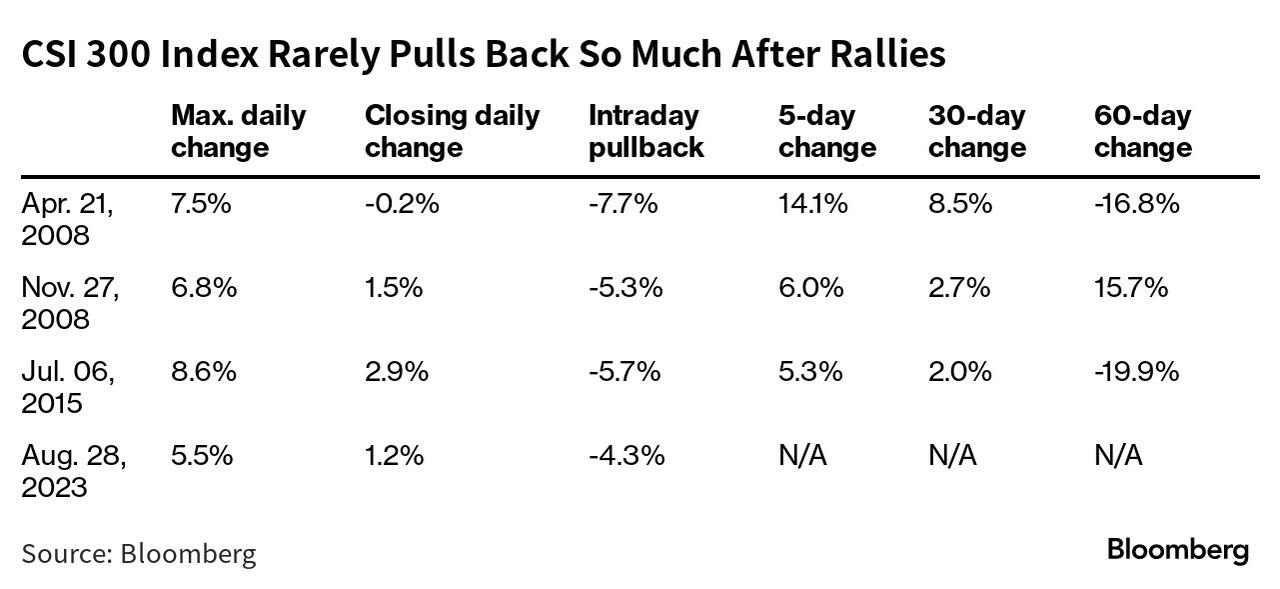
China’s benchmark CSI 300 index surged 5.5% on Monday as authorities unveiled a slew of supportive measures, including a reduction of the stamp duty. By the end of the session, the efforts had fallen flat with investors and the gauge had pared its gain to just 1.2%.

That price action suggests Beijing urgently needs to make a “whatever-it-takes” move — similar to the ECB’s open-ended commitments to saving the common currency in 2011 — or else risks further asset weakness.

The CSI 300 index’s early rally of as much as 5.5% sputtered during the session, with the gauge closing just 1.2% higher. That’s quite the rarity: There have been only three past occasions since 2004 when the equity index soared over 5 percentage points and then pared the gain by 4 percentage points.

Two of those episodes occurred during the 2008 global financial crisis. One happened in 2015 when China’s stock bubble burst. While history shows that the gauge often recovered in the week and month after such volatility, the index fell over the following 60 days in two of the three past instances.

The government has previously delivered massive stimulus to shore up not just financial markets, but also the real economy. During the 2008-2009 crisis, Beijing launched a 4-trillion yuan ($548 billion) spending package. And a program where the PBOC provided cash for policy lenders to finance urban renewal helped turn around a slumping property market in 2015. This time, however, a solution appears to be trickier.

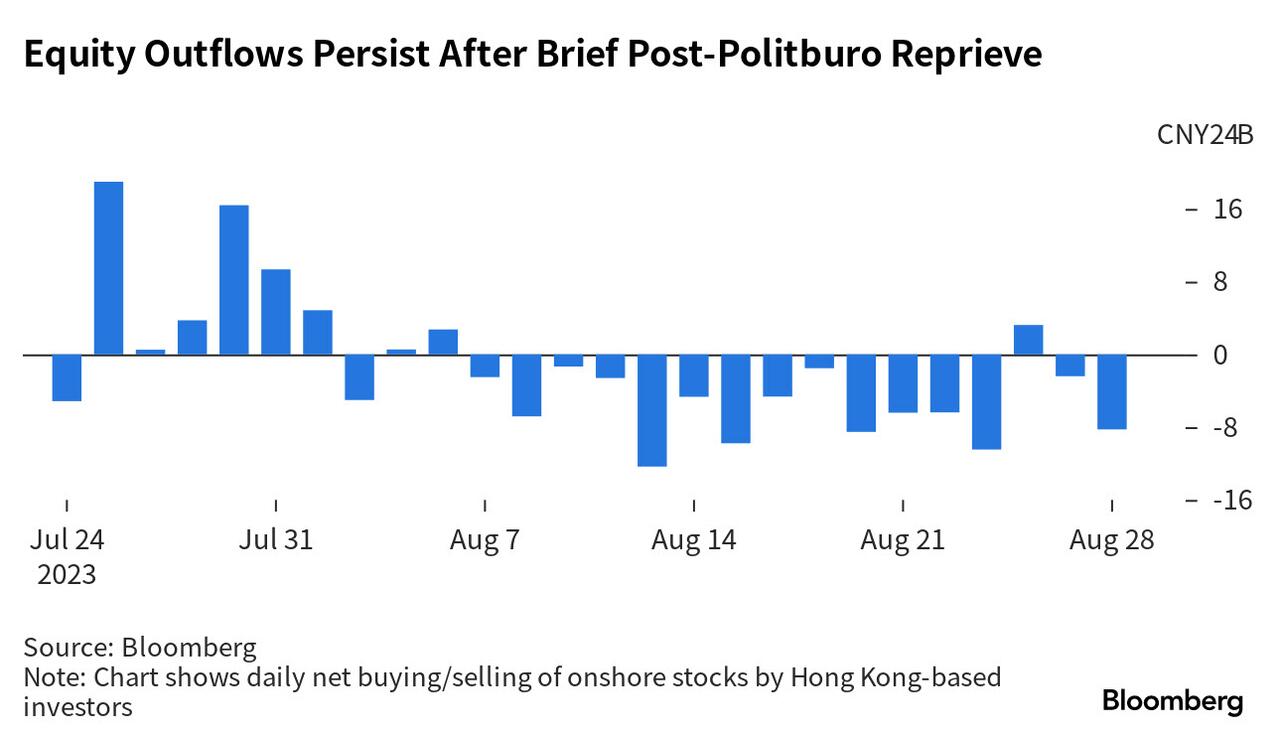
Beijing has stepped up its efforts over the past weekend to lift stocks and rescue the property market, according to Ting Lu, chief China economist at Nomura. Still, “the impact will be short-lived if these measures are not followed by measures for supporting the real economy,” he warned in a client note on Monday. In fact, Hong Kong-based investors have turned into net sellers of onshore Chinese equities throughout August, in contrast to a couple days of brief inflows in late July following positive signals from the politburo meeting.

Forecasts for China’s 2023 and 2024 GDP have been slashed on Wall Street over the past few weeks. The world’s second largest economy now risks missing Beijing’s own growth target for a second straight year and could expand at a sub-5% pace for three years in a row — something unheard of since the death of Mao Zedong in 1976. The sheer scale of the challenge calls for unprecedented policy actions, akin to the Fed’s commitment to purchasing “unlimited amounts of Treasury bonds” in March 2020 or Mario Draghi’s famous line 11 years ago: “The ECB is ready to do whatever it takes to preserve the euro.”

Beijing’s responses have so far been underwhelming and investors are keeping their hopes low after repeated disappointments over the past few years. A Bloomberg MLIV survey of 455 respondents found only 11% look forward to “really big, bazooka-like” stimulus, while more than half expect moderate steps that target specific industries. In a Bank of America survey two weeks ago, only 3% of those polled saw a stronger yuan in the next three months as a result of “policy stimulus restoring growth momentum.” If Beijing cannot surprise investors amid such a low threshold of expectations, Chinese markets are probably headed for further selloffs.