Search This Blog

Wednesday, August 30, 2023

Ocean Biomed: New Patent For Fibrosis Candidate

 Ocean Biomedical Inc 

 announced that the United States Patent and Trademark Office has issued a patent covering Ocean’s anti-Chitinase 1 small molecule candidate. 

Dr. Jack A. Elias, one of Ocean’s Scientific Co-founders, discovered this molecule to be a key factor in controlling and inhibiting fibrosis progression, with potential application in several major fibrotic diseases. 

The patent is U.S. Patent No. 11,717,528 B2, titled “Methods and Compositions Relating to the Treatment of Fibrosis.”

In April, Jack Elias received a Notice of Allowance from the United States Patent and Trademark Office for his U.S. patent application covering a therapeutic molecule for pulmonary fibrosis

Targeted diseases include alcoholic liver disease, idiopathic pulmonary fibrosis (IPF), scleroderma, nonalcoholic steatohepatitis (NASH), and Hermansky-Pudlak Syndrome (HPS), an ultra rare disorder characterized by a condition called oculocutaneous albinism, which causes abnormally light coloring (pigmentation) of the skin, hair, and eyes. 

Ocean Biomedical is the exclusive licensee of this patent family. Ocean’s approach has shown an 85%–90% reduction in collagen accumulation in four different IPF and HPS pulmonary fibrosis animal models. 

This treatment approach is anticipated to be well-tolerated in humans based on data from original (non-Ocean) clinical studies and recent EPA data. 

In addition to the targeted diseases noted above, the patent notes potential use in conditions of chemotherapy-induced pulmonary fibrosis, scleroderma, collagen vascular disease, lupus, rheumatoid arthritis, and interstitial lung disease associated with asbestosis, silicosis, and grain exposure. 

https://www.benzinga.com/general/biotech/23/08/34083536/exclusive-ocean-biomedical-announces-new-patent-for-fibrosis-candidate-catering-to-one-of-leading

British officials say AI chatbots could carry cyber risks

 British officials are warning organisations about integrating artificial intelligence-driven chatbots into their businesses, saying that research has increasingly shown that they can be tricked into performing harmful tasks.

In a pair of blog posts published Wednesday, Britain's National Cyber Security Centre (NCSC) said that experts had not yet got to grips with the potential security problems tied to algorithms that can generate human-sounding interactions - dubbed large language models, or LLMs.

The AI-powered tools are seeing early use as chatbots that some envision displacing not just internet searches but also customer service work and sales calls.

The NCSC said that could carry risks, particularly if such models were plugged into other elements organisation's business processes. Academics and researchers have repeatedly found ways to subvert chatbots by feeding them rogue commands or fool them into circumventing their own built-in guardrails.

For example, an AI-powered chatbot deployed by a bank might be tricked into making an unauthorized transaction if a hacker structured their query just right.

"Organisations building services that use LLMs need to be careful, in the same way they would be if they were using a product or code library that was in beta," the NCSC said in one its blog posts, referring to experimental software releases.

"They might not let that product be involved in making transactions on the customer's behalf, and hopefully wouldn't fully trust it. Similar caution should apply to LLMs."

Authorities across the world are grappling with the rise of LLMs, such as OpenAI's ChatGPT, which businesses are incorporating into a wide range of services, including sales and customer care. The security implications of AI are also still coming into focus, with authorities in the U.S. and Canada saying they have seen hackers embrace the technology.

A recent Reuters/Ipsos poll found many corporate employees were using tools like ChatGPT to help with basic tasks, such as drafting emails, summarising documents and doing preliminary research.

Some 10% of those polled said their bosses explicitly banned external AI tools, while a quarter did not know if their company permitted use of the technology.

Oseloka Obiora, chief technology officer at cybersecurity firm RiverSafe, said the race to integrate AI into business practices would have "disastrous consequences" if business leaders failed to introduce the necessary checks.

"Instead of jumping into bed with the latest AI trends, senior executives should think again," he said. "Assess the benefits and risks as well as implementing the necessary cyber protection to ensure the organisation is safe from harm."

https://www.yahoo.com/lifestyle/british-officials-ai-chatbots-could-230629776.html

Rising caffeine levels spark calls for ban on energy drink sales to children

 Pediatricians and parents are calling for the U.S. to treat new high-caffeine energy drinks like alcohol and cigarettes and ban their sale to minors as a single serving can contain as much caffeine as six Coca-Colas.

Prime Energy, which launched this year, has 200 mg of caffeine within its 350 ml can — exceeding permissible caffeine levels in Canada, Australia and New Zealand. Rival products like Anheuser Busch InBev-backed Ghost energy drinks and Kim Kardashian's “Kimade” energy drink also have 200 mg of caffeine. Competitor Monster Energy contains 150 mg of caffeine.

As caffeine content in energy drinks has climbed over the years, some countries and retailers have banned the products while a few require proof of age for purchase. In the U.S. and UK, no national regulations ban the sale of high-caffeine energy drinks.

Without legal age mandates like those on alcohol and cigarettes, retailers are unlikely to restrict access, said Dr. Holly Benjamin, a professor of pediatrics and orthopedic surgery at the University of Chicago. There is no proven safe dose of caffeine for children, according to the American Academy of Child and Adolescent Psychiatry.

"Retailers could choose to place sports drinks and energy drinks in different locations and label the sections differently; but, I think that is unlikely to happen without regulation which starts with better product labeling and widespread education," Dr. Benjamin said.

She added: "Any energy drink with a high dose caffeine in it, such as Prime Energy, is unsafe for children."

Side effects for kids consuming caffeine could include rapid or irregular heartbeats, headaches, seizures, shaking, stomach upset and adverse emotional effects on mental health, she said.

The FDA is currently reviewing a request by U.S. Senate Majority Leader Chuck Schumer to investigate the caffeine content in Prime Energy, as well as its marketing to kids, a spokesperson said.

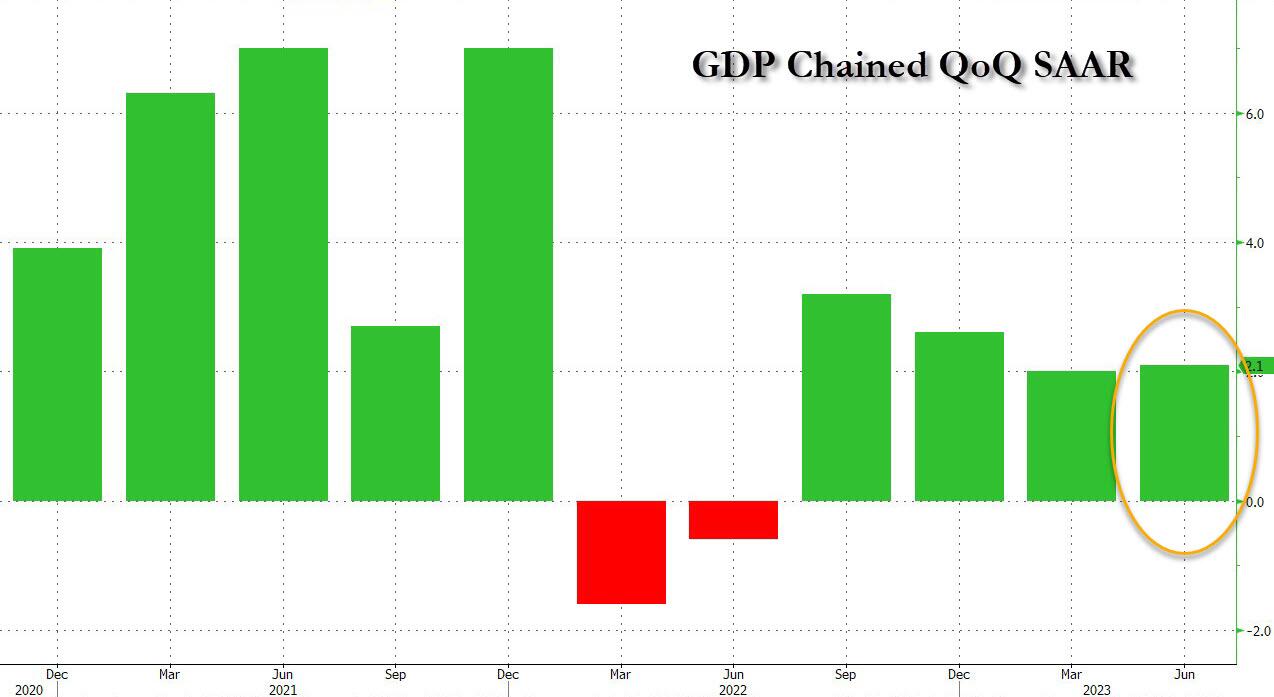
Add Q2 GDP To List Of Economic "Data" Revised Sharply Lower By Biden Administration

 Another data point, another major downward revision lower.

In the past month, the Biden Department of Goalseeking Stuff Higher Before Quietly Revising It Lower The Next Month (BDOGSHBQRILNM) has been busy, and after slashing jobs, JOLTS, new home sales, housing starts and permits and industrial production, moments ago it took the machete to Q2 GDP, which in the first revision of the "data" was just cut to 2.1% (or rather 2.07% to be specific), down from an initial "red hot" print of 2.4% which turned out to be nothing more than some overzealous political activist's excel adjustments, and well below the consensus estimate of 2.4%.

71% Of Americans Say Trump Can't Get An Impartial Jury: Survey

 by Joseph Lord via The Epoch Times (emphasis ours),

A majority of Americans, more than seven in 10, don't think President Donald Trump can get an impartial jury in his ongoing legal battles according to a new survey about Americans' trust in the broader legal system.

The poll, conducted by Ipsos, surveyed Americans from the general population and the population of those who have served on juries in the past 10 years to learn their attitudes toward various aspects of the criminal justice system.

The poll found that former jurors were more likely than the general population to trust in the criminal justice system as a whole, including attorneys across all fields, judges, and state and local law enforcement.

They also had a nearly 20 percent more favorable view of their fellow citizens serving on juries than their peers: 76 percent of former jurors reported "a great deal" or "a fair amount" of trust in jurors, compared to 58 percent of non-jurors—the highest level of trust across both groups for all legal positions discussed.

But Americans are less optimistic about former President Donald Trump's chances of receiving an impartial jury in one of the cases against him relating to his alleged illegal retention of classified documents. Only the documents case, one of four ongoing trials against the former president, was asked about.

In the survey, 1,017 members of the general population—those who haven't served on a jury in the past 10 years—were asked, "If the cases against Donald Trump go to trial, how confident are you, if at all, that the court will be able to find and seat jurors willing to put aside their prior beliefs about Donald Trump and decide the case based on the evidence presented?"

Overall, 71 percent of those said they were not confident, including 30 percent who said they were "not at all confident" of this outcome and 41 percent who said they were "not too confident" about an impartial jury.

Only 28 percent expressed confidence that President Trump's jurors could put aside their past perspectives. And the majority of those answering this way, 23 percent, said they were only "somewhat confident" of this outcome. Only five percent said they were "very confident" that President Trump could receive an unbiased jury.

Over the past several decades, Americans' faith in the jury process, a constitutional pillar of American political life, has remained strong despite a corollary decrease in Americans' trust of other types of political and legal institutions.

Faith in the jury process has survived several blows, including the acquittal of O.J. Simpson, who many believed to have murdered his wife and her friend, who was later acquitted. Politically-fraught outcomes, including the acquittal of George Zimmerman and Kyle Rittenhouse, and the conviction of Derek Chauvin on murder charges related to George Floyd's death, have also failed to shake Americans' core belief in the jury system.

However, the politically fraught criminal cases of the 45th president could erode faith in the system, as members of both the pro-Trump and anti-Trump factions will be unlikely to accept a jury outcome they think was unfair.

Most Cases in Left-Wing Jurisdictions

This problem is only compounded by the political composition of the jurisdictions where President Trump will be tried, as most lean substantially to the left on the political spectrum.

The case related to President Trump's handling of classified documents will likely take place in Fort Pierce, Florida, part of a county that voted for President Trump in 2020, with jurors pulled from nearby areas.

But other cases against President Trump will be carried out in less favorable political environments.

The first criminal case against him, alleging that he paid adult performer Stormy Daniels hush money to cover up an affair in contravention of campaign finance law, will take place in Manhattan—where, in 2020, 86.7 percent of residents voted for President Joe Biden.

Another case filed against President Trump alleges that he sought to illegally overturn the 2020 election. That case will be held in Washington, D.C.—a place where President Trump received only 5.4 percent of the popular vote in 2020 compared to 92.2 percent for President Biden, and where many residents harbor memories and resentment over the Jan. 6, 2021, Capitol breach.

The most recent case filed against President Trump was filed in Fulton County, one of the counties of the greater Atlanta area where President Biden won 72.6 percent of the vote. Nearby counties similarly voted for President Biden by wide margins.

Given the political bent of the areas where the cases are being held, it is even more likely that supporters of President Trump will view any jury pool as suspect.

https://www.zerohedge.com/political/71-percent-americans-say-trump-cant-get-impartial-jury-survey

Aeon: Positive Results from Phase 2 Trial of ABP-450 (prabotulinumtoxinA) in Cervical Dystonia

 AEON Biopharma, Inc. (“AEON” or the “Company”) (NYSE: AEON, AEON WS), a clinical-stage biopharmaceutical company focused on developing a proprietary botulinum toxin complex for the treatment of multiple debilitating medical conditions, announced the presentation of positive results from its Phase 2 clinical study of ABP-450 for the treatment of cervical dystonia (CD), a chronic and debilitating neurologic condition affecting the muscles of the neck, at the International Parkinson and Movement Disorders Society Congress® (IP-MDS), which is being held at the Bella Center in Copenhagen, Denmark, from August 27 – 31, 2023. The data was previously released by the Company in September 2022.

https://finance.yahoo.com/news/aeon-biopharma-presents-positive-results-120000687.html

NanoVibronix Cites Positive Results from Independent Testing of UroShield

 NanoVibronix, Inc. (NASDAQ: NAOV), a medical device company that produces the UroShield®, PainShield® and WoundShield® Surface Acoustic Wave (SAW) Portable Ultrasonic Therapeutic Devices, today cited positive reported outcomes from a study of UroShield® that was conducted at the University of Southampton in the United Kingdom.

Brian Murphy, Chief Executive Officer of NanoVibronix, Inc., said, "As the researchers at Southampton point out, incidences of catheter-associated urinary tract infections (CAUTI) continue to be a major clinical concern, with serious implications for patients and considerable impact on healthcare facilities and resources. We are pleased to learn that through an independent study, researchers witnessed positive outcomes from the use of UroShield both in the lab and with patients. Quantitative data from the research indicated a positive effect of UroShield on catheter-associated urinary tract infections (CAUTI) and catheter blockage with approximately one-third of patients in the study citing a reduction in the frequency of catheter blockages and the need for unscheduled catheter challenges. Furthermore, qualitative data indicated favorable opinions from the majority of the participants and confirmation that the Uroshield was having a positive effect."

https://finance.yahoo.com/news/nanovibronix-cites-positive-results-independent-123000686.html