Search This Blog

Wednesday, August 30, 2023

Are We Facing Lockdowns 2.0?

 by Jeffrey Tucker via The Brownstone Institute,

National Public Radio was in a frenzy this morning but it felt like the movie Groundhog Day: they were spreading tremendous alarm about the rise of Covid cases.

We have to stop the spread, the announcer said, and that’s why masks are coming back to classrooms.

However, they added, relief is on the way in the form of a new vaccine

Rinse, repeat – as the shampoo bottles say. 

This line of thinking – stop the spread to reduce strain on hospitals, mask up, and so on – is being echoed by all major media organs. Leading the way is of course the New York Times. 

I’m a bit superstitious about stories in the New York Times designed to drum up disease panic.

It was February 28, 2020, when this paper threw out one hundred years of editorial policy on infectious disease to counsel panic over calm, thus paving the way for what would come two weeks later: the astonishing wreckage of Covid lockdowns and everything that entailed. 

There was a reason the Times was chosen to be the first media outlet to take this line on Covid. It would be exceedingly naive to think that this was driven by an independent editorial judgment. Someone likely put them up to it. 

Regardless, I knew that day that the darkness was falling, that this was likely the beginning of a grand experiment in public health that would not only fail to achieve its aims but also wreck American liberty and prosperity. After all, sectors of the ruling class had been gaming pandemics for twenty years. They needed to justify the endless hours and billions put into the grand project of pandemic planning. 

The result was a calamity without precedent.

We are nowhere near recovered. Substantial numbers of people today fear lockdowns far more than Covid, and for very good reasons. It was the crisis of our lives. 

Even more striking, we’ve yet to have a reckoning. The people in charge today are the same people who did this or their direct successors. There have been no apologies but rather quite the reverse. They worked hard to codify lockdowns as the preferred policy for pandemics, and we have every reason to suspect that they will repeat the experience if they can get away with it. 

That’s why my heart jumped a beat at the above-the-fold headline in the Times yesterday morning. 
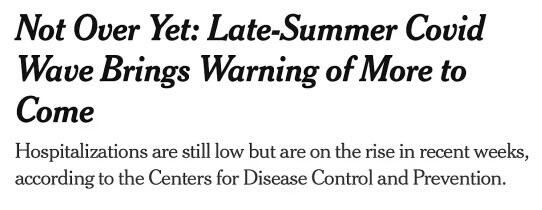
This happens at the same time we are getting more reports of new mask mandates, school closures, and the rollout of a new Covid vaccine invented by the usual suspects that President Biden has personally suggested that every American take. From all appearances, it does seem like another lockdown could be coming, or perhaps they are just trying to scare us into the reminder that they can do it if they want to. 

Just this morning, the White House spokesman took to the lectern to warn Americans about ominous subvariant BA.2.86, not to be confused with all the other subvariants being tracked in a pseudoscientific track-and-trace operation being run by the usual suspects. 

The Washington Post was chosen to announce the terror behind this one.

“While only about a dozen cases of the new BA.2.86 variant have been reported worldwide - including three in the United States - experts say this variant requires intense monitoring and vigilance that many of its predecessors did not. That’s because it has even greater potential to escape the antibodies that protect people from getting sick, even if you’ve recently been infected or vaccinated.”

You will notice that BA.2.86 is not on the current list. That only means it could be the worst yet, whatever that means. 

It will surely be added. And no doubt every commentator on TV in the coming months will have great expertise with all this coded gibberish, spouting off these letters and numbers like they are known friends while the rest of us stare at our screen in amazement at the flashy science these experts are tossing around. 

Our pro-lockdown friend and Pfizer board member Scott Gottlieb is already at it, letting all these subvariant names roll off his tongue on CNN and thus display his astonishing mastery over the microbial kingdom. . 

This could be the way in which Lockdown 2.0 will be different from 1.0. The last time, the main spokespeople like Deborah Birx spoke to us like children to make sure we got the message. The downside of that approach is that it invites regular people to comment on the wisdom of lockdowns. 

The next time around, they will be much more sciency about it, with all this talk of subvariants, R-naughts, hospitalization rates, wastewater examinations, and so on, and do so in ways that intimidate regular people into thinking our opinions cannot possibly matter much. 

Let’s take a closer look at this New York Times piece

“But for Americans who have become accustomed to feeling that the nation has moved beyond Covid,” the newspaper says, “the current wave could be a rude reminder that the emerging New Normal is not a world without the virus.”

Are we really continuing to imagine the goal of eradication still? That seemed to be the purpose of the lockdowns in the first place, if there was any goal at all. It’s utterly impossible to create a world in which there are no viruses. And actually such a world would be stunningly dangerous, for it is the presence of pathogens that themselves train the immune system in the art of resistance, same as exercise makes the body more healthy. 

Sadly, this was the great taboo subject for three years, and, as a result, there was almost no talk of natural immunity during the last Covid mania. And there has been little to no reckoning since those days about the meaning of endemicity, the failure to recommend repurposed drugs as therapeutics, and the positive contribution of widespread exposure to creating the public health benefit of stronger immune systems. All of these topics were denounced and then censored. Oddly, they still are. 

To this day, public health officials continue to pretend that they did everything right. Oh sure, they could have locked down earlier, forced masks earlier, and imposed vaccine mandates with much more ferocity. So far as they are concerned, this was their only failing. And they have no intention of making those supposed mistakes again. 

In my own circles, everyone believes that they will never get away with it all again simply because there is too much resistance. I’m not so optimistic actually. Let’s say that 20 percent of the population is still convinced of the entire Covid religion. These people working with media and Big Tech, combined with daily propaganda from Covid, might be enough to overcome a large portion of the public that swears they will not comply this time. 

Honestly, I never believed they would get away with it the first time. How in the world do you convince Catholic Bishops to demand the closure of Churches on Easter under the excuse of the widespread circulation of a virus with a 99-plus percent survival rate in which the verified deaths from Covid alone is centered on a population older than life expectancy itself? I never could have imagined such a thing would be possible. 

But the desire on the part of aspirational professionals – in academia, industry, and religion – to stay out of trouble and continue to ascend the ranks is so powerful as to cause multitudes to bury their best instincts for what they imagine will be a temporary but prudent compliance. I do not for a moment believe that bravery on the level of the Amish or the Hasidim is widespread enough in the population to create a mass resistance movement. 

“Some institutions have responded to the recent increase in Covid infections by reinstating pandemic-era rules,” writes the Times.

Then the article proceeds to celebrate all the cases of pandemic restrictions, without a hint that these didn’t work last time and won’t work this time either. Again, there has been no reckoning, which only increases the likelihood of a new round of lockdowns. 

Lockdowns were the most successful state/corporate policy in world history for convincing the population to give up volition, liberty, and money to the biomedical cartels and all its associated parts. 

Every government benefitted and so did all the biggest companies, particularly the digital ones that had been working for a leg up and a big win from the great reset. Something that is this monstrously successful for them becomes a model for the future, which they try and try until the population gets utterly and completely sick of it, as they did with the religious wars of old. 

Until that day comes, lockdowns will be an ever present threat. 

https://www.zerohedge.com/covid-19/are-we-facing-lockdowns-20

Abeona: Positive Pre-BLA Meeting with FDA for EB-101 and Plans for BLA Submission

 Abeona Therapeutics Inc. (Nasdaq: ABEO) today announced the Company’s intention to proceed with the submission of a Biologics License Application (BLA) to the U.S. Food and Drug Administration (FDA) for EB-101, its investigational autologous, engineered cell therapy, for patients with recessive dystrophic epidermolysis bullosa (RDEB) after the recent completion of a pre-BLA meeting with the FDA.

At the meeting, Abeona reached alignment with the FDA that the EB-101 clinical efficacy and safety data appear adequate to support a BLA submission. The Agency also agreed that retroviral vector manufactured at Abeona and Indiana University appear comparable based on the data that Abeona provided in its briefing book. The FDA requested that Abeona include within its BLA submission additional background and data supporting the scientific rationale underlying its EB-101 potency and identity assays so that they can be fully evaluated by the Agency post-submission. The Agency also requested that supplemental data pertaining to certain chemistry, manufacturing, and controls and clinical topics be included in the BLA package. Abeona believes that it has the necessary supporting data in-hand to generate these additional reports, including those regarding potency and identity, to address the Agency’s requests.

“We are pleased with the outcome of the pre-BLA meeting for EB-101 and believe that we have aligned with the FDA on what is needed for our upcoming BLA submission,” said Vish Seshadri, Chief Executive Officer of Abeona. “We are focused on gathering and packaging the existing data over the coming weeks to meet the Agency’s expectations. With the constructive feedback from the FDA now in-hand, we are proceeding on a clear regulatory path leading to the planned BLA submission for EB-101 early this Fall.”

EB-101 has been granted Regenerative Medicine Advanced Therapy, Breakthrough Therapy, Orphan Drug and Rare Pediatric Disease designations by the FDA.

https://www.biospace.com/article/releases/abeona-therapeutics-announces-positive-pre-bla-meeting-with-fda-for-eb-101-and-plans-for-bla-submission/

Bionano: Alternative to KT and CMA for Evaluating CRISPR-Edited Cells in Stem Cell Therapy

 Bionano Genomics Inc. (Nasdaq: BNGO) today announced a publication in Nature Communications demonstrating the utility of optical genome mapping (OGM) as an alternative to karyotyping (KT) and chromosomal microarray (CMA) for the evaluation of CRISPR-Cas9 edited human induced pluripotent stem cell (iPSC) lines in order to uncover possible pathogenic structural alterations that may limit their usefulness for stem cell therapy.

The study authors found that approximately 15% of CRISPR-Cas9 edited genomes (2 of 13) had potentially pathogenic large chromosomal deletions at unexpected off-target sites. In addition to those two off-target deletions, the authors reported a large, unexpected deletion at the target site.

“This study is an example of how OGM can be used as part of developing cell and gene therapies, including stem cell therapies.  The expansion of iPSC-mediated cell therapy faces risks due to off-target structural variations that may be introduced during CRISPR-Cas9 genome editing. Since genome aberrations caused by CRISPR-Cas9 editing could lead to unforeseen adverse effects, we believe careful and comprehensive analysis of edited genomes is important in developing these therapies and their manufacture," commented Erik Holmlin, PhD, president and chief executive officer of Bionano.

The paper is available at: https://www.nature.com/articles/s41467-023-40901-x.

https://www.biospace.com/article/releases/bionano-announces-publication-demonstrating-utility-of-ogm-as-an-alternative-to-kt-and-cma-for-evaluating-crispr-edited-cells-as-part-of-stem-cell-therapy-development/

Navajo Leaders Challenge Chaco Canyon Drilling Ban

 by Ethan Brown via RealClear Wire,

On June 2, the U.S. Department of the Interior blocked oil and gas leasing for the next twenty years within a ten-mile radius of Chaco Canyon — the site of a Puebloan civilization in now-northern New Mexico dating back over a millennium. Despite some support from people within the Pueblo tribes and Navajo Nation which surround the land, the vast majority of Navajo leaders have opposed these drilling restrictions. It’s essential that climate advocates hear them out.

Between high-profile cases of extractive industries seizing and polluting Indigenous land and the fact that climate change exacerbates the many environmental and economic challenges facing Indigenous communities, the climate movement routinely finds common ground with Indigenous people. But recently, the two groups have found themselves at odds. The Yurok tribe recently succeeded in an effort to have four hydroelectric dams removed from the Klamath River in Northern California, where renewable energy production was disrupting salmon runs. majority of Alaska Native communities supported the now-approved Willow drilling project in Alaska despite the project’s significant carbon emissions, harm to wildlife, and a viral TikTok movement that spurred a #StopWillow petition with 5.1 million signatures. This conflict over Chaco Canyon drilling could drive yet another wedge between climate zealots and Indigenous people.

Collaboration with these tribes is vital to the climate movement — Indigenous communities have centuries of knowledge regarding environmental stewardship, and often view nature as sacred. Their leadership can help ensure the most sensible and effective climate solutions get implemented. If climate advocates want Indigenous support, we have to listen, build trust, and support their goals too.

Navajos are no stranger to climate change. The American Southwest is experiencing its worst drought in 1,200 years, and peer-reviewed research in Science found human-caused climate change accounted for 47% of 2000-2018 drought severity. Navajos have been hit especially hard — Navajos use 8-10 gallons of water per day (about a tenth of the average American), and 30% of Navajos have no running water.

So when they express opposition to a drilling ban on their land, we can trust they’ve weighed the pros and cons. Within the Navajo Nation, 35.8% of households have incomes below the federal poverty threshold, and about 10% live without electricity. The Chaco Canyon drilling ban would strip an energy source from the Navajo Nation, and could cost Navajos an estimated $194 million over the next two decades.

Knowing these challenges, there could be opportunities for dialogue. Navajo land has an abundance of solar, wind, and geothermal resources. Rather than banning an energy source, the U.S. could prioritize offering technical or financial support for projects that allow Navajos to capitalize on clean energy, generate needed electricity, and even export to major cities to earn revenue. In 2020, 62% of newly installed renewables for power generation were cheaper than the cheapest fossil fuel alternative, so economically, clean energy might offer a win-win.

But if Navajo leaders are committed to drilling in Chaco Canyon, climate advocates ultimately shouldn’t dwell on it. While individual projects are important to debate, the big picture is far more important. No Indigenous community’s primary goal is fossil fuel extraction or hydroelectric dam quashing. Most communities’ key political mission is full nationhood and self-determination. In fact, it is written into Navajo law that the “ultimate goal of the Navajo Nation is self-determination.”

In addition to its moral and practical advantages, respecting Indigenous communities’ autonomy brings significant climate benefits. A 2019 Intergovernmental Science-Policy Platform on Biodiversity and Ecosystem Services report found that while environmental decline is accelerating in many Indigenous communities, it has been “less severe” than in other parts of the world. Indigenous people steward about one fifth of the world’s tropical and subtropical forests, which sequester carbon and mitigate global temperature rise.

Colonization, on the other hand, drove land use changes that worsened climate change. In 1840, European colonizers started confiscating land from the Māori tribes in New Zealand to chop down their forests for timber, leading present-day New Zealand to have at least 60% fewer forests than before. In the late 1800s, French colonizers in North and West Africa banned locals from practicing subsistence farming, requiring them to chop down their forests for cotton plantations and other crops. Concurrently, British colonizers cut down most wildfire-resistant oak and deodar forests in India and replaced them with large-scale pine plantations for resin. Now, these dry pine needles are responsible for wildfires every summer.

And in the early 1900s, American colonizers brought nonnative drought-resistant grasses to Maui for livestock feed. These grasses spread across the island and exacerbated this month’s fires which were the deadliest in modern U.S. history.

Land use change, principally deforestation, contributes 12-20% of global greenhouse gas emissions. If Indigenous self-determination could right some of these ecological wrongs, we shouldn’t resist that.

Smartly, climate leaders are now looking to Indigenous communities for guidance, welcoming more than 300 members of the Indigenous Peoples Caucus to last year’s UN Climate Change Conference in Egypt. That collaboration only works if climate leaders listen to challenges facing Indigenous communities too. If the climate movement only spotlights Indigenous perspectives when it’s convenient, that defeats the purpose of listening to them in the first place.

Climate advocates should absolutely voice concerns over projects and seek win-win solutions, but strong-arming Indigenous communities in the name of climate action is a different story. Big picture, the climate movement is best served by embracing Indigenous peoples’ land management knowledge and supporting their efforts for self-determination.

Ethan Brown is a Writer and Commentator for Young Voices with a B.A. in Environmental Analysis & Policy from Boston University. He is the creator and host of The Sweaty Penguin, an award-winning comedy climate program presented by PBS/WNET’s national climate initiative “Peril and Promise.” Follow him on Twitter @ethanbrown5151

https://www.zerohedge.com/energy/navajo-leaders-challenge-chaco-canyon-drilling-ban-climate-advocates-should-listen

"We Have Turned Away Inventory": US EV Market Struggles As Cars Pile Up On Dealer Lots

 The rising mismatch between electric vehicle supply and demand is showing up at car dealerships as unsold EVs stack up. Dealerships tell Bussiness Insider that EV supply from automakers has been turned away as demand cools. 

Rising EV inventories and a Tesla-fueled price war could signal the beginnings of a pause in growth for the EV market. 

Scott Kunes, the chief operating officer of Kunes Auto and RV Group, which sells Detroit brands and Nissan and Mitsubishi in the Midwest, said: "We have turned away EV inventory." 

Big Detroit brands are "asking us to make a large investment" in these EVs, Kunes added, "and we just want to see some return on that investment."

A recent report from Cox Automotive shows automakers such as General Motors, Ford, Hyundai, and Toyota have more than 90 days' worth of unsold EVs at dealerships in July. That's about 92,000 EVs sitting at lots, more than three times the number compared with a year ago. New vehicle inventories are up about 74% from a year ago. 

"It's not just that these vehicles are expensive — which they are. We're talking about a much more nuanced lifestyle change," said Sam Fiorani, the vice president of global vehicle forecasting at AutoForecast Solutions.

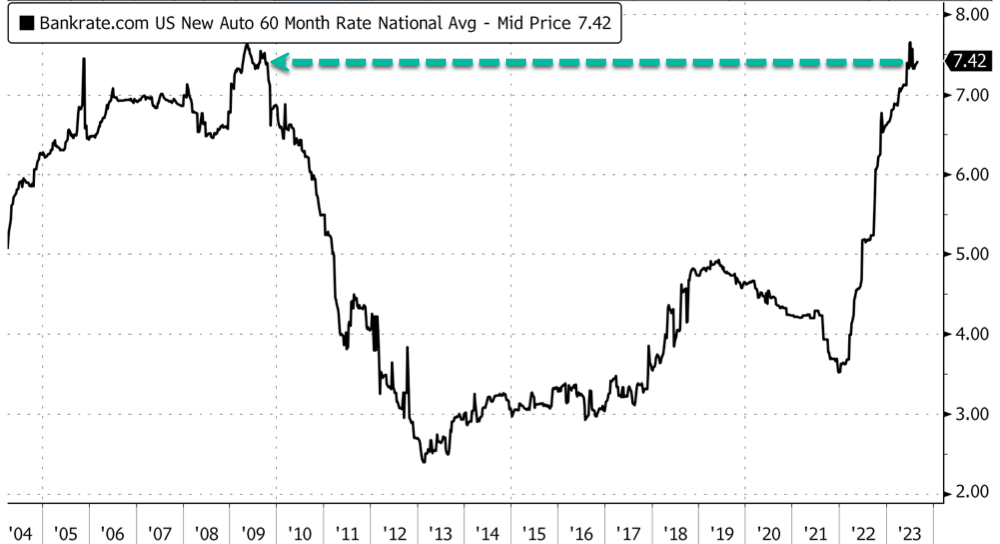
Fiorani said some lifestyle changes include 20-30-minute charges and range anxiety. He said, "It's hard for the average customer to make that leap while spending an extra $10,000." And not just the price but also the highest interest on new auto loans since 2009. 

Several dealers previously told Insider:

As a result, one East Coast Ford dealer told Insider they were only declining allocation of electric cars from the automaker. Another in the Midwest said Lightning orders were piling up uncompleted, leaving those customers with time to pick a different EV. One Hyundai dealer on the West Coast said they were also passing on EV-specific allocation, while another Hyundai dealer told Insider he anticipated having to turn away EVs soon.

EV demand might have plateaued while major automakers are still ramping up production. By 2026, the US market is expected to have 90 new EV models, according to AutoForecast Solutions. We suspect many brands will suffer with profitability. 

https://www.zerohedge.com/markets/we-have-turned-away-inventory-us-ev-market-struggles-cars-pile-dealer-lots

US health officials look to move marijuana to lower-risk drug category

 The U.S. Department of Health and Human Services (HHS) has recommended easing restrictions on marijuana, a department spokesperson said on Wednesday, following a review request from the Biden Administration last year.

Nearly 40 U.S. states have legalized marijuana use in some form, but it remains completely illegal in some states and at the federal level. Reclassifying marijuana as less harmful than drugs like heroin would be a first step toward wider legalization, a move backed by a majority of Americans.

The scheduling recommendation for marijuana was provided to the Drug Enforcement Agency (DEA) on Tuesday as part of President Biden's directive to HHS, the spokesperson said.

"As part of this process, HHS conducted a scientific and medical evaluation for consideration by DEA. DEA has the final authority to schedule or reschedule a drug under the Controlled Substances Act. DEA will now initiate its review," a DEA spokesperson said.

Marijuana is currently classified as a schedule I drug under the Controlled Substances Act, meaning it has a high potential for abuse and no accepted medical use, along with drugs like heroin and LSD.

HHS is recommending reclassifying marijuana to say it has a moderate to low potential for dependence and a lower abuse potential, which would put it in a class with ketamine and testosterone.

If marijuana classification were to ease at the federal level, that could allow major stock exchanges to list businesses that are in the cannabis trade, and potentially allow foreign companies to begin selling their products in the United States.

"The administration's process is an independent process led by HHS, led by the Department of Justice and guided by evidence... we will let that process move forward," White House Press Secretary Karine Jean-Pierre said.

Cannabis is legal in Canada, which has become the home in North America for publicly traded cannabis growers and distributors, many of which would be expected to expand into the United States, if federal legalization follows there.

Shares of several cannabis firms including Canopy Growth, Tilray Brands and Cronos Group rose on the news. Firms such as Verano Holdings and Sunburn Cannabis welcomed the HHS move.

"For far too long, cannabis prohibition and its outdated status as a schedule I substance have unduly harmed countless individuals affected by the failed War on Drugs," Veranos CEO George Archos said.

https://www.aol.com/us-health-officials-look-move-165226105.html

McConnell freezes for 2nd time while taking questions

 Senate Minority Leader Mitch McConnell (R-Ky.) appeared to freeze up at the podium while taking questions in Kentucky on Wednesday, the second time in recent weeks that he paused while talking to reporters.

During a gaggle in Covington, Ky., a reporter asked McConnell, 81, for his thoughts about running for reelection in 2026.

The Senate GOP leader twice asked the reporter to repeat the question, then responded “that’s a,” before freezing and looking ahead for roughly 30 seconds, according to a video posted on X by MSNBC.

At one point during the freeze-up, an aide walked up to McConnell and asked “did you hear the question, senator, running for reelection in 2026?” To which McConnell replied with a word that was inaudible.

“Alright, I’m sorry you all, we’re gonna need a minute,” the aide said.

After the roughly 30 seconds of unresponsiveness passed, McConnell said “okay,” and his aide resumed the gaggle, asking reporters to “please speak up.”

A spokesperson for McConnell said the GOP leader “felt momentarily lightheaded and paused during his press conference today.”

McConnell “feels fine,” an aide said, but “as a prudential measure, the Leader will be consulting a physician prior to his next event.”

Wednesday’s episode came just over one month after McConnell, during his weekly press conference in the Capitol, froze up while fielding questions from reporters. During that incident, he stared straight ahead without saying anything for nearly 20 seconds before being escorted away from the press conference.

He later returned and told reporters “I’m fine” and said “yeah” when asked if he is fully able to do his job, before taking more questions on various topics. A McConnell aide at the time also said the GOP leader “felt lightheaded and stepped away for a moment.”

McConnell on Wednesday also fielded a question from a reporter on Kentucky Attorney General Daniel Cameron (R), who is running for governor of the state. His aide was captured on camera reading the question, according to a separate video posted on X.

A reporter then asked the senator about supporting former President Trump as the GOP presidential nominee despite his latest indictments, a question that the aide repeated. McConnell said “I’m not gonna comment about the presidential race, either on the Republican side or the Democratic side,” an answer he typically gives when asked about Trump.

The Senate GOP leader then walked away from the podium and left the room. According to NBC News, the press gaggle came after McConnell spoke for roughly 20 minutes.

McConnell was hospitalized earlier this year after he fell at a private dinner at the Waldorf Astoria on March 9. He suffered a concussion and a minor rib fracture. The GOP leader was discharged from the hospital days later and went to an in-patient rehabilitation facility. He returned home on March 25 and was back in the Capitol for work on April 17.

After McConnell’s freeze-up in July, news broke that the GOP leader had fallen two other times this year. One was in February in Finland, where McConnell and a U.S. delegation were visiting to meet with the Finnish president, according to CNN. The network said the GOP leader “dusted himself off and continued on with the meeting” with the Finnish president.

The other incident was in July when McConnell was getting off the plane at Reagan National Airport in Washington, D.C., per NBC News. The senator was seen at the Capitol later that day and interacted with at least one reporter, according to the network.

https://thehill.com/homenews/senate/4179341-mcconnell-freezes-for-second-time-during-press-conference/