Search This Blog

Wednesday, August 30, 2023

Invent Your Own Gender. Newsom Encourages Youth With Millions In Taxpayer Support

 By Adam Andrzejewski of OpenTheBooks substack

California governor Newsom’s administration is funneling millions of taxpayer dollars into a nonprofit promoting “neogenders” like foxgender and autismgender and facilitating secret gender transitions for students in his state and across the country.

It’s no longer only “he” and “she” or “man” and “woman” in the California public schools. And if Gavin Newsom gets his way, it’s coming to your school too.

The California Department of Public Health is in partnership with the California-based Gender Spectrum organization through a nine-year grant to “conduct rigorous evaluation” of Gender Spectrum’s “professional development programs."

The organization’s undergirding ideology is one of radical “liberation” from the “gender binary,” encouraging youth to invent their own “genders,” which parents are urged to “affirm.”

However, their “Resources” include a so-called “Gender Support Plan,” which explicitly excludes a child’s parents at the child’s request. Some initiatives start with kids in kindergarten.

In the hours before we published, today, Gender Spectrum’s website became no longer accessible and they didn’t respond to multiple comment requests.

Millions In Taxpayer Dollars

Gender Spectrum will collect $2,340,000 from the California Department of Public Health, Office of Health Equity for the California Reducing Disparities Project. Here’s how the payments break down:

Started in the Jerry Brown era when Newsom was lieutenant governor, the grant originally ran from 2017-2022. However, in March 2022, the Newsom administration more than doubled the annual funding and gave Gender Spectrum an extension until June 2026. In 2022 the California Department of Health gave the organization $355,260 as a part of these payments, up from $160,958 in 2021.

The grant gives financial and technical assistance to two Gender Spectrum professional development programs: The Foundations of Gender Inclusive Schools Training and The Gender Spectrum Inclusive Schools Network. The programs impart, among other items “concrete strategies for applying the lens of gender diversity to school practices.”

The plan is to continue to bring these programs to more schools.

Our auditors at OpenTheBooks.com found state payments to Gender Spectrum after we broke open the California state checkbook for the first time in history last year.

How To Use Neopronouns

Our report uses web resources found on Gender Spectrum’s website, and direct quotes and slides from the Gender Spectrum Family Conference 2022, which featured the organization’s executives as presenters and facilitators.

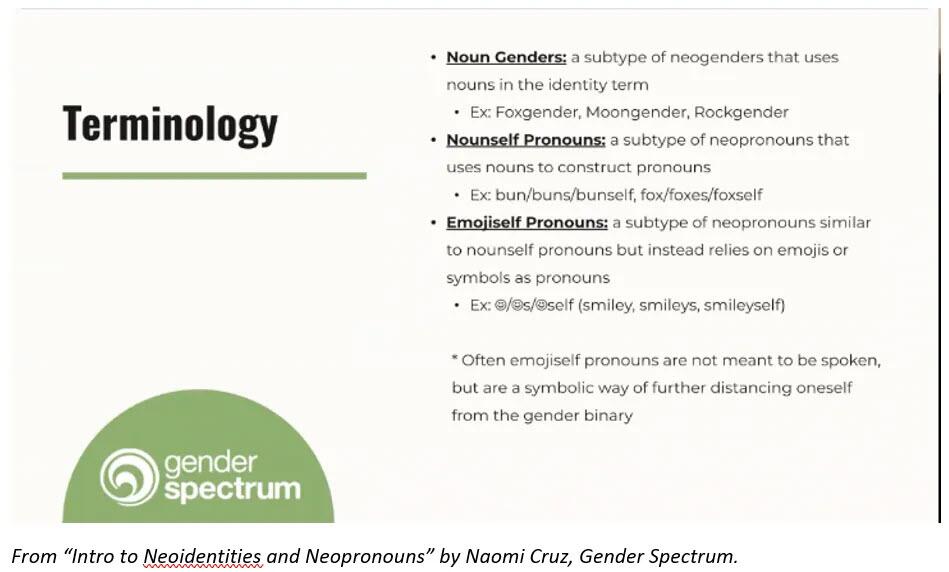
One presentation covered the intricacies of “neoidentities.”

Neogenders, or neoidentities, are words other than “man” and “woman” which individuals use to describe their gender. Neogenders may “describe gender as a personal, aesthetic, synesthetic, or head-space oriented experience.” A neogender may have a corresponding neopronoun other than “he” and “her.”

For example, someone could identify as “foxgender” and use the “foxself” pronoun. This does not necessarily mean the person believes he or she is a fox, but rather the person identifies with “aspects of a fox, whether that’s their appearance, their personality, or how they’re viewed in society.”

If one were to use the foxself pronouns, one could say “Fox said fox would rather do it foxself.” Instead of “She said she would rather do it herself.”

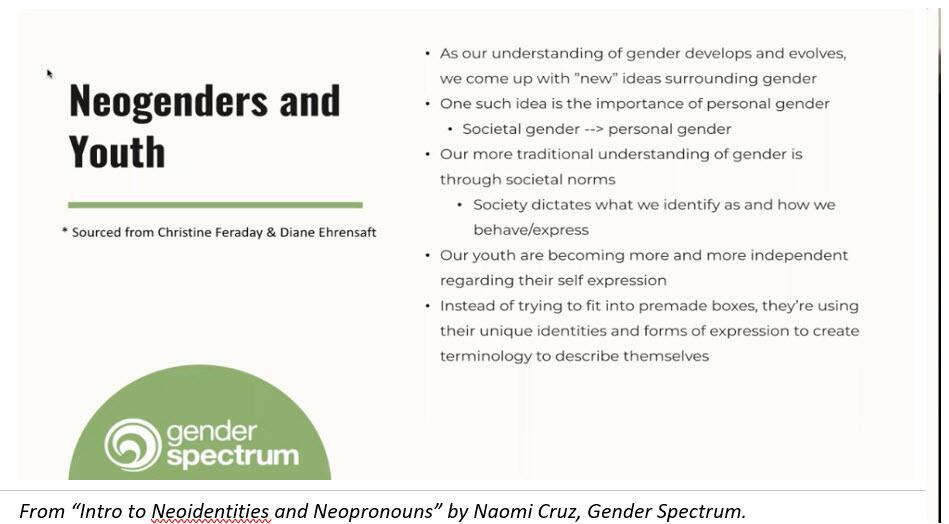
There are an unlimited number of genders one can have, so if an adult does not understand a child’s chosen neogender right away, that is understandable. In fact, youth don’t even have to properly understand their own neogenders, because they are on a “gender journey” that will likely change over time.
Keeping It Secret – Parents Don’t Need To Know

Gender Spectrum’s mission appears to drive a wedge between children and their parents.

Parents are told they should unreservedly “affirm” their child’s neogender. And if parents aren’t affirming, they can expect to be cut out of this aspect of their child’s social and psychological development entirely.

As Naomi Cruz, Manager of Family and Educational Programming at Gender Spectrum, says:

“If parents are not supportive of neogender identities and the youth is feeling really torn because of that, I definitely recommend supporting that youth in the ways that you can, so definitely making sure to use this youth’s pronouns when it's safe to. The youth may request, obviously, ‘don’t use these pronouns around my parents,’ but when you two are alone or in spaces where their parents are not there, or the youth has indicated that it’s safe, making sure to use those neopronouns or making sure to refer to them in ways that make them feel gender affirmed.”

In other words, as soon as parents leave the room, a teacher or other adult can start referring to their child as “fox,” “rock,” “moon,” or whatever else the child fancies. It’s a little secret they don’t have to share with parents.

With One Exception

If a child chooses a gender that encompasses a racial, ethnic, religious, or disability group they are not a part of, the parent must direct the child to a different neogender. For example, only autistic people are allowed to use “autigender” or “autismgender.” Cruz provides a script for parents to correct their children in these cases:

“Yes, I understand that this term means something to you, but perhaps we can create another term or another pronoun that also has a meaning to you, but isn’t specific to a certain racial, ethnic, or other group where there are closed identities and pronouns.”

Cruz did not mention if the parent should redirect the child back to its own sex (or species), but we assume this action would not be considered “affirming.”
Gender Support Plans

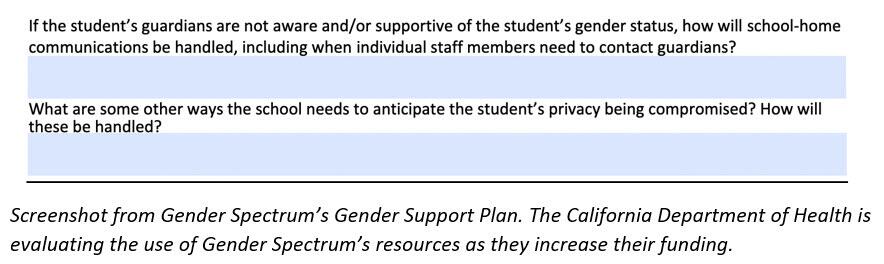
Gender Support Plans are essentially tools to help administrators facilitate the social transition of a child’s gender while at school.

Gender Spectrum’s six-page document covers which bathrooms, locker rooms and facilities the student will be using, which name they will go by, and the "go-to adults” on campus.

Parental knowledge of their child’s gender plan is entirely up to the child, whether or not parents would be supportive of such a transition.

The plan even includes strategies for keeping parents in the dark about their child’s “gender identity.” Such plans have been found in schools across the country.
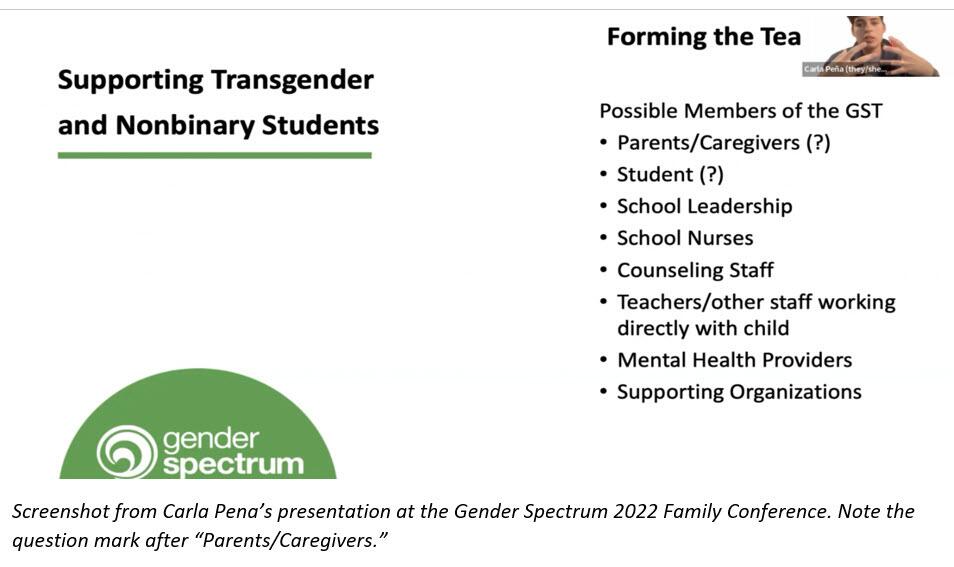
During the Gender Spectrum Family Conference in October 2022, Carla Pena, Director of Training, stated that this is a part of the training administrators and educators receive through Gender Spectrum’s programs:

“We also give this training to school educators and administrators who are working with trans and gender expansive kids, and it’s not always the case that caregivers are supportive of their child’s gender, their gender journey, in that case, if parents are not supportive or if the child is not out, that’s not necessarily someone who will be a part of the gender support team.”
Secret school gender transitions have been an organizational priority for a long time. As reported in the Washington Examiner, in 2015 Gender Spectrum co-authored a report titled "Schools in Transition,” which was also sponsored by the National Education Association, one of America’s biggest teachers' unions.

What seemed like a radical notion then has effectively permeated schools nationwide, boosted by partnerships at the state and national level.

A Federal Partnership Too

The state of California isn’t the only institution boosting the Gender Spectrum’s work; the organization consulted on the National Sex Education Standards, cited by the U.S. Centers for Disease Control for use in schools nationwide.

The standards were published in 2021 and included goals like:

  • By 2nd grade define gender identity
  • By 5th grade children should be able to describe the role of puberty blockers on those who identify as transgender. Also, fifth graders should differentiate between sexual orientation and gender identity and explain that gender expression and gender identity exist along a spectrum
  • By 8th grade define anal sex and describe “pregnancy options” including abortion.

The CDC’s website says of this guidance:

"The standards are designed to help schools focus on what is most essential for students to learn by the end of a grade level or grade span and can be used to create lessons and curricula with aligned learning objectives."

Gender Spectrum’s Kim Westheimer was listed as one of the consultants on the National Sex Education Standards. Westheimer also gave a talk at the 2022 Family Conference, stating that exposing children to different ideas of gender encourages them to take on different gender identities:

“Things like social media and YouTube are giving young people more permission to explore their identity and maybe to try on new identities and decide if those are right for them or not. I would say that’s a good thing, not a bad thing, and that kids should be supported in that.”

The CDC has recommended Gender Spectrum resources in at least three other agency documents or webpages: LGBTQ Inclusivity In Schools: A Self-Assessment Tool; Dating Matters: Strategies to Promote Healthy Teen Relationships; Creating Safe Schools for LGBTQ+ Youth.

Gender Spectrum has not received federal contract or grant funding, but has received $297,111 in federal small business Covid-19 loans. Their first Paycheck Protection Program $153,110 loan in April 2020 was forgiven. On February 26, 2021, the organization took a $145,833 PPP loan and the current status is undetermined.

The organization has partnered with other national groups like National Association of Secondary School Principals, the National PTA, the American School Counselors Association, and the School Superintendents Association.

SUMMARY

Gender Spectrum openly brags about the organization’s national, and even international impact, reaching youth from Switzerland to Singapore.

The half a million dollars in funding from the state of California between 2021 and 2022 (and $2,340,000  by 2026) will go a long way with Gender Spectrum. Indeed, within the California Department of Public Health’s Request for Proposals for the grant Gender Spectrum won is a stipulation for the organization to “increas[e] its current project scale to allow for effective evaluation.”

Along with evaluating the program for supposed “effectiveness” the CDPH stated:

“secondary program goals include the development of infrastructure and business practices to expand and improve existing efforts in order to provide quality mental health services to more at-need community members.”

If California school districts push back, then the California Attorney General sues.

On August 28 California Attorney General Rob Bonta announced a lawsuit against the Chino Valley Unified School District in California to halt the district’s mandatory gender identity disclosure policy. The policy would inform parents if a child asks to use a different name or pronoun in school, a policy which Bonta says is “wrongfully and unconstitutionally discriminating against and violating the privacy rights of LGBTQ+ students.” 

Gavin Newsom stated in one of his wife’s documentaries (also shown in schools),

“At the end of the day a budget is a set of values. Budget reflects your values.”

California voters and taxpayers should consider how this spending reflects their own values and parents nationwide should be alert to how Newsom’s values are being exported to their children’s schools.

NOTE: We reached out for comment, context, and background to Gender Spectrum, the California Department of Public Health, and Gov. Newsom’s office. None responded by publication. If they do respond, we’ll do our best to update the piece in real time.

https://www.zerohedge.com/markets/invent-your-own-gender-governor-gavin-newsom-encourages-youth-millions-taxpayer-support

Philadelphia Fed GDPplus Measure Sure Looks Like Recession Started in 2022 Q4

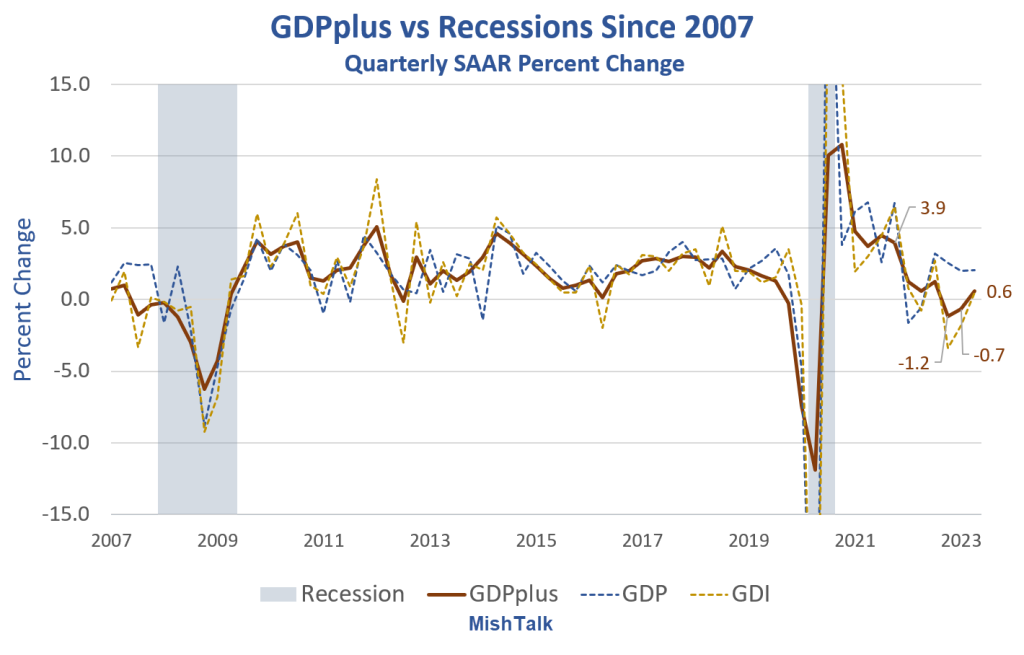
 The Philadelphia Fed GDPplus measure, a blend of GDP and GDI, is flashing a recession has already started signal.

Data from Philadelphia Fed, chart by Mish

GDPplus is a measure of the quarter-over-quarter rate of growth of real output in continuously compounded annualized percentage points.

It’s a blend, but not an average, of Gross Domestic Product (GDP) and Gross Domestic Income (GDI). It is much smoother than either GDP or GDI as the above chart show.

Improving GDP Measurement: A Measurement-Error Perspective

Please consider a 2013 working paper on GDPplus, Improving GDP Measurement: A Measurement-Error Perspective

Aggregate real output is surely the most fundamental and important concept in macroeconomic theory. Surprisingly, however, significant uncertainty still surrounds its measurement. In the U.S., in particular, two often-divergent GDP estimates exist, a widely-used expenditure-side version, GDPE [widely called GDP], and a much less widely-used income-side version, GDPI [GDI].

Nalewaik (2010) and Fixler and Nalewaik (2009) make clear that, at the very least, GDPI deserves serious attention and may even have properties in certain respects superior to those of GDPE. That is, if forced to choose between GDPE and GDPI , a surprisingly strong case exists for GDPI. But of course one is not forced to choose between GDPE and GDPI, and a GDP estimate based on both GDPE and GDPI may be superior to either one alone.

The rest of the paper is for Geeks only. The important points are as follows.

A strong case can be made for accepting GDI as a better measure of GDP than GDPE but a blend, not an average, would be even better.

I put that theory to test by looking at every recession since 1960, 9 cases in all.

GDPplus vs Recessions Since 1960

Data from Philadelphia Fed, chart by Mish

In 100 percent of the cases, with no false signals, no misses, and no lead times more than two quarters, every time GDPplus had two consecutive quarters of negative growth, the economy was in recession.

GDPplus Recession Signals

Mish compilation of recession lead times based on DGPplus data

GDPplus Recession Signals Synopsis

  • GDPplus signaled every recession
  • GDPplus was on time 4 times, early by a quarter 3 times, and early by 2 quarters twice.

This makes it appear as if GDPplus is a leading indicator. It isn’t because the data is heavily revised.

The BEA makes revisions frequently, especially on GDI. And since GDPplus is more reliant on GDI, it also has significant swings.

Also, the BEA does not release GDI in the first estimate of GDP, but somehow the Philadelphia Fed projects GDPplus anyway.

Recent Revisions

Yesterday, the GDPplus numbers for the past three quarters starting with 2022 Q4 were, in order, -1.1 percent, -0.4 percent, +1.5 percent.

Today, those quarters are -1.2 percent, -0.7 percent, and +0.6 percent.

Over time, the strength of revisions decreases greatly.

Thus, the first two numbers are increasingly likely to stay negative now given the decline from -0.4 percent to -0.7 percent for 2023 Q1.

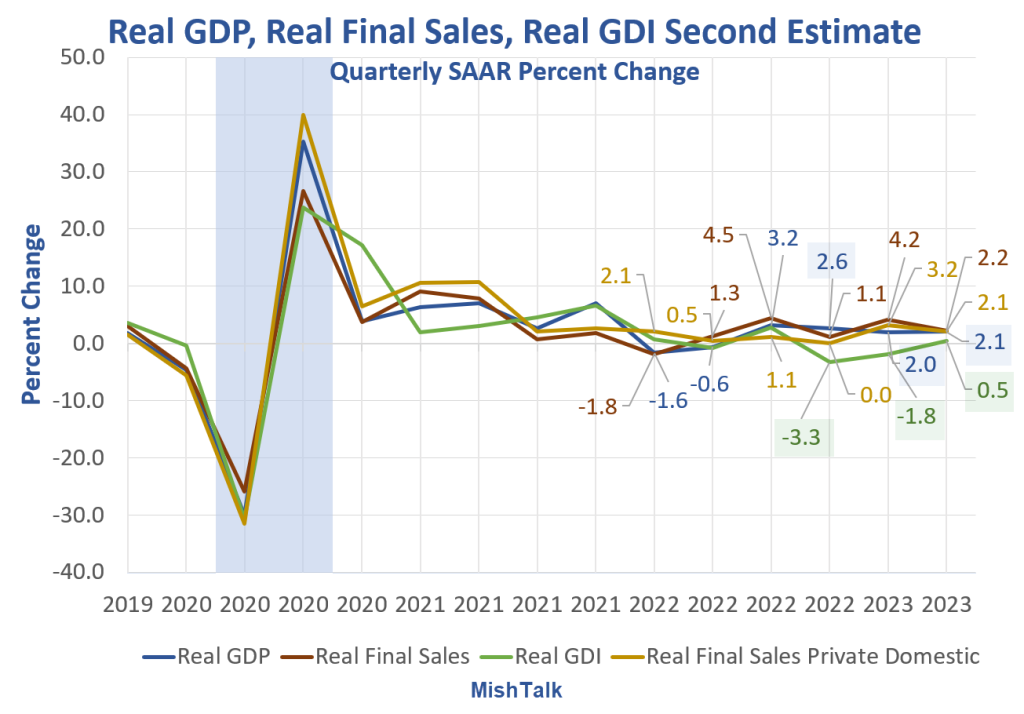
Negative Revision to 2nd Quarter GDP, Huge Discrepancy with GDI Continues

Earlier today I commented Negative Revision to 2nd Quarter GDP, Huge Discrepancy with GDI Continues

GDI is still consistent with a recession starting 2022 Q4. GDP isn’t. The NBER, the official arbiter of recessions, averages the two measures. The result is inconclusive for Q4 and Q1 combined.

Don’t be surprised if the NBER declares we had a recession and it is already over. It’s happened before.

Last Three Quarters Comparison

  • GDP: +2.6 percent, +2.0 percent, +2.1 percent
  • GDI: -3.3 percent, -2.8 percent, +0.5 percent
  • Average of GDP and GDI: -0.4 percent, +0.1 percent, +1.3 percent
  • GDPplus: -1.2 percent, -0.7 percent, and +0.6 percent.

The Averages of GDP and GDI are from the St Louis Fed.

Of those, I strongly suggest based on past performance GDPplus offers the best recession signal.

https://mishtalk.com/economics/philadelphia-fed-gdpplus-measure-sure-looks-like-recession-started-in-2022-q4/

Safer way to fight cancer: Once rhabdomyosarcoma, now muscle

 "Every successful medicine has its origin story. And research like this is the soil from which new drugs are born," says Cold Spring Harbor Laboratory Professor Christopher Vakoc.

For six years, Vakoc's lab has been on a mission to transform sarcoma cells into regularly functioning tissue cells. Sarcomas are cancers that form in connective tissues like muscle. Treatment often involves chemotherapy, surgery, and radiation -- procedures that are especially tough on kids. If doctors could transform cancer cells into healthy cells, it would offer patients a whole new treatment option -- one that could spare them and their families a great deal of pain and suffering.

A devastating and aggressive type of pediatric cancer, rhabdomyosarcoma (RMS) resembles children's muscle cells. No one knew whether this proposed treatment method, called differentiation therapy, might ever work in RMS. It could still be decades out. But now, thanks to Vackoc's lab, it seems like a real possibility.

To carry out their mission, Vakoc and his team created a new genetic screening technique. Using genome-editing technology, they hunted down genes that, when disrupted, would force RMS cells to become muscle cells. That's when a protein called NF-Y emerged. With NF-Y impaired, the scientists witnessed an astonishing transformation.

"The cells literally turn into muscle," Vakoc says. The tumor loses all cancer attributes. They're switching from a cell that just wants to make more of itself to cells devoted to contraction. Because all its energy and resources are now devoted to contraction, it can't go back to this multiplying state."

This newfound relationship between NF-Y and RMS may set off the chain reaction needed to bring differentiation therapy to patients. And the mission doesn't stop at RMS. The technology could be applicable to other cancer types. If so, scientists may someday work out how to turn other tumors into healthy cells.

"This technology can allow you to take any cancer and go hunting for how to cause it to differentiate," Vakoc explains. "This might be a key step toward making differentiation therapy more accessible."

Previously, Vakoc and his team succeeded in transforming Ewing sarcoma cells into healthy tissue cells. The Ewing sarcoma and RMS discoveries were supported by local families who'd lost loved ones to these cancers. "They came together and funded us to try to find, with some desperation, a new therapeutic strategy," says Vakoc.

Those families and Vakoc's lab may now be heroes of a new origin story: a scientific breakthrough that could someday help save children's lives and revolutionize cancer treatment as we know it.

Journal Reference:

  1. Martyna W. Sroka, Damianos Skopelitis, Marit W. Vermunt, Jonathan B. Preall, Osama El Demerdash, Larissa M. N. de Almeida, Kenneth Chang, Raditya Utama, Berkley Gryder, Giuseppina Caligiuri, Diqiu Ren, Benan Nalbant, Joseph P. Milazzo, David A. Tuveson, Alexander Dobin, Scott W. Hiebert, Kristy R. Stengel, Roberto Mantovani, Javed Khan, Rahul M. Kohli, Junwei Shi, Gerd A. Blobel, Christopher R. Vakoc. Myo-differentiation reporter screen reveals NF-Y as an activator of PAX3–FOXO1 in rhabdomyosarcomaProceedings of the National Academy of Sciences, 2023; 120 (36) DOI: 10.1073/pnas.2303859120

Microplastics infiltrate all systems of body, cause behavioral changes

 Plastics -- in particular, microplastics -- are among the most pervasive pollutants on the planet, finding their way into the air, water systems and food chains around the world. While the prevalence of microplastics in the environment is well known -- as are their negative impacts on marine organisms -- few studies have examined the potential health impacts on mammals, prompting University of Rhode Island Professor Jaime Ross' new study.

Ross and her team focused on neurobehavioral effects and inflammatory response to exposure to microplastics, as well as the accumulation of microplastics in tissues, including the brain. They have found that the infiltration of microplastics was as widespread in the body as it is in the environment, leading to behavioral changes, especially in older test subjects.

"Current research suggests that these microplastics are transported throughout the environment and can accumulate in human tissues; however, research on the health effects of microplastics, especially in mammals, is still very limited," said Ross, an assistant professor of biomedical and pharmaceutical sciences at the Ryan Institute for Neuroscience and the College of Pharmacy. "This has led our group to explore the biological and cognitive consequences of exposure to microplastics."

Ross' team -- which includes Research Assistant Professor Giuseppe Coppotelli, biomedical and pharmaceutical sciences graduate student Lauren Gaspar, and Interdisciplinary Neuroscience Program graduate student Sydney Bartman -- exposed young and old mice to varying levels of microplastics in drinking water over the course of three weeks. They found that microplastic exposure induces both behavioral changes and alterations in immune markers in liver and brain tissues. The study mice began to move and behave peculiarly, exhibiting behaviors akin to dementia in humans. The results were even more profound in older animals.

"To us, this was striking. These were not high doses of microplastics, but in only a short period of time, we saw these changes," Ross said. "Nobody really understands the life cycle of these microplastics in the body, so part of what we want to address is the question of what happens as you get older. Are you more susceptible to systemic inflammation from these microplastics as you age? Can your body get rid of them as easily? Do your cells respond differently to these toxins?"

To understand the physiological systems that may be contributing to these changes in behavior, Ross' team investigated how widespread the microplastic exposure was in the body, dissecting several major tissues including the brain, liver, kidney, gastrointestinal tract, heart, spleen and lungs. The researchers found that the particles had begun to bioaccumulate in every organ, including the brain, as well as in bodily waste.

"Given that in this study the microplastics were delivered orally via drinking water, detection in tissues such as the gastrointestinal tract, which is a major part of the digestive system, or in the liver and kidneys was always probable," Ross said. "The detection of microplastics in tissues such as the heart and lungs, however, suggests that the microplastics are going beyond the digestive system and likely undergoing systemic circulation. The brain blood barrier is supposed to be very difficult to permeate. It is a protective mechanism against viruses and bacteria, yet these particles were able to get in there. It was actually deep in the brain tissue."

That brain infiltration also may cause a decrease in glial fibrillary acidic protein (called "GFAP"), a protein that supports many cell processes in the brain, results have shown. "A decrease in GFAP has been associated with early stages of some neurodegenerative diseases, including mouse models of Alzheimer's disease, as well as depression," Ross said. "We were very surprised to see that the microplastics could induce altered GFAP signaling."

She intends to investigate this finding further in future work. "We want to understand how plastics may change the ability for the brain to maintain its homeostasis or how exposure may lead to neurological disorders and diseases, such as Alzheimer's disease," she said.

The study was published in the International Journal of Molecular Science. It was supported by the Rhode Island Medical Research Foundation, Roddy Foundation, Plastics Initiative, URI College of Pharmacy, George and Anne Ryan Institute for Neuroscience, and the Rhode Island Institutional Development Award (IDeA) Network of Biomedical Research Excellence from the National Institute of General Medical Sciences of the National Institutes of Health.

Journal Reference:

  1. Lauren Gaspar, Sydney Bartman, Giuseppe Coppotelli, Jaime M. Ross. Acute Exposure to Microplastics Induced Changes in Behavior and Inflammation in Young and Old MiceInternational Journal of Molecular Sciences, 2023; 24 (15): 12308 DOI: 10.3390/ijms241512308

Molecule reduces inflammation in Alzheimer's models

 Though drug developers have achieved some progress in treating Alzheimer's disease with medicines that reduce amyloid-beta protein, other problems of the disease including inflammation, continue unchecked. In a new study, scientists at The Picower Institute for Learning and Memory at MIT describe a candidate drug that in human cell cultures and Alzheimer's mouse models reduced inflammation and improved memory.

The target of the new "A11" molecule is a genetic transcription factor called PU.1. Prior research has shown that amid Alzheimer's disease, PU.1 becomes an overzealous director of inflammatory gene expression in the brain's microglia immune cells. A11 suppresses this problematic PU.1 activity, the new research shows, by recruiting other proteins that repress the inflammatory genes PU.1 works to express. But because A11 concentrates mostly in the brain and does not reduce PU.1 levels, it does not appear to disrupt PU.1's other job, which is to ensure the production of a wide variety of blood cells.

"Inflammation is a major component of Alzheimer's disease pathology that has been especially hard to treat," said study senior author Li-Huei Tsai, Picower Professor of Neuroscience at MIT and director of The Picower Institute and MIT's Aging Brain Initiative. "This preclinical study demonstrates that A11 reduces inflammation in human microglia-like cells as well as in multiple mouse models of Alzheimer's disease and significantly improves cognition in the mice. We believe A11 therefore merits further development and testing."

Tsai and Elizabeta Gjoneska of the National Institutes of Health are co-corresponding authors of the study published in the Journal of Experimental Medicine.

As a postdoc, Gjoneska co-led a 2015 study that implicated PU.1 as a regulator of errant microglia inflammation in a mouse model of Alzheimer's disease. That research was a collaboration between Tsai's lab and that of MIT Computer Science Professor Manolis Kellis, co-led by former postdoc Andreas Pfenning, now a faculty member at Carnegie Mellon University. Ever since then, Tsai has been seeking a safe way to restore PU.1 activity to healthier levels.

The work described in the new paper, led by Picower Institute research scientist William Ralvenius, starts with experiments to further validate that PU.1 would be a therapeutically meaningful target. To do that the scientists compared gene expression in immune cells of postmortem brain samples from Alzheimer's patients and mouse models and matching non-Alzheimer's controls. The comparisons showed that Alzheimer's effects major changes in microglial gene expression and that an increase in PU.1 binding to inflammatory gene targets was a significant component of that change. Moreover, they showed that reducing PU.1 activity in a mouse model of Alzheimer's reduced inflammation and neurodegeneration, the death of neurons.

Screening success

Genetically knocking down PU.1 in the body is not a viable therapeutic strategy given its importance in normal healthy function. The team therefore screened more than 58,000 small molecules from libraries of FDA-approved drugs and novel chemicals to see if any could safely and significantly reduce key inflammation and Alzheimer's related genes regulated by by PU.1 in cell cultures. After several rounds of increasingly stringent screening, they narrowed the field down to six chemicals. A11 was by far the most potent among them.

They tested the effects of A11 doses on the function of human microglia-like cells cultured from patient stem cells. When they exposed the microglia-like cells to immune molecules that typically trigger inflammation, cells dosed with A11 exhibited reduced expression and secretion of inflammatory cytokines and less of the cell body shape changes associated with microglia inflammatory responses. The cells also showed less accumulation of lipid molecules, another sign of inflammatory activation. Looking at gene expression patterns, the scientists observed that A11-treated cells exposed to inflammatory triggers behaved much like unperturbed microglia, suggesting that A11 helps prevent microglia from overreacting to inflammatory cues.

Two more lab tests aimed at understanding how A11 exerts its effects revealed that it doesn't change PU.1 levels. Instead it counteracts PU.1 activity by recruiting several proteins including MECP2, HDAC1, SIN3A and DMNT3A, known to repress expression of its targets. Essentially amid Alzheimer's disease, A11 tamps down what PU.1 amps up.

"A11 represents a first-in-class molecule that converts PU.1 from a transcriptional activator to a transcriptional repressor, resulting in a controlled state of microglial inflammation," the authors wrote.

Mice in mazes

Having established that A11 reduced inflammatory activity in microglia and determined how that happens, the team focused on whether it worked as a medicine in mouse models of Alzheimer's disease.

Pharmacological tests indicated that A11 is readily cleared from tissues and is capable of reaching brain cells. Moreover, in healthy mice the chemical successfully crossed the blood-brain barrier and remained in brain cells much longer than anywhere else.

Finally the team tested the effects of the drugs on Alzheimer's disease pathology and symptoms in three mouse strains that each model different aspects of Alzheimer's disease: CK-p25 mice (severe neurodegeneration), Tau P301S transgenic mice (tauopathy), and 5XFAD mice (amyloid pathology).

Male and female CK-p25 mice dosed with A11 showed less inflammatory response among microglia and astrocyte cells and lost fewer neurons than untreated controls. TauP301S Tg mice responded similarly, also exhibiting a significant reduction of phosphorylated tau protein in the hippocampus region of the brain, which is an essential area for memory. In 5XFAD mice, amyloid was significantly reduced.

The team subjected the Tau P301S Tg and CK-p25 mice to mazes designed to test their short-term working memory and longer-term learning. In both models and on both tests, A11-treated mice performed significantly better than untreated controls. For example, in the "Morris Water Maze," where mice have to learn the location of a submerged platform that allows them to rest, treated CK-p25 mice learned much faster than untreated ones.

Much more testing needs to be done before A11 could become an approved medicine, Tsai said, but she noted that it could complement the new treatments that target amyloid.

"Given that A11 acts via a distinct mechanism from existing AD therapeutics, A11 could be used alone or in combination with approved therapeutics to provide improved treatment options for neurodegenerative diseases," the authors concluded.

In addition to Tsai, Gjoneska and Ralvenius, the paper's other authors are Alison E. Mungenast, Hannah Woolf, Margaret M. Huston, Tyler Z. Gillingham, Stephen K. Godin, Jay Penney, Hugh P. Cam, Fan Gao, Celia G. Fernandez, Barbara Czako, Yaima Lightfoot, William J. Ray, Adrian Beckmann, Alison M. Goate, Edoardo Marcora, Carmen Romero-Molina, Pinar Ayata, and Anne Schaefer.

The Robert A. and Renee E. Belfer Family Foundation and the National Institutes of Health funded the research. Additional support came from The JPB Foundation and The Picower Institute for Learning and Memory, The Halis Family Foundation, Lester A. Gimpelson and Jay L. and Caroll Miller.

Journal Reference:

  1. William T. Ralvenius, Alison E. Mungenast, Hannah Woolf, Margaret M. Huston, Tyler Z. Gillingham, Stephen K. Godin, Jay Penney, Hugh P. Cam, Fan Gao, Celia G. Fernandez, Barbara Czako, Yaima Lightfoot, William J. Ray, Adrian Beckmann, Alison M. Goate, Edoardo Marcora, Carmen Romero-Molina, Pinar Ayata, Anne Schaefer, Elizabeta Gjoneska, Li-Huei Tsai. A novel molecular class that recruits HDAC/MECP2 complexes to PU.1 motifs reduces neuroinflammationJournal of Experimental Medicine, 2023; 220 (11) DOI: 10.1084/jem.20222105

Drug to target form of previously untreatable life-threatening 'bad cholesterol'

 A new drug offers a breakthrough world first treatment for Lipoprotein(a), a largely genetic form of cholesterol that increases the risk of heart attack and stroke, announced today by study lead Professor Stephen Nicholls, Director of the Monash University's Victorian Heart Institute and Victorian Heart Hospital.

High levels of Lipoprotein(a), known as Lp(a) or spoken as 'LP little a', impact one in five people globally with no approved treatment currently on the market.

The trial demonstrated the success of Muvalaplin -- the first oral drug ever developed to target Lp(a) -- effectively lowering levels by up to 65%. It works by disrupting the ability for Lp(a) to form in the body.

Professor Stephen Nicholls, cardiologist and Director of Monash University's Victorian Heart Institute and the Victorian Heart Hospital at Monash Health, led the landmark research and trial, presented at the European Society of Cardiology Congress in Amsterdam today and published in JAMA.

Lp(a) is similar to LDL cholesterol, sometimes called 'bad cholesterol', but is more sticky, increasing risk of blockages and blood clots in arteries.

Common LDL lowering drugs such as statins don't have the same lowering effect on Lp(a). Being largely genetic, Lp(a) is also difficult to control through diet, exercise and other lifestyle changes.

Although Lp(a) was discovered nearly 60 years ago there still aren't any widely accessible treatments available to lower levels and reduce cardiovascular risk.

Professor Nicholls said the global research industry has been working on a targeted solution to treat elevated Lp(a) for the past decade, but advancements so far have been in difficult to administer injection-based therapies that are not yet on the market.

"When it comes to treating high Lp(a), a known risk factor for cardiovascular disease, our clinicians currently have no effective tools in their kit," Professor Nicholls said.

"This drug is a gamechanger in more ways than one. Not only do we have an option for lowering an elusive form of cholesterol, but being able to deliver it in an oral tablet means it will be more accessible for patients."

"Lp(a) is essentially a silent killer with no available treatment, this drug changes that."

The trial was undertaken in collaboration with Cleveland Clinic and Eli Lilly, the drug will now continue into larger phase clinical trials. It may also have potential to be used in the treatment of other vascular and valve disease

Journal Reference:

  1. Stephen J. Nicholls, Steven E. Nissen, Cynthia Fleming, Shweta Urva, Jeffrey Suico, Paul H. Berg, Helle Linnebjerg, Giacomo Ruotolo, P. Kellie Turner, Laura F. Michael. Muvalaplin, an Oral Small Molecule Inhibitor of Lipoprotein(a) FormationJAMA, 2023; DOI: 10.1001/jama.2023.16503

Antibody shows promise for preventing organ rejection after transplantation

 A man-made antibody successfully prevented organ rejection when tested in primates that had undergone a kidney transplant, Duke Health researchers report.

The finding clears the way for the new monoclonal antibody to move forward in human clinical trials. Results of the study appear online Aug. 30 in the journal Science Translational Medicine.

"Current medications to prevent  are good overall, but they have a lot of side effects," said lead author Imran J. Anwar, M.D., a surgical research fellow in Duke's Department of Surgery. "These therapies suppress the , putting patients at risk of infections and organ damage, and many cause non-immune complications such as diabetes and .

"The push over the last 30 to 40 years has been to develop new, less ," Anwar said. "We are hopeful this antibody moves us closer to that goal."

Anwar and colleagues, including co-senior author Allan Kirk, M.D., Ph.D., chair of the Department of Surgery, focused on a monoclonal antibody identified as AT-1501. It was engineered to minimize the risk of blood clots, which had become problematic for an earlier version of this therapy.

In studies using primates that had undergone , AT-1501 prevented rejection without the need for additional immunosuppressive drugs or promoting blood clots, confirming its immunosuppressive potential.

In animals that had undergone , AT-1501 alone did not lead to uniform rejection control, but it was effective in combination with existing immunosuppressive agents. The combination therapies in islet transplantation led to uniform islet graft survival without weight loss or infections that can typically arise. The islet transplants were performed by Norma Kenyon, Ph.D., co-senior author and professor at the University of Miami.

"These data support AT-1501 as a safe and effective agent to promote both islet and  survival and function and allow us to advance into clinical trials right away," Kirk said. "This less toxic approach has been pursued for over 20 years, and I think we are finally at a turning point. This could be a great advance for people in need of organ transplants."

In addition to Kirk and Anwar, study authors include Dora M. Berman, Isabel DeLaura, Qimeng Gao, Melissa A. Willman, Allison Miller, Alan Gill, Cindy Gill, Steve Perrin, Camillo Ricordi, Philip Ruiz, Mingqing Song, Joseph M Ladowski, and Norma S. Kenyon.

Anelixis Therapeutics, now Eledon Pharmaceuticals, is developing AT-1501 for kidney and islet cell transplant.

More information: Imran Anwar et al, The anti-CD40L monoclonal antibody AT-1501 promotes islet and kidney allograft survival and function in nonhuman primates, Science Translational Medicine (2023). DOI: 10.1126/scitranslmed.adf6376www.science.org/doi/10.1126/scitranslmed.adf6376


https://medicalxpress.com/news/2023-08-antibody-transplantation.html