Search This Blog

Monday, September 4, 2023

Disease-X Is A High-Return Business Strategy

 by David Bell via The Brownstone Institute,

Fearistan, having done very well economically and provided its citizens a long lifespan, noticed that people were still occasionally dying in road accidents. Fearistanis were wealthy and really liked the freedom to travel. While road deaths were uncommon, any unnecessary death surely seemed worth avoiding.

The road-building industry, working closely with government, came up with the idea of building 6-lane highways between cities. Soon the big cities were all connected, and experts from the University of Transport proved that the new highways had a 7 percent lower accident rate than normal roads. University modelers predicted that if 6-lane highways were built between every town in Fearistan, they would save thousands of lives. Experts predicted that they would even save more lives than were actually dying on the existing roads.

The country followed the experts (they were, after all, renowned for building roads) and invested in 6-lane highways everywhere. While the country exhausted itself and most people could not afford to drive their cars anymore, they were rightly grateful that the road-builders were saving them. The near empty roads were now almost completely accident-free, proving the experts right.

Eventually, the road-building industry faced a dilemma; they were running out of towns to which roads could be built. This was not what their investors needed. Then the road regulator and the road-builders met and identified an urgent need to build roads to towns that did not yet exist. Fearistan had vast areas of empty desert that were completely open to town-building. When such towns were eventually built, experts predicted an inevitable and devastating tsunami of road accidents. This would return Fearistan to the total carnage from which they had so narrowly escaped years before. The new Town-X roads (as they termed them) were brilliant examples of high-tech road construction. And everyone could see how important this work was, to keep the public safe. 

In public health, we follow a similarly important business model. We call it ‘Disease-X.’

Understanding pandemic risk from infectious disease

Humans suffered for millennia from pandemics or ‘plagues.’ These killed up to a third of some populations. While causes in some cases remain unclear, such as the Athenian plague of 430 BC, the major plagues since Medieval times were mostly bacterial; particularly bubonic plague, cholera, and typhus. 

Bacterial pandemics ceased in late 19th century Europe with improved sanitation, and elsewhere after the addition of antibiotics. Most deaths from the pre-antibiotic Spanish flu outbreak in the early 20th century are also thought to be untreated secondary bacterial pneumonia. Cholera remains an intermittent marker of extreme poverty and social disruption, whilst most deaths from malaria, tuberculosis, and HIV/AIDS are associated with poverty, which restricts access to effective treatment.

When indigenous populations long separated from the bulk of humanity encountered carriers of smallpox and measles, the effects were also devastating. Having no inherited immunity, whole populations were decimated, particularly in the Americas, Pacific Islands, and Australia. 

Now the world is connected, and such mass death events don’t occur. Connectedness can be a strong defense against pandemics, contrary to what Disease X proponents claim, through its role in supporting early-age immunity and frequent boosting.

These realities reflect orthodox public health but are poorly compatible with current business models. They are, therefore, increasingly ignored.

A century of safety

The past hundred years have seen two significant natural influenza pandemic events (in 1957-8 and 1968-9) and one major coronavirus outbreak (Covid-19) that appears to have arisen from gain-of-function research in a lab. The influenza outbreaks each killed less than currently die annually from tuberculosis, while the coronavirus outbreak was associated with mortality at average age above 75 years, with roughly 1.5 people per thousand dying globally.

While the media fusses about other outbreaks, they have actually been relatively small events. SARS-1 in 2003 killed about 800 people worldwide, or less than half the number of children that die every single day from malaria. MERS killed about 850 people, and the West African Ebola outbreak killed about 11,300. Context here is important; tuberculosis kills over 1.5 million people every year while malaria kills over half a million children, and over 600,000 people die of cancer each year in the United States alone. SARS-1, MERS and Ebola may gain more media coverage than tuberculosis, but this is unrelated to actual risk.

Why are we living longer?

The reason behind increasing human lifespans is frequently forgotten, or ignored. As medical students were once taught, advancements came primarily through improved sanitation, better living conditions, better nutrition, and antibiotics; the same changes responsible for the reduction in pandemics. Vaccines came after most improvement had already occurred (with a few exceptions such as smallpox).

While vaccines do remain an important addition, they are also of particular importance to pharmaceutical companies. They can be mandated, and together with the constant birth of children this provides a continuing, predictable, and profitable market. This is not an anti-vaccine statement. It is just a statement of fact. Facts are what health policy should be based on.

So, we can be confident that, barring an intentional or accidental release of a pathogen engineered by humans, it is highly unlikely that a Medieval-style outbreak will affect anyone currently living. While poverty will reduce life expectancy, it will remain relatively high in wealthier countries. However, we can also be very confident that those half-million young children will die of malaria next year and that 1.5 million people, many of them children and young adults, will die of tuberculosis. 

Over 300,000 women in low-income countries will also die agonizing deaths from cervical cancer because they cannot access cheap screening. We know this, because it happens every year – it is what international public health, particularly the World Health Organization (WHO), was supposed to prioritize.

The ability to monetize an illusion

The Covid-19 response demonstrated how the sponsors of international public health institutions have found a way to monetize public health. This business model involves promoting abnormal responses to relatively normal viruses. It employs behavioral psychology and media campaigns to instill inappropriate fear into the public, then ‘locking them down’ – prison terminology before 2020. The public may then regain a degree of freedom (e.g., fly to visit a dying relative, or work) if they agree to take a vaccine, which in turn directly benefits the original sponsors of the scheme. The heavy public investment in Covid-19 mRNA vaccine development enabled pharmaceutical companies and their investors to reap unprecedented returns.

The major public-private partnership for vaccine development for pandemics, CEPI (inaugurated at the World Economic Forum in 2017), states that “The threat of Disease-X infecting the human population, and spreading quickly around the world, is greater than ever before.” 

Health practitioners are quite susceptible to this propaganda (they are only human). Many also seek income from investments and patents from technologies that may help lock others down or make vaccine production quicker and cheaper. Basing their salaries and careers on loyalty to this pandemic industry, they join in vilifying and scapegoating those who speak against it. Shielded by their sponsors’ ‘greater threat than ever before’ claims, they can blind themselves to the major causes of ill health and act as if only pandemic risk matters.

Why not rely on existing threats?

Despite current efforts with yet another variant, Covid-19 is losing its ability to scare. Sustained fear is necessary for politicians in penetrated governments (as Klaus Schwab of the World Economic Forum notes) to provide this support. This business paradigm requires a continuing target. 

The overall aim is for the public to think that only a corporate authoritarian (fascist) nanny-state can save them from a continuing threat.

Major natural outbreaks being rare, and lab escapes also infrequent, Disease-X fills this need. It provides the material for the media and politicians to work with between variant or monkeypox events.

Where to from here?

For the public, diversion of resources to fairyland diseases will increase mortality by diverting funding for real threats and productive areas of investment. Of course, if increasing lab leaks of engineered pathogens are expected from ongoing and future research, that would be different. But then this would have to be explained plainly and transparently, and prevention may be more effective than a very expensive cure.

Disease-X is a business strategy, dependent on a series of fallacies, dressed up as an altruistic concern for human welfare. Embraced by powerful people, the world they move in accepts amoral practice in public health as a legitimate path to their version of success. 

If our primary aim is to channel taxpayer funding to development of biotechnologies that the public can then be mandated to buy, to their own detriment but at great benefit to the developers, then Disease-X is the road forward. This market model ensures that a relative few can concentrate wealth gained from the many, at virtually no risk to themselves. The public must decide whether they want to keep their part of this highly abusive bargain.

https://www.zerohedge.com/medical/disease-x-high-return-business-strategy

Calcium 'sparks' that can contribute to arrhythmia

 A team of UC Davis and University of Oxford researchers have developed an innovative tool: SparkMaster 2. The open-source software allows scientists to analyze normal and abnormal calcium signals in cells automatically.

Calcium is a key signaling molecule in all cells, including muscles like the heart. The new software enables the automatic analysis of distinct patterns of calcium release in cells. This includes calcium "sparks," microscopic releases of calcium within cardiac cells associated with irregular heartbeats, also known as arrhythmia.

A research article demonstrating the capabilities of SparkMaster 2 was published in Circulation Research.

Jakub Tomek, the first author of the research article, is a Sir Henry Wellcome Fellow in the Department of Physiology, Anatomy and Genetics at the University of Oxford. He spent his fellowship year at UC Davis, working with Distinguished Professor Donald M. Bers.

"It was great to present SparkMaster 2 at recent conferences and see the enthusiastic response. I felt it would be an outlier and that few people would care. But many people were excited about having a new analysis tool that overcomes many of the limitations they have experienced with prior tools," Tomek said.

Fellowship at UC Davis leads to updated tool

Problems with how and when calcium is released by cells can have an impact on a range of diseases, including arrhythmia and hypertension. To understand the mechanisms behind these diseases, researchers use fluorescent calcium indicators and microscopic imaging that can measure the calcium changes at the cellular level.

However, the resulting data files are large and challenging to analyze by hand, so customized software analysis tools are essential.

At the Bers Lab at UC Davis, Tomek discussed analysis tools with Christopher Y. Ko, an assistant project scientist. They identified the need for better, more user-friendly software, which led to the development of SparkMaster 2.

The new tool builds upon the success of SparkMaster, which was released in 2007 by Bers and Eckard Picht. Picht is a physician-scientist who worked with Bers, first at Loyola University Chicago and then for a few years at UC Davis. At the time, there was no user-friendly free software that could analyze calcium sparks -- a crucial part of their research -- so they developed one.

To create the new software, SparkMaster 2, Tomek worked with Bers, Ko, Manuel F. Navedo and Madeline Nieves-Cintron in the Department of Pharmacology at the UC Davis School of Medicine.

Although much of the new interface resembles the original SparkMaster, they started from scratch for the programming. Using Python, an open-source programming language that has grown in popularity, they were able to utilize many existing tools and libraries to create the unique features they wanted.

They ended up with software that can analyze calcium sparks recorded using different microscopy approaches and from cells from different tissues and genetically modified mice. Some key features of the new version include:

  • improved user interface
  • higher accuracy at identifying calcium release events than previous tools
  • ability to identify multiple types of calcium-release events
  • ability to accurately split and analyze individual sparks within spark clusters

"SparkMaster 2 is even easier to use and is much more powerful in the variety of event types it can analyze quantitatively -- sparks, waves, mini-waves and latencies. And it has higher accuracy and sensitivity, resulting in fewer missed events and fewer erroneous positives," Bers said.

Bers anticipates the primary users of the software will be scientists who study calcium in muscle. "But it may be useful for researchers who study other cell types, such as neurons, that exhibit local calcium events that are important in regulating cellular function," Bers said.

Ko, who is a co-developer of the new tool, is also interested in the broader research applications for the new software.

"I'm particularly excited about the new scientific questions that SparkMaster 2 will enable the biomedical research community to answer and, in turn, the ability to more completely and accurately understand the biology that underlies human physiology in health and disease," Ko said.

Additional authors on the paper include Nieves-Cintron and Navedo from UC Davis. They were instrumental in demonstrating how the software can be used outside cardiac research, and across distinct cell types, showing its wide range of possible uses.

Journal Reference:

  1. Jakub Tomek, Madeline Nieves-Cintron, Manuel F. Navedo, Christopher Y. Ko, Donald M. Bers. SparkMaster 2: A New Software for Automatic Analysis of Calcium Spark DataCirculation Research, 2023; 133 (6): 450 DOI: 10.1161/CIRCRESAHA.123.322847

SOCOM To Deploy Argus AI To Scour Social Media For Disinformation, Misinformation And Malinformation

 by Sundance via The Conservative Treehouse,

Annnd… Here we go.  If you have not read the background {Go Deep}, you will not have the appropriate context to absorb the latest revelation about how the Dept of Defense will now conduct online monitoring operations, using enhanced AI to protect the U.S. internet from “disinformation” under the auspices of national security.

Asia Stocks Set to Fall as China Property in Focus

 Asian stocks are set to open lower Tuesday, as traders return their focus to China’s efforts to halt its economic malaise after markets in the US were shut for the US Labor Day holiday.

Futures in Japan and Australia point to shares easing on Tuesday, while Hong Kong’s Hang Seng index — which jumped more than 3% Monday before paring gains — is also set to fall. That comes after European shares failed to provide a strong lead for investors, with the Stoxx 600 gauge closing little-changed in low-volume trading after rising as much as 0.8% earlier.

China’s beleaguered property sector is getting a boost from the announcement that down-payment thresholds across the nation would be lowered, with Shanghai and Beijing seen as benefiting the most. A Bloomberg gauge of Chinese developers jumped as much as 8.7% on Monday, with sentiment improving further after news of a weekend surge in home sales in two of its biggest cities, an early sign that government efforts to cushion a record housing slowdown is helping.

China’s PMI composite and services data to be released Tuesday will provide further indications on whether Asia’s biggest economy is starting to emerge from its post-pandemic torpor.

“We have been looking for more significant property rescue measures for some time to shore up sentiment and consumer confidence,” UBS Global Wealth Management Chief Investment Officer Mark Haefele said. “This now appears to be materializing in a more convincing way.”

On Monday, Europe’s consumer, travel and leisure and mining shares — sectors with exposure to China — advanced. Danish drugmaker Novo Nordisk A/S rose to a new record high, having just become Europe’s most valuable firm. Carmaker Mercedes Benz Group AG added 1% after unveiling a new, longer-range electric vehicle.

Meanwhile, expectations of crude supply cuts from the OPEC+ group kept oil futures near nine-month highs. WTI crude oil edged higher after surging last week on Russia’s announcement that it will extend export curbs. Saudi Arabia — which along with Moscow sets the tone at the OPEC+ alliance — is widely expected by traders to follow suit by pushing its voluntary curbs into October.

Markets got a boost from a US jobs report on Friday that showed a steadily cooling labor market, offering the Federal Reserve room to pause rate increases this month. Some investors are convinced the Fed won’t hike rates further this cycle, bets that were reinforced after last week’s jobs data. At the same time, this year’s US stock market rally is strong enough to withstand another leg higher for bond yields, according to the latest Markets Live Pulse survey.

Some investors are convinced the Fed won’t hike rates further this cycle, bets that were reinforced after last week’s jobs data. At the same time, this year’s US stock market rally is strong enough to withstand another leg higher for bond yields, according to the latest Markets Live Pulse survey.

“The incoming data supports our view of a ‘softish’ landing for the US economy,” Haefele said.

While Treasury markets were closed, bond yields inched higher in the euro zone, with rate-setters seemingly divided on whether policy needs to be tightened further this month, given above-forecast inflation and sluggish growth. In a speech in London, European Central Bank President Christine Lagarde avoided signaling whether policymakers will raise or hold interest rates next week.

Elsewhere, Australia’s central bank is expected to keep its key interest rate unchanged today. The Bloomberg Dollar Spot Index was little changed after rallying 0.4% on Friday.

https://finance.yahoo.com/news/asia-stocks-set-fall-china-222354986.html

Biden Built 'Predictable' Loophole That Resulted In Flood Of Illegal "Family Units" Into US

 A change made to US immigration policy by the Biden administration led to a "predictable" rise in the number of "family units" attempting to cross into the US border.

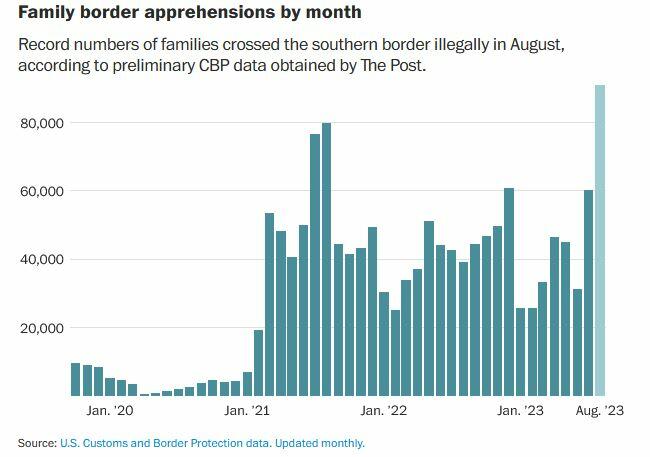
Based on a new report of preliminary Customs and Border Patrol (CBP) data, August was the highest month this year for overall migrant encounters - hitting 91,000. Policy experts say that was 'entirely predictable' due to a rule change which exempted 'family units' from being automatically denied asylum.

"Notwithstanding the administration’s claim that they are refusing to consider asylum claims from people encountered between ports of entry, the rule they adopted has huge loopholes. Among those explicitly exempted are family units," said Ira Mehlman, a spokesperson for the Federation for American Immigration Reform (FAIR), in a Friday statement to Just the News.

"So, guess what? We are seeing a surge in family units crossing the border illegally and it is not even clear if they really are family units. As we have seen in the past, there have been rent-a-kid schemes to help people take advantage of the laxer rules that apply to adults accompanied by children. The record number of family units encountered at the border was entirely predictable," he added.

Since May, immigrants seeking asylum at the U.S. border have been able to request appointments, up to 1,450 per day, CPB says, with immigration officials using the CBP One smartphone application

Mark Krikorian, executive director of the Center for Immigration Studies, told Just the News that the immigrants who use the CBP One app to schedule appointments still have to make it to the border somehow. -Just the News

"They still have to pay smugglers to get here and the whole thing is a boon for alien smugglers," said Krikorian. "It's supposed to only be for people who have made it to Mexico already and even that's bad enough, because you have to pay a smuggler to get there but the smugglers have figured it out. They're actually using it."

Krikorian also says that the increase in family units was predictable due to current DHS policy.

"I don't know what the administration thought was going to happen," he continued.

Hilariously, the White House is now claiming that President Joe Biden has "done more" to secure the border "than anybody else."

Secure it for who, exactly?

According to the CBP, a family is defined as "group of two or more aliens consisting of a minor or minors accompanied by his/her/their adult parent(s) or legal guardian(s)."

Last Thursday, the Washington Post reported that the number of family units seeking entry into the US hit a record high in August.

The Post reports that the US Border Patrol "arrested at least 91,000 immigrants who crossed as part of a family group in August, exceeding the prior one-month record of 84,486 set in May 2019."

And how many didn't they arrest?

https://www.zerohedge.com/political/biden-built-predictable-loophole-resulted-flood-illegal-family-units-us

Wegovy weight-loss drug will cost 199-299 pounds for private UK patients -Simple Online Pharmacy

 Simple Online Pharmacy, a UK-based online pharmacy chain, will charge patients with private insurance or those paying out of their own pockets between 199 pounds and 299 pounds ($251-$377) for a month's supply of Novo Nordisk's weight-loss drug Wegovy.

It was the first indication how much the popular weekly injection would cost private patients in Britain after Novo announced it had launched Wegovy earlier on Monday.

It said it expected to have Wegovy in stock "within the next 24 hours". More than 50,000 people have registered an interest in Wegovy on its website.

Saxenda, a daily injection which is Novo's older weight-loss treatment already on the UK market and which is less effective than Wegovy, is also in short supply.

"Our research into other markets indicates Wegovy demand typically outpaces Saxenda somewhere between 3 and 6 times, so we expect to be inundated," said Chief Executive & Co-Founder Addy Mohammed in the statement.

Simple is one of the main providers of weight-care medications in Britain, alongside Walgreens Boots Alliance and LloydsPharmacy.

https://finance.yahoo.com/news/1-wegovy-weight-loss-drug-101431136.html

Pent-up private Wegovy demand prompts UK availability concerns

 People in Britain who can afford to pay out of their own pocket may get easier access to Novo Nordisk's weight-loss drug Wegovy than those seeking treatment in the country's state-run health service, some doctors and medical experts warned on Monday.

That risks worsening health inequality in the country with the highest obesity levels in Europe when Britain's National Health Service (NHS) is under increasing financial strain and struggling with record waiting times.

Wegovy maker Novo Nordisk announced on Monday the launch of the drug in Britain, its fifth market, making it available on the NHS weight management scheme, where it will be prescribed for free, but also on the private market.

Novo said on Monday that it would allocate a portion of available supply for the NHS, which said around 50,000 patients could be eligible in England, but cautioned that supplies will be constrained for the foreseeable future.

Naveed Sattar, a Professor of Metabolic Medicine at the University of Glasgow who has consulted for Novo but said he had no knowledge of its decision-making process, said he was "not comfortable" with Wegovy being available privately.

"It just doesn't make sense to me because there is substantial need in the NHS. Why wouldn't we put all that (supply) through the NHS?" he said.

A 2019 Organisation for Economic Co-operation and Development (OECD) report said that nearly one in three adults are obese in the United Kingdom, the highest level in Europe.

In the most deprived areas in England, prevalence of obesity or being overweight is 14 percentage points higher than in the least deprived areas, data for 2020/21 show, according to a NHS report published in January.

Many obese people who live in poverty or face other barriers such as not speaking fluent English may struggle to access the NHS specialist service, said Duane Mellor, a dietician and senior lecturer at Aston University's medical school.