by Robert Malone via The Brownstone Institute,
I am a bit embarrassed to admit that I am taking a perverse pleasure in watching this catfight between Pfizer/BioNTech and Moderna play out.
Not to gloat, but I find it validating and rather satisfying to watch these companies file lawsuits and counter lawsuits that boil down to a schoolyard squabble over who came up with the ideas and initial proof of concept for using mRNA for developing drugs and vaccines – when neither actually did the initial “proof of concept” work.
Companies that have exploited and unethically weaponized my early work and ideas for enormous profit while also seeking to write me out of history.
“O what a tangled web.”
Just to be clear (for the haters), I received a total of one US dollar for my pioneering work, discoveries, and patents relating to my graduate research involving mRNA delivery at the Salk Institute, UCSD and Vical between 1986 and 1990. I played no role in development of any gene therapy-based COVID vaccine; the record shows that I was one of the early objectors to the rushed worldwide deployment of this technology, and I actively highlighted the (now proven) fact that the SARS-CoV-2 “Spike” protein expressed using this technology is a toxin. For speaking about which I was widely criticized, “fact-checked” and ridiculed in corporate media (and by the likes of Dr. Paul Offit).
Furthermore, I discovered and documented the profound toxicity (in both cell culture and in animals) associated with the use of cationic lipids for delivering mRNA and DNA during the 1990s, documented and disclosed this at a conference (that I organized) where I invited and first met Dr. K. Kariko (about a decade after my initial work at the Salk).
Around this time, Jill and I abandoned the nano-lipid technology and turned to discovering and developing other methods for delivering nucleic acids into cells and tissues for vaccine development and other indications. Including the initial proof of concept and patent covering the use of gene therapy technologies for eliciting a mucosal immune response. Those are all documented and readily verified facts.
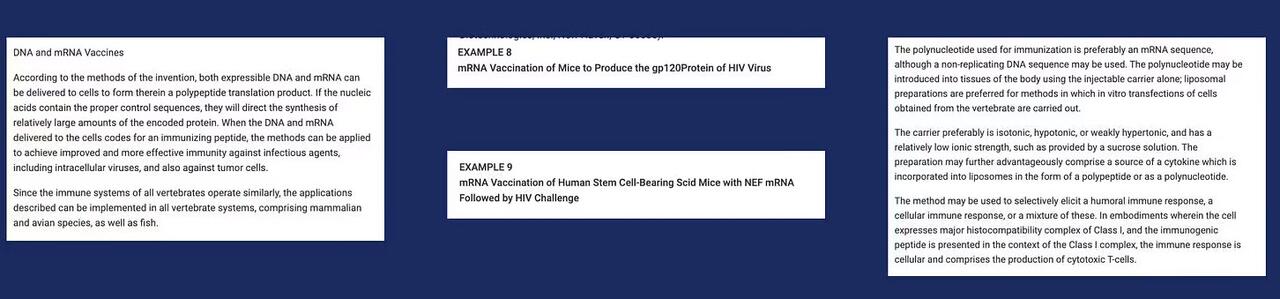
Images from the 1990 filed patents (priority date 1989)
Throughout my career, I have had to deal with other academics who have asserted that THEY were the ones that first discovered and developed what I had clearly pioneered so long ago. Dr. David Weiner (U Penn), Dr. Harriet Robinson (Merck, then Emory), Dr. Margret Liu (Merck), the list goes on and on. They all profited greatly from this. Success has many fathers, failure is a bastard.
This was partly the consequence of the “reduction to practice” of the work for vaccine purposes having occurred at a small La Jolla biotech startup called “Vical,” and my having signed non-disclosure and employment agreements which constrained my ability to disclose what I had done there or to influence the subsequent tide of events in any way.
Suffice to say, academic self-promotion, avarice, hubris, and greed are often well rewarded, and when pharmaceutical industry interests merge with academic competitiveness, then ethics gets to ride in the back of the bus. Meanwhile, while I was a young “soft money” academic, the CEO of Vical (Dr. Vijay Samant, formerly of Merck) sent me a cease and desist letter threatening to sue me if I disclosed or used the discoveries which I had made while working for that firm.
Then along come Drs. Katie Kariko (U Penn and later VP BioNTech- formerly a Hungarian spy) and Drew Weissman (U Penn- trained by Dr. Anthony Fauci)- about a decade later after my work and initial reduction to practice – who wrote a review paper in a high profile academic journal discussing my ideas without citing my work. They then tour widely promoting the logic and technology. This review then becomes the basis of a series of Wiki pages, promoting this pair and others as the original inventors.
Meanwhile, the Vical patents issue, the initial 1990 filing dates (with a priority date of 1989) become public, and it becomes harder for those who have sought to claim credit for my work to continue to do so. But, as is often observed, a lie can circle the world while the truth is still getting its shoes tied. And in academia, it is all about pedigrees and publicity. The stories of academic “stolen valor” are legion.
Wired magazine (a publication with close CIA connections) hyped the tech, asserting that Vical would be the next Microsoft. Vical (and Merck) literally spent billions of dollars trying to develop vaccine products (using plasmid DNA rather than mRNA), and completely failed. Which does not stop them from suing Curevac for infringement with that companies early mRNA delivery and product development research.
Then the initial patents expired. Vical market capitalization collapsed to well below cash on hand, and the company merged with a smaller startup. Dr. Vijay Samant retired in comfort after over a decade collecting a huge salary. Stockholder lawsuits went nowhere. DARPA launched a funding initiative and capitalized Moderna. The German government did likewise with BioNTech.
Fast forward to 2020
Early in the COVIDcrisis, Operation Warp Speed and the NIAID Vaccine Research Center had focused on the unproven use of cationic lipid formulations of mRNA encoding the spike protein as the way to save the world from an engineered coronavirus produced at the Wuhan Institute of Virology with assistance and funding from a wide range of US Government entities (CIA, NIH, USAID, DoD, State Department). They initially did this in close cooperation with a Boston-based American company (Moderna) that was largely the creation of the CIAs technology development arm called DARPA (Defense Advanced Research Project Agency).
U Penn licensed a Kariko and Weissman patent involving the incorporation of Pseudouridine into the mRNA (with no claims issued concerning use for vaccines) to a holding company, which then licensed to both Moderna and BioNTech. A third firm seeking to develop mRNA vaccines (Curevac) – funded in part by Elon Musk- did not license the U Penn patent and developed a SARS-CoV-2 mRNA vaccine that used a lower dose of mRNA/lipid and did not have the Pseudouridine (pseudo-mRNA) issues. Unlike Moderna and BioNTech, Curevac was more methodical, traditional (and ethical) in its product development, but its initial antibody titers and seroconversion (at a reduced dose) were lower than those reported by Moderna and BioNTech, and so it was relegated to the ash-heap of history.
A wall of marketing hype was built around Katie Kariko and Drew Weissman as the original inventors of use of mRNA for vaccination purposes, with initial articles by Boston-based “STAT News,” followed by CNN and the New York Times. A huge corporate media buzz was developed promoting that Kariko and Weissman should be awarded a Nobel Prize (Medicine or Chemistry) for their “pioneering” work. And Moderna, with close involvement of MIT liposome technology and drug discovery superstar Professor Dr. Robert Langer, asserted that it had the dominant patent position for using mRNA as a drug or for vaccine purposes.
Jill and I objected to my being written out of history (including on Wikipedia); Jill wrote up an account of the actual history of the inventions, complete with citations to and copies of the original invention disclosures, patents, data etc. including the original patent filed by the Salk Institute and then inexplicably dropped without notifying me. The summary was sent to many – Salk Institute, UCSD, a close colleague and former collaborator at the Karolinska (now a full professor who sat on the Nobel Prize selection committee), Dr. Robert Langer (who initially claimed ignorance of my role but then conceded the facts), and many others. Letters were sent to STAT News (who refused to retract or alter their publications promoting the Kariko and Weissman stolen valor claims), CNN (who did seem to edit, back off of and retract some of what they had been pushing), and the New York Times (which definitely edited their prior video and written essays to remove claims about Kariko and Weissman being the original source of these ideas).
Kariko and Weissman received millions from the Lasker Award (often considered the American Nobel) and similar awards from the governments of Israel and Spain. But to the astonishment and disappointment of Nature magazine and US Corporate media, no Nobel prize in medicine or chemistry was forthcoming. The Nobel committee had long since reviewed the actual scientific contributions of Kariko and Weissman to the field, and determined that they were not sufficient to merit this distinction. And at that time, many (including myself) had spoken out about the risks of what had been developed for “vaccination” against COVID-19, and the bloom was off the rose.
At this point, it became clear that my role as the inventor of this technology was what gave my concerns about the safety of the mRNA COVID-19 shots gravitas. This then became the reason for mainstream media to deny my role as inventor.
Moderna and Pfizer were awarded “vaccine” contracts from governments across the world, and consequently reported record profits. Their market capitalization went through the roof. Moderna leadership (including Robert Langer) began “divesting” of Moderna stock. And then the patent fights began. The latest version of the various companies spun out of the University of British Columbia research group which had developed the updated version of the cationic lipid formulations which I had worked with filed patent infringement lawsuits against Moderna.
And Moderna filed lawsuits against BioNTech and their Pfizer partner/licensee claiming infringement on issued Moderna patents which, despite the eight previously issued (and expired) Vical patents which cover mRNA and DNA vaccines, claim inventorship of the idea and reduction to practice of mRNA vaccines.
At which point I decided to dig into the actual Kariko, Weissman and Moderna patents to see what are the actual issued claims. Please understand, at this point in time, the Vical patents have expired. I have no (financial) dog in this fight. Only a bystander’s perverse interest and a lingering desire to not be written out of history. And as discussed in a prior August 26, 2022 substack titled “Moderna sues BioNTech/Pfizer?” what I find when I actually do the research (in contrast to the corporate media “reporters”) is that – somehow – consistent with Dr. Robert Langer claiming no knowledge of my role in discovery and development of these ideas as a young graduate student, Moderna and its intellectual property team has completely failed to cite my prior work and the issued patents.
Which brings me to the present. Pfizer is now claiming that the Moderna patents, which Moderna sought to weaponize against Pfizer/BioNTech, are invalid because the technology and invention of using mRNA for vaccination purposes was first disclosed and reduced to practice in 1990.
In other words, Pfizer/BioNTech are now citing my work (and that of my close colleagues) to dispute the Moderna patent infringement claims – precisely as I had recommended in my August 2022 essay.
Please keep in mind that Thompson/Reuters has close ties (at the board of directors level) with Pfizer, my initial reporting on which conflict of interest was one of the key reasons I was deplatformed by Linked-In (the first time).
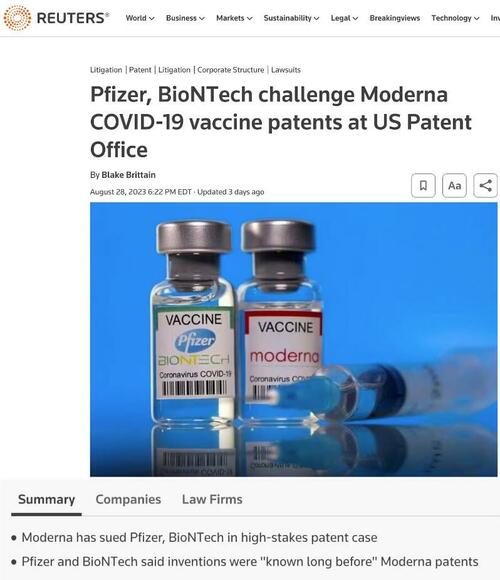
Aug 28 (Reuters) – Pfizer (PFE.N) and BioNTech (22UAy.DE) asked a US government tribunal on Monday to cancel patents on COVID-19 vaccine technology that rival Moderna (MRNA.O) has accused the companies of infringing.
Pfizer and its German partner told the US Patent Office’s Patent Trial and Appeal Board that the two Moderna patents are “unimaginably broad” and cover a “basic idea that was known long before” their invention date of 2015.
Representatives for Moderna did not immediately respond to a request for comment on the filings.
Pfizer said in a statement on Monday that it and BioNTech’s vaccine was “based on BioNTech’s proprietary mRNA technology and developed by both BioNTech and Pfizer,” and that they remain confident in their intellectual property.
Pfizer and BioNTech have separately challenged the two patents and a third related Moderna patent in court in an ongoing Massachusetts federal lawsuit that Moderna filed against them last year.
Moderna in the lawsuit accused Pfizer and BioNTech of violating its patent rights in messenger-RNA vaccine technology. The case is one of several that have been brought by biotech companies seeking patent royalties from Moderna, Pfizer and BioNTech’s blockbuster COVID-19 vaccines.
Pfizer earned $37.8 billion from sales of its COVID-19 vaccine Comirnaty last year, while Moderna made $18.4 billion from its vaccine Spikevax.
The Patent Trial and Appeal Board hears challenges to patent validity based on “prior art” that challengers say disclosed the inventions before they were patented. Defendants frequently turn to the board as an alternative path to fend off patent infringement claims.
Pfizer and BioNTech said in their board petitions that scientists discovered that mRNA could be used for vaccines as early as 1990. They argued that Moderna’s patents were invalid based on separate patent applications and other publications from as early as 2004.
And that would be my work and inventions, that of my colleagues at Vical, and the issued but expired patents which Katie Kariko, Drew Weissman, U Penn, Moderna, and corporate media have tried so hard to write out of history.
The cases are BioNTech SE v. ModernaTX Inc, Patent Trial and Appeal Board, Nos. IPR2023-01358 and IPR2023-01359.
The “fact-checkers,” intelligence community (particularly MI6 and their edits to my Wikipedia page), U Penn and their surrogates, corporate media (and Alex Berenson) have gone to great length to “overlook,” deny, defame, and ridicule me as a liar for asserting that I did the work, had the original ideas, and made these inventions.
But the actual facts are now starting to become undeniable. And corporate media faces a paradox. Continue to conveniently “overlook” those papers I have authored and the issued but expired patents which explicitly list me as co-inventor (as Reuters has done above). Or come to grips with their own shoddy journalism, research and bias.
Having become (justifiably) quite cynical about such matters over the years, I strongly suspect that we will exclusively see the “convenient overlook” strategy.
https://www.zerohedge.com/medical/delights-pfizermoderna-catfight