Search This Blog

Tuesday, September 5, 2023

Abbott to Acquire Bigfoot Biomedical, Furthering Connected Solutions for Diabetes


  • Bigfoot developed Bigfoot Unity, a smart insulin management system that features the first and only FDA-cleared connected insulin pen caps that turn data from a continuous glucose monitor (CGM) into clear and reliable insulin dosing recommendations displayed right on the insulin pen cap

  • Acquisition will bring together two leaders in different aspects of diabetes care: CGM and insulin injection support

  • Together, Abbott and Bigfoot will continue to advance technology-driven solutions for making diabetes management even more personal and precise

MacroGenics: $15 M Milestone Related to Gilead’s Nomination of Bispecific Research

MacroGenics, Inc. (NASDAQ: MGNX), a biopharmaceutical company focused on developing, manufacturing and commercializing innovative antibody-based therapeutics for the treatment of cancer, today announced that its partner, Gilead Sciences, Inc. (NASDAQ: GILD), nominated the first of two research programs, leveraging MacroGenics’ DART® and TRIDENT® platforms for generating bispecific antibodies. This nomination grants Gilead an exclusive option, upon achievement of a pre-defined preclinical milestone, to license worldwide rights to the research program.

Under the October 2022 agreement, MacroGenics will receive $15 million related to the nomination of a bispecific research program to be conducted by MacroGenics and funded by Gilead. Pursuant to this agreement, which covers MGD024, an investigational, bispecific antibody that binds CD123 and CD3 using MacroGenics’ DART platform, and up to two additional bispecific research programs, MacroGenics remains eligible to receive up to $1.7 billion in target nomination, option fees, and development, regulatory and commercial milestones. MacroGenics will also be eligible to receive tiered, double-digit royalties on worldwide net sales of MGD024 and a flat royalty on worldwide net sales of products under the two research programs.

https://finance.yahoo.com/news/macrogenics-announces-achievement-15-million-110000592.html

Sidney Powell Alleges Falsehoods In Georgia Trump Indictment

 by Petr Svab via The Epoch Times (emphasis ours),

Lawyer and former prosecutor Sidney Powell alleged false claims in the indictment against former President Donald Trump in Georgia.

Ms. Powell, who’s a co-defendant in the case, contradicted several claims in the indictment in an Aug. 30 court filing, asking for her case to be tried separately from the other 18 defendants, including President Trump.

Most of the charges don’t involve her and those that do “fatally depend on demonstrably false premises,” the filing said.

Fulton County District Attorney Fani Willis alleged in the Aug. 14 indictment that Ms. Powell participated in a racketeering conspiracy by tampering with election machines and computers and stealing data from them.

She “entered into a contract” with data forensic company SullivanStrickler and “caused” its employees to copy data from election equipment in Coffee County, Georgia, after the 2020 election, the indictment said.

In fact, Ms. Powell asserted, that though her name was printed on the SullivanStrickler contract, she never signed it.

“There was no contract for SullivanStrickler to conduct forensic imaging of the Coffee County Voting Systems,” her filing said.

“Ms. Powell signed no such contract. … Ms. Powell did not plan or organize the Coffee County trip. … Ms. Powell did not request SullivanStrickler to undertake that project,” it said.

As for the breach of the equipment, the firm claimed in a separate lawsuit that its employees believed they were authorized to copy the data. They said at least one Coffee County election official was present during their work.

A unanimous Coffee County Election Board gave permission for the forensic inspection, and nothing was stolen,” the Powell filing said.

The prosecution rests on the assertion that the county officials themselves weren’t authorized to make such a decision.

Ms. Powell also argued that she wasn’t a part of any conspiracy on behalf of President Trump because she wasn’t involved in most of the actions alleged in the indictment, wasn’t in contact with most of the people allegedly involved, and was in fact mostly at odds with them.

Ms. Powell did not agree with any of her purported coconspirators to do anything improper, and many of her purported coconspirators publicly shunned and disparaged Ms. Powell beginning in November 2020. Others she does not know or had no contact with at all,” the filing said.

The main thrust of the indictment focuses on a strategy devised by several lawyers advising President Trump to arrange alternative slates of electors in several states and thus delay the counting of the electoral votes. It alleges the strategy amounted to a criminal enterprise.

Ms. Powell said she had no involvement in those efforts.

https://www.zerohedge.com/political/sidney-powell-alleges-falsehoods-georgia-trump-indictment

Father of woman killed in Maui wildfires sues government for negligence

 The father of a woman killed in the deadly wildfires last month in Hawaii has sued the state, local government of Maui, his local utility company and large landowners in a first-of-its-kind lawsuit alleging they are responsible for the disaster.

Harold Wells filed suit Monday against the group, alleging the government and Hawaiian Electric were negligent and responsible for the death and destruction caused by a raging wildfire that destroyed the town of Lahaina and ended up killing more than 100 people.

The fire was speculated to have started due to downed power lines owned by the electric company in the hills east of Lahaina. Multiple suits have alleged the utility’s infrastructure caused the blaze. 

Wells argues in the filing that government officials and the utility were aware that nonnative vegetation, dried out by weather, posed a serious fire risk to communities.

“The combination of weather, uncontrolled vegetation and aging electrical infrastructure created a tinderbox ready to explode in Maui.” the suit reads. “The risk was not theoretical.”

The lawsuit also argues the officials and Hawaiian Electric should have learned from a 2018 fire that burned over 20 homes near Lahaina and changed policies. The owners of the land in the hills above the town where the fire started should have also been aware of the risks of unmanaged vegetation, it reads.

“Despite this history of serious fires caused by predictable weather conditions, no one in a position to effect change did anything to prevent or substantially mitigate the risk,” the suit states. “The result of these years of neglecting and disregarding the risk that the 2018 Fires would be repeated when similar conditions inevitably occurred was the greatest single-day loss of life and property in Hawai‘i history on August 8, 2023, a catastrophe and tragedy for which all Defendants named herein should share in the fault.”

The filing also cites reports from the Hawaii Wildfire Management Organization that note the Lahaina region as one of “high concern” for fires and recommend methods to reduce flammable vegetation. It claims about 30 percent of landowners in the area did not make any attempt to control vegetation on their properties.

Reports from Maui County cited in the lawsuit also mark West Maui as an area with a “high likelihood” of wildfires.

Hawaiian Electric was also aware of the risk caused by weakening infrastructure, Wells claimed in his suit. He also cited 2022 requests for funds to improve the power infrastructure statewide to help prevent wildfires, as well as lessons learned from California wildfires that have been blamed on similar utility infrastructure.

“[Hawaiian Electric] should have planned for such improvements long before 2022,” the suit reads. “Energy experts have long called for the utility to harden its grid, and despite the cost, to put more of it underground.”

“Had they done so, the capital improvements would have enabled the grid to withstand the hurricane level winds that whipped across Maui on August 8, 2023 and in so doing, prevented a deadly fire,” Wells added.

The suit also criticizes local government authorities for responding to the fires poorly, specifically alleging the city didn’t adequately warn its residents. The county has come under widespread criticism for its response, including the choice not to use warning sirens as the fire approached.

Wells’s demands in the suit include burial expenses for his daughter, compensation for her death and additional penalties as determined by a judge, if he wins the case.

https://thehill.com/regulation/court-battles/4188005-father-of-woman-killed-in-maui-wildfires-sues-government-for-negligence/

U.S. FDIC says started marketing process for $33 bln commercial real estate

 The U.S. Federal Deposit Insurance Corporation (FDIC) has started the marketing process for a $33 billion commercial real estate (CRE) loan portfolio of failed New York lender Signature Bank, the regulator said on Tuesday.

The majority of the CRE loan portfolio being marketed is comprised of multifamily properties, primarily located in New York City, the FDIC said. Approximately $15 billion of the CRE loans secured by multifamily residences are rent stabilized or rent controlled, it added.

https://www.reuters.com/article/usa-fdic-signaturebank/u-s-fdic-says-started-marketing-process-for-33-bln-commercial-real-estate-idINL1N3AH227

Stryker upped to Buy from Neutral by B of A

 Target to $315 from $310

https://finviz.com/quote.ashx?t=SYK&p=d

Biggest Threat To Global Liquidity Is China

by Simon White, Bloomberg macro strategist,

Global money growth will remain under pressure while China refrains from comprehensive easing, posing a potential secular headwind for risk assets and economic growth around the world.

Money makes the world go round. Nowhere is that more true than in markets. No money, no liquidity, no transactions. Any impediments to money are thus a big deal for asset prices and economies.

Money has been in great abundance for most of the last 20 years. But that is in large part due to China. Its current travails therefore pose a significant risk to money’s path in the coming months and years.

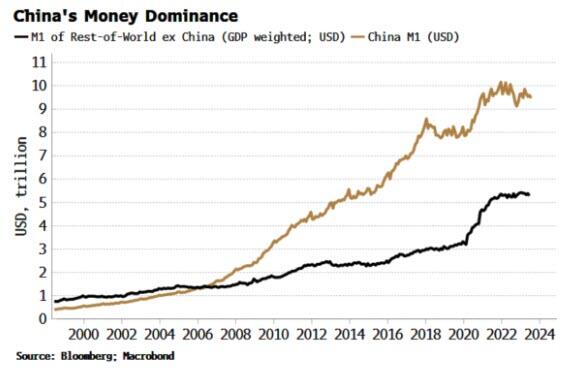
China’s dominance in global money trends can be seen in the chart below. Since 2007, China’s M1 in dollar terms has hugely outpaced GDP-weighted M1 in the rest of the world. M1 in China is 67 trillion CNY, or $9.5 trillion, while M1 in the US, the country with the second largest stock of narrow money after China, is 30% lower, despite an economy that is a third bigger than China’s.
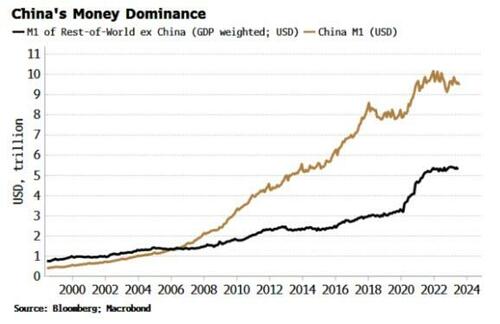
That’s without including the demand deposits of households. They’re not part of M1 in China as they are in most other countries. Adding them in would enlarge China’s M1 by more than half again.

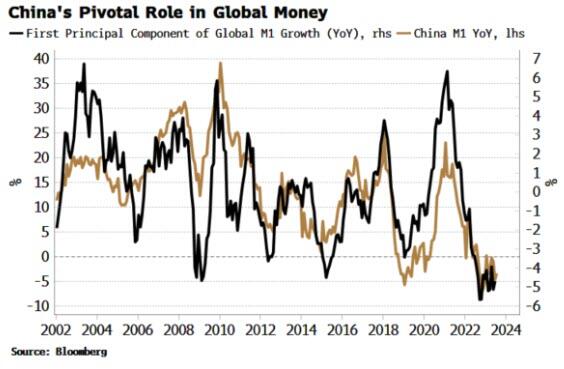
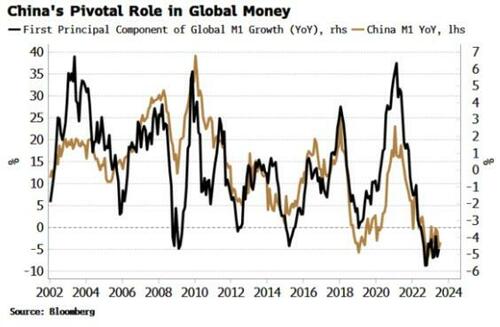
Even without this adjustment, China has been pivotal for global money growth over the last 15 years. That can be seen clearly if we look at the first principal component of global money growth (i.e. where there is maximum variation). This component is very close to China’s money growth (and no other country’s, including the US), showing that China has been the primary driver of global money trends for the last two decades.
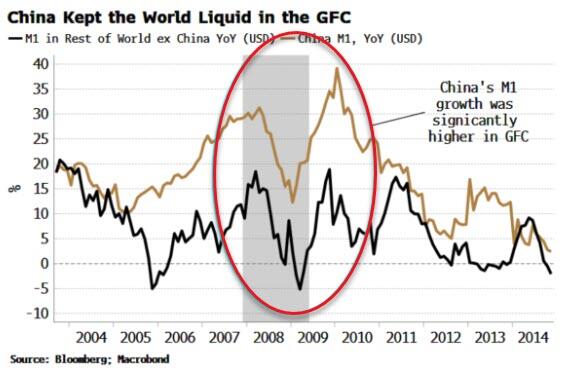
At no time was China’s global monetary significance more critical than in the aftermath of the GFC. While the US was hesitating in providing large-scale fiscal and monetary stimulus, China’s money growth exploded. Between 2008 and 2011, it was on average about twice the rate than in the rest of the world.
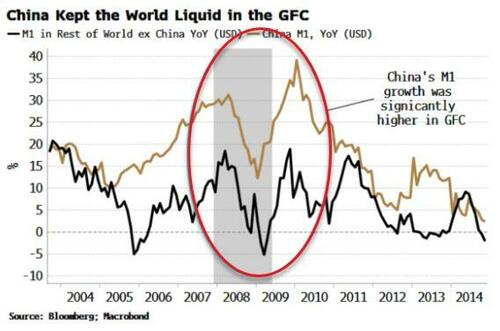
In percentage terms, M1 in the rest of the world rose by 30% in 2008-11, while in China, adjusted for household deposits, it climbed by almost 110%. It’s no overstatement to say a deep recession could well have become a global depression if it were not for China’s largesse.

In the pandemic the situation was reversed, but less dramatic. The US expanded its money supply more than China as the latter refrained from supporting its household sector, while the US handed out stimulus checks. But to put things in perspective, the gap between M1 growth in the pandemic was much smaller than in the GFC, at 14% for China compared to only 38% for the rest of the world. The rest of the world is not providing the money leadership China once did.

Why is M1 is so important? Principally as it’s the most cyclical of the monetary measures. The monetary base, which is currency in circulation and bank reserves, is too narrow a measure. Central-bank reserves can be created but remain locked up in the financial system, and thus have a muted impact on risk assets and especially the real economy.

M2 and M3, on the other hand, are too broad measures of money. They are typically counter-cyclical as they are dominated by items like savings deposits, which tend to rise in periods of risk aversion and fall when economic optimism rises.

M1 is in a sweet spot. It’s primarily made up of the monetary base and demand deposits. Banks create deposits when they lend money, thus it is an excellent sign of forthcoming economic activity. Why borrow unless you are going to spend or invest?

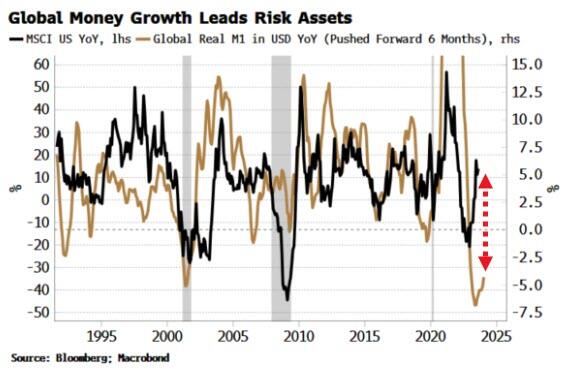
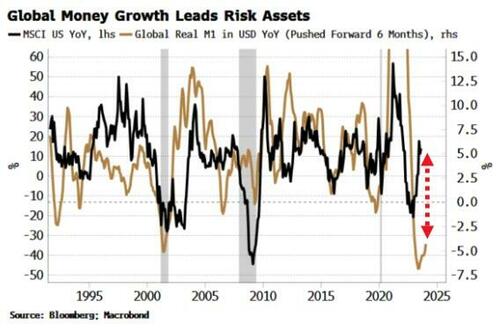
M1’s evolution, therefore, has significant implications for risk assets and global economic activity. We can see in the chart below the strong leading relationship between global M1 growth and US equities, with rises and falls in M1 growth leading stocks by about six months.
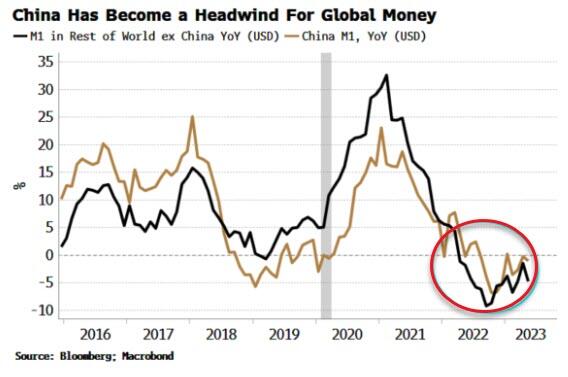
But since the pandemic, China has been faltering. For the first time since it entered the global financial system, China has been a persistent drag on global money growth. Its M1 growth has stalled as it imposed some of the most draconian lockdowns in the world, and since then it has resisted engaging in so-called flood-like stimulus to reflate its economy.
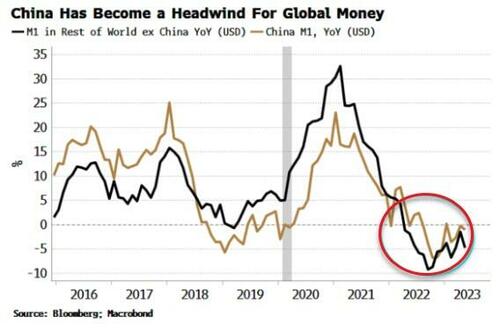
Without China, global money supply is likely to remain depressed, especially as growth is unlikely to come from the US et al when they are in the midst of rate-hiking cycles and reducing the size of their central-banks’ balance sheets.

The pressure is mounting on China to stimulate broadly to resuscitate its property market and avert a debt-deflation. But that doesn’t mean it will definitely happen, and happen in time. If resistance to such measures turns into outright recalcitrance, then it’s not just China that will face the consequences.

https://www.zerohedge.com/markets/biggest-threat-global-liquidity-china