Search This Blog

Tuesday, January 16, 2024

Easy Medicaid Access Discourages Long-term Care Planning

 To resolve persistent problems in the nation’s long-term care (LTC) system, the government must eliminate loopholes that allow people to easily qualify for Medicaid payment, concludes a report titled “Long-Term Care: The Solution,” by Stephen Moses, president of the Center for Long-Term Care Reform (CLTCR), published by the Paragon Health Institute in November.

Moses says generous Medicaid eligibility coupled with estate recovery has failed to promote adequate planning for LTC, whether through savings or insurance, and that has left the LTC safety net in danger of financial collapse.

“Too many people end up on Medicaid, which pays too little to ensure access to quality home care and causes excessive reliance on institutionalization and unpaid help from families and friends,” wrote Brian Blase, president of Paragon, in an announcement of the report’s release.

The report identifies options to empower younger and middle-aged Americans to plan responsibly using wealth held in home equity, individual retirement accounts, life insurance, and estates, and to serve seniors’ desire to see their medical needs met in the home environment rather than in institutions.

Medicaid for the Middle Class

Moses says he identified key issues threatening the viability of government-funded LTC in “Long-Term Care: The Problem,” a study published by CLTCR in 2022.

“Central planning, public funding, heavy regulation, and easy access to welfare benefits have caused most of LTC’s problems, such as nursing home bias, poor access, and quality, inadequate revenue for care providers, caregiver shortages, and the terrible emotional and financial distress for caregiving families,” said Moses.

Today, Medicaid LTC is not just a program for the poor, says Moses.

“Medicaid especially is responsible because, despite the conventional wisdom that it requires impoverishment, the program’s LTC benefits are routinely available not only to the poor but to the middle class and affluent as well,” said Moses.

The CLTCR report included real-life examples of how affluent people have received LTC under Medicaid, such as a couple sheltering $700,000 in liquid assets by purchasing a more expensive house, car, and annuity, all exempt from Medicaid’s eligibility calculation. Another example is an able-bodied wife who received an $89,000-a-month annuity while Medicaid paid for LTC for her husband.

Crisis Needed for Reform

Moses says it won’t be immediate, but politicians soon might embrace the solutions outlined in the report, “…when politicians have to make budget ends meet again,” said Moses.

“Historically we made progress with measures to constrain Medicaid LTC and aim it to the needy during and after recessions forced attention to expenditures,” said Moses. “That stopped since the Great Recession because of wide-open spending, deficits, debt, and artificially low-interest rates. The result is inflation now and (the) inability to service the national debt (in the future).”

“Something will have to be done and we’re ready with the solution,” Moses said.

In the Paragon report, Moses identifies the biggest loopholes that discourage early LTC planning, such as the purchase of exempt assets, the home equity exemption, Medicaid asset protection trusts, Medicaid-compliant annuities, and the “five-year asset transfer lookback,” which is the time-frame Medicaid uses to ensure someone hasn’t given away money or resources to qualify.

Close Asset Loopholes

Medicaid requires LTC recipients to spend down personal assets to $2,000 but doesn’t state how, says Moses, in the Paragon report, but spending down assets should be for documented health or LTC expenditures.

“Such exempt items include an expensive home and—without any dollar limit—the following: one automobile, prepaid burial plans, one business including the capital and cash flow, term life insurance, household goods, personal belongings, and even individual retirement accounts (IRAs) in many cases,” wrote Moses. “Medicaid planners routinely advise clients to maximize this path to eligibility.”

The report also proposes “a phase-in schedule” for the home equity exemption, which can exceed $1,000,000 in some states. The schedule should provide enough warning to incentivize early LTC planning “without unduly affecting people already too old to prepare.”

Other recommendations include eliminating Medicaid Asset Protection Trusts (MAPT), which allow people to shelter assets for five years before applying to Medicaid, and Medicaid-compliant annuities. The “lookback” window for asset transfers should be expanded to 20 years, not five, recommends the report.

Additionally, LTC risk and cost should be widely publicized so that once Medicaid is preserved for the truly needy, people will have far greater incentives to engage in proper planning and will find the LTC challenge less intimidating, says the report.

Eliminate Moral Hazard

“If people could not ignore LTC until they need it and get Medicaid to pay while preserving wealth, they would save, invest, or insure for the risk and be private payers when the time comes with access to the best private LTC in the home instead of a nursing home,” Moses said.

The current system creates a “moral hazard” that discourages consumers from making sound choices, says Blase.

“Most Americans possess enough wealth to fund their average LTC needs, which is about two years of home-based services,” wrote Blase. “If the average 65-year-old had $70,000 set aside for LTC, it would grow to meet that need after age 85, when LTC commonly occurs. Positive incentives to plan early and pay privately avoid the loss of freedom and high economic cost from compulsory, payroll-funded policies.”

Stephen Moses, “Long-Term Care: The Solution,” Paragon Health Institute, November 2023:  https://paragoninstitute.org/research-paper-page-moses-ltc-solution-20231002/

Removing Medicaid Loopholes to Improve Long-Term Care – Stephen Moses, The Heartland Daily PodcastNovember 7, 2023.

https://heartlanddailynews.com/2023/11/easy-medicaid-access-discourages-long-term-care-planning/

What is an Increase in Obamacare Enrollment Costing?

 The first decade of Obamacare raises questions about the program’s lofty promises and its actual performance.

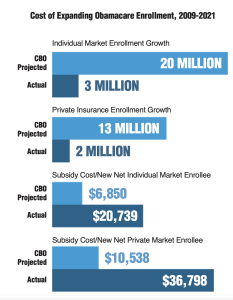
In a post on X, formerly Twitter, President Joe Biden noted that 301,000 “new customers” had signed up in the first week of the open enrollment period that began on November 1. But a study released by the Paragon Health Institute found that the health insurance marketplaces established under the Affordable Care Act (ACA) attracted half as many people as projected by the Congressional Budget Office (CBO), at three times the projected cost to taxpayers.

“The ACA’s individual market policies have produced far less enrollment at a much higher unit cost than projected, write Daniel Cruz and Greg Fann, authors of the Paragon report, titled “The Shortcomings of the ACA Exchanges: Far Less Enrollment at a Much Higher Price.”

ACA Created Federally Regulated Exchanges

Cruz and Fann, actuaries with extensive backgrounds in health care, place Obamacare in historical perspective.

“The passage of the Patient Protection and Affordable Care Act (ACA) in 2010 represented one of the most significant changes in federal health policy since the Social Security Amendments of 1965, which established Medicare and Medicaid,” Cruz and Fann write. “The principal goal of the multifaceted law was to reduce the number of uninsured Americans. The primary barrier to insurance coverage was presumed to be cost, and the intent of the law was to appropriate financial resources to provide coverage incentives for lower-income people.

“The means of accomplishing this goal were two-fold: (1) enhanced federal funding for states to expand eligibility for Medicaid and (2) restructuring the individual market into federally regulated exchanges with large subsidies linked to both premiums and household income.”

Obamacare’s Medicaid Expansion

The Paragon study confirms the decisive role the ACA’s expansion of Medicaid eligibility has played in getting people to sign up for Obamacare.

“While ACA advocates focused on the private market reforms when selling the legislation to the public, the vast majority of individuals who gained coverage following the implementation of the law have done so through Medicaid,” write Cruz and Fann. “Of the 19 million Americans with health coverage after the ACA was implemented, 17.4 million were covered under the newly eligible Medicaid expansion group.”

These figures are in sharp contrast to projections made by the CBO in 2013, the year before the ACA went into effect. The CBO projected a health coverage increase of approximately 25 million Americans, evenly split between new ACA exchanges and the expansion of Medicaid. This lopsided result occurred, the study says, even though ACA subsidies have increased by more than 45 percent since 2014.

(Source:  Paragon Health Institute)


ACA Efficiency Under the Microscope

There has not been much research on the efficiency of the ACA, say Cruz and Fann.

“Health coverage policy efficiency is defined in terms of the increase in overall coverage relative to the taxpayer cost of achieving that increase,” write Cruz and Fann. “While ACA enrollment figures have been reported—and sometimes singularly celebrated—on growth alone, without regard to underlying cost, assessments of efficiency have been lacking and have resulted in a poor understanding of policy efficiency.

“ACA exchange spending of $60 billion in 2021 cost taxpayers $36,798 per additional private insurance enrollee ($20,739 per additional non-group enrollee), more than triple CBO’s original projections of $10,538 and $6,850, respectively.  Overall, employer coverage dropped by 1.3 million, and non-group coverage increased by 2.9 million.”

Employers Cancel Health Insurance

Indeed, the study shows that since the enactment of Obamacare, employer-sponsored coverage has declined significantly, particularly among small businesses.

“According to the most recent (2022) KFF Employer Health Benefit Survey, small employers (3-199 employees) are increasingly not offering health benefits to their employees, with 51 percent offering coverage in 2022, down from 69 percent in 2010,” write Cruz and Fann. “The cost of insurance is cited as the primary reason employers are not offering coverage. Many of the ACA provisions—including benefit minimums, essential health benefit requirements, and the small group market single risk pool—have driven costs higher for these employers.”

Obamacare’s original goals have been further undermined by changes to the program since 2014, including the federal government’s cessation of reimbursing insurers for cost-sharing reductions (CSR) payments, prompting insurers to raise the price of premiums for ACA silver plans to reflect the actuarial value of those plans.

Further, say Cruz and Fann, the 2021 American Recovery Plan Act “reduced required income-based premium contributions for subsidized enrollees and expanded the population eligible for subsidies.”

“Meanwhile, unsubsidized middle- and upper-class families are forced to pay the full cost of plans and have limited options outside of the individual ACA market, resulting in minimal overall non-group enrollment gains due to the ACA,” write Cruz and Fann.

Obamacare Not a Success

“This study should silence all claims that the ACA has been a success,” said Dean Clancy, a senior health policy fellow at Americans for Prosperity. “The law has failed to deliver more affordable care to people and transferred hundreds of billions of dollars from taxpayers to insurance companies—all while, remarkably, making it harder to access quality care.”

“To improve government, it is vital that we analyze how public programs actually work,” said Brian Blase, president of the Paragon Health Institute. “A fair analysis of the ACA finds that it has largely been an expansion of the Medicaid welfare program and that the individual market is in poor condition, with most enrollees needing to receive giant subsidies to purchase coverage.”

Bonner Russell Cohen, Ph. D. (bcohen@nationalcenter.orgis a senior fellow at the National Center for Public Policy Research.

https://heartlanddailynews.com/2023/11/costs-rise-for-increasing-obamacare-enrollment/

Site-Neutral Medicare Payments Could Save a Patient $1,500—Study

 A breast cancer patient could save $1,500 per year in out-of-pocket costs if Medicare reimbursed hospitals and independent health care providers equally for the same service, and taxpayers would spend $7,750 less, according to a study conducted by Avalere Health for the American Cancer Society Action Network (ACSAN).

The study looked at the Medicare practice of paying health care providers by setting. Hospital out-patient departments are paid significantly more money than independent providers for the same services to compensate hospitals for higher overhead and equipment costs.

The report also found that “hospital outpatient departments” were reimbursed at a rate three times higher than what an independent practice would charge. In some cases, the reimbursement rates were five to six times higher.

“Payment policies should not create incentives that push patients into higher cost settings when the same care can be provided in a lower cost, often preferable, site of care,” the report states.

The House Budget Committee Health Care Task Force is examining the implementation of a “site-neutral” reimbursement system and held a roundtable discussion on the issue after ACSAN released its report on October 23.

Why Hospitals Are Paid More

Hospitals are allowed to charge more and collect more money from Medicare than other health care providers, which impacts prices across the board, Richard A. Kube, M.D., founder of Prairie Spine & Pain Institute, an independent orthopedic practice in Illinois, told the Heartland Daily Podcast.

“If I want to pay cash for an MRI or a scan in Peoria, I don’t have an independent option,” said Kube. “I must go to one of the two major hospitals and I’m going to pay a couple of thousand dollars for that. And maybe the insurance company won’t approve it. I know that I can go to another clinic in Bloomington and for $600 get the exact same MRI.”

The costs really add up for major surgeries done in hospitals, says Kobe.

“It is not so much the site-of-service differential but the amount of added costs that goes into keeping these giant administrative superstructures in place,” said Kube.

In other markets, consumers can save more when they deal with a large distributor that has the advantage of economies of scale, says Kobe.

“Hospitals should have that same opportunity,” said Kube. “It’s the only industry where you go to the mass producer, and you pay more.”

Consolidation Spiral

Because hospitals get higher reimbursements, they are at an advantage when dealing with rising administrative costs from government regulations. Independent practices have a hard time competing and may be inclined to merge with large hospital groups. The extra money hospitals collect from Medicare puts them in a better position to buy out practices. What results is a monopoly.

“The price will go up and value is going to go down because the hospitals no longer have to worry about competition,” says Kube. “Years ago, when we had an independent imaging center in Peoria, I could get same-week, sometimes same-day MRIs all the time. Now it takes a month.”

‘Subsidy to Poach’

The likelihood Congress will impose a site-neutral reimbursement system is a big “if,” says Kube, because hospitals have become big business and are in a position to protect their turf.

“It’s based on a monopoly,” said Kube. “The site of service differential can start unraveling the whole thing. All of a sudden, their margins would change drastically. They would no longer have that subsidy to poach all the private practices.”

Kube says he has personally experienced threats and pressure to use hospital imaging services.

“I’m a sub-specialist,” said Kube. “I read probably thousands of MRIs a year and for someone like me who knows the kinds of questions to ask and how [things work, it] it is inappropriate. If they’re willing to do those kinds of things, I’d expect them to spread as many lobby dollars as they can to push. And frankly, the insurance industry would be aligned with them.”

Compete on Price/Quality

Congress is making some headway on establishing site-neutral reimbursements and the Trump administration made progress through executive orders, but permanent reforms have never been enacted.

“The fundamental problem with all provider reimbursements in government health care programs is the fact that bureaucrats or elected officials are setting the payments,” said Roger Stark, M.D., a senior fellow at the Washington Policy Center. “These government officials are subject to intense lobbying by special interest groups. The hospital associations in the U.S. are well organized and pretty well funded, and overall command more attention than physician groups. Hence, hospitals and their clinics continue to get higher reimbursements.

“In a truly free market health care system, all providers would compete on both quality and pricing. Physician offices, with less overhead, would have a definite advantage over high-overhead hospitals for many patient services.”

Site-neutral reimbursement has bipartisan support in Congress, Kube wrote, in a Newsweek op-ed.

“Several congressional committees are now debating a health reform package that includes provisions to establish site neutrality in limited circumstances,” wrote Kobe. “That would be a vital first step, one which physicians across the country hope will soon expand to other services. After all, what could be more fair than reimbursing providers the same amount for the same service?”

Over-the-Counter Decongestant Doesn’t Work – Now What?


By Jeffrey Singer, M.D.

Just before cold and flu season is set to kick off, the Food and Drug Administration’s  (FDA) advisory panel last month reported that an oral decongestant Americans have relied on for nearly 20 years is no better than a placebo.

This ingredient found in popular versions of Sudafed, Dayquil, and other medications has gained popularity since Congress made it difficult for people to obtain an effective oral decongestant. Now, lawmakers can correct that mistake before the winter cold and flu season arrives in full force.

The Meth Connection

In an effort to shut down homegrown meth labs in which people converted oral decongestants containing pseudoephedrine into methamphetamine, Congress 18 years ago passed the Combat Methamphetamine Epidemic Act. Under the CMEA, the  Drug Enforcement Administration ordered all pseudoephedrine-containing products moved “behind the counter” and required pharmacists to register and track people who purchased them.

The DEA placed strict limits on the number and dosage of pseudoephedrine-containing products patients may obtain in 30 days. Until last year, Oregon and Mississippi had required residents to get a doctor’s prescription. But as often happened to the meth lab “cooks,” the methamphetamine law has become a spectacular failure, backfiring on its creators, and harming innocent bystanders.

When the Combat Methamphetamine Epidemic took effect in 2006, there were only two over-the-counter oral decongestants on the market: phenylephrine and pseudoephedrine. A third, phenylpropanolamine, was fading from the market after studies associated it with hemorrhagic strokes.

The CMEA effectively narrowed patients’ choices to one: phenylephrine.

A Marketing Dilemma

Many drug makers substituted pseudoephedrine with phenylephrine so their customers could continue buying their products over the counter and avoid the stigma of registering to purchase pseudoephedrine.

For example, Sudafed, which manufactured pseudoephedrine, came out with Sudafed PE (for phenylephrine). Phenylephrine replaced pseudoephedrine in Nyquil Sinex Nighttime Sinus Relief.

Yet, the makers of Claritin-D, a nonsedating antihistamine combined with the decongestant, pseudoephedrine, chose not to switch to phenylephrine. Their chemists ran tests on phenylephrine and found it ineffective when taken orally. The drug maker decided to stay behind the counter and competitors, Zyrtec and Allegra, made the same decision.

Then, in 2007, two academic pharmacists from the University of Florida looked at the studies the FDA relied on to declare oral phenylephrine safe and effective in the 1970s. The researchers concluded that phenylephrine was no better than a placebo.

A year had passed since the DEA moved pseudoephedrine, an effective oral decongestant, behind the counter. This was not a good time to tell millions of cold and allergy sufferers that the drugs they buy over the counter probably won’t work.

Pharmacists Take Action

Pharmacists petitioned the FDA to reconsider the effectiveness of phenylephrine. The FDA convened a panel that determined the  “murky” evidence phenylephrine worked orally, but the evidence was inconclusive.

By 2015, when the University of Florida pharmacists saw the results of studies by Merck and other drug companies showing oral phenylephrine doesn’t work even at high doses, they asked the FDA to take oral phenylephrine off the shelves.

After the American Pharmacists Association and other groups joined the petitioners, the FDA convened another advisory panel eight years later, in April.

On September 12, 2023, decades after the FDA proclaimed oral phenylephrine safe and effective, the panel concluded that oral phenylephrine is no better than a placebo. Unlike pseudoephedrine, digestive juices break down the phenylephrine before it can be absorbed into the system and work.

It doesn’t take a conspiracy theorist to wonder whether the FDA didn’t want to undermine the newly minted Combat Methamphetamine Epidemic Act by telling cold and allergy sufferers they will all be facing limits on their access to oral decongestants. And it wouldn’t be the first time politics influenced the FDA.

Cartels Get Smarter

Meanwhile, how’s the CMEA working to combat the methamphetamine epidemic?

The Mexican drug cartels soon took advantage of the new hole the law created in black market meth and figured out other ways to make methamphetamine. One way is using phenyl‐​2‐​propanone, also called phenylacetone or P2P.

Meth-related drug deaths per 100,000 thus increased nationally by 1,400 percent between 2006 and 2020.

More than half of American households trust and use oral phenylephrine, accounting for an estimated $1.76 billion in sales last year. The FDA hasn’t yet decided to officially inform them they are wasting their money on phenylephrine or to order it off the shelves.

If it does, expect cold and allergy sufferers to be very upset when they learn how inconvenient the government will make it for them to get relief from pseudoephedrine. Last week, CVS announced that it will begin voluntarily pulling oral phenylephrine decongestant off its store shelves.

Congress Should Act

Lawmakers should admit CMEA was a mistake and get rid of it. The CMEA isn’t working, and worse, it helped to increase meth-related deaths. Congress should repeal it.

Then drugs like Sudafed, Claritin-D, and others can return to the shelves and make America breathe again.

Jeffrey A. Singer, M.D., (jsinger@cato.org) who practices general surgery in Phoenix, is a senior fellow at the Cato Institute. 

https://heartlanddailynews.com/2023/11/over-the-counter-decongestant-doesnt-work-now-what-commentary/

ResMed says its masks to remain on market despite FDA classification

 ResMed said its respiratory masks containing magnets will remain on the market even though the U.S. Food and Drug Administration classified a recall of the product as most serious as their use could cause major injuries or death.

The California-based medical device maker, which started the recall process on Nov. 20, said the classification was due to a correction in the labeling and is not a product removal.

The FDA defines a recall as a method of removing or correcting products that are in violation of laws administered by the health regulator and does not include a market withdrawal.

ResMed's masks are safe to be used when kept at a distance of at least 6 inches away from implants or medical devices that may be adversely affected by magnetic interference, according to the company's website.

The company said people with close physical contact to or patients who have active medical implants that interact with magnets such as pacemakers, implantable cardioverter defibrillators (ICD) or with metallic implants like aneurysm clips and stents should not use the mask.

https://finance.yahoo.com/news/resmed-says-masks-remain-market-125620869.html

Stocks & Bonds Tumble After Fed's Waller Sends Rate-Cut Odds Reeling

 At first glance, Fed Governor Chris Waller's comments were more of the same - data-dependent, mini-mission-accomplished, be careful of easing financial conditions, and the market seems over-enthusiastic about 2024 policy.

But it was the level of detail he added that colored the market's perceptions hawkish (full speech here).

Data-Dependent...

“I am becoming more confident that we are within striking distance of achieving a sustainable level of 2% PCE inflation,” Waller said in prepared remarks at a virtual event hosted by the Brookings Institution on Tuesday.

“As long as inflation doesn’t rebound and stay elevated, I believe the FOMC will be able to lower the target range for the federal funds rate this year.”

But, Waller reiterated his support for three cuts... not six like the market wants...

"This view is consistent with the FOMC's economic projections in December, in which the median projection was three 25-basis-point cuts in 2024".

And certainly does not see the need for aggressive cuts priced into the market:

“When the time is right to begin lowering rates, I believe it can and should be lowered methodically and carefully,” he said.

“With economic activity and labor markets in good shape and inflation coming down gradually to 2%, I see no reason to move as quickly or cut as rapidly as in the past.

He reiterated that the timing of cuts and the actual number “will depend on the incoming data", specifically calling out the surprising strength in the December jobs report as “largely noise” against a trend of ongoing moderation. He noted a number of 2023 job reports have been revised lower, and “there is a good chance December will be revised down.”

Finally, Waller made it clear The Fed is in no hurry to act:

“I believe policy is set properly,” he said.  

“It is restrictive and should continue to put downward pressure on demand to allow us to continue to see moderate inflation readings.”

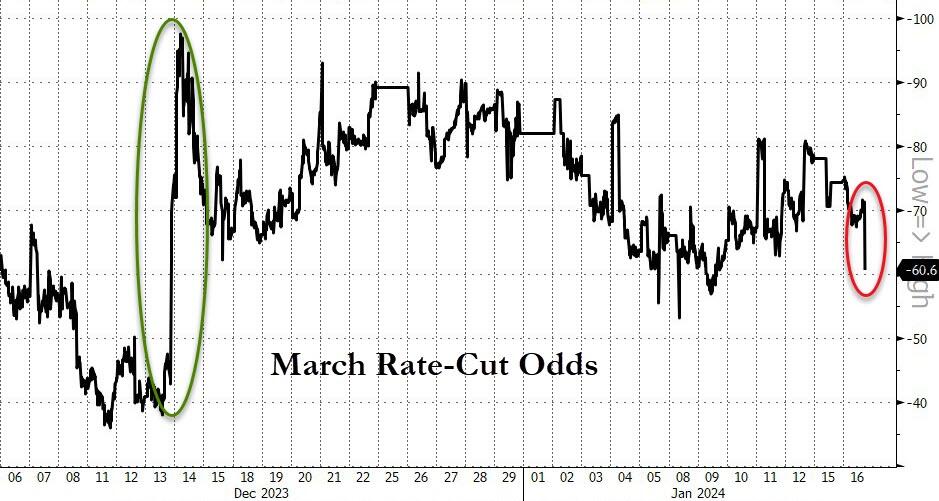
All of which sent March rate-cut odds reeling...

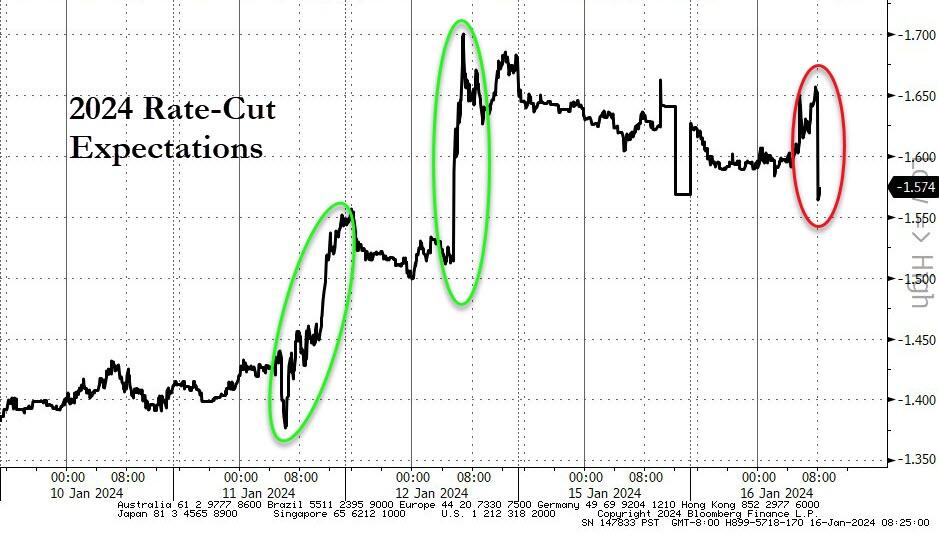
And 2024 rate-cut expectations fell, after last week's CPI and PPI driven increases...

Sparked equity market selling...

And bond yields spiked, extending the earlier move...

It appears the message from Fed Speakers is getting through to the market slowly - don't expect more than six cuts this year and don't count on a March cut...

https://www.zerohedge.com/markets/stocks-bonds-tumble-after-feds-waller-sends-rate-cut-odds-reeling

Immunome Exclusively Licenses Zentalis ROR1 Antibody-Drug Conjugate and Proprietary Tech

 Exclusive worldwide license agreement for preclinical ROR1 ADC, on track to submit IND in 1Q 2025 -

- Proprietary ADC platform enhances Immunome’s development of next-generation ADC programs -

- Zentalis to receive up-front payment of $35 million in cash and Immunome common stock and is eligible to receive up to $275 million of milestone payments and mid-to-high single-digit royalties -

https://www.businesswire.com/news/home/20240108297637/en/