Search This Blog

Tuesday, January 16, 2024

Iran’s Revolutionary Guard deployed in Yemen

 Commanders and advisors from Iran’s elite Islamic Revolutionary Guard Corps are on the ground in Yemen and playing a direct role in Houthi rebel attacks on commercial traffic in the Red Sea.

The IRGC has stationed missile and drone trainers and operators in Yemen, as well as personnel providing tactical intelligence support to the Houthis, U.S. and Middle East officials told Semafor. The IRGC, through its overseas Qods Force, has also overseen the transfer to the Houthis of the attack drones, cruise missiles, and medium-range ballistic missiles used in a string of strikes on Red Sea and Israeli targets in recent weeks, these officials said.

The Houthis say that its military operations are designed to aid the Palestinian militant group, Hamas, which has been locked in a three-month war with Israel. On Monday, the Pentagon said the Houthis struck a U.S.-owned and -operated container vessel, the M/V Gibraltar Eagle, in the Red Sea, but caused no significant damage. The Houthis fired a second anti-ship ballistic missile into the southern Red Sea, the U.S. Central Command said, but it “failed in flight and impacted on land in Yemen.”

The IRGC’s overall presence inside Yemen is overseen by Gen. Abdul Reza Shahlai, a Tehran-based commander whom the Trump administration attempted to assassinate in a 2020 drone strike inside Yemen, U.S. and Mideast officials said. American intelligence believes Shahlai is deeply involved in Tehran’s overseas terrorist operations through his role as the Qods Force’s deputy commander.

This includes a role in overseeing an unsuccessful 2011 Iranian plot to assassinate Saudi Arabia’s then-ambassador to the U.S., Adel al-Jubeir, at a Washington, D.C. restaurant. Shahlai, who’s been sanctioned by the U.S. Treasury Department, also helped oversee IRGC attacks against U.S. military personnel in Iraq over the past two decades. The Department of Justice offered $15 million in 2019 for information related to the commander’s operations and networks.

Last month, the White House declassified some information related to Iran’s backing of the Houthis, including the intelligence and targeting support. But it didn’t reference the IRGC’s on-ground presence in Yemen, or Shahlai’s role in the Houthis’ operations.

The IRGC’s ground presence in Yemen, and role in directing strikes against Western targets, risks fueling a direct confrontation with the U.S. as the Israel-Hamas war in the Gaza Strip grinds on. The Biden administration has to date voiced its intent on avoiding a military conflict with Tehran and preventing a wider regional conflagration. But the Pentagon and U.S. allies started directly hitting Houthi targets inside Yemen last week, raising the possibility of the U.S. also harming IRGC personnel.

U.S. and Mideast officials say Tehran began significantly ramping up its military support for the Houthis in the mid-2010s, when the Yemeni militia and political movement engaged in a war with Saudi Arabia and the United Arab Emirates. The Houthis share Iran’s Shiite faith and antipathy to these regional Sunni powers, but had previously been a poorly funded and equipped military force. Today, it has an advanced armory of attack drones and cruise and ballistic missiles that have allowed the Houthis to seriously disrupt global traffic through the Suez Canal and Bab-el-Mandeb Strait and attempt strikes on targets as far away as Israel’s Eilat port.

Current and former U.S. military officials say Iran has developed the Houthis into a central cog in Tehran’s regional alliance system, known as the Axis of Resistance, which includes Hamas in the Palestinian territories, Hezbollah in Lebanon, and Iraqi and Syrian militias. This system allows Iran to project military power well beyond its borders, while also providing some deniability of involvement in military or terrorist operations.

“Iran has the luxury of really fighting, what I would call, a hidden-hand operation, with various Iranians on the ground, Qods Force people, on the ground [in Yemen],” retired Gen. Kenneth McKenize, a former commander of U.S. forces in the Mideast, said last week at a forum on the Red Sea crisis. “First of all, they fought a major war against Saudi Arabia and Yemen, and now they’re choking world shipping in the Bab-el-Mandeb [Strait] at a very low, very low price for Iran.”

The question now is whether the price is set to rise for Iran. Current and former U.S. military and intelligence officials have described to me what is essentially a blood feud between Washington and the IRGC that stretches back decades. Shahlai has played a central role in this covert war.

The U.S. believes the IRGC oversaw Hezbollah suicide bombings on American diplomatic and military targets in Lebanon in the 1980s. And the IRGC is accused of training Iraqi Shiite militias in the use of roadside bombs, known as IEDS, that were the largest cause of U.S. military deaths in Iraq. The U.S. government has also claimed that Shahlai oversaw a 2007 IRGC operation in the central Iraqi city of Karbala that resulted in the executions of five American soldiers.

THE VIEW FROM TEHRAN

Iran has voiced its support for the Houthis attacks in the Red Sea, claiming that they’re part of the Resistance Axis’ support for Hamas. But Tehran has denied any direct role in either the Houthis’ operations or Hamas’ October 7 attack on Israel.

“The resistance [Houthis] has its own tools… and acts in accordance with its own decisions and capabilities,” Iran’s deputy foreign minister, Ali Bagheri, told Iranian state media last month. “The fact that certain powers, such as the Americans and the Israelis, suffer strikes from the resistance movement… should in no way call into question the reality of the strength of the resistance in the region.”

The Houthis have also denied relying on Iran to conduct its attacks. “It’s strange to attribute everything to Iran as if it were the world’s strongest power,” a Houthi spokesperson told The Wall Street Journal last month. “We have intelligence facilities that have proven themselves over the years of aggression against us.”

NOTABLE

  • Alex Vatanka of the Middle East Institute questions whether Iran is willing to risk “open conflict” with the U.S. to defend the Houthis’ operations in the Red Sea and Bab-al-Mandeb Strait.

OpenAI Is Working With US Military on Cybersecurity Tools


OpenAI is working with the Pentagon on a number of projects including cybersecurity capabilities, a departure from the startup’s earlier ban on providing its artificial intelligence to militaries.

The ChatGPT maker is developing tools with the US Defense Department on open-source cybersecurity software, and has had initial talks with the US government about methods to assist with preventing veteran suicide, Anna Makanju, the company’s vice president of global affairs, said in an interview at Bloomberg House at the World Economic Forum in Davos on Tuesday.

https://www.bloomberg.com/news/articles/2024-01-16/openai-working-with-us-military-on-cybersecurity-tools-for-veterans

Missing Seals Were On Secret Mission That Intercepted Iran Missile Parts Bound For Houthis

 The Pentagon on Tuesday revealed more information about the two missing US Navy Seals, who disappeared off the cost of Somalia in the Gulf of Aden on Thursday after they "fell into the water during a nighttime boarding mission" according to US military officials.

A search and rescue operation has continued, and the US Department of Defense has yet to formally declare them dead. The US has revealed additional information about their secretive mission, saying their team intercepted a shipment of Iranian missile components bound for Houthis in Yemen

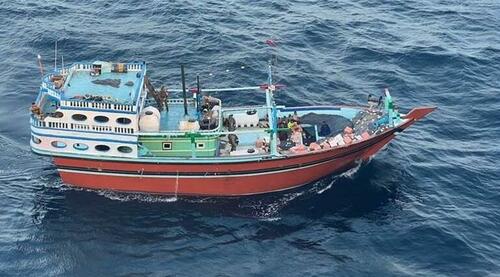
The nighttime raid was conducted against a dhow, or a small sailing boat, which was found to have contained several advanced weapons components on board, according to the new press release by CENTCOM. 

The Seal team was "supported by helicopters and unmanned aerial vehicles (UAVs)" and "executed a complex boarding of the dhow near the coast of Somalia in international waters of the Arabian Sea."

The military says that Iranian-made ballistic missile and cruise missiles components were seized from the vessel, and included "warheads for Houthi medium range ballistic missiles (MRBMs) and anti-ship cruise missiles (ASCMs)."

"It is clear that Iran continues shipment of advanced lethal aid to the Houthis. This is yet another example of how Iran actively sows instability throughout the region," CENTCOM commander Gen. Michael Kurilla said.

He further detailed the following:

This is the first seizure of lethal, Iranian-supplied advanced conventional weapons (ACW) to the Houthis since the beginning of Houthi attacks against merchant ships in November 2023. The interdiction also constitutes the first seizure of advanced Iranian-manufactured ballistic missile and cruise missile components by the U.S. Navy since November 2019.

But importantly, the new statement also confirmed that the two Seals now lost at sea had been directly involved in his operation. "We are conducting an exhaustive search for our missing teammates," the CENTCOM statement emphasized.

The Seal boat had reportedly been headed toward a suspicious vessel off the Somali coast when the elite operators went overboard when a large wave crashed into them. One Seal fell into the sea, and the second reportedly went in while trying to rescue him. Locating them was complicated because it happened in the darkness of night in a vast ocean.

The intercepted dhow, which the US Navy later sunk. Image source: CENTCOM

When the incident was initially reported over the weekend, most news reports assumed or strongly suggested it may have been related to stopping Somali piracy. It was at first only reported that the vessel was deemed "suspicious" by the US Navy and so was approached by the Seal team.

Meanwhile, there have since been reported more strikes on Houthi sites in Yemen by the Western coalition which is patrolling the Red Sea.

https://www.zerohedge.com/military/missing-seals-were-secret-mission-intercepted-iranian-missile-components-bound-houthis

'Remote Work Doesn’t Seem to Affect Productivity, Fed Study Finds'


  • San Francisco Fed economists don’t see evidence of correlation
  • About 30% of paid workdays were still remote as of end of 2023

US industries that are more adaptable to remote work haven’t seen a bigger boost — or decline — in productivity growth since 2020 compared to industries with more in-person work, according to new research from the Federal Reserve Bank of San Francisco.

While the shift toward remote-work arrangements has reshaped society in ways that will continue to evolve, there is “little evidence in industry data that the shift to remote and hybrid work has either substantially held back or boosted the rate of productivity growth,” San Francisco Fed economists led by John Fernald said in a study published Tuesday on the bank’s website.

https://www.bloomberg.com/news/articles/2024-01-16/remote-work-doesn-t-seem-to-affect-productivity-fed-study-finds

Over 100 Ships Transit Red Sea Route Despite Calls To Stay Away

 By Tsvetana Paraskova of OilPrice.com

The number of commercial vessels that have transited the Red Sea/Suez Canal route has more than halved over the past month amid rising tensions off Yemen, but more than 100 ships, including oil tankers, have crossed the water lane since the U.S. and UK navies advised operators on Friday to steer clear of the route.

Amid escalating tensions in the Middle East and the U.S. and UK strikes on Houthi targets in Yemen on Thursday night last week, the largest shipping and tanker industry groups advised on Friday members to stay away from the Bab el-Mandeb Strait while shippers were diverting transit away from the Red Sea en masse again.

In an advisory to its members, the International Association of Independent Tanker Owners (Intertanko), representing nearly 70% of all international oil, chemical, and gas tankers, said that tankers should “stay well away” from Bab el-Mandeb and pause north of Yemen when traveling south through the Suez Canal route.

Many have heeded the advice, but some have not.

A total of 114 commercial vessels — including oil tankers, bulk carriers, and container ships — have continued with their routes and transited into or out of the Red Sea through the Bab el-Mandeb Strait, according to vessel-tracking data monitored by Bloomberg.

That’s down from 131 ships crossing the chokepoint during the same days of the previous week, and more than half from the 272 vessels that used the route one month ago, according to the data compiled by Bloomberg.

Since Friday, tensions in the area ratcheted up further, after an anti-ship cruise missile was fired on Sunday from Iranian-backed Houthi militant areas of Yemen toward USS Laboon, which was operating in the Southern Red Sea. The missile was shot down in vicinity of the coast of Hudaydah by U.S. fighter aircraft, and there were no injuries or damage reported, the U.S. Central Command said.

On Monday, the Houthis fired a missile and struck a U.S.-owned merchant vessel—the Gibraltar Eagle, a Marshall Islands-flagged, U.S.-owned and operated container ship. The ship has reported no injuries or significant damage and is continuing its journey, the U.S. Central Command said.

https://www.zerohedge.com/economics/over-100-ships-transit-red-sea-route-despite-calls-stay-away

Collusion!? Jan. 6 Committee Inserted Itself Into Fani Willis' Georgia Case Against Trump

 In the spring of 2022, Georgia prosecutors investigating Donald Trump over his actions related to the 2020 election received an early boost from another set of investigators... the House Jan. 6 select committee.

In mid-April of that year, Committee staff quietly met with attorneys working on the case in Fulton County for DA Fani Willis, right around the time she was preparing to convene a special grand jury investigation - during which she employed her alleged paramour, Nathan Wade, who would also coordinate with the Biden White House on their case.

So - Fani coordinated with both the J6 committee and the White House, who helped them assemble their case against the former president.

According to Politicothe Jan. 6 committee attorneys allowed the DA's team to review (but not keep) a 'limited set of evidence' they had gathered.

Over the next few months, committee staff also had a series of phone calls with Willis’ team. They answered the prosecutors’ questions and shared insight on matters like Trump’s false electors gambit and his efforts to pressure Georgia Secretary of State Brad Raffensperger. Both of those ploys ultimately featured prominently in the criminal charges that Willis brought against Trump and his allies last summer.

The contacts between the committee and Willis’ team also helped prosecutors prepare for interviews with key witnesses.

The coordination between Willis' team and the J6 committee were described by two former committee officials on condition of anonymity - timing which has been corroborated by new court filings in Willis' case against Trump and 14 co-defendants for their alleged efforts to overturn the 2020 election.

Interestingly, the J6 committee helped Willis' team in its early stages while simultaneously rejecting DOJ requests for material in a separate criminal probe of Trump's actions surrounding the 2020 election - because the committee was worried that federal prosecutors might have been required to disclose the committee's carefully curated evidence in ongoing criminal cases related to January 6th.

Willis rejected congressional GOP efforts to disclose her team's contact with the Jan. 6 committee, calling their investigation an affront to "well-established principles of federalism and separation of powers."

"You cannot — and will not — be provided access to any non-public information about this," she told the House Judiciary Committee in December in a letter obtained by the outlet.

Jan. 6 committee chairman Bennie Thompson (D-Miss.) had previously described “staff-level contacts” between his panel and Fulton County prosecutors. In early April 2022 — nearly two weeks before the panel’s staff met with Willis’ team — Thompson told reporters he wasn’t aware of how extensive those contacts were. And on Wednesday, Thompson told POLITICO that he did not know about the in-person visit that spring.

Willis’ office did not respond to requests for comment. A former Jan. 6 committee aide said in a statement: “As the January 6th Committee’s final report transparently stated, the Committee shared information — all of which is now public — with prosecutors conducting concurrent, independent investigations.” -Politico

After 18 months, the Jan. 6 committee amassed hundreds of witness interviews which have become key evidence in Trump's legal matters.

According to Sol Wisenberg, a former prosecutor working on Ken Starr's probe of Bill Clinton, the nature of the cooperation between Willis' team and the J6 panel is unusual.

"To me, that’s a highly unusual level of specific cooperation," he said, adding "They’re using what’s supposed to be a congressional investigation in aid of a prosecution."

On Dec. 7, 2021, Willis asked Bernie Thompson's office for help with her Trump probe, and wanted to meet in person. Four months later, her team visited DC and met with committee staff. Nathan Wade, Fani's alleged lover, documented the meeting in an invoice he submitted to her office.

"Team meeting; Conf w/Jan 6; Research legal issues to prep interv," reads one line item related to his invoice for work spanning April 18 to April 21, 2022. Two former committee officials told Politico that Willis' team met with committee staff in April 2022, which included some of Willis' top prosecutors (including Wade and Donald Wakeford).

The invoice from Wade became public knowledge in a Monday motion to dismiss filed by an attorney for Mike Roman, a former 2020 Trump campaign aide and a co-defendant in the Fulton County case. Roman's attorney also alleged that Willis and Wade have a romantic relationship, and that Wade's contract with her office poses a conflict of interest.

In the meeting, members of Willis’ team viewed some of the committee’s evidence on Georgia-specific matters, including Trump’s efforts to pressure local officials and the fake electors’ actions in the state.

Committee staff had more calls with the prosecutors over the following months, including discussions of their conversations with witnesses whom the prosecutors were planning to interview. The calls helped prosecutors prepare for those interviews. One witness they discussed was Pat Cipollone, Trump’s final White House counsel, who spoke with committee investigators just days before the meeting with Willis’ team. Cipollone reportedly sat for a formal interview with Willis about six months later.

The topics WIllis' team huddled with the J6 Committee over became prominent features of her indictment against Trump et al.

Meanwhile, Congressional Republicans have recently begun to seek more details about contacts made between Willis and the committee.

https://www.zerohedge.com/markets/collusion-jan-6-committee-inserted-itself-fani-willis-georgia-case-against-trump

Why The Market Is Gunning For An Early Fed Rate-Cut

 by Simon White, Bloomberg macro strategist,

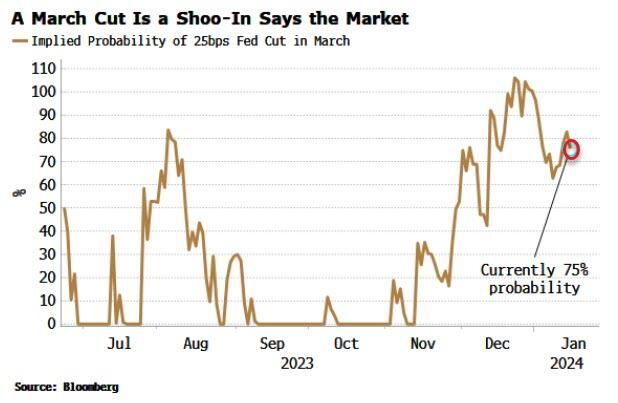
The high degree of certainty the Federal Reserve will deliver an early rate cut - which is a fait accompli historically when pricing is as skewed as it is today - is a sign the market perceives financial-instability risks are rising, and that a near-term reduction in rates is required to help prevent liquidity and funding issues from developing.

The curious case of the March rate-cut rumbles on. Several theories have been put forward for why the market is ascribing such a high probability to it, such as more dovish economic data, or large yield-curve steepening positions skewing front-end rate pricing.

None really pass muster when you look more closely at them.

But under the lens of reserves and financial-stability risks, things start to make more sense.

This is controversial.

A shibboleth of central banking is the “separation principle,” the idea that monetary policy is distinct from financial stability. As Cameron Crise noted last week, in a response to my view that Fed balance-sheet dynamics are playing a much bigger part in the market’s rate outlook, Jerome Powell himself has recently invoked the principle, noting the two are on “independent tracks.”

But the separation principle was always questionable, something the Bank for International Settlements has long argued might be correct in theory, but is wrong in practice. Funding costs, leverage incentives and risk-taking – all influenced by the size and composition of the Fed’s balance sheet – affect credit growth and asset prices.

That’s even more the case when the government is running a large fiscal deficit as it is today. Interest payments are poised to become an ever-greater drain on reserves and reserve velocity, intensifying the risks from the Fed’s ongoing quantitative tightening program.

The savior of market liquidity in the face of vast government supply has been the Treasury’s decision to issue mainly bills, allowing the liquidity parked at the Fed’s reverse repo facility (RRP) to harmlessly absorb much of this supply.

But now the RRP is dropping rapidly, and continues to fall as money market funds’ assets keep rising and bill yields remain attractive.

But the closer the RRP gets to zero, the nearer we are to the point where reserves are approaching their so-called lowest comfortable level, and funding problems could ignite as they did in September 2019.

In a sign risks are already rising, SOFR has jumped higher on more frequent occasions in recent months.

As a result, several banks have brought forward when they believe the Fed will begin to taper and then end QT.

JP Morgan, Bank of America and Barclays believe the process will start as early as April, and end as soon as mid-summer.

This highlights that financial-instability risks are possibly much closer than is commonly thought.

Why?

In practice the Fed does not want to run reserves down to their lowest comfortable level.

Powell has talked about ending QT when reserves are still abundant, but with an added buffer.

Banks will also want to keep a buffer in their reserves so they don’t run into funding issues.

But if perceived risks are rising – which we know is the case as end-of-QT forecasts are brought forward – the incentive is to increase the buffer.

If everyone does this - and everyone knows everyone else is doing it - then it’s prudent to raise your buffer a little more: if you’re going to panic, it’s best to panic first. Reserves could go from superabundant to scarce very rapidly.

Thus a linear correlation between reserves and financial conditions is not the appropriate way to judge whether the relationship is spurious or not, as Cameron argues it may well be.

In non-linear relationships it’s not about what happens through all time, but at turning points.

With reserves, there is likely to be a regime shift when they go below a certain level, where suddenly they do have a strong causal correlation with financial conditions.

That’s why QT’s end could happen rapidly once any taper starts. Cameron disagrees, giving the analogy of running while juggling tennis balls, with the juggling representing banks trading reserves with one another, and the speed of the running the pace of QT. More juggling is needed the more that reserves fall, thus it’s prudent to run slower.

In the analogy, however, there is no penalty for dropping one of the balls. If this cost is perceived to be rising, and yet you’re still being forced to run at a certain pace, i.e. QT is ongoing, then you might decide to stop juggling altogether! In other words, the funding markets would seize up, with negative repercussions for asset prices.

Banks with plenty of reserves will be OK, but it is the unevenness in how they are distributed that is the problem.

5% of the largest US banks own 40% of reserves, and the problem has become even more acute since the repo flare-up in 2019.

Pricing is set at the margin, and smaller banks without reserves will push up the cost of funding - a major risk to financial stability if it happens in an uncontrolled fashion.

The sooner rates are cut, the sooner pressure is taken off reserves from government interest payments, which are set to balloon to as high as an astronomical $1.5 trillion this year.

A simple regression shows that that the drop in yields since November as more rate cuts were priced in could already have taken $250 billion off the government’s interest-rate bill. That eases pressure on the government to tax and borrow more, which is ultimately a boon for reserves and their velocity.

Rate cuts should also bolster banks’ balance sheets as duration positions become less underwater – reducing the risk that banks stop dealing with one another in funding markets.

The Fed may purport to believe in the separation principle, but its unexpected pivot in December without obvious economic justification hints it may not. Either way, neither does the market, hardwired to seek what works in practice, not in theory. If perceived risks are rising, then pushing for an early rate cut makes sense (especially as there is no direct way to express a view on when QT ends).

And we are now at the stage where the market has always got its way.

The chart below shows a market-based Fed easing trigger.

The brown bars are the times when at least the same amount of rate cuts have been priced as there is today, and as imminently. On every occasion the Fed was already cutting rates or very close to doing so.

The Fed could, of course, decide to push back more forcefully on early rate-cut expectations (and the risk-reward for trading a March cut in any event is very poor; an April vs May Fed Funds flattener may be a better option). But the fact so much got priced so quickly when not justified by Fed-speak or the data indicates the market is perhaps conditioning on other factors. Financial stability risks from the Fed’s balance sheet and the heightened impact of Treasury funding decisions fit that bill.

The lesson of the curious case of the March cut is that anticipating the short-term interest outlook in this cycle requires acknowledging we may be in a new paradigm, where unemployment and inflation are only part of the picture.

https://www.zerohedge.com/markets/why-market-gunning-early-fed-rate-cut