Target to $14 from $10
Friday, March 8, 2024

Use of CGM Linked to Lower Risk of Retinopathy in Type 1 Diabetes
In patients with type 1 diabetes, use of continuous glucose monitoring (CGM) devices -- alone or with insulin pumps -- was associated with lower odds of developing diabetic retinopathy and proliferative diabetic retinopathy, according to a retrospective cohort study.
In a multivariable logistic regression analysis, use of CGM devices was associated with lower odds of diabetic retinopathy (OR 0.52, 95% CI 0.32-0.84, P=0.008) and proliferative diabetic retinopathy (OR 0.42, 95% CI 0.23-0.75, P=0.004) compared with no use, reported Risa M. Wolf, MD, of Johns Hopkins University School of Medicine in Baltimore, and colleagues in JAMA Network Open.
In a longitudinal analysis of patients without baseline proliferative diabetic retinopathy, 21.8% had progression of diabetic retinopathy during the 8-year study.
The positive effect likely isn't entirely produced by glycemic control via CGM since the researchers controlled for HbA1c, co-author Nestoras Mathioudakis, MD, MHS, also of Johns Hopkins University School of Medicine, told MedPage Today. Instead, "this is probably being driven by glycemic variability and the percentage of time that you're staying within a certain range."
While insulin pump use alone was not linked to diabetic retinopathy (P=0.48), CGM and pump use together were associated with lower odds of proliferative diabetic retinopathy (OR 0.60, 95% CI 0.38-0.94, P=0.03) compared with no CGM or insulin pump use, the researchers reported. Other factors that were associated with diabetic retinopathy development after adjustment were duration of diabetes (OR 1.07, 95% CI 1.04-1.09, P<0.001), other microvascular complications (OR 8.87, 95% CI 5.60-14.06, P<0.001), and mean HbA1c (OR 1.29, 95% CI 1.11-1.50, P=0.001).
It's not clear why use of insulin pumps alone were not tied to signs of improvement in diabetic retinopathy. However, Mathioudakis said the study's sample size may have been too limited to accurately reflect their impact.
He noted that the current state of the art is a hybrid, closed-loop CGM-insulin pump device that automatically produces tighter glucose control. It wasn't available during the 2013-2021 period of the study. "A similar study will need to be done over the next 5 years to really start to look at the impact of people using those newer technologies," he said.
Could those who used the devices in the study simply be healthier overall or more likely to take care of themselves? Mathioudakis said the researchers tried to control for this possibility by adjusting their analysis for various possible confounders. Notably, 76.8% of white patients had CGM devices (either with or without pumps) versus just 15.9% of Black patients (P<0.001).
"We do expect to see similar findings in type 2 diabetes," he added.
In an accompanying commentary, Estelle M. Everett, MD, MHS, of the David Geffen School of Medicine at the University of California Los Angeles, wrote that "CGM has a unique advantage that can support the prevention of diabetic retinopathy. This can be particularly beneficial in groups that are at the highest risk for retinal complications."
"While the findings in the study ... suggest CGM could be leveraged to improve retinopathy-related outcomes in these high-risk groups, the literature also describes disparities in CGM use in these very populations," she noted.
The study authors pointed to a landmark study that showed that nearly half of patients with type 1 diabetes developed diabetic retinopathy over a mean 6.5 years without intensive insulin therapy, and there's been little research into the effect of CGM devices and insulin pumps on diabetic retinopathy.
However, co-author T. Y. Alvin Liu, MD, of Johns Hopkins University School of Medicine, told MedPage Today that he's seen signs of "a really profound protective effect" in the clinic.
"Unfortunately, a lot of patients with type 1 diabetes typically present with advanced diabetic retinopathy that's really difficult to manage," he said. "However, over the years, we've noticed there's a subset of patients who do extremely well. When I chat with them personally, invariably they're using some sort of technology such as continuous glucose monitoring or insulin pump."
As for cost, Wolf told MedPage Today that CGM devices are now standard of care and covered by most insurers. "That really should not be a barrier to get a CGM," she said.
Liu said he urges patients to use the devices, noting that they often ask, "Does that mean these devices could decrease my chance of going blind?" he said. "And the answer is yes. That is a very encouraging message and motivating message for them to go down this path."
For this study, Wolf and colleagues included 550 adults (median age 40, 54.4% women, 24.5% Black, 68.4% white) who had type 1 diabetes for a median of 20 years. All were treated at the Johns Hopkins Endocrine and Diabetes Center and the Wilmer Eye Institute in Baltimore.
Among these patients, median HbA1c was 7.8%, and 44% had diabetic retinopathy at some point during the study. CGM devices were used by 62.7% of the study population, insulin pumps by 58.2%, and both by 47.5%.
The authors noted study limitations such as its retrospective nature and possible underestimation of the effect of CGM due to limitations in its use as the technology developed.
Disclosures
This study received funding from the Research to Prevent Blindness to the University of Wisconsin-Madison Department of Ophthalmology and Visual Sciences, and from the National Eye Institute of the National Institutes of Health.
Wolf reported receiving grants from Dexcom, Boehringer Ingelheim, and Novo Nordisk.
Co-authors had no disclosures.
Everett had no disclosures.
Primary Source
JAMA Network Open
Source Reference: Liu TYA, et al "Use of diabetes technologies and retinopathy in adults with type 1 diabetes" JAMA Netw Open 2024; DOI: 10.1001/jamanetworkopen.2024.0728.
Secondary Source
JAMA Network Open
Source Reference: Everett EM "Leveraging continuous glucose monitors to reduce the risk of diabetic retinopathy" JAMA Netw Open 2024; DOI: 10.1001/jamanetworkopen.2024.0718.
https://www.medpagetoday.com/ophthalmology/generalophthalmology/109094
Biden Urged To Wed Billionaire Tax With Social Security in SOTU
As President Biden and his team raced to write and rewrite his State of the Union address, a pair of progressives reached out to the White House with warnings, polling data, and even edits.
Not only do Republicans continue to beat Biden on the question of the economy, independent voters “equally trust” Biden and former President Trump to protect Social Security, a notion that in more normal times would be considered “absurd.”
At least, that is the assessment of Adam Green, the co-founder of the Progressive Change Campaign Committee and Data for Progress, who previously urged the White House to put the tired “Bidenomics” term out to pasture.
Now, they are offering the White House a full menu of new talking points backed up by polling to improve the president’s odds. It starts with Social Security.
“Let’s pick a new fight where Republicans can’t even pretend to match our position,” Green said in an interview with RealClearPolitics. The strategy is simple. Because Republicans are not willing to raise taxes on the wealthy, he said, previewing the argument he wants Biden to make, “let’s tie together the idea that they want to cut taxes on billionaires and cut Social Security.”
After initiating that populist turn, according to Green, Biden should stick the landing with a counter agenda of “ensuring billionaires pay their fair share and using that money to protect Social Security.” If the president says words like that in front of Congress and on the campaign trail, he promised, they’d see a double-digit turnaround. Biden has a long way to go.
According to internal polling conducted by Data for Progress last October, independent voters split 31% to 30% between Biden and former President Trump when asked who they trust more to protect Social Security benefits. Among non-college educated voters, the numbers are even worse: 41% prefer Trump over 35% who picked Biden on the issue.
But the progressives brought new, more optimistic polling to the White House. According to a survey conducted in January, Biden can go from losing to Trump 45% to 47% to winning 49% to 42%. How? One simple switch per the memo they shared with Biden’s team: “President Biden and Democrats want to increase taxes on billionaires and protect Social Security from cuts.”
This isn’t exactly groundbreaking stuff. Biden ran on both issues in 2020, and the president has adopted this kind of framing before, most recently when he was in Las Vegas last month. “Instead of protecting Social Security and Medicare like I am,” he told a group of supporters, “Trump and his MAGA friends want to give another multibillion-dollar tax cut to the super-wealthy.”
Green and company insist they aren’t remaking the wheel so much as they’re yoking together two of Biden’s favorite hobby horses. But Republicans might not be so easily cowed on Social Security as they were in years past.
During his last address to Congress, Biden called out “some Republicans” who want “Medicare and Social Security to sunset.” The chamber erupted with boos from the right. “So folks, as we all apparently agree, Social Security and Medicare is off the books now, right?” Biden pivoted as members of both parties cheered. “We’ve got unanimity.”
Trump may have done more to shift the debate on the right, though. He borrowed Democratic talking points to pillory Florida Gov. Ron DeSantis as “a wheelchair over the cliff kind of guy” for voting with former House Speaker Paul Ryan to reform entitlements. DeSantis later joined Trump in vowing not to “mess with” Social Security.
More than anything, the progressives argue for reframing the terms of the debate, and they especially don’t want Biden to borrow any vocabulary from economists. Even when presented with quotes from economists showing inflation and unemployment going down, voters still say the economy isn’t working for them.
“We just cannot keep talking about inflation and unemployment rates when that’s not what people are thinking about,” Green said. Biden should ditch macroeconomic verbiage and go micro. Their recommendation: Talk about the price of gas, the price of groceries, and the price of prescriptions.
This kind of targeted conversation may suit Biden, who has gone after corporations for high prices on everything from packaged meat to concert tickets. Green and company want more of that to blunt the advantage Republicans currently enjoy on the economy.
According to their polling conducted in February, when asked if they trust Democrats or Republicans more on the economy, Biden’s party loses by six percentage points, 38-44%. Again, the progressives believe proper framing can get the president out of a jam.
After telling voters that “Democrats support increasing Social Security benefits, increasing taxes on billionaires, and cracking down on corporations that improperly jack up the price of gas, groceries, bank fees, and prescription drug prices,” the numbers flipped. In that light, Democrats suddenly led Republicans 45% to 40%.
The White House has received plenty of advice from allies and outside well-wishers. This year, they may be especially receptive. The State of the Union could easily attract the largest audience Biden enjoys between now and Election Day, and for the first time in his presidential career, he trails his predecessor in the polls.
With a little reframing, Green and company believe Biden can turn that around.
Wegovy gets FDA approval to reduce risk of heart issues in overweight adults
'This patient population has a higher risk of cardiovascular death, heart attack and stroke,' FDA official says
The FDA on Friday said it approved Novo Nordisk's popular weight-loss drug Wegovy to reduce the risk of severe heart issues in overweight or obese adults.
The agency's announcement broadens the use of Wegovy, an injectable medication, to reduce the riks of cardiovascular death, heart attack or stroke in adults who have cardiovascular disease and who are obese or overweight.
"Wegovy is now the first weight loss medication to also be approved to help prevent life-threatening cardiovascular events in adults with cardiovascular disease and either obesity or overweight," John Sharretts, a director within the FDA's Center for Drug Evaluation and Research, said in a statement.
"This patient population has a higher risk of cardiovascular death, heart attack and stroke. Providing a treatment option that is proven to lower this cardiovascular risk is a major advance for public health," he said.
Shares of Novo Nordisk (NVO) were down 1.6% after hours on Friday.
Novo Nordisk said that the approval was based on a trial that found that Wegovy "statistically significantly reduced the risk" of major adverse cardiovascular events by 20% compared with a placebo. The company said the "exact mechanism of cardiovascular risk reduction has not been established."
The company also said it had filed for a label expansion in the European Union, with a decision is expected this year.
Martin Holst Lange, head of development at Novo Nordisk, said that the data "demonstrated that Wegovy has the potential to prolong lives by addressing some of the leading causes of preventable deaths by reducing the risks of cardiovascular events."
The FDA said that Wegovy should be used alongside a lower-calorie diet and more exercise.
Special Counsel Annihilates Hunter Biden's Motion To Dismiss
Last month Hunter Biden's legal team filed a motion to dismiss his tax charges, claiming among other things that his own father's DOJ has "upped the ante" against him in a politically motivated case of "selective and vindictive prosecution" in order to do Donald Trump's bidding.
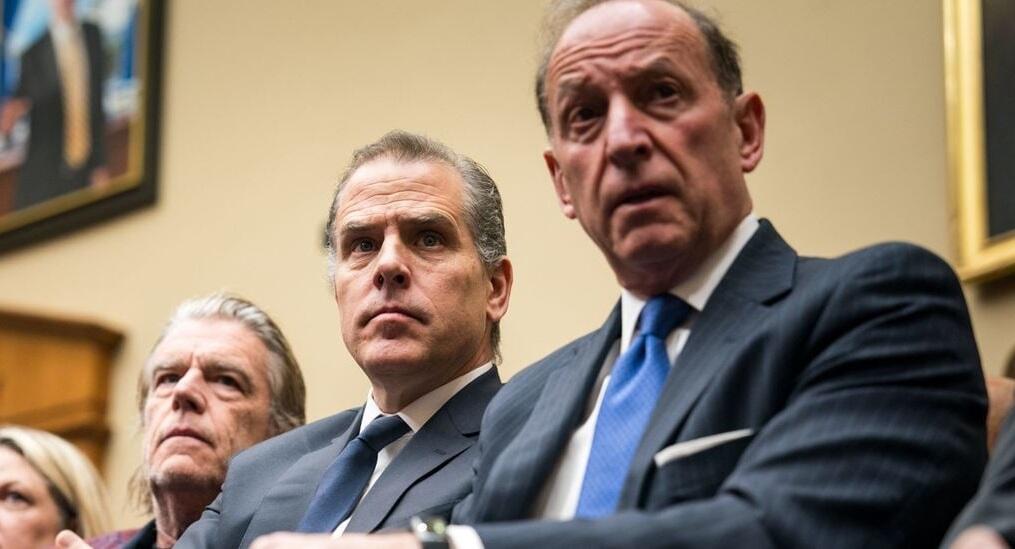
"This case follows a nearly six-year record of [the Justice Department] changing its charging decisions and upping the ante on Mr. Biden in direct response to political pressure and its own self-interests," Hunter's attorneys wrote in the Feb. 20 filing.
They also wanted "salacious" portions of Biden's personal expenditures to be redacted, claiming they are "meant to depict Mr. Biden as irresponsible, frivolous, and otherwise of questionable character and integrity."
Weiss hits back

Fast forward nearly three weeks, and Special Counsel David Weiss just annihilated Hunter's entire filing in a scathing response. It's a fun read.
[T]he defendant concocts a conspiracy theory that the prosecution has “upped the ante” to appease politicians who have absolutely nothing to do with the prosecution and are not even members of the current Executive Branch.
...
"[T]o state an obvious fact that the defendant continues to ignore, former President Trump is not the President of the United States.
The defendant fails to explain how President Biden or the Attorney General, to whom the Special Counsel reports, or the Special Counsel himself, or his team of prosecutors, are acting at the direction of former President Trump or Congressional Republicans, or how this current Executive Branch approved allegedly discriminatory charges against the President’s son at the direction of former President Trump and Congressional Republicans."
Hunter made millions, lied to his accountants, and "chose to commit serious tax crimes"
Under the "factual background" section of the response, Weiss says that Hunter "engaged in a four-year scheme not to pay at least $1.4 million in federal taxes."
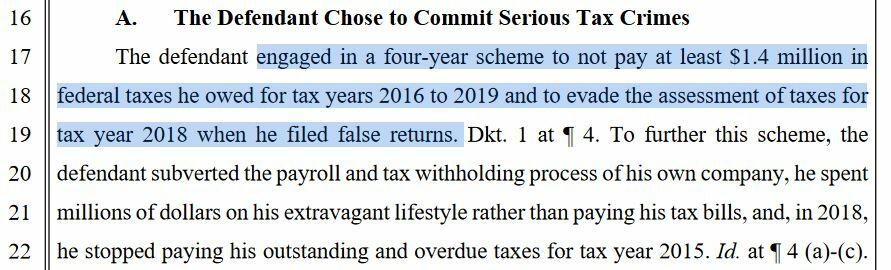
Meanwhile, Hunter "willfully failed to pay his 2016, 2017, 2018, and 2019 taxes, despite having access to funds to pay some or all of these taxes," and "Despite receiving $1.2 million in financial support from a friend to maintain his lifestyle, the defendant did not make payments towards his tax obligations."
Hunter again lied to his accountants in 2020.
"For example, the defendant falsely claimed extensive business travel in 2018 during a period in which he later described his crack cocaine use as “twenty-four hours a day, smoking every fifteen minutes, seven days a week."
The defendant lied to his accountants by claiming as business expenses $43,696 in stays at the Chateau Marmont with his “merry band of crooks, creeps, and outcasts.”
More:
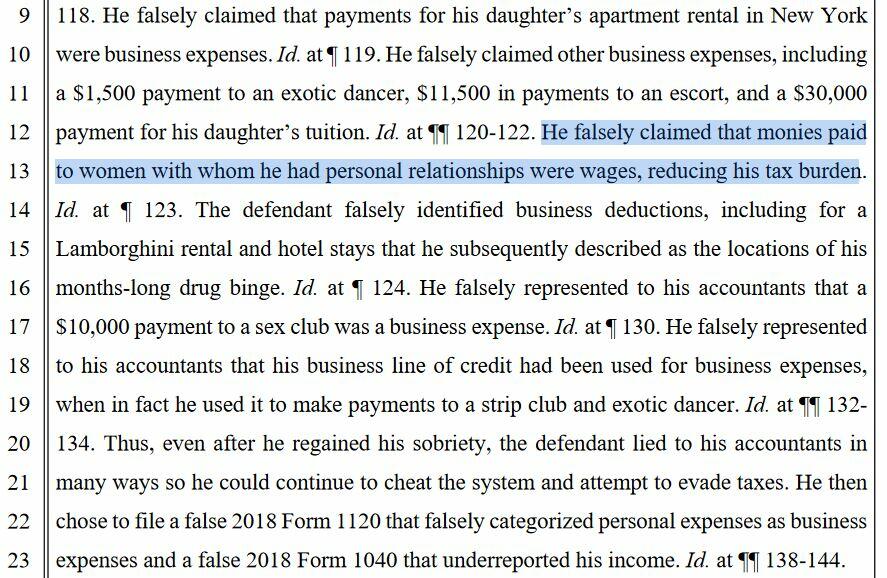
Weiss notes that Hunter "earned millions of dollars in income between years 2016 and 2017," for which he "performed very little actual work for the $7 million in income he was paid during this period."
Hunter "spent nearly $5 million on personal expenses to live an extravagant lifestyle instead of paying his taxes."
Serious Gun Crimes
Weiss then notes that Hunter's crimes "were not limited to tax violations."
"In 2018, he chose to purchase a gun, he chose to lie on background check paperwork by stating he was not addicted to drugs, and he certified that his answers on the paperwork were true, when in fact, he had lied about his addiction."
We also learn that Hunter lied about his legal interactions and negotiations with the DOJ - such as claiming that a plea agreement was approved to handle the gun charge, when in fact it was not.
"The defendant incorrectly claims that DOJ “proposed a non-prosecution agreement for the gun and tax charges, even though DOJ had already determined the charges should not be brought.”
Hunter also claimed that the DOJ "inexplicably demanded" that he plead guilty to felonies with jail time. Not true, according to Weiss:

The rest of the filing, which can be read here, shreds Hunter's various other claims and defenses, while Weiss accuses Hunter's legal team of attempting "to transform a seemingly bland set of plea discussions into a conspiracy theory.
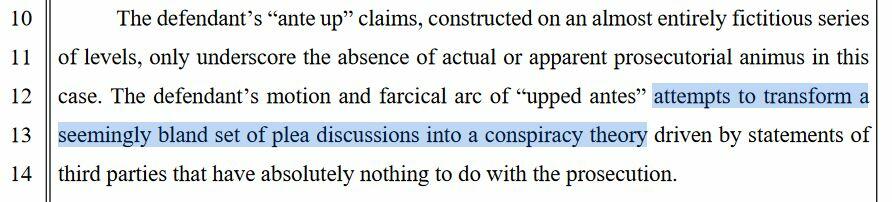
In closing, Weiss asks that Hunter's motion to dismiss be "denied in its entirety."
Watch: MSNBC Declares America "Could Be A Dictatorship Next Year"
by Steve Watson via Modernity.news,
While previewing Joe Biden’s ‘jacked up’ State of The Union address Thursday, an MSNBC talking head declared that if Biden doesn’t win the election, the US “could be a dictatorship next year.”
Americans dish the truth on Biden's inflation: Going 'up and up and up'
While President Biden might’ve touted an economic "comeback" in his State of the Union address Thursday night, Americans woke up Friday morning still feeling an inflationary hangover.
"We're going to do groceries now. Every week we go and we spend about $300. I have not seen a change at all. On the contrary, like it's just going up," a diner named Iris told FOX Business’ Madison Alworth on "Cavuto: Coast to Coast."
"We just got a letter at home saying the rent is going to go up. Our insurance just went up, so everything just keeps going up and up and up," she continued. "I haven't seen the difference in anything."
Iris was one of four diners who dished out the harsh reality of Biden’s economy, arguing everyday inflation and sticker shock still exist despite cooling inflation data.
And though Biden spun a positive economic angle in his national speech, proclaiming "wages keep going up and inflation keeps coming down," price data from the U.S. Bureau of Labor Statistics shows why shoppers are right to be concerned.

Four diners in Reading, Pennsylvania, spoke out against food and grocery prices going "up and up and up." (Fox News)
An examination of just two common grocery list items, eggs and milk, reveals a stark increase in prices from January 2021 to January 2024.
In January 2021, the average U.S. price for a dozen Grade-A eggs in U.S. cities was $1.47. Four years later, that price jumped 52.6% to an average price of $2.52 per dozen. Between those years, the retail price for a dozen eggs peaked at a walloping $4.82 in January 2023.
Another staple household commodity: milk. Three years ago, in January 2021, the average cost for whole milk was $3.47 per gallon in U.S. cities. As of January 2024, the price has climbed 13.2% to $3.96 per gallon.

Biden is 'deflecting blame' for inflation on corporations: Charles Payne
‘Making Money’ host Charles Payne reacts to President Biden’s State of the Union address where he proposed raising taxes for big corporations.
One Pennsylvania diner noted seeing the same trend with orange juice: "A gallon of orange juice is like $6.80 or around $6, and that's at Walmart. Like you don't really expect it to be that," a woman named Tana also told Alworth.
"I have a home business, I do cookies, and I need a bag to put them in, and I buy the 150-count at Walmart. I used to get them for like $3, now they are like $6.50 or something like that. And it's plastic," Tana continued. "It's never coming down. Nothing comes down."
Her friend, Marcia, has pricing concerns within America’s real estate market.

Small business owner pours heart out: Biden economy 'crippled' us
'Fox & Friends' co-host Lawrence Jones speaks to a business owner at the Golden Egg diner in Surfside Beach, South Carolina.
"Housing pricing is still high and the interest rates are high. So I don't know what's going to give there," Marcia said. "I don't see how the economy is good when both of those things are high."
Iris’ husband Alfonzo, who’s a semi-truck driver, also feels price hikes while on the road.
"Everything's up. Parking spots, fuel. Everything's up," he said. "Wherever you go, you see it."
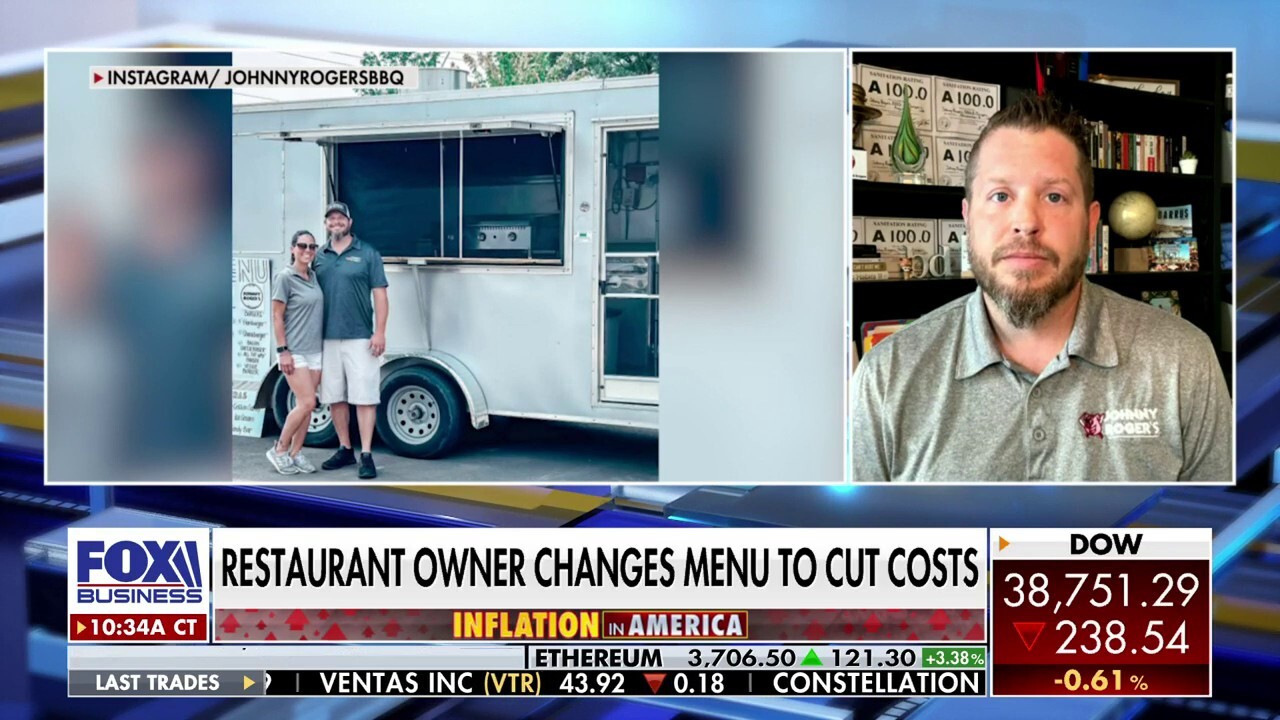
Restaurant owner on inflation’s bite: Menu costs ‘up exponentially’ to ‘stay alive’
Johnny Roger’s owner Barrett Dabbs details how inflation is hurting his Concord, North Carolina barbecue and burger joint on ‘Varney & Co.’
In recent weeks, Biden blamed corporations for raising "their prices to pad their profits, charging you more and more for less and less."
"That's why we're cracking down on corporations that engage in price gouging or deceptive pricing from food to health care to housing," the president said.
https://www.foxbusiness.com/economy/americans-dish-truth-bidens-inflation-going-up-up-up
Subscribe to:
Posts (Atom)