Search This Blog

Thursday, May 2, 2024

EPA’s Deceptive Climate Regulations Won’t Stand in Court

 The Environmental Protection Agency last week finalized a “suite of rules” governing electricity producers. The EPA first announced these air, soil and water regulations two years ago, as tools to reduce greenhouse-gas emissions by forcing coal-fired power plants to close prematurely. The rules reflect the Biden administration’s “whole of government” approach to imposing its climate agenda, which puts ideological ambition above the limits of congressionally delegated authority.

Soon after the EPA announced this plan in 2022, the U.S. Supreme Court in West Virginia v. EPA struck down the Obama-era Clean Power Plan, which also sought what the agency calls “generation shifting,” from fossil fuel to renewables. The court found no evidence that Congress had granted the EPA the sweeping power of “deciding how Americans will get their energy.” This signaled trouble ahead for the Biden strategy, which relied on what was already creative rulemaking in the express pursuit of precisely that goal.

Following that defeat, the EPA labored to shield these rules from that same constitutional challenge. But a standard employed by the Supreme Court against supposedly deceitful conduct during the Trump administration should doom the effort.

In speeches and congressional testimony, EPA officials described this coming “suite of rules” as using “all of the tools in our toolbox” to reduce greenhouse-gas emissions. They cited a variety of statutory regimes, including some with no plausible claim to being vehicles for reducing airborne emissions, like the Clean Water Act and a solid-waste law known as the Resource Conservation and Recovery Act.

While the Clean Power Plan’s constitutionality was still pending before the Supreme Court, EPA Administrator Michael Regan said the new rules would finish the job the plan began. In saying that the regulatory blitz was synchronized to shut down politically disfavored coal-fired generation plants, Mr. Regan described coerced retirements as “the best tool for reducing greenhouse gas emissions.”

That is, the laws were enacted for one purpose, and the agency admitted it planned to use them to achieve a different purpose.

Our system of government frowns on regulators’ lying about their reason for doing something. Supreme Court precedent is clear that “an agency must ‘disclose the basis’ of its action.” In 2019 in Department of Commerce v. New York, the court addressed allegations that the Trump administration included a citizenship question in the 2020 census for reasons beyond those acknowledged in the administrative record. The majority agreed that to determine the real factors driving inclusion of the citizenship question, depositions of senior agency officials were appropriate. Georgetown Adjunct Law Professor Jack Thorlin has described the case as formally unveiling the “rule against pretext.”

Then the court ruled in West Virginia, finding that the Clean Power Plan’s generation-shifting goal presented a “major question.” That changes the inquiry from whether an agency is lawfully exercising a delegated power to whether Congress delegated such a power to the agency at all. The majority specifically ruled that before employing regulations to compel plant closings, the EPA must show a clear grant of authority from Congress, which the agency failed to establish and, the court noted, it is unlikely any agency possesses.

Like the Clean Power Plan, the EPA’s newly finalized replacement rule requires adoption of technology that doesn’t exist. More remarkably, the agency simultaneously published the rules governing mercury, water emissions and solid-waste storage, all of which it had clumsily promised would drive plants to close and thereby reduce greenhouse-gas emissions.

EPA officials apparently grasp that the opinion in West Virginia prohibits the practice that admirers call “law whispering” or “teaching old laws new tricks”—particularly on major questions like contriving changes in our energy mix. Gone are paeans to inventive ways of coercing plants to retire. With a newfound modesty, the administrative record published for these non-greenhouse-gas emissions rules disputes claims of causing “a significant number of retirements” and attributes any generation shifting to Inflation Reduction Act subsidies.

This ploy to dodge constitutional analysis need not succeed. The previously admitted pretext behind the EPA’s “suite of rules,” individually and collectively, is to achieve the outcome that the court in West Virginia declared the agency has no authority to pursue. The doctrine against pretext debuted in Department of Commerce should trigger review under the major-questions doctrine; the disingenuous effort to avoid it presents another basis for review. Courts can take Mr. Regan’s word for it or, as in the Trump-era census case, order discovery to determine what factors truly drove the agency’s decisions.

The group Government Accountability and Oversight has argued exactly this to the U.S. Circuit Court of Appeals for the District of Columbia, in an amicus brief I co-authored in a challenge to one of the suite of rules (Kentucky v. EPA). This argument should ensure Supreme Court review of the constitutionality of Mr. Biden’s “whole of government” approach and specifically the “suite of rules” the EPA assembled to skirt major-questions review.

Bureaucratic workarounds of agencies’ limited delegations of power are an affront to the judiciary and to “our democracy.” The Biden backdoor climate gambit is a good place to draw the line.

https://www.wsj.com/articles/bidens-climate-deception-wont-stand-in-court-suite-west-virginia-pretext-regan-0fae5111

Biden White House meeting on voter registration with left-wing activists: Docs

 In the summer of 2021, the White House convened a meeting over Zoom with outside groups to plan on implementing an executive order from the president granting them historic new tools to register voters. The Biden administration has insisted attendees and the operation at large are “nonpartisan,” though internal documents provide a glimpse into how the July 12, 2021, meeting appears to have overwhelmingly been a key platform for left-wing activist hubs to suggest sweeping election policy changes.

The documents, which have not been reported on until now, are a window into how nonprofit organizations have coordinated with the highest levels of the government on bringing President Joe Biden‘s executive order to fruition. Republican lawmakers and conservative groups have heavily scrutinized the legality and constitutionality of the March 2021 order, which calls for “soliciting and facilitating approved, nonpartisan third-party organizations and state officials to provide voter registration services on agency premises.”

And following the 2020 election, which drew GOP-led investigations in Congress over Facebook CEO Mark Zuckerberg wiring hundreds of millions of dollars to a progressive-left group that boosted Democrats, Republicans are concerned the 2021 “Bidenbucks” order will unlawfully appropriate federal funds in 2024 to promote Democratic voter turnout. The order, lawmakers say, may violate the Antideficiency Act, a law barring federal agencies from spending funds beyond those approved through Congress, and the Hatch Act, which restricts government employees from engaging in certain political activities, among other laws.

“The Biden administration continues to spend taxpayer dollars on partisan voter registration initiatives,” said Rep. Bryan Steil (R-WI), chairman of the House Administration Committee, which oversees elections. “Not only is this shady, but it does not instill trust in our elections.”

Biden’s March 2021 order mandates federal agencies develop plans to provide the public access to voter registration services with the help of “approved” outside groups, as well as assist the public in filling out these forms and mail-in-ballot applications. Concerned GOP lawmakers have since sent letters to the Biden administration asking it to turn over any potential criteria for approved entities.

At the same time, internal meeting notes reveal some of the topics left-wing organizations discussed during a July 12, 2021, “listening session” for the March order. Previously released records revealed a snippet of the agenda of the virtual meeting, which was attended by representatives from the Executive Office of the President, the Department of Justice, and other agencies.

One 2021 meeting attendee, for instance, was Jose Morales, a former Biden-Harris transition team staffer who is listed on the 2021 meeting notes as a representative for the left-wing Fair Fight Action. Morales, ex-chief of staff for the failed 2022 Democratic gubernatorial candidate Stacey Abrams campaign, urged federal agencies in the meeting to make sure they’re “prioritizing opportunities for helping people to fill out voting forms” and to vote by mail. He also stressed that federal employees should receive a day off to vote and assist election workers, who Morales said are under “assault.”

Then there’s Laura Williamson, a then-employee at the left-wing Demos think tank who now works for the Southern Poverty Law Center. At the 2021 meeting, Williamson told agencies they shouldn’t “stop at registration.”

“It’s just the first hurdle,” said the then-employee at Demos, which GOP lawmakers say crafted a document in 2020 that ended up appearing “nearly identical” to the Biden order. Demos notably counted Barack Obama in 2001 as a founding board member, according to tax forms.

At the meeting, Williamson offered that the Department of Housing and Urban Development should “consider integrating voter registration into public housing” as a requirement under federal law, the notes say.

It’s a proposal that Stewart Whitson, an attorney who works for the conservative Foundation for Government Accountability, said is evidence of a coordinated effort between the White House and activists to target vulnerable populations seen as likely Biden voters through the unlawful order. FGA and the Heritage Foundation’s Oversight Project separately obtained the same meeting notes through records requests to the Department of Justice.

Another 2021 meeting participant was Nikolas Youngsmith, then an attorney for the Mexican American Legal Defense and Educational Fund, which appears to support illegal immigration and also awards scholarships to undocumented students. Youngsmith, now a Democratic congressional aide, said at the meeting that his group backed voter registration efforts for “immigrants and noncitizens,” meeting notes show.

“We also want to make sure that they are done in a careful way,” Youngsmith said, according to the unearthed documents. “All fed[eral] employees must be well-trained in this. Need to trust people are acting in bounds of the law. Especially when there are language issues. Federal employees need to know who should be properly registered and not. Don’t want someone to face charges based on bad info[rmation].”

Meanwhile, the “nonpartisan” 2021 meeting fielded presentations from staffers from the League of Women Voters, including registered lobbyist Jessica Jones Capparell. Meeting notes say Capparell, a former campaign aide to ex-Sen. Claire McCaskill, urged agencies to register people to vote at citizen and naturalization ceremonies run by federal courts.

Capparell lobbied in 2023 on behalf of the League of Women Voters against appropriations bills seeking to prohibit agencies from using funding in connection to Biden’s 2021 executive order, congressional filings show.

So did her lobbyist colleague, Celina Stewart, who attended the meeting that year, according to meeting notes.

“Agencies need more funding to make sure this happens,” Stewart, who discussed voter registration, said at the meeting.

Two presenters were also Keeda Haynes of the Sentencing Project, a left-wing group that supports defunding prisons, and Dana Paikowsky, then at the left-wing Campaign Legal Center watchdog. Both discussed reforms to the Bureau of Prisons, according to meeting notes.

“Felony disenfranchisement is voter suppression,” Haynes, a recent Democratic congressional candidate, said at the 2021 meeting. She called for the use of federal resources to register inmates to vote in prisons.

Paikowsky, who says on her LinkedIn profile that she now works at the Justice Department, said in the meeting that the Campaign Legal Center made recommendations to the Bureau of Prisons on certain issues.

The agency was “excited,” Paikowsky apparently said during the meeting.

The 2021 meeting was also attended by representatives from the George Soros-backed Open Society Policy Center, End Citizens United, eBay founder Pierre Omidyar’s Democracy Fund, Black Voters Matter, the Brennan Center for Justice, the Leadership Conference on Civil and Human Rights, and other major left-wing activist groups, documents show.

Ahead of the 2024 election, which will feature a rematch between Biden and Trump, various nonprofit organizations bankrolled by top Democratic dark money groups and linked to this 2021 meeting are launching “nonpartisan” campaigns to mobilize voters.

But to Hans von Spakovsky, a senior Heritage Foundation legal fellow, the reason the order is concerning isn’t solely because groups helping to shape it are partisan.

Fundamentally, the federal government shouldn’t be in the business of voter registration, von Spakovsky told the Washington Examiner.

“There’s too much risk of the party that controls the executive branch using that to manipulate who gets registered,” he said.

The White House did not reply to a request for comment.

https://www.washingtonexaminer.com/news/white-house/2986378/documents-biden-white-house-meeting-voter-registration-left-wing-activists/

'Companies may still buy consumer genetic information despite its modest predictive power'

 Genetics can be associated with one's behavior and health—from the willingness to take risks, and how long one stays in school, to chances of developing Alzheimer's disease and breast cancer. Although our fate is surely not written in our genes, corporations may still find genetic data valuable for risk assessment and business profits, according to a perspective published in The American Journal of Human Genetics. The researchers stress the need for policy safeguards to address ethics and policy concerns regarding collecting genetic data.

At-home DNA tests have provided millions with insights into their  and health risk by simply spitting in a tube. Genetic risk screening of embryos at in vitro fertilization clinics is now available. These tests rely on —a tally of variations in human genes that influence a certain trait. However, while powerful at predicting traits in large populations, these scores are rather weak at an individual level.

"And for that reason, people have said, 'we don't need to worry about companies wanting to use this information at the individual level because it's not very informative,'" says economist and co-corresponding author Nicholas Papageorge of Johns Hopkins University. "Well, that's not exactly true. Firms operate under a lot of uncertainty and any little bit of information that they have about you is worthwhile."

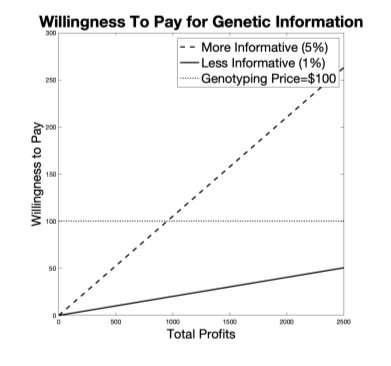
Using an , the researchers found that companies might be willing to pay for a consumer's polygenic score even if it's only marginally accurate as a predictor, because the information may raise profit and is relatively cheap. For example, knowing a person's polygenic score, such as risk of cognitive decline or risky behaviors, an insurance firm may tailor their offerings to individuals, decline insurance, or raise premiums.

Companies may buy consumer genetic information despite its modest predictive power
The economic model shows that companies' willingness to pay for a type of genetic information called a polygenic score increases with expected profits. As the score becomes more informative, the dollar amount companies are willing to pay rises, potentially exceeding the $100 genotyping cost. Credit: Nick Papageorge/Johns Hopkins University

"And it might be counterintuitive, but there might be welfare-enhancing uses of such data," says co-corresponding author, legal scholar, and bioethicist Michelle Meyer of Geisinger College of Health Sciences.

For example, financial service companies may develop products that reduce financial decision-making burdens or offer error monitoring services for people at high polygenic risk of Alzheimer's. "But I do think it's fair to say the burden is on the firm to explicate and help develop appropriate guardrails to prevent nefarious uses."

The researchers argue that current laws and policies are inadequate to address the ethical, privacy, and legal concerns surrounding the potential corporate use of polygenic scores. While the US Genetic Information Nondiscrimination Act prohibits discrimination in health coverage and employment based on genetic information, there are loopholes. The act only covers health insurance, excluding long-term, disability, life, and other insurances. It also doesn't apply to employers with fewer than 15 people, which accounts for 85% of US companies.

"This is a wake-up call to people and to those who are in a position to act," says Meyer. "We need to put things in place now—or yesterday."

"I don't think people realize that when they give up their genetic information today, they're not giving it up just for today; they're giving it up forever," says Papageorge. "When there's new science, they know a little bit more about you."

More information: Potential Corporate Uses of Polygenic Indexes: Starting a Conversation about the Associated Ethics and Policy Issues, The American Journal of Human Genetics (2024). DOI: 10.1016/j.ajhg.2024.03.010www.cell.com/ajhg/fulltext/S0002-9297(24)00083-1


https://medicalxpress.com/news/2024-05-companies-buy-consumer-genetic-modest.html

Scientists track 'doubling' in origin of cancer cells

 Working with human breast and lung cells, Johns Hopkins Medicine scientists say they have charted a molecular pathway that can lure cells down a hazardous path of duplicating their genome too many times, a hallmark of cancer cells.

The findings, published in Science, reveal what goes wrong when a group of molecules and enzymes trigger and regulate what's known as the "cell cycle," the repetitive process of making new cells out of the cells' genetic material.

The findings could be used to develop therapies that interrupt snags in the cell cycle, and have the potential to stop the growth of cancers, the researchers suggest.

To replicate, cells follow an orderly routine that begins with making a copy of their entire , followed by separating the genome copies, and finally, dividing the replicated DNA evenly into two "daughter" cells.

Human cells have 23 pairs of each chromosome—half from the mother and half from the father, including the sex chromosomes X and Y—or 46 total, but cancer cells are known to go through an intermediate state that has double that number—92 chromosomes. How this happens was a mystery.

"An enduring question among scientists in the cancer field is: How do cancer cell genomes get so bad?" says Sergi Regot, Ph.D., associate professor of molecular biology and genetics at the Johns Hopkins University School of Medicine. "Our study challenges the fundamental knowledge of the cell cycle and makes us reevaluate our ideas about how the cycle is regulated."

Regot says cells that are stressed after copying the genome can enter a dormant, or senescent stage, and mistakenly run the risk of copying their genome again.

Generally and eventually, these dormant cells are swept away by the immune system after they are "recognized" as faulty. However, there are times, especially as humans age, when the immune system can't clear the cells. Left alone to meander in the body, the abnormal cells can replicate their genome again, shuffle the chromosomes at the next division, and a growing cancer begins.

In an effort to pin down details of the molecular pathway that goes awry in the cell cycle, Regot and graduate research assistant Connor McKenney, who led the Johns Hopkins team, focused on human cells that line breast ducts and lung tissue. The reason: These cells generally divide at a more rapid pace than other cells in the body, increasing the opportunities to visualize the cell cycle.

Regot's lab specializes in imaging individual cells, making it especially suited to spot the very small percentage of cells that don't enter the dormant stage and continue replicating their genome.

For this new study, the team scrutinized thousands of images of single cells as they went through cell division. The researchers developed glowing biosensors to tag cellular enzymes called cyclin dependent kinases (CDKs), known for their role in regulating the cell cycle.

They saw that a variety of CDKs activated at different times during the cell cycle. After the cells were exposed to an environmental stressor, such as a drug that disrupts , UV radiation or so-called osmotic stress (a sudden change in  around cells), the researchers saw that CDK 4 and CDK 6 activity decreased.

Then, five to six hours later, when the cells started preparations to divide, CDK 2 was also inhibited. At that point, a  called the anaphase promoting complex (APC) was activated during the phase just before the cell pulls apart and divides, a step called mitosis.

"In the stressed environment in the study, APC activation occurred before mitosis, when it's usually been known to activate only during mitosis," says Regot.

About 90% of breast and lung cells leave the cell cycle and enter a quiet state when exposed to any environmental stressors.

In their experimental cells, not all of the cells went quiet.

The research team watched as about 5% to 10% of the breast and  returned to the , dividing their chromosomes again.

Through another series of experiments, the team linked an increase in activity of so-called stress activated protein kinases to the small percentage of cells that skirt the quiet stage and continue to double their genome.

Regot says there are ongoing clinical trials testing DNA-damaging agents with drugs that block CDK. "It's possible that the combination of drugs may spur some cancer cells to duplicate their genome twice and generate the heterogeneity that ultimately confers drug resistance," says Regot.

"There may be drugs that can block APC from activating before mitosis to prevent  from replicating their genome twice and prevent tumor stage progression," says Regot.

Other researchers who contributed to the study include Yovel Lendner, Adler Guerrero-Zuniga, Niladri Sinha, Benjamin Veresko and Timothy Aikin from Johns Hopkins.

More information: Connor McKenney et al, CDK4/6 activity is required during G2 arrest to prevent stress-induced endoreplication, Science (2024). DOI: 10.1126/science.adi2421.


https://medicalxpress.com/news/2024-05-scientists-track-cancer-cells.html

'Noninvasive Brain Stimulation Shows Rapid Relief for Major Depression'

 Noninvasive transcranial alternating current stimulation (tACS) may lead to rapid improvement in major depressive disorder (MDD), results of a randomized, sham-controlled trial suggested. However, independent experts said more research is needed to confirm its benefit. 

While both the active and sham tACS groups exhibited similar clinically significant improvements in self-reported depression severity, post hoc analyses showed active tACS was superior to sham in women and in those with high adherence to treatment. 

"We can feel reasonably confident that tACS is an effective treatment for people with MDD, particularly for women, as long as people use it consistently," study investigator Philip Gehrman, PhD, Department of Psychiatry, University of Pennsylvania Perelman School of Medicine, Philadelphia, told Medscape Medical News.

"Improvements in depression were seen as early as the first week of treatment, and these benefits were maintained for the duration of the study," added co-investigator Kyle Lapidus, MD, PhD, with Affective Care in New York City.

The study was published online April 22 in the Journal of Clinical Psychiatry

Seeking FDA Approval

tACS is a form of wearable noninvasive brain stimulation that delivers a low intensity, pulsed, alternating current via scalp electrodes. The current study utilized the OAK (version 2.0) tACS device from Fisher Wallace Laboratories, which funded the study. 

photo of Transcranial Alternating Current Stimulation wearable device.
The OAK tACS device.

A total of 255 adults (185 women) meeting the criteria for MDD and having a score on the Beck Depression Inventory, Second Edition (BDI-II) between 20 and 63 (mean score, 34) were randomly allocated to at-home active or sham tACS for two, 20-minute treatment sessions daily for 4 weeks. 

Both treatment groups showed similar clinically significant improvements in mean BDI-II scores at week 2 compared with baseline (the primary efficacy outcome), with no significant difference between groups (= .056).

Post hoc analysis of participants with 100% compliance in the first 14 days showed a significantly greater improvement in BDI-II scores at week 2 in the active vs sham tACS group (= .005), and this was true at 1 week (= .022) and 4 weeks (= .018).

In preplanned subgroup analyses, treatment effects were greatest among women for whom active tACS was superior to sham tACS across time points. 

"Active tACS greatly exceeded the 17.5% threshold of minimally clinically important within-group difference established for the BDI-II. Side effects were minimal and mild," the authors reported in their article.

"The speed of response is also impressive and suggests that tACS may be able to provide rapid relief in depression with very limited side effects. Given the risks associated with unmanaged MDD, rapid relief is essential," said Lapidus.

The researchers noted that the large improvements in the sham group make it tough to know how much of the treatment effect was due to the direct effects of the tACS device vs placebo effects. Having participants in both groups engage in 20 minutes twice daily of calm activities during active and sham tACS may itself have therapeutic benefits irrespective of tACS.

Limitations of the study include reliance on self-reported patient outcome measures and the relatively short 4-week treatment period. 

"The next step is to do a longer study to prove the duration of efficacy of tACS in MDD is longer than 4 weeks," study investigator Eric Bartky, MD, with Bartky HealthCare Center, LLC, Livingston, New Jersey, told Medscape Medical News.

On that front, Fisher Wallace said a new 12-week study using their tACS device was designed by Maurizio Fava, MD, psychiatrist-in-chief at Massachusetts General Hospital, Boston, to assess the durability and effectiveness of treatment in men and women. The company intends to use the results of this 12-week study to seek US Food and Drug Administration (FDA) approval. 

Promising but Preliminary 

Reached for comment, Roger McIntyre, MD, professor of psychiatry and pharmacology, University of Toronto, Toronto, Canada, and head of the Mood Disorders Psychopharmacology Unit, said the efficacy being reported with tACS is "promising but needs to be replicated in a much larger study."

McIntyre, who wasn't involved in the study, told Medscape Medical News tACS is "an interesting approach, not only from the point of view of the therapeutic, but also the ecosystem. There is interest in identifying ways to improve access and availability to treatment for depression. Clearly that is the major problem confronting many Americans."

"If we can democratize the access and have home-based care, that clearly would be an improvement over status quo, but, of course, it will need to be guided by best practices, safety, and efficacy, and I look forward to seeing more studies with it," McIntyre added. 

Flavio Frohlich, PhD, professor, Department of Psychiatry, University of North Carolina (UNC) at Chapel Hill and director of the Carolina Center for Neurostimulation, also emphasized the need for more study. 

"In general, having portable, low amplitude, electric brain stimulation devices for psychiatric indications is really exciting. However, this study misses some of the things that we would typically see in gold standard clinical trials of depression treatments," Frohlich, who also wasn't involved in the study, told Medscape Medical News.

One is sole reliance on self-report. "While it's important to get self-reports from patients, what we're usually looking for is a clinician-administered rating scale, such as the Hamilton Depression Rating Scale, which would offer some more reassurance," Frohlich said. 

"It's also important to note that the main analysis did not show a statistically significant difference between the active and the placebo group. There were some interesting exploratory findings, but overall, I would be very cautious in drawing major conclusions from it. It's clear that much more study is needed," Frohlich added.

The study was sponsored by Fisher Wallace Laboratories Inc. Gehrman, Lapidus and Bartky disclosed financial relationships with the company. McIntyre received speaker/consultation fees from Lundbeck, Janssen, Alkermes, Neumora Therapeutics, Boehringer Ingelheim, Sage, Biogen, Mitsubishi Tanabe, Purdue, Pfizer, Otsuka, Takeda, Neurocrine, Sunovion, Bausch Health, Axsome, Novo Nordisk, Kris, Sanofi, Eisai, Intra-Cellular, NewBridge Pharmaceuticals, Viatris, AbbVie, Atai Life Sciences. McIntyre is a CEO of Braxia Scientific Corp. Frohlich is the lead inventor of intellectual property issued to UNC and licensed to Electromedical Products International (EPI). In the last 12 months, he received consulting honoraria from EPI and Insel Spital and royalties from Academic Press and the University of North Carolina at Chapel Hill.

https://www.medscape.com/viewarticle/noninvasive-brain-stimulation-shows-rapid-relief-major-2024a10008ip

Fast-food restaurant sales slump as more people eat at home

 People seem to be buying less food from quick-service restaurants (QSR).

That appears to be the case after companies such as Yum! Brands, Starbucks and McDonald’s offered their latest quarterly updates on their businesses.

In the first quarter, the corporate parent of KFC, Taco Bell and Pizza Hut said its overall same-store sales narrowed by 3%, which was "expected," said Yum! Brands CEO David Gibbs in the company’s press release Wednesday.

CFO Chris Turner told analysts and investors who tuned into the earnings call that Yum! Brands had expected the first quarter to "be our most challenged" in terms of same-store sales "due to prior year lapse, a return to a more normal inflationary environment and discrete consumer demand pressures, including markets impacted by the Middle East conflict."

Of the three major brands owned by Yum! Brands, Pizza Hut and KFC both experienced decreases in same-store sales in the first quarter, at 7% for the pizza chain and 2% for the fried chicken chain. But the same metric at Taco Bell went up 1%, according to the company.

"As far as the international consumer goes, it’s probably more of an emphasis on value than there has been in past quarters," Gibbs said about KFC. "We are seeing the same thing in the U.S."

In the earnings release, he also said Yum! Brands was "encouraged by strong 2-year same-store sales growth and positive momentum exiting the quarter" for its chains.

There was a decrease of 4% in Starbucks’ global comparable store sales for its second quarter. That, the company said Tuesday, was "driven by a 6% decline in comparable transactions, partially offset by a 2% increase in average ticket."

"Headwinds discussed last quarter have continued in a number of key markets; we continue to feel the impact of a more cautious consumer, particularly with our more occasional customer, and a deteriorating economic outlook has weighed on customer traffic and impact felt broadly across the industry," CEO Laxman Narasimhan said. "In the U.S., severe weather impacted both our U.S. and total company comp by nearly 3% during the quarter. The remainder of our challenges were attributable to fewer visits from our more occasional customers."

McDonald’s, known for menu items like the Quarter Pounder and Big Mac, said its first-quarter comparable sales went up 1.9%. In comparison, it showed increases of 3.4% in the prior quarter and 12.6% in 2023’s first quarter.

Chris Kempczinski, the CEO of McDonald’s, said it was "clear that broad-based consumer pressures persist around the world."

"Consumers continue to be even more discriminating with every dollar that they spend as they [face] elevated prices in their day-to-day spending, which is putting pressure on the QSR industry," he said. "It is worth noting the Q1 industry traffic was flat to declining in the U.S., Australia, Canada, Germany, Japan and the U.K. And across almost all major markets, industry traffic is slowing."

Many quick-service restaurants, including McDonald’s, Yum! Brands and Starbucks, have been emphasizing value and deals amid the current economy that has pushed some consumers to prioritize eating at home more to save money.

And some others in the industry, meanwhile, experienced comparable sales growth in their most recently reported quarters. Chipotle and Restaurant Brands International were among them.

Yum! Brands, Starbucks and McDonald’s each have a major global presence, with each having tens of thousands of locations around the world.

https://www.foxbusiness.com/markets/fast-food-restaurant-sales-slump-more-people-eat-home

Why on Earth are we AGAIN collaborating with China to manipulate viruses?

 Bad: When Chinese scientists create a killer disease in a lab and allow it to wipe out millions. 

Worse: When US taxpayers help pay for it.

Unconscionable: Doing it all again.

The  US government hasn’t learned a thing: Disease-watchers are tracking the spread of H5N1 — bird or avian flu — across the globe, as it invades mammals for the first time, leaving beaches in South America littered with dead sea lions. 

In the United States, 34 dairy cattle herds in nine states are infected.

Scientists are anxiously watching for any sign the virus is changing genetically to make human-to-human spread possible.

Against this backdrop, the US Department of Agriculture is collaborating with the Chinese Academy of Sciences, the parent organization of the Wuhan Institute of Virology — the lab that likely concocted COVID.

The collaboration is manipulating strains of bird flu, making them deadlier to humans, and then infecting ducks and geese with them. What could go wrong?

In March, the Biden administration also stealthily extended the US-China Science and Technology Agreement for another six months, despite mounting opposition.

Two centuries ago, the scientist Louis Pasteur said, “Science knows no country, because knowledge belongs to humanity.”

A noble idea but too naïve for today’s world. 

The United States must be guarded about supporting and sharing research with scientists controlled by enemy nations.

Unfortunately, we too often leave decisions about funding international collaborations to the scientists, who generally have a global mindset, making them more loyal to their colleagues than to their country.

Congress needs to take charge.

Canada is curbing its cooperation with China on infectious diseases. Conservative leader Pierre Poilievre told Parliament that “dangerous viruses” had been taken from a Canadian lab to Beijing covertly.

“We should be collaborating with like-minded democracies that we can trust, not those that want to attack our interests,” he warned.

Consider the USDA collaboration with the Chinese Academy of Sciences and the University of Edinburgh’s Roslin Institute to manipulate strains of avian flu, making them more lethal.

The USDA’s Chinese partner, Liu Wenjun, states that “the purpose of the three countries collaborating” is to exchange research data and “control global diseases.”

Can Liu be taken at his word? No. He’s not free to do the right thing, any more than the scientists at the Wuhan Institute were free to alert the world when COVID leaked.

Dr. Ben Hu, the US-funded scientist at Wuhan, is now believed to have become Patient Zero when he fell ill with COVID symptoms in November 2019.

But neither his identity nor his illness was disclosed until June 2023.

Had he been able to tell the world about his illness — something the Chinese government prevented him from doing — millions of lives might have been saved. 

Is China a trustworthy scientific partner? That question has been firmly answered.

From the first cases of the virus in Wuhan, China has blocked all investigations, barred international agencies and foreign scientists’ access to the Wuhan market and hospital data and muzzled Chinese scientists. 

For the Biden administration to renew the US-China Science and Technology Cooperation Agreement while China stonewalls is a slap in the face to the families of COVID’s victims.

And an invitation to future disasters.

The administration’s statement that it is negotiating a “good intentions clause” from China that joint research is only for peaceful purposes is disturbingly naïve.  

“Good intentions” is a laugh line.

In January, a study from Beijing announced the creation of a lab-mutated virus — a coronavirus cousin — that produces agonizing illness and a 100% death rate in “humanized” mice. 

There was no indication the lab had taken rigorous biosecurity steps.  

Reckless is an understatement. Madness is more like it.

Sparks flew in reaction to a House subcommittee hearing Wednesday on COVID’s origins. 

Globalists like Lawrence Gostin of Georgetown University cautioned against discouraging Western scientists from having “strong working relationships” with China.

Nice sentiment, but the committee majority insisted that “high risk virology research” involving collaboration with an enemy country cannot proceed without taking national security into account.

That’s a no-brainer. 

European scientists polled this week on the likeliest cause of a future pandemic point to flu viruses, but say the next biggest risk is “Disease X,” a micro-organism appearing out of the blue, like COVID-19.

Fair warning. The US should not be funding or collaborating to make the next China-created killer.  

Betsy McCaughey is a former lieutenant governor of New York and chairman of the Committee to Reduce Infection Deaths.

https://nypost.com/2024/05/02/opinion/why-on-earth-are-we-again-collaborating-with-china-to-manipulate-viruses/