Search This Blog

Thursday, May 2, 2024

Jim Jordan Drops "Smoking Gun" Over White House 'Lab Leak' Suppression At Facebook

 Rep Jim Jordan (R-OH) has released several new pieces of previously unseen information revealing what Elon Musk called a "smoking gun" in regards White House pressure on Facebook to censor the lab leak theory of Covid-19.

First, Jordan shares a text message from Mark Zuckerberg to Sheryl Sandberg, Nick Clegg and Joel Kaplan - the company's highest-ranking executives at the time, in which he asks if Facebook can tell the world that "the [Biden] WH put pressure on us to censor the lab leak theory?" - hours after Biden accused Facebook of "killing people."


 Clegg responded that the Biden White house is "highly cynical and dishonest," while Sandberg said that they were being scapegoated because the White House wasn't hitting its vaccination numbers.

Facebook felt, in fact, that they had been 'combating misinformation,' (aka censoring Americans) all year.

Then in late May of 2021, Facebook finally stopped removing content regarding the lab leak theory - though they did demote it. When employees told Zuckerberg about the reversal and explained why they censored the lab leak theory in the first place, Zuckerberg replied that this is what happens when Facebook "compromises [its] standards due to pressure from an administration."

According to Elon Musk, this is a "Smoking gun First Amendment violation."

We know the feeling!

 https://www.zerohedge.com/political/jim-jordan-drops-smoking-gun-over-white-house-lab-leak-suppression-facebook

Avian Flu Virus Is Spreading. Should We Be Concerned?

 The progressive spread of a highly infectious strain of avian flu virus infections to more mammal species is a concern to scientists, public health officials, and farmers. However, the publicly released genomic data do not include critical information on the outbreak’s origins and evolution.

Four months ago, we wrote about the surge of the H5N1 bird flu strain that had by then already killed tens of millions of birds in various parts of the U.S. and land and marine animals in the U.S. and other countries. Since then, the avian flu has jumped to cows and goats, surprising experts. It has been reported in 34 herds of dairy cows in nine states, but the outbreak is unquestionably much more extensive than that; fragments of bird flu virus genomic RNA have been detected in more than 20 percent of retail milk samples tested in a nationally representative study.  Also, recently released viral sequences from animal infections provided by USDA indicate that the outbreak likely began in December 2023, with a single spillover incident from birds into cows.

Although these findings surprised health officials, they say there is at present little concern that milk containing infectious virus will make it into the food supply. Dairies must destroy milk from sick cows, and pasteurization is believed to kill the virus in milk from infected cows that have not yet been identified as ill. Sensitive tests have not detected infectious virus in milk, but federal officials are advising not to drink raw milk or eat raw milk-based cheese.

A worrisome development is that a man working on a Texas dairy farm was diagnosed with illness from the avian flu strain, presumably from contact with an infected cow. It is only the second known case in the U.S. of a human contracting avian flu.

H5N1 avian flu lethal in humans

Infections by the current virus strain have been increasing since the 1990s as the world poultry population soared to meet escalating food demand. H5N1 avian flu claimed its first known human victims in 1996-97 in China and Hong Kong, spread to Cambodia in 2003, and then reappeared with a vengeance a decade ago.  

According to the WHO, most of the H5N1 infections and deaths occurred in Egypt, Vietnam, and Indonesia.

We wrote in January:

Despite limited examples of person-to-person transmission, there are no known examples of widespread, sustained transmission among humans or any mammals for that matter. However, virus evolution called “antigenic shift” could give rise to the emergence of novel viral subtypes able to target mammals.

As often happens in the infectious disease world, circumstances have changed dramatically in just a few months. The discovery of H5N1 bird flu in dozens of herds of dairy cows across the U.S. has sparked worry and a call for more transparency from the government — specifically, the USDA. While this strain of bird flu is not new, it had never before been found in cattle. It has now affected herds in at least eight states, with some cows showing reduced milk production and discolored, viscous milk.

Scientists and public health experts are particularly concerned about the virus spreading more widely in cows and mutating to readily infect humans.

Transparency concerns

Many experts have criticized the USDA for not being more forthcoming with information about the outbreak. Their concerns include:

  • How is the virus spreading between cow herds — through cattle movement, contaminated feed or milking machines, or wild birds?
  • Whether the outbreaks in different herds are connected. Are they all linked to a single source in Texas, or are there independent outbreaks happening – perhaps via a new strain of H5N1 in wild birds?
  • The effect of pasteurization on H5N1. Farmers are being told to discard milk from infected cows, although the USDA, the FDA, and the CDC all say they believe pasteurization would kill the viruses. However, that is based on work previously done on other pathogens.

This lack of transparency is hindering the science community’s efforts to understand the outbreak and develop effective control measures. Michael Osterholm, the director of the Center for Infectious Disease Research and Policy at the University of Minnesota Medical School, argues that clear communication is crucial for managing outbreaks successfully:

[Government officials] are creating the perception that something is happening or not happening that would not meet with the public’s approval.  And this is really unfortunate. There’s no evidence here that there’s some kind of a smoking gun, that somebody did something wrong. Just tell us what you’re doing. And that’s not happening.

Risk of further spread

There is reason for grave concern if not (yet) panic.  As we related in our January article:

The deadliest recent twist is the spread of H5N1 to mammals. Brazil recently reported the deaths of more than 900 seals and sea lions, and thousands more were found dead last summer in Chile and Peru.

Washington State is on alert after dozens of seals showed up dead off the Olympic peninsula, alarming scientists. H5N1 has also infected large numbers of foxes, raccoons, skunks, grizzly bears and dolphins. Local authorities in all of these areas are scrambling to contain its spread, and warning humans not to touch the dead animals.

The H5N1 virus has the potential to mutate and increase its host range further. During the past few months, Texas reported its detection in cats from several dairy farms experiencing H5N1 outbreaks in cows. It is unknown whether the virus spread to the cats from affected dairy cows, raw cow milk, or wild birds associated with those farms.

Public health authorities are concerned that the virus could mutate and become capable of human-to-human transmission, which would be disastrous since it has a reported case-fatality rate of over 50% in humans. And although the true case-fatality rate may be significantly lower than that because of the presence of asymptomatic infections, it is noteworthy that during the calamitous 1918 Spanish flu pandemic, the case-fatality rate was only about 2%.

Another concern is that pigs, which can be infected by avian and human flu, could be infected simultaneously (coinfected) by pig and human viruses. That could lead to the reassortment of segments of RNA that comprise the flu virus genome and give rise to a new strain that is more transmissible to people.

Looking for answers

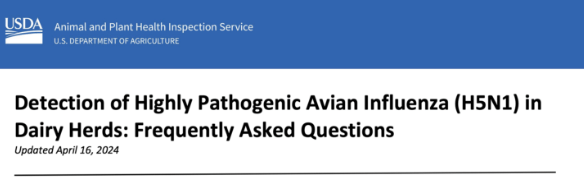
USDA’s frequently asked questions document, posted on its website, offers much information about what is currently known, recommended, or underway. It includes the following:

screenshot pm

  • "Tests so far indicate that the virus detected in dairy cows is …the same clade [i.e., variant] that has been affecting wild birds and commercial poultry flocks and has caused sporadic infections in several species of wild mammals, and neonatal goats in one herd in the United States.”
  • "The spread of the H5N1 virus within and among herds indicates that bovine to bovine spread occurs, likely through mechanical means.  As a result, we are encouraging producers and veterinarians to minimize dairy cattle movement.” 
  • "Unlike in poultry flocks where H5N1 is fatal, among the dairies whose herds are exhibiting symptoms, the affected animals have recovered with little to no associated mortality reported.”
  • "Based on information available at this point [April 16], we do not anticipate that this [outbreak] will impact the availability or the price of milk or other dairy products for consumers.”
  • "Recent detections of H5N1 in poultry have slowed.  As of April 15, 2024, there have been 26 detections of H5N1 in commercial poultry facilities in 2024, which is like the number in January-April of 2023 (19 detections).  Both years are showing significant decreases in the number of detections compared to 2022, when we saw 165 detections in the January-April period.”
  • "At this stage, we do not anticipate the need to depopulate [i.e., cull] dairy herds.  Unlike HPAI (H5N1) in birds which is typically fatal, little to no mortality has been reported and the animals are reportedly recovering.  The affected cows on the dairy farms are currently being isolated from other animals.”
  • It is noteworthy that avian flu has been detected only in dairy herds but not beef cow herds.
  • "FDA’s longstanding position is that unpasteurized, raw milk can harbor dangerous microorganisms that can pose serious health risks to consumers, and FDA is reminding consumers of the risks associated with raw milk consumption in light of the H5N1 detections.”

An important development would be the appointment of a prominent, knowledgeable government official as the point person for this rapidly developing situation, because the current precarious situation highlights the importance of the rapid accumulation and promulgation of information in managing outbreaks. USDA, CDC, and FDA’s sharing of information freely and quickly would allow scientists, public health officials, and farmers to work together to assess and reduce risks.  However, up to now, the publicly released data do not include critical information on the outbreak’s origins and evolution. “In an outbreak response, the faster you get data, the sooner you can act,” says genomic epidemiologist Martha Nelson. “Whether we’re not too late, to me, that’s kind of the million dollar question.”

An earlier version of this article was published by the Genetic Literacy Project.

Henry I. Miller, a physician and molecular biologist, is the Glenn Swogger Distinguished Fellow at the American Council on Science and Health. He was the founding director of the FDA’s Office of Biotechnology. Find Henry on X @HenryIMiller

Kathleen L. Hefferon is an instructor in microbiology at Cornell University. Find her on X @KHefferon

'When Did Progressives Learn to Love Health Insurers?'

 As long as I have been in politics, I have been keenly aware of the role that health insurers play in driving up health costs in the U.S. Let’s be frank: health insurance companies profit by denying medical care and try and hold Democrats hostage by demanding we either go along with their money-making schemes, or that they will walk away from the insurance markets critical to ensuring the continued success of Obamacare. 

I resent this ultimatum and believe that we should be expanding access to Medicare for even more Americans, in order to diminish the influence of the health insurers. Of course, no one wants to eliminate the health insurance industry entirely, because for some customers (like government employees and union members), they do offer good coverage. 

But, let me run some numbers by you that should concern you about the state of the health insurance industry in the U.S. According to the most recent statistics from the federal government, our National Health Expenditure (NHE) in 2022 “grew 4.1% to $4.5 trillion in 2022, or $13,493 per person, and accounted for 17.3% of Gross Domestic Product (GDP)…[and] “Private health insurance spending grew 5.9% to $1,289.8 billion in 2022, or 29 percent of total NHE.” 

And, according to a report from Reuters, “Over one third of all healthcare costs in the U.S. were due to insurance company overhead and provider time spent on billing.” In other words, about a third of the nearly $1.3 trillion we give to health insurers goes to bureaucratic overhead, not healthcare. 

Looking at the profits of the biggest health insurers in 2023, is even more discouraging: “UnitedHealth Group: $22.4 billion,” “CVS Health: $8.3 billion,” “Elevance Health: $6 billion,” and “Cigna Group: $5.2 billion.” 

According to a recent report in Axios, “the revenues of six for-profit parent companies making up nearly 30% of total U.S. health spending last year.” But one of the most surprising aspects of this outrageous situation with insurers, is that Senator Bernie Sanders (I-VT), on MSNBC, in a segment about the diabetes and weight loss drugs Ozempic and Wegovy, claims that the reason for their high prices is that the drug company who makes these medications overcharges the health insurers. 

Sanders claims that the drug maker, Novo Nordisk, charges insurers more than they offer the same drugs for in some European countries so he is investigating them. While the company does charge more in the U.S., it doesn’t tell the whole story. The drug maker also gives rebates to health insurers and pharmacy benefit managers (PBMs) who are both supposed to negotiate lower prices for patients with these rebates.  

But there is no assurance that even if Novo Nordisk did lower their cost to insurers and PBMs, that patients would save. This is because the PBMs and insurers typically take those rebates and pocket the cost savings. In fact, this is why the Federal Trade Commission is investigating PBMs for “negotiating rebates and fees with drug manufacturers that may…impact the costs of prescription drugs to payers and patients.” In other words, PBMs are not passing their cost savings onto Americans. 

Or, another line of the FTC inquiry is that PBMs have become vertically integrated, merging with insurance companies and pharmacies. These vertically integrated corporations often demand drug companies offer (secretly negotiated) rebates that if they don’t get, they then deny patients access to those medications. Which means that either the drug companies go along with the shakedown, or they can’t sell their drugs to patients. But again, even if the drug makers do lower their prices and offer even bigger rebates to the insurer or PBM, there is no guarantee any of those cost savings are realized by the patient. 

Also from Axios, what the FTC should additionally be considering about health insurers is that,: “Three of them processed nearly 80% of prescription claims last year, one of them is owned by the nation's largest pharmacy chain and one has become the largest U.S. employer of doctors.

Ultimately, if the insurance companies and the PBMs helped to ensure lower drug prices, but are having the opposite effect, maybe someone should do something. Senator Bernie Sanders is chairman of the Senate Health, Education, Labor and Pensions committee, which has jurisdiction to hold the insurers and PBMs accountable. If we really want lower drug prices in this country, putting all of the blame on drug companies is ineffective because of the role insurers and PBMs play to inflate the price of medications. 

Of course, I don’t think Bernie Sanders – a member of the Democratic Socialists of America – loves health insurers and PBMs. I believe that he thinks that he can have more success in lowering drug prices by putting pressure on the pharmaceutical industry. But, this punishes the drug company that created lifesaving and life changing treatments like Ozempic and Wegovy, and rewards the middle men who drive up drug costs. This is neither progressive nor the way to lower the price of healthcare in America. 

Hank Naughton is the Executive Director of the Centrist Democrats of America

https://www.realclearhealth.com/blog/2024/05/02/when_did_progressives_learn_to_love_health_insurers_1028903.html

Unredactions Reveal Early White House Involvement in Trump Documents Case

 Top Biden administration officials worked with the National Archives to develop Special Counsel Jack Smith’s case against Donald Trump involving the former president’s alleged mishandling of classified material, according to recently unsealed court documents in the case pending in southern Florida.

More than 300 pages of newly unredacted exhibits, containing emails and other correspondence related to the early stages of the hunt for presidential papers, challenge public statements by Joe Biden about what he knew and when he knew it regarding the case against his political rival.

LinkedIn
Jonathan Su, White House lawyer: In regular touch with National Archives.

The new disclosures indicate the Department of Justice was in touch with the National Archives and Records Administration (NARA) during much of 2021, undermining the DOJ’s claims that it became involved in the matter only after the Archives sent it a criminal referral on February 9, 2022, based on the findings of records with “classified markings” in 15 boxes of materials Trump gave to the Archives a month prior.

The court exhibits, which were compiled by Trump’s defense lawyers and kept under seal until last week, also show that Deputy White House Counsel Jonathan Su regularly communicated with Archive officials.

Although Biden himself is not mentioned in the exhibits, the active participation of Su and other high-ranking White House officials raises questions about whether Biden was forthright when he told “60 Minutes” he wasn’t involved in the investigation.

“I have not asked for the specifics of those documents,” Biden told Scott Pelley in the Sept. 17 broadcast, “because I don't want to get myself in the middle of whether or not the Justice Department should move or not move on certain actions they could take. I agreed I would not tell them what to do and not, in fact, engage in telling them how to prosecute or not.”


Trump’s lawyers first filed the heavily redacted material in a January motion, under a standing protective order issued by the court to initially conceal potentially sensitive information. His team then asked U.S. District Court Judge Aileen Cannon, who is presiding over the matter in southern Florida, to remove many of those redactions based on her review.

Southern District of Florida/Wikimedia
Aileen Cannon, presiding judge: Unseal the files, she ruled..

A protracted battle ensued as Smith fought to keep large portions of the motion and accompanying exhibits from the public. Smith told Cannon that disclosing the material would jeopardize the investigation and expose potential witnesses and government employees to "significant and immediate risks of threats, intimidation, and harassment."

But Cannon, arguing the need for public transparency, authorized the unsealing of the files, which were posted in mostly unredacted form on April 22. A comparison of the redacted and unredacted material shows the Archives acted in concert with several Biden administration agencies to build the case -- coordination that included the DOJ, the Biden White House, and the intelligence community.

The Trump case prompted revelations that both Biden and former Vice President Mike Pence had also retained classified documents – in Biden’s case for decades, stretching back to his time in the Senate. But while the Archives’ outreach to Biden and Pence consisted of requests, the agency took a more assertive stance with Trump. 

National Archives
Gary Stern, National Archives lawyer: Some two dozen boxes of files missing.

Within weeks of Trump’s leaving office in 2021, employees with Biden’s Office of Records Management and the Archives began coordinated demands to Trump’s transition team, including former Chief of Staff Mark Meadows.

Gary Stern, the Archives general counsel, noting “several conversations” with records office employees to discuss “concerns” about material in Trump’s possession, emailed Trump’s team in May 2021 and asked them to account for “roughly two dozen boxes of original Presidential records [that] have not been transferred to NARA.”

Stern did not specify the files the Archives wanted beyond “original correspondence between President Trump and North Korean Leader Kim Jung-un” and “the letter that President Obama left for President Trump on his first day in office.” An unsealed FBI report indicated the Archives also sought the so-called “Sharpiegate” map of Hurricane Dorian that the former president used during a 2018 televised briefing on the track of the storm.

Despite Trump’s cooperation, David Ferriero, the national archivist appointed by Barack Obama in 2009, warned the transition team a month later in June 2021 that he was running “out of patience.”

TK

Before-and-after illustration 1: Unredactions on the National Archives’ early and aggressive focus.

By August 2021, Ferriero and Stern were in contact with DOJ officials and at least one White House attorney to develop what initially appeared to be a records destruction case against Trump. According to White House visitor logs, Stern met with Su on August 12 at the White House.

National Archives and Records Administration/Wikimedia
David Ferriero, national archivist: In touch with Justice Department.

From that point on, the collaboration between the White House and Archives accelerated. On Aug. 30, 2021, Ferriero, making unfounded accusations that 24 boxes of materials were missing, warned Trump’s team, “At this point, I am assuming [the boxes] have been destroyed. In which case, I am obligated to report it to the Hill, the DOJ, and the White House.”

A Trump staffer whose name remains redacted responded, “To my knowledge, nothing has been destroyed.”

The archives, with apparent guidance from top White House lawyers, pressed forward. On Sept. 1, Stern sent an email to Ferriero and deputy archivist Debra Wall with the subject line, “Draft Letter to AG re Missing Trump Records.” In the Sept. 1, 2021 email, Stern disclosed that he already had “reached out to DOJ counsel about this issue,” and that “WH Counsel is now aware of the issue.”

An attachment to the email included a draft letter from Ferriero to Attorney General Merrick Garland to notify him that presidential records “may have been unlawfully removed from U.S. government custody or possibly destroyed.”

On Sept. 2, presumably with the draft letter in hand, Ferriero met with White House Counsel Dana Remus in her office, according to visitor logs. The draft letter was not sent as the Archives and White House continued to advance the case behind the scenes.

TK

.Before-and-after illustration 2: Unredactions suggest early coordination with the White House and DOJ.

On Sept. 9, 2021, both Ferriero and Stern met again with Remus and possibly White House Chief of Staff Ron Klain. (A Sept. 8, 2021, email from Stern referred to a meeting beforehand with “Ron and Dana,” possibly referencing Klain.) The same email indicated plans to also meet with Su.

White House/Wikipedia
Dana Remus, White House counsel: Met with national achivist Ferriero in her office.

An Oct. 2021 letter to Ferriero from Remus referred to a “notification on September 8” related to the January 6 Select Committee’s request for Trump’s records. In the letter, Remus denied Trump’s claims of privilege in preventing the committee from early access to his papers.

But the email chains do not reflect any mention of the January 6 Committee’s demands; to the contrary, emails between the White House and Archives repeatedly reference the “Trump boxes.”

In fact, a Sept. 15 email disclosed that Stern spoke to Su to “get him up to speed on the issue and the dispute whether there are 12 or 24 missing boxes.” A few weeks later, Stern told his colleagues that “WHCO [White House counsel] is ready to set up a call to discuss the Trump boxes.”

TK

Before-and-after illustration 3: Unredactions on cooperation between the Archives and White House counsel.

On Jan. 18, 2022, following roughly seven months of negotiations, Trump’s team delivered 15 boxes to the Archives. In a matter of hours, the Archives’ White House liaison director said he conducted what he described in an email to Ferriero, Wall, and three undisclosed recipients as a “high level overview” of the contents.

Department of Justice
Lisa Monaco, deputy attorney general: "Instructed" National Archives lawyer Stern on how to proceed.

While admitting that most of the material consisted of “newspapers, magazines, and printed news articles,” the official claimed the boxes contained “lots of classified records.”

That assessment triggered deeper involvement by the DOJ. An unsealed FBI interview with an Archives official indicated that on Jan. 22 Su directed Stern to contact the office of Lisa Monaco, the current deputy attorney general and a longtime former adviser to Obama, to lay the groundwork for a criminal referral. It would represent the first time the Archives had ever sent a referral to the DOJ asking for an investigation into the retention of classified records.

Two days later, Monaco’s office “instructed” Stern on how to proceed. For guidance as to how a criminal investigation would proceed, two Monaco associates told Stern to notify the inspectors general for both the Archives and the intelligence community as well as DOJ National Security Division Chief Jay Bratt, now the lead prosecutor for Jack Smith in the classified documents case, and the chief of the DOJ’s public integrity unit.

According to the unredacted defense motion, Stern followed the DOJ’s guidance and sent information about the 15 boxes to the Archives’ inspector general, who then notified the intelligence community’s inspector general about a “very high level potential spillage and records management issue.”

The email chain then made its way to Thomas Windom, a prosecutor now tasked to Smith’s team on the Jan. 6 case against Trump, on Feb. 1. A criminal referral was officially sent to the DOJ on Feb. 9.

Two months after the archives received Trump’s boxes, which he produced voluntarily, the FBI opened on March 30, 2022, what it named the “Plasmic Echo” investigation, according to an unsealed FBI document. The probe centered on the “mishandling of classified or national defense information.”

TK

Before-and-after illustration 4: Unredactions on top-level DOJ involvement before receiving criminal referral.

A grand jury and the FBI summoned Mar-a-Lago employees to testify. In May 2022, at the same time Biden officials were scouring Biden-related locations including the Penn-Biden Center in Washington for classified documents in advance of a potential GOP investigation into the same matter if Republicans won the House, the DOJ issued a subpoena for more classified records.

Not satisfied with the result – that Trump’s lawyers produced 38 more files to investigators in June 2022 – Garland authorized and the FBI executed a nine-hour raid of Mar-a-Lago in August 2022. After seizing more than 13,000 pieces of evidence, prosecutors claimed agents found another 102 records with classified markings.

In June 2023, Smith, appointed in November 2022 to take over the existing investigation, charged Trump with 32 counts of “willfully” retaining national defense information, representing a shift from the premise of the original investigation into more serious Espionage Act crimes. (Visitor logs show that Stern met with Biden’s special counsel Richard Sauber at the White House the day before Smith announced the indictment.)

Smith has also indicted Waltine Nauta, Trump’s personal aide, with obstruction, for moving boxes within Mar-a-Lago in an alleged attempt to conceal materials from investigators, and another Mar-a-Lago employee, Carlos DeOlivera, for allegedly attempting to erase security video at the property. All have pleaded not guilty.

Another Special Counsel, Robert Hur, was subsequently named to investigate Biden’s retention of classified material, dating as far back as 1977. Although Hur reported that Biden had willfully retained state secrets in unsecured locations and illegally shared them with a ghostwriter, he concluded that Biden should not be prosecuted for these violations.

Trump and his co-defendants have filed motions to dismiss based on selective and vindictive prosecution; Cannon has not yet ruled on those motions.

A May 2024 trial date in Florida has been postponed in light of Trump’s other legal entanglements, which the former president has described as a partisan witch hunt to interfere in the 2024 election.

https://www.realclearinvestigations.com/articles/2024/05/02/unredactions_reveal_early_white_house_involvement_in_trump_documents_case_1028630.html

Avoiding Victimhood: A Lesson From Our Jewish Peers

 More than six months have passed since the deadly attacks of Oct. 7, 2023. Yet it seems like every day I wake up to new reports of antisemitic conduct, particularly among America’s most elite young adults, Ivy League students. The latest has been a series of violent protests at Columbia and Yale where Jewish students were harassed and even attacked. At Penn, I have been reporting on the ground while protesters chanted “Israelis are pigs,” and “Al-Qassam make us proud, take another soldier down.” Our famous Ben Franklin statue was even vandalized with the KKK slur “Zios get fuckt.” How did the generation that prided itself on inclusive language, safe spaces, and affirming one another’s identities end up being so hostile toward Jews?

The story is multifold. It starts, of course, with Gen Z’s selective and shallow supposed tolerance. Ninety percent of Gen Zers expressed support for the Black Lives Matter movement, and less than 50% believe there are “just two genders,” statistics that would be lauded by progressives as surefire indicators of “tolerance.” However, this is paired with rapidly increasing rates of intolerance for people of different viewpoints among Gen Z.

None of this explains why Jews are exempt from this veil of tolerance. After all, they are a historically oppressed minority group. American Jews were crucial to the Civil Rights movement of the 1960s and supported gay marriage more than any other religious group. They also are the most reliable liberal voting coalition by faith, with 79% voting for Democratic candidates in the 2018 midterms. So why, then, did progressives not only refuse to rally behind those experiencing antisemitism but actively propagate it?

Here’s the short answer: It is inconsistent with the Jewish heritage to play the victim. Against all odds, a small ethnic group has retained its faith, traditions, and family lines despite every type of persecution imaginable. Whether it was by the Romans, the Ottomans, the Nazis, or the Soviets, efforts to shun and eradicate Jews have been countless. Despite this unparalleled persecution, the more than 15 million Jews worldwide have not only survived but thrived. Twenty-five percent of American Jews report household incomes of more than 200,000 dollars, and over 80% across ages and denominations of Judaism express life and community satisfaction. Approximately 16% of Penn undergraduates are Jewish, a number which is a relative median across the Ivy League. For a group that makes up only 2.4% of the United States and that has been targeted with such ferocity in every generation, these numbers defy all odds.

In his article titled, “On Not Being a Victim,”  Rabbi Jonathan Sacks writes about how Moses impresses personal accountability upon the Jews in the Book of Deuteronomy. He writes, “The choice, he says again and again, is yours alone: you as an individual, second person singular, and you as a people, second person plural. The result was that remarkably, Jews did not see themselves as victims.” As a Catholic, I was also brought up with this sense of personal accountability for my actions. It is through this, as Jews and Catholics both understand, that we can experience both real liberty and moral fulfillment. While this value was once universally understood by Americans it has now become counter-cultural. Therefore, it was second nature for me to see it targeted on Oct. 7th and grieve the attacks alongside my Jewish best friend, and advocate against antisemitism at Penn.

Fueled by this character, against all odds, Judaism and Zionism triumphed. A nation formed by repeated attempts at deadly ethnic cleansing over generations has gone on to thrive. Israel ranks highly on economic and educational measures of success and metrics of political and social freedom. Contrary to popular belief, Israel remains a highly tolerant and accepting place, a standout within the Middle East. It is therefore no surprise that the illiberal progressive ideologies that have captivated Gen Z would draw a target on the nation that refuses to be victimized as it remains strong and tolerant despite constant opposition.

While many pin the blame for this rise in antisemitism on the growth in “diversity, equity and inclusion” policies which center around dividing people into groups of “oppressor” and “oppressed,” this thesis seems to miss part of the story. Yes, this ideology has provided anti-Zionists with useful language like “colonizer” and “apartheid” to express their frustrations with the Jewish state. But people in leftist academic circles have launched these accusations at Jews and Israelis for decades. Why is it that now, among my generation, this virulent sentiment spreads like wildfire?

Though the viral Instagram graphic comparing Columbia’s student protests during Vietnam to those of late would suggest Gen Z is engaged in a storied tradition of student protest, our generation is different. As Abigail Shrier explains in her new best-selling book, Gen Z isn’t only hyper-polarized but also hyper-therapized. As “Bad Therapy” explains, we, and certainly the generation that will follow us, have been raised on “socio-emotional learning,” and “gentle” and “helicopter” parenting. We are shielded from personal accountability and hardship at every turn. After receiving participation awards instead of resiliency, it’s no surprise that belief in meritocracy and the American Dream is rapidly declining. The worst part? We are the most anxious, alienated, and depressed generation in history.

It should be unsurprising that antisemitism would take such a fierce hold among today’s youth. A worldview centered around tradition, community, success, and most importantly survival against all odds, represents everything this generation lacks. Judaism, Zionism, and the West as a whole are the perfect targets for their animus. But theirs is a different, more pervasive kind of progressive activism, fueled by jealousy. These are America’s best and brightest – filled with hatred and ripe for radicalization.

To be clear, peaceful protest is permissible and critique of Israel is not equivalent to antisemitism, but when protesters shout “intifada revolution” and “kill all the Jews,” we should take them seriously. More importantly, we should recognize what we can do better as a nation and a culture to prepare our young people to crave well-being rather than seek to destroy it.

Lexi Boccuzzi is a contributor at Young Voices and a senior at the University of Pennsylvania. She has written about higher education, antisemitism, and Gen Z in The Daily Pennsylvanian, and has just founded a new heterodox student publication, The Pennsylvania Post. Follow her on X @lexiboccuzzi.

https://www.realclearpolitics.com/articles/2024/05/02/avoiding_victimhood_a_lesson_from_our_jewish_peers__150881.html