Search This Blog

Friday, May 3, 2024

26 States File Lawsuits In Federal Courts Over ATF Redefinition Of Gun Dealers

 by Michael Clements via The Epoch Times (emphasis ours),

Attorneys general representing half of the country on May 1 sued President Joe Biden’s administration over a new rule requiring criminal background checks for all gun sales, including private sales.

Lawsuits in Florida, Texas, and Arkansas are asking the courts to block a rule from the Bureau of Alcohol, Tobacco, Firearms and Explosives (ATF) that redefines “engaged in the business” of dealing in firearms.

Under the new rule, almost every transfer of firearm ownership would require at least one party to have a Federal Firearms License and perform a criminal background check, including private sales.

U.S. Attorney General Merrick Garland signed the new rule on April 10, and it goes into effect on May 10.

According to the 466-page rule, the only requirement for determining whether a person is engaged in the business of selling guns is whether the person is trading to “predominately earn a profit.” Previously, the defining characteristic was whether the dealer worked to earn a “livelihood.”

The new definition is in the Bipartisan Safer Communities Act (BSCA), signed into law on June 25, 2022.

In the Florida case, Florida Attorney General Ashley Moody filed suit in the U.S. District Court for the Middle District of Florida.

According to the lawsuit Ms. Moody filed on May 1, the act was passed to balance gun owners’ rights against public safety concerns.

In the filing, Ms. Moody wrote that the BSCA’s sponsors assured voters that the law clarified that dealers were only those who earned their livelihood from selling guns. Ms. Moody claims that President Biden is stretching the language of the act to fit his political agenda.

Sensing an opportunity, the Biden Administration now seeks to exploit the minor changes to federal law enacted in the BSCA to implement President Biden’s preferred policies by executive fiat,” Ms. Moody wrote.

The other two lawsuits—filed in the Northern District of Texas and Eastern District of Arkansas—also decry the change as an unconstitutional infringement on Americans’ Second Amendment rights and an illegal attempt to circumvent the U.S. Congress and enact “universal background checks.”

President Biden has called for expanding the criminal background check requirement since his election in 2020.

Each suit asks its respective court to block the rule’s enforcement and find that it violates the U.S. Constitution and the Administrative Procedures Act.

ATF spokesperson Kristina Mastropasqua said the agency had no comment on the lawsuits.

The White House did not respond to requests from The Epoch Times for comment on this story.

A researcher simulates a check done for the National Instant Criminal Background Check System (NICS) at the FBI’s criminal justice center in Bridgeport, W.Va., on Nov. 18, 2014. (Matt Stroud/AP Photo)

The attorneys general say they are defending their constituents’ rights.

This lawsuit is just the latest instance of me and my colleagues in other states having to remind the President that he must follow the law,” Arkansas Attorney General Tim Griffin wrote in a press release on May 1.

Mr. Griffin joined Kansas Attorney General Kris Kobach in the largest suit, representing 21 states. They say the new rule completely reverses decades of legal precedence that protected the right of private parties to buy, sell, or trade firearms without government intrusion.

Defendants’ claim of authority to implement this scheme dramatically upends both our constitutional traditions and the federal firearms licensing regime Congress designed,” the lawsuit states.

In addition to Kansas and Arkansas, the plaintiffs in the Arkansas lawsuit include Iowa, Montana, Alabama, Alaska, Georgia, Indiana, Idaho, Kentucky, Missouri, Nebraska, New Hampshire, North Dakota, Oklahoma, South Carolina, South Dakota, Tennessee, Virginia, West Virginia, and Wyoming.

Private citizens Phillip Journey, Allen Black, Donald Maxey, and the Chisholm Trail Antique Gun Association joined the lawsuit as plaintiffs.

They are suing Mr. Garland, ATF Director Steven Dettelbach, the U.S. Department of Justice, and the ATF.
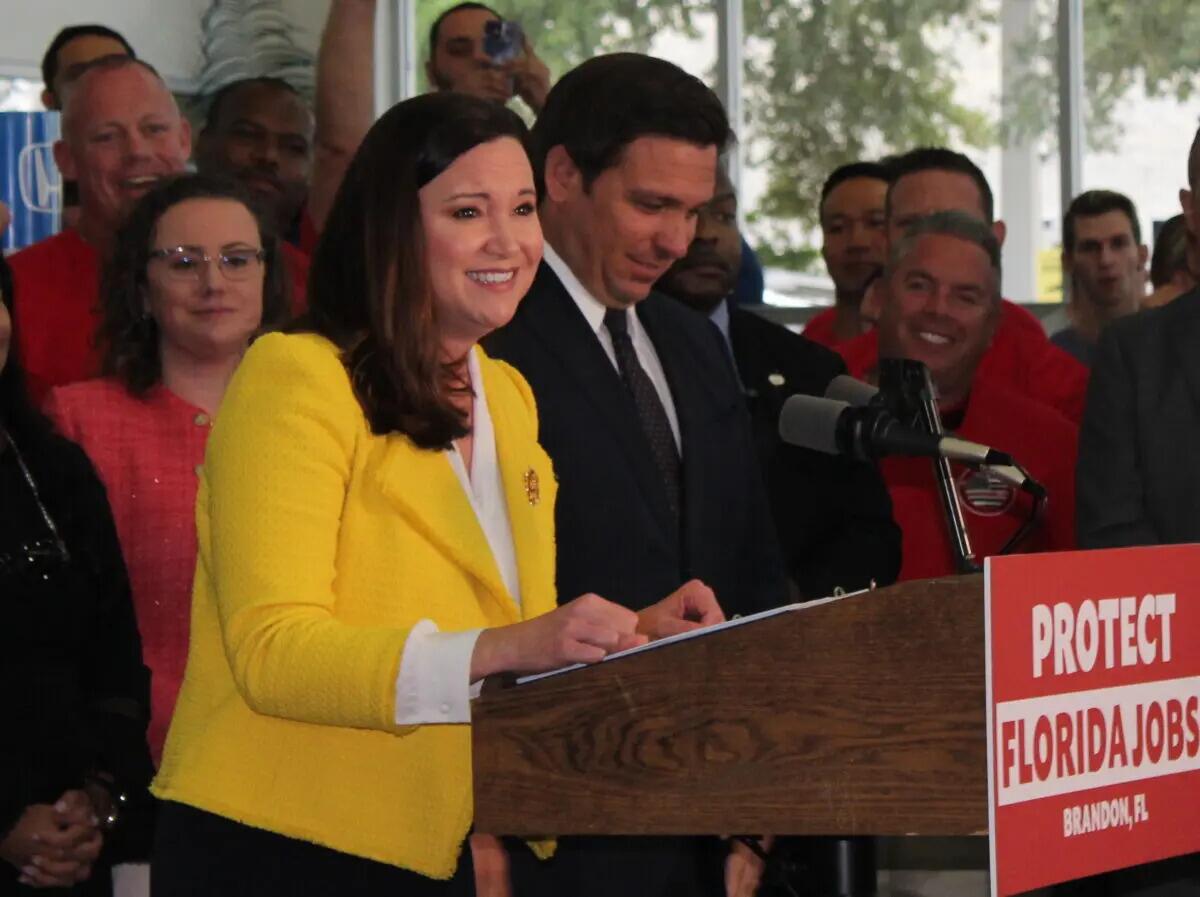
Florida Attorney General Ashley Moody speaks at a press conference in Brandon, Fla. Nov. 18, 2021. (Jann Falkenstern, The Epoch Times)

“This rule is blatantly unconstitutional. We are suing to defend the Second Amendment rights of all Americans,” Mr. Kobach wrote in a press release on his state website.

In Texas, four states, four Second Amendment Advocacy groups, and one individual are challenging the rule in the U.S. District Court for the Northern District of Texas in Amarillo.

That lawsuit was filed on May 1 by the states of Texas, Mississippi, Louisiana, and Utah, along with Gun Owners of America Inc., the Gun Owners’ Foundation, the Tennessee Firearms Association, the Virginia Citizens Defense League, and Jefferey W. Tormey.

Texas Attorney General Ken Paxton issued a press release calling the new rule an affront to the Constitution.

“Yet again, Joe Biden is weaponizing the federal bureaucracy to rip up the Constitution and destroy our citizens’ Second Amendment rights,” Mr. Paxton’s statement reads.

Gun Owners of America Eric Pratt said allowing the rule to stand would send a dangerous message to other government agencies. In the press release, Mr. Pratt wrote that the rule must be struck down entirely.

“Anything less would further encourage this tyrannical administration to continue weaponizing vague statutes into policies that are meant to further harass and intimidate gun owners and dealers at every turn.”


https://www.zerohedge.com/political/26-states-file-lawsuits-federal-courts-over-atf-redefinition-gun-dealers

Digital Health Sector Slowed Down in 2023

 Although artificial intelligence (AI) applications are increasingly prevalent in the healthcare sector each year, investment in digital health slowed down in Europe in 2023, according to investment firm Karista. In 2023, health tech mostly comprised biotechnology companies (32%), medical devices (24%), and digital health (23%), according to France Biotech.

Consequently, the average amount raised in European funding rounds decreased, reaching an average of 10 million euros compared with 20 million euros in 2022. The largest funding rounds were secured by robotic surgery: CMR Surgical raised 152 million euros; Distalmotion, 138 million euros; and Moon Surgical, 51 million euros.

Pharmaceutical Tech Rising

While funding amounts declined, the number of investors increased by 23%. In all, 217 funds invested in European e-health in 2023 compared with 168 in 2022. European funds are investing in France (24%), the United Kingdom (21.7%), and Germany (18.1%). "The pharmatech sector, driven by the rise of AI in 2023, is also growing, both in terms of investments (20%) and collaborations and acquisitions by the pharmaceutical industry. We observe amounts exceeding 100 million (Aqemia, Owkin for collaborations; Lunaphore, Olink for acquisitions)," noted Karista. Despite a somewhat disappointing year in 2023, Karista also identified 55 major e-health investors that have invested in more than 10 companies.

Uncertain Macroeconomics

In its 2023 report on healthcare technology, FranceBiotech echoed Karista's assessment that 2023 was not the best of the last 3 years for the sector. "Given a more uncertain macroeconomic context in 2023 and refinancing difficulties for some companies, the year saw a higher number of judicial liquidations compared with 2019 and 2020. Thus, 39 companies underwent judicial liquidation, with a net balance of 20 new companies," the company wrote.

Fifteen Thousand Jobs

In 2023, the sector represented a turnover of 1.4 billion euros and more than 15,000 direct jobs. Employment in the sector has increased by 40% over the past 3 years. Despite a challenging context in 2023, three quarters of the companies hired new employees, with an average of six new employees per company. Nevertheless, 11% of companies laid off employees. This rate rose to 17% among digital health companies.

Remote Monitoring

The year 2023 was also marked by the reimbursement of remote monitoring, and remote monitoring solutions were the product category with the highest growth, with an increase of four points compared with 2022 (14%). Computer-assisted diagnostics also represented 14% of products in digital health, followed by telemedicine solutions, data analysis (10%), and care coordination software (9%). In biotechnology, however, "half of the pipeline products focus on three main therapeutic areas: Oncology (25%), infectious diseases (13%), and the CNS (13%)," according to France Biotech. In the field of medical technology, surgery (15%), oncology (10%), and neurology (9%) dominated the market.

https://www.medscape.com/viewarticle/digital-health-sector-slowed-down-2023-2024a10008ls

New Perspective on Diabetic Neuropathy

 Diabetic neuropathy was the subject of a dedicated plenary session at the congress of the Francophone Diabetes Society. This already prevalent issue is becoming more prevalent and remains inadequately addressed. Phenotyping patients is essential, and the use of neurofilament for this purpose is insufficient. Electromyography (EMG), too, can be misleading, said Agnès Hartemann, MD, PhD, head of the diabetology department at Pitié-Salpêtrière Hospital in Paris, France.

"The number of people affected by diabetic neuropathy has more than tripled worldwide since 1990, reaching 206 million in 2021," said Liane Ong, PhD, lead research scientist at the University of Washington in Seattle and coauthor of the 2021 Global Burden of Disease, Injuries, and Risk Factors Study.

According to the literature, 25%-30% of individuals with diabetic peripheral neuropathy have neuropathic pain. Not surprisingly, pain progresses with age. Over the 26 years of follow-up of the Epidemiology of Diabetes Interventions and Complications study, the observational follow-up of the DCCT trial (1982-1993), the prevalence of neuropathic pain (Q2: "Have you ever felt burning sensations in your legs and/or feet?" and/or Q6: "Does it hurt when bed covers touch your skin?") increased from 8.5% to 19.8%. The rate of a Michigan Neuropathy Screening Instrument score higher than 2 increased from 22.9% to 43.5%.

"The monofilament has taken an excessive place in screening," said Hartemann, who described the pathophysiology of neuropathic pain at the congress. "It has long been believed that sensory neuropathy affected small fibers and that painful neuropathy affected large fibers. However, this distinction no longer holds true because there can be involvement of both types of fibers in both types of neuropathy." Indeed, there are two forms of nerve suffering in peripheral neuropathy: Firstly, the loss of fibers leading to loss of function (so-called "sensory" neuropathy), and secondly, neuropathy with hyperactivity of fibers, hyperexcitability that constitutes a gain of function. This hyperactivity involves dysfunctional ion channels with spontaneous, iterative, untimely activation at the peripheral level with repercussions at the spinal junctions.

Loss and Gain of Function

The loss of function (sensory neuropathy) corresponds to a rarefaction of large (> 30 m/s) and small (3-30 m/s for thinly myelinated and < 3 m/s for unmyelinated) nerve fibers. "When you look for this loss of function in large fibers, that's where you'll find the abolition of osteotendinous reflexes, decreased vibration and proprioception perception, sensitivity to touch and pressure," said Hartemann. This is what the 10-g monofilament test explores: A light contact between touch and pressure. The rarefaction of small fibers leads to decreased pain sensitivity (as gauged by the needle test), perception of heat and cold, and sensitivity to pressure, which seems to be shared between large and small fibers.

Moreover, painful neuropathy (gain of function) concerns not just small fibers as previously thought because hyperexcitability "can come from large fibers," said Hartemann. Thus, patients describe a sensation that the foot is caught in a vice, as well as mechanical allodynia (rubbing of sheets or with cotton). Hyperexcitability of the small fibers causes the well-known symptoms of pricking, painful cold (the sensation of walking barefoot on snow), burning, itching, thermal allodynia, hyperalgesia, and electric shocks.

The spine sustains a loss of inhibitory pain function. Hyperexcitability has repercussions in the brain in the form of increased depression, anxiety, and sleep disturbances secondary to pain. The frequency and duration of these disturbances, however, exceed what is observed with chronic pain of similar intensity but of another origin, with an amplification by a peripheral-spinal-central vicious circle.

Whether neuropathy begins with hyperactivity of fibers or loss of function is unclear. The percentage of patients presenting one of the neuropathies, the other, or both depends on the population and the tools used. In one study involving 232 patients with type 1 and type 2 diabetes (74%), with an average age of 63 years and neuropathy confirmed by EMG or biopsy, researchers found deafferentation in 54%, "irritable nociceptors" in 15%, and both in 31%.

EMG When in Doubt

The diagnosis of fiber rarefaction (ie, sensory neuropathy) is essentially clinical. EMG may present anomalies only if the loss of function affects large fibers. Therefore, without anomalies on the EMG, it is possible to incorrectly conclude the absence of diabetic neuropathy, although there is targeted involvement of small fibers.

Skin biopsy at the ankle, revealing rarefaction of small fibers in the epidermis and dermis, is used in clinical research to phenotype patients. Confocal corneal microscopy (indirect vision of small fiber loss) has not yet been standardized.

The diagnosis of hyperactivity (excitability) is also clinical. EMG, skin biopsy, and confocal corneal microscopy may be normal and, therefore, useless for positive diagnosis. "We must refer our patients to pain centers so that they are phenotyped and receive the most appropriate treatment for the type of pain," said Hartemann. Recognizing diabetic neuropathy is crucial, especially in patients with diabetes, who may suffer from various pains, especially in the lower limbs.

For this purpose, the DN4 screening questionnaire has been revalidated by several teams in diabetic neuropathy. A score > 4 suggests diabetic neuropathy with a sensitivity of 83% and a specificity of 90%.

A study published in 2013 in which Hartmann participated found that 14% of patients with type 1 diabetes and 24% of patients with type 2 diabetes had diabetic neuropathy. About 70% had consulted a clinician for pain, but only 38% had received appropriate treatment.

Certain characteristics may raise doubts about the diagnosis of diabetic neuropathy, including the speed of onset, symmetry, severe motor deficit, or proximal involvement, which require referral to a neurologist.

Concomitant diagnoses may include radiculopathy associated with cervical, dorsal, and lumbar regions. In these cases, EMG and MRI are relevant. Other etiologies to consider are poststroke neuropathy, Parkinson's disease, chemotherapy, knee osteoarthritis, and peripheral arterial disease.

Neuropathy is characterized by microangiopathy, which results from damage to the microvessels that innervate the nerves. But neuropathy has multiple risk factors, including glycemia and metabolic syndrome, overweight, cardiovascular diseases, dyslipidemia, hypertension, and smoking. "It even begins in type 2 prediabetes," said Hartemann. Therefore, there is an effect of chronic hyperglycemia (microangiopathy on endoneurial capillaries) as well as axonal insulin resistance related to the same risk factors as for muscles. There is axonal mitochondrial dysfunction, oxidative stress, and endoplasmic reticulum stress.

https://www.medscape.com/viewarticle/new-perspective-diabetic-neuropathy-emerges-2024a10008lj

Proton Pump Inhibitors Tied to Migraine, Other Severe Headache Types

 Proton pump inhibitors (PPIs), which are used to control acid reflux, are associated with an increased risk for migraine and other severe headache types, new research showed. 

Using data from the National Health and Nutrition Examination Survey (NHANES) investigators conducted a cross-sectional analysis and found all types of acid-suppression therapy were associated with an increased risk for severe headache including migraine but that PPI's conferred the greatest risk.

"It's important to note that many people do need acid-reducing medications to manage acid reflux or other conditions, and people with migraine or severe headache who are taking these drugs or supplements should talk with their doctors about whether they should continue," lead author Margaret Slavin, PhD, of the University of Maryland in College Park, said in a press release

The findings were published online April 24, 2024, in Neurology Clinical Practice

New Look at Old Data

Previous research has shown that headache is listed among the most common adverse reactions in adults taking PPIs and histamine receptor agonists (H2RAs), which include cimetidinefamotidine, and nizatidine

Other large studies of health databases have shown increased headache risk within a week of PPI exposure.

To compare the risk from PPIs vs H2RAs and other generic researchers analyzed data from the NHANES for those who used PPIs, H2RAs, and generic antacids to learn more about the potential link between acid-suppression therapy and headache.

They used survey data from 1999 to 2004, the only years the NHANES included a question about migraine and other headache during the past 3 months. 

Investigators analyzed data for 11,800 participants aged ≥ 20 years who used prescription drugs, over-the-counter medications, and nutritional supplements during the past month. 

Diet, BMI, Alcohol, Caffeine

Participants who used acid-suppressing medications had an increased risk for migraine or severe headache vs those who did not use these agents. Investigators found PPIs were tied to a 70% increased risk, while H2RAs and antacids were associated with 40% and 30% higher risks, respectively. Use of any type of acid-suppression therapy was tied to a 47% increased risk for severe headache.

Magnesium a Risk Factor?

While magnesium supplements are sometimes prescribed as a "natural" headache prevention therapy to prevent migraine and other headache types, the investigators noted they were surprised to find individuals taking H2RAs who met the dietary reference intake for magnesium had a nearly threefold increased risk for migraine or severe headache (odds ratio, 2.80; 95% CI, 1.02-1.45; = .025).

However, there was no association between magnesium and the other acid-reducing medications. 

The study's limitations included the use of a single question to identify migraine or severe headache, which may have resulted in some misclassification of the outcome. The authors also pointed out that dietary and drug-intake data may be subject to recall bias. 

"These results suggest that there is a need for more intentionally designed prospective

work to inform the extent to which associations between migraine and acid-suppression therapy are merely detecting comorbidities or to what extent migraine is an adverse event associated with the medications," the authors wrote. 

There was no targeted funding. Disclosures are noted in the original article. 

https://www.medscape.com/viewarticle/proton-pump-inhibitors-tied-migraine-other-severe-headache-2024a10008lz

Saving Hamas

 Reports are circulating that the Israelis are planning an operation in Rafah to eliminate the last Hamas stronghold in Gaza. If so, the Netanyahu government will be acting against the very public wishes of the Biden administration, which has spent the last half year moving heaven and earth to save a terrorist organization from destruction. Bizarrely, the White House’s statements and actions show that Hamas’ survival is more important than the security of a traditional American partner, Israel; more crucial to American interests than the preservation of the U.S.-led order of the Middle East; more precious than the dozens of American lives that Hamas ended on Oct. 7; more valuable than however many Americans and Israelis are still alive in the terror army’s tunnels.

Why? As the money and prestige that the U.S. has invested month after month in protecting Hamas demonstrate, the Biden administration sees the terror group as a valuable asset.

A day after the massacre, before Israel’s campaign against Hamas even began, Secretary of State Antony Blinken wrote that he was encouraging the Turkish government’s “advocacy for a cease-fire.” It makes no difference that the tweet has since been deleted, since the White House has produced no shortage of evidence since that its top priority is to deter Israel from defeating Hamas, by increasing Israel’s vulnerabilities at every turn, and conditioning aid on Israel adopting a purely defensive posture.

The Biden administration has stopped Israel from entering Rafah by demanding it produce plans to protect the civilian population, piously insisting that “even one civilian death is too many.” That would be a hard task in any military scenario, but given that Hamas hides among noncombatants, the White House’s policy openly reinforces the terror group’s political and military strategy.

The president abdicated America’s historical role of vetoing anti-Israel activity at the U.N. Instead, the U.S. delegation abstained from a key Security Council resolution in March demanding an immediate cease-fire—thereby putting America’s diplomatic weight behind Hamas’ demand that it should be allowed to keep its hostages and continue ruling Gaza. The White House then sanctioned Israeli civilians on the West Bank for crimes dreamed up by left-wing pro-Palestinian organizations, while ignoring a Palestinian terror wave aimed at murdering Jewish civilians who were guilty of crimes like stopping at a red light, buying gas, and herding sheep. Much of the false reporting supporting the pro-Hamas offensive is channeled through U.S. Army Gen. Michael Fenzel. The U.S. Security Coordinator for Israel and the Palestinian Authority are spending taxpayer resources to build a Palestinian terror army on the West Bank that may soon be repurposed for Gaza, too.

By compelling Jerusalem to “surge” food aid and energy to Gaza, the White House broke Israel’s siege, and demanded an ally resupply its adversary at wartime. Whenever Israel goes on the offensive, Biden and aides publicly threaten to stop resupplying arms. After Iran’s massive missile and drone attack last month, administration officials let on that if Israeli retaliatory strikes exceeded meager U.S. limits, the White House would hobble Israel’s air defense systems. Thus, the Israelis were forced to adopt the battle-tested American military strategy of bombing sand.

The White House has used CIA Director William Burns as one of its main instruments of diplomatic deterrence. He’s traveled to Egypt, Qatar, and elsewhere for endless hostage negotiations with the Palestinian terrorist organization. That none of these negotiations has gone anywhere is the point. Burns’ jawboning is designed to stall Israel’s war while legitimizing the act of hostage-taking, even as it’s become increasingly clear that many of the hostages whose release he is supposedly negotiating for are dead.

To emphasize its evenhandedness in the conflict between a key U.S. military ally and a designated foreign terrorist organization, the White House has amplified Hamas propaganda that has repeatedly been shown to be false. The president himself and the secretary of state enthusiastically repeated accusations that Israel intentionally murdered World Central Kitchen aid workers. Without evidence to support USAID head Samantha Power’s claims of rampant famine in Gaza, the administration and its validators began calling it a “reported famine.”

To fight the mythical famine, Biden is sending thousands of U.S. troops to build a $320 million pier to resupply Hamas—an arrangement that will turn American forces into human shields to deter Israeli military operations against the terror organization. By leaking fake news, most recently an internal State Department memo alleging Israeli war crimes, that Israel was hindering aid to starve Gazans, the administration laid the groundwork for arrest warrants likely to be issued by the International Criminal Court. While the warrants reportedly target Netanyahu and other members of Israel’s war cabinet, the action is likely to set a precedent broad enough to justify arresting any Israeli who served in the Gaza campaign.

It’s useful to remember that what distinguishes the Palestinians from other ethno-national groups born of the breakup of the multiethnic empires of Europe and the Levant after World War I is that their claim on the world’s attention issues largely from their willingness to hire themselves out as terrorist mercenaries.

During the Cold War, the Palestinians were used by the Soviets against the U.S. and American interests and allies. Regional powers like Nasser’s Egypt, Assad’s Syria, Saddam’s Iraq, and Ghaddafi’s Libya used the Palestinians to advance their own interests, against the superpowers and/or each other. Not infrequently, Palestinian factions fought each other on behalf of their Arab patrons.

It was through this nonstop violence that the Palestinian cause flourished. The Palestinians won a place in regional and then international forums not because of a world-historical injustice done to an ad hoc confederacy of minor Levantine bloodlines. Rather, it was because if you didn’t employ a mercenary gang of Palestinians against your enemies, you would be exposed to a terror campaign waged by a rival band of Palestinians, sponsored by your rivals.

What Middle East watchers call the “Palestinian veto” refers to the ability of Palestinian terrorists to destabilize any given regional order that doesn’t suit the ambitions of whoever their dominant patron happens to be. For instance, the 1979 Israel-Egypt peace treaty came about only because Egyptian President Anwar Sadat insisted on keeping the Palestinians out. Unlike Jimmy Carter, Sadat didn’t care about a comprehensive peace in the Holy Land with the Palestinians front and center—he knew that giving the Palestinians a seat would give the Soviets and their Arab allies an opening to derail an agreement he needed to advance Egyptian interests.

On whose behalf were the Palestinians acting when they destabilized the region with their gruesome Oct. 7 attack? Iran—but also the Biden administration. The two share an interest in collapsing the traditional U.S.-led order of the Middle East that Donald Trump had restored, after Barack Obama began the process of dismantling it.

Up until Obama, the pillars of America’s security architecture were the Persian Gulf’s oil-rich Arab states, led by Saudi Arabia, and, in the eastern Mediterranean, Israel and Egypt. Early in his first term Obama signaled he intended to undo that order when he gave a speech in Cairo and invited officials from the Muslim Brotherhood, existential enemies of the military regime then led by Hosni Mubarak. Within two years, the White House withdrew its support for Mubarak during the Arab Spring revolutions and ushered in a Muslim Brotherhood government. Egypt became the first pillar of the old U.S. security order to fall.

Obama’s aides made it clear that his second term would be devoted to securing a nuclear deal with Iran. The purpose of the deal, officially known as the Joint Comprehensive Plan of Action (JCPOA), was not to prevent an Iranian bomb—in fact, the agreement legalizes the clerical regime’s nuclear weapons program. Rather it was to realign U.S. interests with Tehran while stiffing traditional U.S. partners, especially Riyadh and Jerusalem, the other regional pillars of the American order. To cap off his eight years of dismantling the instruments of U.S. policy in the Middle East, Obama’s final foreign affairs initiative was to push a U.N. Security Council resolution adopting the Palestinian position that Israel was in violation of international law by occupying, among other places, historic Jewish holy sites.

Then came Donald Trump, who not only reversed Obama’s realignment but reinforced Washington’s traditional security architecture. Trump’s first official trip was to Saudi Arabia. He explained that the U.S.-Saudi alliance was good for the U.S. because it meant affordable oil, investment in America, and American jobs. Trump defended the Saudis when retired U.S. spies, The Washington Post, Obama operatives, and foreign intelligence services joined in an information operation to isolate Crown Prince Mohammed bin Salman after the murder of former Saudi intelligence official Jamal Khashoggi.

That was only the beginning, as step by step Trump erased Obama’s legacy in the Middle East, and restored the pillars of the American-led regional security order. He backed the military regime in Cairo, and moved the U.S. Embassy in Israel to Jerusalem. He acknowledged Israeli sovereignty over the Golan Heights, the Jordan Valley, and large parts of the West Bank. The Trump-brokered normalization agreements between Israel and other regional states, known as the Abraham Accords, reaffirmed the U.S.-led regional order by binding our allies to each other—and thus to America.

Crucially, the Abraham Accords also ignored the Palestinians. After all, the Palestinians could never normalize relations without forfeiting their ability to project power and demand tribute. Like Sadat, Trump and his diplomats understood that peace could only be made by sidelining the Palestinians and whoever was sponsoring them, in this case Iran.

Naturally, the Abraham Accords were repugnant to the Obama faction. The normalization deals undid Obama’s balance of power project—i.e., strengthen U.S. adversaries at the expense of allies—and pushed the left’s longtime darlings, the Palestinians and the Islamic Republic to the margins. Accordingly, the Biden administration unfroze money to fill Iran’s war chest and undermined regional normalization under cover of expanding it to Saudi Arabia. Any direct talks between Israel and Saudi, the steward of Islam’s holy shrines, would, if only for the sake of protocol, have to involve the Palestinian cause. Thus, the Biden administration put the Palestinians at the center of the region again.

That’s how we got to Oct. 7. Contrary to the Biden administration’s talking points, the Iranians didn’t see Saudi-Israeli normalization talks as an existential threat; rather, they correctly saw it, and other Biden moves, as an invitation to disrupt and destabilize the regional order that Trump had rebuilt. Subsequently, in traditional regional fashion, the Iranians mobilized their Palestinian proxy.

And yet for many good-faith observers, it remains a mystery why Obama and then Biden sought to undo the U.S. order of the Middle East, an arrangement that has kept a volatile and strategically vital region relatively stable. Is it ego alone that requires Obama and his party must be proven right, and that Trump’s successes must be transformed into failures at America’s expense—and at the additional price of destroying the prospects of a relatively hopeful future for Middle Easterners?

The key fact is this: The regional order that Trump restored has long been part of the formula that ensures continued U.S. domestic peace and prosperity. To put it another way, the moves made by Obama and now Biden are not primarily about destabilizing the Middle East. Rather, they are designed to destabilize the United States.

The Biden team’s moves to shelter Hamas are best understood in the context of a revolutionary program of domestic initiatives that aim to reconstitute American society on a new basis, and which in turn require the outright rejection of the country’s history and culture, its existing social arrangements, and constitutional order. The current regime has weaponized the security state, labeled its opponents “domestic terrorists,” and waged a third-world-style campaign against the opposition candidate because it’s a revisionist faction. Its political and cultural manifesto is a program for remaking America, whether through social pressure, or censorship, or bureaucratic fiat, or threats of violence, or actual violence. Among other devices to transform America, the Biden administration has opened the border to at least 7 million illegal aliens (and counting), many from places in the Middle East where Hamas is revered, and for whom political violence means steady, well-paid work.

It’s not the traditional U.S.-led order in the Middle East that the revisionist faction, Obama’s faction, is most determined to dismantle but rather the existing order in the U.S. And it’s not Israel that it’s most keen to grind into dust, but America. For the party that Obama remade in his image to triumph at home, the Palestinians must win.

Lee Smith is the author of The Permanent Coup: How Enemies Foreign and Domestic Targeted the American President (2020).

https://www.tabletmag.com/sections/news/articles/saving-hamas

TD worst-case scenario more likely after drug money laundering allegations: analyst

 TD Bank Group could be hit with more severe penalties than previously expected, says a banking analyst, after a report that the investigation it faces in the U.S. is tied to laundering illicit fentanyl profits.

National Bank analyst Gabriel Dechaine said in a note that the worst-case scenario of the multiple U.S. investigations TD faces needs reassessing after the Wall Street Journal reported the link on Thursday.

The newspaper said the U.S. Justice Department investigation is focused on how Chinese drug traffickers allegedly used TD to launder at least US$653 million, and bribed TD employees to do so.

TD did not directly confirm the report, but said its anti-money laundering defences had been deficient.

"Criminals relentlessly target financial institutions to launder money and TD has a responsibility and an obligation to thwart their illegal activity," said chief executive Bharat Masrani in a late Friday statement.

"I regret that there were serious instances where the bank's AML program fell short and did not effectively monitor, detect, report or respond. This is unacceptable and not in line with our values."

The bank said a comprehensive overhaul of its program is well underway, with over $500 million already spent in program remediation and platform enhancements.

The severity of the allegations means TD could not only face fines well above the $500 million to $1 billion that many investors have anticipated, but also more severe regulator-imposed limitations on its business activities, said Dechaine.

"We believe investors need to put greater weight on worst-case scenarios for the stock," he said in a note.

The cumulative fines could easily hit $2 billion, while regulators could put in place restrictions, including limits on its balance sheet growth, that could affect bank operations for years, said Dechaine.

In a worst-case scenario, the issue could erode TD's future earnings potential by more than $1 billion, he said, and he has dropped his price target for the bank's TSX-listed shares by almost nine per cent to $84.

The link to drug trafficking comes the same week TD announced it had taken an initial provision of US$450 million in connection to the ongoing U.S. regulatory inquiry into its anti-money laundering compliance program.

The bank said on Tuesday its discussions with three U.S. regulators and the Department of Justice are ongoing, and it anticipates additional financial penalties.

Separately, Canada’s financial-crime watchdog Fintrac levied a $9.2-million penalty against the bank on Thursday for non-compliance with money laundering and terrorist financing measures.

TD Bank's stock price fell almost six per cent to $74.80 Friday on the Toronto Stock Exchange.

https://ca.finance.yahoo.com/news/td-penalties-expected-higher-alleged-151810058.html