Search This Blog

Friday, May 10, 2024

The Machinery of Fascism


Fascism became a swear word in the U.S. and the U.K. during the Second World War. It’s been ever since, to the point that the content of the term has been drained away completely. It’s not a system of political economy but an insult.

If we go back a decade before the war, you find a completely different situation. Read any writings from polite society from 1932–1940 or so and you find a consensus that freedom and democracy, along with Enlightenment-style liberalism of the 18th century, were completely doomed.

They should be replaced by some version of what was called the planned society, of which fascism was one option.

A book by that name Planned Society appeared in 1937 published by the prestigious Prentice Hall, and it included contributions by top academics and high-profile influencers. It was highly praised by all respectable outlets at the time.
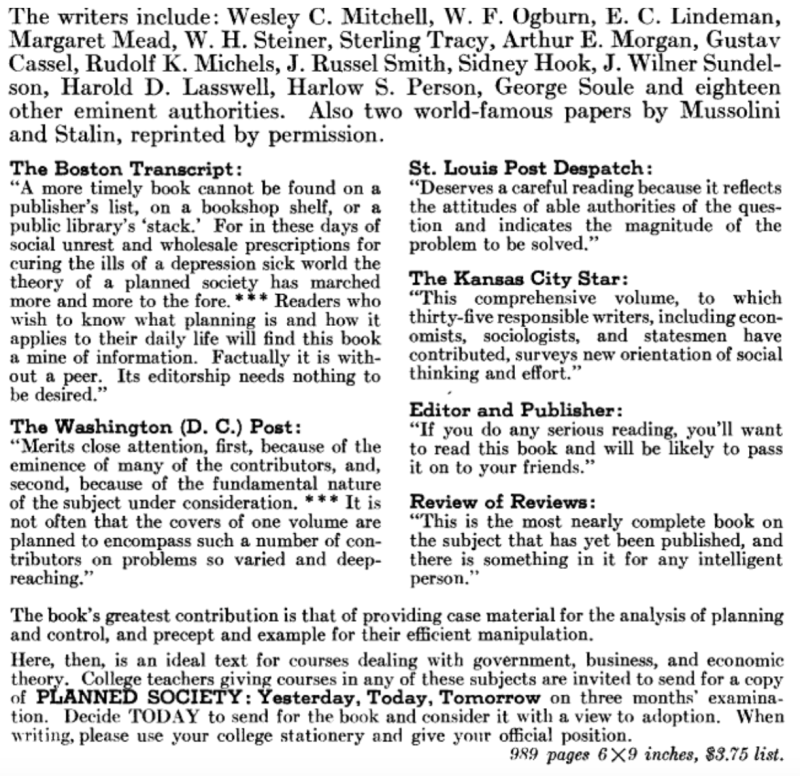
image 1

Everyone in the book was explaining how the future would be constructed by the finest minds who would manage whole economies and societies, the best and the brightest with full power.

All housing should be provided by government, for example, and food too, but with the cooperation of private corporations. That seems to be the consensus in the book. Fascism was treated as a legitimate path. Even the word “totalitarianism” was invoked without opprobrium but rather with respect.

The book has been memory-holed of course.

You’ll notice that the section on economics includes contributions by Benito Mussolini and Joseph Stalin. Yes, their ideas and political rule were part of the prevailing conversation. It’s in this essay, likely ghostwritten by Professor Giovanni Gentile, minister of public education, in which Mussolini offered this concise statement: “Fascism is more appropriately called corporatism, for it is the perfect merge of State and corporate power.”

image 2

All of this became rather embarrassing after the war so it was largely forgotten. But the affection many sectors of the U.S. ruling class had for fascism was still in place. It merely took on new names.

As a result, the lesson of the war, that the U.S. should stand for freedom above all else while wholly rejecting fascism as a system, was largely buried. And generations have been taught to regard fascism as nothing but a quirky and failed system of the past, leaving the word as an insult to fling at in any way deemed reactionary or old-fashioned, which makes no sense.

Below, I show you how fascism is really corporatism — and how it’s alive and well today. Read on.


Fascism Is Corporatism

By Jeffrey Tucker

There’s valuable literature on the topic and it bears reading. One book that is particularly insightful is the 1939 book The Vampire Economy, by Gunter Reimann, a financier in Germany who chronicled the dramatic changes to industrial structures under the Nazis.

In a few short years, from 1933–1939, a nation of enterprise and small shopkeepers was converted to a corporate-dominated machine that gutted the middle class and cartelized industry in preparation for war.

“The corruption in fascist countries arises inevitably from the reversal of the roles of the capitalist and the State as wielders of economic power,” wrote Reimann.

The Nazis weren’t hostile to business as a whole but only opposed traditional, independent, family-owned small businesses that offered nothing for purposes of nation-building and war planning.

The crucial tool to make this happen was establishing the Nazi Party as the central regulator of all enterprises. The large businesses had the resources to comply and the wherewithal to develop good relations with political masters whereas the undercapitalized small businesses were squeezed to the point of extinction.

“Most businessmen in a totalitarian economy feel safer if they have a protector in the State or Party bureaucracy,” Reimann writes. “They pay for their protection as did the helpless peasants of feudal days. It is inherent in the present lineup of forces, however, that the official is often sufficiently independent to take the money but fails to provide the protection.”

He wrote of:

The decline and ruin of the genuinely independent businessman, who was the master of his enterprise, and exercised his property rights. This type of capitalist is disappearing but another type is prospering.

He enriches himself through his Party ties; he himself is a Party member devoted to the Fuehrer, favored by the bureaucracy, entrenched because of family connections and political affiliations. In a number of cases, the wealth of these Party capitalists has been created through the Party’s exercise of naked power.

It is to the advantage of these capitalists to strengthen the Party which has strengthened them. Incidentally, it sometimes happens that they become so strong that they constitute a danger to the system, upon which they are liquidated or “purged.”

This was particularly true for independent publishers and distributors. Their gradual bankruptcy served to effectively nationalize all surviving media outlets who knew it was in their interests to echo Nazi Party priorities.

Reimann wrote: “The logical outcome of a fascist system is that all newspapers, news services, and magazines become more or less direct organs of the fascist party and State. They are governmental institutions over which individual capitalists have no control and very little influence except as they are loyal supporters or members of the all-powerful party.”

“Under fascism or any totalitarian regime an editor no longer can act independently,” wrote Reimann:

Opinions are dangerous. He must be willing to print any “news” issued by State propaganda agencies, even when he knows it to be completely at variance with the facts, and he must suppress real news which reflects upon the wisdom of the leader. His editorials can differ from another newspaper’s only insofar as he expresses the same idea in different language. He has no choice between truth and falsehood, for he is merely a State official for whom “truth” and “honesty” do not exist as a moral problem but are identical with the interests of the Party.”

A feature of the policy included aggressive price controls. They didn’t work to suppress inflation but they were politically useful in other ways. “Under such circumstances nearly every businessman necessarily becomes a potential criminal in the eyes of the Government,” wrote Reimann.

“There is scarcely a manufacturer or shopkeeper who, intentionally or unintentionally, has not violated one of the price decrees. This has the effect of lowering the authority of the State; on the other hand, it also makes the State authorities more feared, for no businessman knows when he may be severely penalized,” he wrote.

I can only highly recommend this book as a brilliant inside look at how enterprise functions under a fascist-style regime. The German case was fascism with a racialist and anti-Jewish twist for purposes of political purges.

In 1939, it was not entirely obvious how this would end in mass and targeted extermination on a gargantuan scale. The German system in those days bore much resemblance to the Italian case, which was fascism without the ambition of full ethnic cleansing. In that case, it bears examination as a model for how fascism can reveal itself in other contexts.

The best book I’ve seen on the Italian case is John T. Flynn’s 1944 classic As We Go Marching. Flynn was a widely respected journalist, historian and scholar in the 1930s who was largely forgotten after the war due to his political activities.

His book deconstructs the history of fascist ideology in Italy from a half-century prior and explains the centralizing ethos of the system, both in politics and economics.

Following an erudite examination of the main theorists, Flynn provides a beautiful summary. Fascism, Flynn writes, is a form of social organization:

    1. In which the government acknowledges no restraint upon its powers — totalitarianism.
    2. In which this unrestrained government is managed by a dictator — the leadership principle.
    3. In which the government is organized to operate the capitalist system and enable it to function under an immense bureaucracy.
    4. In which the economic society is organized on the syndicalist model; that is, by producing groups formed into craft and professional categories under supervision of the state.
    5. In which the government and the syndicalist organizations operate the capitalist society on the planned, autarchical principle.
    6. In which the government holds itself responsible for providing the nation with adequate purchasing power by public spending and borrowing.
    7. In which militarism is used as a conscious mechanism of government spending.
    8. In which imperialism is included as a policy inevitably flowing from militarism as well as other elements of fascism.

Each point bears longer commentary but let’s focus on No. 5 in particular, with its focus on syndicalist organizations. In those days, they were large corporations run with an emphasis on union organization of the workforce.

In our own times, these have been replaced by a managerial overclass in tech and pharma that have the ear of government and have developed close ties with the public sector, each depending on the other. Here’s where we get the essential bones and meat of why this system is called corporatist.

In today’s polarized political environment, the left continues to worry about unbridled capitalism while the right is forever on the lookout for the enemy of full-blown socialism. Each side has reduced fascistic corporatism to a historic problem on the level of witch burning, fully conquered but useful as a historical reference to form a contemporary insult against the other side.

As a result, and armed with partisan bete noires that bear no resemblance to any really existing threat, hardly anyone who’s politically engaged and active is fully aware that there’s nothing particularly new about what is called the Great Reset.

It’s a corporatist model — a combination of the worst of capitalism and socialism without limits — of privileging the elite at the expense of the many which is why these historic works by Reimann and Flynn seem so familiar to us today.

And yet, for some strange reason, the tactile reality of fascism in practice — not the insult but the historical system — is hardly known either in popular or academic culture. That makes it all the easier to reimplement such a system in our time.

Jeffrey Tucker is president of Brownstone Institute and senior economics columnist at Epoch Times.

https://dailyreckoning.com/the-machinery-of-fascism/

DHS: New asylum rule ‘intended to be a national security and public safety measure’

 The Biden administration officially unveiled its latest executive action on border security and immigration on Thursday, emphasizing the asylum rule’s focus on “national security and public safety.”

The proposed rule, which was widely reported a day ahead of its unveiling, would allow asylum officers to determine if an asylum-seeker presents a threat at an earlier stage in the process.

The first step in requesting asylum is a credible fear interview, where a migrant must declare a fear of persecution if they are repatriated — that’s when the new rule will allow officers to cross-check national security and criminal justice data to determine if an individual presents a threat.

Those revisions are currently conducted at a later stage in the process, a formal asylum interview that delves deeper into each migrant’s eligibility for protections.

“The proposed rule we have published today is yet another step in our ongoing efforts to ensure the safety of the American public by more quickly identifying and removing those individuals who present a security risk and have no legal basis to remain here,” Secretary of Homeland Security Alejandro Mayorkas said in a statement.

“We will continue to take action, but fundamentally it is only Congress that can fix what everyone agrees is a broken immigration system.”

The new rule will be formally introduced Monday, and will then go through a comments process.

Officials said the rule will apply to a limited number of migrants but did not specify a number or an estimate of how many people would be affected.

“I just want to note that while the population may be limited, they are the individuals that we are most concerned about from a public safety and national security lens,” a Department of Homeland Security (DHS) senior official told reporters on a call Thursday.

“I will say this is really intended to be a national security and public safety measure. And so it is intended to ensure that, again, the individuals that we are most concerned about that we encounter — people with serious criminal histories or links to terrorism — can be removed as early as possible in the process.”

The official said asylum officers conducting credible fear screenings would not see a significantly increased workload because of the rule.

“What this rule will do is allow them, when we have clear information that obviously disqualifies someone from asylum or withholding of removal because they are a threat to national security or public safety, to consider that information as early in the process as possible,” they said.

In parallel to the new rule, DHS will update its policy on the use of classified information in immigration proceedings, presumably to better screen for national security threats.

The rule comes amid heightened rhetoric from Republicans on alleged threats presented by foreign nationals both in the national security and public safety space.

No one in the United States has ever been killed in a terrorist act committed by someone who illegally crossed the U.S.-Mexico border, and multiple studies have found lower crime rates among immigrants than among native-born U.S. citizens.

Officials did not address whether prospective asylum-seekers tagged as potential threats by immigration officers would have any legal recourse to contest that determination.

“The rule is particularly dangerous for people who are fleeing persecution that can itself involve arrest or baseless allegations by their government. The asylum officer under this rule can quickly deport them without any opportunity to explain that the arrest was in fact part of the persecution they fled,” said Heidi Altman, the director of policy at the National Immigrant Justice Center.

People in immigration proceedings are not entitled to legal counsel, but they may obtain representation. According to the Transactional Records Access Clearinghouse, a government data tracker housed at Syracuse University, only about 30 percent of immigrants in proceedings had legal representation as of December.

DHS officials did not immediately respond to a question on whether due process safeguards were included in the rule.

https://thehill.com/latino/4654773-dhs-new-asylum-rule-border-security-immigration/

Petition calls on DOJ to investigate deaths of Boeing whistleblowers

 More than 25,000 people have signed a petition calling on the Department of Justice (DOJ) to investigate the recent deaths of two Boeing whistleblowers as the company remains under intense scrutiny. 

The petition, organized by the progressive advocacy group MoveOn, urges the DOJ to investigate the deaths of John Barnett and Joshua Dean. 

Barnett, a 32-year veteran of Boeing who blew the whistle on safety and quality control concerns in the company’s production line, was found dead in an apparent suicide in March.  

Dean, a former quality auditor at Boeing supplier Spirit AeroSystems, died last week after contracting a bacterial infection, according to The Seattle Times. He had accused the company’s leadership of ignoring manufacturing defects with the 737 Max. 

“The dangerous trend of Boeing aircraft accidents is extremely alarming, and it’s time the Department of Justice investigate these tragic whistleblower deaths and the mounting allegations from employees that Boeing has sought to silence those that spoke out over safety concerns,” MoveOn spokesperson Britt Jacovich said in a statement. 

Another Boeing whistleblower who testified before a Senate committee last month accused the company of retaliating against him for raising concerns about gaps in the manufacturing process. 

A quality engineer at Boeing, Sam Salehpour said he was silenced and threatened after he raised concerns that portions of the fuselage of the 787 Dreamliner were improperly fused together. 

Santiago Paredes, a former quality inspector at Spirit AeroSystems, also came forward with new allegations against the Boeing supplier on Wednesday, saying he was pressured to hide defects found in airline parts. 

Paredes said he was demoted after complaining that management had changed the defect protocol to encourage fewer reports. He was eventually reinstated to a leadership role after filing a complaint. 

“I felt I was being threatened, and I felt I was being retaliated against for raising concerns,” he said. 

The increased scrutiny on the company comes in the wake of a midair blowout on a Boeing 737 Max 9 aircraft in early January. The plane’s door plug blew off shortly after takeoff, leaving a gaping hole in the side of the aircraft and forcing the plane to make an emergency landing.

https://thehill.com/business/4654691-petition-calls-on-doj-to-investigate-deaths-of-boeing-whistleblowers/

1 in 8 adults has taken Ozempic or other GLP-1 drug: Survey

 A poll from the health policy nonprofit KFF found that 1 in 8 adults say they’ve taken a GLP-1 agonist, the obesity and diabetes medications that include Ozempic, Mounjaro and Zepbound.

Among those surveyed, 12 percent said they had used a GLP-1 agonist, with 6 percent saying they’re currently using one. The majority — 62 percent — of them said they were using the drugs to treat a chronic condition such as diabetes or heart disease, while the remaining 38 percent they took the medications just to lose weight.

Of the participants with diabetes, 4 out of 10 said they had used a GLP-1 agonist.

GLP-1 agonists are indicated for treating people who have diabetes, obesity or are at risk of cardiovascular disease related incidents. The drugs’ off-label use for cosmetic weight loss has sparked widespread interest.

Awareness of these drugs seemed to be relatively high, with a third saying they’d heard “a lot” about the medications and 27 percent saying they’d heard “some.” Older, wealthier adults and those with chronic illnesses were more likely to have heard something about GLP-1 agonists.

About 80 percent said they got a GLP-1 agonist through their primary care provider or a specialist. Another 23 percent said they got the drugs from either an online provider, a medical spa or “somewhere else.”

Several GLP-1 agonists — including Ozempic, Mounjaro and Trulicity — are currently in shortage, with the Food and Drug Administration reporting the reason as an increase in demand.

Survey participants were also asked whether they believed Medicare should cover GLP-1 agonists. The federal health care program is barred from covering weight loss medications, though the recent approval of the weight loss drug Wegovy for cardiovascular disease now means Medicare beneficiaries can access the drug.

A previous KFF analysis indicated that as many as 1 in 4 beneficiaries who have obesity could get Weogvy following its expanded approval.

In total, 61 percent said Medicare should cover GLP-1 agonists to treat obesity. Their opinions remained effectively unchanged after being told the arguments Medicare against covering obesity medications, such as the possibility that premiums could go up or that the coverage would place financial strain on the government program.

The KFF survey was conducted between April 23 and May 1 among a sample of 1,479 U.S. adults

https://thehill.com/homenews/4656282-1-in-8-adults-has-taken-ozempic-or-other-glp-1-drug-survey/

Ascension 2nd major hospital chain hit by cyberattack


Bluebird Boasts Nearly 140% Revenue Jump, Still Misses Target

 Bluebird bio released its first-quarter 2024 business report on Thursday, touting a nearly 140% year-over-year increase in revenue amid the growing uptake of its three gene therapies.

The Massachusetts-based biotech revealed that it has so far initiated 15 patients on its gene therapies, one of whom started the recently approved sickle cell disease (SCD) treatment Lyfgenia just this month. The remaining 14 patients are receiving either Zynteglo, for pediatric beta-thalassemia, or Skysona, which is intended for cerebral adrenoleukodystrophy in boys.

Bluebird has also assembled a large footprint of qualified treatment centers (QTCs) to help it deliver its gene therapies to patients, according to the press release. The company has activated 64 QTCs for Lyfgenia and Zynteglo and has enlisted six centers to administer Skysona.

CEO Andrew Obenshain in a statement called bluebird’s QTC network “unparalleled,” forming a “solid commercial gene therapy foundation” for its products, alongside the company’s patient access and reimbursement schemes.

“Following the completion of the first LYFGENIA patient start earlier this month, and with the continued momentum behind our ongoing launches, we believe we are poised for accelerated growth through the remainder of 2024,” Obenshain said. Bluebird expects to start cell collections for 85 to 105 new patients across all three of its gene therapy products this year, according to its report.

In the first quarter of 2024, bluebird reported a net revenue of $18.6 million, up from $2.4 million during the same period in 2023. Though bluebird saw a 138% increase in revenue, William Blair analyst Sami Corwin said the biotech nevertheless missed the firm’s forecast of $29 million. Bluebird also fell below the consensus estimate of $21 million.

The biotech could see notable growth this year, particularly as it ramps up its commercialization activities for Lyfgenia. Bluebird expects to reflect revenue from its first Lyfgenia infusion in the third quarter of 2024, according to its Thursday news release.

However, Corwin anticipates that Lyfgenia will face stiff competition from CRISPR Therapeutics and Vertex Pharmaceuticals’ Casgevy, which the analyst predicts will be a “headwind” for bluebird. In March 2024, Corwin told BioSpace that despite a slower initial roll-out—Vertex and CRISPR has so far activated 12 centers, versus bluebird’s 64—Casgevy will still likely emerge the ultimate victor in the SCD gene therapy space.

One key advantage for Casgevy is its price. Bluebird gave Lyfgenia a wholesale acquisition cost of $3.1 million, nearly $1 million more than Casgevy’s $2.2 million. The biotech has since signed at least two coverage deals and a loan to support its gene therapy, though the slow uptake could end up disrupting these agreements, according to William Blair.

“Given only one patient has started the cell collection process for Lyfgenia, we remain cautious as to if the company will be able to achieve enough Lyfgenia patient starts to meet the stipulations of its next term loan tranches,” the analyst note read.

https://www.biospace.com/article/bluebird-boasts-140-percent-revenue-jump-but-still-misses-target-/

RFK Jr. Explains Why His Voice Sounds Hoarse

 Independent presidential candidate Robert F. Kennedy Jr., dropped a 30-minute campaign video

opens in a new tab or window on social media last week explaining why his voice sounds creaky and strained.

He says he has spasmodic dysphonia, a rare neurological disorder that impacts the voice.

Spasmodic dysphonia can also be called laryngeal dystonia. A dystonia is an involuntary contraction of muscle, Seth Kaplan, MD, director of Northwell Health's Center for Voice and Swallowing Disorders in Manhattan, told MedPage Today.

While the exact cause of the disorder is unknown, it could be due to abnormal functioning in the brain's basal ganglia, which helps coordinate the movement of muscles, Kaplan said. While generally thought to be idiopathic, in rare instances spasmodic dysphonia has occurred after surgery or trauma, he added.

The disorder often starts with vocal hoarseness, he said. "But it is a kind of interesting presentation of hoarseness -- a kind of a staccato way of speaking, like with very pointed syllables -- and it's often because they're having difficulty controlling the way that they're speaking and it comes off as a strained and strangled sound."

Some patients face a lag in diagnosis when misdiagnosed with more common conditions, like essential or vocal tremor, Kaplan said.

Margaret Huston, MD, division chief of laryngology at Washington University in St. Louis, told MedPage Today that patients with spasmodic dysphonia have said speaking feels "tight" and "effortful." But the ways in which it sounds depends on the type of spasmodic dysphonia.

Adductor spasmodic dysphonia is the most common and the voice breaks when the vocal cords vibrate against each other. On the other hand, with abductor spasmodic dysphonia, the voice breaks on the voiceless sounds. It's possible to have both types, which is called mixed spasmodic dysphonia, she said.

Spasmodic dysphonia mostly develops when a patient is in their 30s or 40s and is more prevalent in women. Kennedy, now age 70, didn't develop the disorder until he was in his 40s, according to an interview with News Nation from last yearopens in a new tab or window. There is no known cure, but there are treatments.

"Right now, Botox is the gold standard of treatment," Huston said. Depending on the type of spasmodic dysphonia, onabotulinum toxin A (Botox) injections target different muscles. For adductor, the thyroarytenoid or vocalis muscles are targeted, and for abductor, the posterior cricoarytenoid muscle. Because the muscle-weakening effects of Botox injections wear off, injections are needed every 3 months. The dose varies, depending on the patient, with some only needing 0.5 units, though most get 1.5 to 2.5 units, she said.

And getting the right dose is crucial; too big a dose and a person may end up with what Huston described as a "Minnie Mouse" or "falsetto voice" for a week or more, and alarmingly, may have trouble speaking or swallowing for weeks at a time. With the correct dose, the high-pitched voice may still occur and patients may have to avoid thin liquids for a week, but the patient will have more ease speaking. Kaplan added that voice therapy and working with a speech pathologist can also help.

Newer treatments are also being explored, notably sodium oxybateopens in a new tab or window (Xyrem), which is mostly used to treat narcolepsy. For some people with spasmodic dysphonia, the symptoms relax with alcohol consumption. A 2017 study in Laryngoscopeopens in a new tab or window found that among this population, "sodium oxybate reduced voice symptoms in 82.2% of alcohol-responsive [spasmodic dysphonia] patients both with and without co-occurring [voice tremor]." Another small trial from 2020 published in Stereotactic and Functional Neurosurgery explored deep brain stimulationopens in a new tab or window as treatment for spasmodic dysphonia.

In the same News Nation interview, Kennedy said he saw Andrew Blitzer, MD, the pioneering researcher who first discovered Botox as a spasmodic dysphonia treatment. Kennedy also said he went to Kyoto, Japan for a "novel surgery" that improved his condition. The Kyoto ENT Surgicenteropens in a new tab or window describes a procedure on their website that smooths "airflow by making the glottal gap wider during phonation." In the U.S., various other surgical techniques have been explored, such as recurrent laryngeal nerve deneration/reinnervationopens in a new tab or window, though Botox remains first-line treatment.

Huston said that while not necessarily dangerous, "voice disorders can be incredibly isolating to patients." Hence, "by sending them on to a voice specialist and having them evaluated, we can really make an improvement in patients' quality of life if we can improve their voice."

Even Kennedy himself said in the News Nation interview: "I cannot listen to myself on TV... so I feel bad about you guys having to listen to me."

https://www.medpagetoday.com/popmedicine/cultureclinic/110058