Search This Blog

Saturday, May 11, 2024

Insane Flip-Flops Over Vaccines, Masks And Ivermectin

 This week AstraZeneca recalled its COVID-19 vaccine after admitting that it caused a 'rare but serious' clotting.

Then we find that former CNN host Chris Cuomo has been taking Ivermectin, after mocking people for taking 'dewoming medication,' leading one to wonder how many dead Americans were dissuaded from taking it during the pandemic.

And in the fullness of time, we've learned that vaccine maker Moderna employed a former FBI analyst to secretly police 'vaccine misinformation,' while the Biden White House directed virtually every social media platform to censor those questioning vaccinations. Hell, the NY Times suggested ZeroHedge was spreading misinformation for suggesting, in December of 2020, that vaccine cards would be used to track people and limit their freedom.

And now people like former NY Governor Andrew Cuomo (D) are playing the whole thing off like he wasn't a complete iron-fisted authoritarian during the pandemic - suggesting that masks were optional.

Or Deborah Birx, who admitted she and Dr. Anthony Fauci pulled all sorts of pandemic-era lockdown protocols out of their assesand has now remade herself into some sort of vaccine freedom advocate.

And so, while there are a plethora of examples out there - and these barely scratch the surface, it's worth watching a montage of authoritarians and their propagandists in the corporate media peddling lockdown hysteria, only to flip-flop with nary a mea culpa (Chris Cuomo blames 'bad information' - not his fault!).

Watch:

These people...

https://www.zerohedge.com/medical/watch-insane-180s-over-vaccines-masks-and-ivermectin

Long-Awaited State Dept Review 'Absolves' Israel Of War Crimes

 Via The Cradle

A US State Department report on Israel’s conduct in the Gaza Strip will be submitted to Congress on Friday and stop short of concluding Tel Aviv has "violated terms for the use of US weapons," according to US officials who spoke with Axios

The report, based on a months-long probe that assessed whether or not Israel has violated international law or stifled Gaza aid efforts, has triggered "contentious internal debate in the State Department."

President Joe Biden agreed in February to issue a national security memorandum to examine the use of US weaponry by Israel in Gaza. The report set out to examine the use of weapons by Israel and six other states, according to Axios

US Secretary of State Anthony Blinken has been pressured by the US ambassador to Israel, Jack Lew, and the outgoing US humanitarian envoy to Gaza, David Satterfield, to conclude that Israel is not hindering aid efforts, despite recommendations to do so by USAID and the Bureau of Democracy, Human Rights, and Labor. 

The two told Blinken in a memo that while Israel restricted aid in the past, it has since changed its policy after pressure from Biden. "Blinken's report is going to list a series of incidents that took place during the war in Gaza and note that they raised serious concerns about violations of international law by Israel," three US officials told Axios

They added that the report will be "very critical" and state that the State Department is still investigating specific incidents; however, "at the same time, Blinken will stop short of concluding that Israel has violated international law in the context of the national security memorandum."

"Blinken's report also adopted the conclusions of Lew and Satterfield and certifies that Israel isn't currently violating the national security memorandum when it comes to facilitating the delivery of US-supported humanitarian aid," another official confirmed. 

Some Republican lawmakers have criticized the national security memorandum and the upcoming report. Last week, 88 Democratic lawmakers wrote to Biden saying there is "sufficient evidence" of Israeli restriction of aid into Gaza. 

Politico reported earlier this week that the release of the State Department report was delayed by several days at the last minute. Friday's report comes a day after Biden warned that his government would not support or provide weapons for an expanded Israeli assault on Gaza’s southernmost city of Rafah

Back in November, there was a scathing 5-page 'dissent memo' circulated in the State Dept:

Israel seized control of the Rafah border crossing on Tuesday morning and has been relentlessly bombarding the east of the city, killing dozens of civilians, including children. 

A US arms shipment to Israel has already been delayed over concerns about Rafah. Had the report corroborated the overwhelming evidence of Israeli war crimes and hampering humanitarian aid efforts, US military aid for Tel Aviv was at risk of drying up. As a result, supporters of Israel in Washington have pressured the State Department against such a conclusion

https://www.zerohedge.com/geopolitical/long-awaited-state-dept-review-absolves-israel-war-crimes

US Power Grid & Communication Networks Survive Extreme Geomagnetic Storm

 The Space Weather Prediction Center of NOAA warned on Friday night about an "extreme" G5 geomagnetic storm impacting Earth, which lasted into the early morning hours. While there have been disruptions in communications, no significant failures in the US power grid have been reported. Intense solar storms can disrupt the digital economy

G5 represents the highest level of a geomagnetic storm on a scale from G1 to G5. This intense space weather event led to disturbances in some satellite orientation and operations, as well as deterioration in radio communications that rely on ionospheric transmission. Additionally, there were some outages in GPS networks. 

"The solar storm has knocked out almost all long-distance shortwave radio," Captain John Konrad, CEO of Captain, wrote on X. 

Yet, no significant impacts on the power grid have been reported. 

Elon Musk reported hours ago, "Major geomagnetic solar storm happening right now. Biggest in a long time. Starlink satellites are under a lot of pressure, but holding up so far." 

The last G5 storm to hit Earth this strong was in October 2003, which sparked power outages across Sweden and damaged transformers in South Africa. Since then, the economy's digitalization has dramatically increased, which means there's an increasing risk of grid failures and disruptions in communication networks. 

We've outlined this in space weather notes over the years: 

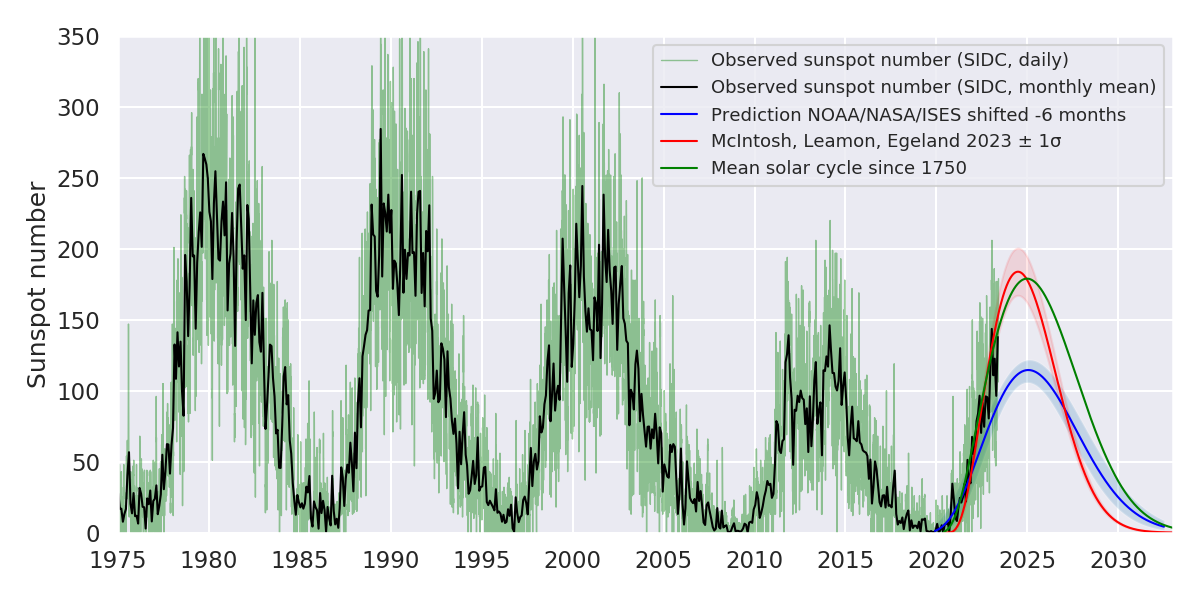
Last year, we pointed out that the current solar cycle (Solar Cycle 25) is expected to peak sometime in 2025. 

This means the solar maximum is nearing or has already arrived. 

Even the federal government has started to prepare the nation for a space weather event with the 2016 executive order signed by the Obama administration titled "Coordinating Efforts to Prepare the Nation for Space Weather Events."  

Two decades ago, the Federal Reserve Bank of Atlanta wrote a paper titled "Playing the Field: Geomagnetic Storms and the Stock Market," outlining that "people affected by geomagnetic storms may be more inclined to sell stocks." However, stocks are mostly traded by algos in today's market... 

Northern lights were reported across the country last night by X users:

The most powerful solar storm to rock Earth in recorded history, the Carrington Event, occurred in September 1859. It sparked fires in telegraph systems across Europe and North America. 

https://www.zerohedge.com/weather/us-power-grid-communication-networks-survive-extreme-geomagnetic-storm

Friday, May 10, 2024

Biden to put tariffs on China medical supplies - sources

 The Biden administration is expected to issue new tariffs on Chinese-made medical devices like syringes and personal protective equipment when it unveils its new trade strategy next week, according to two sources familiar with the decision.

The expected moves are part of the administration's broader strategy to protect the U.S. against supply shortages seen during the COVID pandemic that left hospitals scrambling to find critical equipment, the sources said.

President Joe Biden is set to announce new China tariffs as soon as next week targeting strategic sectors including electric vehicles, solar panels and steel. The size and the scale of the tariffs on medical equipment is unclear.

The White House declined to comment.

For years, China’s leaders have worried that the country depended too much on foreign sources for everything from medical supplies to microchips and used subsidies, economic targets and other government inducements to emerge as a powerhouse in those important industries.

The COVID pandemic exposed a lack of U.S. production of critical medical equipment from gowns and masks to ventilators and the U.S. turned to China for help to fill the gap.

Imports of syringes from China peaked at $348 million in 2021, but have declined since to about $167 million last year, according to U.S. Census Bureau data.

https://finance.yahoo.com/news/exclusive-biden-put-tariffs-china-154212301.html

School board in Virginia votes to restore Confederate names

 The education board for a rural Virginia county voted early on Friday to restore the names of Confederate generals stripped from two schools in 2020, making the mostly white, Republican district the first in the U.S. to take such an action.

By a 5-1 vote, the Shenandoah County board overturned its 2020 decision that stripped a public high school and elementary school of their original names honoring three military leaders of the pro-slavery South in the Civil War.

Under the board's action, Mountain View High School will again become known as Stonewall Jackson High, while Honey Run Elementary School will revert to the name Ashby Lee Elementary.

The names belong to some of the most well-known military leaders of the Confederacy. Robert E. Lee was commander of the Army of Northern Virginia; Thomas Jonathan "Stonewall" Jackson was a Confederate infantry general, and Turner Ashby was a rebel cavalry commander. All of them were Virginians.

Any funds required to implement the changes must come exclusively from private sources, rather than public revenue.

The vote contrasted with a four-year trend of U.S. schools and other public buildings and institutions removing names and symbols associated with the Confederacy, following protests for racial justice sparked by the murder of George Floyd by Minneapolis police in 2020.

Among more than 60 schools that have abolished Confederate appellations across the country since 2020, none had reversed course until now, according to the trade publication Education Week, which has tracked the issue.

Still, the issue has remained a point of contention for many political conservatives, particularly among Southern white people, who see Confederate monuments and place names as honoring the South's traditions and history.

Such was the argument posed by some local citizens who spoke at Thursday night's meeting in favor of restoring the Confederate school names.

Speakers on the other side countered that such symbols and memorials are vestiges of a racist ideology that has perpetuated a sanitized "Lost Cause" myth of the Confederacy as well as the Jim Crow era of racial segregation and discrimination that followed the Civil War.

Many of them noted that Stonewall Jackson High was named in 1959 when it allowed only white people to attend and when Virginia political leaders were still resisting racial integration as ordered by the U.S. Supreme Court under the landmark Brown v. Board of Education ruling.

Thursday's school board debate played out in the seat of Shenandoah County, an overwhelmingly white, heavily Republican jurisdiction in the Shenandoah Valley about 150 miles (240 km) northwest Richmond, Virginia, the Confederate capital. Black people make up fewer than 3% of the county's population, according to 2020 Census figures.

The proposal voted on was initiated by a local conservative group, the Coalition for Better Schools, which cited the "cultural significance" and "historical context" of the original names.

In its written request to the board, the group also cited surveys that it mailed to residents of the districts from which the schools' students are drawn. It said that out of 1,160 responses to 8,507 surveys sent, more than 90% favored switching back to the Confederate names.

Sarah Kohrs, who graduated from both schools, is co-leader of an opposing citizens group that gathered 687 signatures on an online petition to keep the current names. Her oldest child attends the high school, and she expects to enroll a younger child there as well.

After Friday's vote, Kohrs said her group deplored the decision to "regress and 'honor' Civil War figures that consciously betrayed the United States and were proponents of slavery and segregation," and vowed to work even harder to promote public understanding of "complete history, good and bad."

"This decision seems more about vengeance, control, and hatred than heritage or due process," she said.

Kohrs said the political makeup of the school board has grown more conservative over the past four years.

Kyle Gutshall, the board's vice chairman, said the 2020 name change had increased public attention on the board and helped shift its political composition to the right.

He voted to reinstate the Confederate names when a similar motion came up in 2022, primarily because he felt the 2020 decision was made without sufficient public input. The 2022 motion failed due to a tied vote.

Gutshall cast the lone "no" vote on Friday, after previously telling Reuters there was overwhelming support in his part of the county to keep the current names.

https://www.yahoo.com/news/education-board-virginia-votes-restore-115002150.html

Maze gets new Pompe partner in Shionogi after FTC blocks Sanofi deal

 Five months after Sanofi backed away from a proposed deal with Maze Therapeutics on a Pompe disease therapy after an antitrust challenge, Shionogi has snapped up the drug.

The Japanese pharma group has licensed Maze’s MZE001 for an upfront fee of $150 million and additional undisclosed milestone payments, adding to its pipeline of rare disease therapies.

Sanofi also said it was prepared to stump up $150 million upfront in its deal, first disclosed a year ago, with another $600 million at the back end. A few months later, however, the US Federal Trade Commission launched a lawsuit seeking to block the deal and the drugmaker abandoned its attempt.

The FTC was concerned about Sanofi’s strong position in Pompe disease with drugs like Nexviazyme/Nexviadyme (avalglucosidase alfa) and Myozyme/Lumizyme (alglucosidase alfa), which together generated $1.21 billion in sales last year.

That gave Shionogi the chance to get its hands on MZE001, which is vying to become the first oral therapy for Pompe disease, a glycogen storage disorder caused by a deficiency in the enzyme acid alfa glucosidase (GAA) that results in progressive weakness in the heart and skeletal muscles.

Current therapies are based on recombinant forms of the missing enzyme and have to be administered by intravenous infusion.

Glycogen synthase 1 (GYS1) inhibitor MZE001 works differently, inhibiting the formation of glycogen, which has to be broken down in the body by GAA to prevent toxic effects. According to Maze, that provides a more complete blockade of glycogen accumulation that should translate to improved efficacy.

The company has completed a phase 1 trial of the drug and has said the results suggest it has the potential to be used both as a monotherapy option and as an add-on therapy with enzyme replacement therapies.

“Shionogi is committed to advancing and commercializing MZE001 because they understand the potential this therapy has for patients and the unmet medical needs it could address,” said Jason Coloma, Maze’s chief executive.

“Shionogi has a track record of developing and delivering innovative medicines to patients worldwide, and we’re confident they are the right partner to continue to advance MZE001 through clinical trials so that it may reach patients with this life-threatening condition as soon as possible.”

https://pharmaphorum.com/news/maze-gets-new-pompe-partner-after-ftc-blocks-sanofi-deal

'US review of Israel’s war conduct raises ‘serious concerns’'

 The U.S. has concluded it was “reasonable to assess” Israel has violated international humanitarian law in its war conduct in Gaza, but stopped short of a determinative finding of wrongdoing because the review did not find specific instances of violations. 

A highly anticipated report from the State Department, released Friday, that looked into whether Israel violated international humanitarian law, described “sufficient reported incidents to raise serious concerns” about how Israeli forces have carried out the war against Palestinian militant group Hamas in Gaza.

The report notes that 34,700 Palestinians have been killed amid the war according to the Hamas-run Gaza Health Ministry. While the United Nations and aid groups say the majority of those killed are women and children, Israel claims that half of those numbers are Hamas fighters. The U.S. government said it could not independently verify the figures. 

“Given Israel’s significant reliance on U.S.-made defense articles, it is reasonable to assess that defense articles covered under [the national security memorandum] have been used by Israeli security forces since October 7 in instances inconsistent with its [international humanitarian law] obligations or with established best practices for mitigating civilian harm,” officials wrote in the report.

Still, U.S. officials acknowledged it was “difficult to assess or reach conclusive findings on individual incidents,” which appeared to prevent language for a definitive finding that Israel has violated any laws in the report. 

The report drew on assessments from multiple U.S. agencies, including bureaus in the State Department, Department of Defense and the Intelligence Community. The intelligence findings further raise concern about Israel’s war conduct, saying that Israel’s security forces “have inflicted harm on civilians in military or security operations, potentially using U.S.-provided equipment.”

While the IC assessment said that there’s no indication Israel directly targeted civilians, it “assesses that Israel could do more to avoid civilian harm, however.”

The State Department said it was difficult to reach conclusive findings on individual incidents because of the lack of personnel on the ground in Gaza. Officials also said Israel has not shared complete information to verify whether U.S. weapons have been used in violation of international humanitarian law in Gaza, the West Bank or East Jerusalem. 

The report comes after Biden has paused a delivery of heavy bombs to Israel and vowed to hold more offensive weapons if Israeli forces launch a major operation in Rafah, where more than a million Palestinians are sheltering.

The reports publication on Friday drew intense backlash from Sen. Chris Van Hollen (D-Md.), a senior member of the Senate Foreign Relations Committee, and who had spearheaded the effort to get the Biden administration to more closely scrutinize Israel’s war actions. 

“If this conduct complies with international standards, God help us all,” Van Hollen said in a call with reporters shortly after the State Department transmitted its report to Congress.

“Because that would set a very low bar for what is allowed, it would set a very low bar for the rules of war, it would set a very low bar what’s required to facilitate the delivery of humanitarian assistance.”

The State Department review was ordered by Biden back in February to conduct an assessment of whether Israel has violated international humanitarian law or U.S. law with American-provided weapons. 

The review also looked at whether Israel has impeded the delivery of humanitarian aid shipments.

The reports authors provided specific instances of attacks on humanitarian aid deliveries, sheltering Palestinians, and Israeli actions that “delayed or had a negative effect on the delivery of aid to Gaza.”

Still, the report authors say that it does not assess Israel to be “prohibiting or otherwise restricting the transport or delivery of U.S. humanitarian assistance.”

Biden’s pause on the heavy bombs, his criticism of Israel’s military campaign and his threat to withhold more weapons in the event of a Rafah invasion comes amid sweeping college protests and frustration with the war from some Democrats and his left flank.

But the president’s shift in tone on the war has angered Republicans. After the release of the State Department memo, Sen. Jim Risch (R-Idaho) piled onto the criticism, arguing that Biden is “trying to have it both ways” in the war.

“Today, the administration has given Israel a politically damaging assessment while publicly announcing it is withholding a select set of precision weapons,” Risch said in a Friday statement. “The administration is attempting to placate voters on the far left at the expense of a close ally in the midst of its justified war with Hamas terrorists.”

Sen. Ben Cardin (D-Md.), chair of the Senate Foreign Relations Committee, said it was critical to ensure Israel can continue fighting against Hamas but also added that “any operation must take all measures to protect civilian lives.”

“While the most recent report regarding Israel under the [review] has raised concerns, I agree with its assessment that Israel has not violated International Humanitarian Law and that military assistance to support Israel’s security remains in the U.S. interest and should continue,” he said in a statement. “In this regard, I differ with President Biden’s recent decision” to withhold bomb shipments.

The review of humanitarian assistance remains an ongoing assessment.

The United Nations and humanitarian aid groups have accused Israel of slowing the delivery of aid shipments into Gaza, which is facing a severe hunger crisis and a famine in the northern part of the territory. Israel now controls all three major checkpoints that facilitate aid into the strip. 

In the report, officials also noted that Israel has repeatedly struck humanitarian aid workers, including seven workers from the charity World Central Kitchen (WCK) in April, despite attempts to avoid those casualties. More than 250 aid workers have died in Gaza.

The State Department review also found credible reports of “Israeli airstrikes impacting civilians and civilian objects unrelated to humanitarian operations that have raised questions about Israel’s compliance with its legal obligations.”

Israel has divided Gaza up into 300 different zones to better assess the level of civilians in each area, but the State Department memo questioned the efficacy of the system. It also raised concerns about the adequacy of Irael’s other methods to prevent civilian casualties, including weapon selection for certain strikes or attacks, advanced warnings and target determination.

“While Israel has the knowledge, experience, and tools to implement best practices for mitigating civilian harm in its military operations,” the report says, “the results on the ground, including high levels of civilian casualties, raise substantial questions as to whether [Israel] is using them effectively in all cases.”

The White House said earlier Friday that Biden was briefed on a the report scrutinizing Israel’s conduct in its war against Hamas in the Gaza Strip, but would not indicate if it influenced his decision to hold back the transfer of thousands of heavy bombs earlier this week. 

The State Department transmitted the report to Congress on Friday.

“The president has been briefed and is obviously aware of the contents,” White House national security communications adviser John Kirby told reporters Friday. “I am just not going to get into the specifics of when he was briefed and how that transpired, but he’s fully briefed on it.” 

The report was mandated by National Security Memorandum 20, which Biden issued in February under pressure from congressional Democrats to scrutinize Israel’s use of U.S. weapons in its war against Hamas.

The report was due to Congress on Wednesday.

Biden, earlier in the week, paused the transfer of more than 3,000 heavy bombs to Israel. And the president warned in an interview with CNN — broadcast Wednesday — that the U.S. could hold back more arms transfers if Israel launched a major offensive into Rafah, the southern Gazan city believed to be the last holdout for Hamas but sheltering more than 1 million displaced Palestinians. 

Kirby said the White House is closely watching Israel’s military operations in Rafah, and that includes a seizure of a crossing with Egypt. 

“I wouldn’t go so far as to say what we’ve seen in the last 24 hours connotes or indicates a broad, large-scale invasion or major ground operation. It appears to be localized near the crossing,” Kirby said, but added that the White House is watching “with concern.”

Kirby called for Israel to reopen the Rafah crossing for humanitarian assistance deliveries into the strip. 

“Every day that that crossing is not available and usable for humanitarian assistance, there’s going to be more suffering and that’s of deep concern to us. And so once again, we urge the Israelis to open up that crossing to humanitarian assistance immediately,” he said. “That aid is desperately needed, and we urge them, as we have in the past, to be as careful, precise and discriminate as they can here so that they are not putting innocent lives at greater risk than they already are. But we’re watching this very closely.” 

Israel launched its war against Hamas following its Oct. 7 attack on Israel, killing 1,200 people and taking more than 250 hostage, with approximately 133 still held in the strip.

Biden has supported Israel’s determination to defeat Hamas, but has grown increasingly frustrated with Israeli Prime Minister Benjamin Netanyahu’s prosecution of the war/ The president has come under pressure from Democrats and protests across the U.S. decrying a staggering Palestinian civilian death toll and an appalling humanitarian crisis. 

Efforts to secure a deal between Hamas and Israel to secure the release of hostages and implement a six-week cease-fire fizzled out this week amid discussions in Cairo. 

https://thehill.com/homenews/administration/4657003-biden-us-review-israel-war-conduct/