Search This Blog

Saturday, January 18, 2025

'New York commits $188M to new Queens cancer center'

 The state of New York will provide up to $188 million to help establish a new comprehensive cancer center in the Queens borough of New York City.

The Comprehensive Cancer Program of Queens will be built through a partnership between Memorial Sloan Kettering Cancer Center and Jamaica Hospital Medical Center, both based in New York City, according to a Jan. 17 news release from Gov. Kathy Hochul's office.

The funding will support the addition of radiation and infusion therapy services at Jamaica Hospital, the release said.


https://www.beckershospitalreview.com/oncology/new-york-commits-188m-to-new-cancer-center.html

'New York to invest up to $188M in safety-net hospitals'

 New York Gov. Kathy Hochul has given preliminary approval for investments in seven hospital and healthcare partnerships through the state's Healthcare Safety Net Transformation Program.

Three notes:

1. The program incentivizes partnerships with healthcare organizations to improve resilience of safety-net hospitals through capital investments, operational support and regulatory flexibility, according to a Jan. 17 news release from Ms. Hochul's office.

2. Up to $188 million will support a partnership with Jamaica Hospital Medical Center and Memorial Sloan Kettering Cancer Center, both in New York City. The initiative is designed to establish a "Comprehensive Cancer Program of Queens," including a new radiation and infusion therapy campus at Jamaica Hospital.

3. The six other preliminarily approved projects are:

  • Glens Falls Hospital and Albany Med Health System will modernize the hospital's emergency department and integrate Glens Falls into Albany Med's electronic medical record system.

  • Olean General Hospital and Springfield-based Bertrand Chaffee Hospital will receive infrastructure upgrades in partnership with Buffalo-based Kaleida Health.

  • St. Barnabas Hospital will receive emergency department upgrades and reduce unnecessary admissions and readmissions through a partnership with Cityblock Health and Union Community Health Center, all in New York City.

  • Westchester Community Health Center in Mount Vernon will partner with Montefiore New Rochelle Hospital to strengthen its maternal child health program.

  • UVM Champlain Valley Physicians Hospital in Elizabethtown will partner with Champlain Valley Family Center in Plattsburgh to improve quality and access to behavioral healthcare.

  • Mary Imogene Bassett Hospital in Cooperstown will create two partnerships, one with a specialty pharmacy and another with an ambulance service to enhance care delivery.

HHS $800M+ vaccine investment aims to boost pandemic readiness

 HHS is investing more than $800 million in vaccine development and manufacturing capacity to strengthen the nation's response capabilities to emerging infectious disease threats, including bird flu. 

Five notes: 

  • On Jan. 16, the agency said it intends to invest $211 million to support the development of an RNA-based vaccine technology platform and long-term manufacturing capabilities. The funds will be allocated through the agency's Administration for Strategic Preparedness and Response.

  • "The funding will allow us to bring the benefits of mRNA vaccine technology to bear against a wider array of emerging threats," Dawn O'Connell, assistant secretary for preparedness and response at HHS, said in a Jan. 16 news release. "mRNA technology can be faster to develop and easier to update than other vaccines making it a helpful tool to have against viruses that move fast and mutate quickly."

  • HHS will also provide approximately $590 million to Moderna. The drugmaker will use the funds to accelerate development of pandemic influenza mRNA-based vaccines, according to a separate announcement Jan. 17.

  • The U.S. has announced a series of new measures aimed at accelerating the nation's response to bird flu in recent days. On Jan. 14, the Biden administration released a 300-page playbook meant for future administrations to "protect the nation and effectively respond to any future biological threat." On Jan. 16, the CDC published a health alert recommending hospitals perform subtyping to test for bird flu in all hospitalized patients who test positive for influenza A. 

  • The CDC has confirmed 67 cases of bird flu among humans since the spring of 2024. There has been no evidence of person-to-person transmission, and federal health officials maintain that the risk the disease poses to public health remains low.

FDA grants tentative approval for Amneal generic of Bausch Health's Xiafan


  • The U.S. FDA has granted tentative approval to an abbreviated new drug application from Amneal Pharmaceuticals (NASDAQ:AMRX) for a generic of Bausch Health's Xifaxan (rifaximin).
  • The drug is indicated for reduction in risk of overt hepatic encephalopathy recurrence in adults and irritable bowel syndrome with diarrhea.
  • The agency previously granted tentative ANDA approvals for rifaximin to Sandoz and Norwich Pharmaceuticals.
  • In April 2024, Bausch sued Amneal to prevent the launch of its version of rifaximin.
  • Bausch has also filed a patent infringement suit against Norwich.

'Surgical De-escalation Increases in Gynecologic Oncology'

 An analysis of over 1.2 million gynecologic cancer cases revealed a trend towards surgical de-escalation, with researchers observing a growing shift to minimally invasive techniques and sentinel lymph node dissection for many but not all procedures.

METHODOLOGY:

  • Surgical de-escalation in gynecologic cancers is a strategy to optimize patient outcomes, minimize the adverse effects associated with extensive surgical interventions, and improve patients’ quality of life; however, a comprehensive analysis of de-escalation trends is lacking.
  • Researchers evaluated data from the National Cancer Database from January 2004 to December 2020 evaluating 1,218,490 patients with gynecologic cancers, including those with cervical (13.7%), endometrial (56.3%), ovarian (24.7%), and vulvar (5.2%) cancers, between.
  • Surgical de-escalation was defined as the use of less invasive surgical approaches or reduction in the extent of surgery.
  • Researchers analyzed the surgical de-escalation trends, including the use of minimally invasive surgery and sentinel lymph node dissection, as well as assessments of organ preservation during surgical management.

TAKEAWAY:

  • Overall, the percentage of patients undergoing any surgical treatment, including minimally invasive surgery, decreased from 2010 to 2020. In this time, the adoption of minimally invasive surgery increased significantly for endometrial cancer (45.8% to 82.2%) for an average annual percentage change (AAPC) of 4.6%, and ovarian cancer (13.3% to 37.0%; AAPC, 9.4%); however, the use of laparoscopy for cervical cancer fluctuated, peaking at 69.7% in 2017 before declining to 49.9% in 2020.
  • Sentinel lymph node dissection rates increased substantially from 0.2% to 10.6% for cervical cancer (AAPC, 44.0%), 0.7% to 39.6% for endometrial cancer (AAPC, 51.8%), and 12.3% to 36.9% for vulvar cancer (AAPC, 10.7%), while rates of complete lymphadenectomy decreased, with annual percentage changes of −1.6% for cervical, −5.8% for endometrial, and −4.3% for cervical cancers.
  • From 2012 to 2020, the rates of radical hysterectomy for early-stage cervical cancer with a tumor size under 2 cm increased from 58.1% to 68.8% (AAPC, 2.0%), while the rates of simple hysterectomy decreased from 42.0% to 31.2% (AAPC, −2.8%).
  • Fertility-sparing surgery rates increased from 17.8% in 2004 to 28.1% in 2020 (AAPC, 3.1%) in patients with cervical cancer aged less than 40 years; however, among younger patients with endometrial cancer, the rate of ovarian preservation during hysterectomy declined from 20.6% to 6.0% and the rate of ovarian removal increased from 79.5% to 94.0%.

IN PRACTICE:

“This cohort study illustrates a trend toward de-escalation in gynecologic oncology,” characterized by a growing adoption of minimally invasive surgery and sentinel lymph node evaluation, the authors wrote. “However, we observed varying levels of de-escalation in surgical radicality.”

SOURCE:

The study, led by Alexa Kanbergs, MD-ScM, MS, Department of Gynecologic Oncology and Reproductive Medicine, The University of Texas MD Anderson Cancer Center, Houston, was published online in JAMA Network Open.

LIMITATIONS:

The study findings were limited by potential inaccuracies, variability, and underreporting of surgical and treatment codes. While alternative analyses were used to validate the findings in cases of underreporting, certain analyses of surgical trends could not be performed due to limited coding availability for specific disease sites.

DISCLOSURES:

This study received funding support from the National Institutes of Health and National Cancer Institute through multiple awards. Additional funding came from the Department of Defense and Fundación Alfonso Martín Escudero. One author reported receiving personal fees from Guidepoint and Sago outside the submitted work.

This article was created using several editorial tools, including AI, as part of the process. Human editors reviewed this content before publication.

https://www.medscape.com/viewarticle/surgical-de-escalation-increases-gynecologic-oncology-2025a100015a

MedPAC Members Vote to Recommend Pay Hikes for Physicians and Hospitals

 Physicians would get a 3% Medicare fee-for-service pay increase -- with primary care doctors getting a little more and other doctors getting a little less -- and hospitals would also receive a pay bump if Congress adopted two draft recommendations approved Thursday by the Medicare Payment Assessment Commission (MedPAC).

"I think this reflects really excellent work," Commissioner Scott Sarran, MD, MBA, of Triple Aim Geriatrics in Cook County, Illinois, said of the physician payment recommendation. "We are threading a variety of needles," and although concerns remain about ensuring more holistic care and moving more toward outcomes-based payments, "those are ongoing issues we will continue to grapple with. In the meantime, we are where we are, and I think this is an excellent set of recommendations."

The physician pay recommendationopens in a new tab or window, which the commissioners approved unanimously, would replace the current fee-for-service update scheduled for 2026 with an increase equal to the increase in the Medicare Economic Index (MEI) -- a measure of medical inflation -- minus 1%. Since the MEI is expected to increase by 2.3% in 2026, that would give physicians a 1.3% pay bump.

The recommendation also includes an extra pay increase for "safety net" providers who treat low-income Medicare beneficiaries; that would add an average of 1.7% to physician pay, for a total increase of 3%. However, because the commissioners also want to incentivize primary care providers, the "safety net" pay increase would vary depending on specialty, with primary care clinicians receiving a bigger bump than other specialties.

Overall, if Congress were to pass both parts of the recommendation, primary care clinicians would see an average 5.7% pay increase compared with 2.5% for all other clinicians. This recommendation is expected to increase Medicare spending by $2 billion to $5 billion for 1 year and by $10 billion to $25 billion over 5 years, according to MedPAC staff.

Some of the factors considered in formulating the recommendations included beneficiary access to care, quality of care, and physicians' revenues and costs. The staff found that beneficiaries had access to care that was "comparable to, or in most cases better than, privately insured people ages 50-64," said MedPAC principal policy analyst Rachel Burton, MPP. Quality of care was harder to measure, with wide geographic variation in measurements, although patient experience scores remained stable, she said.

As for clinician revenues and costs, the numbers there were mixed, Burton said. In 2023 -- the latest year for which numbers were available -- spending per Medicare beneficiary increased 4.2%, while the ratio of private-insurance payment rates to Medicare fee-for-service rates grew slightly in 2023, to 140% of Medicare. As for clinicians' costs, the increase in the MEI hit a peak of 4.4% in 2022 but is projected to slow to 2.3% in 2026, she said.

Commission member Gina Upchurch, RPh, MPH, of Senior PharmAssist in Durham, North Carolina, said that although she supported the recommendation, "I do wish we would track the number of geriatricians and make that super clear to people. We're supposed to be helping Medicare beneficiaries, the vast majority of them being older adults. We have a shrinking group of geriatricians, not just geriatricians, but advanced practice folks who are specialized and trained in geriatrics ... I hope we will keep an eye on the number of geriatricians."

Commissioners also approved a second recommendationopens in a new tab or window to update the 2025 acute care hospitals base payment rates by the amount specified under current law -- plus 1%, and add $4 billion to payments for hospitals that serve low-income and uninsured patients. However, this recommendation was a little more controversial than the physician pay recommendation.

"Our methodology here, historically and currently, is flawed," said Brian Miller, MD, MPH, MBA, of Johns Hopkins University in Baltimore, who was one of two commissioners to vote against the recommendation. In addition to possible flawed calculations related to hospital outpatient departments, "we should not be analyzing [outpatient payments] and [inpatient payments] together; they must be examined separately." Miller added that the inpatient payment update may be too low, while the outpatient payment update "is too high. We're also failing to integrate the commission's prior site-neutral [payment] recommendations," which suggest that Medicare should be paying the same amount for a given service regardless of where it is performed.

Commissioner Kenny Kan, CPA, of Horizon Blue Cross Blue Shield, in Newark, New Jersey, agreed, saying that services provided under Medicare's Inpatient Prospective Payment System should be analyzed separately from payments for outpatient services, "as those services are provided at different sites of care and vary in resource intensity, I believe it is important to compare payments to hospital outpatient departments to the appropriate market for outpatient services, which would include [ambulatory surgery centers] and physician services." He also endorsed the idea of site-neutral payments.

But commissioner Lawrence Casalino, MD, PhD, of Weill Cornell Medical College in New York City, supported the recommendation, although he did agree that site-neutral payments need more attention. "The lack of site-neutral payments, has led to the reorganization of the whole healthcare system," he said, with hospitals buying up physician practices so they can benefit from the higher payments hospitals get for outpatient care. "It may be a good thing or it may be a bad thing for physicians to be employed by hospitals -- there are certainly advantages and disadvantages to that. But if it happens, it should happen on its merits, not because there's extra pay for the same service."

Both the physician pay recommendation and the hospital pay recommendation will be included in the commission's March 2025 report to Congress.

https://www.medpagetoday.com/publichealthpolicy/medicare/113846

Capital One continuing outage leaves customers in free-fall

 Capital One is still battling to fix whatever brought down its systems on Wednesday, which has left people unable to access their money.

While the US banking and credit-card giant continues to accept incoming deposits, attempts to withdraw funds or look up accounts bring up errors or restrictions, customers have complained. Capital One attributed the problem to a technical issue caused by a third-party provider, without naming the vendor.

"We are experiencing a technical issue with a third-party vendor that is temporarily impacting some account services, deposits, and payment processing for portions of our consumer, small business, and commercial bank," C-One said on Thursday.

"We’re working closely with our provider to resolve this issue and restore processing as quickly as possible. We expect services to gradually begin to return to normal throughout today and the majority of issues to be resolved by tomorrow morning."

It's now Friday, and work is still ongoing to address the IT breakdown, with accounts not showing the correct balances and withdrawals not working as expected. The corporation said it would cover "all reasonable fees incurred as a result of this incident once we are restored."

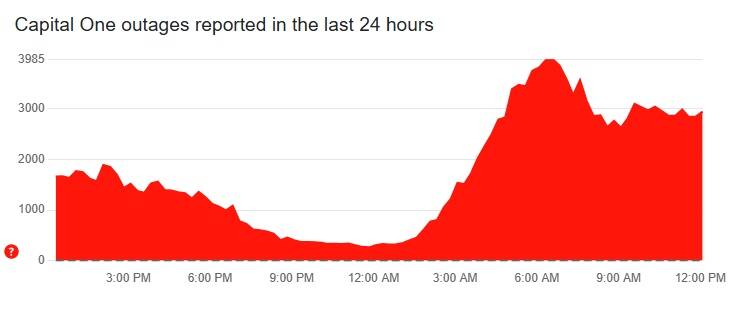
Graph showing number of complaints from users over the past day on Downdetector that Capital One's service isn't working

No resolution in sight ... Graph showing number of complaints from users over the past day on Downdetector that Capital One's service isn't working

The bank had no comment at the time of publication other than its social media posts asking for patience as it continues to rectify the problem. Indeed, according to Downdetector, the situation appears to be getting worse, with more and more complaints coming in. Customers are understandably peeved.

"Do we have an ETA? I have to feed my son and I can’t without getting access to my money," one said on social media. Capital One's response was, "We are actively working to resolve the issue and restore all services, and apologize for the inconvenience" - a line that gets repeated a lot.

https://www.theregister.com/2025/01/17/capital_one_outage/